


Genesis 35:19
Bible text: King James Version (1769 Blayney text) · Public domain
Bible text: Berean Standard Bible · Public domain
Bible text: American Standard Version (1901) · Public domain
Bible text: World English Bible, Messianic edition · Public domain
Bible text: Geneva Bible (1599) · Public domain
Bible text: Young's Literal Translation · Public domain
- וַתָּמָתva·Ta·motand she diedH4191Conj-w ¦ V-Qal-ConsecImperf-3fsVerb Qal Consecutive Imperfect 3rd Singular Feminineוַandתָּמָתshe died
- רָחֵלra·ChelRachelH7354N-proper-fNoun Proper Feminine
- וַתִּקָּבֵרva·ti·ka·Verand she was buriedH6912Conj-w ¦ V-Niphal-ConsecImperf-3fsVerb Niphal Consecutive Imperfect 3rd Singular Feminineוַandתִּקָּבֵרshe was buried
- בְּדֶרֶךְbe·De·rekhon [the] way ofH1870Prep-b ¦ N-cscNoun Singular common gender Constructבְּonדֶרֶךְ[the] way of
- אֶפְרָתָה'ef·Ra·tahEphrathahH672N-properNoun Proper Location
- הִואhi'thatH1931Pro-3fsPronoun Personal 3rd Singular Feminine
- בֵּיתbeit[is] Beth-H1035N-properNoun Proper Location
- לָחֶםLa·chem-lehemH1035N-properNoun Proper Location
English is a literal word-by-word gloss of the Hebrew, not the KJV's wording. Why?
This is the original text the KJV's translators worked from — each Hebrew word with its own literal English meaning in this verse, prepared by scholars at Tyndale House, Cambridge. The KJV translates whole sentences, not word by word, so its wording differs: one Hebrew word can become several English words, and the KJV may choose “the LORD” where the gloss reads “Yahweh”. Both are faithful — they answer different questions. For the KJV's own rendering, switch to the KJV text.
Details
See on the biblical-era maps


Study this verse
Public-domain commentary
Matthew Henry
From his Commentary on the Whole Bible. Henry comments on passages, not single verses — this entry covers Genesis 35:16–20.
We have here the story of the death of Rachel, the beloved wife of Jacob. 1. She fell in travail by the way, not able to reach to Bethlehem, the next town, though they were near it; so suddenly does pain sometimes come upon a woman in travail, which she cannot escape, or put off. We may suppose Jacob had soon a tent up, convenient enough for her reception. 2. Her pains were violent. She had hard labour, harder than usual: this was the effect of sin, Gen 3:16. Note, Human life begins with sorrow, and the roses of its joy are surrounded with thorns. 3. The midwife encouraged her, Gen 35:17. No doubt she had her midwife with her, ready at hand, yet that would not secure her. Rachel had said, when she bore Joseph, God shall add another son, which now the midwife remembers, and tells her her words were made good. Yet this did not avail to keep up her spirits; unless God command away fear, no one else can. He only says as one having authority, Fear not. We are apt, in extreme perils, to comfort ourselves and our friends with the hopes of a temporal deliverance, in which we may be disappointed; we had better found our comforts on that which cannot fail us, the hope of eternal life. 4. Her travail was to the life of the child, but to her own death. Note, Though the pains and perils of childbearing were introduced by sin, yet they have sometimes been fatal to very holy women, who, though not saved in childbearing, are saved through it with an everlasting salvation. Rachel had passionately said, Give me children, or else I die; and now that she had children (for this was her second) she died. Her dying is here called the departing of her soul. Note, The death of the body is but the departure of the soul to the world of spirits. 5. Her dying lips called her new-born son Ben-oni, The son of my sorrow. And many a son, not born in such hard labour, yet proves the son of his parent's sorrow, and the heaviness of her that bore him. Children are enough the sorrow of their poor mothers in the breeding, bearing, and nursing of them; they should therefore, when they grow up, study to be their joy, and so, if possible, to make them some amends. But Jacob, because he would not renew the sorrowful remembrance of the mother's death every time he called his son by his name, changed his name, and called him Benjamin, The son of my right hand; that is, "very dear to me, set on my right hand for a blessing, the support of my age, like the staff in my right hand." 6. Jacob buried her near the place where she died. As she died in child-bed, it was convenient to bury her quickly; and therefore he did not bring her to the burying-place of his family. If the soul be at rest after death, it matters little where the body lies. In the place where the tree falls, there let it be. No mention is made of the mourning that was at her death, because that might easily be taken for granted. Jacob, no doubt, was a true mourner. Note, Great afflictions sometimes befal us immediately after great comforts. Lest Jacob should be lifted up with the visions of the Almighty with which he was honoured, this was sent as a thorn in the flesh to humble him. Those that enjoy the favours peculiar to the children of God must yet expect the troubles that are common to the children of men. Deborah, who, had she lived, would have been a comfort to Rachel in her extremity, died but a little before. Note, When death comes into a family, it often strikes double. God by it speaks once, yea, twice. The Jewish writers say, "The death of Deborah and Rachel was to expiate the murder of the Shechemites, occasioned by Dinah, a daughter of the family." 7. Jacob set up a pillar upon her grave, so that it was known, long after, to be Rachel's sepulchre (Sa1 10:2), and Providence so ordered it that this place afterwards fell in the lot of Benjamin. Jacob set up a pillar in remembrance of his joys (Gen 35:14), and here he sets up one in remembrance of his sorrows; for, as it may be of use to ourselves to keep both in mind, so it may be of use to others to transmit the memorials of both: the church, long afterwards, owned that what God said to Jacob at Bethel, both by his word and by his rod, he intended for their instruction (Hos 12:4), There he spoke with us.
Continue studying Genesis 35:19 across the web’s major study libraries — every link below opens this exact verse, chapter, or book on the destination site.
Read & Compare
 BibleGatewayThis verse in more than 200 translations and 70 languages.
 Bible.comThe YouVersion reader — hundreds of translations, reading plans, and highlights.
 ESV.orgCrossway's official English Standard Version reader.
 NET BibleThe NET translation with 60,000+ translators' notes on every rendering decision.
 STEP BibleTyndale House's free study tool — original text, vocabulary, and scholarly resources.
 BibliaLogos Bible Software's free web reader.
 USCCBThe New American Bible (Revised Edition) with the U.S. bishops' study notes.
Commentaries
 BibleHub CommentariesDozens of classic commentaries on this verse, gathered on one page.
 StudyLightMore than 100 commentary sets — the largest collection on the web.
 BibleRefPlain-English commentary on what this verse means, verse by verse.
 Enduring WordDavid Guzik's free commentary on this chapter, widely used by Bible teachers.
 Bible Study ToolsVerse commentary alongside Greek and Hebrew study aids.
Original Language & Research
- BibleHub InterlinearThe verse word by word — original language, transliteration, and English.
- BibleHub LexiconEvery word's original-language definition and Strong's entry.
 Blue Letter BibleDeep-study tools — Strong's numbers, concordance, and word studies.
 SefariaThe Hebrew text with Rashi and centuries of Jewish commentary.
Sermons, Hymns & Audio


TrulyRandomVerse is not affiliated with these sites and doesn’t control their content. They’re linked because they’re genuinely useful.
Summary
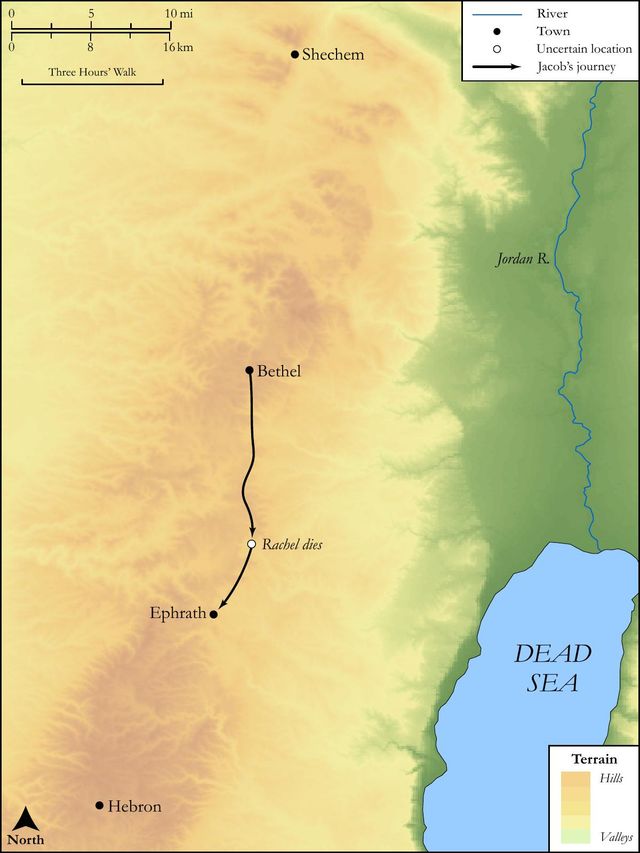
Genesis 35:19 records the poignant death and burial of Rachel, Jacob's beloved wife, on the journey from Bethel to Ephrath, which is identified as Bethlehem. This sorrowful event, occurring immediately after the birth of Benjamin, underscores the blend of profound personal grief within the patriarch's life and the unwavering progression of God's sovereign plan in the formation of Israel, subtly foreshadowing future redemptive history tied to this remarkably significant location.
Context
ShowHideLiterary Context
This verse is situated within a pivotal section of Jacob's life, detailing his return to the land of Canaan after his twenty-year sojourn with Laban. Following a divine encounter and renewal of covenant promises at Bethel (Genesis 35:1-15), Jacob continues his journey southward. The narrative immediately preceding Rachel's death describes her difficult labor and the birth of Benjamin, her second son, a birth that tragically costs her life (Genesis 35:16-18). This event marks a significant personal loss for Jacob, who had waited many years for Rachel and loved her more than Leah. Her death, alongside the earlier mention of Deborah's burial (Genesis 35:8), highlights the theme of mortality and loss within the patriarchal narratives, even as God's promises of numerous descendants continue to unfold.
Historical & Cultural Context
In the days of the patriarchs, death during childbirth was a common and tragic occurrence, reflecting the perilous nature of life and the challenges of procreation. Burial "in the way" (Hebrew: derek) indicates an immediate, roadside interment, a practical necessity for nomadic or traveling groups when far from established burial grounds. This contrasts with the more elaborate family tombs, such as the cave of Machpelah, where Abraham, Sarah, Isaac, Rebekah, and Leah were buried (Genesis 49:29-32). The precise identification of the location as "Ephrath, which is Bethlehem" is crucial. Ephrath was likely an older, regional name for the area, or a district encompassing the town of Bethlehem, which would later become a significant Judean city. This specific geographical detail, recorded for posterity, underscores the importance of place in the unfolding of biblical history and God's redemptive plan.
Key Themes
ShowHideGenesis 35:19 contributes to several overarching themes in Genesis. Firstly, it highlights the reality of human suffering and mortality even amidst divine blessing and the fulfillment of promises. Jacob's life, though guided by God, is marked by significant personal sorrow. Secondly, it subtly reinforces the theme of God's sovereignty and faithfulness; despite this profound loss, God's plan for Jacob's descendants to become a great nation continues to advance, marked by the birth of the twelfth son, Benjamin. Thirdly, the naming of the burial site as Bethlehem introduces a theme of prophetic geography and foreshadowing. This seemingly minor detail sets the stage for Bethlehem's immense future significance as the ancestral home of King David (1 Samuel 17:12) and, most notably, the prophesied birthplace of the Messiah (Micah 5:2).
Exposition and Analysis
ShowHideGenesis 35:19 concisely records a pivotal and sorrowful event in the life of Jacob and the unfolding history of Israel: "And Rachel died, and was buried in the way to Ephrath, which [is] Bethlehem." This brief statement carries immense theological and narrative weight.
Key Word Analysis
ShowHideThis primitive root signifies the cessation of life, whether literally or figuratively. In Rachel's case, it refers to her physical death, a tragic consequence of childbirth. The word conveys the finality and sorrow of the event, marking the end of a beloved matriarch's life and a profound loss for Jacob, who had waited and labored for her for many years.
This term denotes a road or path, often implying a journey or course. Rachel's burial "in the way" emphasizes the suddenness and hardship of her death, occurring during a nomadic journey rather than in a settled family burial ground. It highlights the practical realities of their migratory life and the immediate necessity of interment.
Meaning "house of bread," this name identifies the specific location near where Rachel was buried. The inclusion of this detail is highly significant, transforming a simple geographical marker into a place of future historical and prophetic importance. It links Rachel's sorrowful end to a location that would later become central to Israel's royal lineage and, ultimately, the birthplace of the Messiah.
Verse Breakdown
ShowHide"And Rachel died"
This clause starkly presents the tragic reality. Rachel, Jacob's beloved wife and the mother of Joseph and Benjamin, succumbs to the difficulties of childbirth. Her death is a profound personal loss for Jacob, who had loved her deeply from their first encounter (Genesis 29:18). This event marks the end of an era for Jacob's immediate family, as Rachel was the last of his four wives to bear children, and her death completes the patriarchal family unit of twelve sons.
"and was buried in the way to Ephrath"
This phrase describes the circumstances of her interment. The burial "in the way" indicates a roadside grave, necessitated by the family's journey. It implies a hasty, yet necessary, burial, far from the ancestral tomb at Machpelah. "Ephrath" was likely an older or regional name for the area, suggesting a specific district or territory in which the burial took place.
"which [is] Bethlehem"
This crucial clarification precisely identifies "Ephrath" with the town of Bethlehem. This seemingly simple geographical note transforms the location from a mere burial site into a place of immense future significance. It ensures that future generations, and the biblical narrative itself, can pinpoint this exact location, which would later play a pivotal role in the history of Israel and the unfolding of God's redemptive plan.
Literary Devices
ShowHideGenesis 35:19 employs several literary devices that enrich its meaning and impact. The most prominent is Foreshadowing, as the precise identification of Rachel's burial site as Bethlehem subtly points to the town's future significance as the birthplace of King David and, more importantly, the Messiah. This detail, seemingly incidental, becomes a crucial geographical marker in God's unfolding plan. There is also a strong sense of Poignancy and Pathos, as the verse concisely captures the deep sorrow of Jacob's loss, immediately following the joy of Benjamin's birth. This juxtaposition of life and death, joy and sorrow, highlights the unpredictable and often painful realities of human existence. The phrase "in the way" can also be seen as a form of Symbolism, representing not just a physical journey but also the journey of life itself, marked by unexpected turns and inevitable ends, even as God's purposes continue to advance.
Theological and Thematic Connections
ShowHideRachel's death and burial, occurring at a moment of both personal sorrow and divine fulfillment (the birth of Benjamin completes the twelve sons), underscore profound theological truths. It highlights the reality of human suffering and mortality within a divinely guided narrative, demonstrating that God's people are not exempt from the pain and loss inherent in a fallen world. Yet, even in tragedy, God's sovereign plan progresses; the completion of the twelve tribes through Benjamin's birth, despite Rachel's death, illustrates that God's purposes are not thwarted by human pain but often unfold through and even within it. The specific identification of Bethlehem as her burial place is a remarkable instance of God's meticulous attention to detail, setting the stage for future redemptive history.
Reflection and Application
ShowHideGenesis 35:19 offers timeless lessons on navigating the complexities of life, where profound joy can be intertwined with deep sorrow. It reminds us that even during periods of divine blessing and progress in God's plan, we will inevitably face loss and grief. The biblical narrative does not shy away from depicting real human pain, encouraging us to acknowledge and process our sorrows with honesty before God. Simultaneously, it calls us to trust in God's overarching plan, even when circumstances are tragic and difficult to comprehend. Just as Benjamin's birth completed the twelve tribes despite Rachel's death, God's purposes continue to unfold despite our pain and beyond our immediate understanding. Furthermore, the significance of Bethlehem teaches us to pay attention to seemingly small details in our lives and in Scripture, recognizing that God often uses ordinary places and events to lay the groundwork for His extraordinary, long-term purposes in salvation history. Our present circumstances, no matter how mundane or painful, may be part of a larger, divine tapestry.
Questions for Reflection
ShowHideFAQ
ShowHideWhy is Ephrath identified as Bethlehem in this verse?
ShowHideEphrath was likely an older or regional name for the area, or a district closely associated with the town of Bethlehem. The clarification "which is Bethlehem" serves to precisely identify the burial site for future readers, emphasizing its significance as a known landmark and, later, a pivotal location in biblical history. This detail ensures the reader understands the exact geographical context for future prophetic fulfillments, particularly concerning the lineage of King David and the birth of the Messiah. It highlights the Bible's meticulous attention to geographical detail, often for redemptive purposes.
Christ-Centered Fulfillment
ShowHideRachel's burial "in the way to Ephrath, which is Bethlehem" carries profound Christ-centered fulfillment, subtly weaving a thread from the patriarchal age to the advent of the Messiah. Bethlehem, the "House of Bread" (Hebrew: Bêyth Lechem), becomes the birthplace of Jesus, the very "Bread of Life" who came down from heaven to give life to the world (John 6:35). Centuries after Rachel's sorrowful death and roadside interment, this same location, marked by her grave, becomes the site where the long-awaited Savior, the Son of David, is born (Matthew 2:1; Micah 5:2). The grief associated with Rachel's death in Bethlehem, even echoed in Jeremiah's prophecy of Rachel weeping for her children (Jeremiah 31:15), is ultimately overshadowed by the profound joy and hope of the birth of the Messiah in that very same place. This demonstrates God's sovereign ability to bring ultimate hope and salvation out of human suffering and to fulfill His grand redemptive purposes through seemingly ordinary historical details and geographical locations, culminating in the person of Jesus Christ, who conquers death and brings eternal life.