


Genesis 48:7
Bible text: King James Version (1769 Blayney text) · Public domain
Bible text: King James Version with Strong's numbers · Public domain
Bible text: Berean Standard Bible · Public domain
Bible text: American Standard Version (1901) · Public domain
Bible text: World English Bible, Messianic edition · Public domain
Bible text: Geneva Bible (1599) · Public domain
Bible text: Young's Literal Translation · Public domain
- וַאֲנִיva·'a·Niand IH589Conj-w ¦ Pro-1csPronoun Personal 1st Singular common genderוַandאֲנִיI
- בְּבֹאִיbe·vo·'Iwhen I cameH935Prep-b ¦ V-Qal-Inf ¦ 1csVerb Qal Infinitive ConstructבְּwhenבֹאִcameיI
- מִפַּדָּןmi·pa·Danfrom PaddanH6307Prep-m ¦ N-properNoun Proper LocationמִfromפַּדָּןPaddan
- מֵתָהme·tahshe diedH4191V-Qal-Perf-3fsVerb Qal Perfect 3rd Singular Feminine
- עָלַי'a·Laion meH5921Prep ¦ 1csPrepositionעָלַonיme
- רָחֵלra·ChelRachelH7354N-proper-fNoun Proper Feminine
- בְּאֶרֶץbe·'E·retzin [the] land ofH776Prep-b ¦ N-fscNoun Singular Feminine Constructבְּinאֶרֶץ[the] land of
- כְּנַעַןke·Na·'anCanaanH3667N-properNoun Proper Location
- בַּדֶּרֶךְba·De·rekhon the journeyH1870Prep-b ¦ N-csNoun Singular common gender Absoluteבַּon theדֶּרֶךְjourney
- בְּעוֹדbe·'odat yetH5750Prep-b ¦ Adj-msAdjective Numerical Singular Masculine Absoluteבְּatעוֹדyet
- כִּבְרַתkiv·rata distance ofH3530N-fscNoun Singular Feminine Construct
- אֶרֶץ'E·retzlandH776N-fsNoun Singular Feminine Absolute
- לָבֹאla·Vo'to goH935Prep-l ¦ V-Qal-InfVerb Qal Infinitive Constructלָtoבֹאgo
- אֶפְרָתָה'ef·Ra·tahEphrathahH672N-properNoun Proper Location
- וָאֶקְבְּרֶהָva·'ek·be·Re·haand I buried herH6912Conj-w ¦ V-Qal-ConsecImperf-1cs ¦ 3fsVerb Qal Consecutive Imperfect 1st Singular common genderוָandאֶקְבְּרֶI buriedהָher
- שָּׁםshamthereH8033AdvAdverb
- בְּדֶרֶךְbe·De·rekhon [the] journey ofH1870Prep-b ¦ N-cscNoun Singular common gender Constructבְּonדֶרֶךְ[the] journey of
- אֶפְרָת'ef·RatEphrathH672N-proper-fNoun Proper Feminine
- הִואhi'thatH1931Pro-3fsPronoun Personal 3rd Singular Feminine
- בֵּיתbeit[is] Beth-H1035N-properNoun Proper Location
- לָחֶםLa·chem-lehemH1035N-properNoun Proper Location
English is a literal word-by-word gloss of the Hebrew, not the KJV's wording. Why?
This is the original text the KJV's translators worked from — each Hebrew word with its own literal English meaning in this verse, prepared by scholars at Tyndale House, Cambridge. The KJV translates whole sentences, not word by word, so its wording differs: one Hebrew word can become several English words, and the KJV may choose “the LORD” where the gloss reads “Yahweh”. Both are faithful — they answer different questions. For the KJV's own rendering, switch to the KJV text.
Details
See on the biblical-era maps


Study this verse
Public-domain commentary
Matthew Henry
From his Commentary on the Whole Bible. Henry comments on passages, not single verses — this entry covers Genesis 48:1–7. His three-level outline is real structure in the source text, so it is rendered as structure.
Here, I. Joseph, upon notice of his father's illness, goes to see him; though a man of honour and business, yet he will not fail to show this due respect to his aged father, Gen 48:1. Visiting the sick, to whom we lie under obligations, or may have opportunity of doing good, either for body or soul, is our duty. The sick bed is a proper place both for giving comfort and counsel to others and receiving instruction ourselves. Joseph took his two sons with him, that they might receive their dying grandfather's blessing, and that what they might see in him, and hear from him, might make an abiding impression upon them. Note, 1. It is good to acquaint young people that are coming into the world with the aged servants of God that are going out of it, whose dying testimony to the goodness of God, and the pleasantness of wisdom's ways, may be a great encouragement to the rising generation. Manasseh and Ephraim (I dare say) would never forget what passed at this time. 2. Pious parents are desirous of a blessing, not only for themselves, but for their children. "O that they may live before God!" Joseph had been, above all his brethren, kind to his father, and therefore had reason to expect particular favour from him.
II.Jacob, upon notice of his son's visit, prepared himself as well as he could to entertain him, Gen 48:2.
He did what he could to rouse his spirits, and to stir up the gift that was in him; what little was lift of bodily strength he put forth to the utmost, and sat upon the bed. Note, It is very good for sick and aged people to be as lively and cheerful as they can, that they may not faint in the day of adversity. Strengthen thyself, as Jacob here, and God will strengthen thee; hearten thyself and help thyself, and God will help and hearten thee. Let the spirit sustain the infirmity.
III.In recompence to Joseph for all his attentions to him, he adopted his two sons. In this charter of adoption there is,
1.A particular recital of God's promise to him, to which this had reference: "God blessed me (Gen 48:3), and let that blessing be entailed upon them." God had promised him two things, a numerous issue, and Canaan for an inheritance (Gen 48:4); and Joseph's sons, pursuant hereunto, should each of them multiply into a tribe, and each of them have a distinct lot in Canaan, equal with Jacob's own sons. See how he blessed them by faith in that which God had said to him, Heb 11:21. Note, In all our prayers, both for ourselves and for our children, we ought to have a particular eye to, and remembrance of, God's promises to us.
2.An express reception of Joseph's sons into his family: "Thy sons are mine (Gen 48:5), not only my grandchildren, but as my own children." Though they were born in Egypt, and their father was then separated from his brethren, which might seem to have cut them off from the heritage of the Lord, yet Jacob takes them in, and owns them for visible church members. He explains this at Gen 48:16, Let my name be named upon them, and the name of my fathers; as if he had said, "Let them not succeed their father in his power and grandeur here in Egypt, but let them succeed me in the inheritance of the promise made to Abraham," which Jacob looked upon as much more valuable and honourable, and would have them to prize and covet accordingly. Thus the aged dying patriarch teaches these young persons, now that they were of age (being about twenty-one years old), not to look upon Egypt as their home, nor to incorporate themselves with the Egyptians, but to take their lot with the people of God, as Moses afterwards in the like temptation, Heb 11:24-26. And because it would be a piece of self-denial in them, who stood so fair for preferment in Egypt, to adhere to the despised Hebrews, to encourage them he constitutes each of them the head of a tribe. Note, Those are worthy of double honour who, through God's grace, break through the temptations of worldly wealth and preferment, to embrace religion in disgrace and poverty. Jacob will have Ephraim and Manasseh to believe that it is better to be low and in the church than high and out of it, to be called by the name of poor Jacob than to be called by the name of rich Joseph.
3.A proviso inserted concerning the children he might afterwards have; they should not be accounted heads of tribes, as Ephraim and Manasseh were, but should fall in with either the one or the other of their brethren, Gen 48:6. It does not appear that Joseph had any more children; however, it was Jacob's prudence to give this direction, for the preventing of contest and mismanagement. Note, In making settlements, it is good to take advice, and to provide for what may happen, while we cannot foresee what will happen. Our prudence must attend God's providence.
4.Mention is made of the death and burial of Rachel, Joseph's mother, and Jacob's best beloved wife (Gen 48:7), referring to that story, Gen 35:19. Note,
(1.)When we come to die ourselves, it is good to call to mind the death of our dear relations and friends, that have gone before us, to make death and the grave the more familiar to us. See Num 27:13. Those that were to us as our own souls are dead and buried; and shall we think it much to follow them in the same path?
(2.)The removal of dear relations from us is an affliction the remembrance of which cannot but abide with us a great while. Strong affections in the enjoyment cause long afflictions in the loss.
Continue studying Genesis 48:7 across the web’s major study libraries — every link below opens this exact verse, chapter, or book on the destination site.
Read & Compare
 BibleGatewayThis verse in more than 200 translations and 70 languages.
 Bible.comThe YouVersion reader — hundreds of translations, reading plans, and highlights.
 ESV.orgCrossway's official English Standard Version reader.
 NET BibleThe NET translation with 60,000+ translators' notes on every rendering decision.
 STEP BibleTyndale House's free study tool — original text, vocabulary, and scholarly resources.
 BibliaLogos Bible Software's free web reader.
 USCCBThe New American Bible (Revised Edition) with the U.S. bishops' study notes.
Commentaries
 BibleHub CommentariesDozens of classic commentaries on this verse, gathered on one page.
 StudyLightMore than 100 commentary sets — the largest collection on the web.
 BibleRefPlain-English commentary on what this verse means, verse by verse.
 Enduring WordDavid Guzik's free commentary on this chapter, widely used by Bible teachers.
 Bible Study ToolsVerse commentary alongside Greek and Hebrew study aids.
Original Language & Research
- BibleHub InterlinearThe verse word by word — original language, transliteration, and English.
- BibleHub LexiconEvery word's original-language definition and Strong's entry.
 Blue Letter BibleDeep-study tools — Strong's numbers, concordance, and word studies.
 SefariaThe Hebrew text with Rashi and centuries of Jewish commentary.
Sermons, Hymns & Audio


TrulyRandomVerse is not affiliated with these sites and doesn’t control their content. They’re linked because they’re genuinely useful.
Summary
In Genesis 48:7, Jacob, in his final discourse to Joseph in Egypt, poignantly recounts the sorrowful and unexpected death of his beloved wife, Rachel, during their journey from Padan-aram. He details her burial "in the way" near Ephrath, explicitly identifying this location as Bethlehem, a seemingly minor geographical detail that profoundly connects the patriarchal narrative to future pivotal events in redemptive history, underscoring the enduring impact of personal loss within God's sovereign plan.
Context
ShowHideLiterary Context
This verse is embedded within Jacob's final days in Egypt, where he is blessing Joseph's two sons, Ephraim and Manasseh, effectively adopting them as his own and granting Joseph a double portion among the tribes of Israel. Jacob's recounting of Rachel's death serves as a deeply personal explanation and justification for this unique arrangement. By recalling the profound sorrow of losing Rachel, the mother of Joseph and Benjamin, and her burial outside the ancestral tomb at Machpelah, Jacob underscores Joseph's special place in his heart and in the lineage of Israel, thereby elevating Joseph's sons to the status of direct heirs alongside Jacob's other sons. This moment of remembrance highlights the emotional weight of Jacob's past as he prepares to pass on the torch of the covenant to the next generation.
Historical & Cultural Context
Among the patriarchs, burial practices were highly significant, with family tombs often serving as permanent resting places that symbolized continuity and connection to one's ancestors and land. The patriarchal family, including Abraham, Sarah, Isaac, Rebekah, and Leah, were buried in the Cave of Machpelah in Hebron, a purchased burial plot in the Promised Land, signifying their claim to the land and their hope in God's covenant promises. Rachel's death "in the way" (Hebrew: derek, a road or journey) meant she died unexpectedly during travel, necessitating an immediate burial on the spot. This was a deviation from the ideal, highlighting the urgency and constraints of their nomadic journey back to Canaan. The mention of "a little way" to Ephrath emphasizes the suddenness and proximity to a known landmark, underscoring the tragic circumstances of her passing.
Key Themes
ShowHideGenesis 48:7 contributes to several overarching themes within the book of Genesis and the broader biblical narrative. It powerfully illustrates the theme of enduring grief and remembrance, showing that even figures of great faith experience profound and lasting sorrow over personal loss. The verse also subtly highlights God's sovereign plan amidst human sorrow, as Rachel's burial place, though a result of tragedy, becomes a site of immense prophetic significance. This geographical detail foreshadows the birth of King David and, most importantly, the Messiah in Bethlehem, demonstrating God's intricate weaving of personal narratives into His grand redemptive design. Furthermore, it speaks to the cost of covenant and pilgrimage, reminding readers that the journey of faith for Jacob and his family was marked by both divine blessing and significant personal hardship, all contributing to the formation of the nation of Israel in the promised land of Canaan.
Exposition and Analysis
ShowHideKey Word Analysis
ShowHideThis primitive root signifies to die, literally or figuratively, or causatively, to kill. In this context, it emphasizes the literal and sudden cessation of life for Rachel, highlighting the finality and unexpected nature of her passing on the journey.
From a root meaning "to tread," this word denotes a road or path, but figuratively, it can also refer to a course of life or mode of action. Here, its repeated use ("in the way," "in the way of Ephrath") emphasizes the circumstances of Rachel's death and burial occurring during a journey, away from a settled home or a prepared burial site, underscoring the nomadic and often challenging nature of the patriarchal pilgrimage.
Meaning "house of bread," Bethlehem is identified here as Ephrath. This geographical name, seemingly a simple detail, carries immense theological weight. Its mention anchors Rachel's burial site to a location that would later become profoundly significant in Israel's history, particularly as the birthplace of the Messiah, linking the sorrow of the past to the hope of future redemption.
Verse Breakdown
ShowHide"And as for me, when I came from Padan, Rachel died by me in the land of Canaan in the way,"
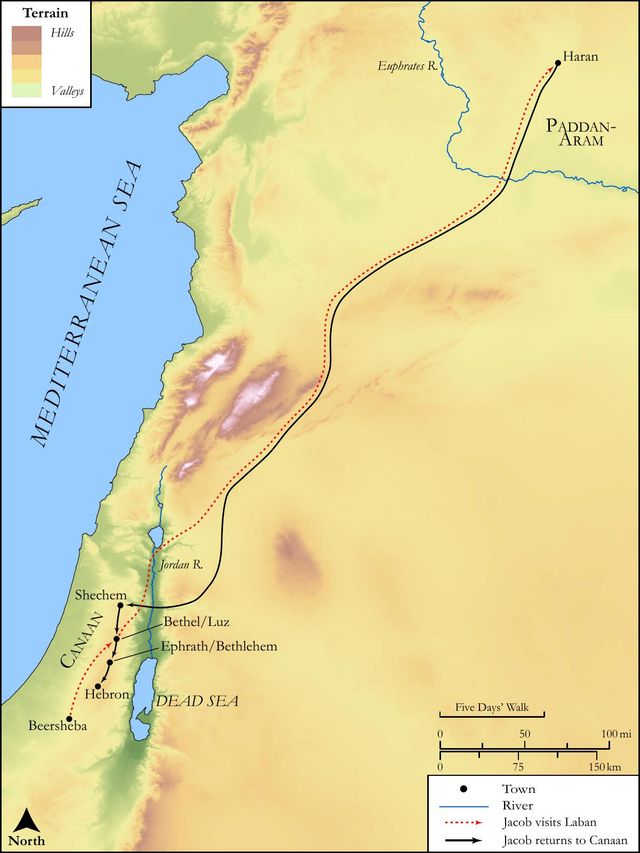
Jacob begins with a deeply personal recollection ("as for me"), emphasizing that this was a direct, impactful experience for him. He recalls the journey from Padan-aram, where he had lived with Laban, back to the Promised Land. Rachel's death occurred "by me," signifying his immediate presence and the profound, personal nature of the loss. It happened "in the way," during their travels within the land of Canaan, highlighting the unexpected and inconvenient circumstances of her passing.
"when yet [there was] but a little way to come unto Ephrath:"
This clause provides a crucial detail about the location and timing of Rachel's death. The phrase "a little way" (Hebrew: kibrâh, a measure of uncertain dimension, implying a short distance) underscores the suddenness of her death, occurring just before they reached a more established settlement or a more convenient place for burial. Ephrath is introduced as the proximate landmark.
"and I buried her there in the way of Ephrath; the same [is] Bethlehem."
Jacob explicitly states that he buried her "there in the way," confirming that the burial was immediate and on the road, rather than in a family tomb. This detail reinforces the urgency and circumstances of her death during travel. The concluding identification, "the same [is] Bethlehem," is profoundly significant. This seemingly straightforward geographical clarification elevates the seemingly tragic and ordinary event of a roadside burial into a moment of prophetic foreshadowing, connecting the patriarchal narrative to future pivotal events in Israel's history, particularly the lineage of King David and the birthplace of the Messiah.
Literary Devices
ShowHideGenesis 48:7 is rich with literary artistry, primarily employing Remembrance and Foreshadowing. Jacob's vivid and detailed recollection of Rachel's death, decades after the event and on his own deathbed, serves as a powerful instance of Remembrance, highlighting the enduring impact of personal grief and the human capacity to carry significant life events throughout one's existence. The specific details—the journey from Padan, the death "in the way," the proximity to Ephrath, and the immediate burial—lend a poignant Poignancy to the narrative, allowing the reader to feel the weight of Jacob's sorrow. Most significantly, the verse utilizes Geographical Significance to create powerful Foreshadowing. The explicit identification of Ephrath as Bethlehem transforms a simple geographical marker into a prophetic signpost. This seemingly minor detail subtly points forward to the future birth of King David and, ultimately, the Messiah, Jesus Christ, in that very location, weaving a thread of divine purpose through personal tragedy and connecting the patriarchal past to the climax of God's redemptive plan.
Theological and Thematic Connections
ShowHideJacob's poignant recounting of Rachel's death, even at the end of his own life, powerfully illustrates the enduring nature of human grief and the deep emotional bonds that transcend time. It reminds us that even patriarchs of faith experienced profound sorrow, and that such losses leave an indelible mark. Yet, amidst this personal tragedy, the precise geographical detail of Rachel's burial place—Ephrath, which is Bethlehem—reveals a profound theological truth: God's sovereign plan often unfolds through and redeems human suffering. What was a sorrowful necessity for Jacob becomes a crucial prophetic marker in God's grand narrative, demonstrating His meticulous attention to detail and His ability to weave even the most painful events into a tapestry of redemptive purpose. This connection underscores the idea that no detail is too small for God's overarching plan, and that even our deepest sorrows can be integrated into His divine design, ultimately pointing towards a greater hope.
Reflection and Application
ShowHideJacob's recollection in Genesis 48:7 offers a profound lesson on the enduring nature of human grief and the intricate ways in which our personal stories intersect with God's larger redemptive narrative. It teaches us that it is natural and even necessary to acknowledge and carry our losses, even decades after they occur. Jacob, a man of immense faith and trials, openly expresses his sorrow, demonstrating that vulnerability in the face of loss is not a weakness but a part of the human experience. This passage invites us to reflect on our own experiences of loss: How do we process and carry our grief over time? Do we allow ourselves to remember and feel, even as we move forward? Furthermore, the subtle yet powerful connection of Rachel's burial site to Bethlehem encourages us to consider how God might be working in seemingly tragic or insignificant details of our lives. It challenges us to look beyond immediate circumstances and trust that God, in His sovereignty, can redeem and use even our deepest pains and most unexpected detours for His ultimate glory and purpose, often in ways we cannot immediately discern.
Questions for Reflection
ShowHideFAQ
ShowHideWhy did Jacob recount Rachel's death at this specific moment?
ShowHideJacob recounted Rachel's death at this moment primarily to explain and justify his decision to adopt Joseph's two sons, Ephraim and Manasseh, as his own. This act effectively gave Joseph a double portion of the inheritance among the tribes of Israel, a special blessing typically reserved for the firstborn. By recalling the profound sorrow of Rachel's untimely death and her burial outside the family tomb, Jacob underscored his deep love for her, Joseph's unique status as Rachel's son, and the personal cost associated with the journey that ultimately established his family in the land of Canaan. It was a deeply personal and emotional rationale for a significant tribal allocation.
Why was Rachel not buried in the Cave of Machpelah with other patriarchs and matriarchs?
ShowHideRachel's death occurred suddenly and unexpectedly "in the way" (on the road) while Jacob and his family were traveling from Padan-aram back to the land of Canaan, just a "little way" from Ephrath (which is Bethlehem). The immediate circumstances of her death during a journey necessitated an on-the-spot burial. Transporting her body a long distance to the family tomb at Machpelah in Hebron, where Abraham, Sarah, Isaac, Rebekah, and Leah were interred, would have been impractical and perhaps impossible given the travel conditions of the time. Her roadside burial reflects the urgency and constraints of their nomadic life.
What is the significance of Bethlehem being mentioned as Ephrath?
ShowHideThe explicit identification of Ephrath as Bethlehem is profoundly significant for future biblical narratives and theological understanding. While a seemingly minor geographical detail in the patriarchal era, Bethlehem later became renowned as the hometown of King David and, most importantly, the prophetic birthplace of the Messiah, Jesus Christ, as foretold in Micah 5:2 and fulfilled in Matthew 2:1. This connection subtly weaves the patriarchal history into the grand tapestry of God's redemptive plan, demonstrating His meticulous attention to detail and His sovereign orchestration of events across centuries, linking a moment of profound sorrow to the ultimate source of hope.
Christ-Centered Fulfillment
ShowHideThe identification of Rachel's burial place as Ephrath, which is Bethlehem, holds profound Christ-centered significance, subtly weaving a thread from patriarchal sorrow to messianic hope. While Rachel's death was a deep personal tragedy for Jacob, occurring "in the way" and necessitating a roadside burial, this very location becomes pivotal in God's redemptive narrative. Centuries later, Bethlehem would be revealed as the prophesied birthplace of the Messiah, Jesus Christ (Micah 5:2). This seemingly coincidental geographical detail highlights God's sovereign hand, demonstrating how even moments of profound human suffering and inconvenience are meticulously integrated into His overarching plan for salvation. Just as Rachel's life ended in sorrow near Bethlehem, so too would the ultimate hope for humanity emerge from this very town, demonstrating God's ability to bring forth life, light, and redemption from humble, and often sorrowful, beginnings, ultimately culminating in the Incarnation of the Lamb of God, who takes away the sin of the world. The sorrow of Rachel's death foreshadows the suffering that would ultimately lead to the joy of Christ's birth and His redemptive work, fulfilling God's promises in the very place marked by ancient grief.