


Genesis 35:16
Bible text: King James Version (1769 Blayney text) · Public domain
Bible text: Berean Standard Bible · Public domain
Bible text: American Standard Version (1901) · Public domain
Bible text: World English Bible, Messianic edition · Public domain
Bible text: Geneva Bible (1599) · Public domain
Bible text: Young's Literal Translation · Public domain
- וַיִּסְעוּvai·yis·'Uand they set outH5265Conj-w ¦ V-Qal-ConsecImperf-3mpVerb Qal Consecutive Imperfect 3rd Plural Masculineוַandיִּסְעוּthey set out
- מִבֵּיתmi·Beitfrom Beth-H1008Prep-m ¦ N-properNoun Proper LocationמִfromבֵּיתBeth-
- אֵל'El-elH1008N-properNoun Proper Location
- וַיְהִיvay·hiand it wasH1961Conj-w ¦ V-Qal-ConsecImperf-3msVerb Qal Consecutive Imperfect 3rd Singular Masculineוַandיְהִיit was
- עוֹדodyetH5750Adj-msAdjective Numerical Singular Masculine Absolute
- כִּבְרַתkiv·rat[the] distance ofH3530N-fscNoun Singular Feminine Construct
- הָאָרֶץha·'A·retzthe landH776Art ¦ N-fsNoun Singular Feminine Absoluteהָtheאָרֶץland
- לָבוֹאla·Vo'to goH935Prep-l ¦ V-Qal-InfVerb Qal Infinitive Constructלָtoבוֹאgo
- אֶפְרָתָה'ef·Ra·tahEphrathahH672N-properNoun Proper Location
- וַתֵּלֶדva·Te·ledand she gave birthH3205Conj-w ¦ V-Qal-ConsecImperf-3fsVerb Qal Consecutive Imperfect 3rd Singular Feminineוַandתֵּלֶדshe gave birth
- רָחֵלra·ChelRachelH7354N-proper-fNoun Proper Feminine
- וַתְּקַשׁva·te·Kashand she had difficultiesH7185Conj-w ¦ V-Piel-ConsecImperf-3fsVerb Piel Consecutive Imperfect 3rd Singular Feminineוַandתְּקַשׁshe had difficulties
- בְּלִדְתָּהּbe·lid·Tahwhen she gave birthH3205Prep-b ¦ V-Qal-Inf ¦ 3fsVerb Qal Infinitive Constructבְּwhenלִדְתָּgave birthהּshe
English is a literal word-by-word gloss of the Hebrew, not the KJV's wording. Why?
This is the original text the KJV's translators worked from — each Hebrew word with its own literal English meaning in this verse, prepared by scholars at Tyndale House, Cambridge. The KJV translates whole sentences, not word by word, so its wording differs: one Hebrew word can become several English words, and the KJV may choose “the LORD” where the gloss reads “Yahweh”. Both are faithful — they answer different questions. For the KJV's own rendering, switch to the KJV text.
Details
See on the biblical-era maps


Study this verse
Public-domain commentary
Matthew Henry
From his Commentary on the Whole Bible. Henry comments on passages, not single verses — this entry covers Genesis 35:16–20.
We have here the story of the death of Rachel, the beloved wife of Jacob. 1. She fell in travail by the way, not able to reach to Bethlehem, the next town, though they were near it; so suddenly does pain sometimes come upon a woman in travail, which she cannot escape, or put off. We may suppose Jacob had soon a tent up, convenient enough for her reception. 2. Her pains were violent. She had hard labour, harder than usual: this was the effect of sin, Gen 3:16. Note, Human life begins with sorrow, and the roses of its joy are surrounded with thorns. 3. The midwife encouraged her, Gen 35:17. No doubt she had her midwife with her, ready at hand, yet that would not secure her. Rachel had said, when she bore Joseph, God shall add another son, which now the midwife remembers, and tells her her words were made good. Yet this did not avail to keep up her spirits; unless God command away fear, no one else can. He only says as one having authority, Fear not. We are apt, in extreme perils, to comfort ourselves and our friends with the hopes of a temporal deliverance, in which we may be disappointed; we had better found our comforts on that which cannot fail us, the hope of eternal life. 4. Her travail was to the life of the child, but to her own death. Note, Though the pains and perils of childbearing were introduced by sin, yet they have sometimes been fatal to very holy women, who, though not saved in childbearing, are saved through it with an everlasting salvation. Rachel had passionately said, Give me children, or else I die; and now that she had children (for this was her second) she died. Her dying is here called the departing of her soul. Note, The death of the body is but the departure of the soul to the world of spirits. 5. Her dying lips called her new-born son Ben-oni, The son of my sorrow. And many a son, not born in such hard labour, yet proves the son of his parent's sorrow, and the heaviness of her that bore him. Children are enough the sorrow of their poor mothers in the breeding, bearing, and nursing of them; they should therefore, when they grow up, study to be their joy, and so, if possible, to make them some amends. But Jacob, because he would not renew the sorrowful remembrance of the mother's death every time he called his son by his name, changed his name, and called him Benjamin, The son of my right hand; that is, "very dear to me, set on my right hand for a blessing, the support of my age, like the staff in my right hand." 6. Jacob buried her near the place where she died. As she died in child-bed, it was convenient to bury her quickly; and therefore he did not bring her to the burying-place of his family. If the soul be at rest after death, it matters little where the body lies. In the place where the tree falls, there let it be. No mention is made of the mourning that was at her death, because that might easily be taken for granted. Jacob, no doubt, was a true mourner. Note, Great afflictions sometimes befal us immediately after great comforts. Lest Jacob should be lifted up with the visions of the Almighty with which he was honoured, this was sent as a thorn in the flesh to humble him. Those that enjoy the favours peculiar to the children of God must yet expect the troubles that are common to the children of men. Deborah, who, had she lived, would have been a comfort to Rachel in her extremity, died but a little before. Note, When death comes into a family, it often strikes double. God by it speaks once, yea, twice. The Jewish writers say, "The death of Deborah and Rachel was to expiate the murder of the Shechemites, occasioned by Dinah, a daughter of the family." 7. Jacob set up a pillar upon her grave, so that it was known, long after, to be Rachel's sepulchre (Sa1 10:2), and Providence so ordered it that this place afterwards fell in the lot of Benjamin. Jacob set up a pillar in remembrance of his joys (Gen 35:14), and here he sets up one in remembrance of his sorrows; for, as it may be of use to ourselves to keep both in mind, so it may be of use to others to transmit the memorials of both: the church, long afterwards, owned that what God said to Jacob at Bethel, both by his word and by his rod, he intended for their instruction (Hos 12:4), There he spoke with us.
Historical interpretation
Historical reception
1 surviving comment on this verse from the historical church.
(Verse 16.) And it came to pass, while he was approaching Chabratha in the land of Canaan, to come to Ephratha, Rachel gave birth to the Hebrew word () Chabratha, in the following, where Jacob speaks to Joseph: But when I came from Mesopotamia in Syria, your mother Rachel died in the land of Canaan, on the way to Hippodrome, to come to Ephrata (Gen. 48): I do not know what they wanted, the Septuagint interpreters translated Hippodrome: and immediately there, where it is said in Hebrew: And they buried her on the way to Ephrata, this is Bethlehem (Gen. 35:19), again the Septuagint put Hippodrome instead of Ephrata: since surely if Chabratha is Hippodrome, Ephrata cannot be Hippodrome. But Aquila translated it this way: And it came to pass καθ᾽ ὁδον τῆς γῆς, that is, in the journey of the earth, when he entered into Ephratah. But it is better if it is translated, in the chosen time of the earth, when he entered into Ephratha. Moreover, it signifies the springtime, when all things burst into flower, and the chosen time of the year: or when those passing by along the way pluck and choose from the nearby fields whatever comes to hand, enticed by various flowers. Indeed, Ephrata and Bethlehem are two names for the same city, with similar meanings. For they both translate to 'fruitful' and 'house of bread', respectively. This is because of the bread that is said to have come down from heaven (John 6).
Continue studying Genesis 35:16 across the web’s major study libraries — every link below opens this exact verse, chapter, or book on the destination site.
Read & Compare
 BibleGatewayThis verse in more than 200 translations and 70 languages.
 Bible.comThe YouVersion reader — hundreds of translations, reading plans, and highlights.
 ESV.orgCrossway's official English Standard Version reader.
 NET BibleThe NET translation with 60,000+ translators' notes on every rendering decision.
 STEP BibleTyndale House's free study tool — original text, vocabulary, and scholarly resources.
 BibliaLogos Bible Software's free web reader.
 USCCBThe New American Bible (Revised Edition) with the U.S. bishops' study notes.
Commentaries
 BibleHub CommentariesDozens of classic commentaries on this verse, gathered on one page.
 StudyLightMore than 100 commentary sets — the largest collection on the web.
 BibleRefPlain-English commentary on what this verse means, verse by verse.
 Enduring WordDavid Guzik's free commentary on this chapter, widely used by Bible teachers.
 Bible Study ToolsVerse commentary alongside Greek and Hebrew study aids.
Original Language & Research
- BibleHub InterlinearThe verse word by word — original language, transliteration, and English.
- BibleHub LexiconEvery word's original-language definition and Strong's entry.
 Blue Letter BibleDeep-study tools — Strong's numbers, concordance, and word studies.
 SefariaThe Hebrew text with Rashi and centuries of Jewish commentary.
Sermons, Hymns & Audio


TrulyRandomVerse is not affiliated with these sites and doesn’t control their content. They’re linked because they’re genuinely useful.
Summary
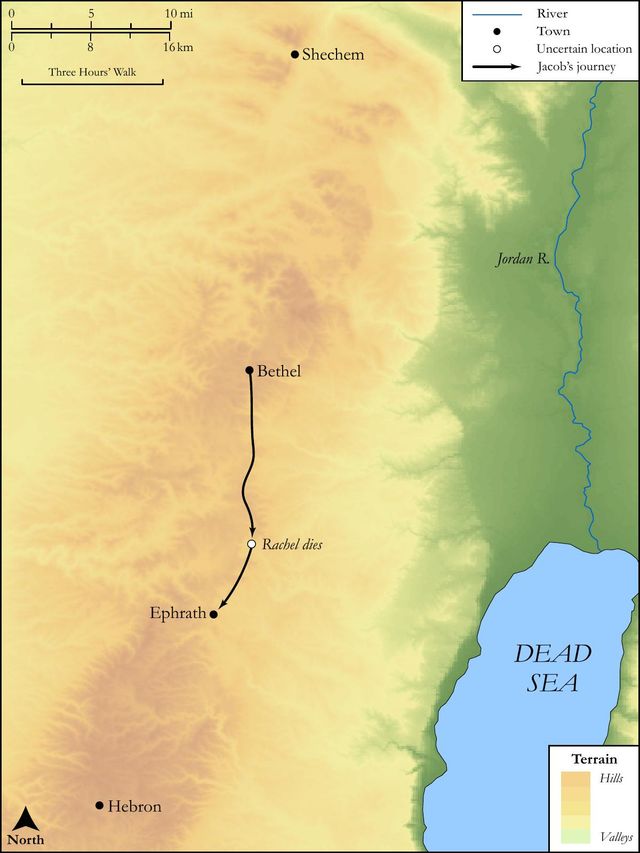
Genesis 35:16 recounts a pivotal and deeply poignant moment in Jacob's journey southward from Bethel. As his large household approached Ephrath, later known as Bethlehem, his beloved wife Rachel entered into an intensely difficult and dangerous labor. This verse serves as a somber and critical prelude to the birth of Benjamin and the tragic death of Rachel, highlighting the intertwined realities of life, suffering, and divine purpose within the unfolding patriarchal narrative.
Context
ShowHideLiterary Context
This verse is strategically placed immediately following Jacob's profound encounter with God at Bethel, where the Lord reaffirmed His covenant promises to him and his descendants. The narrative then abruptly shifts from divine blessing and prophetic vision to the harsh reality of human suffering and mortality. This juxtaposition creates a powerful dramatic effect, emphasizing that even those under God's direct blessing are not exempt from the trials of a fallen world. The verse also directly precedes the detailed account of Rachel's death and the birth of Benjamin in Genesis 35:17-19, setting the stage for one of the most sorrowful events in Jacob's life.
Historical & Cultural Context
Jacob's journey southward was part of his return to the land of Canaan, fulfilling God's earlier command to return to his homeland (Genesis 31:3). Travel in the days of the patriarchs was arduous, especially for a large household with women, children, and livestock. Childbirth, particularly in nomadic or semi-nomadic settings without modern medical care, was inherently dangerous. The high mortality rate for both mothers and infants was a stark reality, making Rachel's "hard labour" a life-threatening situation. Ephrath, identified with Bethlehem, was a significant location in Canaan, though its full biblical importance would only unfold centuries later.
Key Themes
ShowHideGenesis 35:16 contributes significantly to several overarching themes within the book. It underscores the theme of God's faithfulness amidst human frailty, as the divine promises to Jacob continue to unfold even through personal tragedy. It highlights the pilgrimage nature of life, where Jacob's constant movement is marked by both divine encounters and profound suffering. Furthermore, it starkly portrays the intertwined realities of life and death, demonstrating how moments of creation (birth) can be inextricably linked with loss, a poignant reflection on the consequences of the fall found throughout the human story in Genesis. The mention of Ephrath also subtly introduces the theme of significant geographical locations in God's redemptive plan.
Exposition and Analysis
ShowHideThe verse "And they journeyed from Bethel; and there was but a little way to come to Ephrath: and Rachel travailed, and she had hard labour" is a concise yet emotionally charged account of a pivotal moment in Jacob's family history.
Key Word Analysis
ShowHideThis primitive root signifies "to pull up," especially tent-pins, indicating the act of starting on a journey or moving camp. It highlights the nomadic and unsettled nature of the patriarchs' lives, constantly on the move under God's direction. In this context, it marks a physical progression from a place of divine revelation (Bethel) towards a destination that would become a site of profound human suffering.
This primitive root means "to bear young" or "to beget," often referring to the act of childbirth. It can also imply the pain and effort associated with labor. The repetition of this root in the verse ("travailed" and "labour") emphasizes the ongoing and intense nature of Rachel's ordeal, underscoring the physical agony she was enduring.
This primitive root means "to be dense," "tough," or "severe." When applied to labor, as here, it conveys extreme difficulty, grievousness, or a life-threatening situation. The use of "hard" powerfully intensifies the description of Rachel's labor, signaling the critical and dangerous nature of her condition and foreshadowing the tragic outcome.
Verse Breakdown
ShowHide"And they journeyed from Bethel"
This clause establishes the immediate past event and the direction of travel. Having just experienced a reaffirmation of God's covenant at Bethel, Jacob and his large family are now on the move, continuing their pilgrimage towards the promised land. This movement underscores the dynamic and often challenging nature of their lives.
"and there was but a little way to come to Ephrath"
This phrase pinpoints their approximate location, indicating they were very close to their destination. Ephrath is historically recognized as an older name for Bethlehem, a place that would later hold immense significance in biblical history, particularly as the birthplace of King David and, crucially, the Messiah. The proximity to this future sacred site adds a layer of poignant irony to the impending tragedy.
"and Rachel travailed"
This marks the onset of Rachel's labor. Rachel, Jacob's beloved wife and mother of Joseph, begins the painful process of childbirth. The simple statement conveys the beginning of a profound physical and emotional ordeal for her.
"and she had hard labour"
This final clause intensifies the description, emphasizing the severity and difficulty of Rachel's childbirth. The term "hard labour" (combining qâshâh and yâlad) vividly portrays the extreme pain and life-threatening nature of her condition, setting a somber tone for the subsequent events of her death and the birth of Benjamin.
Literary Devices
ShowHideThe verse employs several powerful literary devices. Juxtaposition is evident in the immediate transition from the divine encounter and covenant renewal at Bethel to the raw, painful reality of Rachel's "hard labour." This stark contrast highlights the truth that divine blessing does not negate human suffering. Foreshadowing is strongly present in the description of Rachel's "hard labour," which powerfully anticipates her death in the very next verses (Genesis 35:18-19). The intensity of her suffering serves as a grim premonition of the tragic outcome. Finally, the verse evokes pathos, drawing the reader into the emotional weight of Rachel's distress and the impending sorrow for Jacob and his family.
Theological and Thematic Connections
ShowHideGenesis 35:16 powerfully illustrates that even within God's unfolding redemptive plan for His chosen people, life is marked by profound suffering and loss. Rachel's "hard labour" reminds us that the realities of a fallen world, including pain, struggle, and death, are experienced even by those closest to God's covenant promises. Yet, it is precisely through these human events—both joyous and tragic—that God's sovereign purposes continue to advance, leading to the formation of the twelve tribes of Israel and ultimately, the lineage of the Messiah. The mention of Ephrath subtly hints at the divine orchestration of locations for future pivotal events in salvation history.
Reflection and Application
ShowHideGenesis 35:16 offers a poignant reminder that the journey of faith is rarely a straight or easy path, even for those walking in direct obedience to God. It confronts us with the raw realities of human vulnerability, suffering, and loss, even in the midst of divine blessing and covenant promises. Rachel's agony underscores that pain is an intrinsic part of the human experience in a fallen world, inviting us to cultivate empathy for those enduring physical or emotional distress. This verse challenges us to trust in God's overarching sovereignty and benevolent purposes, even when circumstances are deeply painful or seemingly contradictory to our expectations of blessing. It encourages us to find solace in the knowledge that God is present in our suffering, weaving even our deepest sorrows into the larger, beautiful tapestry of His redemptive plan, just as Rachel's death paved the way for the completion of Jacob's twelve sons.
Questions for Reflection
ShowHideFAQ
ShowHideWhat is the significance of Ephrath in this verse?
ShowHideEphrath is an ancient name for Bethlehem, a town that holds immense biblical and theological significance. Its mention here is a subtle yet powerful foreshadowing of future pivotal events. Centuries later, Bethlehem would be prophesied as the birthplace of the Messiah (Micah 5:2), and it would indeed be the birthplace of King David and, ultimately, Jesus Christ. Thus, this moment of profound human suffering and birth occurs near a location central to God's redemptive plan.
Why is Rachel's "hard labour" emphasized?
ShowHideThe emphasis on Rachel's "hard labour" (H7185 qâshâh) serves multiple purposes. Firstly, it highlights the severe physical suffering she endured, underscoring the painful realities of human existence and the dangers of childbirth in that age. Secondly, it creates intense pathos, drawing the reader into the emotional gravity of the situation. Most importantly, it acts as a powerful foreshadowing of her imminent death, which is explicitly stated in the very next verses (Genesis 35:17-19). This emphasis underscores the intertwined nature of life and death, joy and sorrow, within the biblical narrative.
Christ-Centered Fulfillment
ShowHideWhile Genesis 35:16 directly describes a moment of human suffering and birth within the patriarchal narrative, it profoundly points toward Christ in several significant ways. The geographical mention of Ephrath, an older name for Bethlehem, is deeply prophetic, as it is the very place where the Messiah would be born centuries later, as foretold in Micah 5:2. Rachel's intense suffering and ultimate death in bringing forth her son, Benjamin, who completed the twelve sons of Israel, can be seen as a poignant foreshadowing of the greater suffering and sacrificial death of Christ. Just as Rachel's profound cost brought forth a son who became part of the lineage of God's chosen people, Christ's unparalleled suffering and death on the cross brought forth spiritual children for God and new life for all humanity (John 1:12-13). His sacrifice, far exceeding any human pain, was the ultimate act of love that conquered sin and death, fulfilling God's redemptive plan in a way that truly brings forth life from death (Romans 5:8).