


2 Kings 5:19
Bible text: King James Version (1769 Blayney text) · Public domain
Bible text: Berean Standard Bible · Public domain
Bible text: American Standard Version (1901) · Public domain
Bible text: World English Bible, Messianic edition · Public domain
Bible text: Geneva Bible (1599) · Public domain
Bible text: Young's Literal Translation · Public domain
- וַיֹּאמֶרvai·Yo·merand he saidH559Conj-w ¦ V-Qal-ConsecImperf-3msVerb Qal Consecutive Imperfect 3rd Singular Masculineוַandיֹּאמֶרhe said
- לוֹloto himPrep-l ¦ 3msSuffix Personal 3rd Singular Masculineלtoוֹhim
- לֵךְlekhgoH1980V-Qal-Imp-2msVerb Qal Imperative 2nd Singular Masculine
- לְשָׁלוֹםle·sha·Lomto peaceH7965Prep-l ¦ N-msNoun Singular Masculine Absoluteלְtoשָׁלוֹםpeace
- וַיֵּלֶךְvai·Ye·lekhand he wentH1980Conj-w ¦ V-Qal-ConsecImperf-3msVerb Qal Consecutive Imperfect 3rd Singular Masculineוַandיֵּלֶךְhe went
- מֵאִתּוֹme·'i·Tofrom with <the> himH854Prep-m ¦ Prep ¦ 3msPreposition Definiteמֵfromאִתּwith <the>וֹhim
- כִּבְרַתkiv·rata distance ofH3530N-fscNoun Singular Feminine Construct
- אָרֶץ'A·retzlandH776N-fsNoun Singular Feminine Absolute
English is a literal word-by-word gloss of the Hebrew, not the KJV's wording. Why?
This is the original text the KJV's translators worked from — each Hebrew word with its own literal English meaning in this verse, prepared by scholars at Tyndale House, Cambridge. The KJV translates whole sentences, not word by word, so its wording differs: one Hebrew word can become several English words, and the KJV may choose “the LORD” where the gloss reads “Yahweh”. Both are faithful — they answer different questions. For the KJV's own rendering, switch to the KJV text.
Details
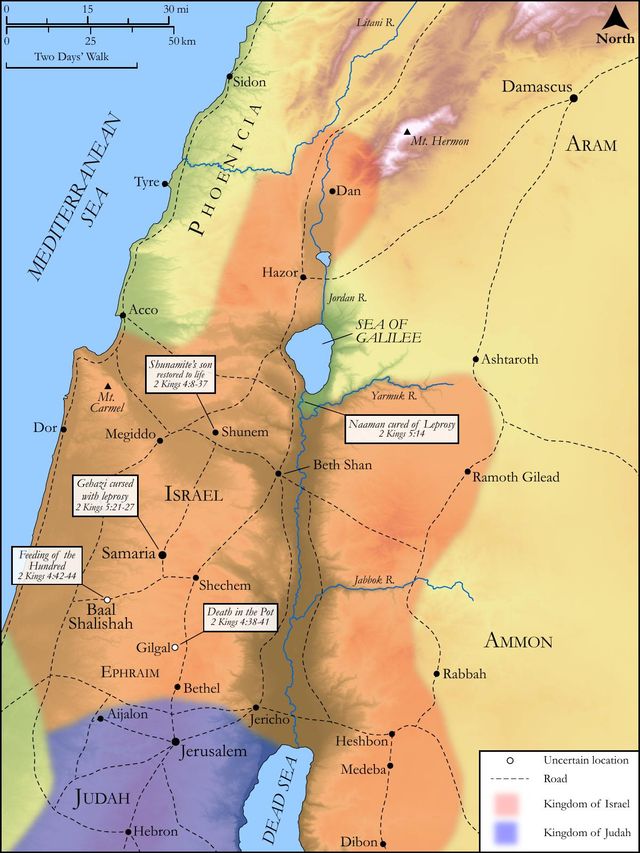
See on the biblical-era map
Study this verse
Public-domain commentary
Matthew Henry
From his Commentary on the Whole Bible. Henry comments on passages, not single verses — this entry covers 2 Kings 5:15–19.
Of the ten lepers that our Saviour cleansed, the only one that returned to give thanks was a Samaritan, Luk 17:16. This Syrian did so, and here expresses himself.
I.Convinced of the power of the God of Israel, not only that he is God, but that he is God alone, and that indeed there is no God in all the earth but in Israel (Kg2 5:15) - a noble confession, but such as intimates the misery of the Gentile world; for the nations that had many gods really had no God, but were without God in the world. He had formerly thought the gods of Syria gods indeed, but now experience had rectified his mistake, and he knew Israel's God was God alone, the sovereign Lord of all. Had he seen other lepers cleansed, perhaps the sight would not have convinced him, but the mercy of the cure affected him more than the miracle of it. Those are best able to speak of the power of divine grace who have themselves experienced it.
II.Grateful to Elisha the prophet:
"Therefore, for his sake whose servant thou art, I have a present for thee, silver, and gold, and raiment, whatever thou wilt please to accept." He valued the cure, not by the easiness of it to the prophet, but the acceptableness of it to himself, and would gladly pay for it accordingly. But Elisha generously refused the fee, though urged to accept it; and, to prevent further importunity, backed his refusal with an oath: As the Lord liveth, I will receive none (Kg2 5:16), not because he did not need it, for he was poor enough, and knew what to do with it, and how to bestow it among the sons of the prophets, nor because he thought it unlawful, for he received presents from others; but he would not be beholden to this Syrian, nor should he say, I have made Elisha rich, Gen 14:23. It would be much for the honour of God to show this new convert that the servants of the God of Israel were taught to look upon the wealth of this world with a holy contempt, which would confirm him in his belief that there was no God but in Israel. See Co1 9:18; Co2 11:9.
III.Proselyted to the worship of the God of Israel.
He will not only offer a sacrifice to the Lord, in thanks for his present cure, but he resolves he will never offer sacrifice to any other gods, Kg2 5:17. It was a happy cure of his leprosy which cured him of his idolatry, a more dangerous disease. But here are two instances of his weakness and infirmity in his conversion: - 1. In one instance he over-did it, that he would not only worship the God of Israel, but he would have clods of earth out of the prophet's garden, or at least of the prophet's ordering, to make an altar of, Kg2 5:17. He that awhile ago had spoken very slightly of the waters of Israel (Kg2 5:12) now is in another extreme, and over-values the earth of Israel, supposing (since God has appointed altars of earth, Exo 20:24) that an altar of that earth would be most acceptable to him, not considering that all the earth is the Lord's and the fulness thereof. Or perhaps the transport of his affection and veneration for the prophet, not only upon the account of his power, but of his virtue and generosity, made him, as we say, love the very ground he went upon and desire to have some of it home with him. The modern compliment equivalent to this would be, "Pray, sir, let me have your picture." 2. In another instance he under-did it, that he reserved to himself a liberty to bow in the house of Rimmon, in complaisance to the king his master, and according to the duty of his place at court (Kg2 5:18), in this thing he must be excused. He owns he ought not to do it, but that he cannot otherwise not do it, but that he cannot otherwise keep his place, - protests that his bowing is not, nor ever shall be, as it had been, in honour to the idol, but only in honour to the king, - and therefore he hopes God will forgive him. Perhaps, all things considered, this might admit of some apology, though it was not justifiable. But, as to us, I am sure, (1.) If, in covenanting with God, we make a reservation for any known sin, which we will continue to indulge ourselves in, that reservation is a defeasance of his covenant. We must cast away all our transgressions and not except any house of Rimmon. (2.) Though we are encouraged to pray for the remission of the sins we have committed, yet, if we ask for a dispensation to go on in any sin for the future, we mock God, and deceive ourselves. (3.) Those that know not how to quit a place at court when they cannot keep it without sinning against God, and wronging their consciences, do not rightly value the divine favour. (4.) Those that truly hate evil will make conscience of abstaining from all appearances of evil. Though Naaman's dissembling his religion cannot be approved, yet because his promise to offer no sacrifice to any god but the God of Israel only was a great point gained with a Syrian, and because, by asking pardon in this matter, he showed such a degree of conviction and ingenuousness as gave hopes of improvement, the prophet took fair leave of him, and bade him Go in peace, Kg2 5:19. Young converts must be tenderly dealt with.
Historical interpretation
Historical reception
1 surviving comment on this verse from the historical church.
Go in peace: What the prophet here allowed, was not an outward conformity to an idolatrous worship; but only a service which by his office he owed to his master: who on all public occasions leaned on him: so that his bowing down when his master bowed himself down was not in effect adoring the idols: nor was it so understood by the standers by, since he publicly professed himself a worshipper of the only true and living God, but it was no more than doing a civil office to the king his master, whose leaning upon him obliged him to bow at the same time that he bowed.
Continue studying 2 Kings 5:19 across the web’s major study libraries — every link below opens this exact verse, chapter, or book on the destination site.
Read & Compare
 BibleGatewayThis verse in more than 200 translations and 70 languages.
 Bible.comThe YouVersion reader — hundreds of translations, reading plans, and highlights.
 ESV.orgCrossway's official English Standard Version reader.
 NET BibleThe NET translation with 60,000+ translators' notes on every rendering decision.
 STEP BibleTyndale House's free study tool — original text, vocabulary, and scholarly resources.
 BibliaLogos Bible Software's free web reader.
 USCCBThe New American Bible (Revised Edition) with the U.S. bishops' study notes.
Commentaries
 BibleHub CommentariesDozens of classic commentaries on this verse, gathered on one page.
 StudyLightMore than 100 commentary sets — the largest collection on the web.
 BibleRefPlain-English commentary on what this verse means, verse by verse.
 Enduring WordDavid Guzik's free commentary on this chapter, widely used by Bible teachers.
 Bible Study ToolsVerse commentary alongside Greek and Hebrew study aids.
Original Language & Research
- BibleHub InterlinearThe verse word by word — original language, transliteration, and English.
- BibleHub LexiconEvery word's original-language definition and Strong's entry.
 Blue Letter BibleDeep-study tools — Strong's numbers, concordance, and word studies.
 SefariaThe Hebrew text with Rashi and centuries of Jewish commentary.
Sermons, Hymns & Audio


TrulyRandomVerse is not affiliated with these sites and doesn’t control their content. They’re linked because they’re genuinely useful.
Summary
Second Kings 5:19 marks the culmination of Naaman's miraculous healing and spiritual conversion, as the prophet Elisha sends him forth with a profound blessing. This verse captures the moment of Naaman's departure, signifying not merely a physical journey home but the commencement of a new life founded on faith in the God of Israel. Elisha's parting words, "Go in peace," encapsulate a comprehensive blessing of wholeness and divine favor, affirming the genuine transformation that has taken place in the Syrian general's life and setting the stage for his future walk with Yahweh.
Context
ShowHideLiterary Context
This verse serves as the narrative's resolution to Naaman's personal encounter with Elisha, immediately following his miraculous cleansing from leprosy in 2 Kings 5:14 and his subsequent declaration of exclusive faith in Yahweh, stating, "Now I know that there is no God in all the earth, but in Israel" (2 Kings 5:15). Having refused Naaman's lavish gifts, Elisha demonstrates the gratuitous nature of God's grace. Naaman then makes two significant requests: permission to take two mule-loads of Israelite earth to build an altar to Yahweh in Syria, and forgiveness for his unavoidable duty of bowing in the house of Rimmon, his king's god. Elisha's concise response in 2 Kings 5:19 addresses these complex requests implicitly, offering a comprehensive blessing of "peace" that encompasses divine approval and a release from the burdens of his past. This verse also acts as a critical transition, immediately preceding the contrasting episode of Gehazi's covetous pursuit of Naaman, which starkly highlights the integrity of Elisha against the corruption of his servant.
Historical & Cultural Context
Naaman was a formidable figure, the commander of the Aramean (Syrian) army, a nation frequently in conflict with Israel. Leprosy in Israel was a terrifying, often incurable disease, carrying severe social and religious stigmas that rendered individuals ceremonially unclean and ostracized. Naaman's journey to Israel, prompted by a young Israelite captive girl, underscores the surprising and often humble instruments God uses to enact His will across national and social divides. The Hebrew concept of "peace" (shalom) was far more expansive than merely the absence of conflict; it signified holistic well-being, encompassing prosperity, health, security, and spiritual completeness. For Elisha to send Naaman "in peace" was to invoke a divine blessing upon his entire being and future, acknowledging his profound transformation and new allegiance to Yahweh. Naaman's request for Israelite earth reflects the Syrian belief in localized gods, voiced in the words "Their gods are gods of the hills," so that worship was often tied to the land of the god. His concern about bowing in the house of Rimmon reveals the practical and ethical dilemmas faced by converts in high public office, a challenge Elisha addresses with pastoral wisdom rather than strict legalism.
Key Themes
ShowHideThe overarching theme of 2 Kings 5 is the universal sovereignty and grace of Yahweh, demonstrating that God's power and redemptive reach are not confined to Israel but extend even to a high-ranking Gentile enemy. This verse specifically emphasizes divine transformation and new beginnings, as Naaman's physical healing serves as a powerful symbol of his spiritual rebirth from a proud, leprous idolater to a humble, healed believer in the one true God. Elisha's blessing of "peace" underscores the theme of holistic well-being (shalom) that accompanies genuine faith, encompassing physical, emotional, and spiritual dimensions. Furthermore, the narrative highlights the contrast between human pride and divine humility, as Naaman's initial arrogance and expectation of grand rituals give way to obedient faith in Elisha's simple instruction, leading to miraculous results (2 Kings 5:10-14). The integrity of Elisha, who refuses any reward for God's work, also sets a standard for prophetic ministry, contrasting sharply with the subsequent actions of Gehazi, which underscore the theme of greed versus grace in the prophetic office.
Exposition and Analysis
ShowHideKey Word Analysis
ShowHideThe Hebrew verb אמר (ʼâmar) is a primitive root meaning "to say," but used with great latitude, encompassing answering, appointing, commanding, declaring, and uttering. Here, Elisha's "saying" is not a mere utterance but a pronouncement of blessing and dismissal. It carries the weight of prophetic authority, conveying God's peace and implicit approval to Naaman. This word choice underscores the intentionality and significance of Elisha's final words to the newly converted general.
The Hebrew word שלום (shâlôwm) is derived from a root meaning "to be complete" or "to be sound." It signifies far more than the absence of conflict; it denotes completeness, wholeness, well-being, prosperity, health, security, and harmony. When Elisha says "Go in peace," he is invoking a comprehensive blessing for Naaman's physical, emotional, and spiritual journey. It signifies God's favor and the state of holistic well-being that comes from a right relationship with Him, affirming Naaman's new spiritual standing and releasing him into a life of divine favor.
B The Hebrew term כברה (kibrâh) refers to a "length" or "measure" of uncertain dimension, often translated as "a little way" or "some distance." It describes the short physical distance Naaman traveled away from Elisha before the subsequent events unfolded. While seemingly a simple spatial descriptor, its inclusion highlights the immediate commencement of Naaman's journey and creates the precise temporal and spatial gap necessary for Gehazi's unauthorized pursuit, a crucial narrative detail for the events that follow.
Verse Breakdown
ShowHide"And he said unto him, Go in peace."
This first clause captures Elisha's final, gracious interaction with Naaman. "Go in peace" (לך לשלום, lech l'shalom) is a common Hebrew farewell, but in this context, it is imbued with profound spiritual significance. It is not a casual dismissal but a comprehensive blessing, signifying Elisha's acceptance of Naaman's sincerity and his trust in God's ongoing work in Naaman's life. It implies divine approval for Naaman's return to Aram, acknowledging his transformed state and releasing him from the burdens of his past life and disease into a future guided by Yahweh's shalom. This blessing implicitly addresses Naaman's complex requests regarding the earth and bowing to Rimmon, indicating that God's grace covers his unique circumstances.
"So he departed from him a little way."
This second clause describes Naaman's immediate and respectful action following Elisha's blessing. The phrase "a little way" (Hebrew: כִּבְרַת־אֶרֶץ, kibrat-ʼerets, literally "a kibrath of land") indicates that Naaman did not linger but promptly began his journey home. This swift departure underscores his acceptance of Elisha's words and his readiness to embrace his transformed life. Narratively, this brief distance is crucial; it creates the necessary temporal and spatial window for Gehazi to pursue Naaman without Elisha's immediate knowledge, setting up the dramatic and contrasting confrontation that immediately follows in the chapter.
Literary Devices
ShowHideThe verse employs several subtle yet potent literary devices. Symbolism is evident in Naaman's physical departure, which powerfully symbolizes his spiritual departure from his former life of idolatry, pride, and disease into a new life of faith, humility, and wholeness in Yahweh. The "peace" (shalom) Elisha bestows is not merely an emotional state but a profound symbol of the comprehensive well-being and divine favor that God grants to those who genuinely turn to Him. There is also a significant element of Foreshadowing in Naaman's departure "a little way," as this brief distance creates the immediate opportunity for Gehazi to act on his covetous desires, setting the stage for the dramatic and contrasting events that follow in the chapter, which serve to highlight the dangers of greed. Furthermore, the narrative subtly uses Contrast by placing Elisha's selfless, grace-filled blessing immediately before Gehazi's selfish and deceitful pursuit, thereby accentuating the integrity of the true prophet against the corruption of his servant and emphasizing the purity of God's miraculous work.
Theological and Thematic Connections
ShowHideThis verse powerfully illustrates God's boundless grace and universal salvific intent, extending beyond the boundaries of Israel to embrace a Gentile military leader. Elisha's "Go in peace" is a testament to the comprehensive nature of God's peace, which encompasses physical healing, spiritual transformation, and holistic well-being. It affirms that true peace is found not in worldly power or rituals, but in a genuine encounter with the living God. Naaman's story anticipates the New Testament revelation that God's salvation is for all peoples, regardless of their background or nationality, and that faith, not lineage or ritual, is the pathway to divine favor. It underscores the truth that God's work of redemption is holistic, addressing both the physical and spiritual brokenness of humanity.
Reflection and Application
ShowHideElisha's simple yet profound blessing to Naaman, "Go in peace," offers a powerful model for how we, as believers, should approach those who have genuinely encountered God's transformative power. It is a reminder that once God has worked a miracle of healing and conversion in someone's life, our role is often to send them forth with blessing and trust in God's ongoing work, rather than imposing further burdens or conditions. For us, Naaman's story encourages us to embrace the comprehensive peace that God offers—a peace that addresses not just our spiritual state but our entire being. It challenges us to reflect on areas where we might still be clinging to old ways, seeking peace in worldly solutions, or feeling burdened by past failures, rather than fully trusting in the shalom that comes from God alone. Like Naaman, we are called to depart from our former lives and walk forward in the peace and newness of life that Christ provides, trusting Him to guide our steps even when the path ahead is uncertain or requires navigating complex social and ethical realities. This verse invites us to live out the peace we have received, extending it to others as we journey in faith.
Questions for Reflection
ShowHideFAQ
ShowHideWhy did Elisha not explicitly tell Naaman what to do about bowing in the house of Rimmon?
ShowHideElisha's response, "Go in peace," reflects profound pastoral wisdom and trust in God's ongoing work in Naaman's life. Rather than imposing a strict legalistic command that might have been impossible for Naaman to fulfill given his high-ranking public duties, Elisha chose to send him off with a comprehensive blessing of shalom. This implies that Naaman's heart had genuinely turned to Yahweh, as evidenced by his confession in 2 Kings 5:15 and his desire for Israelite earth to build an altar. Elisha understood that true faith is a journey, not a rigid set of rules, and that God would continue to guide Naaman's conscience. This approach highlights God's grace and patience, allowing Naaman to navigate his unique circumstances while maintaining his new allegiance to the one true God. It suggests that Elisha prioritized the sincerity of Naaman's new faith over immediate, perfect adherence to every detail of Israelite religious practice, trusting God to illuminate his path and work out the details of his devotion.
Christ-Centered Fulfillment
ShowHideThe narrative of Naaman's healing and Elisha's blessing in 2 Kings 5:19 beautifully foreshadows the comprehensive salvation offered through Jesus Christ. Naaman, a Gentile afflicted by a debilitating disease, finds healing and peace not through his own efforts or wealth, but through humble obedience to the word of God's prophet. Similarly, all humanity, afflicted by the spiritual leprosy of sin, finds true cleansing and shalom not through works of the law or human merit, but through faith in the Lamb of God who takes away the sin of the world. Jesus, the ultimate Prophet and Physician, offers a peace that "transcends all understanding" (Philippians 4:7), a peace that reconciles us to God (Romans 5:1) and brings wholeness to our broken lives. Naaman's status as a Gentile receiving God's grace points directly to the universal scope of the Gospel, where in Christ, "there is neither Jew nor Gentile, neither slave nor free, nor is there male and female, for you are all one in Christ Jesus" (Galatians 3:28). Just as Naaman departed in peace, cleansed and transformed, so too do believers in Christ embark on a new journey, walking in the peace and newness of life provided by His atoning sacrifice and resurrection (Romans 6:4). Christ is our shalom, our complete and perfect peace.