


2 Kings 5:18
Bible text: King James Version (1769 Blayney text) · Public domain
Bible text: King James Version with Strong's numbers · Public domain
Bible text: Berean Standard Bible · Public domain
Bible text: American Standard Version (1901) · Public domain
Bible text: World English Bible, Messianic edition · Public domain
Bible text: Geneva Bible (1599) · Public domain
Bible text: Young's Literal Translation · Public domain
- לַדָּבָרla·da·Varto the matterH1697Prep-l ¦ N-msNoun Singular Masculine Absoluteלַto theדָּבָרmatter
- הַזֶּהha·Zeh<the> thisH2088Art ¦ PrtParticle Demonstrativeהַ<the>זֶּהthis
- יִסְלַחyis·Lachmay he forgiveH5545V-Qal-Imperf-3msVerb Qal Imperfect 3rd Singular Masculine
- יְהוָהYah·wehYahwehH3068N-properNoun Proper Title
- לְעַבְדֶּךָle·'av·De·kha<to> your servantH5650Prep-l ¦ N-msc ¦ 2msNoun Singular Masculine Constructלְ<to>עַבְדֶּservantךָyour
- בְּבוֹאbe·Vo'when goesH935Prep-b ¦ V-Qal-InfVerb Qal Infinitive Constructבְּwhenבוֹאgoes
- אֲדֹנִי'a·do·Nimy masterH113N-msc ¦ 1csNoun Singular Masculine Constructאֲדֹנִmasterיmy
- בֵיתveit[the] house ofH1004N-mscNoun Singular Masculine Construct
- רִמּוֹןri·mOnRimmonH7417N-properNoun Proper Title
- לְהִשְׁתַּחֲוֹתle·hish·ta·cha·Votto bow downH7812Prep-l ¦ V-Hishtaphel-InfVerb Hishtaphel Infinitive Constructלְtoהִשְׁתַּחֲוֹתbow down
- שָׁמָּהSha·mahthere <towards>H8033Adv ¦ SfxAdverbשָׁמָּthereה<towards>
- וְהוּאve·Hu'and heH1931Conj-w ¦ Pro-3msPronoun Personal 3rd Singular Masculineוְandהוּאhe
- נִשְׁעָןnish·'An[is] supporting himselfH8172V-Niphal-Prtcpl-msVerb Niphal Participle Singular Masculine Absolute
- עַל'alonH5921PrepPreposition
- יָדִיya·Dimy handH3027N-csc ¦ 1csNoun Singular common gender Constructיָדִhandיmy
- וְהִשְׁתַּחֲוֵיתִיve·hish·ta·cha·Vei·tiand I will bow downH7812Conj-w ¦ V-Hishtaphel-ConsecPerf-1csVerb Hishtaphel Consecutive Perfect 1st Singular common genderוְandהִשְׁתַּחֲוֵיתִיI will bow down
- בֵּיתbeit[the] house ofH1004N-mscNoun Singular Masculine Construct
- רִמֹּןri·MonRimmonH7417N-properNoun Proper Title
- בְּהִשְׁתַּחֲוָיָתִיbe·hish·ta·cha·va·Ya·tiwhen I bow downH7812Prep-b ¦ V-Hishtaphel-Inf ¦ 1csVerb Hishtaphel Infinitive Constructבְּwhenהִשְׁתַּחֲוָיָתִbow downיI
- בֵּיתbeit[the] house ofH1004N-mscNoun Singular Masculine Construct
- רִמֹּןri·MonRimmonH7417N-properNoun Proper Title
- יִסְלַחyis·lachmay he forgiveH5545V-Qal-Imperf-3msVerb Qal Imperfect 3rd Singular Masculine
- יְהוָהYah·wehYahwehH3068N-properNoun Proper Title
- לְעַבְדְּךָle·'av·de·Kha<to> your servantH5650Prep-l ¦ N-msc ¦ 2msNoun Singular Masculine Constructלְ<to>עַבְדְּservantךָyour
- בַּדָּבָרba·da·Varin the matterH1697Prep-b ¦ N-msNoun Singular Masculine Absoluteבַּin theדָּבָרmatter
- הַזֶּהha·Zeh<the> thisH2088Art ¦ PrtParticle Demonstrativeהַ<the>זֶּהthis
English is a literal word-by-word gloss of the Hebrew, not the KJV's wording. Why?
This is the original text the KJV's translators worked from — each Hebrew word with its own literal English meaning in this verse, prepared by scholars at Tyndale House, Cambridge. The KJV translates whole sentences, not word by word, so its wording differs: one Hebrew word can become several English words, and the KJV may choose “the LORD” where the gloss reads “Yahweh”. Both are faithful — they answer different questions. For the KJV's own rendering, switch to the KJV text.
Details
See on the biblical-era map
Study this verse
Public-domain commentary
Matthew Henry
From his Commentary on the Whole Bible. Henry comments on passages, not single verses — this entry covers 2 Kings 5:15–19.
Of the ten lepers that our Saviour cleansed, the only one that returned to give thanks was a Samaritan, Luk 17:16. This Syrian did so, and here expresses himself.
I.Convinced of the power of the God of Israel, not only that he is God, but that he is God alone, and that indeed there is no God in all the earth but in Israel (Kg2 5:15) - a noble confession, but such as intimates the misery of the Gentile world; for the nations that had many gods really had no God, but were without God in the world. He had formerly thought the gods of Syria gods indeed, but now experience had rectified his mistake, and he knew Israel's God was God alone, the sovereign Lord of all. Had he seen other lepers cleansed, perhaps the sight would not have convinced him, but the mercy of the cure affected him more than the miracle of it. Those are best able to speak of the power of divine grace who have themselves experienced it.
II.Grateful to Elisha the prophet:
"Therefore, for his sake whose servant thou art, I have a present for thee, silver, and gold, and raiment, whatever thou wilt please to accept." He valued the cure, not by the easiness of it to the prophet, but the acceptableness of it to himself, and would gladly pay for it accordingly. But Elisha generously refused the fee, though urged to accept it; and, to prevent further importunity, backed his refusal with an oath: As the Lord liveth, I will receive none (Kg2 5:16), not because he did not need it, for he was poor enough, and knew what to do with it, and how to bestow it among the sons of the prophets, nor because he thought it unlawful, for he received presents from others; but he would not be beholden to this Syrian, nor should he say, I have made Elisha rich, Gen 14:23. It would be much for the honour of God to show this new convert that the servants of the God of Israel were taught to look upon the wealth of this world with a holy contempt, which would confirm him in his belief that there was no God but in Israel. See Co1 9:18; Co2 11:9.
III.Proselyted to the worship of the God of Israel.
He will not only offer a sacrifice to the Lord, in thanks for his present cure, but he resolves he will never offer sacrifice to any other gods, Kg2 5:17. It was a happy cure of his leprosy which cured him of his idolatry, a more dangerous disease. But here are two instances of his weakness and infirmity in his conversion: - 1. In one instance he over-did it, that he would not only worship the God of Israel, but he would have clods of earth out of the prophet's garden, or at least of the prophet's ordering, to make an altar of, Kg2 5:17. He that awhile ago had spoken very slightly of the waters of Israel (Kg2 5:12) now is in another extreme, and over-values the earth of Israel, supposing (since God has appointed altars of earth, Exo 20:24) that an altar of that earth would be most acceptable to him, not considering that all the earth is the Lord's and the fulness thereof. Or perhaps the transport of his affection and veneration for the prophet, not only upon the account of his power, but of his virtue and generosity, made him, as we say, love the very ground he went upon and desire to have some of it home with him. The modern compliment equivalent to this would be, "Pray, sir, let me have your picture." 2. In another instance he under-did it, that he reserved to himself a liberty to bow in the house of Rimmon, in complaisance to the king his master, and according to the duty of his place at court (Kg2 5:18), in this thing he must be excused. He owns he ought not to do it, but that he cannot otherwise not do it, but that he cannot otherwise keep his place, - protests that his bowing is not, nor ever shall be, as it had been, in honour to the idol, but only in honour to the king, - and therefore he hopes God will forgive him. Perhaps, all things considered, this might admit of some apology, though it was not justifiable. But, as to us, I am sure, (1.) If, in covenanting with God, we make a reservation for any known sin, which we will continue to indulge ourselves in, that reservation is a defeasance of his covenant. We must cast away all our transgressions and not except any house of Rimmon. (2.) Though we are encouraged to pray for the remission of the sins we have committed, yet, if we ask for a dispensation to go on in any sin for the future, we mock God, and deceive ourselves. (3.) Those that know not how to quit a place at court when they cannot keep it without sinning against God, and wronging their consciences, do not rightly value the divine favour. (4.) Those that truly hate evil will make conscience of abstaining from all appearances of evil. Though Naaman's dissembling his religion cannot be approved, yet because his promise to offer no sacrifice to any god but the God of Israel only was a great point gained with a Syrian, and because, by asking pardon in this matter, he showed such a degree of conviction and ingenuousness as gave hopes of improvement, the prophet took fair leave of him, and bade him Go in peace, Kg2 5:19. Young converts must be tenderly dealt with.
Continue studying 2 Kings 5:18 across the web’s major study libraries — every link below opens this exact verse, chapter, or book on the destination site.
Read & Compare
 BibleGatewayThis verse in more than 200 translations and 70 languages.
 Bible.comThe YouVersion reader — hundreds of translations, reading plans, and highlights.
 ESV.orgCrossway's official English Standard Version reader.
 NET BibleThe NET translation with 60,000+ translators' notes on every rendering decision.
 STEP BibleTyndale House's free study tool — original text, vocabulary, and scholarly resources.
 BibliaLogos Bible Software's free web reader.
 USCCBThe New American Bible (Revised Edition) with the U.S. bishops' study notes.
Commentaries
 BibleHub CommentariesDozens of classic commentaries on this verse, gathered on one page.
 StudyLightMore than 100 commentary sets — the largest collection on the web.
 BibleRefPlain-English commentary on what this verse means, verse by verse.
 Enduring WordDavid Guzik's free commentary on this chapter, widely used by Bible teachers.
 Bible Study ToolsVerse commentary alongside Greek and Hebrew study aids.
Original Language & Research
- BibleHub InterlinearThe verse word by word — original language, transliteration, and English.
- BibleHub LexiconEvery word's original-language definition and Strong's entry.
 Blue Letter BibleDeep-study tools — Strong's numbers, concordance, and word studies.
 SefariaThe Hebrew text with Rashi and centuries of Jewish commentary.
Sermons, Hymns & Audio


TrulyRandomVerse is not affiliated with these sites and doesn’t control their content. They’re linked because they’re genuinely useful.
Summary
Naaman, the Syrian commander, having experienced miraculous healing and declared his exclusive allegiance to the God of Israel, seeks divine pardon for a specific future action. His high-ranking position necessitates his accompaniment of the King of Syria into the temple of the pagan deity Rimmon, where he must physically support the king and, in doing so, bow down with him. Naaman's earnest plea reveals the immediate and profound challenge of integrating his newfound monotheistic faith with his unavoidable civic duties in a polytheistic culture, demonstrating his sincere desire to maintain a clear conscience before the LORD.
Context
ShowHideLiterary Context
This verse is strategically placed immediately after Naaman's profound encounter with the God of Israel. Having been miraculously healed of leprosy through Elisha's instruction to dip seven times in the Jordan River, Naaman returns to the prophet, declaring, "Indeed, now I know that there is no God in all the earth, except in Israel" 2 Kings 5:15. This confession marks a pivotal turning point, establishing his conversion to monotheism. His subsequent request for two mule-loads of earth, with the intention of building an altar to the LORD in Syria and vowing to offer sacrifices only to the God of Israel 2 Kings 5:17, further solidifies his commitment. Naaman's request for pardon in 2 Kings 5:18 directly addresses the practical and ethical implications of his new faith within his existing life circumstances, setting the stage for Elisha's concise and often debated response in 2 Kings 5:19.
Historical & Cultural Context
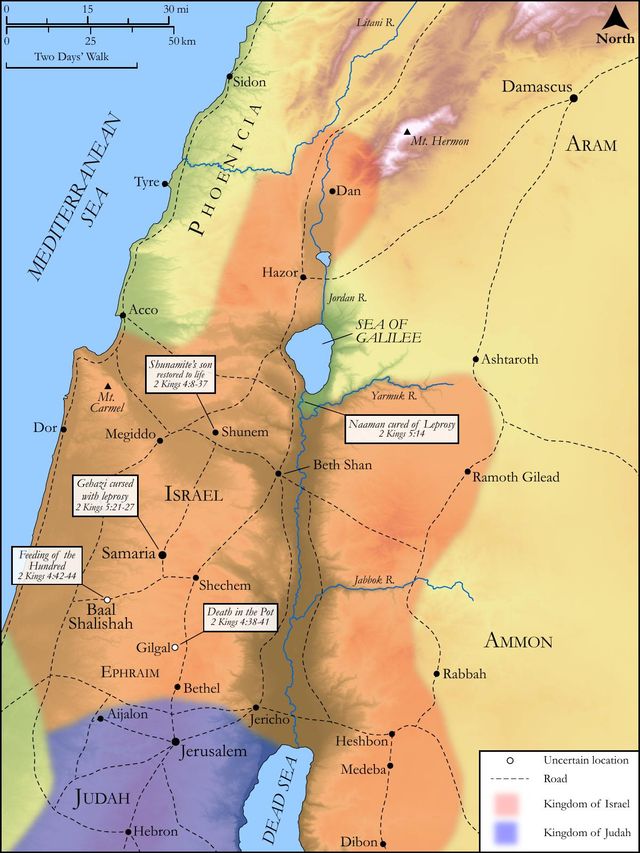
Naaman was a high-ranking military commander in Aram (Syria), a powerful kingdom situated north of Israel. In Aram, the worship of various gods, including storm deities like Hadad-Rimmon (often simply referred to as Rimmon), was pervasive. Kings were frequently regarded as divine representatives or even deities themselves, and their public religious rituals were fundamental to national identity and political stability. As a trusted aide and chief military officer, Naaman's role in supporting the king during public worship in the temple of Rimmon was an integral and non-negotiable part of his official duties. This was a matter of state protocol and personal loyalty to the king, not a personal act of devotion to Rimmon. This cultural expectation placed Naaman in a unique and challenging predicament, where his outward actions, dictated by his civic role, might contradict his newly embraced inward conviction, a common dilemma for monotheists living within polytheistic societies.
Key Themes
ShowHideNaaman's plea profoundly highlights the transition of faith and conscience for a new convert, as he grapples with the practicalities of living out his monotheistic belief in a deeply polytheistic environment. It underscores the inherent tension between spiritual conviction and civic obligation, a dilemma that believers have faced across history and cultures. The passage implicitly emphasizes that true worship is ultimately a matter of the heart and intention, not merely outward conformity, as Naaman's heartfelt concern for divine pardon demonstrates his earnest desire for authenticity before the God of Israel. Furthermore, it introduces the theme of God's grace and understanding for those navigating complex ethical situations, particularly new believers, a theme further developed by Elisha's subsequent response in 2 Kings 5:19. This narrative also subtly foreshadows the broader biblical theme of God's redemptive work extending beyond Israel's borders, reaching Gentiles like Naaman, as seen in the broader narrative of 2 Kings 5.
Exposition and Analysis
ShowHideKey Word Analysis
ShowHideThis verb (סָלַח, H5545) specifically means "to forgive" or "to pardon." In the Old Testament, it is consistently used to describe divine forgiveness, particularly for sins committed against God. Naaman's use of this word indicates his understanding that his compelled action, though a civic duty, could be considered an offense against the LORD, to whom he has just pledged exclusive allegiance. His earnest request for divine pardon underscores his newfound reverence for God's holiness and his desire to maintain a clear conscience.
The name (רִמּוֹן, H7417) refers to a prominent Syrian storm god, often identified with Hadad, the chief deity of the Aramean pantheon. Temples dedicated to Rimmon were common throughout Syria. Naaman's explicit mention of "the house of Rimmon" highlights the specific context of his moral dilemma: he is not personally worshipping this pagan deity, but his official duties require his physical presence and participation in a public ritual dedicated to Rimmon, which could be misconstrued as an act of homage or compromise of his new faith.
This primitive root (שָׁחָה, H7812) means "to depress," or "to prostrate," especially reflexively, in homage to royalty or God. It implies an act of deep reverence, obeisance, or worship. Naaman's concern revolves around this specific physical action. While his heart's allegiance is now to the LORD, his position requires him to perform an action that, outwardly, appears to be an act of worship to Rimmon. His request for pardon is precisely for this unavoidable outward posture.
Verse Breakdown
ShowHide"In this thing the LORD pardon thy servant,"
Naaman initiates his plea with a direct and urgent appeal to the LORD for forgiveness. The phrase "in this thing" immediately identifies the specific, singular issue causing him profound spiritual distress, indicating his deep concern for his integrity before the God he has come to know.
"that when my master goeth into the house of Rimmon to worship there,"
This clause establishes the setting and the primary actor, the king. It clarifies that the king's regular practice involves entering the temple of Rimmon for worship. Naaman is not going there of his own volition for personal worship, but as an attendant to his sovereign.
"and he leaneth on my hand,"
This detail specifies Naaman's crucial and intimate role as a high-ranking official. As the king's trusted aide, he would physically support the monarch, perhaps due to the king's age or infirmity, or as a symbol of royal dignity and reliance during the ritual. This makes Naaman's physical presence and proximity an integral, unavoidable component of the king's worship. The word for "hand" (H3027, yâd) here implies not just a physical limb, but also power, means, and support.
"and I bow myself in the house of Rimmon:"
This is the crux of Naaman's ethical dilemma. Because he is physically supporting the king, when the king bows in worship to Rimmon, Naaman must also bow in tandem. He recognizes that this outward act, regardless of his inward intention, could be perceived as idolatry or a direct compromise of his newfound exclusive faith in the LORD.
"when I bow down myself in the house of Rimmon, the LORD pardon thy servant in this thing."
The repetition of the specific action ("when I bow down myself in the house of Rimmon") and the repeated plea for pardon ("the LORD pardon thy servant in this thing") powerfully emphasizes Naaman's earnestness and the immense weight of the ethical challenge he faces. It underscores his profound desire for God's understanding and grace in a situation where his professional duty directly conflicts with his newly established spiritual allegiance.
Literary Devices
ShowHideThe passage powerfully employs Dilemma to highlight Naaman's immediate and acute ethical challenge as a new convert. He finds himself caught between his profound and recently declared commitment to the LORD and his non-negotiable civic duty to the King of Syria. The striking Repetition of the phrase "when I bow down myself in the house of Rimmon, the LORD pardon thy servant in this thing" underscores the depth of Naaman's spiritual concern and his earnest, almost desperate, desire for divine understanding and forgiveness. There is a subtle yet profound Irony in a pagan military commander, recently healed by the God of Israel, now seeking pardon from that very God for an act related to a pagan deity. This highlights the transformative power of his encounter with YHWH, as his conscience is now keenly attuned to God's standards, a sensitivity he previously lacked.
Theological and Thematic Connections
ShowHideNaaman's heartfelt plea for pardon illuminates the complex interplay between outward action and inward intention, a perennial challenge for believers navigating their faith in a fallen world. It suggests that God, in His infinite grace and wisdom, understands the unique pressures and unavoidable circumstances that may lead to outward conformity while the heart remains true and exclusively devoted to Him. This passage does not, by any means, condone idolatry or compromise of faith, but rather offers a nuanced perspective on the sincerity of a new convert's heart and God's compassionate response to those genuinely striving to honor Him amidst difficult and ethically ambiguous realities. It underscores the profound biblical principle that while God demands exclusive worship and devotion, He also extends abundant grace to those who are genuinely seeking to follow Him, especially when faced with situations beyond their immediate control or that arise from unavoidable civic duties.
Reflection and Application
ShowHideNaaman's profound dilemma in 2 Kings 5:18 resonates deeply with believers today who find themselves navigating their faith in secular, pluralistic, or even overtly hostile environments. His concern reminds us that true faith is not merely a private conviction to be compartmentalized, but a transformative force that seeks to permeate every aspect of life, even when it presents significant ethical and practical challenges. This passage encourages us to cultivate a sensitive and discerning conscience before God, always striving to honor Him in all our ways, while simultaneously trusting in His boundless grace and understanding for the complexities of our human experience. It prompts us to consider the crucial distinction between active, willful participation in sin and an unavoidable, passive presence or action compelled by external circumstances, and to discern where our primary allegiance truly lies. Ultimately, Naaman's sincerity, his immediate concern for God's perspective, serves as a powerful reminder that God looks beyond mere outward appearance to the heart, and His patience extends to those genuinely seeking to walk in integrity, even as they grow in their understanding and application of His divine truth.
Questions for Reflection
ShowHideFAQ
ShowHideDid Elisha condone Naaman's bowing in the temple of Rimmon?
ShowHideElisha's response to Naaman's plea is found in 2 Kings 5:19, where he simply says, "Go in peace." This concise statement is not an explicit endorsement of Naaman's action, nor is it a condemnation. Rather, it is widely interpreted by scholars as an expression of divine grace, understanding, and perhaps even a pastoral blessing for a new convert navigating an incredibly complex and unavoidable situation. Elisha recognizes Naaman's sincere desire to honor the LORD exclusively and the unique constraints of his high-ranking position. The emphasis is on Naaman's heart and intention, which is to worship only the God of Israel, even if his physical presence and posture are dictated by his civic duty to his king. It highlights God's compassion and patience for those in difficult circumstances, trusting in His ability to discern the true intent of the heart over mere outward conformity in such a unique case.
Christ-Centered Fulfillment
ShowHideNaaman's profound dilemma, caught between his new allegiance to the LORD and his unavoidable civic duty involving a pagan deity, beautifully foreshadows the ultimate freedom and comprehensive grace found in Christ. While Naaman sought pardon for a specific, future act, Christ's perfect life, atoning death, and glorious resurrection provide a complete and final pardon for all sins—past, present, and future—thereby reconciling us fully to God Colossians 1:21-22. In Christ, believers are definitively freed from the need to appease any other gods, powers, or even the fear of human judgment regarding outward actions, for He is "the image of the invisible God, the firstborn over all creation," holding all authority Colossians 1:15. Our primary allegiance shifts from earthly masters or cultural demands to the absolute Lordship of Jesus Christ, who enables us to live with integrity and singular devotion even in the most challenging environments, knowing that "no one can serve two masters" Matthew 6:24. Furthermore, Christ, as our sympathetic High Priest, truly understands our weaknesses and the immense pressures we face, having been tempted in every way, yet without sin Hebrews 4:15. He offers not just pardon, but also the indwelling power of the Holy Spirit to navigate such complexities, empowering us to live a life of worship that is truly "in spirit and truth" John 4:24, regardless of outward circumstances or societal expectations.