


2 Kings 7:17
Bible text: King James Version (1769 Blayney text) · Public domain
Bible text: King James Version with Strong's numbers · Public domain
Bible text: Berean Standard Bible · Public domain
Bible text: American Standard Version (1901) · Public domain
Bible text: World English Bible, Messianic edition · Public domain
Bible text: Geneva Bible (1599) · Public domain
Bible text: Young's Literal Translation · Public domain
- וְהַמֶּלֶךְve·ha·me·leKhand the kingH4428Conj-w ¦ Art ¦ N-msNoun Singular Masculine Absoluteוְandהַtheמֶּלֶךְking
- הִפְקִידhif·Kidhe appointedH6485V-Hiphil-Perf-3msVerb Hiphil Perfect 3rd Singular Masculine
- אֶת'et<obj.>H853DirObjMParticle Object Indicator
- הַשָּׁלִישׁha·sha·Lishthe officerH7991Art ¦ N-msNoun Singular Masculine Absoluteהַtheשָּׁלִישׁofficer
- אֲשֶׁר'a·SherwhoH834RelParticle Relative
- נִשְׁעָןnish·'An[was] leaningH8172V-Niphal-Prtcpl-msVerb Niphal Participle Singular Masculine Absolute
- עַל'alonH5921PrepPreposition
- יָדוֹya·Dohis handH3027N-csc ¦ 3msNoun Singular common gender Constructיָדhandוֹhis
- עַל'aloverH5921PrepPreposition
- הַשַּׁעַרha·Sha·'arthe gateH8179Art ¦ N-msNoun Singular Masculine Absoluteהַtheשַּׁעַרgate
- וַיִּרְמְסֻהוּvai·yir·me·Su·huand they trampled himH7429Conj-w ¦ V-Qal-ConsecImperf-3mp ¦ 3msVerb Qal Consecutive Imperfect 3rd Plural Masculineוַandיִּרְמְסֻthey trampledהוּhim
- הָעָםha·'Amthe peopleH5971Art ¦ N-msNoun Singular Masculine Absoluteהָtheעָםpeople
- בַּשַּׁעַרba·Sha·'arin the gateH8179Prep-b ¦ N-msNoun Singular Masculine Absoluteבַּin theשַּׁעַרgate
- וַיָּמֹתvai·ya·Motand he diedH4191Conj-w ¦ V-Qal-ConsecImperf-3msVerb Qal Consecutive Imperfect 3rd Singular Masculineוַandיָּמֹתhe died
- כַּאֲשֶׁרka·'a·Sherjust asH834Prep-k ¦ RelParticle Relativeכַּjustאֲשֶׁרas
- דִּבֶּרdi·Berhe had spokenH1696V-Piel-Perf-3msVerb Piel Perfect 3rd Singular Masculine
- אִישׁ'ish[the] man ofH376N-mscNoun Singular Masculine Construct
- הָאֱלֹהִיםha·'E·lo·Him<the> GodH430Art ¦ N-mpNoun Plural Masculine Absoluteהָ<the>אֱלֹהִיםGod
- אֲשֶׁר'a·SherwhoH834RelParticle Relative
- דִּבֶּרdi·Berhe spokeH1696V-Piel-Perf-3msVerb Piel Perfect 3rd Singular Masculine
- בְּרֶדֶתbe·Re·detwhen came downH3381Prep-b ¦ V-Qal-InfVerb Qal Infinitive Constructבְּwhenרֶדֶתcame down
- הַמֶּלֶךְha·Me·lekhthe kingH4428Art ¦ N-msNoun Singular Masculine Absoluteהַtheמֶּלֶךְking
- אֵלָיו'e·Lavto himH413Prep ¦ 3msPrepositionאֵלָיtoוhim
English is a literal word-by-word gloss of the Hebrew, not the KJV's wording. Why?
This is the original text the KJV's translators worked from — each Hebrew word with its own literal English meaning in this verse, prepared by scholars at Tyndale House, Cambridge. The KJV translates whole sentences, not word by word, so its wording differs: one Hebrew word can become several English words, and the KJV may choose “the LORD” where the gloss reads “Yahweh”. Both are faithful — they answer different questions. For the KJV's own rendering, switch to the KJV text.
Details
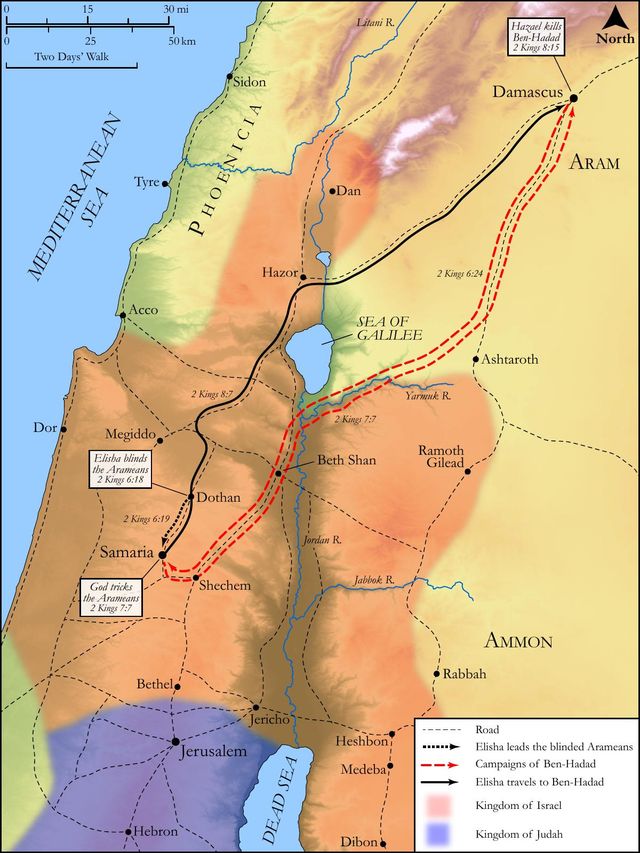
See on the biblical-era map
Study this verse
Public-domain commentary
Matthew Henry
From his Commentary on the Whole Bible. Henry comments on passages, not single verses — this entry covers 2 Kings 7:12–20. His three-level outline is real structure in the source text, so it is rendered as structure.
Here we have,
I.The king's jealousy of a stratagem in the Syrian's retreat, Kg2 7:12.
He feared that they had withdrawn into an ambush, to draw out the besieged, that they might fall on them with more advantage. he knew he had no reason to expect that God should appear thus wonderfully for him, having forfeited his favour by his unbelief and impatience. He knew no reason the Syrians had to fly, for it does not appear that he or any of this attendants heard the noise of the chariots which the Syrians were frightened at. Let not those who, like him, are unstable in all their ways, think to receive any thing from God; nay, a guilty conscience fears the worst and makes men suspicious.
II.The course they took for their satisfaction, and to prevent their falling into a snare.
They sent out spies to see what had become of the Syrians, and found they had all fled indeed, commanders as well a common soldiers. They could track them by the garments which they threw off, and left by the way, for their greater expedition, Kg2 7:15. He that gave this advice seems to have been very sensible of the deplorable condition the people were in (Kg2 7:13); for speaking of the horses, many of which were dead and the rest ready to perish for hunger, he says, and repeats it, "They are as all the multitude of Israel. Israel used to glory in their multitude, but now they are diminished and brought low." He advised to send five horsemen, but, it should seem, there were only two horses fit to be sent, and those chariot-horses, Kg2 7:14. Now the Lord repented himself concerning his servants, when he saw that their strength was gone, Deu 32:36.
III.The plenty that was in Samaria, from the plunder of the camp of the Syrians, Kg2 7:16.
Had the Syrians been governed by the modern policies of war, when they could not take their baggage and their tents with them they would rather have burnt them (as it is common to do with the forage of a country) than let them fall into their enemies' hands; but God determined that the besieging of Samaria, which was intended for its ruin, should turn to its advantage, and that Israel should now be enriched with the spoil of the Syrians as of old with that of the Egyptians. here see,
1.The wealth of the sinner laid up for the just (Job 27:16, Job 27:17) and the spoilers spoiled, Isa 33:1.
2.The wants of Israel supplied in a way that they little thought of, which should encourage us to depend upon the power and goodness of God in our greatest straits.
3.The word of Elisha fulfilled to a tittle: A measure of fine flour was sold for a shekel; those that spoiled the camp had not only enough to supply themselves with, but an overplus to sell at an easy rate for the benefit of others, and so even those that tarried at home did divide the spoil, Psa 68:12; Isa 33:23. God's promise may be safely relied on, for no word of his shall fall to the ground.
IV.The death of the unbelieving courtier, that questioned the truth of Elisha's word.
Divine threatenings will as surely be accomplished as divine promises. He that believeth not shall be damned stands as firm as He that believeth shall be saved. This lord,
1.Was preferred by the king to the charge of the gate (Kg2 7:17), to keep the peace, and to see that there was no tumult or disorder in dividing and disposing of the spoil. So much trust did the king repose in him, in his prudence and gravity, and so much did he delight to honour him. He that will be great, let him serve the public.
2.Was trodden to death by the people in the gate, either by accident, the crowd being exceedingly great, and he in the thickest of it, or perhaps designedly, because he abused his power, and was imperious in restraining the people from satisfying their hunger. However it was, God's justice was glorified, and the word of Elisha was fulfilled. He saw the plenty, for the silencing and shaming of his unbelief, corn cheap without opening windows in heaven, and therein saw his own folly in prescribing to God; but he did not eat of the plenty he saw. When he was about to fill his belly God cast the fury of his wrath upon him (Job 20:23) and it came between the cup and the lip. Justly are those thus tantalized with the world's promises that think themselves tantalized with the promises of God. If believing shall not be seeing, seeing shall not be enjoying. This matter is repeated, and the event very particularly compared with the prediction (Kg2 7:18-20), that we might take special notice of it, and might learn,
(1.)How deeply God resents out distrust of him, of his power, providence, and promise. When Israel said, Can God furnish a table? the Lord heard it and was wroth. Infinite wisdom will not be limited by our folly. God never promises the end without knowing where to provide the means.
(2.)How uncertain life and the enjoyments of it are. Honour and power cannot secure men from sudden and inglorious deaths. He whom the king leaned upon the people trod upon; he who fancied himself the stay and support of the government was trampled under foot as the mire in the streets. Thus hath the pride of men's glory been often stained.
(3.)How certain God's threatenings are, and how sure to alight on the guilty and obnoxious heads. Let all men fear before the great God, who treads upon princes as mortar and is terrible to the kings of the earth.
Continue studying 2 Kings 7:17 across the web’s major study libraries — every link below opens this exact verse, chapter, or book on the destination site.
Read & Compare
 BibleGatewayThis verse in more than 200 translations and 70 languages.
 Bible.comThe YouVersion reader — hundreds of translations, reading plans, and highlights.
 ESV.orgCrossway's official English Standard Version reader.
 NET BibleThe NET translation with 60,000+ translators' notes on every rendering decision.
 STEP BibleTyndale House's free study tool — original text, vocabulary, and scholarly resources.
 BibliaLogos Bible Software's free web reader.
 USCCBThe New American Bible (Revised Edition) with the U.S. bishops' study notes.
Commentaries
 BibleHub CommentariesDozens of classic commentaries on this verse, gathered on one page.
 StudyLightMore than 100 commentary sets — the largest collection on the web.
 BibleRefPlain-English commentary on what this verse means, verse by verse.
 Enduring WordDavid Guzik's free commentary on this chapter, widely used by Bible teachers.
 Bible Study ToolsVerse commentary alongside Greek and Hebrew study aids.
Original Language & Research
- BibleHub InterlinearThe verse word by word — original language, transliteration, and English.
- BibleHub LexiconEvery word's original-language definition and Strong's entry.
 Blue Letter BibleDeep-study tools — Strong's numbers, concordance, and word studies.
 SefariaThe Hebrew text with Rashi and centuries of Jewish commentary.
Sermons, Hymns & Audio


TrulyRandomVerse is not affiliated with these sites and doesn’t control their content. They’re linked because they’re genuinely useful.
Summary
This verse brings to a dramatic and tragic close the subplot of the skeptical royal officer within the larger narrative of God's miraculous deliverance of Samaria from a severe Aramean siege. It recounts the precise fulfillment of Elisha's prophecy concerning the officer's death, serving as a powerful, undeniable testament to the absolute certainty of God's spoken word and the grave consequences of defiant unbelief.
Context
ShowHideLiterary Context
The broader narrative of 2 Kings 6-7 sets the stage for this verse. Samaria is enduring a horrific, prolonged siege by the Aramean army, leading to extreme famine and even cannibalism within the city walls. In this desperate situation, the prophet Elisha boldly declares a seemingly impossible prophecy: within 24 hours, food would be so abundant and cheap at the city gates that it would be sold for a pittance (2 Kings 7:1). A high-ranking royal officer, described as the one "on whose hand he leaned," scoffed at this divine promise, questioning God's ability to act so supernaturally. Elisha immediately retorted with a counter-prophecy, stating that the officer would indeed see the abundance with his own eyes but would not partake of it (2 Kings 7:2). The miraculous lifting of the siege, orchestrated by God causing the Arameans to flee in panic, led to the immediate fulfillment of Elisha's first prophecy. As the people rushed out to plunder the deserted Aramean camp, the king, perhaps seeking to restore order or manage the sudden influx of provisions, appointed this very officer to oversee the city gate. It was in this chaotic rush that the officer met his prophesied end, trampled by the very people he was meant to manage, thus fulfilling Elisha's second prophecy to the letter. This verse, therefore, serves as the climactic resolution to the narrative thread initiated in 2 Kings 7:2, bringing divine judgment upon defiant unbelief.
Historical & Cultural Context
The city of Samaria, the capital of the northern kingdom of Israel, was a strategically important city, often targeted during conflicts. Sieges in that day were brutal affairs, designed to starve out the inhabitants and force surrender. The conditions described in 2 Kings 6:24-30—eating donkey's heads and dove's dung, and even cannibalism—illustrate the extreme suffering and desperation that would have gripped the city. The city gate was far more than a mere entrance; it was the nerve center of urban life. It served as a marketplace where goods were bought and sold, a court where legal disputes were settled and justice administered, and a place where public announcements were made and official business conducted. To be "in charge of the gate" was a position of significant authority, responsibility, and public visibility, often entrusted to trusted royal officials. This context amplifies the irony and divine justice in the officer's fate: his position of authority, intended to bring order, instead placed him directly in the path of the surging, desperate crowd, leading to his demise in the very place where the promised abundance was being distributed.
Key Themes
ShowHideThis verse powerfully reinforces several major themes woven throughout the book of 2 Kings and the broader biblical narrative. Foremost is The Certainty and Authority of God's Word. Elisha's prophecies, both of abundance and of judgment, are fulfilled with absolute precision, underscoring that God's word is not merely a prediction but a decree that will inevitably come to pass. This theme echoes the divine faithfulness seen in passages like Numbers 23:19 and Isaiah 55:11. Secondly, the verse highlights The Consequences of Unbelief and Defiance. The officer's tragic death serves as a stark warning against skepticism that borders on defiant rejection of God's revealed will and supernatural power. His refusal to believe God's ability to act supernaturally led directly to his exclusion from the blessing and his demise, a principle seen throughout scripture, such as in the wilderness wanderings of Israel (Numbers 14:26-35). Thirdly, it illustrates Divine Justice. God's justice is demonstrated as the officer's fate perfectly aligns with Elisha's prophecy: he saw the abundance but could not partake of it, a fitting consequence for his mocking disbelief. Finally, the narrative emphasizes God's Sovereignty over Human Affairs. Despite the chaos and human agency involved in the trampling, the ultimate outcome was precisely what God, through His prophet, had declared, demonstrating His control even over seemingly random events to accomplish His purposes.
Exposition and Analysis
ShowHideKey Word Analysis
ShowHideThe phrase "on whose hand he leaned" signifies a position of intimate trust, reliance, and high authority. The Hebrew verb שָׁעַן (sha'an, H8172) means "to lean upon, to support oneself, to rely on, to trust in." This indicates that the officer was not a commoner but a trusted confidant, a personal aide, or a high-ranking advisor to the king. His skepticism, therefore, was not born of ignorance but of a presumptuous, influential position, making his public demise an even more potent object lesson.
The verb רָמַס (ramas, H7429) means "to trample, to tread down, to crush." This word conveys the violent, chaotic, and utterly destructive nature of the officer's death. It was not a gentle pushing aside but a forceful, overwhelming trampling by the desperate, surging crowd. This detail emphasizes the raw power of the people's hunger and their frenzied rush for the promised provisions, which became the instrument of divine judgment.
This title, consistently applied to Elisha (and Elijah before him) throughout 2 Kings, designates him as a prophet uniquely chosen and empowered by God. It combines אִישׁ (ʼîysh, H376), meaning "man," and אֱלֹהִים (ʼĕlôhîym, H430), referring to "God." It signifies that his words are not his own but direct divine pronouncements. The text explicitly states that the officer died "as the man of God had said," reinforcing the absolute authority and reliability of Elisha's prophecy and, by extension, the God who spoke through him.
Verse Breakdown
ShowHide"And the king appointed the lord on whose hand he leaned to have the charge of the gate:"
Following the miraculous flight of the Arameans and the discovery of their abandoned camp, the king, likely seeking to manage the sudden influx of people and provisions, assigns this high-ranking, trusted officer to a crucial public role at the city gate. This appointment, seemingly a logical administrative decision, ironically places the officer directly in the path of his prophesied doom, setting the stage for the fulfillment of Elisha's word.
"and the people trode upon him in the gate, and he died,"
As the starving populace rushed out of the city to plunder the abundant provisions in the deserted Aramean camp, the officer, positioned at the gate to maintain order, was overwhelmed and trampled to death by the frenzied crowd. This chaotic and violent end directly fulfills Elisha's prophecy that he would see the abundance but not partake of it. The very instrument of the city's salvation (the rush for food) became the instrument of his judgment.
"as the man of God had said, who spake when the king came down to him."
This concluding phrase serves as the theological punchline of the verse. It explicitly connects the officer's death back to Elisha's precise prophecy in 2 Kings 7:2. The narrator leaves no doubt that this was not a random accident but the direct, undeniable fulfillment of God's word spoken through His prophet, demonstrating divine sovereignty and justice. The mention of the king coming down to Elisha refers to the initial encounter where the king, in despair, sought Elisha's counsel, only to be met with the prophecy and the officer's scoffing.
Literary Devices
ShowHide2 Kings 7:17 masterfully employs several literary devices to underscore its theological message. Irony is prominent, as the officer, a trusted royal advisor appointed to a position of authority at the gate, meets his end precisely at that gate, trampled by the very people whose hunger was about to be satisfied. He was meant to bring order but became a victim of chaos, seeing the abundance he doubted but never tasting it. This is a direct fulfillment of Elisha's ironic prophecy. Foreshadowing is evident in Elisha's initial declaration in 2 Kings 7:2, which sets up the expectation of the officer's specific fate long before its dramatic execution. The narrative also uses Divine Retribution, where the punishment directly fits the crime. The officer's sin was his defiant unbelief in God's ability to provide abundance; his judgment was to witness that abundance without partaking in it, dying by the very rush of the people seeking it. The narrative's concise, almost clinical recounting of his death ("and he died, as the man of God had said") adds to its stark, impactful nature, emphasizing the certainty of divine judgment.
Theological and Thematic Connections
ShowHideThe death of the skeptical officer in 2 Kings 7:17 serves as a stark and powerful demonstration of God's absolute sovereignty and the unwavering certainty of His word. It underscores that God is not bound by human limitations or skepticism; what He declares, He will accomplish, whether it be a promise of miraculous provision or a pronouncement of judgment. This event highlights the grave spiritual peril of unbelief, particularly when it borders on defiant mockery of divine truth. The officer's fate is a solemn reminder that while God is merciful and abundant in grace, He is also just, and there are consequences for those who harden their hearts against His revealed will and power. It teaches us to approach God's promises and warnings with humility and faith, recognizing that His ways are higher than our ways, and His word is utterly reliable.
Reflection and Application
ShowHideThe tragic end of the royal officer in 2 Kings 7:17 offers profound lessons for believers today, primarily emphasizing the critical importance of faith in God's promises, even when circumstances seem utterly impossible. In a world that often prioritizes human reason and tangible evidence, this narrative calls us to trust in a God who can "make windows in heaven" and provide beyond all human comprehension. It challenges us to examine our own hearts: do we truly believe that God's word is infallible, or do we, like the officer, harbor secret doubts when faced with seemingly insurmountable challenges? The officer's fate is a sobering reminder that defiant skepticism can lead to missing out on God's blessings and even facing severe consequences. Instead, we are called to cultivate a spirit of humble trust, recognizing that God's sovereignty extends over all events, working through them to fulfill His perfect will. Our response to God's word, whether in faith or unbelief, has eternal implications.
Questions for Reflection
ShowHideFAQ
ShowHideWas the officer's death a just punishment for his unbelief?
ShowHideFrom a biblical perspective, yes, his death is presented as a direct and just consequence of his defiant unbelief and mockery of God's prophetic word. When Elisha declared the miraculous provision, the officer's response was not merely doubt but a scornful dismissal of God's omnipotence ("If the LORD would make windows in heaven, might this thing be?"). Elisha's immediate counter-prophecy ("Behold, thou shalt see it with thine eyes, but shalt not eat thereof" 2 Kings 7:2) established the direct link between his unbelief and his exclusion from the blessing, culminating in his death. This serves as a powerful demonstration of divine justice, where the punishment fits the nature of the offense, highlighting the seriousness with which God regards faith in His word.
What does it mean that the king "leaned on his hand"?
ShowHideThe phrase "the lord on whose hand he leaned" indicates that this officer was a highly trusted and influential advisor or personal attendant to the king. In the courts of Syria and Israel, a king might literally lean on the arm of a close confidant or senior official for support, both physical and metaphorical. This position signified intimacy, reliance, and deep trust. It underscores that the officer's skepticism came from a place of authority and proximity to power, making his public downfall an even more significant object lesson regarding the consequences of defying God's word, regardless of one's earthly status.
Does this story imply that all doubt leads to death?
ShowHideNo, this story does not imply that all doubt automatically leads to physical death. The officer's case was extreme: his doubt was not a hesitant question but a mocking, defiant rejection of a direct prophetic word from God, spoken through His accredited prophet Elisha, in a moment of national crisis. His unbelief was a public act of defiance against the declared will and power of God. The Bible distinguishes between honest questioning or struggles with faith (which God often meets with patience and revelation) and a hardened, scornful unbelief that actively rejects divine truth. The officer's death was a specific, divinely ordained judgment to underscore the absolute certainty of God's word and the gravity of such defiant unbelief in the face of miraculous divine intervention.
Christ-Centered Fulfillment
ShowHideThe narrative of the skeptical officer in 2 Kings 7:17, while a story of judgment, ultimately points to the greater fulfillment found in Jesus Christ. The officer's tragic end underscores the absolute certainty of God's word and the dire consequences of rejecting it. In Christ, we see the ultimate embodiment of God's trustworthy word, for He is the Word made flesh (John 1:14). While the officer saw physical abundance but died in his unbelief, Jesus offers spiritual abundance and eternal life to those who believe in Him. He is the true bread from heaven (John 6:35) who provides sustenance that truly satisfies, unlike the temporary physical provisions of Samaria. The officer's judgment serves as a shadow of the ultimate judgment for those who reject Christ, who is the Way, the Truth, and the Life (John 14:6). Just as Elisha's word was perfectly fulfilled, so too are all of God's promises and warnings perfectly fulfilled in Christ's first coming (salvation for believers) and His second coming (judgment for unbelievers). The story calls us to put our complete trust in Jesus, the one who provides true life and whose words will never pass away (Matthew 24:35).