


2 Kings 6:32
Bible text: King James Version (1769 Blayney text) · Public domain
Bible text: King James Version with Strong's numbers · Public domain
Bible text: Berean Standard Bible · Public domain
Bible text: American Standard Version (1901) · Public domain
Bible text: World English Bible, Messianic edition · Public domain
Bible text: Geneva Bible (1599) · Public domain
Bible text: Young's Literal Translation · Public domain
- וֶאֱלִישָׁעve·'e·li·Sha'and ElishaH477Conj-w ¦ N-proper-mNoun Proper MasculineוֶandאֱלִישָׁעElisha
- יֹשֵׁבyo·Shev[was] sittingH3427V-Qal-Prtcpl-msVerb Qal Participle Singular Masculine Absolute
- בְּבֵיתוֹbe·vei·Toin his houseH1004Prep-b ¦ N-msc ¦ 3msNoun Singular Masculine Constructבְּinבֵיתhouseוֹhis
- וְהַזְּקֵנִיםve·ha·ze·ke·Nimand the eldersH2205Conj-w ¦ Art ¦ Adj-mpAdjective Plural Masculine Absoluteוְandהַtheזְּקֵנִיםelders
- יֹשְׁבִיםyo·she·Vim[were] sittingH3427V-Qal-Prtcpl-mpVerb Qal Participle Plural Masculine Absolute
- אִתּוֹ'i·Towith himH854Prep ¦ 3msPrepositionאִתּwithוֹhim
- וַיִּשְׁלַחvai·yish·Lachand he sentH7971Conj-w ¦ V-Qal-ConsecImperf-3msVerb Qal Consecutive Imperfect 3rd Singular Masculineוַandיִּשְׁלַחhe sent
- אִישׁ'isha manH376N-msNoun Singular Masculine Absolute
- מִלְּפָנָיוmi·le·fa·Navfrom to before himH6440Prep-m ¦ Prep-l ¦ N-mpc ¦ 3msNoun Plural Masculine Constructמִfromלְּtoפָנָיbeforeוhim
- בְּטֶרֶםbe·Te·rem<in> beforeH2962Prep-b ¦ Adj-csAdjective Numerical Singular common gender Absoluteבְּ<in>טֶרֶםbefore
- יָבֹאya·Vo'he cameH935V-Qal-Imperf-3msVerb Qal Imperfect 3rd Singular Masculine
- הַמַּלְאָךְha·mal·'Akhthe messengerH4397Art ¦ N-msNoun Singular Masculine Absoluteהַtheמַּלְאָךְmessenger
- אֵלָיו'e·Lavto himH413Prep ¦ 3msPrepositionאֵלָיtoוhim
- וְהוּאve·Hu'and heH1931Conj-w ¦ Pro-3msPronoun Personal 3rd Singular Masculineוְandהוּאhe
- אָמַר'a·Marhe saidH559V-Qal-Perf-3msVerb Qal Perfect 3rd Singular Masculine
- אֶל'eltoH413PrepPreposition
- הַזְּקֵנִיםha·ze·ke·Nimthe eldersH2205Art ¦ Adj-mpAdjective Plural Masculine Absoluteהַtheזְּקֵנִיםelders
- הַרְּאִיתֶםha·re·'i·Tem¿ do you seeH7200Interrog ¦ V-Qal-Perf-2mpVerb Qal Perfect 2nd Plural Masculineהַ¿רְּאִיתֶםdo you see
- כִּיkithatH3588PrtParticle Conditional
- שָׁלַחsha·Lachhe has sentH7971V-Qal-Perf-3msVerb Qal Perfect 3rd Singular Masculine
- בֶּןben[the] son ofH1121N-mscNoun Singular Masculine Construct
- הַמְרַצֵּחַham·ra·Tze·achthe murdererH7523Art ¦ V-Piel-Prtcpl-msVerb Piel Participle Singular Masculine Absoluteהַtheמְרַצֵּחַmurderer
- הַזֶּהha·Zeh<the> thisH2088Art ¦ PrtParticle Demonstrativeהַ<the>זֶּהthis
- לְהָסִירle·ha·Sirto removeH5493Prep-l ¦ V-Hiphil-InfVerb Hiphil Infinitive Constructלְtoהָסִירremove
- אֶת'et<obj.>H853DirObjMParticle Object Indicator
- רֹאשִׁיro·Shimy headH7218N-msc ¦ 1csNoun Singular Masculine Constructרֹאשִׁheadיmy
- רְאוּre·'UlookH7200V-Qal-Imp-2mpVerb Qal Imperative 2nd Plural Masculine
- כְּבֹאke·Vo'when comesH935Prep-k ¦ V-Qal-InfVerb Qal Infinitive Constructכְּwhenבֹאcomes
- הַמַּלְאָךְha·mal·'Akhthe messengerH4397Art ¦ N-msNoun Singular Masculine Absoluteהַtheמַּלְאָךְmessenger
- סִגְרוּsig·RushutH5462V-Qal-Imp-2mpVerb Qal Imperative 2nd Plural Masculine
- הַדֶּלֶתha·De·letthe doorH1817Art ¦ N-fsNoun Singular Feminine Absoluteהַtheדֶּלֶתdoor
- וּלְחַצְתֶּםu·le·chatz·Temand you will pushH3905Conj-w ¦ V-Qal-ConsecPerf-2mpVerb Qal Consecutive Perfect 2nd Plural Masculineוּandלְחַצְתֶּםyou will push
- אֹתוֹ'o·To<obj.> himH853DirObjM ¦ 3msParticle Object Indicatorאֹת<obj.>וֹhim
- בַּדֶּלֶתba·De·letwith the doorH1817Prep-b ¦ N-fsNoun Singular Feminine Absoluteבַּwith theדֶּלֶתdoor
- הֲלוֹאha·Lo'¿ notH3808Interrog ¦ NegParticle Negativeהֲ¿לוֹאnot
- קוֹלKol[is] [the] sound ofH6963N-mscNoun Singular Masculine Construct
- רַגְלֵיrag·Lei[the] feet ofH7272N-fdcNoun Dual Feminine Construct
- אֲדֹנָיו'a·do·Navhis master<s>H113N-mpc ¦ 3msNoun Plural Masculine Constructאֲדֹנָיmaster<s>וhis
- אַחֲרָיו'a·cha·Ravafter himH310Adj-mpc ¦ 3msAdjective Numerical Plural Masculine Constructאַחֲרָיafterוhim
English is a literal word-by-word gloss of the Hebrew, not the KJV's wording. Why?
This is the original text the KJV's translators worked from — each Hebrew word with its own literal English meaning in this verse, prepared by scholars at Tyndale House, Cambridge. The KJV translates whole sentences, not word by word, so its wording differs: one Hebrew word can become several English words, and the KJV may choose “the LORD” where the gloss reads “Yahweh”. Both are faithful — they answer different questions. For the KJV's own rendering, switch to the KJV text.
Details
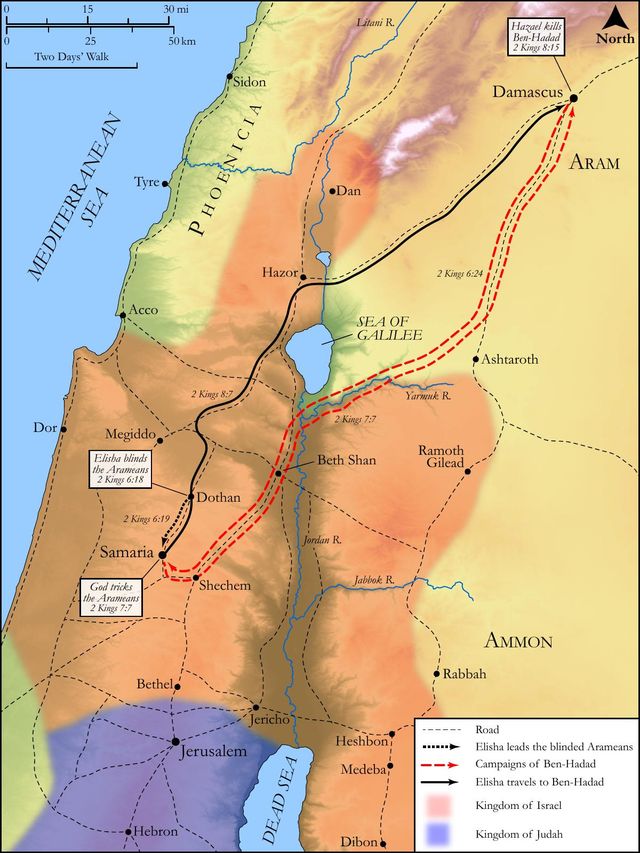
See on the biblical-era map
Study this verse
Public-domain commentary
Matthew Henry
From his Commentary on the Whole Bible. Henry comments on passages, not single verses — this entry covers 2 Kings 6:24–33.
This last paragraph of this chapter should, of right, have been the first of the next chapter, for it begins a new story, which is there continued and concluded. Here is,
I.The siege which the king of Syria laid to Samaria and the great distress which the city was reduced to thereby.
The Syrians had soon forgotten the kindnesses they had lately received in Samaria, and very ungratefully, for aught that appears without any provocation, sought the destruction of it, Kg2 6:24. There are base spirits that can never feel obliged. The country, we may suppose, was plundered and laid waste when this capital city was brought to the last extremity, Kg2 6:25. The dearth which had of late been in the land was probably the occasion of the emptiness of their stores, or the siege was so sudden that they had not time to lay in provisions; so that, while the sword devoured without, the famine within was more grievous (Lam 4:9): for, it should seem, the Syrians designed not to storm the city, but to starve it. So great was the scarcity that an ass's head, that has but little flesh on it and that unsavoury, unwholesome, and ceremonially unclean, was sold for five pounds, and a small quantity of fitches, or lentiles, or some such coarse corn, then called dove's dung, no more of it than the quantity of six eggs, for five pieces of silver, about twelve or fifteen shillings. Learn to value plenty, and to be thankful for it; see how contemptible money is, when, in time of famine, it is so freely parted with for anything that is eatable.
II.The sad complaint which a poor woman had to make to the king, in the extremity of the famine.
He was passing by upon the wall to give orders for the mounting of the guard, the posting of the archers, the repair of the breaches, and the like, when a woman of the city cried to him, Help, my lord, O king! Kg2 6:26. Whither should the subject, in distress, go for help but to the prince, who is, by office, the protector of right and the avenger of wrong? He returns but a melancholy answer (Kg2 6:27): If the Lord do not help thee, whence shall I? Some think it was a quarrelling word, and the language of his fretfulness: "Why dost thou expect anything from me, when God himself deals thus hardly with us?" Because he could not help her as he would, out of the floor or the wine-press, he would not help her at all. We must take heed of being made cross by afflictive providences. It rather seems to be a quieting word: "Let us be content, and make the best of our affliction, looking up to God, for, till he help us, I cannot help thee." 1. He laments the emptiness of the floor and the wine-press. These were not as they had been; even the king's failed. We read (Kg2 6:23) of great provisions which he had a command, sufficient for the entertainment of an army, yet now he has not wherewithal to relieve one poor woman. Scarcity sometimes follows upon great plenty; we cannot be sure that tomorrow shall be as this day, Isa 56:12; Psa 30:6. 2. He acknowledges himself thereby disabled to help, unless God would help them. Note, Creatures are helpless things without God, for every creature is that, all that, and only that, which he makes it to be. However, though he cannot help her, he is willing to hear her (Kg2 6:28): "What ails thee? Is there anything singular in thy case, or dost thou fare worse than thy neighbours?" Truly yes; she and one of her neighbours had made a barbarous agreement, that, all provisions failing, they should boil and eat her son first and then her neighbour's; hers was eaten (who can think of it without horror?) and now her neighbour hid hers, Kg2 6:28, Kg2 6:29. See an instance of the dominion which the flesh has got above the spirit, when the most natural affections of the mind may be thus overpowered by the natural appetites of the body. See the word of God fulfilled; among the threatenings of God's judgments upon Israel for their sins this was one (Deu 28:53-57), that they should eat the flesh of their own children, which one would think incredible, yet it came to pass.
III.The king's indignation against Elisha upon this occasion.
He lamented the calamity, rent his clothes, and had sackcloth upon his flesh (Kg2 6:30), as one heartily concerned for the misery of his people, and that it was not in his power to help them; but he did not lament his own iniquity, nor the iniquity of his people, which was the procuring cause of the calamity; he was not sensible that his ways and his doings had procured this to himself; this is his wickedness, for it is bitter. The foolishness of man perverteth his way, and then his heart fretteth against the Lord. Instead of vowing to pull down the calves at Dan and Beth-el, or letting the law have its course against the prophets of Baal and of the groves, he swears the death of Elisha, Kg2 6:31. Why, what is the matter? What had Elisha done? his head is the most innocent and valuable in all Israel, and yet that must be devoted, and made an anathema. Thus in the days of the persecuting emperors, when the empire groaned under any extraordinary calamity, the fault was laid on the Christians, and they were doomed to destruction. Christianos ad leones - Away with the Christians to the lions. Perhaps Jehoram was in this heat against Elisha because he had foretold this judgment, or had persuaded him to hold out, and not surrender, or rather because he did not, by his prayers, raise the siege, and relieve the city, which he though he could do but would not; whereas till they repented and reformed, and were ready for deliverance, they had no reason to expect that the prophet should pray for it.
IV.The foresight Elisha had of the king's design against him, Kg2 6:32.
He sat in his house well composed, and the elders with him, well employed no doubt, while the king was like a wild bull in a net, or like the troubled sea when it cannot rest; he told the elders there was an officer coming from the king to cut off his head, and bade them stop him at the door, and not let him in, for the king his master was just following him, to revoke the order, as we may suppose. The same spirit of prophecy that enabled Elisha to tell him what was done at a distance authorized him to call the king the son of a murderer, which, unless we could produce such an extraordinary commission, it is not for us to initiate; far be it from us to despise dominion and to speak evil of dignities. He appealed to the elders whether he had deserved so ill at the king's hands: "See whether in this he be not the son of a murderer?" For what evil had Elisha done? He had not desired the woeful day, Jer 17:16.
V.The king's passionate speech, when he came to prevent the execution of his edict for the beheading of Elisha.
He seems to have been in a struggle between his convictions and his corruptions, knew not what to say, but, seeing things brought to the last extremity, he even abandoned himself to despair (Kg2 6:33): This evil is of the Lord. Therein his notions were right and well applied; it is a general truth that all penal evil is of the Lord, as the first cause, and sovereign judge (Amo 3:6), and this we ought to apply to particular cases: if all evil, then this evil, whatever it is we are now groaning under, whoever are the instruments, God is the principal agent of it. But his inference from this truth was foolish and wicked: What should I wait for the Lord any longer? When Eli, and David, and Job, said, It is of the Lord, they grew patient upon it, but this bad man grew outrageous upon it: "I will neither fear worse nor expect better, for worse cannot come and better never will come: we are all undone, and there is no remedy." It is an unreasonable thing to be weary of waiting for God, for he is a God of judgment, and blessed are all those that wait for him.
Historical interpretation
Historical reception
2 surviving comments on this verse. Each one is dated, so this reads as a timeline rather than a list.
“Some time later King Ben-hadad of Aram mustered his entire army; he marched against Samaria and laid siege to it.” This is that Ben-hadad who had been condemned to death by God; and Ahab had received the order to execute him. But he spared his life and sent him back in peace. Therefore the Arameans besieged the city and prolonged the siege for many days, because their army occupied the whole surrounding area, so that bread began to be more and more scarce, and famine ruled. And when [the citizens] did not find the usual sustenance and food, they fell on the corpses of the dead. For the Scripture relates that there were certain mothers who decided to kill their children to assuage their hunger. And after one of them had put her son to death, when her companion in crime hid her own son (in order to save him) and broke the contract, an argument rose between them, and they both went before the judge. And they began to expound their reasons before the king, that is, Jehoram, the son of Ahab. The king, seeing that that was a harsh trial for him, was taken over by a violent rage against Elisha. For he thought [the prophet] was the cause of his disaster. Therefore he said, “Yesterday he gave abundant goods to Aramean robbers, and today has given sufficient bread to his disciples, and they are not lacking food, but he has no care for the people of his city and abandons them in their need.” And he swore that on that day itself he would take revenge on Elisha for the blood of his people. But Jehoram had no right to accuse the prophet, but rather Ahab, his father, who had scorned the prophets. In fact, if he had been persuaded by their words and had killed Ben-hadad, that [king] would have never besieged Samaria and would have never thrown him into such calamities.From the symbolic point of view the atrocious famine which tortured the Samaritans for so many days and forced them to eat in such an abominable manner shows the lack of heavenly nourishment, which affected in those days all the nations of the earth. So the city of Samaria signifies the whole of humankind, and its famine represents the famine of all. But Elisha made it disappear through his prayer, as well as through the grace of Christ. The sick were fortified by his strength, and “those who were full hired themselves out for bread.” This means that the apostles, announcers [of the gospel], have transmitted to the Gentiles the knowledge of salvation, and it has flowed, as Isaiah predicted, like “the waters covering the sea.” In the same manner it had been decreed before God that the hungry should eat the crop of the foolish and that the thirsty should absorb his goods, as the friend of the righteous Job said. Indeed, as the Samaritans plundered the food that they had collected for the Arameans and the needs of their army and brought it into their army, so the church of the Gentiles took the holy books which were preserved in the Hebrew synagogues, and gave them for the benefit of their descendants.
“Famine in Samaria became so great that a donkey’s head was sold for eighty shekels of silver.” The donkey’s head, which the Scripture reports here to be so expensive, signifies the teaching coming from the ravings of the philosophers and the scientists of the world. And it was an abominable and rotting food but was very precious when the famine reigned over the earth, and there was no one to break and give the bread to those children who asked for it, that is, until the advent of Christ.“And one-fourth of a kab of dove’s dung [was sold] for five shekels of silver.” Even though the symbol is contrary—in fact, it does not fit in with the Word—but because the righteous are likened to a dove, we say that the kab of dove’s dung represents the teaching of the law of Moses, if we compare it with the gospel of Christ. So it can be said that it was mud, a mud precious to the Jews at that time, with which they covered their eyes, which were to be opened soon by the spiritual bath and the gospel of Christ.
Continue studying 2 Kings 6:32 across the web’s major study libraries — every link below opens this exact verse, chapter, or book on the destination site.
Read & Compare
 BibleGatewayThis verse in more than 200 translations and 70 languages.
 Bible.comThe YouVersion reader — hundreds of translations, reading plans, and highlights.
 ESV.orgCrossway's official English Standard Version reader.
 NET BibleThe NET translation with 60,000+ translators' notes on every rendering decision.
 STEP BibleTyndale House's free study tool — original text, vocabulary, and scholarly resources.
 BibliaLogos Bible Software's free web reader.
 USCCBThe New American Bible (Revised Edition) with the U.S. bishops' study notes.
Commentaries
 BibleHub CommentariesDozens of classic commentaries on this verse, gathered on one page.
 StudyLightMore than 100 commentary sets — the largest collection on the web.
 BibleRefPlain-English commentary on what this verse means, verse by verse.
 Enduring WordDavid Guzik's free commentary on this chapter, widely used by Bible teachers.
 Bible Study ToolsVerse commentary alongside Greek and Hebrew study aids.
Original Language & Research
- BibleHub InterlinearThe verse word by word — original language, transliteration, and English.
- BibleHub LexiconEvery word's original-language definition and Strong's entry.
 Blue Letter BibleDeep-study tools — Strong's numbers, concordance, and word studies.
 SefariaThe Hebrew text with Rashi and centuries of Jewish commentary.
Sermons, Hymns & Audio


TrulyRandomVerse is not affiliated with these sites and doesn’t control their content. They’re linked because they’re genuinely useful.
Summary
Second Kings 6:32 presents a dramatic scene during the severe Syrian siege of Samaria, showcasing the prophet Elisha's extraordinary divine insight and the desperate, murderous rage of the King of Israel. As Elisha sits with the elders, he supernaturally perceives the king's secret intent to execute him and foresees the immediate arrival of the king's messenger, followed closely by the king himself. This moment underscores God's active involvement in protecting His servants and revealing hidden truths, even amidst intense national crisis and human depravity.
Context
ShowHideLiterary Context
This verse is situated at the climax of a deeply distressing narrative detailing the siege of Samaria by Ben-hadad, king of Syria. The preceding verses vividly portray the horrific famine within the city, where conditions became so dire that two women resorted to cannibalism, a desperate act that shocked the King of Israel (likely Jehoram, son of Ahab). Upon hearing of this abomination, the king, in a fit of despair and misplaced anger, tore his clothes and vowed to kill Elisha, whom he held responsible for the calamity. This immediate context of extreme suffering and the king's rash, violent reaction directly sets the stage for Elisha's prophetic awareness and response. The narrative then immediately shifts to the king's arrival and Elisha's subsequent prophecy of deliverance in 2 Kings 6:33.
Historical & Cultural Context
The period of the Divided Monarchy was marked by constant political instability, idolatry in Israel, and frequent conflicts with neighboring nations, particularly Aram (Syria). Sieges were common but devastating, leading to extreme privation and, as seen here, even cannibalism, a horror prophesied as a consequence of covenant disobedience in Deuteronomy 28:53-57. Kings of that day held absolute power, and rash decrees were not uncommon, especially under duress. The king's immediate blame of Elisha reflects a common human tendency to scapegoat prophets who deliver unwelcome truths or whose God does not immediately intervene as desired. Elisha, as a prophet of Yahweh, often challenged royal authority and idolatry, making him a potential target for a king who, though perhaps acknowledging Yahweh, still largely operated outside of true covenant faithfulness.
Key Themes
ShowHideThis passage powerfully illustrates several key themes prevalent throughout the book of Kings and the prophetic literature. Firstly, it highlights Divine Revelation and Prophetic Insight, demonstrating God's supernatural knowledge and His ability to disclose hidden intentions and events to His chosen servants, as seen in Amos 3:7. Secondly, the passage underscores God's Protection of His Servants, even when they face mortal threats from powerful human authorities. Elisha is not caught unawares but is divinely forewarned, enabling him to take precautionary measures. Thirdly, it exposes the Rashness and Desperation of Ungodly Leadership. The King of Israel's decision to kill Elisha is born out of extreme pressure and a failure to seek divine counsel, illustrating the dangers of leadership driven by fear and anger rather than faith and wisdom, a recurring motif in the history of Israel's kings, such as King Saul's similar attempts against David in 1 Samuel 19:9-10.
Exposition and Analysis
ShowHideKey Word Analysis
ShowHideElisha's scathing indictment of the king as "this son of a murderer" is deeply significant. The Hebrew term râtsach specifically denotes a killer, often one who commits premeditated murder, rather than accidental homicide. By calling the king "son of a murderer," Elisha is not merely insulting him but prophetically linking Jehoram's present murderous intent to the infamous legacy of his father, King Ahab, who orchestrated the unjust murder of Naboth to seize his vineyard (1 Kings 21:1-19). This accusation highlights a generational pattern of unrighteousness and violence within the Omride dynasty, emphasizing that the king's current action is consistent with his family's character.
The phrase "to take away mine head" is a stark and unambiguous idiom for execution by decapitation. The word rôʼsh literally means "head" and is used here in its most direct and brutal sense. This emphasizes the severity of the king's command and the mortal danger Elisha faced. It is a blunt declaration of the king's lethal intent, leaving no room for misinterpretation of his decree.
In the phrase "is not the sound of his master's feet behind him?", the word qôwl refers to a voice or sound. Here, it signifies the audible approach of the king. Elisha's prophetic insight is so precise that he not only knows the messenger is coming with murderous intent but also perceives that the king himself, the "master" of the messenger, is closely following to ensure the execution is carried out or to confront Elisha directly. This detail elevates Elisha's knowledge beyond mere intuition to a profound, divinely-granted awareness of immediate future events, including subtle sensory details.
Verse Breakdown
ShowHide"But Elisha sat in his house, and the elders sat with him;"
This sets the scene, depicting Elisha in a posture of teaching or counsel, surrounded by the elders of Israel. This gathering suggests a context of spiritual authority and community, perhaps a prophetic school or a place where people sought Elisha's wisdom during the crisis. It contrasts Elisha's calm, divinely-informed state with the king's agitated despair.
"and [the king] sent a man from before him:"
This brief clause confirms the king's decisive action. Having heard the women's plea and made his vow, the king immediately dispatches an executioner. The phrase "from before him" implies a direct order and dispatch from the king's presence, underscoring the immediacy and royal authority behind the command.
"but ere the messenger came to him, he said to the elders, See ye how this son of a murderer hath sent to take away mine head?"
This is the pivotal moment revealing Elisha's supernatural insight. Before the messenger even reaches the door, Elisha, by divine revelation, knows the king's secret, murderous intent. His reference to the king as "this son of a murderer" is a prophetic denunciation, linking the king's present evil design to the notorious actions of his father, Ahab. It's a statement of profound spiritual discernment and moral judgment.
"look, when the messenger cometh, shut the door, and hold him fast at the door:"
Elisha's instructions to the elders demonstrate his calm and strategic response to the impending threat. He is not surprised or afraid. His command to "shut the door, and hold him fast" implies a temporary restraint, preventing the messenger from entering and carrying out his deadly mission, thereby gaining crucial time.
"[is] not the sound of his master's feet behind him?"
This rhetorical question reveals the astonishing depth of Elisha's prophetic vision. He knows that the king himself is following closely behind the messenger, likely to ensure the deed is done or to confront Elisha personally. This detail confirms that Elisha's knowledge is not merely of the messenger's arrival but of the king's immediate presence and involvement, underscoring God's comprehensive revelation to His prophet.
Literary Devices
ShowHideThe narrative in 2 Kings 6:32 is rich with literary devices that heighten its dramatic impact and theological significance. Foreshadowing is evident in Elisha's pre-knowledge of the messenger's arrival and, more strikingly, the king's imminent follow-up, building suspense for the confrontation that immediately ensues. There is profound Irony in the king, a "son of a murderer" (referencing Ahab), attempting to murder a righteous prophet, thereby perpetuating his family's dark legacy. The scene is charged with Dramatic Tension, created by the contrast between the king's desperate rage and Elisha's serene, divinely-informed composure, as well as the race against time before the messenger arrives. The core of the passage relies on Divine Omniscience and Prophetic Insight, where Elisha's supernatural knowledge serves as a powerful demonstration of God's active presence and control, even in moments of extreme human chaos and evil intent. This prophetic foresight is not merely a plot device but a theological statement about God's intimate knowledge of human hearts and His sovereign protection over His chosen instruments.
Theological and Thematic Connections
ShowHideThis pivotal moment in Elisha's ministry powerfully illustrates God's sovereign oversight and His intimate knowledge of human hearts and intentions. Even in the chaos of siege and famine, and the king's desperate, murderous rage, God is not absent or unaware. He grants Elisha supernatural insight, not only into the king's secret decree but also into the immediate sequence of events, including the king's personal pursuit. This demonstrates that God's protection of His faithful servants is not passive but active and pre-emptive, ensuring His purposes are fulfilled despite human opposition. It reinforces the truth that no human scheme, however powerful or secretive, can thwart the divine will or catch God off guard.
Reflection and Application
ShowHideThe narrative of 2 Kings 6:32 offers profound lessons for contemporary believers navigating a complex world. In moments of crisis, whether personal or societal, it is natural to feel overwhelmed, fearful, or even to lash out in anger, much like the King of Israel. However, Elisha's calm and divinely-informed response provides a powerful counter-example. It reminds us that even when circumstances seem dire and human solutions fail, God remains sovereign, aware of every hidden intention and every impending threat. We are called to cultivate a deep trust in His omniscience and His protective care, knowing that He sees beyond what is immediately apparent. This passage encourages us to seek God's wisdom and guidance diligently, especially when under pressure, rather than succumbing to rash decisions or misplaced blame. It underscores the importance of spiritual discernment, allowing God to reveal truths and provide direction that transcends human understanding, enabling us to respond with faith and strategic wisdom rather than panic.
Questions for Reflection
ShowHideFAQ
ShowHideWho was "this son of a murderer" that Elisha referred to?
ShowHideElisha was referring to the current King of Israel, Jehoram (sometimes spelled Joram), who was the son of King Ahab. Elisha's epithet "son of a murderer" was a direct and scathing indictment, linking Jehoram's present murderous intent against Elisha to the infamous legacy of his father, Ahab, who notoriously orchestrated the murder of Naboth to seize his vineyard (1 Kings 21:19). This was not merely an insult but a prophetic declaration highlighting the continuity of unrighteousness within the Omride dynasty.
Why did the king want to kill Elisha?
ShowHideThe king's desire to kill Elisha stemmed from extreme desperation and misplaced blame during the severe Syrian siege of Samaria. The famine within the city had become so horrific that people resorted to cannibalism, as revealed in the verses immediately preceding 2 Kings 6:32. Overwhelmed by the suffering and perhaps feeling helpless, the king, in a fit of rage and despair, tore his clothes and vowed to execute Elisha, whom he held responsible for the calamity, likely viewing the prophet as either the cause of the disaster or as failing to deliver the city from it. This reaction reflects a common human tendency to blame God's messenger when His judgments or delays are not understood or welcomed.
Christ-Centered Fulfillment
ShowHideThe dramatic confrontation in 2 Kings 6:32, where Elisha supernaturally discerns the king's murderous intent and imminent arrival, powerfully foreshadows the ultimate Prophet, Jesus Christ. Like Elisha, Jesus possessed perfect divine knowledge, not only of human thoughts and intentions (Matthew 9:4) but also of future events, including His own impending suffering and death at the hands of those in authority (Matthew 16:21). While Elisha was divinely protected from the king's murderous plot, Jesus, the true Lamb of God, willingly submitted to the murderous intentions of religious and political leaders, allowing Himself to be "taken away" for the sins of the world (John 1:29). His omniscience was not used for self-preservation but for the fulfillment of God's redemptive plan. The "son of a murderer" in 2 Kings 6:32 reminds us of humanity's fallen nature and its propensity for violence against God's messengers, a pattern that culminated in the crucifixion of the Son of God. Yet, through Christ's willing sacrifice, God's ultimate protective and redemptive purpose was achieved, offering salvation where human kings offered only death.