


Amos 3:7
Bible text: King James Version (1769 Blayney text) · Public domain
Bible text: Berean Standard Bible · Public domain
Bible text: American Standard Version (1901) · Public domain
Bible text: World English Bible, Messianic edition · Public domain
Bible text: Geneva Bible (1599) · Public domain
Bible text: Young's Literal Translation · Public domain
- כִּיkiforH3588PrtParticle Conditional
- לֹאlo'notH3808NegParticle Negative
- יַעֲשֶׂהya·'a·Sehhe doesH6213V-Qal-Imperf-3msVerb Qal Imperfect 3rd Singular Masculine
- אֲדֹנָי'a·do·Nai[the] LordH136N-properNoun Proper Title
- יְהוִהYah·wehYahwehH3069N-properNoun Proper Title
- דָּבָרda·VaranythingH1697N-msNoun Singular Masculine Absolute
- כִּיkithatH3588PrtParticle Conditional
- אִם'imexceptH518PrtParticle Conditional
- גָּלָהga·Lahhe has revealedH1540V-Qal-Perf-3msVerb Qal Perfect 3rd Singular Masculine
- סוֹדוֹso·Dohis secret counselH5475N-msc ¦ 3msNoun Singular Masculine Constructסוֹדsecret counselוֹhis
- אֶל'eltoH413PrepPreposition
- עֲבָדָיו'a·va·Davhis servantsH5650N-mpc ¦ 3msNoun Plural Masculine Constructעֲבָדָיservantsוhis
- הַנְּבִיאִיםha·ne·vi·'Imthe prophetsH5030Art ¦ N-mpNoun Plural Masculine Absoluteהַtheנְּבִיאִיםprophets
English is a literal word-by-word gloss of the Hebrew, not the KJV's wording. Why?
This is the original text the KJV's translators worked from — each Hebrew word with its own literal English meaning in this verse, prepared by scholars at Tyndale House, Cambridge. The KJV translates whole sentences, not word by word, so its wording differs: one Hebrew word can become several English words, and the KJV may choose “the LORD” where the gloss reads “Yahweh”. Both are faithful — they answer different questions. For the KJV's own rendering, switch to the KJV text.
Details
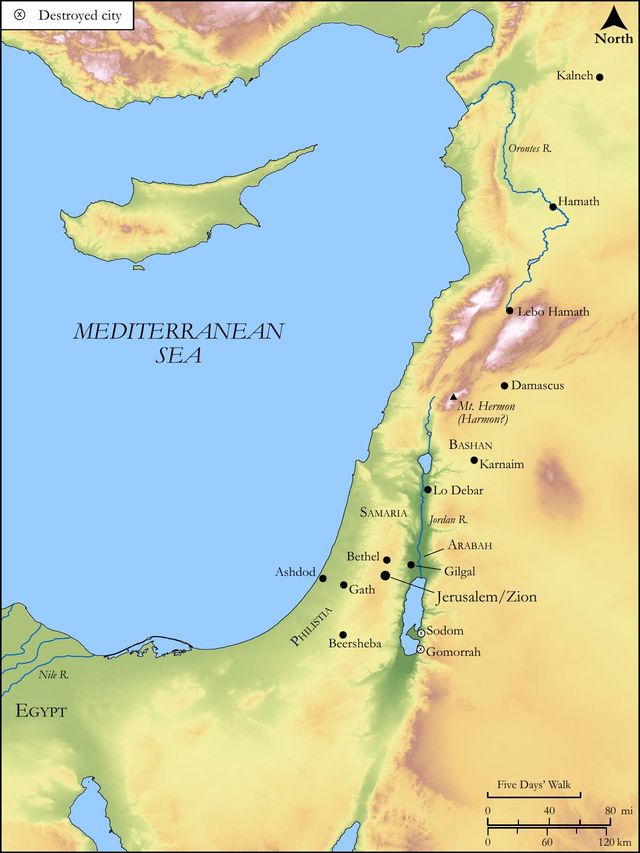
See on the biblical-era map
Study this verse
Public-domain commentary
Matthew Henry
From his Commentary on the Whole Bible. Henry comments on passages, not single verses — this entry covers Amos 3:1–8. His two-level outline is real structure in the source text, so it is rendered as structure.
The scope of these verses is to convince the people of Israel that God had a controversy with them. That which the prophet has to say to them is to let them know that the Lord has something to say against them, Amo 3:1. They were his peculiar people above others, knew his name, and were called by it; nevertheless he had something against them, and they were called to hear what it was, that they might consider what answer they should make, as the prisoner at the bar is told to hearken to his indictment. The children of Israel would not regard the words of counsel and comfort that God had many a time spoken to them, and now they shall be made to hear the word of reproof and threatening that the Lord has spoken against them; for he will act as he has spoken.
I.Let them know that the gracious cognizance God has taken of them, and the favours he has bestowed upon them, should not exempt them from the punishment due to them for their sins. Israel is a family that God brought up out of the land of Egypt, (Amo 3:1), and it was no more than a family when it went down thither; thence God delivered it; thence he fetched it to be a family to himself. It is not only the ten tribes, the kingdom of Israel, that must take notice of this, but that of Judah also, for it is spoken against the whole family that God brought up out of Egypt. It is a family that God has bestowed distinguishing favours upon, has owned in a peculiar manner. You only have I known of all the families of the earth. Note, God's church in the world is a family dignified above all the families of the earth. Those that know God are known of him. In Judah is God known, and therefore Judah is more than any people known of God. God has known them, that is, he has chosen them, covenanted with them, and conversed with them as his acquaintance. Now, one would think, it should follow, "Therefore I will spare you, will connive at your faults, and excuse you." No: Therefore I will punish you for all your iniquities. Note, The distinguishing favours of God to us, if they do not serve to restrain us from sin, shall not serve to exempt us from punishment; nay, the nearer any are to God in profession, and the kinder notice he has taken of them, the more surely, the more quickly, and the more severely will he reckon with them, if they by a course of wilful sin profane their character, disgrace their relation to him, violate their engagements, and put a slight upon the favours and honours with which they have been distinguished. Therefore they shall be punished, because their sins dishonour him, affront him, and grieve him, more than the sins of others, and because it is necessary that God should vindicate his own honour by making it appear that he hates sin and hates it most in those that are nearest to him; if they be but as bad as others, they shall be punished worse than others, because it is justly expected that they should be so much better than others. Judgment begins at the house of God, begins at the sanctuary; for God will be sanctified either by or upon those that come nigh unto him, Lev 10:3.
II.Let them know that they could not expect any comfortable communion with God unless they first made their peace with him (Amo 3:3):
Can two walk together except they be agreed? No; how should they? Where there is not friendship there can be no fellowship; if two persons be at variance, they must first accommodate the matters in difference between them before there can be any interchanging of good offices. Israel has affronted God, had broken their covenant with him, and ill-requited his favours to them; and yet they expected that he should continue to walk with them, should take their part, act for them, and give them assurances of his presence with them, though they took no care by repentance and reformation to agree with their adversary and to turn away his wrath. "But how can that be?" says God. "While you continue to walk contrary to God you can look for no other than that he should walk contrary to you," Lev 26:23, Lev 26:24. Note, We cannot expect that God should be present with us, or act for us, unless we be reconciled to him. God and man cannot walk together except they be agreed. Unless we agree with God in our end, which is his glory, we cannot walk with him by the way.
III.Let them know that the warnings God gave them of judgments approaching were not causeless and groundless, merely to amuse them, but certain declarations of the wrath of God against them, which (if they did not speedily repent) they would infallibly feel the effects of (Amo 3:4): "Will a lion roar in the forest when he has no prey in view? No: he roars upon his prey. Nor will a young lion cry out of his den if the old lion have taken nothing to bring home to him; nor would God thus give you warning both by the threatenings of his word, and by less judgments, if you had not by your sins made yourselves a prey to his wrath, nor if he were not really about to fall upon you with desolating destroying judgments." Note, The threatenings of the word and providence of God are not bugbears, to frighten children and fools, but are certain inferences from the sin of man and certain presages of the judgments of God.
IV.Let them know that, as their own wickedness was the procuring cause of these judgments, so they shall not be removed till they have done their work, Amo 3:5. When God has come forth to contend with a sinful people it is necessary that they should understand,
1.That it is their own sin that has entangled them; for can a bird fall in a snare upon the earth where no gin is for him? No, nature does not lay snares for the creatures, but the art of men; a bird is not taken in a snare by chance, but with the fowler's design; so the providence of God prepares trouble for sinners, and it is in the work of their own hands that they are snared. Affliction does not spring out of the dust, but it is God's justice, and our own wickedness, that correct us.
2.It is nothing but their own repentance that can disentangle them; for shall one take up a snare from the earth, which he laid with design, except he have taken something as he designed? So neither will God remove the affliction he has sent till it have done its work and accomplished that for which he sent it. If our hearts be duly humbled, and we are brought by our afflictions to confess and forsake our sins, then the snare has taken something, then the point is gained, the end is answered, and then, and not till then, the snare is broken, is taken up from the earth, and we are delivered in love and mercy.
V.Let them know that all their troubles came from the hand of God's providence and from the counsel of his will (Amo 3:6):
Shall there be evil in a city, in a family, in a nation, and the Lord has not done it, appointed it, and performed what he appointed? The evil of sin is from ourselves; it is our own doing. But the evil of trouble, personal or public, is from God, and is his doing; whoever are the instruments, God is the principal agent. Out of his mouth both evil and good proceed. This consideration, that, whatever evil is in the city, the Lord has done it, should engage us patiently to bear our share in public calamities and to study to answer God's intention in them.
VI.Let them know that their prophets, who give them warning of judgments approaching, deliver nothing to them but what they have received from the Lord to be delivered to his people.
1.God makes it known beforehand to the prophets (Amo 3:7): Surely the Lord Jehovah will do nothing, none of that evil in the city spoken of (Amo 3:6), but he reveals it to his servants the prophets, though to others it is a secret. Therefore those know not what they do who make light of the warnings which the prophets give them, in God's name. Observe, God's prophets are his servants, whom he employs to go on his errands to the children of men. The secret of God is with them; it is in some sense with all the righteous (Pro 3:32), with all that fear God (Psa 25:14), but in a peculiar manner with the prophets, to whom the Spirit of prophecy is a Spirit of revelation. It would have put honour enough upon prophets if it had been only said that sometimes God is pleased to reveal to his prophets what he designs to do, but it speaks something very great to say that he does nothing but what he reveals to them, as if they were the men of his counsel. Shall I hide from Abraham, who is a prophet, the thing which I do? Gen 18:17. God will therefore be sure to reckon with those that put contempt on the prophets, whom he puts this honour upon.
2.The prophets cannot but make that known to the people which God has made known to them (Amo 3:8): The Lord God has spoken; who can but prophesy? His prophets, to whom he has spoken in secret by dreams and visions, cannot but speak in public to the people what they have heard from God. They are so full of those things themselves, so well assured concerning them, and so much affected with them, that they cannot but speak of them; for out of the abundance of the heart the mouth will speak. I believed; therefore have I spoken, Act 4:20. Nay, and besides the prophetic impulse which went along with the inspiration, and made the word like a fire in their bones (Jer 20:9), they received a command from God to deliver what they had been charged with; and they would have been false to their trust if they had not done it. Necessity was laid upon them, as upon the preachers of the gospel, Co1 9:16.
VII.Let them know that they ought to tremble before God upon the fair warning he had given them, as they would,
1.Upon the sounding of a trumpet, to give notice of the approach of the enemy, that all may stand upon their guard and stand to their arms: Shall a trumpet be blown in the city, and the people be not afraid, or run together? so some read it, Amo 3:6. Will they not immediately come together in a fright, to consider what is best to be done for the common safety? Yet when God by his prophets gives them notice of their danger, and summons them to come and enlist themselves under his banner, it makes no impression; they will sooner give credit to a watchman on their walls than to a prophet sent of God, will sooner obey the summons of the governor of their city than the orders given them by the Governor of the world. God says, Hearken to the voice of the trumpet; but they will not hearken, nay, and they tell him plainly that they will not, Jer 6:17.
2.Upon the roaring of a lion. God is sometimes as a lion, and a young lion, to the house of Judah, Hos 5:14. The lion roars before he tears; thus God warns before he wounds. If therefore the lion roars upon a poor traveller (as he did against Samson, Jdg 14:5), he cannot but be put into great consternation; yet the Lord roars out of Zion (Amo 1:2), and none are afraid, but they go on securely as if they were in no danger. Note, The fair warning given to a careless world, if it be not taken, will aggravate its condemnation another day. The lion roared, and they were not moved with fear to prepare an ark. O the amazing stupidity of an unbelieving world, that will not be wrought upon, no, not by the terrors of the Lord!
Historical interpretation
Nine Centuries of Reception
2 surviving comments on this verse. Each one is dated, so this reads as a timeline rather than a list.
Select a marker to jump to its quote. Markers stagger vertically where authors wrote within a few decades of each other.
(Verse 3 onwards) Will two walk together unless they have agreed? Does a lion roar in the forest unless it has prey? Does a lion's cub give a cry from its den without capturing something? Does a bird fall into a trap on the ground without a trapper? Does a trap spring up from the ground before catching something? If a trumpet is blown in a city, will not the people be afraid? If there is calamity in a city, has not the Lord caused it? For the Lord God does nothing without revealing his secret to his servants the prophets. The lion roars, who will not fear? The Lord God has spoken, who will not prophesy? Amos: If two shall walk together, except they know each other? If the lion shall roar in his den, having no prey? If the lion's cub gives forth its voice from its lair, unless it has taken something? If a bird falls to the ground without a fowler? If a snare is laid upon the ground, unless it has caught something? If the trumpet sounds in the city, and the people do not fear? If there is wickedness in the city that the Lord did not make, because the Lord God will not do anything unless He reveals His teaching to His servant prophets. Will a lion roar, and who will not fear? The Lord God has spoken, and who will not prophesy? I read in the commentaries of someone who desired to convince of a difficult matter, about eight crimes, wickednesses, and sins: first, Damascus; second, Gaza, and the other cities of Palestine; third, Tyre; fourth, Edom; fifth, the sons of Ammon; sixth, Moab; seventh, Judah, that is, the two tribes; eighth, which is the last, Israel, that is, the ten tribes, with the same number of judgments, now given, and the first answering the first, that is, Damascus, the second answering the second, that is, Gaza, and the rest answering the rest. The one who wrote it knows whether it is true or not. However, another person thinks that the six examples given, of two people walking together on a road, and a lion roaring while leaping, and a lion cub making its voice when it catches something, and a bird caught by a bird catcher, and a snare set in the ground for catching prey, and a trumpet sounding in the city, and with these examples, a similar argument is given, that just as the previous things have a cause and do not happen unless those things have preceded them: likewise, no evil occurs in the city that has not been done by the Lord's command. There are those who consider the first example to contain doctrine, because two cannot walk together unless they have agreed to do so beforehand. He who made both one, and destroyed the middle wall of partition, and created of the two one new man (Ephesians 2): and made peace between them, and joined them together with the bond of charity, so that when they are together, the two may ask the Father and obtain whatever they have requested. These are the two sticks that are joined together in Ezekiel (Ezek. VII), and the two peoples, the circumcision and the Gentiles, about whom the Lord speaks to Elijah: I have left for myself seven thousand men who have not bowed the knee before Baal (3 Kings XIX, 18). And in another place, God says: I was found by those who did not seek me; I appeared to those who did not ask for me (Isaiah LXV, 1). But when the two are brought together, they will cling to the Lord, and they will become one spirit: for he who clings to the Lord is one spirit (1 Cor. VI, 17). Therefore, these two who agree with each other and walk together in the way of Christ, cannot fear the attack of any adversaries. But if they are separated by discord, immediately the roaring lion will invade them, about which Peter the Apostle said: Your adversary the devil prowls around like a roaring lion, seeking someone to devour (I Pet. 5:8). This roaring lion does not roam in cultivated fields, nor among vineyards, nor in olive groves, nor among fruit-bearing trees which praise God; but where there are forests and uncultivated ground, and where wild beasts dwell. And not only will they be exposed to the bites of the lion, but the lion cub will capture them and lead them to its den, fleeing from the light and going towards darkness. For everyone who sins loves darkness and hates the light (John 3), as we read in the psalm: You have set darkness, and it has become night: in it all the beasts of the forest will roam. The lion cubs roaring, to snatch and seek food from God (Psalm 104). For the lion cub seeks not the prey which it possesses and is under its power; but that it may snatch from the Church of Christ, of which it is written in Habakkuk: Its choice food (Hab. 1:16). The third punishment is for those whom discord has separated, that they lose their wings, on which they were previously carried aloft, and fall from heaven to earth, and are caught by the birdcatcher, who is better called the fowler, because he catches birds that are entangled in birdlime, which have descended willingly to earthly things. About which it is written in Proverbs: 'The nets are not unjustly spread for the birds' (Prov. I, 17, and XXIX, 5). For it is a just punishment for sinners, who, having the wings of doves, ought to fly through the air, that they are weighed down by the burden of sins and are brought down to earth, sticking to their vices. Concerning this, we read in the Apostle: 'He who joins himself to a harlot becomes one body with her' (I Cor. VI, 16). The fourth punishment is for those who are in discord, so that they are caught in a snare not set in heaven, but on earth. Regarding this, the holy one rejoices and says: 'Our soul has been delivered as a sparrow from the snare of the hunters; the snare has been broken, and we have been set free' (Ps. CXXIII, 7). This is the broken snare, of which the Apostle speaks to believers: God will crush Satan beneath your feet quickly (Rom. XVI, 20). And again in David we read: They have set a stumbling block on my path (Ps. CXXXVI, 6). For they cannot deceive the simple ones of the believers unless they propose the name of Christ, so that while we think we find Christ, we may go on to the Antichrist. The fifth punishment is for those who have forsaken the peace, which surpasses all understanding (Philipp. IV), and which the Lord, going to the Father, left to the Apostles, saying: My peace I give to you, my peace I leave with you (John XIV, 27), so that as citizens of the Lord, they are terrified by the sound of the trumpet. For whatever is said in the Holy Scriptures, it is like a threatening trumpet, penetrating the ears of believers with a loud voice. If we are righteous, we are provoked to blessedness through the trumpet of Christ; if we are sinners, we hear what torments we will suffer. However, the evil that the Lord does in a city is not contrary to virtue, but it is affliction and torment, as we read: Each day has enough trouble of its own (Matthew 6:34), that is, tribulation and distress. And in the Prophet, we read: I am God who made light and darkness, who brings peace and creates evil (Isaiah XLV, 6, 7). Just as darkness is contrary to light and day, so war is contrary to peace, which in itself is not evil, but seems evil to those who suffer it. And so we know, from the holy Scriptures, that sometimes wickedness is not opposed to virtue, but is rather affliction, punishment, and distress. Let us take one more example from Jonah: And God saw their works, that they turned from their evil ways, and he repented of the evil which he had said that he would do unto them (Jonah III, 10). Surely there is the evil overthrow of the Ninevites, which God had threatened through the prophet, and it is not contrary to virtue, which pertains to sin, for which He threatened torment to sinners. It follows: The Lord God will not do a word unless He has revealed His secret, or His correction, to His servant prophets: not that God reveals to the prophets all that He does in heaven, or has already done before; but what He is about to do on earth. Noah revealed to his servant that he would bring a flood. Abraham and Lot revealed to their servants that Sodom and Gomorrah, Admah and Zeboiim would be destroyed. Joseph revealed the interpretation of a dream of seven years of famine in Egypt. And Jonah revealed the destruction of Nineveh, so that those who heard of the coming punishments would either repent and avoid torment, or those who ignored them would be justly punished. And now the Lord reveals through his servant and prophet Amos what he will do to the ten tribes, that if they are converted to better things and forsake their idols, they may be delivered from the impending danger. And note that the merciful and gracious God always foretells the future so that he is not compelled to inflict punishments. And as for the heretics who slander the Creator as if he were severe and harsh, cruel and only a judge, because there is no evil in the state that he does not do, we refer this to the greatness of his mercy, that he does not inflict punishments unless he has foretold them beforehand. But whoever predicts does not want to punish the sinners. The lion, he says, will roar, and who will not be afraid? The Lord God has spoken, who will not prophesy? Who in this place is not accepted as being for the rare, but not for the impossible. For he who disregards the Lord due to his own stubbornness will not be afraid and will not prophesy. And the meaning is according to the story: if everything trembles at the voice of the lion, and all the nature of animals is frightened, shall we, by God's command to speak and announce to the people the coming punishments, not prophesy? Shall we not speak? I know that someone has written in his Commentaries about a roaring lion to be understood as the devil, and roaring towards those who are about to perish: but God, who speaks through the Prophets, should be referred to the Lord Savior, just as those who hear the roaring of the lion in a bad way and are captured unto death, so the holy ones should hear the Lord commanding in a good way and be saved.
The Lord reveals to the prophets all things that are necessary for the instruction of the faithful; yet not all to every one, but some to one, and some to another.
And although God revealed in general to the prophets what He was one day to do regarding the salvation of the human race, still the apostles knew some particulars of the same, which the prophets did not know. Thus we read (Ephesians 3:4-5): "As you reading, may understand my knowledge in the mystery of Christ, which in other generations was not known to the sons of men, as it is now revealed to His holy apostles." Among the prophets also, the later ones knew what the former did not know; according to Psalm 118:100: "I have had understanding above ancients," and Gregory says: "The knowledge of Divine things increased as time went on" (Hom. xvi in Ezech.).
Continue studying Amos 3:7 across the web’s major study libraries — every link below opens this exact verse, chapter, or book on the destination site.
Read & Compare
 BibleGatewayThis verse in more than 200 translations and 70 languages.
 Bible.comThe YouVersion reader — hundreds of translations, reading plans, and highlights.
 ESV.orgCrossway's official English Standard Version reader.
 NET BibleThe NET translation with 60,000+ translators' notes on every rendering decision.
 STEP BibleTyndale House's free study tool — original text, vocabulary, and scholarly resources.
 BibliaLogos Bible Software's free web reader.
 USCCBThe New American Bible (Revised Edition) with the U.S. bishops' study notes.
Commentaries
 BibleHub CommentariesDozens of classic commentaries on this verse, gathered on one page.
 StudyLightMore than 100 commentary sets — the largest collection on the web.
 BibleRefPlain-English commentary on what this verse means, verse by verse.
 Enduring WordDavid Guzik's free commentary on this chapter, widely used by Bible teachers.
 Bible Study ToolsVerse commentary alongside Greek and Hebrew study aids.
Original Language & Research
- BibleHub InterlinearThe verse word by word — original language, transliteration, and English.
- BibleHub LexiconEvery word's original-language definition and Strong's entry.
 Blue Letter BibleDeep-study tools — Strong's numbers, concordance, and word studies.
 SefariaThe Hebrew text with Rashi and centuries of Jewish commentary.
Sermons, Hymns & Audio


TrulyRandomVerse is not affiliated with these sites and doesn’t control their content. They’re linked because they’re genuinely useful.
Summary
Amos 3:7 declares a foundational principle of God's interaction with humanity: the Lord GOD, in His sovereign power, does not execute His significant plans or judgments without first revealing His intentions to His chosen messengers, the prophets. This verse underscores God's deliberate and communicative nature, highlighting His intimate relationship with those He commissions to speak on His behalf, ensuring that His actions are never arbitrary but are preceded by divine disclosure and warning.
Context
ShowHideLiterary Context
Amos 3:7 is nestled within a powerful rhetorical section (Amos 3:3-8) where the prophet Amos establishes the divine origin and inevitability of his message of judgment against Israel. He employs a series of cause-and-effect rhetorical questions: "Can two walk together, except they be agreed?" (Amos 3:3); "Will a lion roar in the forest, when he hath no prey?" (Amos 3:4); "Shall a trumpet be blown in the city, and the people not be afraid?" (Amos 3:6). These questions lead to the inescapable conclusion in Amos 3:8 that "The lion hath roared, who will not fear? the Lord GOD hath spoken, who can but prophesy?" (Amos 3:8). Verse 7 serves as the theological linchpin, explaining why Amos is prophesying: because God has revealed His "secret" to him and other prophets, thereby legitimizing their pronouncements as divine decrees rather than human opinions.
Historical & Cultural Context
Amos prophesied to the Northern Kingdom of Israel during a period of relative peace and prosperity under King Jeroboam II (circa 760-750 BC). Despite external stability, internal corruption was rampant, characterized by injustice, oppression of the poor, moral decay, and widespread idolatry, particularly the worship of Baal and the golden calves at Bethel and Dan. Amos, a shepherd and fig-picker from Judah, was sent by God to confront this spiritual and moral decline, warning of imminent judgment, specifically the Assyrian invasion and exile. In a culture where prophets often served as royal advisors or cultic functionaries, Amos stood apart as a direct messenger of Yahweh, challenging the prevailing religious and political complacency. His message was often met with resistance, as seen in his confrontation with Amaziah, the priest of Bethel, who accused Amos of conspiracy (Amos 7:10-13).
Key Themes
ShowHideThis verse powerfully contributes to several key themes in the book of Amos and broader biblical theology. Firstly, it emphasizes Divine Sovereignty, portraying God as the ultimate initiator and orchestrator of all events, including judgment. Nothing happens outside of His knowledge or permission. Secondly, it highlights Prophetic Revelation, affirming the unique role of prophets as God's chosen conduits for communicating His will and plans to humanity. They are not merely foretellers but "servants" who stand in God's counsel. Thirdly, it underscores God's Justice and Faithfulness; He does not bring judgment without ample warning, providing an opportunity for repentance, even if Israel ultimately fails to heed it. This theme is echoed throughout the prophetic literature, such as in Isaiah 1:18-20 and Jeremiah 7.
Exposition and Analysis
ShowHideKey Word Analysis
ShowHideThis compound title emphasizes God's absolute sovereignty and covenant faithfulness. ʼĂdônây (H136) signifies "Master" or "Lord," denoting His supreme authority and ownership. Yᵉhôvih (H3069) is a special vocalization of the divine name YHWH (Yahweh), used specifically when ʼĂdônây precedes it, to avoid repeating the same sound (as Jews would pronounce YHWH as ʼĂdônây). This combination powerfully conveys that the sovereign Master, the covenant-keeping God of Israel, is the one acting and revealing.
From the primitive root gâlâh (H1540), meaning "to uncover," "to denude," or "to disclose." In this context, it signifies the act of making known what was previously hidden or secret. It implies a deliberate unveiling, a removal of a veil or covering, to expose truth or intent. The active participle form used here ("he revealing") emphasizes the continuous and characteristic nature of God's disclosure.
From çôwd (H5475), this word carries a rich meaning beyond mere hidden information. It refers to a "council," "intimacy," or "confidential deliberation." It suggests a shared plan or decision made within a trusted circle. When God reveals His çôwd, He is not just giving information; He is inviting His prophets into His divine counsel, sharing His intimate thoughts and purposes, treating them as trusted confidants rather than mere servants.
Verse Breakdown
ShowHide"Surely the Lord GOD will do nothing,"
This opening clause asserts God's absolute control and intentionality. It implies that no significant event, especially concerning His people or the world, occurs without His prior knowledge, decree, and active involvement. It sets the stage for the subsequent revelation, emphasizing that God's actions are purposeful and deliberate, not random or impulsive.
"but he revealeth his secret"
This is the crucial conjunction, presenting the necessary condition for God's action. Before He "does" anything of consequence, particularly judgment or a major plan, He first "reveals" it. The term "secret" (çôwd) here refers to His intimate counsel, His divine plans, and His hidden purposes. This revelation is not merely information but an an invitation into His divine deliberation.
"unto his servants the prophets."
This specifies the recipients of God's revelation. The "servants" (ʻebed, H5650) are those who are devoted to His will, and specifically, "the prophets" (nâbîyʼ, H5030) are His chosen spokespersons. This highlights their unique and privileged position as God's confidants and messengers, entrusted with communicating His divine will and warnings to humanity.
Literary Devices
ShowHideAmos 3:7 is a powerful statement that functions as a Theological Principle within the broader rhetorical argument of Amos 3. It serves as the logical conclusion and justification for the preceding Rhetorical Questions (Amos 3:3-6), establishing the divine source of Amos's prophecy. The verse itself employs Divine Sovereignty as its central theme, asserting God's absolute control over events and His deliberate method of operation. The use of "secret" (Hebrew: çôwd) is a subtle form of Metonymy, where the "secret" (the content of the counsel) stands for the "counsel" or "intimate deliberation" itself. This choice of word elevates the revelation from mere information to a sharing of divine intimacy, portraying the prophets as privileged participants in God's inner circle. The verse also functions as a Proleptic Declaration, anticipating and validating the pronouncements of judgment that Amos is about to deliver, grounding them firmly in the revealed will of God.
Theological and Thematic Connections
ShowHideAmos 3:7 articulates a profound theological truth about God's character: His deliberate, communicative, and just nature. He is not a capricious deity who acts without warning, but a sovereign Lord who, out of His faithfulness and desire for humanity to respond, reveals His intentions before executing His plans, especially those involving judgment or significant shifts in history. This principle underscores the importance of divine revelation and the unique role of prophets as God's chosen conduits. It demonstrates God's commitment to relationship, inviting His chosen servants into His "counsel" and entrusting them with His "secrets." This divine pattern of revelation serves as a testament to God's desire for humanity to understand His ways and respond accordingly, even when the message is one of impending judgment.
Reflection and Application
ShowHideAmos 3:7 offers profound insights into the character of God and our relationship with Him. It reminds us that God is actively involved in the affairs of the world, and He operates with purpose and intentionality. His actions are not random, but part of a grand divine plan. The fact that He reveals His "secret" to His servants, the prophets, speaks to His desire for humanity to be informed, to understand His will, and to respond. For us today, while the specific office of Old Testament prophet has changed, the principle of God revealing His will remains. God primarily reveals His "secrets"—His plans, His character, His truth, and His will for our lives—through His inspired Word, the Bible, and through the indwelling Holy Spirit. This verse calls us to cultivate a deep, intimate relationship with God, characterized by diligent study of Scripture and attentive listening to the Spirit's leading. It encourages us to seek His counsel, to understand His heart, and to align our lives with His revealed purposes, so that we too might be His "servants" who understand and participate in His divine agenda.
Questions for Reflection
ShowHideFAQ
ShowHideDoes Amos 3:7 mean God tells us everything before it happens?
ShowHideNot necessarily "everything" in the sense of every minute detail of future events, but rather His significant plans, especially those involving His covenant people or major historical shifts. The "secret" (Hebrew: çôwd) refers more to His intimate counsel, His divine purposes, and His overarching will, particularly concerning judgment or salvation. God reveals enough of His plans to His chosen messengers (the prophets in the Old Testament, and through His Word and Spirit today) to ensure that His actions are understood as deliberate and just, not arbitrary. The purpose is often to provide warning, call to repentance, or prepare His people for what He is about to do, as seen in God's revelation to Noah about the flood or Jesus' predictions of His own suffering and resurrection.
Christ-Centered Fulfillment
ShowHideAmos 3:7 finds its ultimate and most profound fulfillment in Jesus Christ. While Old Testament prophets were God's "servants" to whom He revealed His "secret" plans, Jesus is not merely a servant but the very Son of God, the full and final revelation of God Himself. As the Word made flesh, Jesus embodies the divine çôwd, making known the Father's heart and eternal purposes in a way no prophet ever could. John's Gospel declares, "No man hath seen God at any time; the only begotten Son, which is in the bosom of the Father, he hath declared him" (John 1:18). Jesus Himself stated, "All things that I have heard of my Father I have made known unto you" (John 15:15), elevating His disciples from servants to friends, sharing the intimate counsel of God. Through Christ, God's ultimate "secret"—the mystery of His redemptive plan for humanity—has been fully unveiled. The New Testament reveals that this "mystery... has been made manifest to His saints" (Colossians 1:26) through Christ, in whom "are hid all the treasures of wisdom and knowledge" (Colossians 2:3). Thus, Christ is both the revealer and the revealed "secret" of God, through whom all of God's purposes, including judgment and salvation, are perfectly accomplished.