


2 Kings 7:1
Bible text: King James Version (1769 Blayney text) · Public domain
Bible text: King James Version with Strong's numbers · Public domain
Bible text: Berean Standard Bible · Public domain
Bible text: American Standard Version (1901) · Public domain
Bible text: World English Bible, Messianic edition · Public domain
Bible text: Geneva Bible (1599) · Public domain
Bible text: Young's Literal Translation · Public domain
- וַיֹּאמֶרvai·Yo·merand he saidH559Conj-w ¦ V-Qal-ConsecImperf-3msVerb Qal Consecutive Imperfect 3rd Singular Masculineוַandיֹּאמֶרhe said
- אֱלִישָׁע'e·li·Sha'ElishaH477N-proper-mNoun Proper Masculine
- שִׁמְעוּshim·'UhearH8085V-Qal-Imp-2mpVerb Qal Imperative 2nd Plural Masculine
- דְּבַרde·var[the] word ofH1697N-mscNoun Singular Masculine Construct
- יְהוָהYah·wehYahwehH3068N-properNoun Proper Title
- כֹּהkohthusH3541AdvAdverb
- אָמַר'a·Marhe saysH559V-Qal-Perf-3msVerb Qal Perfect 3rd Singular Masculine
- יְהוָהYah·wehYahwehH3068N-properNoun Proper Title
- כָּעֵתka·'Etabout <the> this timeH6256Prep-k ¦ N-csNoun Singular common gender Absoluteכָּabout <the>עֵתthis time
- מָחָרma·ChartomorrowH4279N-msNoun Singular Masculine Absolute
- סְאָהse·'aha seah ofH5429N-fsNoun Singular Feminine Absolute
- סֹלֶתSo·letfine flourH5560N-fsNoun Singular Feminine Absolute
- בְּשֶׁקֶלbe·She·kelfor a shekelH8255Prep-b ¦ N-msNoun Singular Masculine Absoluteבְּforשֶׁקֶלa shekel
- וְסָאתַיִםve·sa·Ta·yimand two seahsH5429Conj-w ¦ N-fdNoun Dual Feminine Absoluteוְandסָאתַיִםtwo seahs
- שְׂעֹרִיםse·'o·Rimbarley<s>H8184N-mpNoun Plural Masculine Absolute
- בְּשֶׁקֶלbe·She·kelfor a shekelH8255Prep-b ¦ N-msNoun Singular Masculine Absoluteבְּforשֶׁקֶלa shekel
- בְּשַׁעַרbe·Sha·'arat [the] gate ofH8179Prep-b ¦ N-mscNoun Singular Masculine Constructבְּatשַׁעַר[the] gate of
- שֹׁמְרוֹןsho·me·RonSamariaH8111N-properNoun Proper Location
English is a literal word-by-word gloss of the Hebrew, not the KJV's wording. Why?
This is the original text the KJV's translators worked from — each Hebrew word with its own literal English meaning in this verse, prepared by scholars at Tyndale House, Cambridge. The KJV translates whole sentences, not word by word, so its wording differs: one Hebrew word can become several English words, and the KJV may choose “the LORD” where the gloss reads “Yahweh”. Both are faithful — they answer different questions. For the KJV's own rendering, switch to the KJV text.
Details
See on the biblical-era map
Study this verse
Public-domain commentary
Matthew Henry
From his Commentary on the Whole Bible. Henry comments on passages, not single verses — this entry covers 2 Kings 7:1–2.
Here, I. Elisha foretels that, notwithstanding the great straits to which the city of Samaria is reduced, yet within twenty-four hours they shall have plenty, Kg2 7:1. The king of Israel despaired of it and grew weary of waiting: then Elisha foretold it, when things were at the worst. Man's extremity is God's opportunity of magnifying his own power; his time to appear for his people is when their strength is gone, Deu 32:36. When they had given over expecting help it came. When the son of man comes shall he find faith on the earth? Luk 18:8. The king said, What shall I wait for the Lord any longer? And perhaps some of the elders were ready to say the same: "Well," said Elisha, "you hear what these say; now hear you the word of the Lord, hear what he says, hear it and heed it and believe it: tomorrow corn shall be sold at the usual rate in the gate of Samaria;" that is, the siege shall be raised, for the gate of the city shall be opened, and the market shall be held there as formerly. The return of peace is thus expressed (Jdg 5:11), Then shall the people of the Lord go down to the gates, to buy and sell there. 2. The consequence of that shall be great plenty. This would, in time, follow of course, but that corn should be thus cheap in so short a time was quite beyond what could be thought of. Though the king of Israel had just now threatened Elisha's life, God promises to save his life and the life of his people; for where sin abounded grace doth much more abound.
II.A peer of Israel that happened to be present openly declared his disbelief of this prediction, Kg2 7:2.
He was a courtier whom the king had an affection for, as the man of his right hand, on whom he leaned, that is, on whose prudence he much relied, and in whom he reposed much confidence. He thought it impossible, unless God should rain corn out of the clouds, as once he did manna; no less than the repetition of Moses's miracle will serve him, though that of Elijah might have served to answer this intention, the increasing of the meal in the barrel.
III.The just doom passed upon him for his infidelity, that he should see this great plenty for this conviction, and yet not eat of it to his comfort. Note, Unbelief is a sin by which men greatly dishonour and displease God, and deprive themselves of the favours he designed for them. The murmuring Israelites saw Canaan, but could not enter in because of unbelief. Such (says bishop Patrick) will be the portion of those that believe not the promise of eternal life; they shall see it at a distance - Abraham afar off, but shall never taste of it; for they forfeit the benefit of the promise if they cannot find in their heart to take God's word.
Historical interpretation
Fifteen Centuries of Reception
2 surviving comments on this verse. Each one is dated, so this reads as a timeline rather than a list.
Select a marker to jump to its quote. Markers stagger vertically where authors wrote within a few decades of each other.
You will also find similar things in the times of Elisha, when the son of Jader, king of Syria, came up against Samaria and besieged it. “And there was a great famine in Samaria for so long,” Scripture says, “that a donkey’s head became worth fifty shekels of silver and a quarter of pigeon dung five pieces of silver.” But suddenly an amazing change occurs through the word of the prophet, who says, “Hear the word of the Lord. Thus says the Lord: ‘Tomorrow, at this hour a measure of the finest wheat flour shall be one shekel and two measure of barley shall be one shekel, in the gates of Samaria.’ ”Notice, therefore, what is inferred from all these texts: when famine prevails over a land, not only does it not prevail over the just, but rather through them, a remedy is brought to the threatened destruction.
A stater: It is the same as a sicle or shekel.
Continue studying 2 Kings 7:1 across the web’s major study libraries — every link below opens this exact verse, chapter, or book on the destination site.
Read & Compare
 BibleGatewayThis verse in more than 200 translations and 70 languages.
 Bible.comThe YouVersion reader — hundreds of translations, reading plans, and highlights.
 ESV.orgCrossway's official English Standard Version reader.
 NET BibleThe NET translation with 60,000+ translators' notes on every rendering decision.
 STEP BibleTyndale House's free study tool — original text, vocabulary, and scholarly resources.
 BibliaLogos Bible Software's free web reader.
 USCCBThe New American Bible (Revised Edition) with the U.S. bishops' study notes.
Commentaries
 BibleHub CommentariesDozens of classic commentaries on this verse, gathered on one page.
 StudyLightMore than 100 commentary sets — the largest collection on the web.
 BibleRefPlain-English commentary on what this verse means, verse by verse.
 Enduring WordDavid Guzik's free commentary on this chapter, widely used by Bible teachers.
 Bible Study ToolsVerse commentary alongside Greek and Hebrew study aids.
Original Language & Research
- BibleHub InterlinearThe verse word by word — original language, transliteration, and English.
- BibleHub LexiconEvery word's original-language definition and Strong's entry.
 Blue Letter BibleDeep-study tools — Strong's numbers, concordance, and word studies.
 SefariaThe Hebrew text with Rashi and centuries of Jewish commentary.
Sermons, Hymns & Audio


TrulyRandomVerse is not affiliated with these sites and doesn’t control their content. They’re linked because they’re genuinely useful.
Summary
2 Kings 7:1 records the prophet Elisha's astonishing declaration of divine intervention, promising an immediate and dramatic reversal of fortunes for the besieged city of Samaria. In the midst of an agonizing famine, where desperation had driven its inhabitants to unthinkable acts of cannibalism, Elisha boldly proclaims that within twenty-four hours, food would become so abundant and cheap that a measure of fine flour and two measures of barley would each sell for a mere shekel at the city gate, signaling the miraculous end of the crippling siege and starvation.
Context
ShowHideLiterary Context
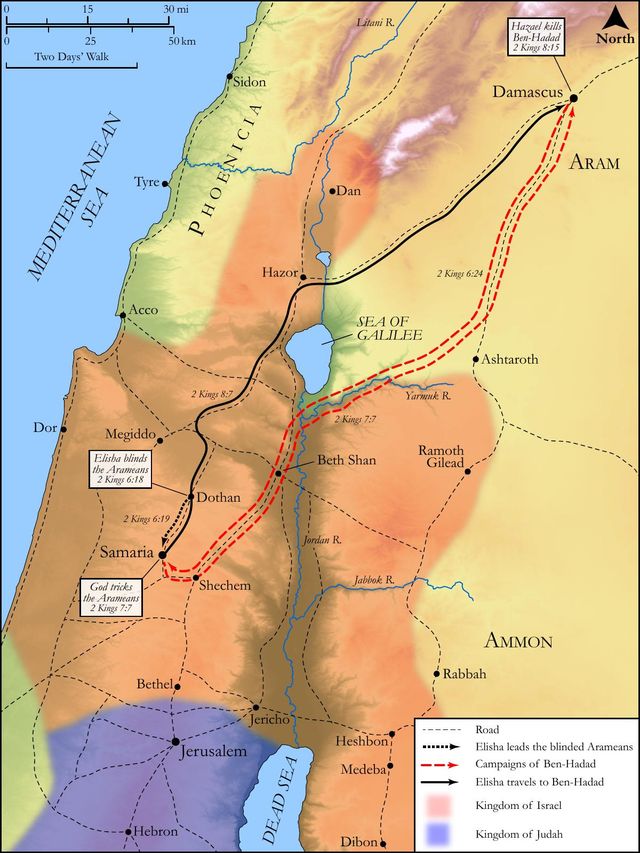
This verse serves as the pivotal turning point in a narrative steeped in extreme suffering and human failure. Immediately preceding this declaration, the city of Samaria, the capital of Israel, is under a brutal and prolonged siege by the Aramean army led by King Ben-hadad, a situation detailed in 2 Kings 6:24-33. The famine within the city had reached catastrophic levels, leading to unspeakable horrors, including a mother resorting to cannibalism to survive, a vivid and shocking account in 2 Kings 6:28-29. King Jehoram, in his despair and rage, blamed Elisha for the nation's plight and vowed to execute him, as seen in 2 Kings 6:31-33. It is precisely in this atmosphere of utter hopelessness, human depravity, and royal despair that Elisha, unprovoked and undeterred, steps forward with a direct, authoritative word from the LORD, shifting the narrative from human failure to divine omnipotence and miraculous intervention.
Historical & Cultural Context
The practice of siege warfare was common in that day, and prolonged sieges inevitably led to famine as supplies dwindled, making survival precarious. Samaria, a well-fortified city, was designed to withstand such attacks, but its resilience was being tested to its limits by the Aramean forces. The exorbitant prices mentioned in the preceding chapter—a donkey's head for eighty shekels of silver and a quarter of a cab of dove's dung for five shekels (2 Kings 6:25)—underscore the severity of the famine, indicating that even inedible or undesirable items were astronomically expensive. The "gate of Samaria" was not merely an entrance but a central hub for commerce, legal proceedings, and public announcements. Prophetic declarations, especially those concerning national fate, were often made publicly in such prominent locations to ensure wide dissemination and to serve as a verifiable witness to the divine word. The cultural expectation was that only God could reverse such a desperate situation, highlighting the truly miraculous nature of Elisha's prophecy.
Key Themes
ShowHideThis verse powerfully introduces and reinforces several major themes that resonate throughout the book of Kings and the broader biblical narrative. Firstly, it highlights Divine Sovereignty and Omnipotence, demonstrating God's absolute control over circumstances, even the most dire human situations, and His ability to bring about instantaneous and complete turnarounds. Secondly, it underscores Prophetic Authority and the Power of God's Word, as Elisha speaks not his own words but prefaced with the emphatic "Hear ye the word of the LORD; Thus saith the LORD," validating his role as a true messenger and emphasizing that God's word is efficacious and will not return void, a concept powerfully echoed in Isaiah 55:11. Thirdly, the prophecy illustrates God's Miraculous Provision and Abundance After Scarcity, promising a dramatic shift from exorbitant prices due to famine to incredibly low prices due to overwhelming abundance, symbolizing God's capacity to provide supernaturally when all natural means have failed. Finally, it offers a profound message of Hope in Despair, challenging the prevailing skepticism and hopelessness of the city's inhabitants, as exemplified by the king's officer's reaction in 2 Kings 7:2, and calling for faith in God's power despite seemingly impossible circumstances.
Exposition and Analysis
ShowHideKey Word Analysis
ShowHideContracted from a name meaning "God is salvation," Elisha is the famous prophet and successor to Elijah. His very name encapsulates the message of this verse, as he is the instrument through whom God's salvation and provision are declared and manifested for Samaria, demonstrating that deliverance comes from the LORD.
This is the Jewish national name of God, signifying "the self-Existent or Eternal." The repeated use of "the LORD" in Elisha's proclamation ("Hear ye the word of the LORD; Thus saith the LORD") emphasizes that the prophecy is not from human wisdom or power, but a direct, authoritative, and certain declaration from the sovereign, covenant-keeping God of Israel, Yahweh, who alone possesses the power to fulfill such an impossible promise.
This word, meaning "the morrow" or "hereafter," specifies a remarkably precise and immediate timeframe for the prophecy's fulfillment. This immediacy intensifies the dramatic tension and highlights the miraculous nature of God's intervention, promising a complete reversal of fortunes within a mere twenty-four hours, making the divine power undeniably evident.
Verse Breakdown
ShowHide"Then Elisha said, Hear ye the word of the LORD; Thus saith the LORD"
This opening establishes Elisha as the authoritative prophet, delivering a direct, undeniable oracle from Yahweh. The double declaration ("word of the LORD," "Thus saith the LORD") emphasizes the divine origin, absolute authority, and certainty of the message, positioning Elisha as God's faithful mouthpiece in a moment of national crisis.
"To morrow about this time"
This phrase injects a sense of immediate, tangible hope and a precise timeframe. The prophecy is not vague or distant but promises an astonishing reversal of fortunes within a mere twenty-four hours, allowing for immediate verification of God's power and faithfulness and intensifying the dramatic impact.
"[shall] a measure of fine flour [be sold] for a shekel, and two measures of barley for a shekel"
This is the heart of the prophecy, detailing the specific, miraculous economic turnaround. Fine flour was a more desirable and expensive grain, while barley was a staple for the common people. The promise of both in abundance at such incredibly low prices signifies a complete collapse of the famine-driven market and an overflowing supply of food for all, rich and poor, indicating not just relief but overflowing provision.
"in the gate of Samaria"
This detail specifies the public location where this miraculous market reversal would occur. The city gate was the commercial hub, the place of justice, and public assembly. Its mention ensures that the fulfillment would be public, undeniable, and accessible to everyone, leaving no room for doubt about the divine intervention and God's faithfulness.
Literary Devices
ShowHideThe passage employs several potent literary devices to underscore its dramatic impact and theological significance. Dramatic Irony is evident as the reader is made privy to God's miraculous plan through Elisha's prophecy, while the characters within the narrative (especially the king and his officer) remain in their state of despair and disbelief, setting up the tension for the prophecy's fulfillment. Contrast is perhaps the most striking device, sharply juxtaposing the extreme famine and exorbitant prices of 2 Kings 6:25 with the promised abundance and incredibly low prices in 2 Kings 7:1. This sharp contrast magnifies the miraculous nature of God's intervention. The use of a Prophetic Oracle with its formulaic "Hear ye the word of the LORD; Thus saith the LORD" lends immense authority and gravitas to Elisha's words, establishing them as a non-negotiable divine decree rather than a mere prediction. Furthermore, the specificity of time ("To morrow about this time") and place ("in the gate of Samaria") adds to the Verisimilitude and testability of the prophecy, challenging both the characters and the reader to observe God's faithfulness.
Theological and Thematic Connections
ShowHide2 Kings 7:1 stands as a powerful testament to God's absolute sovereignty and His capacity to intervene decisively in human affairs, even when circumstances appear utterly hopeless. It underscores the truth that God is not limited by human limitations, economic realities, or military might. His word, once spoken through His chosen prophet, carries inherent power to bring about its own fulfillment, demonstrating His faithfulness to His covenant people, even when they are in a state of despair due to their own sin or external pressures. This passage teaches that God's provision is not merely sufficient but often abundant, turning scarcity into overflowing supply, and that His timing is precise, often delivering salvation at the eleventh hour to magnify His glory. It challenges believers to trust in God's promises even when they defy human logic or experience, reminding us that His ways are higher than our ways.
Reflection and Application
ShowHideThe narrative of 2 Kings 7:1 offers profound encouragement for believers facing seemingly insurmountable challenges today. Just as Samaria was trapped in a physical famine, we often encounter "famines" in our lives—periods of financial hardship, emotional depletion, spiritual dryness, or relational brokenness. In such moments of despair, when all human solutions have failed and hope seems lost, this verse reminds us that God's word is the ultimate source of hope and the guarantee of supernatural provision. It calls us to shift our gaze from the overwhelming circumstances to the unwavering character and omnipotent power of God, who can turn our deepest scarcity into overflowing abundance, often in ways we least expect and within timelines that defy logic. Our role is to "hear the word of the LORD" and to cling to His promises with unwavering faith, even when a "shekel for a measure" seems utterly impossible. This passage challenges us to cultivate a posture of expectant faith, believing that God's power is not diminished by our impossibility, but rather magnified through it.
Questions for Reflection
ShowHideFAQ
ShowHideWhat was the immediate reaction to Elisha's prophecy?
ShowHideThe immediate reaction, as recorded in 2 Kings 7:2, was one of profound skepticism, particularly from a high-ranking officer accompanying the king. This officer scoffed, declaring that such a thing could not happen "though the LORD should make windows in heaven." Elisha immediately pronounced judgment upon him, stating that he would see the abundance with his own eyes but would not partake of it. This reaction highlights the human tendency to doubt God's power when faced with overwhelming circumstances that defy natural explanation.
How was the prophecy of 2 Kings 7:1 fulfilled?
ShowHideThe prophecy was fulfilled miraculously and dramatically, as detailed in 2 Kings 7:3-16. Four lepers, desperate and facing certain death, decided to surrender to the Arameans. As they approached the enemy camp, the LORD caused the Arameans to hear the sound of chariots and horses, leading them to believe that the king of Israel had hired the Hittite and Egyptian armies to attack them. In a panic, the Arameans fled in the night, abandoning their entire camp, including vast quantities of food, clothing, silver, and gold. The lepers discovered the deserted camp and its immense provisions, then reported it to the city. The people of Samaria then plundered the camp, leading to such an abundance of food that the prices plummeted exactly as Elisha had prophesied, fulfilling every detail of 2 Kings 7:1.
What is the significance of the prophecy being fulfilled "in the gate of Samaria"?
ShowHideThe "gate of Samaria" was the central marketplace, the place where goods were bought and sold, and where legal and public announcements were made. Its mention in the prophecy and its subsequent fulfillment there (2 Kings 7:16) emphasizes the public, undeniable, and verifiable nature of God's miraculous intervention. It meant that the abundance was not hidden or limited to a select few, but was openly available to all citizens, confirming the complete reversal of the famine and the direct hand of God in their deliverance. It served as a public testimony to the power and faithfulness of the LORD, leaving no room for doubt about His ability to transform impossible situations.
Christ-Centered Fulfillment
ShowHideThe dramatic reversal witnessed in 2 Kings 7:1, where famine gives way to overflowing abundance through the prophetic word, finds its ultimate and most profound fulfillment in Jesus Christ. Just as Elisha declared a word of life over a city facing physical death by starvation, Jesus, the living Word of God (John 1:1), came to a humanity spiritually besieged by sin and facing eternal death. He is the true "Bread of Life" who satisfies the deepest spiritual hunger, declaring, "I am the bread of life; whoever comes to me shall not hunger, and whoever believes in me shall never thirst" (John 6:35). The physical provision for Samaria foreshadows the spiritual abundance found in Christ, who offers not just temporary relief but eternal life and an inexhaustible supply of grace, mercy, and righteousness. Through His atoning sacrifice, Jesus broke the siege of sin and death, providing a way for humanity to move from spiritual destitution and despair to an overflowing inheritance in God's kingdom (Ephesians 2:4-7). The "shekel for a measure" of grain points to the immeasurable and free gift of salvation and spiritual nourishment provided by Christ, "without money and without price" (Isaiah 55:1). He is the one who turns our spiritual famine into a feast, fulfilling all the promises of God in Himself, for "all the promises of God find their Yes in him" (2 Corinthians 1:20).