


Joshua 3:5
Bible text: King James Version (1769 Blayney text) · Public domain
Bible text: Berean Standard Bible · Public domain
Bible text: American Standard Version (1901) · Public domain
Bible text: World English Bible, Messianic edition · Public domain
Bible text: Geneva Bible (1599) · Public domain
Bible text: Young's Literal Translation · Public domain
- וַיֹּאמֶרvai·Yo·merand he saidH559Conj-w ¦ V-Qal-ConsecImperf-3msVerb Qal Consecutive Imperfect 3rd Singular Masculineוַandיֹּאמֶרhe said
- יְהוֹשֻׁעַye·ho·Shu·a'JoshuaH3091N-proper-mNoun Proper Masculine
- אֶל'eltoH413PrepPreposition
- הָעָםha·'Amthe peopleH5971Art ¦ N-msNoun Singular Masculine Absoluteהָtheעָםpeople
- הִתְקַדָּשׁוּhit·ka·Da·shuconsecrate yourselvesH6942V-Hithpael-Imp-2mpVerb Hithpael Imperative 2nd Plural Masculine
- כִּיkiforH3588PrtParticle Conditional
- מָחָרma·ChartomorrowH4279N-msNoun Singular Masculine Absolute
- יַעֲשֶׂהya·'a·Sehhe will doH6213V-Qal-Imperf-3msVerb Qal Imperfect 3rd Singular Masculine
- יְהוָהYah·wehYahwehH3068N-properNoun Proper Title
- בְּקִרְבְּכֶםbe·kir·be·Khemin your midstH7130Prep-b ¦ N-msc ¦ 2mpNoun Singular Masculine Constructבְּinקִרְבְּmidstכֶםyour
- נִפְלָאוֹתnif·la·'otwondersH6381V-Niphal-Prtcpl-fpVerb Niphal Participle Plural Feminine Absolute
English is a literal word-by-word gloss of the Hebrew, not the KJV's wording. Why?
This is the original text the KJV's translators worked from — each Hebrew word with its own literal English meaning in this verse, prepared by scholars at Tyndale House, Cambridge. The KJV translates whole sentences, not word by word, so its wording differs: one Hebrew word can become several English words, and the KJV may choose “the LORD” where the gloss reads “Yahweh”. Both are faithful — they answer different questions. For the KJV's own rendering, switch to the KJV text.
Details
See on the biblical-era map
Study this verse
Public-domain commentary
Matthew Henry
From his Commentary on the Whole Bible. Henry comments on passages, not single verses — this entry covers Joshua 3:1–6. His three-level outline is real structure in the source text, so it is rendered as structure.
Rahab, in mentioning to the spies the drying up of the Red Sea (Jos 2:10), the report of which terrified the Canaanites more than anything else, intimates that those on that side the water expected that Jordan, that great defence of their country, would in like manner give way to them. Whether the Israelites had any expectation of it does not appear. God often did things for them which they looked not for, Isa 64:3. Now here we are told,
I.That they came to Jordan and lodged there, Jos 3:1.
Though they were not yet told how they should pass the river, and were unprovided for the passing of it in any ordinary way, yet they went forward in faith, having been told (Jos 1:11) that they should pass it. We must go on in the way of our duty though we foresee difficulties, trusting God to help us through them when we come to them. Let us proceed as far as we can, and depend on divine sufficiency for that which we find ourselves not sufficient for. In this march Joshua led them, and particular notice is taken of his early rising as there is afterwards upon other occasions (Jos 6:12; Jos 7:16; Jos 8:10), which intimates how little he loved his ease, how much he loved his business, and what care and pains he was willing to take in it. Those that would bring great tings to pass must rise early. Love not sleep, lest thou come to poverty. Joshua herein set a good example to the officers under him, and taught them to rise early, and to all that are in public stations especially to attend continually to the duty of their place.
II.That the people were directed to follow the ark.
Officers were appointed to go through the host to give these directions (v. 2), that every Israelite might know both what to do and what to depend upon.
1.They might depend upon the ark to lead them; that is, upon God himself, of whose presence the ark was an instituted sign and token. It seems, the pillar of cloud and fire was removed, else that would have led them, unless we suppose that it now hovered over the ark and so they had a double guide: honour was put upon the ark, and a defence upon that glory. It is called here the ark of the covenant of the Lord their God. What greater encouragement could they have than this, that the Lord was their God, a God in covenant with them? Here was the ark of the covenant; if God be ours, we need not fear any evil. He was nigh to them, present with them, went before them: what could come amiss to those that were thus guided, thus guarded? Formerly the ark was carried in the midst of the camp, but now it went before them to search out a resting-place for them (Num 10:33), and, as it were, to give them livery and seisin of the promised land, and put them in possession of it In the ark the tables of the law were, and over it the mercy-seat; for the divine law and grace reigning in the heart are the surest pledges of God's presence and favour, and those that would be led to the heavenly Canaan must take the law of God for their guide (if thou wilt enter into life keep the commandments) and have the great propitiation in their eye, looking for the mercy of our Lord Jesus Christ unto eternal life.
2.They might depend upon the priests and Levites, who were appointed for that purpose to carry the ark before them. The work of ministers is to hold forth the word of life, and to take care of the administration of those ordinances which are the tokens of God's presence and the instruments of his power and grace; and herein they must go before the people of God in their way to heaven.
3.The people must follow the ark: Remove from your place and go after it,
(1.)As those that are resolved never to forsake it. Wherever God's ordinances are, there we must be; if they flit, we must remove and go after them.
(2.)As those that are entirely satisfied in its guidance, that it will lead in the best way to the best end; and therefore, Lord, I will follow thee whithersoever thou goest. This must be all their car, to attend the motions of the ark, and follow it with an implicit faith. Thus must we walk after the rule of the word and the direction of the Spirit in every thing, so shall peace be upon us, as it now was upon the Israel of God. They must follow the priests as far as they carried the ark, but no further; so we must follow our ministers only as they follow Christ.
4.In following the ark, they must keep their distance, v. 4. They must none of them come within a thousand yards of the ark.
(1.)They must thus express their awful and reverent regard to that token of God's presence, lest its familiarity with them should breed contempt. This charge to them not to come near was agreeable to that dispensation of darkness, bondage, and terror: but we now through Christ have access with boldness.
(2.)Thus it was made to appear that the ark was able to protect itself, and needed not to be guarded by the men of war, but was itself a guard to them. With what a noble defiance of the enemy did it leave all it its friends half a mile behind except the unarmed priests that carried it as perfectly sufficient for its own safety and theirs that fallowed it!
(3.)Thus it was the better seen by those that were to be led by it: That you may know the way by which you must go, seeing it, as it were, chalked out or tracked by the ark. Had they been allowed to come near it, they would have surrounded it, and none would have had the sight of it but those that were close to it; but, as it was put at such a distance before them, they would all have the satisfaction of seeing it, and would be animated by the sight. And it was with good reason that this provision was made for their encouragement: For you have not passed this way heretofore. This had been the character of all their way through the wilderness, it was an untrodden path, but this especially through Jordan. While we are here we must expect and prepare for unusual events, to pass ways that we have not passed before, and much more when we go hence; our way through the valley of the shadow of death is a way we have not gone before, which makes it the more formidable. But, if we have the assurance of God's presence, we need not fear; that will furnish us with such strength as we never had when we come to do a work we never did.
III.They were commanded to sanctify themselves, that they might be prepared to attend the ark; and with good reason:
For tomorrow the Lord will do wonders among you, v. 5. See how magnificently he speaks of God's works: he doeth wonders, and is therefore to be adored, admired, and trusted in. See how intimately acquainted Joshua was with the divine counsels: he could tell before-hand what god would do, and when. See what preparation we must make to receive the discoveries of God's glory and the communications of his grace: we must sanctify ourselves. This we must do when we are to attend the ark, and God by it is about to do wonders among us; we must separate ourselves from all other cares, devote ourselves to God's honour, and cleanse ourselves from all filthiness of flesh and spirit. The people of Israel were now entering into the holy land, and therefore must sanctify themselves. God was about to give them uncommon instances of his favour, which by meditation and prayer they must compose their minds to a very careful observation of, that they might give God the glory, and take to themselves the comfort, of these appearances.
IV.The priests were ordered to take up the ark and carry it before the people, v.
6. It was the Levites' work ordinarily to carry the ark, Num 4:15. But on this great occasion the priests were ordered to do it. And they did as they were commanded, took up the ark, and did not think themselves disparaged, went before the people, and did not thing themselves exposed; the ark they carried was both their honour and their defence. And now we may suppose that prayer of Moses used, when the ark set forward (Num 10:35), Rise up, Lord and let they enemies be scattered. Magistrates are here instructed to stir up ministers to their work, and to make use of their authority for the furtherance of religion. Ministers must likewise learn to go before in the way of God, and not to shrink nor draw back when dangers are before them. They mus expect to be most struck at, but they know whom they have trusted.
Historical interpretation
Historical reception
1 surviving comment on this verse from the historical church.
In conformity with these words, let us also ask God to grant us the ability to understand spiritually the crossing of the Jordan through Jesus [Joshua]. We say that Paul would have said also of this crossing, "I do not wish you to be ignorant, brothers, that our fathers all passed through the Jordan and all were baptized into Jesus in the Spirit and in the river."Jesus [Joshua], who succeeded Moses, was a type of Jesus the Christ who succeeded the dispensation through the law with the gospel proclamation. This is why, although they are all baptized into Moses in the cloud and in the sea, their baptism has a bitter and briny element, for they still fear their enemies and cry out to the Lord and to Moses, saying, "Did you bring us out to die in the wilderness because there were no graves in Egypt? Why did you do this to us, having brought us out of Egypt?"
But baptism into Jesus in the truly sweet and fresh river has many elements superior to that baptism, since the religion has by this time been clarified and received a proper order. The ark of the covenant of the Lord our God and the priests and Levites lead the way; the people follow the servants of God, which means that they follow those who are capable of understanding the commandment about purity. Jesus [Joshua] says to the people, "Purify yourselves tomorrow; the Lord will do wonders among us."
Continue studying Joshua 3:5 across the web’s major study libraries — every link below opens this exact verse, chapter, or book on the destination site.
Read & Compare
 BibleGatewayThis verse in more than 200 translations and 70 languages.
 Bible.comThe YouVersion reader — hundreds of translations, reading plans, and highlights.
 ESV.orgCrossway's official English Standard Version reader.
 NET BibleThe NET translation with 60,000+ translators' notes on every rendering decision.
 STEP BibleTyndale House's free study tool — original text, vocabulary, and scholarly resources.
 BibliaLogos Bible Software's free web reader.
 USCCBThe New American Bible (Revised Edition) with the U.S. bishops' study notes.
Commentaries
 BibleHub CommentariesDozens of classic commentaries on this verse, gathered on one page.
 StudyLightMore than 100 commentary sets — the largest collection on the web.
 BibleRefPlain-English commentary on what this verse means, verse by verse.
 Enduring WordDavid Guzik's free commentary on this chapter, widely used by Bible teachers.
 Bible Study ToolsVerse commentary alongside Greek and Hebrew study aids.
Original Language & Research
- BibleHub InterlinearThe verse word by word — original language, transliteration, and English.
- BibleHub LexiconEvery word's original-language definition and Strong's entry.
 Blue Letter BibleDeep-study tools — Strong's numbers, concordance, and word studies.
 SefariaThe Hebrew text with Rashi and centuries of Jewish commentary.
Sermons, Hymns & Audio


TrulyRandomVerse is not affiliated with these sites and doesn’t control their content. They’re linked because they’re genuinely useful.
Summary
Joshua 3:5 records a pivotal divine command issued by Joshua to the Israelite nation on the verge of entering the Promised Land. Standing before the formidable barrier of the Jordan River, Joshua instructs the people to "sanctify yourselves," a call to spiritual and ceremonial purity, in anticipation of the Lord's imminent and miraculous intervention. This directive underscores the essential spiritual readiness required for God to manifest His awe-inspiring power and unwavering faithfulness, setting the stage for the miraculous crossing and the fulfillment of His ancient covenant promises to Abraham, Isaac, and Jacob.
Context
ShowHideLiterary Context
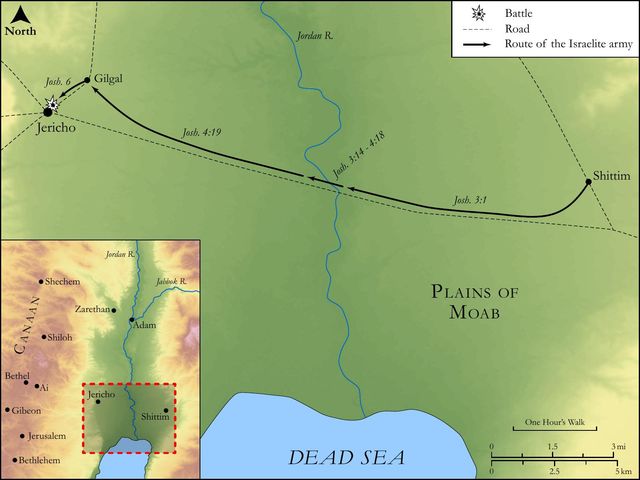
This verse is situated at a critical juncture in the book of Joshua, immediately following the Israelites' encampment at Shittim and the successful reconnaissance mission to Jericho (Joshua 2). After forty years of wilderness wandering, a new generation of Israelites now stands poised to enter the land promised to their forefathers. Joshua 3:1-4 details the logistical preparations for the crossing: the people breaking camp, the Ark of the Covenant being carried by the Levitical priests, and the instruction to maintain a significant distance from the Ark. Joshua's command in this verse serves as the spiritual prerequisite for the extraordinary event that will unfold in Joshua 3:7-17, where the Jordan River, at its flood stage, will be miraculously parted, allowing the entire nation to cross on dry ground. This command resonates with similar calls for sanctification before direct encounters with God's holiness, such as the preparations made prior to the giving of the Law at Mount Sinai.
Historical & Cultural Context
The setting is the eastern bank of the Jordan River, specifically during the harvest season (Joshua 3:15), when the river typically swelled its banks due to melting snows from Mount Hermon, making it a formidable natural barrier. For the Israelites, "sanctification" (Hebrew: qadash) was a multifaceted concept deeply embedded in their covenant relationship with God, particularly as defined by the Mosaic Law. It involved both ceremonial purity (e.g., washing clothes, abstaining from certain activities, as detailed in Exodus 19:10-15) and an internal spiritual readiness, a setting apart of oneself for a holy purpose or an imminent encounter with the divine. This act of purification was not merely ritualistic but signified a conscious turning of the heart towards God, acknowledging His holiness and preparing to receive His mighty acts. The crossing of the Jordan was not just a geographical shift but a profound theological transition, marking the end of wilderness wandering and the beginning of covenant fulfillment in the land, demanding a renewed commitment to God's commands and a posture of reverent expectation.
Key Themes
ShowHideJoshua 3:5 contributes significantly to several overarching themes within the book of Joshua and the broader biblical narrative. Firstly, it highlights the Sovereignty and Faithfulness of God, demonstrating that the Lord Himself is the initiator and executor of His promises, performing "wonders" that transcend human capability. This echoes God's faithfulness in bringing Israel out of Egypt through the Red Sea. Secondly, the command to "sanctify yourselves" emphasizes the theme of Human Responsibility and Preparation in response to divine initiative; while God acts, His people are called to a posture of spiritual readiness and obedience. This sanctification is a prerequisite for experiencing God's manifest presence and power. Thirdly, the verse underscores the theme of God's Presence and Covenant Fulfillment, as the miraculous crossing of the Jordan serves as a powerful sign that the Lord, who led them through the Red Sea and sustained them in the wilderness, is still with them and faithful to bring them into the land promised to their forefathers. This event also solidifies Joshua's leadership, confirming him as God's chosen successor to Moses, a theme developed further in Joshua 3:7.
Exposition and Analysis
ShowHideKey Word Analysis
ShowHideDerived from H3068 (Jehovah) and H3467 (to save), meaning "Jehovah-saved" or "Jehovah is salvation." This name is highly significant, foreshadowing his role as the one chosen by God to lead Israel into the Promised Land, a land of rest and inheritance. It also points to the ultimate deliverer, Jesus, whose Greek name is derived from the same Hebrew root.
Meaning "to be (causatively, make, pronounce or observe as) clean (ceremonially or morally); appoint, bid, consecrate, dedicate, defile, hallow, (be, keep) holy(-er, place), keep, prepare, proclaim, purify, sanctify(-ied one, self), [idiom] wholly." In its reflexive form, as used here ("sanctify yourselves"), it implies an active, intentional effort on the part of the people to make themselves holy or set themselves apart for a sacred purpose. This involved both external ritual purification (e.g., washing clothes, abstaining from marital relations, as seen in Exodus 19:10-15) and an internal, spiritual readiness—a turning of the heart and mind towards God in anticipation of His holy presence and mighty acts. It signifies a state of purity and dedication essential for encountering the divine.
This is the sacred, covenantal name of God, often transliterated as Yahweh. It means "(the) self-Existent or Eternal; Jehovah, Jewish national name of God; Jehovah, the Lord." The use of YHWH here emphasizes that the imminent "wonders" are not random occurrences but the deliberate, powerful acts of the faithful, covenant-keeping God who has chosen Israel and is actively fulfilling His promises to them. This name underscores His unchanging character and His active presence among His people.
This root means "to separate, i.e. distinguish (literally or figuratively); by implication, to be (causatively, make) great, difficult, wonderful; accomplish, (arise...too, be too) hard, hidden, things too high, (be, do, do a, shew) marvelous(-ly, -els, things, work), miracles, perform, separate, make singular, (be, great, make) wonderful(-ers, -ly, things, works), wondrous (things, works, -ly)." The plural noun form, niphla'ot, refers to extraordinary, miraculous, or astonishing deeds. These are actions that are beyond human capability and are specifically attributed to God, demonstrating His unique power, majesty, and sovereignty. The term often carries the connotation of awe-inspiring acts that reveal God's character and His intervention in human history. In this context, it specifically refers to the miraculous parting of the Jordan River, an event comparable in its divine magnitude to the parting of the Red Sea.
Verse Breakdown
ShowHide"And Joshua said unto the people"
This opening clause establishes Joshua's authoritative role as God's chosen leader and mediator for the nation. He is not speaking on his own accord but delivering a divine mandate, positioning him as the legitimate successor to Moses and the one through whom God's instructions are conveyed to the nation. His leadership is crucial for unifying the people and guiding them into the Promised Land, demonstrating God's continued provision of leadership for His people.
"Sanctify yourselves"
This is the central command of the verse, a direct imperative calling for spiritual and ceremonial preparation. The reflexive nature ("yourselves") emphasizes the people's active participation and responsibility in this process. It is a call to intentional purity and dedication, setting themselves apart from the ordinary and profane, in anticipation of a sacred encounter with the holy God. This act of sanctification is not for earning God's favor but for properly positioning themselves to witness and receive His holy work, demonstrating reverence and obedience.
"for to morrow the LORD will do wonders among you"
This clause provides the divine motivation and certain promise for the command. "To morrow" indicates the immediacy and certainty of God's impending action, building anticipation. "The LORD" (YHWH, the covenant name of God) underscores that it is the faithful, covenant-keeping God who will act, not Joshua or human strength. The "wonders" refer to extraordinary, miraculous deeds that will unequivocally demonstrate God's power and faithfulness to His covenant promises. The phrase "among you" highlights God's immanent presence and active involvement within the community, confirming His commitment to His people and their journey into the land.
Literary Devices
ShowHideJoshua 3:5 employs several significant Literary Devices. The primary device is Command and Promise, where Joshua issues a direct imperative ("Sanctify yourselves") immediately followed by a divine assurance ("for to morrow the LORD will do wonders among you"). This structure highlights the cause-and-effect relationship between human obedience and divine action, emphasizing God's faithfulness to respond to His people's preparation. The use of Foreshadowing is also evident; the command to sanctify before a great divine act echoes the preparation before the giving of the Law at Sinai (Exodus 19), suggesting that the upcoming Jordan crossing will be an equally monumental display of God's power and presence, marking a new phase in Israel's covenant relationship. Furthermore, the phrase "do wonders" functions as a form of Divine Manifestation and Hyperbole, indicating an act so profound and supernatural that it transcends normal human experience, serving as a clear revelation of God's omnipotence and His active involvement in the history of His people. The verse also implicitly uses Contrast between human limitation and divine omnipotence, as the people's humble act of sanctification precedes God's grand, impossible feat, emphasizing that the power belongs solely to the Lord.
Theological and Thematic Connections
ShowHideJoshua 3:5 profoundly illustrates the biblical principle that human preparation and spiritual purity are often prerequisites for experiencing God's manifest power and presence. It underscores that God, in His holiness, requires His people to set themselves apart when He is about to reveal His glory in extraordinary ways. This act of sanctification is not about earning God's favor or manipulating His hand, but about aligning oneself with His will and character, cultivating a receptive and reverent posture for divine intervention. The "wonders" are a testament to God's unwavering faithfulness to His covenant promises, demonstrating that He is actively involved in fulfilling His word, even when faced with seemingly insurmountable obstacles. This passage connects the physical journey into the Promised Land with a necessary spiritual journey of consecration, revealing that the land is not merely a geographical inheritance but a sacred space where God dwells among His sanctified people, and where His glory is to be revealed.
Reflection and Application
ShowHideJoshua 3:5 offers a timeless and profound principle for believers today: before God moves in powerful, transformative ways, He often calls His people to a season of spiritual preparation and sanctification. This is not about earning His favor or manipulating His hand, but about cultivating a heart and life that are aligned with His holiness and purposes, demonstrating our reverence and readiness. To "sanctify yourselves" in a contemporary context means actively pursuing purity—confessing sin, seeking forgiveness, and intentionally setting apart our lives (our time, resources, thoughts, and actions) for God's glory. It involves cultivating spiritual disciplines such as prayer, Bible study, and worship; seeking intimacy with God; and allowing the Holy Spirit to transform us from within, conforming us to the image of Christ. When we respond to this call with expectant faith and obedient hearts, we position ourselves to witness God's "wonders" in our personal lives, our families, our churches, and our communities. Just as the Israelites prepared for a physical breakthrough into their inheritance, we prepare for spiritual breakthroughs, trusting that God is faithful to reveal His power and accomplish His purposes through a consecrated people.
Questions for Reflection
ShowHideFAQ
ShowHideWhat was involved in "sanctifying yourselves" for the Israelites in Joshua's time?
ShowHideFor the ancient Israelites, "sanctifying yourselves" involved both ritual and spiritual preparation. Ritually, it meant performing acts of ceremonial cleansing, such as washing their clothes, abstaining from marital relations, and refraining from anything considered ritually impure, for a specified period (as seen in Exodus 19:10-15 before the giving of the Law). Spiritually, it implied a turning of the heart towards God, a conscious decision to set themselves apart for a holy encounter or task. It was about acknowledging God's holiness and preparing their minds and hearts to receive His divine instructions and witness His mighty acts, demonstrating reverence and readiness for His manifest presence and power.
Does God still require us to "sanctify ourselves" today to see His wonders?
ShowHideYes, the principle of sanctification remains vital for believers today, though its expression has shifted from ceremonial rituals to an inward, spiritual transformation. Through Christ, believers are already declared holy and set apart positionally (1 Corinthians 1:2), but there is also a progressive, ongoing process of sanctification (1 Thessalonians 4:3). This involves daily repentance, pursuing purity of heart and action, dedicating our lives to God's will, and allowing the Holy Spirit to conform us to the image of Christ (Romans 12:1-2). While God's wonders are ultimately by His grace and sovereignty, our spiritual readiness and obedience position us to better perceive, participate in, and be used by Him in His extraordinary work in the world. As Hebrews 12:14 states, "without holiness no one will see the Lord."
Christ-Centered Fulfillment
ShowHideJoshua 3:5, with its call to sanctification preceding divine wonders, finds its ultimate and most profound fulfillment in Jesus Christ. The Old Testament requirement for ceremonial and spiritual purity before encountering God's holiness pointed forward to the perfect and complete sanctification accomplished by Christ. We are no longer required to wash clothes or abstain from certain activities to prepare for God's presence, for Christ Himself is our sanctification (1 Corinthians 1:30). Through His once-for-all sacrifice on the cross, Jesus made us holy and set us apart for God (Hebrews 10:10), enabling us to draw near to God with confidence (Hebrews 10:19-22). The "wonders" God performed through Joshua, parting a river to bring His people into a physical land, foreshadow the far greater "wonders" of salvation, spiritual rebirth, and new creation accomplished through Christ. He is the ultimate Lamb of God who takes away the sin of the world (John 1:29), making us fit to dwell in God's presence eternally. Furthermore, the indwelling Holy Spirit empowers believers to live a life of ongoing, progressive sanctification, enabling us to participate in and witness the "greater works" that Jesus promised His followers would do (John 14:12) as the Kingdom of God advances. Thus, the call to sanctify ourselves in Joshua 3:5 is ultimately fulfilled in our union with Christ, who is our holiness, and through whom God continues to do wonders in and through His people by the power of His Spirit.