


1 Thessalonians 4:3
Bible text: King James Version (1769 Blayney text) · Public domain
Bible text: Berean Standard Bible · Public domain
Bible text: American Standard Version (1901) · Public domain
Bible text: World English Bible, Messianic edition · Public domain
Bible text: Geneva Bible (1599) · Public domain
Bible text: Young's Literal Translation · Public domain
- τοῦτοtoutoThisG3778D-NSNDemonstrative pronoun Nominative Singular Neuter
- γάρgarforG1063CONJConjunction
- ἐστινestinisG1510V-PAI-3SVerb Present Active Indicative 3rd Singular
- θέλημαthelēma[the] willG2307N-NSNNoun Nominative Singular Neuter
- τοῦtou<the>G3588T-GSMDefinite article Genitive Singular Masculine
- θεοῦtheouof GodG2316N-GSM-TNoun Genitive Singular Masculine Title
- ὁhotheG3588T-NSMDefinite article Nominative Singular Masculine
- ἁγιασμὸςhagiasmossanctificationG38N-NSMNoun Nominative Singular Masculine
- ὑμῶνhumōnof youG4771P-2GPPersonal pronoun Genitive 2nd Plural
- ἀπέχεσθαιapechesthaiTo abstainG568V-PMNVerb Present Middle Infinitive
- ὑμᾶςhumasyou [are]G4771P-2APPersonal pronoun Accusative 2nd Plural
- ἀπὸapofromG575PREPPreposition
- τῆςtēs<the>G3588T-GSFDefinite article Genitive Singular Feminine
- πορνείας·porneiassexual immoralityG4202N-GSFNoun Genitive Singular Feminine
English is a literal word-by-word gloss of the Greek, not the KJV's wording. Why?
This is the original text the KJV's translators worked from — each Greek word with its own literal English meaning in this verse, prepared by scholars at Tyndale House, Cambridge. The KJV translates whole sentences, not word by word, so its wording differs: one Greek word can become several English words, and the KJV may choose “charity” where the gloss reads “love”. Both are faithful — they answer different questions. For the KJV's own rendering, switch to the KJV text.
Details
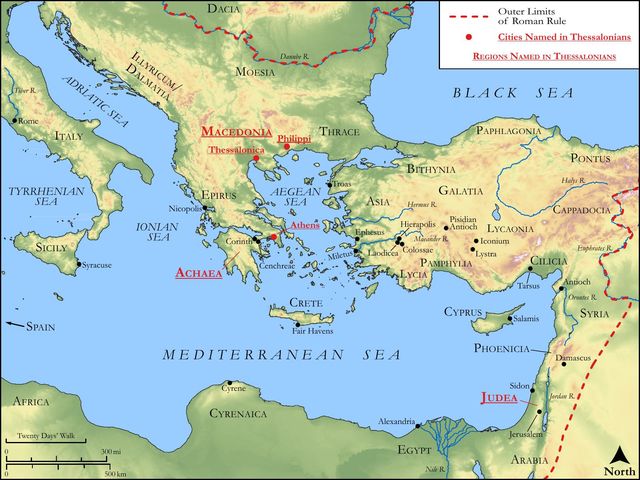
See on the biblical-era maps

Study this verse
Public-domain commentary
Matthew Henry
From his Commentary on the Whole Bible. Henry comments on passages, not single verses — this entry covers 1 Thessalonians 4:1–8. His three-level outline is real structure in the source text, so it is rendered as structure.
Here we have,
I.An exhortation to abound in holiness, to abound more and more in that which is good, Th1 4:1, Th1 4:2. We may observe,
1.The manner in which the exhortation is given - very affectionately. The apostle entreats them as brethren; he calls them so, and loved them as such. Because his love to them was very great, he exhorts them very earnestly: We beseech and exhort you. The apostle was unwilling to take any denial, and therefore repeats his exhortation again and again.
2.The matter of his exhortation - that they would abound more and more in holy walking, or excel in those things that are good, in good works. Their faith was justly famed abroad, and they were already examples to other churches: yet the apostle would have them yet further to excel others, and to make further progress in holiness. Note,
(1.)Those who most excel others fall short of perfection. The very best of us should forget those things which are behind, and reach forth unto those things which are before.
(2.)It is not enough that we abide in the faith of the gospel, but we must abound in the work of faith. We must not only persevere to the end, but we should grow better, and walk more evenly and closely with God.
3.The arguments with which the apostle enforces his exhortation.
(1.)They had been informed of their duty. They knew their Master's will, and could not plead ignorance as an excuse. Now as faith, so knowledge, is dead without practice. They had received of those who had converted them to Christianity, or been taught of them, how they ought to walk. Observe, The design of the gospel is to teach men not only what they should believe, but also how they ought to live; not so much to fill men's minds with notions as to regulate their temper and behaviour. The apostle taught them how to walk, not how to talk. To talk well without living well will never bring us to heaven: for the character of those who are in Christ Jesus is this: They walk not after the flesh, but after the Spirit.
(2.)Another argument is that the apostle taught and exhorted them in the name, or by the authority, of the Lord Jesus Christ. He was Christ's minster and ambassador, declaring to them what was the will and command of the Lord Jesus.
(3.)Another argument is this. Herein they would please God. Holy walking is most pleasing to the holy God, who is glorious in holiness. This ought to be the aim and ambition of every Christian, to please God and to be accepted of him. We should not be men-pleasers, nor flesh-pleasers, but should walk so as to please God.
(4.)The rule according to which they ought to walk and act - the commandments they had given them by the Lord Jesus Christ, which were the commandments of the Lord Jesus Christ himself, because given by authority and direction from him and such as were agreeable to his will. The apostles of our Lord Jesus Christ were only commissioned by him to teach men to observe all things whatsoever he had commanded them, Mat 28:20. Though they had great authority from Christ, yet that was to teach men what Christ had commanded, not to give forth commandments of their own. They did not act as lords over God's heritage (Pe1 5:3), nor should any do so that pretend to be their successors. The apostle could appeal to the Thessalonians, who knew what commandments he gave them, that they were no other than what he had received from the Lord Jesus.
II.A caution against uncleanness, this being a sin directly contrary to sanctification, or that holy walking to which he so earnestly exhorts them. This caution is expressed, and also enforced by many arguments,
1.It is expressed in these words: That you should abstain from fornication (Th1 4:3), by which we are to understand all uncleanness whatsoever, either in a married or unmarried state. Adultery is of course included, though fornication is particularly mentioned. And other sorts of uncleanness are also forbidden, of which it is a shame even to speak, though they are done by too many in secret. All that is contrary to chastity in heart, speech, and behaviour, is contrary to the command of God in the decalogue, and contrary to that holiness which the gospel requires.
2.There are several arguments to enforce this caution. As,
(1.)This branch of sanctification in particular is the will of God, Th1 4:3. It is the will of God in general that we should be holy, because he that called us is holy, and because we are chosen unto salvation through the sanctification of the Spirit; and not only does God require holiness in the heart, but also purity in our bodies, and that we should cleanse ourselves from all filthiness both of flesh and spirit, Co2 7:1. Whenever the body is, as it ought to be, devoted to God, and dedicated and set apart for him, it should be kept clean and pure for his service; and, as chastity is one branch of our sanctification, so this is one thing which God commands in his law, and what his grace effects in all true believers.
(2.)This will be greatly for our honour: so much is plainly implied, Th1 4:4. Whereas the contrary will be a great dishonour. And his reproach shall not be wiped away, Pro 6:33. The body is here called the vessel of the soul, which dwells therein (so Sa1 21:5), and it must be kept pure from defiling lusts. Every one should be careful in this matter, as he values his own honour and will not be contemptible on this account, that his inferior appetites and passions gain not the ascendant, tyrannizing over his reason and conscience, and enslaving the superior faculties of his soul. What can be more dishonourable than for a rational soul to be enslaved by bodily affections and brutal appetites?
(3.)To indulge the lust of concupiscence is to live and act like heathens? Even as the Gentiles who know not God, Th1 4:5. The Gentiles, and especially the Grecians, were commonly guilty of some sins of uncleanness which were not so evidently forbidden by the light of nature. But they did not know God, nor his mind and will, so well as Christians know, and should know, this his will, namely our sanctification in this branch of it. It is not so much to be wondered at, therefore, if the Gentiles indulge their fleshly appetites and lusts; but Christians should not walk as unconverted Gentiles, in lasciviousness, lusts, excess of wine, revellings, banquetings, etc. (Pe1 4:3), because those who are in Christ have crucified the flesh with its affections and lusts.
(4.)The sin of uncleanness, especially adultery, is a great piece of injustice that God will be the avenger of; so we may understand those words, That no man go beyond or defraud his brother (Th1 4:6), in any matter - en tō pragmati, in this matter of which the apostle is speaking in the preceding and following verses, namely, the sin of uncleanness. Some understand these words as a further warning and caution against injustice and oppression, all fraud and deceit in our dealings with men, which are certainly criminal, and contrary to the gospel. And Christians should not impose upon the ignorance and necessity of those they deal with, and so go beyond them, nor should they by equivocations or lying arts defraud them; and although this may be practised by some and lie long undiscovered, and so go unpunished among men, yet the righteous God will render a recompence. But the meaning may rather be to show the injustice and wrong that in many cases are done by the sin of uncleanness. Not only are fornication and other acts of uncleanness sins against his own body who commits them (Co1 6:18), not only are they very injurious to the sinner himself both in soul and body, but sometimes they are very injurious, and no less than defrauding, acts of injustice to others, particularly to those who are joined together in the marriage covenant and to their posterity. And, as this sin is of such a heinous nature, so it follows that God will be the avenger of it. Whoremongers and adulterers God will judge, Heb 13:4. This the apostle had forewarned and testified by his gospel, which, as it contained exceedingly great and precious promises, so also it revealed from heaven the wrath of God against all ungodliness and unrighteousness among men, Rom 1:18.
(5.)The sin of uncleanness is contrary to the nature and design of our Christian calling: For God hath called us not unto uncleanness, but unto holiness, Th1 4:7. The law of God forbids all impurity, and the gospel requires the greatest purity; it calls us from uncleanness unto holiness.
(6.)The contempt therefore of God's law and gospel is the contempt of God himself: He that despises despises God, not man only. Some might possibly make light of the precepts of purity and holiness, because they heard them from men like themselves; but the apostle lets them know that they were God's commands, and to violate them was no less than to despise God. He adds, God hath given Christians his Spirit, intimating that all sorts of uncleanness do in an especial manner grieve the Holy Spirit, and will provoke him to withdraw from us; and also the Holy Spirit is given unto us to arm us against these sins, and to help us to mortify these deeds of the body, that we may live, Rom 8:13.
Historical interpretation
Four Centuries of Reception
10 surviving comments on this verse. Each one is dated, so this reads as a timeline rather than a list.
Select a marker to jump to its quote. Markers stagger vertically where authors wrote within a few decades of each other.
Wherefore he that despiseth, despiseth not man, but God, who hath also given His Holy Spirit to you."
For the devil tempts us. He knows what we are but does not know if we will hold out. Wishing to dislodge us from the faith, he also attempts to bring us into subjection to himself. This tempting is all that God has allowed him to do, partly because it is God’s will to save us from ourselves. For indeed, by the opportunity afforded by the commandment we are truly sinners. But the other reason God so limits the devil is to disgrace him and show him up as a failure, thereby strengthening the church and the conscience of those who are awed at such constancy.… The Lord did not suffer by the will of the Father, nor are those who are persecuted persecuted by the will of God. Indeed, either of two things is the case: persecution in consequence of the will of God is a good thing, or, those who decree and inflict suffering are guiltless. But nothing is without the will of the Lord of the universe. It remains to say that such things happen without the prevention of God. Only this way of thinking about suffering saves both the providence and the goodness of God. We must not think therefore that he actively produces afflictions (far be it that we should think this!) … Providence is a disciplinary art—in the case of others for each individual’s sins, and in the case of the Lord and his apostles for ours. To this point the divine apostle prays: “For this is the will of God, even your sanctification.”
The will of God is our sanctification, for He wishes His "image "-us-to become likewise His "likeness; " that we may be "holy" just as Himself is "holy.
What, in short, does he write to the Thessalonians withal? "For our consolation (originated) not of seduction, nor of impurity: "and, "This is the will of God, your sanctification, that ye abstain from fornication; that each one know how to possess his vessel in sanctification and honour, not in the lust of concupiscence, as (do) the nations which are ignorant of God." What do the Galatians read? "Manifest are the works of the flesh.
Christ gave this judgment when, being inquired of, He said that a wife must not be put away, save for the cause of adultery; such honour did He put upon chastity. Hence arose the decree: "Ye shall not suffer adulteresses to live." Hence the apostle says: "This is the will of God, that ye abstain from fornication." Hence also he says the same thing: "That the members of Christ must not be joined with the members of an harlot." Hence the man is delivered over unto Satan for the destruction of the flesh, who, treading under foot the law of chastity, practises the vices of the flesh. Hence with reason adulterers do not attain the kingdom of heaven. Hence it is that every sin is without the body, but that the adulterer alone sins against his own body. Hence other authoritative utterances of the instructor, all of which it is not necessary at this time to collect, especially among you, who for the most part know and do them; and you cannot find cause for complaint concerning these things, even though they are not described. For the adulterer has not an excuse, nor could he have, because he might take a wife.
The cardinal principles of chastity, brothers, are ancient. How so? Because they were ordained at the same time as the human race itself. For both her own husband belongs to the woman, for the reason that she may know no other besides him, and because the woman is given to the man. This latter is in order that, when what is his own has been given to him, he should seek nothing belonging to another.… Christ gave this judgment when, having been questioned, he said that a wife must not be put away except because of adultery. Thus did he honor chastity. From this has come the levitical decree, “You shall not allow adulteresses to live.” Therefore, the apostle says, “This is the will of God, your sanctification, that you abstain from fornication.”
"For this is the will of God, even your sanctification."
And observe how he nowhere so vehemently glances at any other thing, as at this. As elsewhere also he writes to this effect; "Follow after peace with all men, and the sanctification without which no man shall see the Lord." (Heb. xii. 14) And why dost thou wonder, if he everywhere writes to his disciples upon this subject, when even in his Epistle to Timothy he has said, "Keep thyself pure." (1 Tim. v. 22) Also in his second Epistle to the Corinthians he has said, "In much patience, in fastings, by pureness." (2 Cor. vi. 5, 6) And one may find this in many places, both in this Epistle to the Romans, and everywhere, and in all his Epistles. For in truth this is an evil pernicious to all. And as a swine full charged with mire, wherever he enters, fills all places with his ill odor, and chokes the senses with dung, so too does fornication; it is an evil not easy to be washed away. But when some even who have wives practice this, how excessive is the outrage! "For this," he says, "is the will of God, even your sanctification, that ye abstain from all fornication." For there are many forms of disorderly conduct. The pleasures of wantonness are of many kinds and various, it were not tolerable to mention them. But having said "from all fornication," he leaves it to those who know them.
The disease of disordered desire is what the apostle refers to, when, speaking to married believers, he says, “This is the will of God, even your sanctification, that you should abstain from fornication, that everyone of you should know how to possess his vessel in sanctification and honor, not in the disease of desire, even as the Gentiles who do not know God.” The married believer, therefore, must not only not use another man’s vessel—which is what they do who lust after other men’s wives—but he must know that even his own vessel is not to be possessed in the disease of disordered sexual desire. Paul’s counsel is not to be understood as if the apostle prohibited conjugal—that is to say, lawful and honorable—cohabitation.
Gregory said, ‘God asks three things of anyone who is baptized: to keep the true faith with all his soul and all his might; to control his tongue; to be chaste in his body.’
It is said through the voice of the prophet to the soul that grows proud, “You trusted in your beauty and played the harlot because of your renown.” For a soul to trust in its beauty is to presume within itself on its righteous works. It plays the harlot on the basis of its renown when in its righteous acts it seeks the glory of its own reputation rather than the spread of its Creator’s praise.… What then is to be done in this case but that, when the malignant spirit of pride enjoys the good things that we have done in order to exalt the mind, we should ever recall to memory our evil deeds. The goal is that we may acknowledge our sinful acts as our own and our avoidance of sin as the gift of Almighty God. And so Paul says, “For this is the will of God, even your sanctification, that you abstain from unchastity.”
Continue studying 1 Thessalonians 4:3 across the web’s major study libraries — every link below opens this exact verse, chapter, or book on the destination site.
Read & Compare
 BibleGatewayThis verse in more than 200 translations and 70 languages.
 Bible.comThe YouVersion reader — hundreds of translations, reading plans, and highlights.
 ESV.orgCrossway's official English Standard Version reader.
 NET BibleThe NET translation with 60,000+ translators' notes on every rendering decision.
 STEP BibleTyndale House's free study tool — original text, vocabulary, and scholarly resources.
 BibliaLogos Bible Software's free web reader.
 USCCBThe New American Bible (Revised Edition) with the U.S. bishops' study notes.
Commentaries
 BibleHub CommentariesDozens of classic commentaries on this verse, gathered on one page.
 StudyLightMore than 100 commentary sets — the largest collection on the web.
 BibleRefPlain-English commentary on what this verse means, verse by verse.
 Enduring WordDavid Guzik's free commentary on this chapter, widely used by Bible teachers.
 Bible Study ToolsVerse commentary alongside Greek and Hebrew study aids.
Original Language & Research
- BibleHub InterlinearThe verse word by word — original language, transliteration, and English.
- BibleHub LexiconEvery word's original-language definition and Strong's entry.
 Blue Letter BibleDeep-study tools — Strong's numbers, concordance, and word studies.
 CNTR CollationThe earliest Greek manuscripts of this verse, collated letter by letter.
Sermons, Hymns & Audio


TrulyRandomVerse is not affiliated with these sites and doesn’t control their content. They’re linked because they’re genuinely useful.
Summary
The Apostle Paul, addressing the nascent church in Thessalonica, unequivocally declares that God's express and non-negotiable will for every believer is their sanctification, which he immediately and practically defines as abstaining from all forms of sexual immorality. This verse serves as a foundational ethical mandate, setting a clear standard for Christian conduct that stands in stark contrast to the prevailing pagan culture and remains profoundly relevant for believers today.
Context
ShowHideLiterary Context
1 Thessalonians 4:3 marks a significant transition in Paul's letter from theological instruction and pastoral encouragement (chapters 1-3) to practical ethical exhortation (chapters 4-5). Having affirmed their faith, love, and endurance in the face of persecution, Paul now moves to specific directives on how the Thessalonian believers are to live out their Christian calling. This verse initiates a crucial section (verses 3-8) that focuses intensely on sexual purity, followed by exhortations regarding brotherly love, industriousness, and living quietly, culminating in teaching about the Lord's return. The placement of sexual ethics at the forefront of his practical instructions underscores its critical importance to Paul and to God's will for His people.
Historical & Cultural Context
The city of Thessalonica was a bustling port and a major commercial center in the Roman province of Macedonia. As in many Gentile cities of that day, sexual morality was vastly different from biblical standards. Prostitution, concubinage, and various forms of illicit sexual activity were common, often integrated into religious practices (e.g., temple prostitution) and generally not considered morally reprehensible by pagan society. Many of the Thessalonian converts would have come directly out of this pagan background, where such practices were normalized. Therefore, Paul's explicit command to "abstain from fornication" was not merely a general moral guideline but a radical call to counter-cultural living, demanding a complete break from deeply ingrained societal norms and personal habits. This instruction was vital for the new believers to understand what it meant to live as a distinct, holy community set apart for God in a sexually permissive world.
Key Themes
ShowHide1 Thessalonians 4:3 powerfully encapsulates several core themes central to Paul's theology and the broader Christian life. First, it highlights The Will of God as a clear, discernible, and authoritative directive for believers. Paul presents sanctification, specifically sexual purity, not as a suggestion or an optional spiritual discipline, but as God's express desire and command for His children, echoing the call to transformation found in Romans 12:2. Second, the verse introduces the pivotal theme of Sanctification, which refers to the process by which believers are set apart from sin and consecrated to God, growing in holiness and becoming increasingly conformed to the image of Christ. This is both a definitive act of God (positional holiness) and an ongoing, lifelong process of spiritual transformation (progressive holiness), a pursuit that Hebrews 12:14 also emphasizes. Finally, the verse directly addresses Sexual Purity, making it a concrete and immediate application of sanctification. By commanding abstinence from "fornication," Paul establishes sexual integrity as a fundamental hallmark of Christian living and a visible demonstration of one's commitment to God's will, a theme he reiterates forcefully in passages like 1 Corinthians 6:18-20.
Exposition and Analysis
ShowHideKey Word Analysis
ShowHideThis term, derived from the verb meaning "to wish" or "to desire," signifies a determination, purpose, or decree. In this context, it is not merely a passive inclination but an active, sovereign choice and command from God. It denotes what God has purposed and what He desires to see accomplished in the lives of His people.
From the root meaning "to make holy" or "to set apart," hagiasmós refers to the state of purity and consecration, as well as the process by which one is made holy. It implies being separated from the common or profane and dedicated exclusively to God's service and purposes. It is both a gift from God (being set apart by Him) and a call to live a life that reflects that setting apart.
This is a broad and comprehensive term encompassing all forms of unlawful sexual intercourse outside the God-ordained covenant of marriage. It includes premarital sex, adultery, prostitution, incest, homosexual acts, and any other illicit sexual activity. Its breadth indicates Paul's intention to condemn all forms of sexual immorality that deviate from God's design for human sexuality. The English word "pornography" is directly derived from this Greek root.
Verse Breakdown
ShowHide"For this is the will of God"
Paul begins with a strong declarative statement, asserting divine authority for the instruction that follows. "This" (G5124, toûto) points forward to the subsequent clause, emphasizing that what is about to be stated is not a human suggestion or a cultural norm, but an explicit and non-negotiable decree from God Himself. The use of "is" (G2076, estí) underscores the present and enduring nature of this divine will.
"even your sanctification"
This clause directly identifies the content of God's will. The word "even" serves as an explanatory or appositional particle, clarifying that God's will is their sanctification. It signifies the process and state of being set apart for God, purified from sin, and consecrated to Him. This is the overarching goal of God for His people, a transformation into holiness that reflects His own character.
"that ye should abstain from fornication"
This final clause provides the immediate and most crucial practical application of sanctification in the Thessalonians' context. The phrase "that ye should abstain" (G567, apéchomai) is a strong imperative, commanding a decisive turning away or holding oneself off from. "Fornication" (G4202, porneía) is the specific sin from which they are to abstain, serving as a primary example of the kind of unholy behavior that is incompatible with God's will for their sanctification. This makes the abstract concept of holiness concrete and actionable.
Literary Devices
ShowHidePaul employs several literary devices in 1 Thessalonians 4:3 to convey his message with clarity and authority. The verse opens with a Declarative Statement, "For this is the will of God," which immediately establishes the divine origin and non-negotiable nature of the command. This authoritative tone leaves no room for ambiguity regarding the source or importance of the instruction. Following this, Paul uses Explication or Apposition with the phrase "even your sanctification," which clarifies and defines "this" (the will of God). This structure highlights that sanctification is not merely part of God's will, but is His will itself. Finally, the verse culminates in an Ethical Imperative, "that ye should abstain from fornication," which provides a direct, practical, and actionable command. This imperative functions as a concrete example and primary expression of the broader call to sanctification, demonstrating how abstract theological concepts are to be lived out in daily conduct. Implicitly, there is also a Contrast drawn between the prevailing pagan sexual norms and the distinctive, holy lifestyle expected of believers.
Theological and Thematic Connections
ShowHide1 Thessalonians 4:3 is deeply rooted in the biblical understanding of God's character and His relationship with His people. God is inherently holy, and His call for His people to be holy is a consistent theme throughout Scripture, from the Old Testament command "Be holy, for I am holy" (Leviticus 11:44) to the New Testament's emphasis on living a life worthy of the calling. Sanctification, as God's will, is not merely about avoiding sin, but about being set apart for God's purposes, reflecting His purity and righteousness. Sexual purity is presented as a fundamental aspect of this sanctification because human sexuality, created by God, is intended to reflect His design for intimacy, covenant, and procreation within the sanctity of marriage. Deviations from this design defile the body, which is the temple of the Holy Spirit, and dishonor God. Therefore, abstaining from fornication is a direct act of obedience and worship, demonstrating a commitment to God's will and a desire to glorify Him in every aspect of life.
Reflection and Application
ShowHideIn a contemporary world increasingly saturated with sexualized media, fluid moral boundaries, and pervasive sexual immorality, 1 Thessalonians 4:3 stands as an urgent and unwavering call to distinctiveness for every follower of Christ. This verse challenges us to recognize that sexual purity is not an antiquated cultural standard or an optional add-on to our faith, but an explicit divine mandate central to our sanctification. Living out this truth requires intentionality, self-control, and a profound reliance on the Holy Spirit. It means actively choosing to guard our eyes, minds, and bodies from anything that defiles, and to cultivate a lifestyle that honors God in our relationships, thoughts, and actions. Our pursuit of holiness, particularly in the realm of sexuality, serves as a powerful witness to a watching world, demonstrating the transformative power of the Gospel and the reality of God's perfect will for human flourishing. It is a lifelong journey of becoming more like Christ, empowered by His grace and driven by our love for Him.
Questions for Reflection
ShowHideFAQ
ShowHideIs sexual purity really that important to God, or is it just a cultural hang-up from ancient times?
ShowHide1 Thessalonians 4:3 makes it unequivocally clear that sexual purity is not a cultural relic but "the will of God" for believers' sanctification. Throughout Scripture, God consistently emphasizes sexual integrity as foundational to holiness. Passages like 1 Corinthians 6:18 command believers to "flee sexual immorality" because it is a sin against one's own body, which is the temple of the Holy Spirit. God's concern for sexual purity stems from His own holy character and His design for human sexuality, which He created to be expressed within the covenant of marriage (Hebrews 13:4). Therefore, it is of paramount importance to Him.
What does "sanctification" mean in practice, and how does abstaining from fornication relate to it?
ShowHide"Sanctification" refers to the process by which believers are set apart for God and progressively made more like Christ. It has two main aspects: positional sanctification (being declared holy by God at conversion) and progressive sanctification (the ongoing work of the Holy Spirit to transform us into holiness). Abstaining from fornication is a direct and concrete expression of progressive sanctification. It means actively choosing to refrain from all forms of sexual activity outside of biblical marriage, including premarital sex, adultery, pornography, and other illicit acts. By doing so, believers demonstrate their commitment to live according to God's holy standards, honoring Him with their bodies and minds, and reflecting the purity to which they have been called by God's will (1 Peter 1:15-16).
Christ-Centered Fulfillment
ShowHideThe command for sanctification and abstinence from fornication in 1 Thessalonians 4:3 finds its ultimate fulfillment and empowerment in Jesus Christ. He is the embodiment of perfect holiness, the one who lived a life completely set apart for God, untainted by sin, including sexual impurity. Our sanctification is first and foremost a gift made possible by His atoning sacrifice on the cross, through which we are justified and positionally declared holy in God's sight (Hebrews 10:10). Furthermore, Christ, through the indwelling Holy Spirit, empowers believers to live out this progressive sanctification. The Spirit provides the strength to "abstain from fornication" and to cultivate purity of heart and action, transforming us into the likeness of Christ (2 Corinthians 3:18). Our union with Christ means we are called to walk as He walked, reflecting His purity and dedication to the Father's will. Ultimately, Christ's work ensures that His church will be presented to Him "holy and blameless and above reproach" at His glorious return, fulfilling the very purpose of our sanctification (Ephesians 5:25-27 and Colossians 1:21-22).