


1 Thessalonians 4:1
Bible text: King James Version (1769 Blayney text) · Public domain
Bible text: King James Version with Strong's numbers · Public domain
Bible text: Berean Standard Bible · Public domain
Bible text: American Standard Version (1901) · Public domain
Bible text: World English Bible, Messianic edition · Public domain
Bible text: Geneva Bible (1599) · Public domain
Bible text: Young's Literal Translation · Public domain
- ΛοιπὸνLoiponFinallyG3063A-ASNAdjective Accusative Singular Neuter
- οὖνounthenG3767CONJConjunction
- ἀδελφοίadelphoibrothersG80N-VPMNoun Vocative Plural Masculine
- ἐρωτῶμενerōtōmenwe imploreG2065V-PAI-1PVerb Present Active Indicative 1st Plural
- ὑμᾶςhumasyouG4771P-2APPersonal pronoun Accusative 2nd Plural
- καὶkaiandG2532CONJConjunction
- παρακαλοῦμενparakaloumenwe exhort [you]G3870V-PAI-1PVerb Present Active Indicative 1st Plural
- ἐνeninG1722PREPPreposition
- κυρίῳkuriō[the] LordG2962N-DSM-TNoun Dative Singular Masculine Title
- ἸησοῦIēsouJesusG2424N-DSM-PNoun Dative Singular Masculine Individual
- καθὼςkathōseven asG2531CONJConjunction
- παρελάβετεparelabeteyou have receivedG3880V-2AAI-2PVerb 2nd Aorist Active Indicative 2nd Plural
- παρ᾽par᾽fromG3844PREPPreposition
- ἡμῶνhēmōnusG3165P-1GPPersonal pronoun Genitive 1st Plural
- τὸto<the>G3588T-ASNDefinite article Accusative Singular Neuter
- πῶςpōsin what mannerG4459PRT-IInterrogative Particle Interrogative
- δεῖdeiit behoovesG1163V-PAI-3SVerb Present Active Indicative 3rd Singular
- ὑμᾶςhumasyouG4771P-2APPersonal pronoun Accusative 2nd Plural
- περιπατεῖνperipateinto walkG4043V-PANVerb Present Active Infinitive
- καὶkaiandG2532CONJConjunction
- ἀρέσκεινareskeinto pleaseG700V-PANVerb Present Active Infinitive
- θεῷtheōGodG2316N-DSM-TNoun Dative Singular Masculine Title
- ἵναinasoG2443CONJConjunction
- περισσεύητεperisseuēteyou may aboundG4052V-PAS-2PVerb Present Active Subjunctive 2nd Plural
- μᾶλλον·mallonmoreG3123ADVAdverb
English is a literal word-by-word gloss of the Greek, not the KJV's wording. Why?
This is the original text the KJV's translators worked from — each Greek word with its own literal English meaning in this verse, prepared by scholars at Tyndale House, Cambridge. The KJV translates whole sentences, not word by word, so its wording differs: one Greek word can become several English words, and the KJV may choose “charity” where the gloss reads “love”. Both are faithful — they answer different questions. For the KJV's own rendering, switch to the KJV text.
Details
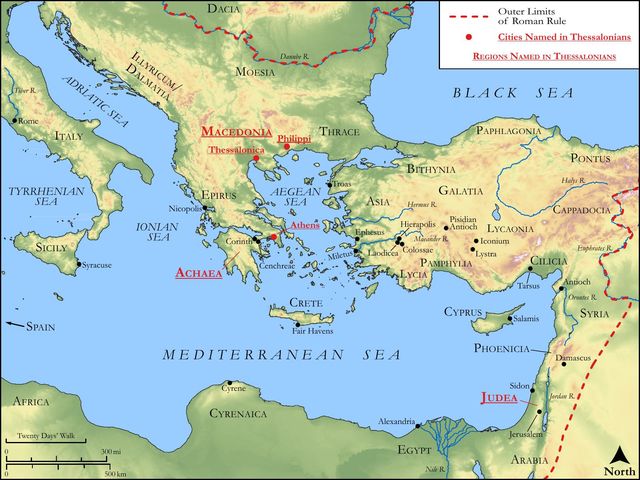
See on the biblical-era maps

Study this verse
Public-domain commentary
Matthew Henry
From his Commentary on the Whole Bible. Henry comments on passages, not single verses — this entry covers 1 Thessalonians 4:1–8. His three-level outline is real structure in the source text, so it is rendered as structure.
Here we have,
I.An exhortation to abound in holiness, to abound more and more in that which is good, Th1 4:1, Th1 4:2. We may observe,
1.The manner in which the exhortation is given - very affectionately. The apostle entreats them as brethren; he calls them so, and loved them as such. Because his love to them was very great, he exhorts them very earnestly: We beseech and exhort you. The apostle was unwilling to take any denial, and therefore repeats his exhortation again and again.
2.The matter of his exhortation - that they would abound more and more in holy walking, or excel in those things that are good, in good works. Their faith was justly famed abroad, and they were already examples to other churches: yet the apostle would have them yet further to excel others, and to make further progress in holiness. Note,
(1.)Those who most excel others fall short of perfection. The very best of us should forget those things which are behind, and reach forth unto those things which are before.
(2.)It is not enough that we abide in the faith of the gospel, but we must abound in the work of faith. We must not only persevere to the end, but we should grow better, and walk more evenly and closely with God.
3.The arguments with which the apostle enforces his exhortation.
(1.)They had been informed of their duty. They knew their Master's will, and could not plead ignorance as an excuse. Now as faith, so knowledge, is dead without practice. They had received of those who had converted them to Christianity, or been taught of them, how they ought to walk. Observe, The design of the gospel is to teach men not only what they should believe, but also how they ought to live; not so much to fill men's minds with notions as to regulate their temper and behaviour. The apostle taught them how to walk, not how to talk. To talk well without living well will never bring us to heaven: for the character of those who are in Christ Jesus is this: They walk not after the flesh, but after the Spirit.
(2.)Another argument is that the apostle taught and exhorted them in the name, or by the authority, of the Lord Jesus Christ. He was Christ's minster and ambassador, declaring to them what was the will and command of the Lord Jesus.
(3.)Another argument is this. Herein they would please God. Holy walking is most pleasing to the holy God, who is glorious in holiness. This ought to be the aim and ambition of every Christian, to please God and to be accepted of him. We should not be men-pleasers, nor flesh-pleasers, but should walk so as to please God.
(4.)The rule according to which they ought to walk and act - the commandments they had given them by the Lord Jesus Christ, which were the commandments of the Lord Jesus Christ himself, because given by authority and direction from him and such as were agreeable to his will. The apostles of our Lord Jesus Christ were only commissioned by him to teach men to observe all things whatsoever he had commanded them, Mat 28:20. Though they had great authority from Christ, yet that was to teach men what Christ had commanded, not to give forth commandments of their own. They did not act as lords over God's heritage (Pe1 5:3), nor should any do so that pretend to be their successors. The apostle could appeal to the Thessalonians, who knew what commandments he gave them, that they were no other than what he had received from the Lord Jesus.
II.A caution against uncleanness, this being a sin directly contrary to sanctification, or that holy walking to which he so earnestly exhorts them. This caution is expressed, and also enforced by many arguments,
1.It is expressed in these words: That you should abstain from fornication (Th1 4:3), by which we are to understand all uncleanness whatsoever, either in a married or unmarried state. Adultery is of course included, though fornication is particularly mentioned. And other sorts of uncleanness are also forbidden, of which it is a shame even to speak, though they are done by too many in secret. All that is contrary to chastity in heart, speech, and behaviour, is contrary to the command of God in the decalogue, and contrary to that holiness which the gospel requires.
2.There are several arguments to enforce this caution. As,
(1.)This branch of sanctification in particular is the will of God, Th1 4:3. It is the will of God in general that we should be holy, because he that called us is holy, and because we are chosen unto salvation through the sanctification of the Spirit; and not only does God require holiness in the heart, but also purity in our bodies, and that we should cleanse ourselves from all filthiness both of flesh and spirit, Co2 7:1. Whenever the body is, as it ought to be, devoted to God, and dedicated and set apart for him, it should be kept clean and pure for his service; and, as chastity is one branch of our sanctification, so this is one thing which God commands in his law, and what his grace effects in all true believers.
(2.)This will be greatly for our honour: so much is plainly implied, Th1 4:4. Whereas the contrary will be a great dishonour. And his reproach shall not be wiped away, Pro 6:33. The body is here called the vessel of the soul, which dwells therein (so Sa1 21:5), and it must be kept pure from defiling lusts. Every one should be careful in this matter, as he values his own honour and will not be contemptible on this account, that his inferior appetites and passions gain not the ascendant, tyrannizing over his reason and conscience, and enslaving the superior faculties of his soul. What can be more dishonourable than for a rational soul to be enslaved by bodily affections and brutal appetites?
(3.)To indulge the lust of concupiscence is to live and act like heathens? Even as the Gentiles who know not God, Th1 4:5. The Gentiles, and especially the Grecians, were commonly guilty of some sins of uncleanness which were not so evidently forbidden by the light of nature. But they did not know God, nor his mind and will, so well as Christians know, and should know, this his will, namely our sanctification in this branch of it. It is not so much to be wondered at, therefore, if the Gentiles indulge their fleshly appetites and lusts; but Christians should not walk as unconverted Gentiles, in lasciviousness, lusts, excess of wine, revellings, banquetings, etc. (Pe1 4:3), because those who are in Christ have crucified the flesh with its affections and lusts.
(4.)The sin of uncleanness, especially adultery, is a great piece of injustice that God will be the avenger of; so we may understand those words, That no man go beyond or defraud his brother (Th1 4:6), in any matter - en tō pragmati, in this matter of which the apostle is speaking in the preceding and following verses, namely, the sin of uncleanness. Some understand these words as a further warning and caution against injustice and oppression, all fraud and deceit in our dealings with men, which are certainly criminal, and contrary to the gospel. And Christians should not impose upon the ignorance and necessity of those they deal with, and so go beyond them, nor should they by equivocations or lying arts defraud them; and although this may be practised by some and lie long undiscovered, and so go unpunished among men, yet the righteous God will render a recompence. But the meaning may rather be to show the injustice and wrong that in many cases are done by the sin of uncleanness. Not only are fornication and other acts of uncleanness sins against his own body who commits them (Co1 6:18), not only are they very injurious to the sinner himself both in soul and body, but sometimes they are very injurious, and no less than defrauding, acts of injustice to others, particularly to those who are joined together in the marriage covenant and to their posterity. And, as this sin is of such a heinous nature, so it follows that God will be the avenger of it. Whoremongers and adulterers God will judge, Heb 13:4. This the apostle had forewarned and testified by his gospel, which, as it contained exceedingly great and precious promises, so also it revealed from heaven the wrath of God against all ungodliness and unrighteousness among men, Rom 1:18.
(5.)The sin of uncleanness is contrary to the nature and design of our Christian calling: For God hath called us not unto uncleanness, but unto holiness, Th1 4:7. The law of God forbids all impurity, and the gospel requires the greatest purity; it calls us from uncleanness unto holiness.
(6.)The contempt therefore of God's law and gospel is the contempt of God himself: He that despises despises God, not man only. Some might possibly make light of the precepts of purity and holiness, because they heard them from men like themselves; but the apostle lets them know that they were God's commands, and to violate them was no less than to despise God. He adds, God hath given Christians his Spirit, intimating that all sorts of uncleanness do in an especial manner grieve the Holy Spirit, and will provoke him to withdraw from us; and also the Holy Spirit is given unto us to arm us against these sins, and to help us to mortify these deeds of the body, that we may live, Rom 8:13.
Historical interpretation
Historical reception
2 surviving comments on this verse. Each one is dated, so this reads as a timeline rather than a list.
There is only one calamity for a Christian, this being disobedience to God. All the other things, such as loss of property, exile, peril of life, Paul does not even consider a grievance at all. And that which all dread, departure from this life to the other world—this is to him sweeter than life itself. For as when one has climbed to the top of a cliff and gazes on the sea and those who are sailing upon it, he sees some being washed by the waves, others running upon hidden rocks, some hurrying in one direction, others being driven in another, like prisoners, by the force of the gale. Many are actually in the water, some of them using their hands only in the place of a boat and a rudder, and many drifting along upon a single plank or some fragment of the vessel, others floating dead. He witnesses a scene of manifold and various disasters. Even so he who is engaged in the service of Christ draws himself out of the turmoil and stormy billows of life and takes his seat upon secure and lofty ground. For what position can be loftier or more secure than that in which a man has only one anxiety, “How he ought to please God”? Have you seen the shipwrecks, Theodore, of those who sail upon this sea?
"Finally then, brethren, we beseech and exhort you in the Lord Jesus, that, as ye received of us how ye ought to walk and to please God, so ye abound more and more. For ye know what charge we gave you through the Lord Jesus Christ."
When he has met what was pressing, and what was upon his hands, and is about henceforth to enter upon things that are perpetual, and which they ought continually to hear, he adds this expression, "finally," that is, always and forever. "We beseech and exhort you in the Lord." Strange! He does not even speak of himself as of sufficient credit to exhort. And yet who was so worthy of credit? But he takes Christ along with him. We exhort you, he says, by God. Which also he said to the Corinthians, "God entreats (exhorts) you through us." (2 Cor. v. 20) "That as ye received of us." This "received" is not of words only, but of actions also, viz. "how ye ought to walk," and he means thereby the whole conduct of life. "And to please God, that ye abound more and more." That is, that by more abounding ye do not stop at the limit of the commandments, but that you even go beyond them. For this it is, that "ye abound more and more." In what preceded he accepts the marvel of their firm faith, but here he regulates their life. For this is proficiency, even to go beyond the commandments and the statutes. For no longer from the constraint of a teacher, but from their own voluntary choice, is all this performed.
Continue studying 1 Thessalonians 4:1 across the web’s major study libraries — every link below opens this exact verse, chapter, or book on the destination site.
Read & Compare
 BibleGatewayThis verse in more than 200 translations and 70 languages.
 Bible.comThe YouVersion reader — hundreds of translations, reading plans, and highlights.
 ESV.orgCrossway's official English Standard Version reader.
 NET BibleThe NET translation with 60,000+ translators' notes on every rendering decision.
 STEP BibleTyndale House's free study tool — original text, vocabulary, and scholarly resources.
 BibliaLogos Bible Software's free web reader.
 USCCBThe New American Bible (Revised Edition) with the U.S. bishops' study notes.
Commentaries
 BibleHub CommentariesDozens of classic commentaries on this verse, gathered on one page.
 StudyLightMore than 100 commentary sets — the largest collection on the web.
 BibleRefPlain-English commentary on what this verse means, verse by verse.
 Enduring WordDavid Guzik's free commentary on this chapter, widely used by Bible teachers.
 Bible Study ToolsVerse commentary alongside Greek and Hebrew study aids.
Original Language & Research
- BibleHub InterlinearThe verse word by word — original language, transliteration, and English.
- BibleHub LexiconEvery word's original-language definition and Strong's entry.
 Blue Letter BibleDeep-study tools — Strong's numbers, concordance, and word studies.
 CNTR CollationThe earliest Greek manuscripts of this verse, collated letter by letter.
Sermons, Hymns & Audio


TrulyRandomVerse is not affiliated with these sites and doesn’t control their content. They’re linked because they’re genuinely useful.
Summary
First Thessalonians 4:1 marks a pivotal shift in Paul's letter, moving from commendation and defense to direct, practical instruction for Christian living. Paul, with Silvanus and Timotheus, earnestly appeals to the Thessalonian believers, urging them to continue and increasingly excel in the godly conduct they have already learned and embraced, emphasizing that their spiritual walk is to be one that consistently pleases God.
Context
ShowHideLiterary Context
This verse serves as a crucial transition point in 1 Thessalonians. The preceding chapters (1-3) primarily focus on Paul's thanksgiving for the Thessalonians' faith and love, his defense of his ministry among them, and his deep affection and concern for their spiritual well-being amidst persecution. Chapter 3 concludes with Paul's prayer for their growth in love and holiness, setting the stage for the practical exhortations that begin in chapter 4. From this point forward, Paul addresses specific areas of Christian ethics, including sexual purity (1 Thessalonians 4:3-8), brotherly love (1 Thessalonians 4:9-10), diligent work (1 Thessalonians 4:11-12), and the hope of Christ's return (1 Thessalonians 4:13-18). Thus, 1 Thessalonians 4:1 acts as an overarching introduction to these practical instructions, grounding them in the believers' prior reception of apostolic teaching.
Historical & Cultural Context
The church in Thessalonica was relatively young, likely founded during Paul's second missionary journey (Acts 17). It was composed of both Jewish converts and a significant number of Gentile converts, who had turned from idolatry to serve the living and true God (1 Thessalonians 1:9-10). Located in a prominent Roman city, the believers faced considerable pressure and persecution from both Jewish opposition and the Gentiles around them, whose pagan life was characterized by widespread immorality, particularly in sexual practices. Paul's exhortations regarding "how ye ought to walk and to please God" were not abstract theological concepts but vital instructions for navigating a society hostile to Christian values, ensuring their conduct distinguished them as followers of Christ in a tangible way.
Key Themes
ShowHideThis verse encapsulates several key themes prevalent in 1 Thessalonians and Paul's broader theology. First, it highlights the theme of progressive sanctification, emphasizing that Christian growth is not a one-time event but an ongoing process of "abound[ing] more and more" in holiness. Second, it underscores the authority of apostolic teaching, as Paul's instructions are presented not merely as human advice but as what the Thessalonians "received of us" and are given "by the Lord Jesus." This establishes the divine origin and binding nature of the ethical commands. Third, the phrase "to walk and to please God" introduces the theme of practical holiness and godly conduct, asserting that a believer's daily life and moral choices are central to honoring God. This foundational principle sets the stage for the specific ethical directives that follow in 1 Thessalonians 4 and beyond.
Exposition and Analysis
ShowHideKey Word Analysis
ShowHideThis single Greek word is rendered by two English verbs in the KJV, capturing its rich semantic range. It means "to call near," implying an invitation, imploration, hortation, or consolation. In this context, it conveys Paul's earnest appeal, combining tender encouragement with authoritative instruction. It reflects his pastoral heart, desiring their spiritual welfare, while also asserting his apostolic authority in guiding their conduct.
This preposition denotes "fixed position (in place, time or state)" or "instrumentality." When Paul says "by the Lord Jesus," it signifies that his exhortation is not merely a human suggestion but is given in the sphere of Christ's authority, through Christ's power, and according to Christ's will. It grounds the ethical imperative in the divine person of Jesus, making the appeal weighty and binding.
Literally meaning "to tread all around" or "walk at large," this verb is a common biblical metaphor for one's overall conduct, lifestyle, or manner of life. It encompasses all aspects of daily behavior, moral choices, and spiritual disposition. Paul's instruction on "how ye ought to walk" therefore refers to the entirety of their Christian existence, emphasizing that faith is to be demonstrated through consistent, godly living.
This verb means "to be agreeable" or "to seek to be so." In the context of "to please God," it signifies living in a way that is acceptable, gratifying, and honorable to God. It implies a life lived in conscious obedience and devotion, where the believer's actions are motivated by a desire to honor God's character and commands, rather than human approval or self-gratification.
Verse Breakdown
ShowHide"Furthermore then we beseech you, brethren, and exhort [you] by the Lord Jesus"
Paul initiates a new section of his letter with an earnest and authoritative appeal. The phrase "furthermore then" (KJV) or "finally then" (NIV) signals a transition to practical matters. The dual verbs "beseech" (a tender plea) and "exhort" (a strong urging or command) reveal Paul's blend of pastoral affection and apostolic authority. The crucial qualifier "by the Lord Jesus" elevates these instructions from mere human advice to divine imperatives, emphasizing that the ethical demands are rooted in Christ's authority and are to be lived out in His power.
"that as ye have received of us how ye ought to walk and to please God"
This clause acknowledges the Thessalonians' prior instruction and initial obedience. They had already "received" (learned and accepted) from Paul and his companions the principles of Christian conduct—specifically, "how ye ought to walk" (their manner of life) and "to please God" (to live in a way that honors Him). This demonstrates that Paul's current exhortation is not introducing new concepts but building upon the foundation they already possessed, affirming their initial faithfulness.
"[so] ye would abound more and more."
This is the core of Paul's appeal: that they would not merely maintain their current level of obedience but would "abound" (excel, increase, overflow) "more and more." This emphasizes the dynamic nature of the Christian life—a journey of continuous growth, deepening commitment, and increasing conformity to God's will. It highlights the concept of progressive sanctification, where believers are called to ever-greater holiness and devotion.
Literary Devices
ShowHidePaul employs several literary devices to convey his earnest message in 1 Thessalonians 4:1. The most prominent is Metaphor, specifically the use of "walk" (Greek: peripatéō) to represent one's entire lifestyle and conduct. This common biblical idiom effectively communicates that Christian faith is not merely intellectual assent but a holistic way of living. Paul also uses Earnest Appeal/Exhortation, evident in the pairing of "beseech" and "exhort" (both from parakaléō). This dual expression underscores the urgency and importance of his message, blending tender pastoral care with authoritative apostolic instruction. Furthermore, the phrase "more and more" serves as an Intensification or Hyperbole, emphasizing the continuous, progressive, and increasing nature of the spiritual growth Paul desires for the Thessalonians. This linguistic emphasis highlights the dynamic and lifelong pursuit of holiness.
Theological and Thematic Connections
ShowHideThis verse is foundational for understanding the Pauline concept of progressive sanctification. It affirms that while believers are justified by faith, their spiritual journey involves an ongoing process of growth in holiness and obedience. Paul acknowledges their initial reception of truth and their commendable walk, yet he presses them toward an ever-increasing pursuit of God's will. This "abounding more and more" is not a call to earn salvation but a natural outflow of a transformed life, empowered by the Spirit and motivated by a desire to please God in every aspect of daily living. It underscores that Christian ethics are not prescriptive rules but a dynamic response to God's grace, continually striving for greater conformity to Christ.
Reflection and Application
ShowHideFirst Thessalonians 4:1 serves as a timeless call to intentional and ever-growing Christian living. It challenges believers to move beyond initial conversion and basic understanding, urging a continuous and deepening commitment to a life that honors God. Our "walk" encompasses every decision, every relationship, and every area of our existence. It reminds us that pleasing God is not a passive state but an active pursuit, requiring diligent application of biblical truth. This pursuit is not about legalism but about a loving response to the grace we have received, empowered by the Holy Spirit. Just as the Thessalonians had a foundation of instruction, we too have the Word of God as our guide, and we are called to not just know it, but to live it out "more and more," striving for excellence in every aspect of our spiritual journey. This verse encourages us to regularly assess our lives, identify areas for growth, and actively seek to align our conduct more fully with God's desires.
Questions for Reflection
ShowHideFAQ
ShowHideWhat does Paul mean by "abound more and more"?
ShowHideBy "abound more and more," Paul is emphasizing the concept of progressive sanctification. He is not suggesting that the Thessalonians were deficient in their initial faith or conduct, but rather that Christian growth is a dynamic and continuous process. It means to excel, increase, or overflow in their spiritual walk and in their efforts to please God. It's a call to deeper commitment, greater understanding, and more consistent application of the truth they had already received. This ongoing development is a hallmark of a healthy Christian life, moving beyond initial steps to greater maturity and fruitfulness, as seen in passages like Philippians 1:9-11.
Christ-Centered Fulfillment
ShowHideThe call to "walk and to please God" and to "abound more and more" finds its ultimate fulfillment and empowerment in Jesus Christ. Our ability to please God is not based on our own strength or merit, but on the indwelling Spirit of Christ, who enables us to live a life worthy of the Gospel. Jesus Himself is the perfect example of one who always did what pleased the Father (John 8:29). As believers, we are united with Christ, and our "walk" is therefore a participation in His life, empowered by His resurrection power. It is through abiding in Him that we bear much fruit and truly "abound" (John 15:4-5). Furthermore, every exhortation to holiness in the New Testament is ultimately a call to reflect the character of Christ. Our progressive sanctification is the Spirit's work of conforming us to the image of the Son (Romans 8:29), enabling us to walk in love as Christ loved us (Ephesians 5:1-2), and to live lives that genuinely bring glory and pleasure to God through Him (Colossians 3:17).