


2 Thessalonians 1:3
Bible text: King James Version (1769 Blayney text) · Public domain
Bible text: King James Version with Strong's numbers · Public domain
Bible text: Berean Standard Bible · Public domain
Bible text: American Standard Version (1901) · Public domain
Bible text: World English Bible, Messianic edition · Public domain
Bible text: Geneva Bible (1599) · Public domain
Bible text: Young's Literal Translation · Public domain
- ΕὐχαριστεῖνEucharisteinTo thankG2168V-PANVerb Present Active Infinitive
- ὀφείλομενopheilomenwe oughtG3784V-PAI-1PVerb Present Active Indicative 1st Plural
- τῷtō<the>G3588T-DSMDefinite article Dative Singular Masculine
- θεῷtheōGodG2316N-DSM-TNoun Dative Singular Masculine Title
- πάντοτεpantotealwaysG3842ADVAdverb
- περὶpericoncerningG4012PREPPreposition
- ὑμῶνhumōnyouG4771P-2GPPersonal pronoun Genitive 2nd Plural
- ἀδελφοίadelphoibrothersG80N-VPMNoun Vocative Plural Masculine
- καθὼςkathōseven asG2531CONJConjunction
- ἄξιόνaxionfittingG514A-NSNAdjective Nominative Singular Neuter
- ἐστινestinit isG1510V-PAI-3SVerb Present Active Indicative 3rd Singular
- ὅτιhotibecauseG3754CONJConjunction
- ὑπεραυξάνειhuperauxaneiis increasing exceedinglyG5232V-PAI-3SVerb Present Active Indicative 3rd Singular
- ἡhētheG3588T-NSFDefinite article Nominative Singular Feminine
- πίστιςpistisfaithG4102N-NSFNoun Nominative Singular Feminine
- ὑμῶνhumōnof youG4771P-2GPPersonal pronoun Genitive 2nd Plural
- καὶkaiandG2532CONJConjunction
- πλεονάζειpleonazeiis aboundingG4121V-PAI-3SVerb Present Active Indicative 3rd Singular
- ἡhētheG3588T-NSFDefinite article Nominative Singular Feminine
- ἀγάπηagapēloveG26N-NSFNoun Nominative Singular Feminine
- ἑνὸςhenosof oneG1520A-GSMAdjective Genitive Singular Masculine
- ἑκάστουhekastoueachG1538A-GSMAdjective Genitive Singular Masculine
- πάντωνpantōnof allG3956A-GPMAdjective Genitive Plural Masculine
- ὑμῶνhumōnyouG4771P-2GPPersonal pronoun Genitive 2nd Plural
- εἰςeistoG1519PREPPreposition
- ἀλλήλους·allēlousone anotherG240C-APMReciprocal pronoun Accusative Plural Masculine
English is a literal word-by-word gloss of the Greek, not the KJV's wording. Why?
This is the original text the KJV's translators worked from — each Greek word with its own literal English meaning in this verse, prepared by scholars at Tyndale House, Cambridge. The KJV translates whole sentences, not word by word, so its wording differs: one Greek word can become several English words, and the KJV may choose “charity” where the gloss reads “love”. Both are faithful — they answer different questions. For the KJV's own rendering, switch to the KJV text.
Details
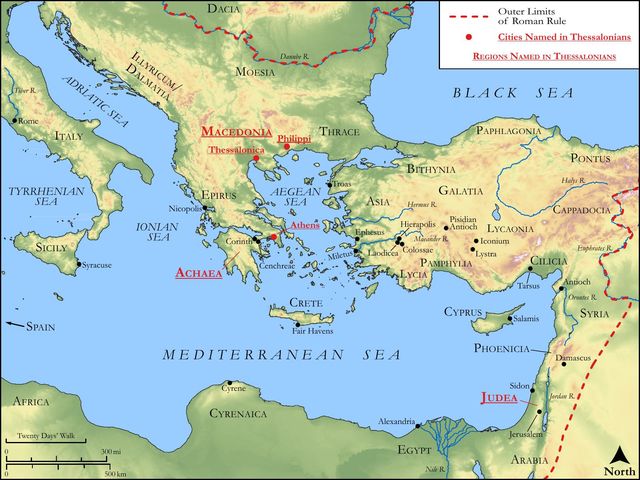
See on the biblical-era maps

Study this verse
Public-domain commentary
Matthew Henry
From his Commentary on the Whole Bible. Henry comments on passages, not single verses — this entry covers 2 Thessalonians 1:1–4. His three-level outline is real structure in the source text, so it is rendered as structure.
Here we have,
I.The introduction (Th2 1:1, Th2 1:2), in the same words as in the former epistle, from which we may observe that as this apostle did not count it grievous to him to write the same things (Phi 3:1) in his epistles that he had delivered in preaching, so he willingly wrote the same things to one church that he did to another. The occurrence of the same words in this epistle as in the former shows us that ministers ought not so much to regard the variety of expression and elegance of style as the truth and usefulness of the doctrines they preach. And great care should be taken lest, from an affectation of novelty in method and phrases, we advance new notions or doctrines, contrary to the principles of natural or revealed religion, upon which this church of the Thessalonians was built, as all true churches are; namely, in God our Father and the Lord Jesus Christ.
II.The apostle's expression of the high esteem he had for them.
He not only had a great affection for them (as he had expressed in his former epistle, and now again in his pious wish of grace and peace for them), but he also expresses his great esteem for them, concerning which observe,
1.How his esteem of them is expressed.
(1.)He glorified God on their behalf: We are bound to thank God always for you, brethren, as it is meet, Th2 1:3. He chose rather to speak of what was praiseworthy in them in a way of thanksgiving to God than by commendation of them; and, as what he mentions was matter of his rejoicing, he accounted it matter of thanksgiving, and it was meet or fit it should be so, for we are bound, and it is our duty, to be thankful to God for all the good that is found in us or others: and it not only is an act of kindness to our fellow-christians, but our duty, to thank God on their behalf.
(2.)He also glories in them before the churches of God, Th2 1:4. The apostle never flattered his friends, but he took pleasure in commending them, and speaking well of them, to the glory of God and for the excitement and encouragement of others. Paul did not glory in his own gifts, nor in his labour among them, but he gloried in the grace of God which was bestowed upon them, and so his glorying was good, because all the commendation he gave to them, and the pleasure he took himself, centered in the praise and glory of God.
2.For what he esteemed them and thanked God; namely, the increase of their faith, and love, and patience. In his former epistle (Th1 1:3) he gave thanks for their faith, love, and patience; here he gives thanks for the increase of all those graces, that they were not only true Christians, but growing Christians. Note, Where there is the truth of grace there will be increase of it. The path of the just is as the shining light, which shines more and more unto the perfect day. And where there is the increase of grace God must have all the glory of it. We are as much indebted to him for the improvement of grace, and the progress of that good work, as we are for the first work of grace and the very beginning of it. We may be tempted to think that though when we were bad we could not make ourselves good, yet when we are good we can easily make ourselves better; but we have as much dependence on the grace of God for increasing the grace we have as for planting grace when we had it not. The matter of the apostle's thanksgiving and glorying on behalf of the Thessalonians was,
(1.)That their faith grew exceedingly, Th2 1:3. They were more confirmed in the truth of gospel-revelations, confided in gospel-promises, and had lively expectations of another world. The growth of their faith appeared by the works of faith; and, where faith grows, all other graces grow proportionably.
(2.)Their charity abounded (Th2 1:3), their love to God and man. Note, Where faith grows love will abound, for faith works by love; and not only the charity of some few of them, but of every one to each other, did abound. There were no such divisions among them as in some other churches.
(3.)Their patience as well as faith increased in all their persecutions and tribulations. And patience has then its perfect work when it extends itself to all trials. There were many persecutions which the Thessalonians endured for the sake of righteousness, as well as other troubles which they met with in this calamitous life; yet they endured all these, by faith seeing him that is invisible, and looking to the recompence of reward; and endured them with patience, not with an insensibility under them, but with patience arising from Christian principles, which kept them quiet and submissive, and afforded them inward strength and support.
Historical interpretation
Nine Centuries of Reception
6 surviving comments on this verse. Each one is dated, so this reads as a timeline rather than a list.
Select a marker to jump to its quote. Markers stagger vertically where authors wrote within a few decades of each other.
Paul adds in a fitting manner, so that they testify that great thanks must be given to God for such an infinite gift.
"We are bound to give thanks to God alway for you, brethren, even as it is meet."
Again a sign of great humility. For he led them to reflect and consider, that if for our good actions others do not admire us first, but God, much more also ought we. And in other respects too he raises up their spirits, because they suffer such things as are not worthy of tears and lamentations, but of thanksgiving to God. But if Paul is thankful for the good of others, what will they suffer, who not only are not thankful, but even pine at it.
"For that your faith groweth exceedingly, and the love of each one of you all toward one another aboundeth."
And how, you say, can faith increase? That is when we suffer something dreadful for it. It is a great thing for it to be established, and not to be carried away by reasonings. But when the winds assail us, when the rains burst upon us, when a violent storm is raised on every side, and the waves succeed each other-then that we are not shaken, is a proof of no less than this, that it grows, and grows exceedingly, and becomes loftier. For as in the case of the flood all the stony and lower parts are soon hidden, but as many things as are above, it reaches not them, so also the faith that is become lofty, is not drawn downwards. For this reason he does not say "your faith groweth;" but "groweth exceedingly, and the love of each one of you all toward one another aboundeth." Seest thou how this contributes for the ease of affliction, to be in close guard together, and to adhere to one another? From this also arose much consolation. The love and faith, therefore, that is weak, afflictions shake, but that which is strong they render stronger. For a soul that is in grief, when it is weak, can add nothing to itself; but that which is strong doth it then most. And observe their love. They did not love one indeed, and not love another, but it was equal on the part of all. For this he has intimated, by saying, "of each one of you all toward one another." For it was equally poised, as that of one body. Since even now we find love existing among many, but this love becoming the cause of division. For when we are knit together in parties of two or three, and the two indeed, or three or four, are closely bound to one another, but draw themselves off from the rest, because they can have recourse to these, and in all things confide in these; this is the division of love-not love. For tell me, if the eye should bestow upon the hand the foresight which it has for the whole body, and withdrawing itself from the other members, should attend to that alone, would it not injure the whole? Assuredly. So also if we confine to one or two the love which ought to be extended to the whole Church of God, we injure both ourselves and them, and the whole. For these things are not of love, but of division; schisms, and distracting rents. Since even if I separate and take a member from the whole man, the part separated indeed is united in itself, is continuous, all compacted together, yet even so it is a separation, since it is not united to the rest of the body.
For what advantage is it, that thou lovest a certain person exceedingly? It is a human love. But if it is not a human love, but thou lovest for God's sake, then love all. For so God hath commanded to love even our enemies. And if He hath commanded to love our enemies, how much more those who have never aggrieved us? But, sayest thou, I love, but not in that way. Rather, thou dost not love at all. For when thou accusest, when thou enviest, when thou layest snares, how dost thou love? "But," sayest thou, "I do none of these things." But when a man is ill spoken of, and thou dost not shut the mouth of the speaker, dost not disbelieve his sayings, dost not check him, of what love is this the sign? "And the love," he says, "of each one of you all toward one another aboundeth."
Paul seems to say here that the activity of grace has grown, for he does not say that “we give thanks” but that “we are bound to give thanks.” In the same way we deserve to have a complaint lodged against us if we do not render to someone what is justly owed. This is the force of “as is fitting,” where the point is that there has been an increase in the work of grace, such that what has happened in the Thessalonians is rightly referred to God as its source.
There could be no merit in men’s choice of Christ, if it were not that God’s grace precedes any faith or action on their part in his choosing them. This is why the apostle Paul pronounces to the Thessalonians this benediction, “The Lord make you to increase and abound in love toward one another, and toward all men.” This benediction to love one another he gave us, who had also given us a law that we should love one another. Then, in the salutation addressed to the same church where some of its members possessed the disposition which he had wished them to cultivate, Paul says, “We are bound to thank God always for you, brothers. This is quite fitting, because your faith grows robustly, and your mutual charity abounds.”
Indeed, we must note that in the first letter he does not say 'we ought to give thanks,' but 'we give thanks.' For truly there is a greater virtue in what he says, 'we ought to give thanks,' because indeed somebody can freely give thanks for some thing; but truly he who says that he ought, shows that he, too, is a debtor. Therefore the Apostle shows that he, too, is a debtor.
because your faith is increasing greatly, and because the charity of each of you toward one another is abundant
Certainly with these words they show the connection and narration of the first letter, since they show to them the progress of the same persons, in order that they might love the good things which they were more devotedly doing. In this act preachers are instructed that, while they know that their hearers have made progress, they must desire to show to them the same progress. To the extent that they give attention to their own progress, they should also love more firmly the good things which they do, and they should try to be imitators of the Thessalonians.
'we ought to give thanks,'
Paul mentions things that ought to be present in thanksgiving. First, thanksgiving should be directed to God:
we give thanks always to God.
“He bestows favor and honor” (Ps. 84:11). “Every good endowment and every perfect gift is from above, coming down from the Father of lights” (Jas. 1: 17). Thanksgiving should be unceasing; so Paul says, always.
Continue studying 2 Thessalonians 1:3 across the web’s major study libraries — every link below opens this exact verse, chapter, or book on the destination site.
Read & Compare
 BibleGatewayThis verse in more than 200 translations and 70 languages.
 Bible.comThe YouVersion reader — hundreds of translations, reading plans, and highlights.
 ESV.orgCrossway's official English Standard Version reader.
 NET BibleThe NET translation with 60,000+ translators' notes on every rendering decision.
 STEP BibleTyndale House's free study tool — original text, vocabulary, and scholarly resources.
 BibliaLogos Bible Software's free web reader.
 USCCBThe New American Bible (Revised Edition) with the U.S. bishops' study notes.
Commentaries
 BibleHub CommentariesDozens of classic commentaries on this verse, gathered on one page.
 StudyLightMore than 100 commentary sets — the largest collection on the web.
 BibleRefPlain-English commentary on what this verse means, verse by verse.
 Enduring WordDavid Guzik's free commentary on this chapter, widely used by Bible teachers.
 Bible Study ToolsVerse commentary alongside Greek and Hebrew study aids.
Original Language & Research
- BibleHub InterlinearThe verse word by word — original language, transliteration, and English.
- BibleHub LexiconEvery word's original-language definition and Strong's entry.
 Blue Letter BibleDeep-study tools — Strong's numbers, concordance, and word studies.
 CNTR CollationThe earliest Greek manuscripts of this verse, collated letter by letter.
Sermons, Hymns & Audio


TrulyRandomVerse is not affiliated with these sites and doesn’t control their content. They’re linked because they’re genuinely useful.
Summary
In 2 Thessalonians 1:3, the Apostle Paul, along with Silvanus and Timotheus, expresses profound and obligatory gratitude to God for the Thessalonian believers. This thanksgiving is prompted by their exceptional spiritual growth, evidenced by their faith that is "growing exceedingly" and their "charity" (love) for one another that "aboundeth." This verse serves as a powerful commendation of their spiritual vitality and perseverance amidst trials, setting an encouraging and appreciative tone for the entire epistle.
Context
ShowHideLiterary Context
This verse initiates the body of Paul's second letter to the Thessalonians, immediately following the salutation in 2 Thessalonians 1:1-2. It functions as an opening thanksgiving, a common feature in Pauline epistles, which serves to build rapport and introduce the letter's main themes. This particular thanksgiving sets a positive tone, affirming the Thessalonians' spiritual progress before addressing the more challenging topics of persecution and eschatological clarification that dominate the rest of the letter, particularly in 2 Thessalonians 1:4-10. The commendation of their faith and love provides a foundation for Paul's subsequent exhortations and teachings.
Historical & Cultural Context
Written likely from Corinth, shortly after the first letter (circa AD 51-52), 2 Thessalonians addresses a young church established during Paul's second missionary journey. The Thessalonian Christians were facing significant persecution, as evidenced by Paul's earlier comments in 1 Thessalonians 2:14 and his direct acknowledgement in 2 Thessalonians 1:4. Despite these external pressures and internal misunderstandings about the Day of the Lord, their spiritual state was remarkably robust. Paul's emphasis on their growing faith and abounding love highlights the counter-cultural nature of Christian community, where adversity often strengthens rather than diminishes spiritual virtues.
Key Themes
ShowHideThis verse contributes to several overarching themes in 2 Thessalonians and Paul's broader theology. It underscores the theme of Divine Obligation and Gratitude, presenting thanksgiving for the spiritual growth of others not merely as an option but as a fitting and necessary response to God's work. The mention of their "faith groweth exceedingly" highlights the theme of Progressive Sanctification and Spiritual Maturity, emphasizing that Christian life is a dynamic journey of increasing trust and reliance on God, even amidst suffering (as seen in Philippians 1:6). Furthermore, the "charity of every one of you all toward each other aboundeth" powerfully reinforces the theme of Agape Love as a Mark of True Discipleship, demonstrating that genuine faith expresses itself in overflowing, selfless love within the community, a concept central to Paul's teachings, particularly in 1 Corinthians 13.
Exposition and Analysis
ShowHideKey Word Analysis
ShowHideThis word signifies a moral obligation or duty, indicating that Paul and his companions felt it was not merely appropriate but necessary and fitting to give thanks to God for the Thessalonians. It implies a sense of indebtedness or a proper response to God's gracious work.
A compound verb formed from "hyper" (over, above) and "auxano" (to grow), this term powerfully conveys the idea of an extraordinary, super-abundant, or exponential growth. It suggests their faith was not merely increasing, but thriving beyond expectation, flourishing remarkably.
This is the distinctive New Testament word for divine, selfless, unconditional love. It describes a benevolent, volitional love that seeks the highest good of the other, distinct from familial affection (philia) or romantic desire (eros). Here, it specifically refers to the practical, self-sacrificing love demonstrated by the Thessalonian believers for one another.
Verse Breakdown
ShowHide"We are bound to thank God always for you, brethren, as it is meet,"
Paul, Silvanus, and Timotheus declare their deep and constant obligation to give thanks to God on behalf of the Thessalonian believers. The phrase "as it is meet" (G514, áxios) reinforces that this thanksgiving is not optional but entirely appropriate and fitting, a proper response to what God has accomplished in them. It highlights a divine imperative to acknowledge God's work in the lives of others.
"because that your faith groweth exceedingly,"
This clause provides the primary reason for their thanksgiving. The Thessalonians' faith was not stagnant but was actively and remarkably increasing, even "super-growing." This indicates a dynamic and vibrant spiritual life, suggesting that their trust and confidence in God were deepening and expanding significantly, likely in response to the trials they were enduring.
"and the charity of every one of you all toward each other aboundeth;"
The second reason for gratitude is the overflowing nature of their love. "Charity" (agape) refers to their selfless, benevolent love, which was not just present but "abounding" (G4121, pleonázō), meaning it was increasing, overflowing, and lavishly demonstrated among all members of the community. This mutual love served as a powerful testament to their genuine transformation and the presence of God's Spirit within them.
Literary Devices
ShowHideThe verse employs several significant literary devices. Hyperbole is evident in the phrases "groweth exceedingly" and "aboundeth," which emphasize the extraordinary and overflowing nature of the Thessalonians' faith and love. While not strictly hyperbole in the sense of exaggeration, these terms convey a growth beyond the ordinary, highlighting its remarkable quality. The use of Parallelism is also clear, as Paul lists two distinct but related virtues—faith and love—both described with verbs indicating super-abundant growth. This structural balance underscores the dual pillars of their spiritual maturity. Furthermore, the verse uses Metaphor in the concept of "growing" faith, likening spiritual development to organic growth, suggesting vitality, natural progression, and a living, dynamic quality. The term "aboundeth" for love also carries a metaphorical sense of an overflowing river or spring, indicating an inexhaustible and generous supply.
Theological and Thematic Connections
ShowHideThis verse profoundly connects to the New Testament's emphasis on the dynamic nature of Christian life. It teaches that genuine faith is not static but is characterized by continuous growth and that this growth is intrinsically linked to an increasing, selfless love for fellow believers. Paul's "bound" obligation to give thanks underscores the theological truth that all spiritual progress is ultimately God's work, prompting gratitude. The flourishing of faith and love in the midst of persecution also highlights God's sustaining power and the resilience of the church, demonstrating that adversity can serve as a catalyst for deeper spiritual maturity and communal solidarity.
Reflection and Application
ShowHidePaul's commendation of the Thessalonians serves as a powerful mirror for contemporary believers and churches. It challenges us to examine the quality and trajectory of our own faith and love. Is our faith merely present, or is it "growing exceedingly," deepening in conviction and trust, especially when faced with trials or uncertainties? Is our love for fellow believers merely adequate, or does it "abound," overflowing in practical service, forgiveness, and genuine concern for one another? This verse calls us to cultivate a culture of gratitude, recognizing and celebrating God's work in the lives of others, and to actively pursue spiritual growth not just individually, but corporately, as a visible testimony to the transforming power of the Gospel. It reminds us that authentic Christian discipleship is marked by both an increasing trust in God and an overflowing, self-sacrificial love for His people.
Questions for Reflection
ShowHideFAQ
ShowHideWhy was Paul "bound" to thank God for the Thessalonians?
ShowHidePaul felt "bound" (Greek, opheílō) to thank God because it was a moral obligation and a fitting response to God's evident work among the Thessalonians. Their remarkable spiritual growth—their faith "growing exceedingly" and their love "abounding"—was clearly a result of divine grace and power, not merely human effort. Therefore, giving thanks to God was the appropriate and necessary acknowledgment of His active presence and blessing in their lives, demonstrating Paul's deep appreciation for God's faithfulness to His people, as seen in the spirit of gratitude expressed throughout his letters, such as in Philippians 1:3-5.
What does "groweth exceedingly" mean for our faith today?
ShowHide"Groweth exceedingly" (Greek, hyperauxánō) implies an extraordinary, super-abundant, or exponential growth. For our faith today, this means that Christian faith is not meant to be static or stagnant. It's a dynamic, living trust in God that should deepen and expand over time, especially through trials and experiences that test and refine it. It suggests a faith that is not just maintained but actively thrives, becoming more robust, resilient, and influential in every aspect of life, reflecting the call to mature in Christ found in passages like Ephesians 4:15.
Christ-Centered Fulfillment
ShowHideWhile 2 Thessalonians 1:3 directly commends the Thessalonians' growth in faith and love, it implicitly points to Christ as the ultimate source and object of these virtues. The "faith" that "groweth exceedingly" is ultimately faith in Jesus Christ, whose life, death, and resurrection provide the foundation for all Christian belief and hope. It is through His finished work that believers are empowered by the Holy Spirit to grow in spiritual maturity. Similarly, the "charity" (love) that "aboundeth" among them is a reflection of the very nature of God, who is love (1 John 4:8), and supremely demonstrated in Christ's sacrificial love on the cross (John 15:13). Jesus Himself commanded His disciples to love one another as He had loved them (John 13:34-35), making this abounding love a defining characteristic of His followers. Thus, the Thessalonians' commendable spiritual state is not merely a testament to their own effort, but a powerful witness to the transformative power of the Gospel of Jesus Christ, actively at work within His body, the church. Their growth serves as a living illustration of the new creation in Christ, where believers are continually being conformed to His image (Romans 8:29).