


1 Thessalonians 2:14
Bible text: King James Version (1769 Blayney text) · Public domain
Bible text: King James Version with Strong's numbers · Public domain
Bible text: Berean Standard Bible · Public domain
Bible text: American Standard Version (1901) · Public domain
Bible text: World English Bible, Messianic edition · Public domain
Bible text: Geneva Bible (1599) · Public domain
Bible text: Young's Literal Translation · Public domain
- ὑμεῖςhumeisyou yourselvesG4771P-2NPPersonal pronoun Nominative 2nd Plural
- γὰρgarforG1063CONJConjunction
- μιμηταὶmimētaiimitatorsG3402N-NPMNoun Nominative Plural Masculine
- ἐγενήθητεegenēthētebecameG1096V-2AOI-2PVerb 2nd Aorist Passive Deponent Indicative 2nd Plural
- ἀδελφοίadelphoibrothersG80N-VPMNoun Vocative Plural Masculine
- τῶνtōnof theG3588T-GPFDefinite article Genitive Plural Feminine
- ἐκκλησιῶνekklēsiōnchurchesG1577N-GPFNoun Genitive Plural Feminine
- τοῦtou<the>G3588T-GSMDefinite article Genitive Singular Masculine
- θεοῦtheouof GodG2316N-GSM-TNoun Genitive Singular Masculine Title
- τῶνtōnwhichG3588T-GPFDefinite article Genitive Plural Feminine
- οὐσῶνousōnare beingG1510V-PAP-GPFVerb Present Active Participle Genitive Plural Feminine
- ἐνeninG1722PREPPreposition
- τῇtēa<the>G3588T-DSFDefinite article Dative Singular Feminine
- ἸουδαίᾳIoudaiaJudeaG2449N-DSF-LNoun Dative Singular Feminine Location
- ἐνeninG1722PREPPreposition
- ΧριστῷChristōChristG5547N-DSM-TNoun Dative Singular Masculine Title
- ἸησοῦIēsouJesusG2424N-DSM-PNoun Dative Singular Masculine Individual
- ὅτιhotiForG3754CONJConjunction
- τὰtathe [same]G3588T-APNDefinite article Accusative Plural Neuter
- αὐτὰautatheseG846P-APNPersonal pronoun Accusative Plural Neuter
- ἐπάθετεepathetesufferedG3958V-2AAI-2PVerb 2nd Aorist Active Indicative 2nd Plural
- καὶkaialsoG2532CONJConjunction
- ὑμεῖςhumeisyou yourselvesG4771P-2NPPersonal pronoun Nominative 2nd Plural
- ὑπὸhupofromG5259PREPPreposition
- τῶνtōn<the>G3588T-GPMDefinite article Genitive Plural Masculine
- ἰδίωνidiōn[your] ownG2398A-GPMAdjective Genitive Plural Masculine
- συμφυλετῶνsumphuletōncountrymenG4853N-GPMNoun Genitive Plural Masculine
- καθὼςkathōseven asG2531CONJConjunction
- καὶkaialso [did]G2532CONJConjunction
- αὐτοὶautoitheyG846P-NPMPersonal pronoun Nominative Plural Masculine
- ὑπὸhupofromG5259PREPPreposition
- τῶνtōntheG3588T-GPMDefinite article Genitive Plural Masculine
- ἸουδαίωνIoudaiōnJewsG2453N-GPM-PGNoun Genitive Plural Masculine Person Gentilic
English is a literal word-by-word gloss of the Greek, not the KJV's wording. Why?
This is the original text the KJV's translators worked from — each Greek word with its own literal English meaning in this verse, prepared by scholars at Tyndale House, Cambridge. The KJV translates whole sentences, not word by word, so its wording differs: one Greek word can become several English words, and the KJV may choose “charity” where the gloss reads “love”. Both are faithful — they answer different questions. For the KJV's own rendering, switch to the KJV text.
Details
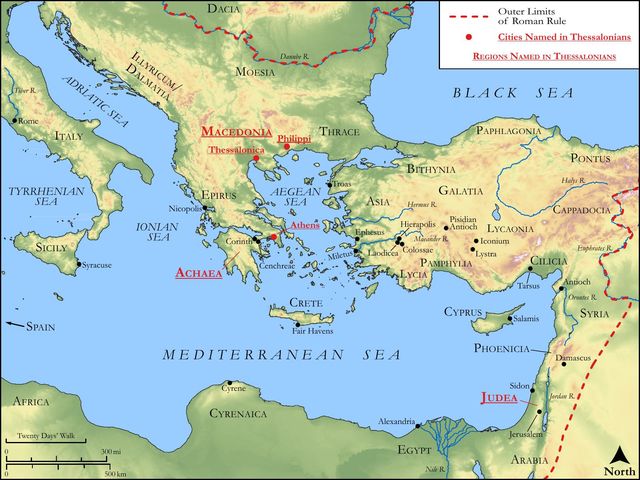
See on the biblical-era maps

Study this verse
Public-domain commentary
Matthew Henry
From his Commentary on the Whole Bible. Henry comments on passages, not single verses — this entry covers 1 Thessalonians 2:13–16. His three-level outline is real structure in the source text, so it is rendered as structure.
Here observe, I. The apostle makes mention of the success of his ministry among these Thessalonians (Th1 2:13), which is expressed,
1.By the manner of their receiving the word of God: When you received the word of God, which you heard of us, you received it, not as the word of men, but (as it is in truth) the word of God. Where note,
(1.)The word of the gospel is preached by men like ourselves, men of like passions and infirmities with others: We have this treasure in earthen vessels. The word of God, which these Thessalonians received, they heard from the apostles.
(2.)However, it is in truth the word of God. Such was the word the apostles preached by divine inspiration, and such is that which is left upon record, written in the scriptures by divine inspiration; and such is that word which in our days is preached, being either contained, or evidently founded on, or deduced fRom. these sacred oracles.
(3.)Those are greatly to blame who give out their own fancies or injunctions for the word of God. This is the vilest way of imposing upon a people, and to deal unfaithfully.
(4.)Those are also to blame who, in hearing the word, look no further than to the ministry of men, who are only, or chiefly, pleased with the elegance of the style, or the beauty of the composition, or the voice and manner in which the word is preached, and expect to receive their advantage herein.
(5.)We should receive the word of God as the word of God, with affections suitable to the holiness, wisdom, verity, and goodness, thereof. The words of men are frail and perishing, like themselves, and sometimes false, foolish, and fickle: but God's word is holy, wise, just, and faithful; and, like its author, lives and abides for ever. Let us accordingly receive and regard it.
2.By the wonderful operation of this word they received: It effectually worketh in those that believe, Th1 2:13. Those who by faith receive the word find it profitable. It does good to those that walk uprightly, and by its wonderful effects evidences itself to be the word of God. This converts their souls, and enlightens their minds, and rejoices their hearts (Psa 19:1-14); and such as have this inward testimony of the truth of the scriptures, the word of God, by the effectual operations thereof on their hearts, have the best evidence of their divine original to themselves, though this is not sufficient to convince others who are strangers thereto.
II.He mentions the good effects which his successful preaching had,
1.Upon himself and fellow-labourers. It was a constant cause of thankfulness: For this cause thank we God without ceasing, Th1 2:13. The apostle expressed his thankfulness to God so often upon this account that he seemed to think he never could be sufficiently thankful that God had counted him faithful, and put him into the ministry, and made his ministrations successful.
2.Upon them. The word wrought effectually in them, not only to be examples unto others in faith and good works (which he had mentioned before), but also in constancy and patience under sufferings and trials for the sake of the gospel: You became followers of the churches of God, and have suffered like things as they have done (Th1 2:14), and with like courage and constancy, with like patience and hope. Note, The cross is the Christian's mark: if we are called to suffer we are called only to be followers of the churches of God; so persecuted they the prophets that were before you, Mat 5:12. It is a good effect of the gospel when we are enabled to suffer for its sake. The apostle mentions the sufferings of the churches of God, which in Judea were in Christ Jesus. Those in Judea first heard the gospel, and they first suffered for it: for the Jews were the most bitter enemies Christianity had, and were especially enraged against their countrymen who embraced Christianity. Note, Bitter zeal and fiery persecution will set countrymen at variance, and break through all the bonds of nature, as well as contradict all the rules of religion. In every city where the apostles went to preach the gospel the Jews stirred up the inhabitants against them. They were the ringleaders of persecution in all places; so in particular it was at Thessalonica: Act 17:5, The Jews that believed not, moved with envy, took unto them certain lewd fellows of the baser sort, and gathered a company, and set all the city in an uproar. Upon this occasion, the apostle gives a character of the unbelieving Jews (Th1 2:15), enough to justify their final rejection and the ruin of their place, and church, and nation, which was now approaching.
(1.)They killed the Lord Jesus, and impudently and presumptuously wished that his blood might be on them and their children.
(2.)They killed their own prophets: so they had done all along; their fathers had done so: they had been a persecuting generation.
(3.)They hated the apostles, and did them all the mischief they could. They persecuted them, and drove and chased them from place to place: and no marvel, if they killed the Lord Jesus, that they persecuted his followers.
(4.)They pleased not God. They had quite lost all sense of religion, and due care to do their duty to God. It was a most fatal mistake to think that they did God service by killing God's servants. Murder and persecution are most hateful to God and cannot be justified on any pretence; they are so contrary to natural religion that no zeal for any true or only pretended institution of religion can ever excuse them.
(5.)They were contrary to all men. Their persecuting spirit was a perverse spirit; contrary to the light of nature, and contrary to humanity, contrary to the welfare of all men, and contrary to the sentiments of all men not under the power of bigotry.
(6.)They had an implacable enmity to the Gentiles, and envied them the offers of the gospel: Forbidding the apostles to speak to the Gentiles, that they might be saved. The means of salvation had long been confined to the Jews. Salvation is of the Jews, says our Saviour. And they were envious against the Gentiles, and angry that they should be admitted to share in the means of salvation. Nothing provoked them more than our Saviour's speaking to them at any time concerning this matter; this enraged the Jews at Jerusalem, when, in his defence, Paul told them, he was sent unto the Gentiles, Act 22:21. They heard him patiently till he uttered these words, but then could endure no longer, but lifted up their voices, and said, Away with such a fellow from the earth, for it is not fit that he should live. Thus did the Jews fill up their sins; and nothing tends more to any person or people's filling up the measure of their sins than opposing the gospel, obstructing the progress of it, and hindering the salvation of precious souls. For the sake of these things wrath has come upon them to the uttermost; that is, wrath was determined against them, and would soon overtake them. It was not many years after this that Jerusalem was destroyed, and the Jewish nation cut off by the Romans. Note, When the measure of any man's iniquity is full, and he has sinned to the uttermost, then comes wrath, and that to the uttermost.
Historical interpretation
Two Centuries of Reception
3 surviving comments on this verse. Each one is dated, so this reads as a timeline rather than a list.
Select a marker to jump to its quote. Markers stagger vertically where authors wrote within a few decades of each other.
“But Jesus said unto them, A prophet is not without honor, save in his own country.” We must inquire whether the expression has the same force when applied universally to every prophet (as if all prophets are dishonored in their own country). Or, it may be the case that because the expression “a prophet” is in the singular, these things were said only about one. If, then, these words are spoken about one person, these things which have been said suffice, if we refer that which was written to the Savior. But if it is a general principle in view, it is not historically true; for Elijah was not dishonored in Tishbeth of Gilead, nor Elisha in Abelmeholah, nor Samuel in Ramathaim, nor Jeremiah in Anathoth. But figuratively interpreted, it is absolutely true; for we must think of Judea as their country and Israel as their kindred and perhaps of the body as the house. For all suffered dishonor in Judea from the Israel which is according to the flesh, while they were yet in the body. Thus it is written in the Acts of the Apostles, as Stephen censured the people, “Which of the prophets did not your fathers persecute, who appeared before of the coming of the Righteous One?” And Paul says similar things in his first letter to the Thessalonians: “For you brethren became imitators of the churches of God which are in Judaea in Christ Jesus, for you also suffered the same things of your own countrymen even as they did of the Jews, who both killed the Lord Jesus and the prophets, and drove us out, and please not God, and are contrary to all men.”
Are we worthy, then, so much as even to mention the name of Paul? He had, in addition, the help of grace, yet did not presume that grace eliminated the need to take chances. We, on the other hand, who are destitute of the confidence grace brings, on what basis, tell me, do we expect either to preserve those who are committed to our charge or to gain those who have not come to the fold? We, indeed, are those who have been making a study of self-indulgence, who are searching the world over for ease and who are unable or rather unwilling to endure the slightest hint of danger. We are as far distant from Paul’s wisdom as earth is from heaven. So it is, too, that they who are under us fall so far short of the men of those days. The reason is that the disciples of those days were better than the teachers of the present, isolated as they were in the midst of the populace, tyrants, surounded by enemies on all sides, and yet not in the slightest degree dragged down or giving up. Hear at least what Paul says to the Philippians: “Because to you it has been granted in the behalf of Christ, not only to believe on him but also to suffer in his behalf.” And again to the Thessalonians, “For you, brethren, became imitators of the churches of God which are in Judea.” … And you see them too, all employed in doing good. And so in those days grace worked effectually, and they also lived in good works.
"For ye, brethren, became imitators of the Churches of God, which are in Judaea in Christ Jesus: for ye also suffered the same things of your own countrymen, even as they did of the Jews; who both killed the Lord Jesus and their own prophets, and drave out us, and please not God, and are contrary to all men; forbidding us to speak to the Gentiles that they may be saved; to fill up their sins alway: but the wrath is come upon them to the uttermost."
"For ye," he says, "became imitators of the Churches of God which are in Judaea." This is a great consolation. It is no wonder, he says, that they should do these things to you, inasmuch as they have done it also to their own countrymen. And this too is no little proof that the Preaching is true, that even Jews were able to endure all things. "For ye also," he says, "have suffered the same things of your own countrymen, even as they did of the Jews." There is something more in his saying, "as they also did in Judaea"; it shows that everywhere they rejoiced, as having nobly contended. He says therefore, "that ye also suffered the same things." And again, what wonder is it, if to you also, when even to the Lord they dared do such things?
Do you see how he introduces this as containing great consolation? And constantly he adverts to it; and upon a close examination one may find it in nearly all his Epistles, how variously, upon all occasions of temptation, he brings forward Christ. Observe accordingly, that here also, when accusing the Jews, he puts them in mind of the Lord, and of the sufferings of the Lord; so well does he know that this is a matter of the greatest consolation.
"Who both killed the Lord," he says-but, perhaps, they did not know Him,-assuredly they did know Him. What then? Did they not slay and stone their own prophets, whose books even they carry about with them? And they did not do this for the sake of truth. There is therefore not only a consolation under the temptations, but they are reminded not to think that (the Jews) did it for the truth's sake, and be troubled on that account. "And drave out us," he says. And we also, he says, have suffered numberless evils. "And please not God, and are contrary to all men; forbidding us to speak to the Gentiles, that they may be saved." "Contrary to all men," he says. How? Because if we ought to speak to the world, and they forbid us, they are the common enemies of the world. They have slain Christ and the prophets, they insult God, they are the common enemies of the world, they banish us, when coming for their salvation. What wonder if they have done such things also to you, when they have done them even in Judaea? "Forbidding us to speak to the Gentiles, that they might be saved." It is a mark of envy therefore to hinder the salvation of all. "To fill up their sins alway. But the wrath is come upon them to the uttermost." What is "to the uttermost"? These things are no longer like the former. There is here no return back, no limit. But the wrath is nigh at hand. Whence is this manifest? From that which Christ foretold. For not only is it a consolation to have partakers in our afflictions, but to hear also that our persecutors are to be punished. And if the delay is a grievance, let it be a consolation that they will never lift up their heads again; or rather he hath cut short the delay, by saying, "The wrath," showing that it was long ago due, and predetermined, and predicted.
Continue studying 1 Thessalonians 2:14 across the web’s major study libraries — every link below opens this exact verse, chapter, or book on the destination site.
Read & Compare
 BibleGatewayThis verse in more than 200 translations and 70 languages.
 Bible.comThe YouVersion reader — hundreds of translations, reading plans, and highlights.
 ESV.orgCrossway's official English Standard Version reader.
 NET BibleThe NET translation with 60,000+ translators' notes on every rendering decision.
 STEP BibleTyndale House's free study tool — original text, vocabulary, and scholarly resources.
 BibliaLogos Bible Software's free web reader.
 USCCBThe New American Bible (Revised Edition) with the U.S. bishops' study notes.
Commentaries
 BibleHub CommentariesDozens of classic commentaries on this verse, gathered on one page.
 StudyLightMore than 100 commentary sets — the largest collection on the web.
 BibleRefPlain-English commentary on what this verse means, verse by verse.
 Enduring WordDavid Guzik's free commentary on this chapter, widely used by Bible teachers.
 Bible Study ToolsVerse commentary alongside Greek and Hebrew study aids.
Original Language & Research
- BibleHub InterlinearThe verse word by word — original language, transliteration, and English.
- BibleHub LexiconEvery word's original-language definition and Strong's entry.
 Blue Letter BibleDeep-study tools — Strong's numbers, concordance, and word studies.
 CNTR CollationThe earliest Greek manuscripts of this verse, collated letter by letter.
Sermons, Hymns & Audio


TrulyRandomVerse is not affiliated with these sites and doesn’t control their content. They’re linked because they’re genuinely useful.
Summary
In 1 Thessalonians 2:14, the Apostle Paul commends the believers in Thessalonica for their steadfast faith, evidenced by their endurance of persecution. He draws a profound parallel between their suffering at the hands of their own countrymen and the similar afflictions faced by the early Christian churches in Judea from Jewish opposition. This verse highlights the universal nature of Christian suffering, affirming the Thessalonians' authentic spiritual identity and their solidarity with the broader body of Christ.
Context
ShowHideLiterary Context
This verse immediately follows Paul's thanksgiving for the Thessalonians' reception of the gospel, where he praises them for accepting God's word "not as the word of men, but as it is in truth, the word of God, which effectually worketh also in you that believe" 1 Thessalonians 2:13. Verse 14 then provides concrete evidence of this effectual working: their willingness to suffer for the faith. It serves as a bridge, transitioning from Paul's commendation of their faith to his subsequent lament concerning the Jewish opposition that persecuted both the Judean churches and, by implication, hindered the spread of the gospel to the Gentiles 1 Thessalonians 2:15-16. The shared experience of suffering validates their conversion and places them firmly within the lineage of faithful believers.
Historical & Cultural Context
Thessalonica was a bustling Roman port city and the capital of Macedonia, characterized by a diverse population including Romans, Greeks, and a significant Jewish community. When Paul, Silas, and Timothy preached there, their message about Jesus as Messiah and Lord challenged both pagan idolatry and traditional Jewish expectations, leading to immediate and severe opposition. As recorded in Acts 17:5-9, some Jews, along with "lewd fellows of the baser sort," incited a riot against Paul and his companions, extending their hostility to the new believers. The "churches of God which in Judaea" refer to the earliest Christian communities, particularly those in Jerusalem and its surrounding regions. These believers, including the apostles, faced intense persecution primarily from factions within the Jewish leadership who rejected Jesus' messianic claims and the burgeoning Christian movement, as vividly depicted throughout the book of Acts, from the stoning of Stephen Acts 7:54-60 to the widespread persecution that scattered believers Acts 8:1.
Key Themes
ShowHideThis verse powerfully contributes to several key themes within 1 Thessalonians and Pauline theology. Firstly, it underscores the universal nature of Christian suffering and solidarity. Believers in Thessalonica, a predominantly Gentile city, shared a common bond of persecution with Jewish Christians in Judea, demonstrating that suffering for the gospel transcends ethnic and geographical boundaries. This fosters a profound sense of unity within the nascent Christian movement. Secondly, the verse highlights the authenticity and validation of faith through endurance. Paul often viewed the willingness to suffer for Christ as tangible proof of genuine conversion and deep commitment to the gospel. The Thessalonians' steadfastness in the face of adversity confirmed that their belief was not superficial but deeply rooted in their union with Christ. Finally, the concept of imitation is central; Paul commends the Thessalonians for becoming "followers" (Greek: mimētēs) of the Judean churches, implying not a mere copying of rituals but an active emulation of their faithful endurance in suffering. This theme of imitation, whether of Christ or faithful leaders, is a recurring motif in Paul's letters, encouraging believers to embody the character and experiences of those who truly follow God.
Exposition and Analysis
ShowHideKey Word Analysis
ShowHideThis term signifies "an imitator." In this context, it denotes more than passive observation; it implies active emulation and adherence to the pattern set by the Judean churches. The Thessalonians did not just hear about the suffering of others; they actively mirrored it in their own experience, demonstrating a shared spiritual reality and commitment.
Meaning "a calling out," this word refers to a popular meeting or, concretely, a religious congregation. Here, it specifically denotes the organized Christian communities in Judea. Paul's use of this term emphasizes the corporate, communal nature of their faith and suffering, highlighting that the Thessalonians were joining a collective body of God's people.
This primary verb means "to experience a sensation or impression (usually painful)." It directly conveys the reality of their affliction and persecution. The use of this word underscores the tangible, painful reality of the opposition faced by both groups of believers, creating a strong empathetic link between them.
Verse Breakdown
ShowHide"For ye, brethren, became followers of the churches of God which in Judaea are in Christ Jesus:"
Paul addresses the Thessalonian believers as "brethren," emphasizing their familial bond in Christ. He states that they have "become followers" or imitators of the Christian communities established in Judea. This imitation is specifically in their experience of suffering, but it also implies a shared spiritual identity and foundation "in Christ Jesus," signifying that both groups derive their life and identity from their union with Him. The phrase "churches of God" highlights the divine origin and ownership of these communities, both in Judea and Thessalonica.
"for ye also have suffered like things of your own countrymen,"
This clause provides the specific reason and nature of their imitation. The Thessalonians have "also suffered like things" (Greek: tautá, "the same things") as the Judean churches. Their persecutors were "their own countrymen," likely referring to the non-Christian Greek and Roman inhabitants of Thessalonica who were hostile to the new faith, as well as some local Jews who opposed Paul's message. This suffering was not accidental but a direct consequence of their Christian confession.
"even as they [have] of the Jews:"
This final clause completes the parallel, explicitly stating that the Judean churches suffered similar persecution "of the Jews." This refers to the opposition and hostility faced by the early Jewish Christians from their fellow Jews who rejected Jesus as the Messiah. By drawing this direct comparison, Paul validates the Thessalonians' experience, placing their suffering within a broader, shared narrative of Christian endurance and confirming the authenticity of their faith.
Literary Devices
ShowHideThe verse primarily employs Analogy and Comparison, drawing a direct parallel between the suffering of the Thessalonian believers and that of the Judean churches. This rhetorical strategy serves to validate the Thessalonians' experience, demonstrating that their persecution is not unique or isolated but part of a universal pattern for those "in Christ Jesus." Furthermore, the use of Identification is evident as Paul refers to the Thessalonians as "brethren," fostering a sense of solidarity and shared identity with the wider Christian community. The central concept of "followers" (Greek: mimētḗs) itself highlights Imitation, emphasizing that the Thessalonians' actions and experiences are mirroring the steadfastness of established Christian communities, thereby affirming their genuine connection to the body of Christ.
Theological and Thematic Connections
ShowHideThis verse profoundly articulates the theological truth that suffering is an inherent, though not always present, aspect of genuine Christian discipleship. The parallel drawn between the Thessalonians and the Judean churches underscores the unity of the body of Christ across geographical and ethnic divides, demonstrating that the experience of persecution for the gospel is a shared bond that transcends cultural differences. It affirms that the authenticity of faith is often tested and proven through adversity, validating the believers' commitment to Christ. This shared suffering is not merely a negative experience but a participation in the historical reality of the church, connecting contemporary believers to the earliest expressions of Christian faith and endurance.
Reflection and Application
ShowHideFirst Thessalonians 2:14 offers timeless lessons for believers today, reminding us that the path of discipleship is often marked by opposition, yet also by profound solidarity. In a world that frequently resists the values and truths of the Kingdom of God, Christians should not be surprised by hostility or misunderstanding. This verse encourages us to view such experiences not as anomalies, but as a shared heritage with believers across history and around the globe. Our endurance in the face of challenges, whether overt persecution or subtle societal pressures, serves as a powerful testimony to the transforming power of the gospel and the reality of our union with Christ. It calls us to find strength in the knowledge that we are part of a vast, interconnected family of faith, united by a common Lord and a common experience of His redemptive work, even amidst adversity.
Questions for Reflection
ShowHideFAQ
ShowHideWho are 'the churches of God which in Judaea' mentioned in this verse?
ShowHide"The churches of God which in Judaea" refers to the earliest Christian communities established in the region of Judea, particularly Jerusalem, where the Christian movement originated. These were primarily Jewish believers who had accepted Jesus as the Messiah. They faced significant opposition and persecution from certain factions within the Jewish leadership and wider society who rejected Jesus' claims and the burgeoning Christian faith, as extensively documented in the book of Acts (e.g., Acts 8:1, Acts 12:1-3). Paul uses them as a foundational example of faithful endurance in the face of adversity.
What kind of suffering did the Thessalonians experience from 'their own countrymen'?
ShowHideThe suffering experienced by the Thessalonian believers from "their own countrymen" likely encompassed various forms of persecution. As recorded in Acts 17:5-9, Paul and his companions, and by extension the new converts, faced mob violence, public accusations, and harassment instigated by some Jewish residents and "lewd fellows of the baser sort" among the Gentile population. This could have included social ostracization, economic discrimination, verbal abuse, false accusations, and physical assault. Their adherence to Christ challenged the established pagan cults and Roman imperial worship, leading to significant societal pressure and hostility.
Why does Paul compare the Thessalonians' suffering to that of the Judean churches?
ShowHidePaul compares the Thessalonians' suffering to that of the Judean churches for several crucial reasons. Firstly, it validates the Thessalonians' experience, assuring them that their persecution is not unique or a sign of God's disfavor, but rather a shared reality for those who follow Christ. Secondly, it fosters a sense of unity and solidarity within the nascent Christian movement, showing that believers, regardless of their ethnic or geographical background, are part of one body of Christ united by a common faith and often a common experience of opposition. Thirdly, by becoming "followers" or "imitators" of the Judean churches in their endurance, the Thessalonians' faith is affirmed as authentic and deeply rooted, mirroring the steadfastness of the earliest and most established Christian communities.
Christ-Centered Fulfillment
ShowHideThe suffering endured by the Thessalonian believers, mirroring that of the Judean churches, finds its ultimate significance and fulfillment in the person and work of Jesus Christ. Their experience of persecution is not merely a historical parallel but a participation in the very pattern of Christ's life and mission. Jesus Himself declared that His followers would face rejection and hatred from the world, just as He did John 15:18-20. He is the ultimate example of suffering for righteousness, enduring the cross "for the joy that was set before him" Hebrews 12:2. The Thessalonians, "in Christ Jesus," were not merely imitating human churches but were, by extension, participating in the sufferings of Christ, filling up "that which is behind of the afflictions of Christ" in their flesh for His body's sake Colossians 1:24. Their endurance was a testament to the power of Christ working within them, enabling them to stand firm, knowing that if they suffer with Him, they will also reign with Him 2 Timothy 2:12. Thus, their suffering, and all Christian suffering, is not random but deeply connected to the redemptive narrative of Christ, identifying believers with their crucified and risen Lord, and anticipating their future glory with Him Romans 8:17.