


Galatians 1:22
- ἤμηνēmēnI wasG1510V-IMI-1SVerb Imperfect Middle Indicative 1st Singular
- δὲdethenG1161CONJConjunction
- ἀγνοούμενοςagnooumenosunknownG50V-PPP-NSMVerb Present Passive Participle Nominative Singular Masculine
- τῷtō<the>G3588T-DSNDefinite article Dative Singular Neuter
- προσώπῳprosōpōby faceG4383N-DSNNoun Dative Singular Neuter
- ταῖςtaisto theG3588T-DPFDefinite article Dative Plural Feminine
- ἐκκλησίαιςekklēsiaischurchesG1577N-DPFNoun Dative Plural Feminine
- τῆςtēs<the>G3588T-GSFDefinite article Genitive Singular Feminine
- ἸουδαίαςIoudaiasof JudeaG2449N-GSF-LNoun Genitive Singular Feminine Location
- ταῖςtaisthat [are]G3588T-DPFDefinite article Dative Plural Feminine
- ἐνeninG1722PREPPreposition
- ΧριστῷChristōChristG5547N-DSM-TNoun Dative Singular Masculine Title
English is a literal word-by-word gloss of the Greek, not the KJV's wording. Why?
This is the original text the KJV's translators worked from — each Greek word with its own literal English meaning in this verse, prepared by scholars at Tyndale House, Cambridge. The KJV translates whole sentences, not word by word, so its wording differs: one Greek word can become several English words, and the KJV may choose “charity” where the gloss reads “love”. Both are faithful — they answer different questions. For the KJV's own rendering, switch to the KJV text.
Details
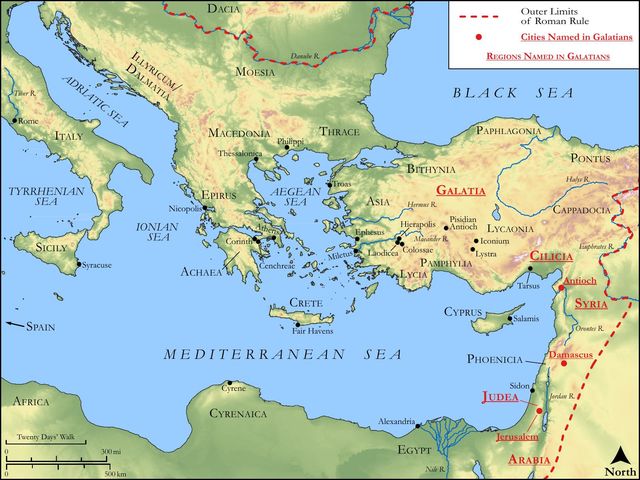
See on the biblical-era maps

Study this verse
Public-domain commentary
Matthew Henry
From his Commentary on the Whole Bible. Henry comments on passages, not single verses — this entry covers Galatians 1:10–24. His two-level outline is real structure in the source text, so it is rendered as structure.
What Paul had said more generally, in the preface of this epistle, he now proceeds more particularly to enlarge upon. There he had declared himself to be an apostle of Christ; and here he comes more directly to support his claim to that character and office. There were some in the churches of Galatia who were prevailed with to call this in question; for those who preached up the ceremonial law did all they could to lessen Paul's reputation, who preached the pure gospel of Christ to the Gentiles: and therefore he here sets himself to prove the divinity both of his mission and doctrine, that thereby he might wipe off the aspersions which his enemies had cast upon him, and recover these Christians into a better opinion of the gospel he had preached to them. This he gives sufficient evidence of,
I.From the scope and design of his ministry, which was not to persuade men, but God, etc.
The meaning of this may be either that in his preaching the gospel he did not act in obedience to men, but God, who had called him to this work and office; or that his aim therein was to bring persons to the obedience, not of men, but of God. As he professed to act by a commission from God; so that which he chiefly aimed at was to promote his glory, by recovering sinners into a state of subjection to him. And as this was the great end he was pursuing, so, agreeably hereunto, he did not seek to please men. He did not, in his doctrine, accommodate himself to the humours of persons, either to gain their affection or to avoid their resentment; but his great care was to approve himself to God. The judaizing teachers, by whom these churches were corrupted, had discovered a very different temper; they mixed works with faith, and the law with the gospel, only to please the Jews, whom they were willing to court and keep in with, that they might escape persecution. But Paul was a man of another spirit; he was not so solicitous to please them, nor to mitigate their rage against him, as to alter the doctrine of Christ either to gain their favour or to avoid their fury. And he gives this very good reason for it, that, if he yet pleased men, he would not be the servant of Christ. These he knew were utterly inconsistent, and that no man could serve two such masters; and therefore, though he would not needlessly displease any, yet he dared not allow himself to gratify men at the expense of his faithfulness to Christ. Thus, from the sincerity of his aims and intentions in the discharge of his office, he proves that he was truly an apostle of Christ. And from this his temper and behaviour we may note,
1.That the great end which ministers of the gospel should aim at is to bring men to God.
2.That those who are faithful will not seek to please men, but to approve themselves to God.
3.That they must not be solicitous to please men, if they would approve themselves faithful servants to Christ. But, if this argument should not be thought sufficient, he goes on to prove his apostleship,
II.From the manner wherein he received the gospel which he preached to them, concerning which he assures them (Gal 1:11, Gal 1:12) that he had it not by information from others, but by revelation from heaven. One thing peculiar in the character of an apostle was that he had been called to, and instructed for, this office immediately by Christ himself. And in this he here shows that he was by no means defective, whatever his enemies might suggest to the contrary. Ordinary ministers, as they receive their call to preach the gospel by the mediation of others, so it is by means of the instruction and assistance of others that they are brought to the knowledge of it. But Paul acquaints them that he had his knowledge of the gospel, as well as his authority to preach it, directly from the Lord Jesus: the gospel which he preached was not after man; he neither received it of man, nor was he taught it by man, but by immediate inspiration, or revelation from Christ himself. This he was concerned to make out, to prove himself an apostle: and to this purpose,
1.He tells them what his education was, and what, accordingly, his conversation in time past had been, Gal 1:13, Gal 1:14. Particularly, he acquaints them that he had been brought up in the Jewish religion, and that he had profited in it above many his equals of his own nation - that he had been exceedingly zealous of the traditions of the elders, such doctrines and customs as had been invented by their fathers, and conveyed down from one generation to another; yea, to such a degree that, in his zeal for them, he had beyond measure persecuted the church of God, and wasted it. He had not only been a rejecter of the Christian religion, notwithstanding the many evident proofs that were given of its divine origin; but he had been a persecutor of it too, and had applied himself with the utmost violence and rage to destroy the professors of it. This Paul often takes notice of, for the magnifying of that free and rich grace which had wrought so wonderful a change in him, whereby of so great a sinner he was made a sincere penitent, and from a persecutor had become an apostle. And it was very fit to mention it here; for it would hence appear that he was not led to Christianity, as many others are, purely by education, since he had been bred up in an enmity and opposition to it; and they might reasonably suppose that it must be something very extraordinary which had made so great a change in him, which had conquered the prejudices of his education, and brought him not only to profess, but to preach, that doctrine, which he had before so vehemently opposed.
2.In how wonderful a manner he was turned from the error of his ways, brought to the knowledge and faith of Christ, and appointed to the office of an apostle, Gal 1:15, Gal 1:16. This was not done in an ordinary way, nor by ordinary means, but in an extraordinary manner; for, (1.) God had separated him hereunto from his mother's womb: the change that was wrought in him was in pursuance of a divine purpose concerning him, whereby he was appointed to be a Christian and an apostle, before he came into the world, or had done either good or evil. (2.) he was called by his grace. All who are savingly converted are called by the grace of God; their conversion is the effect of his good pleasure concerning them, and is effected by his power and grace in them. But there was something peculiar in the case of Paul, both in the suddenness and in the greatness of the change wrought in him, and also in the manner wherein it was effected, which was not by the mediation of others, as the instruments of it, but by Christ's personal appearance to him, and immediate operation upon him, whereby it was rendered a more special and extraordinary instance of divine power and favour. (3.) He had Christ revealed in him. He was not only revealed to him, but in him. It will but little avail us to have Christ revealed to us if he is not also revealed in us; but this was not the case of Paul. It pleased God to reveal his Son in him, to bring him to the knowledge of Christ and his gospel by special and immediate revelation. And, (4.) It was with this design, that he should preach him among the heathen; not only that he should embrace him himself, but preach him to others; so that he was both a Christian and an apostle by revelation.
3.He acquaints them how he behaved himself hereupon, from Gal 1:16, to the end. Being thus called to his work and office, he conferred not with flesh and blood. This may be taken more generally, and so we may learn from it that, when God calls us by his grace, we must not consult flesh and blood. But the meaning of it here is that he did not consult men; he did not apply to any others for their advice and direction; neither did he go up to Jerusalem, to those that were apostles before him, as though he needed to be approved by them, or to receive any further instructions or authority from them: but, instead of that, he steered another course, and went into Arabia, either as a place of retirement proper for receiving further divine revelations, or in order to preach the gospel there among the Gentiles, being appointed to be the apostle of the Gentiles; and thence he returned again to Damascus, where he had first begun his ministry, and whence he had with difficulty escaped the rage of his enemies, Acts 9. It was not till three years after his conversion that he went up to Jerusalem, to see Peter; and when he did so he made but a very short stay with him, no more than fifteen days; nor, while he was there, did he go much into conversation; for others of the apostles he saw none, but James, the Lord's brother. So that it could not well be pretended that he was indebted to any other either for his knowledge of the gospel or his authority to preach it; but it appeared that both his qualifications for, and his call to, the apostolic office were extraordinary and divine. This account being of importance, to establish his claim to this office, to remove the unjust censures of his adversaries, and to recover the Galatians from the impressions they had received to his prejudice, he confirms it by a solemn oath (Gal 1:20), declaring, as in the presence of God, that what he had said was strictly true, and that he had not in the least falsified in what he had related, which, though it will not justify us in solemn appeals to God upon every occasion, yet shows that, in matters of weight and moment, this may sometimes not only be lawful, but duty. After this he acquaints them that he came into the regions of Syria and Cilicia: having made this short visit to Peter, he returns to his work again. He had no communication at that time with the churches of Christ in Judea, they had not so much as seen his face; but, having heard that he who persecuted them in times past now preached the faith which he once destroyed, they glorified God because of him; thanksgivings were rendered by many unto God on that behalf; the very report of this mighty change in him, as it filled them with joy, so it excited them to give glory to God on the account of it.
Historical interpretation
Historical reception
4 surviving comments on this verse. Each one is dated, so this reads as a timeline rather than a list.
Select a marker to jump to its quote. Markers stagger vertically where authors wrote within a few decades of each other.
"And they glorified God in me."
See here again how accurately he observes the rule of his humility; he says not, they admired me, they applauded or were astonished at me, but ascribes all to Divine grace by the words, "they glorified God in me."
"And I was still unknown by face unto the Churches of Judaea; but they only heard say, he that once persecuted us now preacheth the faith of which he once made havoc."
What modesty in thus again mentioning the facts of his persecuting and laying waste the Church, and in thus making infamous his former life, while he passes over the illustrious deeds he was about to achieve! He might have told, had he wished it, all his successes, but he mentions none of these and stepping with one word over a vast expanse, he says merely, "I came into the regions of Syria and Cilicia;" and, "they had heard, that he, which once persecuted us, now preacheth the faith of which he once made havoc." The purpose of the words, "I was unknown to the Churches of Judaea," is to show, that so far from preaching to them the necessity of circumcision, he was not known to them even by sight.
(Verses 22-24.) But I was unknown by face to the churches of Judea, which were in Christ Jesus. They only heard it said: He who once persecuted us now preaches the faith which he once tried to destroy. And they glorified God in me. The churches of Judea had only heard of me by reputation. And among them, they saw me more as a persecutor than as an apostle. But in Syria and Cilicia, Arabia and Damascus, they might have recognized me by sight as well: because I, as the Apostle to the Gentiles, preached the gospel of Christ not to the Jews, but to the Gentiles. But the whole point of what he does is this: to show that he could never have been glorious before those very people whom he had previously persecuted unless his preaching had also been proven by their judgment, even by those who had known him before as evil. And he returns secretly to his purpose, affirming that he spent such a short time in Judea that even those who believed were unaware of his appearance. From this he shows that he did not have Peter, James, or John as his teachers, but Christ, who revealed the Gospel to him. At the same time, it should be noted that while it was said above that the Church was under attack, here faith is: there men, here things; so that now (or then) it could be more opportune: He preaches the faith, which he once attacked. For they could not make a similar sound about the Church.
It should be observed that Jews had believed in Christ not only in Jerusalem, nor were they so few that they had been absorbed into the Gentile churches, but they were so numerous that churches came into being from them.
Continue studying Galatians 1:22 across the web’s major study libraries — every link below opens this exact verse, chapter, or book on the destination site.
Read & Compare
 BibleGatewayThis verse in more than 200 translations and 70 languages.
 Bible.comThe YouVersion reader — hundreds of translations, reading plans, and highlights.
 ESV.orgCrossway's official English Standard Version reader.
 NET BibleThe NET translation with 60,000+ translators' notes on every rendering decision.
 STEP BibleTyndale House's free study tool — original text, vocabulary, and scholarly resources.
 BibliaLogos Bible Software's free web reader.
 USCCBThe New American Bible (Revised Edition) with the U.S. bishops' study notes.
Commentaries
 BibleHub CommentariesDozens of classic commentaries on this verse, gathered on one page.
 StudyLightMore than 100 commentary sets — the largest collection on the web.
 BibleRefPlain-English commentary on what this verse means, verse by verse.
 Enduring WordDavid Guzik's free commentary on this chapter, widely used by Bible teachers.
 Bible Study ToolsVerse commentary alongside Greek and Hebrew study aids.
Original Language & Research
- BibleHub InterlinearThe verse word by word — original language, transliteration, and English.
- BibleHub LexiconEvery word's original-language definition and Strong's entry.
 Blue Letter BibleDeep-study tools — Strong's numbers, concordance, and word studies.
 CNTR CollationThe earliest Greek manuscripts of this verse, collated letter by letter.
Sermons, Hymns & Audio


TrulyRandomVerse is not affiliated with these sites and doesn’t control their content. They’re linked because they’re genuinely useful.
Summary
Galatians 1:22 serves as a pivotal statement in Paul's defense of his apostolic authority and the divine origin of the gospel he preached. Following his conversion and initial period of ministry in Arabia, Paul emphasizes that he did not immediately consult with or seek validation from the established apostolic leadership in Jerusalem. Instead, he highlights his physical separation and lack of personal acquaintance with the Christian communities in Judea, thereby reinforcing the argument that his commission and message were received directly from Christ, independent of human mediation or endorsement.
Context
ShowHideLiterary Context
This verse is a crucial part of Paul's autobiographical defense in Galatians 1. Having recounted his dramatic conversion on the road to Damascus (Galatians 1:15-16), Paul immediately stresses that he did not go up to Jerusalem to consult with those who were apostles before him (Galatians 1:16b-17). His subsequent journey to Arabia and then back to Damascus, followed by a brief visit to Jerusalem three years later to see Peter and James (Galatians 1:18-19), all serve to demonstrate his independence from the Jerusalem apostles. Verse 21, which states he went into the regions of Syria and Cilicia, directly precedes and sets the geographical stage for his being "unknown by face" to the churches of Judea in verse 22, thereby strengthening his argument for a gospel received directly from Christ, not from human tradition or instruction (Galatians 1:11-12).
Historical & Cultural Context
The early Christian movement was rapidly expanding beyond its Jewish roots in Jerusalem. Judea, as the heartland of Judaism and the initial epicenter of Christianity, contained the earliest and most prominent Christian communities. For Paul to assert that he was "unknown by face" to these churches for a significant period (implied by the timeline in the preceding verses) was a powerful statement. In a culture where personal acquaintance and endorsement from established leaders were highly valued and often necessary for legitimacy, Paul's claim underscores his radical reliance on divine commissioning. This also highlights the nascent, decentralized nature of the early church, where communities were springing up in various regions, often without direct, immediate oversight from a central authority, though spiritual unity was maintained through shared faith in Christ.
Key Themes
ShowHideThis verse contributes significantly to several key themes in Galatians. Foremost is Paul's Apostolic Authority and the Divine Origin of the Gospel. By emphasizing his lack of prior personal contact with the Judean churches, Paul reinforces his claim that his gospel message and apostolic commission were not derived from human sources or validated by existing ecclesiastical structures, but directly from Christ (Galatians 1:1). Another theme is The Unity of the Church in Christ, despite geographical and personal separation. Even though Paul was physically unknown to them, these communities are still identified as "churches of Judaea which were in Christ," highlighting the spiritual bond that transcends physical presence and human recognition. This subtly foreshadows the broader unity of believers, Jew and Gentile, in Christ, a major theological thrust of the entire letter (Galatians 3:28).
Exposition and Analysis
ShowHideKey Word Analysis
ShowHideDerived from a negative particle and the verb "to know," this word signifies a lack of information or intelligence, implying an absence of acquaintance. In this context, it emphasizes Paul's physical unfamiliarity to the Judean churches, underscoring that his early ministry and gospel were not a product of their recognition or endorsement.
From a compound meaning "a calling out," this term refers to a popular assembly or, specifically in the New Testament, a religious congregation or Christian community. The plural "churches" indicates that Christianity had already spread and established multiple distinct communities throughout the region of Judea, signifying the early growth and organization of the nascent Christian movement.
The preposition "in" denotes a fixed position, state, or intimate union. Coupled with "Christ," this phrase signifies a profound spiritual reality: believers are united with Christ, sharing in His life, death, and resurrection. It defines the very essence of their identity and fellowship. Here, it highlights that despite Paul's physical absence, these Judean communities were authentically Christian, bound by their common union with Jesus the Messiah.
Verse Breakdown
ShowHide"And was unknown by face"
This clause directly states Paul's lack of personal recognition. The phrase "by face" (Greek: prosopon) emphasizes a physical, visual unfamiliarity, not merely a lack of reputation. Paul is asserting that he had no personal, face-to-face interaction or acquaintance with these specific congregations during this significant early period of his ministry. This is a crucial piece of evidence in his argument for the independent, divine origin of his apostolic commission.
"unto the churches of Judaea which were in Christ"
This specifies the communities to whom Paul was unknown. "The churches of Judaea" refers to the Christian congregations established throughout the geographical region of Judea, distinct from Jerusalem, though often associated with it. The qualifying phrase "which were in Christ" is profoundly significant. It affirms the genuine spiritual identity of these communities. Despite Paul's physical distance and lack of personal connection, he acknowledges their authentic Christian status, united by their shared spiritual union with Jesus Christ. This phrase underscores the foundational theological truth that the church's identity is defined by its relationship with Christ, not by human recognition or organizational hierarchy.
Literary Devices
ShowHidePaul employs several literary devices in this concise statement. There is clear Emphasis through negation ("unknown by face"), highlighting the absence of human connection as a testament to divine commissioning. This serves as a powerful rhetorical move in his defense against those who questioned his authority. Furthermore, there is a subtle Contrast presented: Paul was physically absent and unknown, yet these churches were profoundly present and known "in Christ." This contrast underscores the spiritual unity that transcends geographical and personal separation. The phrase "by face" can also be seen as a form of Metonymy, where "face" stands for personal presence or acquaintance, emphasizing the lack of direct, personal interaction.
Theological and Thematic Connections
ShowHideGalatians 1:22 profoundly illustrates the nature of true apostolic authority and the spiritual unity of the early church. Paul's emphasis on being "unknown by face" to the Judean churches reinforces his central argument that his gospel and apostleship were not derived from human validation or tradition, but directly from a divine revelation of Jesus Christ. This highlights a crucial theological principle: God can and does raise up and equip ministers and movements independently of existing human structures or established religious centers. The verse also subtly points to the organic, Spirit-led growth of the early church, where communities were forming and thriving in various regions, all bound together not by a central human authority, but by their shared spiritual identity "in Christ." This spiritual bond transcends geographical distance and personal familiarity, demonstrating that the universal church is fundamentally defined by its relationship with its Head, Jesus Christ, rather than by human organizational ties.
Reflection and Application
ShowHidePaul's testimony in Galatians 1:22 offers profound insights for believers today. It challenges us to consider the source of our spiritual authority and validation. Just as Paul's commission came directly from Christ, our ultimate standing and purpose as believers derive from our union with Him, not from human recognition, institutional affiliation, or popular acclaim. This verse reminds us that God often works in ways that defy human expectations and established norms, raising up leaders and movements from unexpected places. It encourages us to trust in God's sovereign hand in equipping His servants and building His church, even when it appears decentralized or lacking traditional endorsements. Furthermore, the phrase "churches of Judaea which were in Christ" serves as a powerful reminder of the spiritual unity that binds all true believers. Despite our diverse backgrounds, denominations, or geographical locations, our shared identity "in Christ" is the ultimate bond that transcends all differences, calling us to recognize and affirm our common spiritual family.
Questions for Reflection
ShowHideFAQ
ShowHideWhat is the significance of Paul being "unknown by face" to the churches of Judea?
ShowHideThe significance is twofold. First, it strongly supports Paul's argument that his apostolic authority and the gospel he preached were not derived from human sources or validated by the established apostles in Jerusalem. By emphasizing his physical unfamiliarity with the Judean churches, Paul demonstrates that he did not receive his message or commission through human instruction or endorsement from the traditional centers of Christian activity. Second, it highlights the independent and direct nature of his divine calling. He was commissioned by Christ Himself, and his early ministry unfolded without immediate consultation or recognition from the prominent Judean communities, underscoring the supernatural origin of his apostleship as detailed in Galatians 1:11-12.
Christ-Centered Fulfillment
ShowHideGalatians 1:22, while describing Paul's personal history, ultimately points to the centrality of Christ as the sole source of authority and unity for His church. Paul's independence from human validation is not a claim to self-sufficiency, but a testament to his direct and absolute dependence on Christ. Just as Paul was called and equipped by Christ Himself, so too is the entire church built upon the foundation of Christ, the chief cornerstone (Ephesians 2:20). The phrase "in Christ" is the profound theological anchor of the verse, signifying that the true identity and fellowship of these Judean churches, and indeed of all believers, is found in their spiritual union with Jesus. This union is a direct result of Christ's redemptive work, through which He gathers His people from every tribe and nation into one body (Ephesians 1:22-23). Thus, Paul's physical separation from the Judean churches does not negate their spiritual unity, because that unity is forged not by human proximity or recognition, but by their shared life "in Christ," who is the Head of the body, the church (Colossians 1:18). This verse, therefore, implicitly celebrates Christ as the ultimate bond that transcends all human barriers and the divine authority from whom all true ministry flows.