


1 Thessalonians 3:4
Bible text: King James Version (1769 Blayney text) · Public domain
Bible text: King James Version with Strong's numbers · Public domain
Bible text: Berean Standard Bible · Public domain
Bible text: American Standard Version (1901) · Public domain
Bible text: World English Bible, Messianic edition · Public domain
Bible text: Geneva Bible (1599) · Public domain
Bible text: Young's Literal Translation · Public domain
- καὶkaiAndG2532CONJConjunction
- γὰρgarindeedG1063CONJConjunction
- ὅτεhotewhenG3753CONJConjunction
- πρὸςproswithG4314PREPPreposition
- ὑμᾶςhumasyouG4771P-2APPersonal pronoun Accusative 2nd Plural
- ἦμενēmenwe wereG1510V-IAI-1PVerb Imperfect Active Indicative 1st Plural
- προελέγομενproelegomenwe were telling beforehandG4302V-IAI-1PVerb Imperfect Active Indicative 1st Plural
- ὑμῖνhuminyouG4771P-2DPPersonal pronoun Dative 2nd Plural
- ὅτιhotithatG3754CONJConjunction
- μέλλομενmellomenwe are aboutG3195V-PAI-1PVerb Present Active Indicative 1st Plural
- θλίβεσθαιthlibesthaito suffer afflictionG2346V-PPNVerb Present Passive Infinitive
- καθὼςkathōseven asG2531CONJConjunction
- καὶkaialsoG2532CONJConjunction
- ἐγένετοegenetoit came to passG1096V-2ADI-3SVerb 2nd Aorist Middle Deponent Indicative 3rd Singular
- καὶkaiandG2532CONJConjunction
- οἴδατε·oidateyou knowG1492V-RAI-2PVerb Perfect Active Indicative 2nd Plural
English is a literal word-by-word gloss of the Greek, not the KJV's wording. Why?
This is the original text the KJV's translators worked from — each Greek word with its own literal English meaning in this verse, prepared by scholars at Tyndale House, Cambridge. The KJV translates whole sentences, not word by word, so its wording differs: one Greek word can become several English words, and the KJV may choose “charity” where the gloss reads “love”. Both are faithful — they answer different questions. For the KJV's own rendering, switch to the KJV text.
Details
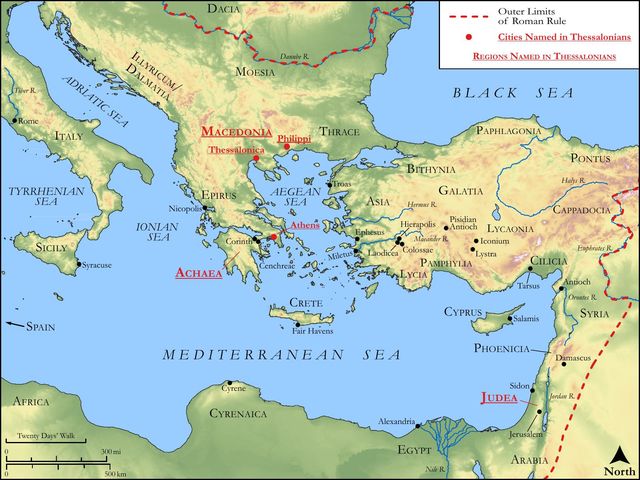
See on the biblical-era maps

Study this verse
Public-domain commentary
Matthew Henry
From his Commentary on the Whole Bible. Henry comments on passages, not single verses — this entry covers 1 Thessalonians 3:1–5. His four-level outline is real structure in the source text, so it is rendered as structure.
In these words the apostle gives an account of his sending Timothy to the Thessalonians. Though he was hindered from going to them himself, yet his love was such that he could not forbear sending Timothy to them. Though Timothy was very useful to him, and he could not well spare him, yet Paul was content, for their good, to be left alone at Athens. Note, Those ministers do not duly value the establishment and welfare of their people who cannot deny themselves in many things for that end. Observe,
I.The character he gives of Timothy (Th1 3:2):
We sent Timotheus, our brother. Elsewhere he calls him his son; here he calls him brother. Timothy was Paul's junior in age, his inferior in gifts and graces, and of a lower rank in the ministry: for Paul was an apostle, and Timothy but an evangelist; yet Paul calls him brother. This was an instance of the apostle's humility, and showed his desire to put honour upon Timothy and to recommend him to the esteem of the churches. He calls him also a minister of God. Note, Ministers of the gospel of Christ are ministers of God, to promote the kingdom of God among men. He calls him also his fellow-labourer in the gospel of Christ. Note, Ministers of the gospel must look upon themselves as labourers in the Lord's vineyard; they have an honourable office and hard work, yet a good work. This is a true saying, If any man desire the office of a bishop, he desires a good work, Ti1 3:1. And ministers should look upon one another, and strengthen one another's hands, not strive and contend one with another (which will hinder their work), but strive together to carry on the great work they are engaged in, namely, to preach and publish the gospel of Christ, and to persuade people to embrace and entertain it and live suitably thereto.
II.The end and design why Paul sent Timothy:
To establish you and to comfort you concerning your faith, Th1 3:2. Paul had converted them to the Christian faith, and now he was desirous that they might be confirmed and comforted, that they might confirmed in the choice they had made of the Christian religion, and comforted in the profession and practice of it. Note, The more we are comforted, the more we shall be confirmed, because, when we find pleasure in the ways of God, we shall thereby be engaged to continue and persevere therein. The apostle's design was to establish and comfort the Thessalonians concerning their faith, - concerning the object of their faith, namely, the truths of the gospel, and particularly that Jesus Christ was the Saviour of the world, and so wise and good, so powerful and faithful, that they might rely upon him, - concerning the recompence of faith, which was more than sufficient to balance all their losses and reward all their labours.
III.The motive inducing Paul to send Timothy for this end, namely, a godly fear or jealousy, lest they should be moved from the faith of Christ, Th1 3:3. He was desirous that no man, no one among them, should be moved or shaken in mind, that they should not apostatize or waver in the faith. And yet,
1.He apprehended there was danger, and feared the consequence.
(1.)There was danger,
[1.]By reason of affliction and persecution for the sake of the gospel, Th1 3:3. These Thessalonians could not but perceive what afflictions the apostles and preachers of the gospel met with, and this might possibly stumble them; and also those who made profession of the gospel were persecuted, and without doubt these Thessalonians themselves were afflicted.
[2.]By reason of the tempter's subtlety and malice. The apostle was afraid lest by any means the tempter had tempted them, Th1 3:5. The devil is a subtle and unwearied tempter, who seeks an opportunity to beguile and destroy us, and takes all advantages against us, both in a time of prosperity and adversity; and he has often been successful in his attacks upon persons under afflictions. He has often prejudiced the minds of men against religion on account of the sufferings its professors are exposed to. We have reason therefore to be jealous over ourselves and others, lest we be ensnared by him.
(2.)The consequence the apostle feared was lest his labour should be in vain. And thus it would have been, if the tempter had tempted them, and prevailed against them, to move them from the faith. They would have lost what they had wrought, and the apostle would have lost what he laboured for. Note, It is the devil's design to hinder the good fruit and effect of the preaching of the gospel. If he cannot hinder ministers from labouring in the word and doctrine, he will, if he be able, hinder them of the success of their labours. Note also, Faithful ministers are much concerned about the success of their labours. No one would willingly labour in vain; and ministers are loth to spend their strength, and pains, and time, for nought.
2.To prevent this danger, with its bad consequence, the apostle tells them what care he took in sending Timothy,
(1.)To put them in mind of what he had told them before concerning suffering tribulation (Th1 3:4), he says (Th1 3:3), We are appointed thereunto, that is, unto afflictions. So is the will and purpose of God that through many afflictions we must enter into his kingdom. Their troubles and persecutions did not come by chance, not merely from the wrath and malice of the enemies of religion, but by the appointment of God. The event only came to pass according as God had determined, and they knew he had told them before it would be; so that they should not think it strange, and, being fore-warned, they should be fore-armed. Note, The apostles were so far from flattering people with an expectation of worldly prosperity in religion that, on the contrary, they told them plainly they must count upon trouble in the flesh. And herein they followed the example of their great Master, the author or our faith. Besides, it might prove a confirmation of their faith, when they perceived that it only happened to them as was predicted before.
(2.)To know their faith, that so he might inform the apostles whether they remained stedfast under all their sufferings, whether their faith failed or not, because, if their faith did not fail, they would be able to stand their ground against the tempter and all his temptations: their faith would be a shield, to defend them against all the fiery darts of the wicked, Eph 6:16.
Historical interpretation
Historical reception
1 surviving comment on this verse from the historical church.
"That no man be moved by these afflictions; for yourselves know that hereunto we are appointed. For verily, when we were with you, we told you beforehand that we are to suffer affliction; even as it came to pass, and ye know."
What then does he say here? Because the temptations of the teachers trouble their disciples, and he had then fallen into many temptations, as also he himself says, that "Satan hindered us," always saying this; "both once," he says, "and again I would have come to you," and was not able, which was a proof of great violence. And it was reasonable that this should trouble them, for they are not so much troubled at their own temptations, as at those of their teachers; as neither is the soldier so much troubled at his own trials, as when he sees his general wounded. "To establish you," he says; not that they were at all deficient in faith, nor that they required to learn anything.
Ye ought not, he says, to be troubled, for nothing strange, nothing contrary to expectation is happening; which was sufficient to raise them up. For do you see that on this account also Christ foretold to His disciples? For hear Him saying, "Now I have told you before it came to pass, that when it is come to pass ye may believe." (John xiv. 29) For greatly indeed, greatly does it tend to the comfort of others, to have heard from their teachers what is to happen. For as he that is sick, if he hear from his physician that this or that is taking place, is not much troubled; but if anything happen unexpectedly, as if he too were at a loss, and the disorder was beyond his art, he is afflicted and troubled; so also is it here. Which Paul fore-knowing, foretold to them, "we are about to be afflicted," "as it came to pass, and ye know." He not only says that this came to pass, but that he foretold many things, and they happened. "Hereunto we are appointed." So that not only ye ought not to be troubled and disturbed about the past, but not even about the future, if any such thing should happen, "for hereunto we are appointed."
Let us hear, who have ears to hear. The Christian is appointed hereunto. For concerning all the faithful is this said, "Hereunto we are appointed." And we, as if we were appointed for ease, think it strange if we suffer anything; and yet what reason have we for thinking anything strange? For no season of affliction or temptation has overtaken us, but what is common to man.
Continue studying 1 Thessalonians 3:4 across the web’s major study libraries — every link below opens this exact verse, chapter, or book on the destination site.
Read & Compare
 BibleGatewayThis verse in more than 200 translations and 70 languages.
 Bible.comThe YouVersion reader — hundreds of translations, reading plans, and highlights.
 ESV.orgCrossway's official English Standard Version reader.
 NET BibleThe NET translation with 60,000+ translators' notes on every rendering decision.
 STEP BibleTyndale House's free study tool — original text, vocabulary, and scholarly resources.
 BibliaLogos Bible Software's free web reader.
 USCCBThe New American Bible (Revised Edition) with the U.S. bishops' study notes.
Commentaries
 BibleHub CommentariesDozens of classic commentaries on this verse, gathered on one page.
 StudyLightMore than 100 commentary sets — the largest collection on the web.
 BibleRefPlain-English commentary on what this verse means, verse by verse.
 Enduring WordDavid Guzik's free commentary on this chapter, widely used by Bible teachers.
 Bible Study ToolsVerse commentary alongside Greek and Hebrew study aids.
Original Language & Research
- BibleHub InterlinearThe verse word by word — original language, transliteration, and English.
- BibleHub LexiconEvery word's original-language definition and Strong's entry.
 Blue Letter BibleDeep-study tools — Strong's numbers, concordance, and word studies.
 CNTR CollationThe earliest Greek manuscripts of this verse, collated letter by letter.
Sermons, Hymns & Audio


TrulyRandomVerse is not affiliated with these sites and doesn’t control their content. They’re linked because they’re genuinely useful.
Summary
In the Apostle Paul reminds the Thessalonian believers of a vital truth he had shared during his initial ministry among them: they were to expect suffering and tribulation for their faith. This verse serves as a powerful affirmation of Paul's transparent and honest ministry, validating his prophetic insight and the inherent reality of the Christian journey, which often involves hardship.
Context
ShowHideLiterary Context
This verse is situated within Paul's deeply pastoral first letter to the Thessalonians, specifically in a section where he expresses his profound concern for their spiritual well-being following his abrupt departure from their city. Having been forced to leave Thessalonica due to persecution (Acts 17:5-10), Paul was anxious about the young church's ability to withstand the trials they were facing. He had sent Timothy to strengthen and encourage them in their faith, "that no man should be moved by these afflictions" (1 Thessalonians 3:2-3). Verse 4 directly reinforces the message Timothy was to deliver, reminding them that their current suffering was not a sign of God's abandonment or an unexpected turn of events, but rather the fulfillment of a clear warning Paul had given them. This reminder serves to anchor their faith in the face of adversity, preventing disillusionment.
Historical & Cultural Context
Paul's ministry in Thessalonica, as recounted in Acts 17:1-9, was brief but impactful. He preached in the synagogue for three Sabbaths, leading to conversions among both Jews and "devout Greeks" and "chief women." However, this success quickly stirred up opposition from unbelieving Jews who incited a mob, accusing Paul and Silas of "turning the world upside down" and proclaiming "another king, one Jesus." This immediate and violent persecution forced Paul and Silas to flee to Berea. For new converts, especially those from a pagan background, facing such intense social and potentially physical hostility for abandoning traditional worship and embracing Christ would have been a profound test. The Roman Empire, while generally tolerant of diverse religions, viewed any exclusive loyalty that challenged the emperor's divinity or public order with suspicion. Therefore, the "tribulation" mentioned by Paul would have encompassed social ostracism, economic hardship, verbal abuse, and potentially physical violence, all stemming from their allegiance to Christ.
Key Themes
ShowHideThe verse significantly contributes to several overarching themes in 1 Thessalonians and Paul's broader theology. Firstly, it highlights the Reality of Christian Suffering, emphasizing that tribulation is not an anomaly but an expected component of discipleship, a truth Jesus himself articulated in John 16:33. Secondly, it underscores Apostolic Integrity and Transparency. Paul's forewarning demonstrates that he did not present a "gospel of ease" but was honest about the cost of following Christ, thereby validating his message and leadership. This honesty would have built trust and credibility with the Thessalonians. Thirdly, the verse subtly promotes Steadfastness and Endurance in faith. By reminding them that their suffering was foretold, Paul implicitly encourages them to view their trials through a theological lens—as part of God's sovereign plan, not as a sign of His displeasure or absence. This perspective is crucial for maintaining hope and perseverance, as seen in Paul's later encouragement in Romans 5:3-5.
Exposition and Analysis
ShowHideKey Word Analysis
ShowHideMeaning "to say beforehand, i.e., predict, forewarn." This word is crucial as it emphasizes Paul's deliberate and explicit communication of future hardship. It wasn't a vague hint but a direct prophecy or warning, indicating that the suffering was not unforeseen by the apostles, and therefore should not be surprising or destabilizing for the believers.
Meaning "to crowd (literally or figuratively); to afflict, narrow, throng, suffer tribulation, trouble." While the KJV translates it as "suffer tribulation," the Greek verb thlíbō itself carries the sense of being "pressed" or "squeezed." This vividly conveys the intense pressure, distress, and affliction that the Thessalonian believers were experiencing, whether from social ostracism, economic hardship, or physical persecution. It speaks to the real and tangible difficulties they faced for their faith.
Meaning "to see (literally or figuratively); by implication, (in the perfect tense only) to know." This word signifies a deep, experiential knowledge or understanding. The Thessalonians didn't just hear about suffering; they were living through it. Their "knowing" was not merely intellectual assent to Paul's prior warning but a personal, undeniable confirmation through their current circumstances, validating the truth of Paul's words.
Verse Breakdown
ShowHide"For verily, when we were with you"
Paul begins by grounding his statement in their shared past experience. The "verily" (a combination of G1063 gár and G2532 kaí) emphasizes the truth and certainty of what follows. He appeals to their memory of his direct presence among them, establishing the historical context and the personal nature of his previous warnings.
"we told you before that we should suffer tribulation"
This is the core of Paul's reminder. He explicitly states that he and his companions (referring to the apostolic team, using "we" to include himself, Silas, and Timothy) had forewarned the Thessalonians about the inevitable suffering that would accompany their Christian walk. The phrase "should suffer tribulation" (G3195 méllō G2346 thlíbō) indicates an intended or expected future event, not a mere possibility, but a certainty for those who follow Christ.
"even as it came to pass, and ye know"
This concluding clause serves as a powerful confirmation. "Even as it came to pass" (G2532 kaí G2531 kathṓs G1096 gínomai) affirms the fulfillment of the prophecy; their current reality perfectly aligned with Paul's earlier warning. The final phrase, "and ye know" (G2532 kaí G1492 eídō), appeals to their direct, undeniable, and painful experience. They were living proof of the truth of Paul's words, which would have reinforced his credibility and the divine nature of his message.
Literary Devices
ShowHideThe verse effectively employs several literary devices. Foreshadowing is central, as Paul explicitly states he "told you before that we should suffer tribulation," setting up the expectation of future hardship. This is immediately followed by Verification, where the reality of their suffering is confirmed with "even as it came to pass, and ye know." This direct correspondence between prediction and fulfillment serves to underscore Paul's Apostolic Authenticity and the divine origin of his message. His ability to accurately foretell their trials would have significantly bolstered his credibility in the eyes of the Thessalonians, assuring them that he was a true messenger of God, not one who offered a false gospel of ease. The use of "ye know" also acts as a form of Audience Engagement, directly appealing to their lived experience and confirming their shared understanding of the situation.
Theological and Thematic Connections
ShowHide1 Thessalonians 3:4 powerfully reinforces the consistent biblical theme that suffering is an expected, even integral, part of the Christian life. It challenges any notion of a pain-free discipleship, aligning with the New Testament's broader teaching that following Christ often entails opposition from a world hostile to God. This foreknowledge of tribulation is not meant to discourage but to prepare believers, allowing them to interpret their difficulties not as signs of divine abandonment or personal failure, but as opportunities for spiritual growth, perseverance, and a deeper identification with Christ. Paul's transparency in warning them also underscores the integrity required of spiritual leaders, who must faithfully present the full reality of the gospel, including its challenges.
Reflection and Application
ShowHide1 Thessalonians 3:4 offers profound and enduring lessons for believers today. In a world that often promotes comfort and ease, this verse serves as a sober reminder that the path of discipleship is not devoid of hardship. Paul's forewarning prepares us mentally and spiritually, preventing disillusionment when trials inevitably arise. Understanding that suffering is a shared experience among believers, and even foretold by apostolic teaching, allows us to view our afflictions not as random misfortunes but as part of God's sovereign plan for our sanctification and the advancement of His kingdom. It encourages us to cultivate resilience, relying on God's grace to endure, knowing that our trials can produce perseverance, character, and hope. Furthermore, this verse calls us to value and seek out spiritual leadership that is truthful and transparent, preparing us for the realities of the Christian walk rather than offering an unrealistic, problem-free existence.
Questions for Reflection
ShowHideFAQ
ShowHideWhy did Paul forewarn the Thessalonians about suffering, and what was the effect of this warning?
ShowHidePaul forewarned the Thessalonians about suffering for several crucial reasons. Firstly, it was to prepare them mentally and spiritually for the inevitable opposition that comes with following Christ. He wanted them to understand that tribulation was not an anomaly or a sign of God's displeasure, but an expected part of the Christian journey (John 16:33). This foreknowledge was intended to prevent them from being "moved" or shaken in their faith when trials arose (1 Thessalonians 3:3). Secondly, Paul's accurate prediction served to validate his apostolic message and integrity. When their suffering "came to pass," it confirmed that Paul was a true messenger of God, not someone who offered a false gospel of ease. The effect was to strengthen their faith and trust in Paul's teaching, enabling them to endure their trials with a clearer understanding and greater steadfastness.
Does this verse imply that God causes suffering, or simply allows it?
ShowHideThis verse, by stating "we should suffer tribulation," indicates that suffering is an anticipated and certain reality for believers, fitting within God's sovereign plan, rather than implying God directly causes every specific instance of suffering. The Greek word méllō (G3195), translated "should," conveys a sense of divine intention or necessity for what is "about to be." This aligns with the biblical understanding that while God is not the author of evil or suffering, He permits it and can use it for His redemptive purposes, such as refining faith (1 Peter 1:6-7) and conforming believers to the image of Christ (Romans 8:28-29). The suffering mentioned here is specifically persecution for their faith, which is often instigated by human opposition to the gospel, but which God incorporates into His overarching plan for His people.
Christ-Centered Fulfillment
ShowHide1 Thessalonians 3:4 finds its ultimate fulfillment and deepest meaning in the person and work of Jesus Christ. Paul's warning that believers "should suffer tribulation" directly mirrors the path of the Messiah himself, who was "a man of sorrows, and acquainted with grief" (Isaiah 53:3). Jesus consistently forewarned His disciples that they would face persecution, just as He did, stating, "If they have persecuted me, they will also persecute you" (John 15:20). The tribulation experienced by the Thessalonians, and by all believers, is a participation in the sufferings of Christ (Philippians 3:10), a hallmark of genuine discipleship that identifies us with our suffering Savior. Yet, this suffering is not without purpose; it is through Christ's own suffering that He was "made perfect through sufferings" as the Captain of our salvation (Hebrews 2:10). Our tribulation, therefore, is not a sign of God's abandonment but a means by which we are conformed to Christ's image, sharing in His redemptive work and anticipating the ultimate glory that will be revealed with Him (Romans 8:17-18). Thus, the foretold and experienced tribulation of believers points to Christ as the one who suffered on our behalf, conquered suffering through His resurrection, and empowers us to endure, knowing that our momentary afflictions are preparing us for an eternal weight of glory far beyond comparison (2 Corinthians 4:17).