


2 Corinthians 8:1
- ΓνωρίζομενGnōrizomenWe make knownG1107V-PAI-1PVerb Present Active Indicative 1st Plural
- δὲdenowG1161CONJConjunction
- ὑμῖνhuminto youG4771P-2DPPersonal pronoun Dative 2nd Plural
- ἀδελφοίadelphoibrothersG80N-VPMNoun Vocative Plural Masculine
- τὴνtēntheG3588T-ASFDefinite article Accusative Singular Feminine
- χάρινcharingraceG5485N-ASFNoun Accusative Singular Feminine
- τοῦtou<the>G3588T-GSMDefinite article Genitive Singular Masculine
- θεοῦtheouof GodG2316N-GSM-TNoun Genitive Singular Masculine Title
- τὴνtēnwhichG3588T-ASFDefinite article Accusative Singular Feminine
- δεδομένηνdedomenēnbestowedG1325V-RPP-ASFVerb Perfect Passive Participle Accusative Singular Feminine
- ἐνenamongG1722PREPPreposition
- ταῖςtaistheG3588T-DPFDefinite article Dative Plural Feminine
- ἐκκλησίαιςekklēsiaischurchesG1577N-DPFNoun Dative Plural Feminine
- τῆςtēs<the>G3588T-GSFDefinite article Genitive Singular Feminine
- ΜακεδονίαςMakedoniasof MacedoniaG3109N-GSF-LNoun Genitive Singular Feminine Location
English is a literal word-by-word gloss of the Greek, not the KJV's wording. Why?
This is the original text the KJV's translators worked from — each Greek word with its own literal English meaning in this verse, prepared by scholars at Tyndale House, Cambridge. The KJV translates whole sentences, not word by word, so its wording differs: one Greek word can become several English words, and the KJV may choose “charity” where the gloss reads “love”. Both are faithful — they answer different questions. For the KJV's own rendering, switch to the KJV text.
Details
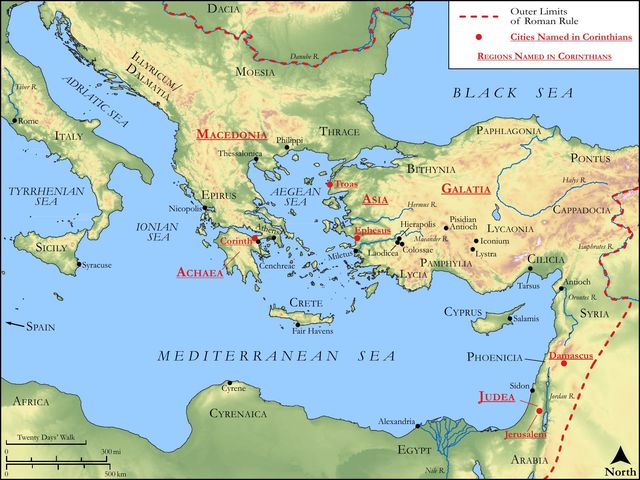
See on the biblical-era map

Study this verse
Public-domain commentary
Matthew Henry
From his Commentary on the Whole Bible. Henry comments on passages, not single verses — this entry covers 2 Corinthians 8:1–6. His four-level outline is real structure in the source text, so it is rendered as structure.
Observe here,
I.The apostle takes occasion from the good example of the churches of Macedonia, that is, of Philippi, Thessalonica, Berea, and others in the region of Macedonia, to exhort the Corinthians and the Christians in Achaia to the good work of charity. And,
1.He acquaints them with their great liberality, which he calls the grace of God bestowed on the churches, Co2 8:1. Some think the words should be rendered, the gift of God given in or by the churches. He certainly means the charitable gifts of these churches, which are called the grace or gifts of God, either because they were very large, or rather because their charity to the poor saints did proceed from God as the author, and was accompanied with true love to God, which also was manifested this way. The grace of God must be owned as the root and fountain of all the good that is in us, or done by us, at any time; and it is great grace and favour from God, and bestowed on us, if we are made useful to others, and are forward to any good work.
2.He commends the charity of the Macedonians, and sets it forth with good advantage. He tells them,
(1.)They were but in a low condition, and themselves in distress, yet they contributed to the relief of others. They were in great tribulation and deep poverty, Co2 8:2. It was a time of great affliction with them, as may be seen, Act 18:17. The Christians in these parts met with ill treatment, which had reduced them to deep poverty; yet, as they had abundance of joy in the midst of tribulation, they abounded in their liberality; they gave out of a little, trusting in God to provide for them, and make it up to them.
(2.)They gave very largely, with the riches of liberality (Co2 8:2), that is, as liberally as if they had been rich. It was a large contribution they made, all things considered; it was according to, yea beyond, their power (Co2 8:3), as much as could well be expected from them, if not more. Note, Though men may condemn the indiscretion, yet God will accept the pious zeal, of those who in real works of piety and charity do rather beyond their power.
(3.)They were very ready and forward to this good work. They were willing of themselves (Co2 8:3), and were so far from needing that Paul should urge and press them with many arguments that they prayed him with much entreaty to receive the gift, Co2 8:4. It seems Paul was backward to undertake this trust, for he would give himself to the word and prayer; or, it may be, he was apprehensive how ready his enemies would be to reproach and blacken him upon all occasions, and might take a handle against him upon account of so large a sum deposited in his hands, to suspect or accuse him of indiscretion and partiality in the distribution, if not of some injustice. Note, How cautious ministers should be, especially in money-matters, not to give occasion to those who seek occasion to speak reproachfully!
(4.)Their charity was founded in true piety, and this was the great commendation of it. They performed this good work in a right method: First they gave themselves to the Lord, and then they gave unto us their contributions, by the will of God (Co2 8:5), that is, according as it was the will of God they should do, or to be disposed of as the will of God should be, and for his glory. This, it seems, exceeded the expectation of the apostle; it was more than he hoped for, to see such warm and pious affections shining in these Macedonians, and this good work performed with so much devotion and solemnity. They solemnly, jointly, and unanimously, made a fresh surrender of themselves, and all they had, unto the Lord Jesus Christ. They had done this before, and now they do it again upon this occasion; sanctifying their contributions to God's honour, by first giving themselves to the Lord. Note,
[1.]We should give ourselves to God; we cannot bestow ourselves better.
[2.]When we give ourselves to the Lord, we then give him all we have, to be called for and disposed of according to his will.
[3.]Whatever we use or lay out for God, it is only giving to him what is his own.
[4.]What we give or bestow for charitable uses will not be accepted of God, nor turn to our advantage, unless we first give ourselves to the Lord.
II.The apostle tells them that Titus was desired to go and make a collection among them (Co2 8:6), and Titus, he knew, would be an acceptable person to them. He had met with a kind reception among them formerly. They had shown good affection to him, and he had a great love for them. Besides, Titus had already begun this work among them, therefore he was desired to finish it. So that he was, on all accounts, a proper person to be employed; and, when so good a work had already prospered in so good a hand, it would be a pity if it should not proceed and be finished. Note, It is an instance of wisdom to use proper instruments in a work we desire to do well; and the work of charity will often succeed the best when the most proper persons are employed to solicit contributions and dispose of them.
Historical interpretation
Historical reception
3 surviving comments on this verse. Each one is dated, so this reads as a timeline rather than a list.
Select a marker to jump to its quote. Markers stagger vertically where authors wrote within a few decades of each other.
Paul says that they had received the grace of God because they accepted the word of faith devoutly.
"Moreover, brethren, we make known to you the grace of God which hath been given in the Churches of Macedonia." Having encouraged them with these encomiums, he again tries exhortation. For on this account he mingled these praises with his rebuke, that he might not by proceeding from rebuke to exhortation make what he had to say ill received; but having soothed their ears, might by this means pave the way for his exhortation. For he purposeth to discourse of alms-giving; wherefore also he saith beforehand, "I rejoice that in everything I am of good courage concerning you;" by their past good works, making them the more ready to this duty also. And he said not at once, 'Therefore give alms,' but observe his wisdom, how he draws from a distance and from on high the preparation for his discourse. For he says, "I make known to you the grace of God which hath been given in the Churches of Macedonia." For that they might not be uplifted he calleth what they did "grace;" and whilst relating what others did he worketh greater zeal in them by his encomiums on others. And he mentions together two praises of the Macedonians, or rather three; namely, that they bear trials nobly; and that they know how to pity; and that, though poor, they had displayed profuseness in almsgiving, for their property had been also plundered.
By “the grace of God” Paul means the possession of every good thing. He is not excluding the role of free will by saying this but teaching that every good work is made possible by the help of God.
Continue studying 2 Corinthians 8:1 across the web’s major study libraries — every link below opens this exact verse, chapter, or book on the destination site.
Read & Compare
 BibleGatewayThis verse in more than 200 translations and 70 languages.
 Bible.comThe YouVersion reader — hundreds of translations, reading plans, and highlights.
 ESV.orgCrossway's official English Standard Version reader.
 NET BibleThe NET translation with 60,000+ translators' notes on every rendering decision.
 STEP BibleTyndale House's free study tool — original text, vocabulary, and scholarly resources.
 BibliaLogos Bible Software's free web reader.
 USCCBThe New American Bible (Revised Edition) with the U.S. bishops' study notes.
Commentaries
 BibleHub CommentariesDozens of classic commentaries on this verse, gathered on one page.
 StudyLightMore than 100 commentary sets — the largest collection on the web.
 BibleRefPlain-English commentary on what this verse means, verse by verse.
 Enduring WordDavid Guzik's free commentary on this chapter, widely used by Bible teachers.
 Bible Study ToolsVerse commentary alongside Greek and Hebrew study aids.
Original Language & Research
- BibleHub InterlinearThe verse word by word — original language, transliteration, and English.
- BibleHub LexiconEvery word's original-language definition and Strong's entry.
 Blue Letter BibleDeep-study tools — Strong's numbers, concordance, and word studies.
 CNTR CollationThe earliest Greek manuscripts of this verse, collated letter by letter.
Sermons, Hymns & Audio


TrulyRandomVerse is not affiliated with these sites and doesn’t control their content. They’re linked because they’re genuinely useful.
Summary
In 2 Corinthians 8:1, the Apostle Paul introduces a pivotal discussion on Christian giving by highlighting the remarkable generosity of the churches in Macedonia. He presents their sacrificial giving, which occurred despite their own severe poverty, as a tangible demonstration of "the grace of God" at work within them. This verse serves as an exemplary introduction, setting the stage for Paul's appeal to the Corinthians to complete their promised contribution to the collection for the impoverished saints in Jerusalem, emphasizing that true generosity is divinely empowered and flows from an experience of God's unmerited favor.
Context
ShowHideLiterary Context
This verse initiates a significant two-chapter section (2 Corinthians 8-9) where Paul addresses the Corinthians' commitment to a collection for the impoverished believers in Jerusalem. Having previously agreed to participate in this relief effort (implied from 1 Corinthians 16:1-4), the Corinthians had evidently delayed or faltered in their commitment. Paul strategically introduces the Macedonian churches' example as a powerful, motivating illustration of genuine, Spirit-empowered generosity, contrasting it implicitly with any potential reluctance or excuses from the Corinthians. This introduction is designed to inspire emulation rather than to shame, framing giving as a spiritual privilege and a fruit of grace.
Historical & Cultural Context
The collection for the saints in Jerusalem was a significant initiative within the early church, demonstrating the unity and mutual care between Gentile and Jewish believers. Jerusalem, the birthplace of the church, faced persistent economic hardship, exacerbated by famine and persecution. Paul had been actively organizing this collection among the Gentile churches, viewing it as both a practical act of charity and a theological expression of Gentile gratitude for the spiritual blessings received from Jerusalem (Romans 15:26-27). Macedonia, a Roman province in northern Greece, included churches like Philippi, Thessalonica, and Berea. These churches, often composed of converts from various social strata, were themselves experiencing "deep poverty" (2 Corinthians 8:2), yet their generosity was extraordinary, standing in stark contrast to their economic circumstances.
Key Themes
ShowHideThe verse introduces several key themes that Paul develops throughout chapters 8 and 9. Foremost is the theme of Grace as the Source of Giving, emphasizing that Christian liberality is not merely human charity but a divine enablement, an outflow of God's unmerited favor at work in the believer's heart. This is underscored by the phrase "the grace of God bestowed on the churches of Macedonia." Another crucial theme is Exemplary Giving, as the Macedonian churches are presented as a model for other believers, demonstrating that a willing spirit, not material abundance, is the prerequisite for true generosity. This theme implicitly challenges the Corinthians to rise to a similar standard. Finally, the broader theme of Unity and Mutual Support within the Body of Christ is foundational, as the collection symbolizes the interdependence of believers across geographical and cultural divides, fostering a sense of shared responsibility for one another's welfare, as seen in passages like Galatians 2:10.
Exposition and Analysis
ShowHideKey Word Analysis
ShowHideFrom a derivative of ginōskō, meaning "to make known; subjectively, to know." In the KJV's archaic phrasing "we do you to wit," it simply means "we make known to you" or "we want you to know." Paul is formally introducing the subject matter, signaling its importance and his intention to inform the Corinthians about a significant spiritual reality.
From chairō, denoting "graciousness (as gratifying), of manner or act (abstract or concrete; literal, figurative or spiritual; especially the divine influence upon the heart, and its reflection in the life; including gratitude)." Here, "grace of God" refers to God's unmerited favor and divine enablement, which empowered the Macedonian churches to give so generously. It highlights that their generosity was not a natural human impulse but a supernatural work of God within them.
From a compound of ek (out) and a derivative of kaleō (to call), meaning "a calling out, i.e. (concretely) a popular meeting, especially a religious congregation (Jewish synagogue, or Christian community of members on earth or saints in heaven or both)." This term emphasizes that the recipients of God's grace and the practitioners of this exemplary giving were not isolated individuals but organized communities of believers, highlighting the corporate nature of God's work and the collective expression of their faith.
Verse Breakdown
ShowHide"Moreover, brethren,"
Paul begins with a transitional particle ("Moreover," G1161, dé) that connects this new topic to his previous discussions, indicating a continuation of his pastoral instruction. Addressing them as "brethren" (adelphós) underscores the familial bond and spiritual unity within the Christian community, setting a tone of affectionate appeal rather than harsh rebuke.
"we do you to wit of the grace of God"
This archaic phrase, "we make known to you," serves as Paul's formal declaration. The core of his message is the "grace of God" (cháris theou), which he presents as the ultimate source and explanation for the Macedonians' actions. This emphasizes that their generosity was not a product of human effort or natural inclination but a direct result of divine favor and empowerment working within them.
"bestowed on the churches of Macedonia;"
The "grace of God" was "bestowed" (dídōmi, given) upon specific entities: "the churches of Macedonia." This highlights the corporate experience of God's grace and its tangible manifestation within these Christian communities. It sets up the subsequent verses, which will elaborate on the extraordinary nature of this grace as evidenced by their sacrificial giving despite their poverty.
Literary Devices
ShowHidePaul employs several literary devices in this opening verse. The use of Emphasis is clear through the archaic but direct phrasing "we do you to wit," which immediately draws the Corinthians' attention to the significant truth Paul is about to reveal. This serves as a strong signal that what follows is of utmost importance. Furthermore, the verse functions as an Exemplum, presenting the Macedonian churches as a positive example to be emulated. By highlighting their experience of "the grace of God," Paul subtly employs Anticipation, setting the stage for the detailed description of their generosity in the subsequent verses and implicitly challenging the Corinthians to reflect on their own response to God's grace. This also involves a degree of Euphemism or gentle persuasion, as Paul chooses to motivate the Corinthians through a positive model rather than direct accusation regarding their own lagging commitment.
Theological and Thematic Connections
ShowHideThis verse lays a foundational theological principle: genuine Christian giving is not merely an act of human philanthropy but a direct outpouring of God's grace working in the hearts of believers. The Macedonians' generosity, despite their poverty, serves as a powerful testament to the transformative power of divine grace, demonstrating that God empowers His people to live sacrificially for others. This concept aligns with the broader biblical teaching that all good works flow from God's initiative and enablement, not human merit. It reframes giving from a legalistic obligation to a joyful response to God's unmerited favor, making it a spiritual act of worship and a tangible expression of faith.
Reflection and Application
ShowHide2 Corinthians 8:1 invites us to re-evaluate our understanding of generosity, shifting our focus from the amount given to the source of our giving. The Macedonian churches, though poor, gave abundantly because they had first received and experienced the abundant grace of God. This challenges us to recognize that true liberality flows from a heart transformed by divine favor, not from a surplus of material possessions. It encourages us to cultivate a deeper awareness of God's grace in our own lives, allowing it to motivate our actions, particularly in areas of giving and service. When we understand that our capacity to give, whether financially, with our time, or with our talents, is itself a gift of grace, our giving becomes a joyful and worshipful response to God's generosity towards us. This verse prompts us to ask whether our own acts of generosity genuinely reflect the "grace of God bestowed" upon us, regardless of our circumstances.
Questions for Reflection
ShowHideFAQ
ShowHideWhat does "we do you to wit" mean in modern English?
ShowHideThe King James Version phrase "we do you to wit" is an archaic expression that simply means "we want you to know," "we inform you," or "we make known to you." It's Paul's way of formally introducing the important subject of the Macedonian churches' generosity to the Corinthians, signaling that the information he's about to share is significant and exemplary.
Why does Paul highlight the Macedonian churches' generosity?
ShowHidePaul highlights the Macedonian churches' generosity for several key reasons. Firstly, their giving was remarkably sacrificial, occurring "in a great trial of affliction" and out of "deep poverty" (2 Corinthians 8:2), making their example particularly powerful and inspiring. Secondly, it served as a gentle but firm challenge to the Corinthians, who had previously committed to the collection but had apparently stalled. By presenting a positive model, Paul aimed to stir their zeal without shaming them, encouraging them to complete their promised contribution (2 Corinthians 9:5). Lastly, it underscored Paul's central point that true Christian giving is a result of "the grace of God" at work, demonstrating that divine enablement, not human wealth, is the true source of liberality.
Christ-Centered Fulfillment
ShowHideWhile 2 Corinthians 8:1 speaks of the grace of God enabling the Macedonian churches to give, its ultimate fulfillment and most profound expression are found in the person and work of Jesus Christ. The "grace of God" that empowered the Macedonians is perfectly embodied in Christ, who, though "He was rich, yet for your sakes He became poor, that you through His poverty might be rich" (2 Corinthians 8:9). This verse, just a few lines later in the same chapter, reveals the ultimate divine act of grace and sacrificial giving. Jesus' entire life, death, and resurrection are the supreme demonstration of God's unmerited favor and boundless generosity towards humanity. He is the Lamb of God who "gave Himself for our sins" (Galatians 1:4), a gift beyond measure. Thus, the grace bestowed upon the churches of Macedonia, enabling their earthly generosity, is a reflection and outflow of the infinitely greater grace poured out through Christ's self-giving on the cross, which makes us "heirs according to the hope of eternal life" (Titus 3:7). Our ability to give, therefore, is not only empowered by grace but is also a participation in the very nature of Christ, who perfectly exemplified sacrificial love and generosity.