


1 Thessalonians 4:10
Bible text: King James Version (1769 Blayney text) · Public domain
Bible text: King James Version with Strong's numbers · Public domain
Bible text: Berean Standard Bible · Public domain
Bible text: American Standard Version (1901) · Public domain
Bible text: World English Bible, Messianic edition · Public domain
Bible text: Geneva Bible (1599) · Public domain
Bible text: Young's Literal Translation · Public domain
- καὶkaiAndG2532CONJConjunction
- γὰρgarforG1063CONJConjunction
- ποιεῖτεpoieiteyou are doingG4160V-PAI-2PVerb Present Active Indicative 2nd Plural
- αὐτὸautothisG846P-ASNPersonal pronoun Accusative Singular Neuter
- εἰςeistowardG1519PREPPreposition
- πάνταςpantasallG3956A-APMAdjective Accusative Plural Masculine
- τοὺςtoustheG3588T-APMDefinite article Accusative Plural Masculine
- ἀδελφοὺςadelphousbrothersG80N-APMNoun Accusative Plural Masculine
- τοὺςtousthe [ones]G3588T-APMDefinite article Accusative Plural Masculine
- ἐνeninG1722PREPPreposition
- ὅλῃholēallG3650A-DSFAdjective Dative Singular Feminine
- τῇtēa<the>G3588T-DSFDefinite article Dative Singular Feminine
- ΜακεδονίᾳMakedoniaMacedoniaG3109N-DSF-LNoun Dative Singular Feminine Location
- ΠαρακαλοῦμενParakaloumenWe exhortG3870V-PAI-1PVerb Present Active Indicative 1st Plural
- δὲdehoweverG1161CONJConjunction
- ὑμᾶςhumasyouG4771P-2APPersonal pronoun Accusative 2nd Plural
- ἀδελφοίadelphoibrothersG80N-VPMNoun Vocative Plural Masculine
- περισσεύεινperisseueinto aboundG4052V-PANVerb Present Active Infinitive
- μᾶλλονmallonmore and moreG3123ADVAdverb
English is a literal word-by-word gloss of the Greek, not the KJV's wording. Why?
This is the original text the KJV's translators worked from — each Greek word with its own literal English meaning in this verse, prepared by scholars at Tyndale House, Cambridge. The KJV translates whole sentences, not word by word, so its wording differs: one Greek word can become several English words, and the KJV may choose “charity” where the gloss reads “love”. Both are faithful — they answer different questions. For the KJV's own rendering, switch to the KJV text.
Details
See on the biblical-era maps

Study this verse
Public-domain commentary
Matthew Henry
From his Commentary on the Whole Bible. Henry comments on passages, not single verses — this entry covers 1 Thessalonians 4:9–12. His three-level outline is real structure in the source text, so it is rendered as structure.
In these words the apostle mentions the great duties,
I.Of brotherly love.
This he exhorts them to increase in yet more and more. The exhortation is introduced, not with a compliment, but with a commendation, because they were remarkable in the exercise of it, which made it less needful that he should write to them about it, Th1 4:9. Thus by his good opinion of them he insinuated himself into their affections, and so made way for his exhortation to them. Note, We should take notice of that in others which is good, to their praise, that by so doing we may lay engagements upon them to abound therein more and more. Observe,
1.What it is that the apostle commends in them. It was not so much their own virtue as God's grace; yet he takes notice of the evidence they gave of the grace of God in them.
(1.)It was God's grace that he took special notice of: that God had taught them this good lesson: You yourselves are taught of God to love one another, Th1 4:9. Whoever does that which is good is taught of God to do it, and God must have the glory. All who are savingly taught of God are taught this lesson, to love one another. This is the livery of Christ's family. Note also, The teaching of the Spirit exceeds the teaching of men; and, as no man should teach contrary to what God teaches, so none can teach so effectually as he teaches; and men's teaching is fain and useless unless God teach also.
(2.)The Thessalonians gave good evidence of their being taught of God by their love to the brethren in all Macedonia, Th1 4:10. They not only loved those of their own city and society, or such as were near them and just of their own sentiments, but their love was extensive. And a true Christian's is so to all the saints, though distant from him in place, and differing from him in some opinions or practices of less moment.
2.The exhortation itself is to increase more and more in this great grace and duty of brotherly love, Th1 4:10. Though these Thessalonians had in some sense no need of an exhortation to brotherly love, as if it were wholly wanting, yet they must be exhorted to pray for more, and labour for more. There are none on this side heaven who love in perfection. Those who are eminent in this or any other grace have need of increase therein as well as of perseverance unto the end.
II.Of quietness and industry in their callings. Observe,
1.The apostle exhorts to these duties: that they should study to be quiet, Th1 4:11. It is the most desirable thing to have a calm and quiet temper, and to be of a peaceable and quiet behaviour. This tends much to our own and others' happiness; and Christians should study how to be quiet. We should be ambitious and industrious how to be calm and quiet in our minds, in patience to possess our own souls, and to be quiet towards others; or of a meek and mild, a gentle and peaceable disposition, not given to strife, contention, or division. Satan is very busy to disquiet us; and we have that in our own hearts that disposes us to be disquiet; therefore let us study to be quiet. It follows, Do your own business. When we go beyond this, we expose ourselves to a great deal of inquietude. Those who are busy-bodies, meddling in other men's matters, generally have but little quiet in their own minds and cause great disturbances among their neighbours; at least they seldom mind the other exhortation, to be diligent in their own calling, to work with their own hands; and yet this was what the apostle commanded them, and what is required of us also. Christianity does not discharge us from the work and duty of our particular callings, but teaches us to be diligent therein.
2.The exhortation is enforced with a double argument; namely,
(1.)So we shall live creditably. Thus we shall walk honestly, or decently and creditably, towards those that are without, Th1 4:12. This will be to act as becomes the gospel, and will gain a good report from those that are strangers, yea, enemies to it. Note, It is a great ornament to religion when the professors of it are of meek and quiet spirits, diligent to do their own business, and not busy-bodies in other men's matters.
(2.)We shall live comfortably, and have lack of nothing, Th1 4:12. People often by their slothfulness bring themselves into narrow circumstances, and reduce themselves to great straits, and are liable to many wants, when such as are diligent in their own business live comfortably and have lack of nothing. They are not burdensome to their friends, nor scandalous to strangers. They earn their own bread, and have the greatest pleasure in so doing.
Historical interpretation
Historical reception
1 surviving comment on this verse from the historical church.
"But concerning love of the brethren we have no need to write unto you: for ye yourselves are taught of God to love one another; for indeed ye do it toward all the brethren, and those which are in all Macedonia."
Why then having discoursed with them earnestly concerning chastity, and being about to discourse about the duty of working, and about the not sorrowing for the departed, does he introduce that which was the principal of all good things, love, as if he were passing it over, saying, "We have no need to write to you"? This also is from his great wisdom, and belongs to spiritual instruction. For here he shows two things. First, that the thing is so necessary, as not to require instruction. For things that are very important are manifest to all. And secondly, by saying this he makes them more ashamed than if he had admonished them. For he who thinks that they have behaved aright, and therefore does not admonish them, even if they had not behaved aright, would the sooner lead them to it. And observe, he does not speak of love towards all, but of that towards the brethren. "We have no need to write unto you." He ought then to have been silent, and to say nothing, if there was no need. But now by saying there is no need, he has done a greater thing, than if he had said it.
"For ye yourselves are taught of God." And see with how high a praise he has made God their Teacher in this matter. Ye need not, he says, to learn from man. Which also the prophet says, "and they shall all be taught of God." (Isa. liv. 13) "For ye yourselves," he says, "are taught of God to love one another. For indeed ye do it toward all the brethren, and those which are in all Macedonia"; and toward all the others, he means. These words are very encouraging to make them do so. And I do not merely say, that ye are taught of God, but I know it from the things which you do. And in this respect he bore many testimonies to them.
Continue studying 1 Thessalonians 4:10 across the web’s major study libraries — every link below opens this exact verse, chapter, or book on the destination site.
Read & Compare
 BibleGatewayThis verse in more than 200 translations and 70 languages.
 Bible.comThe YouVersion reader — hundreds of translations, reading plans, and highlights.
 ESV.orgCrossway's official English Standard Version reader.
 NET BibleThe NET translation with 60,000+ translators' notes on every rendering decision.
 STEP BibleTyndale House's free study tool — original text, vocabulary, and scholarly resources.
 BibliaLogos Bible Software's free web reader.
 USCCBThe New American Bible (Revised Edition) with the U.S. bishops' study notes.
Commentaries
 BibleHub CommentariesDozens of classic commentaries on this verse, gathered on one page.
 StudyLightMore than 100 commentary sets — the largest collection on the web.
 BibleRefPlain-English commentary on what this verse means, verse by verse.
 Enduring WordDavid Guzik's free commentary on this chapter, widely used by Bible teachers.
 Bible Study ToolsVerse commentary alongside Greek and Hebrew study aids.
Original Language & Research
- BibleHub InterlinearThe verse word by word — original language, transliteration, and English.
- BibleHub LexiconEvery word's original-language definition and Strong's entry.
 Blue Letter BibleDeep-study tools — Strong's numbers, concordance, and word studies.
 CNTR CollationThe earliest Greek manuscripts of this verse, collated letter by letter.
Sermons, Hymns & Audio


TrulyRandomVerse is not affiliated with these sites and doesn’t control their content. They’re linked because they’re genuinely useful.
Summary
Paul's commendation to the Thessalonian believers serves as both an affirmation and a powerful exhortation, acknowledging their active and widespread love for fellow believers throughout Macedonia while simultaneously urging them to intensify and expand this vital Christian virtue even further. This verse highlights the dynamic nature of spiritual growth, emphasizing that Christian love, though already present and effective, is always capable of deeper expression and broader reach.
Context
ShowHideLiterary Context
This verse is situated within the practical and ethical section of Paul's first epistle to the Thessalonians, following his foundational theological teachings. Specifically, 1 Thessalonians 4:10 immediately follows Paul's explicit instruction in 1 Thessalonians 4:9 regarding brotherly love, where he states, "But as touching brotherly love ye need not that I write unto you: for ye yourselves are taught of God to love one another." Verse 10 then provides concrete evidence that the Thessalonians were indeed living out this divine teaching. It acts as a bridge, affirming their current obedience before launching into further exhortations regarding the coming of the Lord and the resurrection in 1 Thessalonians 4:13-18. The commendation serves to build rapport and encourage them before challenging them to greater spiritual maturity.
Historical & Cultural Context
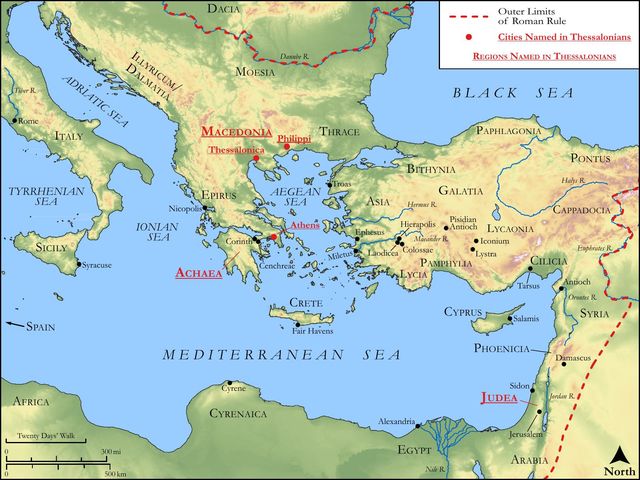
The city of Thessalonica was a bustling port city and the capital of the Roman province of Macedonia. It was a diverse metropolis, making the unity and love among believers, transcending social and ethnic divides, particularly noteworthy. Paul had a relatively short but impactful ministry there, as detailed in Acts 17:1-9, before being forced to leave due to persecution. The church was young, likely composed of both Jewish and Gentile converts, and faced ongoing opposition. Paul's letter, written from Corinth, aimed to strengthen their faith, correct misunderstandings, and encourage them in their walk. The mention of their love extending "toward all the brethren which are in all Macedonia" (a region encompassing cities like Philippi and Berea) underscores the interconnectedness of early Christian communities and the practical expression of their shared faith across geographical boundaries, likely involving financial support or hospitality.
Key Themes
ShowHide1 Thessalonians 4:10 significantly contributes to several key themes within the epistle and Paul's broader theology. Firstly, it highlights the theme of Christian Love (Agape) as a practical, demonstrable virtue, not merely an abstract concept. Paul emphasizes that this love is "taught of God" (1 Thessalonians 4:9) and is a hallmark of genuine faith. Secondly, the verse underscores the theme of Spiritual Growth and Progress. Despite their commendable efforts, Paul calls them to "increase more and more," indicating that Christian maturity is a continuous process of abounding in virtues, not a static state. This aligns with Paul's consistent emphasis on believers pressing on towards the prize, as seen in Philippians 3:12-14. Lastly, it reinforces the theme of Christian Unity and Fellowship, demonstrating that the "brethren" extended beyond their local congregation to a wider network of believers throughout the entire region of Macedonia, embodying the early church's sense of being one body in Christ (Ephesians 4:1-6).
Exposition and Analysis
ShowHideKey Word Analysis
ShowHideThis particle, often translated as "for" or "because," here serves to confirm or emphasize the preceding statement. In the context of 1 Thessalonians 4:10, Paul uses it to affirm the truth of their loving actions, validating his earlier statement in 1 Thessalonians 4:9 that they were "taught of God to love one another." It reinforces the reality of their existing obedience.
This verb means "to call near," and by extension, "to invite, invoke, implore, exhort, or comfort." Paul's use of parakaléō here is not a harsh command but a tender, earnest appeal or encouragement. It conveys a pastoral tone, reflecting his deep care for the Thessalonians and his desire for their continued spiritual flourishing, rather than a reprimand for deficiency. It's a gentle yet firm urging towards greater maturity.
Derived from a word meaning "to be in excess" or "to superabound," perisseúō signifies an overflowing abundance, going beyond what is merely sufficient or expected. It implies growth in quantity, quality, and intensity. When Paul urges them to "increase more and more," he is calling them to excel, to have an overabundance of love, suggesting an ever-expanding generosity and affection that is not limited by previous achievements. This isn't just about doing more, but about the very nature of their love becoming richer and more pervasive.
This adverb is the neuter comparative form meaning "more" or "rather," often implying a greater degree or intensity. Coupled with perisseúō ("increase"), it creates a strong emphasis on continuous, progressive growth. It underscores that spiritual virtues, particularly love, are not static but dynamic, requiring ongoing effort and expansion. This phrase highlights the limitless potential for growth in Christian love.
Verse Breakdown
ShowHide"And indeed ye do it toward all the brethren which are in all Macedonia:"
This opening clause serves as a powerful commendation. Paul affirms that the Thessalonians are actively practicing the brotherly love he just mentioned in 1 Thessalonians 4:9. The phrase "ye do it" indicates their practical, ongoing actions. Crucially, their love is not confined to their local assembly but extends "toward all the brethren which are in all Macedonia," demonstrating a wide sphere of influence and a deep sense of Christian solidarity across the entire Roman province. This would have involved acts of hospitality, financial support, and mutual encouragement among the scattered Christian communities.
"but we beseech you, brethren,"
Following the commendation, Paul introduces a gentle yet firm exhortation. The conjunction "but" (Greek, dé) signals a transition from affirmation to appeal. The term "beseech" (Greek, parakaléō) conveys a heartfelt plea, reflecting Paul's pastoral care rather than a harsh command. Addressing them as "brethren" (Greek, adelphoi) reinforces the familial bond within the Christian community, softening the exhortation and emphasizing the shared spiritual journey.
"that ye increase more and more;"
This final clause contains the core of Paul's exhortation. Despite their already commendable actions, Paul urges them to "increase" (Greek, perisseúō) in their love. The repetition of "more and more" (Greek, mâllon) intensifies this call, emphasizing not just continued growth, but an escalating, superabundant expression of love. It implies a limitless horizon for spiritual development, where Christian virtues are never fully perfected but always capable of deeper and broader manifestation. This is a call to excel and abound in love, pushing beyond existing boundaries.
Literary Devices
ShowHidePaul employs several literary devices in 1 Thessalonians 4:10 to achieve his pastoral aims. He begins with Commendation, affirming their current praiseworthy actions ("And indeed ye do it toward all the brethren..."). This positive reinforcement builds rapport and encourages the believers, demonstrating Paul's genuine appreciation for their faithfulness. Following this, he transitions to Exhortation, using the tender yet earnest verb "beseech" (Greek: parakaléō) to urge them forward. The phrase "increase more and more" is a form of Intensification or Hyperbole, using the Greek perisseúō (to superabound) combined with mâllon (more, in a greater degree) to powerfully convey the idea of limitless growth and an overflowing abundance of love. This is not merely a call for more acts of love, but for love to become ever deeper, richer, and more pervasive in their lives. The consistent use of "brethren" (Greek: adelphoi) throughout the letter, and specifically twice in this verse, employs Familial Language, reinforcing the strong bond and shared identity among believers, which naturally undergirds the call to brotherly love.
Theological and Thematic Connections
ShowHideThe theological significance of 1 Thessalonians 4:10 lies in its affirmation of love as the quintessential Christian virtue and its dynamic nature. It teaches that genuine faith is active and expressed through love for fellow believers, extending beyond local congregations to the wider body of Christ. Furthermore, it underscores the principle of progressive sanctification, where believers are continually called to grow and abound in spiritual fruit, never reaching a point of static perfection but always pressing forward in Christ-likeness. This abounding love is not merely human effort but a divine enablement, as they are "taught of God to love one another" (1 Thessalonians 4:9). The extensive reach of their love across Macedonia also highlights the early church's understanding of itself as a unified, interconnected family, transcending geographical and social barriers.
Reflection and Application
ShowHide1 Thessalonians 4:10 offers profound insights for contemporary believers. First, it reminds us of the power of affirmation. Paul begins by commending the Thessalonians, validating their existing faithfulness before challenging them further. This teaches us the importance of acknowledging and celebrating the good we see in others, fostering an environment of encouragement rather than constant critique. Second, the exhortation to "increase more and more" in love is a timeless call to continuous spiritual growth. Christian love is not a static achievement but a dynamic, ever-expanding virtue. We are challenged to actively seek opportunities to deepen our affection, extend our compassion, and broaden our sphere of care, moving beyond our comfort zones and immediate circles. This involves intentional acts of service, forgiveness, patience, and generosity, striving for an overflowing abundance of love that reflects the heart of God. Our love should not be limited by convenience or familiarity but should reach out to the "brethren" near and far, demonstrating the unity of the global church.
Questions for Reflection
ShowHideFAQ
ShowHideWhat does Paul mean by "increase more and more" in love?
ShowHideWhen Paul urges the Thessalonians to "increase more and more" (Greek: perisseúō mâllon), he is calling them to a continuous and escalating abundance in their brotherly love. It's not merely about doing more acts of love, but about the quality, depth, and intensity of their affection becoming richer and more pervasive. It implies a love that overflows, exceeds expectations, and is never content with its current level but always seeks to grow and abound. This concept of spiritual growth is a recurring theme in Paul's letters, emphasizing that Christian virtues are dynamic and require ongoing development, as seen in his prayer for the Philippians that their love might "abound yet more and more in knowledge and in all judgment" (Philippians 1:9).
Christ-Centered Fulfillment
ShowHide1 Thessalonians 4:10, while a direct command to the Thessalonian believers, finds its ultimate fulfillment and enablement in Jesus Christ. The "love one another" that Paul commends and calls to "increase more and more" is the very love that flows from Christ and is empowered by His Spirit. Jesus Himself is the supreme example of this abounding love, demonstrated in His self-sacrificial life and death for humanity (John 15:13). He commanded His disciples, "A new commandment I give unto you, That ye love one another; as I have loved you, that ye also love one another" (John 13:34). Thus, the Thessalonians' existing love, and the call for its increase, is a reflection of Christ's indwelling presence and His ongoing work in their hearts. As believers are united with Christ, they are transformed into His likeness, enabling them to manifest the divine love (agape) that is characteristic of God Himself (1 John 4:7-8). The church's love for one another, extending throughout Macedonia and beyond, becomes a tangible witness to the world of the reality of Christ's transforming power and the unity found in Him (John 13:35).