


2 Corinthians 9:2
Bible text: King James Version (1769 Blayney text) · Public domain
Bible text: King James Version with Strong's numbers · Public domain
Bible text: Berean Standard Bible · Public domain
Bible text: American Standard Version (1901) · Public domain
Bible text: World English Bible, Messianic edition · Public domain
Bible text: Geneva Bible (1599) · Public domain
Bible text: Young's Literal Translation · Public domain
- οἶδαoidaI knowG1492V-RAI-1SVerb Perfect Active Indicative 1st Singular
- γὰρgarforG1063CONJConjunction
- τὴνtēntheG3588T-ASFDefinite article Accusative Singular Feminine
- προθυμίανprothumianreadinessG4288N-ASFNoun Accusative Singular Feminine
- ὑμῶνhumōnof youG4771P-2GPPersonal pronoun Genitive 2nd Plural
- ἣνhēnwhichG3739R-ASFRelative pronoun Accusative Singular Feminine
- ὑπὲρhuperconcerningG5228PREPPreposition
- ὑμῶνhumōnyouG4771P-2GPPersonal pronoun Genitive 2nd Plural
- καυχῶμαιkauchōmaiI boast ofG2744V-PNI-1SVerb Present Middle Or Passive Deponent Indicative 1st Singular
- ΜακεδόσινMakedosinto MacedoniansG3110N-DPM-LGNoun Dative Plural Masculine Location Gentilic
- ὅτιhotithatG3754CONJConjunction
- ἈχαΐαAchaiaAchaiaG882N-NSF-LNoun Nominative Singular Feminine Location
- παρεσκεύασταιpareskeuastaihas prepared itselfG3903V-RMI-3SVerb Perfect Middle Indicative 3rd Singular
- ἀπὸapofromG575PREPPreposition
- πέρυσιperusia year agoG4070ADVAdverb
- καὶkaiandG2532CONJConjunction
- τὸto<the>G3588T-NSNDefinite article Nominative Singular Neuter
- ἐξexfromG1537PREPPreposition
- ὑμῶνhumōnyourG4771P-2GPPersonal pronoun Genitive 2nd Plural
- ζῆλοςzēloszealG2205N-NSNNoun Nominative Singular Neuter
- ἠρέθισενērethisenhas been provokingG2042V-AAI-3SVerb Aorist Active Indicative 3rd Singular
- τοὺςtoustheG3588T-APMDefinite article Accusative Plural Masculine
- πλείοναςpleionasgreater numberG4119A-APM-CAdjective Accusative Plural Masculine Comparative
English is a literal word-by-word gloss of the Greek, not the KJV's wording. Why?
This is the original text the KJV's translators worked from — each Greek word with its own literal English meaning in this verse, prepared by scholars at Tyndale House, Cambridge. The KJV translates whole sentences, not word by word, so its wording differs: one Greek word can become several English words, and the KJV may choose “charity” where the gloss reads “love”. Both are faithful — they answer different questions. For the KJV's own rendering, switch to the KJV text.
Details
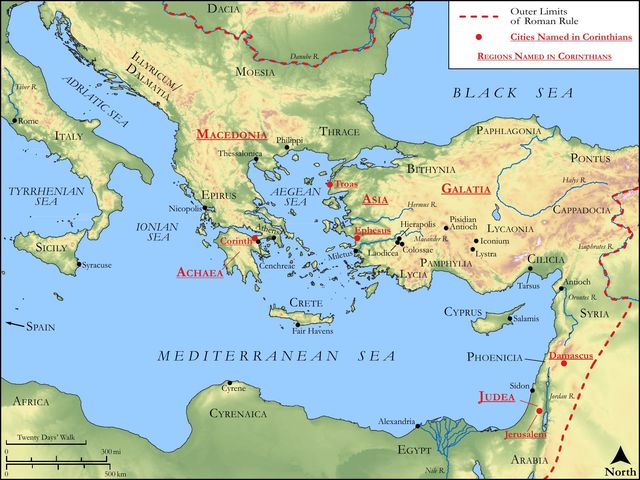
See on the biblical-era maps

Study this verse
Public-domain commentary
Matthew Henry
From his Commentary on the Whole Bible. Henry comments on passages, not single verses — this entry covers 2 Corinthians 9:1–5. His two-level outline is real structure in the source text, so it is rendered as structure.
In these verses the apostle speaks very respectfully to the Corinthians, and with great skill; and, while he seems to excuse his urging them so earnestly to charity, still presses them thereto, and shows how much his heart was set upon this matter.
I.He tells them it was needless to press them with further arguments to afford relief to their poor brethren (Co2 9:1), being satisfied he had said enough already to prevail with those of whom he had so good an opinion. For,
1.He knew their forwardness to every good work, and how they had begun this good work a year ago, insomuch that,
2.He had boasted of their zeal to the Macedonians, and this had provoked many of them to do as they had done. Wherefore he was persuaded, that, as they had begun well, they would go on well; and so, commending them for what they had done, he lays an obligation on them to proceed and persevere.
II.He seems to apologize for sending Titus and the other brethren to them.
He is unwilling they should be offended at him for this, as if he were too earnest, and pressed too hard upon them; and tells the true reasons why he sent them, namely,
1.That, having this timely notice, they might be fully ready (Co2 9:3), and not surprised with hasty demands, when he should come to them. When we would have others to do that which is good we must act towards them prudently and tenderly, and give them time.
2.That he might not be ashamed of his boasting concerning them, if they should be found unready, Co2 9:3, Co2 9:4. He intimates that some from Macedonia might haply come with him: and, if the collection should not then be made, this would make him, not to say them, ashamed, considering the boasting of the apostle concerning them. Thus careful was he to preserve their reputation and his own. Note, Christians should consult the reputation of their profession, and endeavour to adorn the doctrine of God our Saviour.
Historical interpretation
Historical reception
3 surviving comments on this verse. Each one is dated, so this reads as a timeline rather than a list.
Select a marker to jump to its quote. Markers stagger vertically where authors wrote within a few decades of each other.
The other churches followed after Corinth. When they heard that a church which had previously been involved in many errors had put them right, they were moved to good works. After accepting the faith and then behaving badly, they began to have this desire to improve. How much more then ought others, in whom such vices were not present, do so as well?
"For I know your readiness of which I glory on your behalf to them of Macedonia." Now it was a great thing that he even knew it himself, but much greater, that he also published it to others: for the force it has is greater: for they would not like to be so widely disgraced. Seest thou his wisdom of purpose? He exhorted them by others' example, the Macedonians, for, he says, "I make known to you the grace of God which hath been given in the Churches of Macedonia." He exhorted them by their own, for he saith, "who were the first to make a beginning a year ago not only to do, but also to will." He exhorted them by the Lord's, for "ye know" he saith, "the grace of our Lord, that though He was rich, yet for our sakes He became poor." Again he retreats upon that strong main point, the conduct of others. For mankind is emulous. And truly the example of the Lord ought to have had most power to draw them over: and next to it, the consideration of the recompense: but because they were somewhat weak, this draws them most. For nothing does so much as emulation. "And your zeal has stirred up very many." What sayest thou? A little before thou saidst, they did it "of their own accord, beseeching us with much entreaty," how then now, "your zeal?" 'Yes,' he saith, 'we did not advise we did not exhort, but we only praised you, we only boasted of you, and this was enough to incite them.' Seest thou how he rouses them each by the other, these by those, and those by these, and, along with the emulation, has intermingled also a very high encomium. Then, that he may not elate them, he follows it up in a tempered tone, saying, "Your zeal hath stirred up very many."
Paul holds up the Macedonians to the Corinthians and the Corinthians to the Macedonians as examples to imitate.
Continue studying 2 Corinthians 9:2 across the web’s major study libraries — every link below opens this exact verse, chapter, or book on the destination site.
Read & Compare
 BibleGatewayThis verse in more than 200 translations and 70 languages.
 Bible.comThe YouVersion reader — hundreds of translations, reading plans, and highlights.
 ESV.orgCrossway's official English Standard Version reader.
 NET BibleThe NET translation with 60,000+ translators' notes on every rendering decision.
 STEP BibleTyndale House's free study tool — original text, vocabulary, and scholarly resources.
 BibliaLogos Bible Software's free web reader.
 USCCBThe New American Bible (Revised Edition) with the U.S. bishops' study notes.
Commentaries
 BibleHub CommentariesDozens of classic commentaries on this verse, gathered on one page.
 StudyLightMore than 100 commentary sets — the largest collection on the web.
 BibleRefPlain-English commentary on what this verse means, verse by verse.
 Enduring WordDavid Guzik's free commentary on this chapter, widely used by Bible teachers.
 Bible Study ToolsVerse commentary alongside Greek and Hebrew study aids.
Original Language & Research
- BibleHub InterlinearThe verse word by word — original language, transliteration, and English.
- BibleHub LexiconEvery word's original-language definition and Strong's entry.
 Blue Letter BibleDeep-study tools — Strong's numbers, concordance, and word studies.
 CNTR CollationThe earliest Greek manuscripts of this verse, collated letter by letter.
Sermons, Hymns & Audio


TrulyRandomVerse is not affiliated with these sites and doesn’t control their content. They’re linked because they’re genuinely useful.
Summary
Second Corinthians 9:2 reveals the Apostle Paul's profound confidence in the Corinthian believers' commitment to the collection for the impoverished saints in Jerusalem. He proudly declares their eager readiness, which had been established a year prior, to the churches in Macedonia. Their proactive zeal and enthusiastic commitment served as a powerful and positive catalyst, inspiring and motivating many others to participate in this significant act of Christian generosity and solidarity.
Context
ShowHideLiterary Context
This verse is situated within a larger appeal for generosity that spans 2 Corinthians chapters 8 and 9. Paul is urging the Corinthians to complete a collection they had initiated a year earlier for the struggling believers in Jerusalem. Chapter 8 focuses on the exemplary giving of the Macedonian churches, highlighting their sacrificial generosity despite their own poverty (2 Corinthians 8:1-5). Chapter 9, which includes our verse, continues this theme by appealing to the Corinthians' own prior commitment and the positive impact their readiness has had on others. Paul's approach is not one of coercion but of encouragement, reminding them of their initial enthusiasm and the spiritual benefits of cheerful giving (2 Corinthians 9:7). The entire section underscores the principles of Christian stewardship, inter-church fellowship, and the spiritual blessings that accompany generous giving.
Historical & Cultural Context
The collection Paul was organizing was a significant undertaking, designed to provide financial relief to the impoverished Christian community in Jerusalem. This community, being the birthplace of the church, likely faced unique economic hardships, possibly due to famine, persecution, or the communal sharing of resources among early believers. The collection also held profound theological significance: it was a tangible expression of unity between the Gentile churches (like Corinth and Macedonia) and the Jewish-Christian mother church in Jerusalem. This act of solidarity helped bridge potential divides and affirmed the universal nature of the body of Christ, demonstrating that Gentile believers acknowledged their spiritual debt to Jerusalem, from whom the Gospel had come (Romans 15:26-27). The Roman province of Achaia, where Corinth was located, was known for its wealth, while Macedonia was generally poorer, making the Macedonian churches' generosity particularly striking and the Corinthian readiness a point of strategic boasting for Paul.
Key Themes
ShowHideSeveral major themes emerge from 2 Corinthians 9:2. First, Commendation and Trust are evident in Paul's boasting about the Corinthians' readiness; he trusts their intentions and uses positive affirmation as a pastoral tool, demonstrating a leadership style that builds on existing strengths. Second, Proactive Generosity is highlighted by the phrase "forwardness of your mind" and the fact that their readiness was established "a year ago," emphasizing their initial enthusiasm and commitment to the cause. This speaks to the importance of not just good intentions but also follow-through in Christian giving. Third, the theme of Inspirational Influence is central, as the Corinthians' "zeal" had "provoked very many." This shows the ripple effect of genuine Christian commitment; one church's faithfulness can stir up and motivate others to similar acts of love and service, fostering a spirit of healthy emulation within the broader Christian community, as seen in Hebrews 10:24. Finally, the broader context of the collection underscores Inter-Church Unity and Solidarity, demonstrating how practical acts of love can bind diverse communities together in the body of Christ.
Exposition and Analysis
ShowHideKey Word Analysis
ShowHideThis term signifies an eager readiness, willingness, or alacrity. It describes a disposition of the mind that is prompt and enthusiastic to act, not out of compulsion or obligation, but out of a genuine desire to do good. In this context, it speaks to the Corinthians' initial and sustained enthusiasm for participating in the collection for the saints in Jerusalem.
Properly meaning "heat," this word figuratively denotes "zeal" in a favorable sense, indicating ardor, fervent mind, or passionate eagerness. It captures the intense, positive energy and commitment the Corinthians demonstrated towards their promised contribution, which Paul uses as a point of commendation.
Derived from a root meaning "strife" or "contention," this verb can mean to stimulate, stir up, or incite, often to anger. However, in this specific context, especially when paired with "zeal" and the positive outcome of "many" being stirred, it carries a positive connotation of stimulating or encouraging others to good works, rather than to irritation or conflict.
Verse Breakdown
ShowHide"For I know the forwardness of your mind,"
Paul begins by affirming his deep personal knowledge and confidence in the Corinthians' eager readiness and willingness to participate in the collection. This highlights his trust in their initial commitment and their genuine disposition towards generosity.
"for which I boast of you to them of Macedonia,"
Paul reveals that their readiness has been a source of pride for him. He has used their example as a commendation, sharing their positive intentions and commitment with the churches in the region of Macedonia, likely to encourage and inspire them further in their own giving.
"that Achaia was ready a year ago;"
This clause specifies the duration of the Corinthians' commitment. "Achaia" refers to the Roman province where Corinth was located, representing the Corinthian church. Their readiness was not a recent development but had been established a full year prior, underscoring their sustained and proactive engagement.
"and your zeal hath provoked very many."
This final clause describes the powerful impact of the Corinthians' enthusiasm. Their "zeal"—their fervent and passionate commitment—had positively "provoked" or stimulated a great number of people, particularly the Macedonians, to similar acts of generosity. This demonstrates the ripple effect of genuine Christian commitment and the power of example.
Literary Devices
ShowHidePaul masterfully employs several literary devices in this verse to convey his message. The primary device is Commendation, as Paul openly praises the Corinthians, not to flatter them, but to affirm their good intentions and encourage their follow-through. This commendation functions as a form of Positive Reinforcement, building on their past readiness. The act of Paul "boasting" about the Corinthians to the Macedonians serves as Exemplification, presenting the Corinthians as a model for others to emulate, thereby leveraging their positive example to inspire generosity in other communities. The term "provoked" (erethízō), while often carrying a negative connotation, is used here with Irony or Semantic Shift, as it clearly implies a positive stimulation or incitement to good works, rather than anger or irritation. This highlights the transformative power of genuine Christian zeal.
Theological and Thematic Connections
ShowHideThis verse beautifully illustrates the interconnectedness of the early Christian communities and the spiritual power of a good example. It demonstrates that Christian generosity is not merely a financial transaction but an act of worship and an expression of love that can have a profound impact beyond the immediate recipients. Paul's confidence in the Corinthians, and his willingness to boast about their readiness, underscores a key principle of spiritual leadership: affirming and celebrating the good in people can powerfully motivate them to fulfill their commitments and inspire others. The "zeal" that "provoked very many" speaks to the contagious nature of genuine faith and selfless giving, emphasizing that our actions, especially those rooted in love and generosity, can create a ripple effect that strengthens the entire body of Christ. This mutual encouragement and inspiration are vital for the health and growth of the church.
Reflection and Application
ShowHideSecond Corinthians 9:2 serves as a powerful reminder that our intentions and commitments in faith, particularly in areas of generosity and service, are not only observed by God but also hold significant potential to inspire and encourage our fellow believers. Paul's "boasting" about the Corinthians was not self-aggrandizement but a strategic and loving act of affirming their positive disposition, leveraging their good example to stir up generosity in others. This challenges us to consider how our own "forwardness of mind" and "zeal" in Christian living might serve as a catalyst for good within our communities. Are we proactive in our commitments, not just in word but in deed? Do our actions reflect a genuine enthusiasm for God's work, an enthusiasm that might "provoke" others to greater love and good works? This verse encourages us to be mindful of the powerful influence our faithfulness can have, urging us to complete what we have started and to live in such a way that our lives become a compelling testament to God's grace, inspiring others to join in the mission of the Kingdom.
Questions for Reflection
ShowHideFAQ
ShowHideWhat does Paul mean by "boast of you"? Is boasting acceptable for a Christian?
ShowHidePaul's "boasting" here is not self-glorifying or prideful in a negative sense. Instead, it is a commendation and affirmation of the Corinthians' positive intentions and commitment. He is boasting about them, not of himself. In this context, "boasting" functions as a form of positive reinforcement and strategic encouragement. Paul uses their example to motivate others, demonstrating a wise pastoral approach. He often contrasts this kind of boasting in the Lord or in others' faithfulness with boasting in human achievements or self-righteousness, which he condemns (1 Corinthians 1:31). His boasting here is rooted in genuine appreciation for their readiness and a desire to see God's work advanced through their example.
How could the Corinthians' "zeal" have "provoked" many others?
ShowHideThe word "provoked" (Greek: erethízō) here is used in a positive sense, meaning to stimulate, stir up, or incite to good works. The Corinthians' initial eager commitment to the collection, even a year prior, served as a powerful example. When Paul spoke of their readiness to the Macedonian churches, it likely created a sense of healthy competition or inspiration. The Macedonians, hearing of the Corinthians' proactive generosity, were themselves stirred to greater acts of giving, even out of their own poverty (2 Corinthians 8:1-5). Thus, the Corinthians' zeal acted as a catalyst, demonstrating the ripple effect that one community's faithfulness can have on others within the body of Christ.
Christ-Centered Fulfillment
ShowHideSecond Corinthians 9:2, with its emphasis on proactive generosity and the power of a compelling example, finds its ultimate fulfillment in the person and work of Jesus Christ. Our Lord is the supreme example of "forwardness of mind" and "zeal," having willingly and eagerly embraced the Father's will to accomplish salvation for humanity. His entire life, culminating in His sacrificial death on the cross, was an act of unparalleled generosity, demonstrating that He "though he was rich, yet for your sakes he became poor, so that you through his poverty might become rich" (2 Corinthians 8:9). His "zeal" for God's house and for the redemption of His people consumed Him (John 2:17). This divine generosity and zeal were not merely for His own sake but were intended to "provoke" or inspire us, His followers, to live lives of similar self-giving love. We are called to imitate Christ's sacrificial love, to be ready and zealous in our giving and service, knowing that our transformed lives, empowered by His Spirit, can in turn become a powerful testimony that draws others to His saving grace and inspires them to join in the work of His Kingdom (Ephesians 5:2).