


1 Corinthians 16:15
- ΠαρακαλῶParakalōI exhortG3870V-PAI-1SVerb Present Active Indicative 1st Singular
- δὲdenowG1161CONJConjunction
- ὑμᾶςhumasyouG4771P-2APPersonal pronoun Accusative 2nd Plural
- ἀδελφοί·adelphoibrothersG80N-VPMNoun Vocative Plural Masculine
- οἴδατεoidateyou knowG1492V-RAI-2PVerb Perfect Active Indicative 2nd Plural
- τὴνtēntheG3588T-ASFDefinite article Accusative Singular Feminine
- οἰκίανoikianhouseG3614N-ASFNoun Accusative Singular Feminine
- ΣτεφανᾶStephanaof StephanasG4734N-GSM-PNoun Genitive Singular Masculine Individual
- ὅτιhotithatG3754CONJConjunction
- ἐστὶνestinit isG1510V-PAI-3SVerb Present Active Indicative 3rd Singular
- ἀπαρχὴaparchēfirstfruitG536N-NSFNoun Nominative Singular Feminine
- τῆςtēs<the>G3588T-GSFDefinite article Genitive Singular Feminine
- ἈχαΐαςAchaiasof AchaiaG882N-GSF-LNoun Genitive Singular Feminine Location
- καὶkaiandG2532CONJConjunction
- εἰςeistoG1519PREPPreposition
- διακονίανdiakonianserviceG1248N-ASFNoun Accusative Singular Feminine
- τοῖςtoisto theG3588T-DPMDefinite article Dative Plural Masculine
- ἁγίοιςhagioissaintsG40A-DPMAdjective Dative Plural Masculine
- ἔταξανetaxanthey have devotedG5021V-AAI-3PVerb Aorist Active Indicative 3rd Plural
- ἑαυτούς·he'autousthemselvesG1438F-3APMReflexive pronoun Accusative 3rd Plural Masculine
English is a literal word-by-word gloss of the Greek, not the KJV's wording. Why?
This is the original text the KJV's translators worked from — each Greek word with its own literal English meaning in this verse, prepared by scholars at Tyndale House, Cambridge. The KJV translates whole sentences, not word by word, so its wording differs: one Greek word can become several English words, and the KJV may choose “charity” where the gloss reads “love”. Both are faithful — they answer different questions. For the KJV's own rendering, switch to the KJV text.
Details
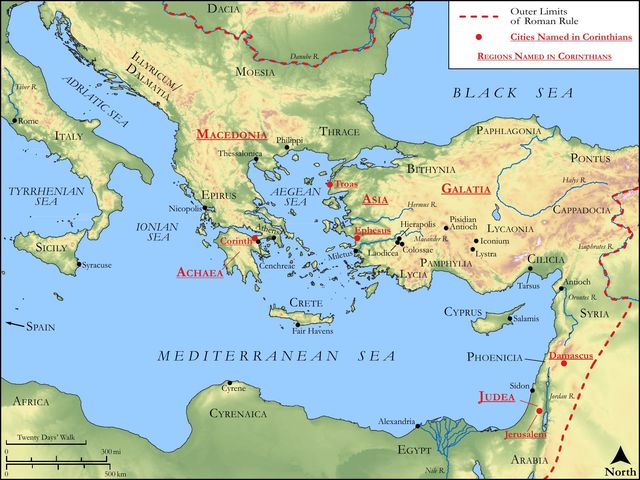
See on the biblical-era map

Study this verse
Public-domain commentary
Matthew Henry
From his Commentary on the Whole Bible. Henry comments on passages, not single verses — this entry covers 1 Corinthians 16:13–18. His three-level outline is real structure in the source text, so it is rendered as structure.
In this passage the apostle gives,
I.Some general advices; as,
1.That they should watch (Co1 16:13), be wakeful and upon their guard. A Christian is always in danger, and therefore should ever be on the watch; but the danger is greater at some times and under some circumstances. The Corinthians were in manifest danger upon many accounts: their feuds ran high, the irregularities among them were very great, there were deceivers got among them, who endeavoured to corrupt their faith in the most important articles, those without which the practice of virtue and piety could never subsist. And surely in such dangerous circumstances it was their concern to watch. Note, If a Christian would be secure, he must be on his guard; and the more his danger the greater vigilance is needful for his security.
2.He advises them to stand fast in the faith, to keep their ground, adhere to the revelation of God, and not give it up for the wisdom of the world, nor suffer it to be corrupted by it - stand for the faith of the gospel, and maintain it even to death; and stand in it, so as to abide in the profession of it, and feel and yield to its influence. Note, A Christian should be fixed in the faith of the gospel, and never desert nor renounce it. It is by this faith alone that he will be able to keep his ground in an hour of temptation; it is by faith that we stand (Co2 1:24); it is by this that we must overcome the world (Jo1 5:4), both when it fawns and when it frowns, when it tempts and when it terrifies. We must stand therefore in the faith of the gospel, if we would maintain our integrity.
3.He advises them to act like men, and be strong: "Act the manly, firm, and resolved part: behave strenuously, in opposition to the bad men who would divide and corrupt you, those who would split you into factions or seduce you from the faith: be not terrified nor inveigled by them; but show yourselves men in Christ, by your steadiness, by your sound judgment and firm resolution." Note, Christians should be manly and firm in all their contests with their enemies, in defending their faith, and maintaining their integrity. They should, in an especial manner, be so in those points of faith that lie at the foundation of sound and practical religion, such as were attacked among the Corinthians: these must be maintained with solid judgment and strong resolution.
4.He advises them to do every thing in charity, Co1 16:14. Our zeal and constancy must be consistent with charity. When the apostle would have us play the man for our faith or religion, he puts in a caution against playing the devil for it. We may defend our faith, but we must, at the same time, maintain our innocence, and not devour and destroy, and think with ourselves that the wrath of man will work the righteousness of God, Jam 1:24. Note, Christians should be careful that charity not only reign in their hearts, but shine out in their lives, nay, in their most manly defences of the faith of the gospel. There is a great difference between constancy and cruelty, between Christian firmness and feverish wrath and transport. Christianity never appears to so much advantage as when the charity of Christians is most conspicuous when they can bear with their mistaken brethren, and oppose the open enemies of their holy faith in love, when every thing is done in charity, when they behave towards one another, and towards all men, with a spirit of meekness and good will.
II.Some particular directions how they should behave towards some that had been eminently serviceable to the cause of Christ among them.
1.He gives us their character (1.) The household of Stephanas is mentioned by him, and their character is, that they were the first-fruits of Achaia, the first converts to Christianity in that region of Greece in which Corinth was. Note, It is an honourable character to any man to be early a Christian, betimes in Christ. But they had moreover addicted themselves to the ministry of the saints, to serve the saints. They have disposed and devoted themselves - etaxan heautous, to serve the saints, to do service to the saints. It is not meant of the ministry of the word properly, but of serving them in other respects, supplying their wants, helping and assisting them upon all occasions, both in their temporal and spiritual concerns. The family of Stephanas seems to have been a family of rank and importance in those parts, and yet they willingly offered themselves to this service. Note, It is an honour to persons of the highest rank to devote themselves to the service of the saints. I do not mean to change ranks, and become proper servants to the inferiors, but freely and voluntarily to help them, and do good to them in all their concerns. (2.) He mentions Stephanas, and Fortunatus, and Achaicus, as coming to him from the church of Corinth. The account he gives of them is that they supplied the deficiencies of the church towards him, and by so doing refreshed his spirit and theirs, Co1 16:17, Co1 16:18. They gave him a more perfect account of the state of the church by word of mouth than he could acquire by their letter, and by that means much quieted his mind, and upon their return from him would quiet the minds of the Corinthians. Report had made their cause much worse than it was in fact, and their letters had not explained it sufficiently to give the apostle satisfaction; but he had been made more easy by converse with them. It was a very good office they did, by truly stating facts, and removing the ill opinion Paul had received by common fame. They came to him with a truly Christian intention, to set the apostle right, and give him as favourable sentiments of the church as they could, as peace-makers. Note, It is a great refreshment to the spirit of a faithful minister to hear better of a people by wise and good men of their own body than by common report, to find himself misinformed concerning them, that matters are not so bad as they had been represented. It is a grief to him to hear ill of those he loves; it gladdens his heart to hear the report thereof is false. And the greater value he has for those who give him this information, and the more he can depend upon their veracity, the greater is his joy.
2.Upon this account of the men, he directs how they should behave towards them; and,
(1.)He would have them acknowledged (Co1 16:11), that is, owned and respected. They deserve it for their good offices. Those who serve the saints, those who consult the honour and good esteem of the churches, and are concerned to wipe off reproaches from them, and take off from the ill opinion fame had propagated, are to be valued, and esteemed, and loved. Those who discover so good a spirit cannot easily be over-valued.
(2.)He advises that they should submit themselves to such, and to all who helped with the apostles, and laboured, Co1 16:16. This is not to be understood of subjection to proper superiors, but of a voluntary acknowledgment of their worth. They were persons to whom they owed peculiar respect, and whom they should have in veneration. Note, It is a venerable character which those bear who serve the saints and labour hard to help the success of the gospel, who countenance and encourage the faithful ministers of Christ, and endeavour to promote their usefulness. Such should be had in honourable esteem.
Historical interpretation
Historical reception
2 surviving comments on this verse. Each one is dated, so this reads as a timeline rather than a list.
Select a marker to jump to its quote. Markers stagger vertically where authors wrote within a few decades of each other.
Paul calls these people the “first fruits” of Achaia, either because they were the first to be converted or because their piety was greater than that of others or because they refused to be ordained on account of their great humility and instead dedicated themselves to the service of others.
In the beginning too he mentions this man, saying, "I baptized also the home of Stephanas:" and now he speaks of him as "the first-fruits" not of Corinth only, but also of all Greece. And this too is no small encomium that he was the first to come to Christ. Wherefore also in the Epistle to the Romans, praising certain persons on this account, he said, "Who also were in Christ before me." And he said not, that they were the first who believed, but were the "first-fruits;" implying that together with their faith they showed forth also a most excellent life, in every way proving themselves worthy, as in the case of fruits. For so the first-fruits ought to be better than the rest of those things whereof they are the first-fruits: a kind of praise which Paul hath attributed to these also by this expression: namely, that they not only had a genuine faith, as I was saying, but also they exhibited great piety, and the climax of virtue, and liberality in alms-giving.
And not from hence only, but from another topic likewise he indicates their piety, i.e., from their having filled their whole house also with godliness.
And that they flourished in good works also, he declares by what follows, saying, "They have set themselves to minister unto the saints." Hear ye, how vast are the praises of their hospitality? For he did not say, "they minister," but, "have set themselves:" this kind of life they have chosen altogether, this is their business in which they are always busy.
Continue studying 1 Corinthians 16:15 across the web’s major study libraries — every link below opens this exact verse, chapter, or book on the destination site.
Read & Compare
 BibleGatewayThis verse in more than 200 translations and 70 languages.
 Bible.comThe YouVersion reader — hundreds of translations, reading plans, and highlights.
 ESV.orgCrossway's official English Standard Version reader.
 NET BibleThe NET translation with 60,000+ translators' notes on every rendering decision.
 STEP BibleTyndale House's free study tool — original text, vocabulary, and scholarly resources.
 BibliaLogos Bible Software's free web reader.
 USCCBThe New American Bible (Revised Edition) with the U.S. bishops' study notes.
Commentaries
 BibleHub CommentariesDozens of classic commentaries on this verse, gathered on one page.
 StudyLightMore than 100 commentary sets — the largest collection on the web.
 BibleRefPlain-English commentary on what this verse means, verse by verse.
 Enduring WordDavid Guzik's free commentary on this chapter, widely used by Bible teachers.
 Bible Study ToolsVerse commentary alongside Greek and Hebrew study aids.
Original Language & Research
- BibleHub InterlinearThe verse word by word — original language, transliteration, and English.
- BibleHub LexiconEvery word's original-language definition and Strong's entry.
 Blue Letter BibleDeep-study tools — Strong's numbers, concordance, and word studies.
 CNTR CollationThe earliest Greek manuscripts of this verse, collated letter by letter.
Sermons, Hymns & Audio


TrulyRandomVerse is not affiliated with these sites and doesn’t control their content. They’re linked because they’re genuinely useful.
Summary
In 1 Corinthians 16:15, the Apostle Paul commends the household of Stephanas, highlighting their significant role and exemplary devotion within the early Christian community in Achaia, the Roman province encompassing Corinth. Paul identifies them as the "firstfruits" of the region, signifying their early conversion and foundational influence, and praises their voluntary and profound commitment to the practical "ministry of the saints," setting them forth as a model of selfless service and spiritual leadership for the Corinthian believers.
Context
ShowHideLiterary Context
This verse is situated within the concluding section of Paul's First Epistle to the Corinthians, a letter addressing numerous issues of doctrine, ethics, and church order within the Corinthian community. Chapter 16 specifically deals with practical matters such as the collection for the saints in Jerusalem, Paul's travel plans, and various personal greetings and exhortations. Verse 15 introduces the household of Stephanas as a specific example of faithful service, immediately preceding Paul's direct instruction in 1 Corinthians 16:16 for the Corinthians to submit to such devoted individuals and those who labor with them. This commendation serves to reinforce Paul's broader appeals for unity, order, and mutual service throughout the letter, culminating in his final charge to "be watchful, stand firm in the faith, act like men, be strong" (1 Corinthians 16:13).
Historical & Cultural Context
Achaia was a Roman senatorial province in Greece, with Corinth as its capital. As a bustling port city, Corinth was a melting pot of cultures, philosophies, and religions, making the establishment of a Christian community particularly challenging yet significant. The term "firstfruits" (Greek: aparchē) in this context refers to the very first converts in a region, carrying connotations of a foundational and pioneering role, much like the first portion of a harvest offered to God. Such individuals or households often became pillars of the early church, providing leadership, hospitality, and resources. Their "addiction" (a KJV translation of a Greek word implying voluntary devotion) to the "ministry of the saints" would have involved practical acts of service, such as providing lodging for traveling missionaries, caring for the sick and poor, and facilitating gatherings of believers, which were crucial in a time when the church lacked formal structures and public buildings. This communal support was vital for the nascent Christian movement, reflecting the early church's commitment to mutual care as seen in Acts 2:44-45.
Key Themes
ShowHideThe verse significantly contributes to several key themes within 1 Corinthians and the broader New Testament. Firstly, it highlights the theme of Christian Service and Ministry (diakonia), emphasizing that genuine faith is expressed through active, selfless devotion to others within the community. Stephanas's household exemplifies the kind of practical love and sacrificial giving that Paul consistently advocates. Secondly, it underscores the theme of Exemplary Leadership and Influence in the early church, where those who were first to embrace the faith often took on informal yet vital roles in nurturing and guiding new believers. Their status as "firstfruits" implies not just chronological priority but also spiritual maturity and foundational importance. Finally, the passage subtly touches on the theme of Mutual Submission and Recognition, as Paul encourages the Corinthians to acknowledge and respect those who have so wholeheartedly given themselves to the work of the Lord, reinforcing the call for unity and order within the body of Christ that runs throughout 1 Corinthians.
Exposition and Analysis
ShowHideKey Word Analysis
ShowHideThis term literally refers to the initial portion of a harvest offered to God as a token of the entire crop. Figuratively, as used here, it signifies the very first converts in a particular region. It implies not only chronological priority but also a sense of being consecrated to God and serving as a representative sample of the larger group that would follow. The household of Stephanas, being the "firstfruits of Achaia," were pioneers of the Christian faith in that province, suggesting their foundational importance and spiritual maturity.
The KJV translation "addicted" can be misleading in modern English, as it often carries a negative connotation of involuntary compulsion. However, in the original Greek, tássō (or its perfect passive form, as used here) means "to arrange in an orderly manner," "to appoint," "to set," or "to devote oneself." It conveys a strong, deliberate, and voluntary commitment or assignment. Thus, Stephanas's household did not compulsively serve, but rather intentionally and resolutely "devoted themselves" or "set themselves" to the ministry. This emphasizes their willing and purposeful dedication.
This word denotes "service," "attendance," or "administration." In the context of the early church, diakonía encompassed a wide range of practical and spiritual services, including providing hospitality, caring for the poor and sick, teaching, and generally serving the needs of the community. It is the root of our word "deacon" and signifies humble, self-sacrificial service, often involving practical aid and support for others, especially "the saints" (fellow believers).
Verse Breakdown
ShowHide"I beseech you, brethren,"
Paul opens this section with a direct appeal to the Corinthian believers, using a term of endearment ("brethren") to underscore the familial bond and the earnestness of his exhortation. The verb "beseech" (Greek, parakaléō) implies a strong appeal, an earnest request, or even an exhortation, setting a tone of pastoral urgency and affection.
"(ye know the house of Stephanas,"
Paul refers to a household well-known to the Corinthians, indicating their prominence and established presence within the community. The "house" (Greek, oikía) refers not just to a physical dwelling but to the entire household, including family members, servants, and possibly dependents, suggesting a collective and unified commitment to their faith and service.
"that it is the firstfruits of Achaia,"
This clause defines the unique status of Stephanas's household. Being the "firstfruits" (Greek, aparchḗ) means they were among the very first converts to Christianity in the entire Roman province of Achaia. This designation implies their pioneering role, spiritual maturity, and perhaps even a foundational influence in establishing the church in that region.
"and [that] they have addicted themselves to the ministry of the saints,)"
This final clause describes the defining characteristic of Stephanas's household: their profound and voluntary dedication to service. The phrase "addicted themselves" (Greek, tássō in the perfect passive, indicating a settled state of self-assignment) highlights their intentional and ongoing commitment. Their service was directed "to the ministry" (Greek, eis diakonía) which refers to practical, humble service, specifically "of the saints" (Greek, tōn hagiōn), meaning their fellow believers. This points to their active role in meeting the needs of the Christian community through acts of hospitality, support, and practical care.
Literary Devices
ShowHidePaul employs Commendation and Exemplum (setting an example) in this verse. By explicitly naming and praising the household of Stephanas, Paul uses them as a positive model for the entire Corinthian church. The description of them as "the firstfruits of Achaia" and those who have "addicted themselves to the ministry of the saints" serves as a powerful Ethos appeal, lending credibility and moral weight to Paul's subsequent exhortation for the Corinthians to submit to such individuals (1 Corinthians 16:16). The vivid language of "addicted themselves" (though an archaic translation) also functions as a form of Hyperbole in its original intent, emphasizing the extraordinary and wholehearted nature of their voluntary devotion.
Theological and Thematic Connections
ShowHideThe dedication of Stephanas's household to the "ministry of the saints" embodies a core New Testament theological principle: that genuine faith is active and expressed through selfless service to others within the community of believers. This is not merely an optional activity but a fundamental outworking of Christian love and a reflection of Christ's own servanthood. Their status as "firstfruits" also connects to the broader theme of God's initiative in salvation, where He calls and sets apart individuals to be the initial bearers of His truth, laying foundations for the growth of His kingdom. Their example serves as a timeless reminder that spiritual maturity is often evidenced by a willing commitment to practical service, contributing to the health and vitality of the church body.
Reflection and Application
ShowHideThe household of Stephanas stands as a profound challenge and inspiration for believers today. Their voluntary and wholehearted devotion to the "ministry of the saints" reminds us that Christian service is not a burden or a mere obligation, but a joyful, intentional, and self-given response to God's grace. In a world often characterized by self-interest and consumerism, their example calls us to examine our own level of commitment to the local church and the broader body of Christ. Are we merely attendees, or are we active participants, eagerly seeking opportunities to serve, support, and uplift our fellow believers? Their "firstfruits" status also encourages us to consider the impact of our initial steps of faith and how our early devotion can set a powerful precedent for others and lay a strong foundation for spiritual growth within our communities. True spiritual leadership, as exemplified by Stephanas, often emerges not from a desire for position, but from a deep-seated commitment to humble, practical service.
Questions for Reflection
ShowHideFAQ
ShowHideWhat does Paul mean by "firstfruits of Achaia" in this verse?
ShowHideWhen Paul refers to the household of Stephanas as the "firstfruits of Achaia," he means they were among the very first individuals or families to embrace Christianity in that Roman province, which included the city of Corinth. The term "firstfruits" (Greek: aparchḗ) is an agricultural metaphor, referring to the initial, best portion of a harvest offered to God. In a spiritual sense, it signifies that Stephanas and his household were pioneers of the faith in that region. This designation implies their early conversion, their foundational role in establishing the church there, and often suggests a level of spiritual maturity and influence within the nascent Christian community. It's a commendation that highlights their significance as early, exemplary believers, much like Epaenetus, who is called the "firstfruits of Asia for Christ" in Romans 16:5.
Christ-Centered Fulfillment
ShowHideThe exemplary devotion of Stephanas's household to the "ministry of the saints" finds its ultimate fulfillment and perfect embodiment in Jesus Christ Himself. Christ is the quintessential Servant, who "did not come to be served, but to serve, and to give his life as a ransom for many" (Mark 10:45). His entire earthly life was a profound diakonía, a selfless ministry to humanity, culminating in His sacrificial death on the cross. Furthermore, Christ is the true "firstfruits" – not merely of a region's converts, but of the resurrection itself, "the firstfruits of those who have fallen asleep" (1 Corinthians 15:20). His resurrection guarantees the future resurrection of all who believe in Him. Thus, Stephanas's household, by their willing and "addicted" service to others, beautifully reflects the very heart of Christ's mission and character. Their call to ministry becomes a pattern for all believers, who are likewise called to follow in the footsteps of their Lord, serving one another in love as an overflow of the grace they have received from the ultimate Servant, Jesus Christ (Philippians 2:5-8).