


1 Corinthians 1:16
Bible text: King James Version (1769 Blayney text) · Public domain
Bible text: Berean Standard Bible · Public domain
Bible text: American Standard Version (1901) · Public domain
Bible text: World English Bible, Messianic edition · Public domain
Bible text: Geneva Bible (1599) · Public domain
Bible text: Young's Literal Translation · Public domain
- ἐβάπτισαebaptisaI baptizedG907V-AAI-1SVerb Aorist Active Indicative 1st Singular
- δὲdenowG1161CONJConjunction
- καὶkaialsoG2532CONJConjunction
- τὸνtontheG3588T-ASMDefinite article Accusative Singular Masculine
- ΣτεφανᾶStephanaof StephanasG4734N-GSM-PNoun Genitive Singular Masculine Individual
- οἶκον·oikonhouseholdG3624N-ASMNoun Accusative Singular Masculine
- λοιπὸνloiponas to the restG3063A-ASNAdjective Accusative Singular Neuter
- οὐκouknotG3756PRT-NNegative Particle Negative
- οἶδαoidaI knowG1492V-RAI-1SVerb Perfect Active Indicative 1st Singular
- εἴeiwhetherG1487CONDConjunction
- τιναtinaanyG5100X-ASMIndefinite pronoun Accusative Singular Masculine
- ἄλλονallonotherG243A-ASMAdjective Accusative Singular Masculine
- ἐβάπτισαebaptisaI baptizedG907V-AAI-1SVerb Aorist Active Indicative 1st Singular
English is a literal word-by-word gloss of the Greek, not the KJV's wording. Why?
This is the original text the KJV's translators worked from — each Greek word with its own literal English meaning in this verse, prepared by scholars at Tyndale House, Cambridge. The KJV translates whole sentences, not word by word, so its wording differs: one Greek word can become several English words, and the KJV may choose “charity” where the gloss reads “love”. Both are faithful — they answer different questions. For the KJV's own rendering, switch to the KJV text.
Details
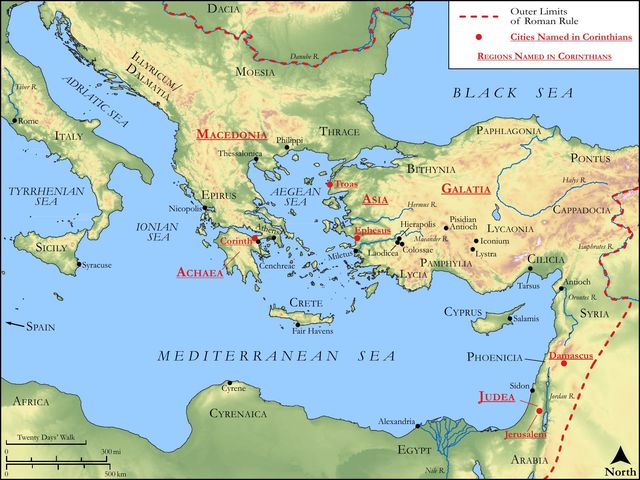
See on the biblical-era maps

Study this verse
Public-domain commentary
Matthew Henry
From his Commentary on the Whole Bible. Henry comments on passages, not single verses — this entry covers 1 Corinthians 1:14–16.
Here the apostle gives an account of his ministry among them. He thanks God he had baptized but a few among them, Crispus, who had been a ruler of a synagogue at Corinth (Act 18:8), Gaius, and the household of Stephanas, besides whom, he says, he did not remember that he had baptized any. But how was this a proper matter for thankfulness? Was it not a part of the apostolical commission to baptize all nations? And could Paul give thanks to God for his own neglect of duty? He is not to be understood in such a sense as if he were thankful for not having baptized at all, but for not having done it in present circumstances, lest it should have had this very bad construction put upon it - that he had baptized in his own name, made disciples for himself, or set himself up as the head of a sect. He left it to other ministers to baptize, while he set himself to more useful work, and filled up his time with preaching the gospel. This, he thought, was more his business, because the more important business of the two. He had assistants that could baptize, when none could discharge the other part of his office so well as himself. In this sense he says, Christ sent him not to baptize, but to preach the gospel - not so much to baptize as to preach. Note, Ministers should consider themselves sent and set apart more especially to that service in which Christ will be most honoured and the salvation of souls promoted, and for which they are best fitted, though no part of their duty is to be neglected. The principal business Paul did among them was to preach the gospel (Co1 1:17), the cross (Co1 1:18), Christ crucified, Co1 1:23. Ministers are the soldiers of Christ, and are to erect and display the banner of the cross. He did not preach his own fancy, but the gospel - the glad tidings of peace, and reconciliation to God, through the mediation of a crucified Redeemer. This is the sum and substance of the gospel. Christ crucified is the foundation of all our joys. By his death we live. This is what Paul preached, what all ministers should preach, and what all the saints live upon.
Historical interpretation
Historical reception
1 surviving comment on this verse from the historical church.
Then, having abashed those who were unsound in this respect and subjoining, "I baptized also the house of Stephanas," he again drags down their pride, saying besides, "I know not whether I baptized any other." For by this he signifies that neither did he seek much to enjoy the honor accruing hereby from the multitude, nor did he set about this work for glory's sake.
Continue studying 1 Corinthians 1:16 across the web’s major study libraries — every link below opens this exact verse, chapter, or book on the destination site.
Read & Compare
 BibleGatewayThis verse in more than 200 translations and 70 languages.
 Bible.comThe YouVersion reader — hundreds of translations, reading plans, and highlights.
 ESV.orgCrossway's official English Standard Version reader.
 NET BibleThe NET translation with 60,000+ translators' notes on every rendering decision.
 STEP BibleTyndale House's free study tool — original text, vocabulary, and scholarly resources.
 BibliaLogos Bible Software's free web reader.
 USCCBThe New American Bible (Revised Edition) with the U.S. bishops' study notes.
Commentaries
 BibleHub CommentariesDozens of classic commentaries on this verse, gathered on one page.
 StudyLightMore than 100 commentary sets — the largest collection on the web.
 BibleRefPlain-English commentary on what this verse means, verse by verse.
 Enduring WordDavid Guzik's free commentary on this chapter, widely used by Bible teachers.
 Bible Study ToolsVerse commentary alongside Greek and Hebrew study aids.
Original Language & Research
- BibleHub InterlinearThe verse word by word — original language, transliteration, and English.
- BibleHub LexiconEvery word's original-language definition and Strong's entry.
 Blue Letter BibleDeep-study tools — Strong's numbers, concordance, and word studies.
 CNTR CollationThe earliest Greek manuscripts of this verse, collated letter by letter.
Sermons, Hymns & Audio


TrulyRandomVerse is not affiliated with these sites and doesn’t control their content. They’re linked because they’re genuinely useful.
Summary
In 1 Corinthians 1:16, the Apostle Paul offers a parenthetical clarification to his earlier statement regarding his limited involvement in baptizing the Corinthian believers. He specifically recalls baptizing "the household of Stephanas" and then, with a degree of uncertainty, adds, "besides, I know not whether I baptized any other." This brief but insightful verse serves to underscore Paul's overarching argument against factionalism in the Corinthian church, redirecting their focus from human leaders and the administrators of rituals to the supreme importance of the gospel message and the unifying person of Christ.
Context
ShowHideLiterary Context
This verse is situated within Paul's fervent appeal for unity in the Corinthian church, directly following his rebuke of their divisions based on allegiance to various leaders (e.g., "I am of Paul; and I of Apollos; and I of Cephas" in 1 Corinthians 1:12). Paul's initial declaration in 1 Corinthians 1:14—"I thank God that I baptized none of you, but Crispus and Gaius"—is a rhetorical move to distance himself from the very factions that bore his name. Verse 16 then functions as a slight, almost incidental, amendment to this statement, as he remembers one more specific instance of baptism. This minor correction further emphasizes that the act of baptism, and especially its administrator, was of secondary concern to Paul compared to his primary mission: preaching the gospel of Christ.
Historical & Cultural Context
Corinth was a bustling, cosmopolitan city in Achaia, known for its diverse population, philosophical schools, and a culture that often valued rhetoric and personal charisma. Within this environment, it was common for people to align themselves with prominent teachers or leaders, a tendency that unfortunately spilled over into the nascent Christian community. The concept of "household" (Greek: oikos) was also profoundly significant among the Greeks and Romans. An oikos encompassed not just immediate family but also extended relatives, servants, and dependents. When a head of a household converted to a new faith, it was customary for the entire household to follow, signifying a collective commitment. Stephanas and his household are recognized elsewhere in Paul's letters as among the "firstfruits" of Achaia and devoted servants to the saints (1 Corinthians 16:15).
Key Themes
ShowHideThe verse subtly reinforces several key themes prevalent in 1 Corinthians and Paul's broader theology. First, it highlights The Primacy of the Gospel over ritual or human personality. Paul's apparent lack of concern for who baptized whom underscores that the message of the cross is paramount, not the messenger. Second, it contributes to the theme of Unity in Christ. By downplaying his own role in baptism, Paul aims to dismantle the very basis for the Corinthian divisions, redirecting their allegiance from human figures to the singular authority of Christ. This aligns with his broader teaching that believers are united into one body through baptism in the Spirit (1 Corinthians 12:13). Third, the mention of Household Conversion and Baptism offers insight into early church evangelism and practice, where the faith was often embraced by entire family units, as seen in other New Testament accounts like Lydia's household (Acts 16:15) and the Philippian jailer's household (Acts 16:33).
Exposition and Analysis
ShowHideKey Word Analysis
ShowHideMeaning "to immerse, submerge; to make whelmed (i.e. fully wet); used only (in the New Testament) of ceremonial ablution, especially (technically) of the ordinance of Christian baptism." Paul's use here refers to the Christian rite of water baptism, symbolizing identification with Christ's death, burial, and resurrection, and initiation into the Christian community. His casual recollection of administering it highlights his focus on the gospel's proclamation rather than the ritual's administration.
Meaning "a dwelling (more or less extensive, literal or figurative); by implication, a family (more or less related, literally or figuratively)." This term signifies the entire domestic unit, including family members, servants, and dependents. Its inclusion supports the historical understanding that conversion in the early church often encompassed the entire oikos, not just individuals in isolation, reflecting a corporate understanding of faith.
Meaning "properly, to see (literally or figuratively); by implication, (in the perfect tense only) to know." Paul's phrase "I know not" (οὐκ οἶδα, ouk oida) indicates a genuine lack of memory or certainty regarding other baptisms he performed. This is not a sign of forgetfulness but rather a deliberate demonstration of how little importance he placed on the act of baptism itself, relative to the preaching of the gospel. His focus was on the message, not the ritual's administrator.
Verse Breakdown
ShowHide"And I baptized also the household of Stephanas"
This clause serves as a specific recall, a parenthetical addition to Paul's earlier statement in 1 Corinthians 1:14 that he had baptized only Crispus and Gaius. The mention of Stephanas's household confirms that Paul did, in fact, perform more baptisms than initially stated, but it is presented as an afterthought, reinforcing his disinterest in cataloging such acts. The "household" (Greek: oikos) signifies that Stephanas, as the head, likely brought his entire family and dependents into the Christian faith, a common pattern in early church conversions.
"besides, I know not whether I baptized any other."
This concluding phrase further emphasizes Paul's detachment from the act of baptism. The Greek word for "besides" (loipón) can mean "furthermore" or "what remains." His declaration of not knowing if he baptized anyone else is not an admission of poor memory but a rhetorical device to underscore that the identity of the baptizer is irrelevant. His mission, as he explicitly states in 1 Corinthians 1:17, was "not to baptize, but to preach the gospel." This statement powerfully redirects attention away from human agents and towards the divine message.
Literary Devices
ShowHideThe Apostle Paul employs several literary devices in this concise verse. Primarily, it functions as a Parenthesis or Digression, a brief interjection that clarifies or adds information to an ongoing thought without disrupting the main argument. This momentary pause to recall Stephanas's household serves as a minor correction to his previous statement in 1 Corinthians 1:14. Furthermore, Paul's "I know not whether I baptized any other" can be seen as a form of Understatement or Apostolic Humility. Rather than meticulously listing his accomplishments, Paul deliberately downplays his administrative role in baptism. This self-effacement is a rhetorical strategy designed to deflect attention from himself and other human leaders, thereby undermining the factionalism prevalent in Corinth. By minimizing the importance of who performed the baptism, Paul subtly elevates the significance of the gospel message itself and the unifying power of Christ over any human agent or ritual.
Theological and Thematic Connections
ShowHide1 Corinthians 1:16, though seemingly a minor detail, profoundly reinforces the theological truth that the power and efficacy of Christian ordinances, particularly baptism, do not reside in the administrator but in Christ alone and the accompanying work of the Holy Spirit. Paul's casual recollection and subsequent uncertainty about who he baptized serve as a powerful rhetorical tool to dismantle the Corinthian church's dangerous tendency to form factions around human leaders. The verse redirects focus from the "who" of baptism to the "what" and "why"—the gospel message and the unity it creates in Christ. It underscores that the core of Christian faith is not allegiance to a particular minister or a specific ritual, but a shared identity in the crucified and risen Christ.
Reflection and Application
ShowHideThis seemingly small verse holds significant implications for believers today, reminding us where our ultimate allegiance and focus should lie. In an age where personalities, denominational distinctives, or even specific ministry styles can become sources of division, Paul's example calls us back to the essentials. Our faith is not in the one who baptized us, the pastor who preaches, or the specific church building we attend, but in Jesus Christ alone. This verse encourages us to prioritize the unity of the Spirit, the proclamation of the gospel, and the work of Christ above all else. It challenges us to examine our own hearts: Do we inadvertently elevate human leaders or specific traditions above the foundational truth of Christ's saving work? The mention of Stephanas's household also serves as a beautiful reminder of the holistic nature of faith, encouraging us to share the gospel not just with individuals but to consider the spiritual well-being of our entire families and those within our sphere of influence.
Questions for Reflection
ShowHideFAQ
ShowHideWhy did Paul seem to forget who he baptized, or claim not to know?
ShowHidePaul's statement "I know not whether I baptized any other" is not an indication of poor memory but a deliberate rhetorical device. His primary mission, as he explicitly states in 1 Corinthians 1:17, was "not to baptize, but to preach the gospel." By downplaying his role as an administrator of baptism and even expressing uncertainty, Paul powerfully underscores that the identity of the baptizer is irrelevant. His focus was entirely on the content of the message—the cross of Christ—and not on the ritual or the human agent performing it. This served to undermine the factionalism in Corinth, where believers were aligning themselves with specific leaders based on who had baptized them.
What is the significance of "the household of Stephanas" being mentioned?
ShowHideThe mention of "the household of Stephanas" (Greek: oikos Stephana) is significant for several reasons. Firstly, it provides a glimpse into early Christian evangelism, where conversion often encompassed the entire family unit, including children, servants, and dependents. This reflects the corporate nature of society at the time and suggests that faith was often embraced collectively. Secondly, Stephanas and his household were known as the "firstfruits of Achaia" (1 Corinthians 16:15), meaning they were among the very first converts in that region, and were highly esteemed for their service to the saints. Their inclusion here serves as a specific, verifiable example of Paul's baptismal activity, even as he generally minimized it.
Does this verse diminish the importance of baptism in the Christian faith?
ShowHideNo, this verse does not diminish the importance of baptism itself. Rather, it elevates the purpose and meaning of baptism above the identity of the one administering it. Paul's point is not that baptism is unimportant, but that the focus should be on Christ, into whom one is baptized, and the gospel, which baptism proclaims. The act of baptism is a significant symbolic and spiritual event, signifying identification with Christ's death and resurrection and incorporation into the body of believers (Romans 6:3-4; Galatians 3:27). Paul's statement simply ensures that human pride or allegiance to a particular minister does not overshadow the divine significance of the ordinance.
Christ-Centered Fulfillment
ShowHide1 Corinthians 1:16, though a seemingly minor detail, powerfully points to Christ as the ultimate fulfillment of the church's unity and the singular object of its faith. Paul's deliberate downplaying of his role in baptism, and his emphasis on preaching the gospel over administering the rite, underscores that the power and efficacy of salvation do not reside in human agents or rituals, but solely in the person and work of Jesus Christ. The Corinthian church's factionalism, rooted in allegiance to human leaders, is antithetical to the very nature of the church, which is the body of Christ (1 Corinthians 12:27). Christ alone is the head of the church (Ephesians 1:22-23), and it is His sacrifice on the cross, not the charisma of any human minister, that brings salvation and reconciliation (Colossians 1:20). The gospel that Paul was commissioned to preach is the "word of the cross" (1 Corinthians 1:18), which is the power of God for salvation to everyone who believes (Romans 1:16). Thus, Paul's recollection of Stephanas's household and his subsequent uncertainty about other baptisms serves as a profound Christ-centered lesson: the focus of the church must always be on the one who died and rose again for its redemption, the Lord Jesus Christ, in whom all believers are united as one body (Ephesians 4:4-6).