


Acts 16:9
- καὶkaiAndG2532CONJConjunction
- ὅραμαhoramaa visionG3705N-NSNNoun Nominative Singular Neuter
- διὰdiaduringG1223PREPPreposition
- τῆςtēstheG3588T-GSFDefinite article Genitive Singular Feminine
- νυκτὸςnuktosnightG3571N-GSFNoun Genitive Singular Feminine
- τῷtō<the>G3588T-DSMDefinite article Dative Singular Masculine
- ΠαύλῳPaulōto PaulG3972N-DSM-PNoun Dative Singular Masculine Individual
- ὤφθη·ōphthēappearedG3700V-API-3SVerb Aorist Passive Indicative 3rd Singular
- ἀνὴρanērA manG435N-NSMNoun Nominative Singular Masculine
- ΜακεδώνMakedōnof MacedoniaG3110N-NSM-LGNoun Nominative Singular Masculine Location Gentilic
- τιςtiscertainG5100X-NSMIndefinite pronoun Nominative Singular Masculine
- ἦνēnwasG1510V-IAI-3SVerb Imperfect Active Indicative 3rd Singular
- ἑστὼςhestōsalready standingG2476V-RAP-NSMVerb Perfect Active Participle Nominative Singular Masculine
- παρακαλῶνparakalōnbeseechingG3870V-PAP-NSMVerb Present Active Participle Nominative Singular Masculine
- αὐτὸνautonhimG846P-ASMPersonal pronoun Accusative Singular Masculine
- καὶkaiandG2532CONJConjunction
- λέγων·legōnsayingG3004V-PAP-NSMVerb Present Active Participle Nominative Singular Masculine
- διαβὰςdiabasHaving passed overG1224V-2AAP-NSMVerb 2nd Aorist Active Participle Nominative Singular Masculine
- εἰςeisintoG1519PREPPreposition
- ΜακεδονίανMakedonianMacedoniaG3109N-ASF-LNoun Accusative Singular Feminine Location
- βοήθησονboēthēsondo helpG997V-AAM-2SVerb Aorist Active Imperative 2nd Singular
- ἡμῖνhēminusG3165P-1DPPersonal pronoun Dative 1st Plural
English is a literal word-by-word gloss of the Greek, not the KJV's wording. Why?
This is the original text the KJV's translators worked from — each Greek word with its own literal English meaning in this verse, prepared by scholars at Tyndale House, Cambridge. The KJV translates whole sentences, not word by word, so its wording differs: one Greek word can become several English words, and the KJV may choose “charity” where the gloss reads “love”. Both are faithful — they answer different questions. For the KJV's own rendering, switch to the KJV text.
Details
See on the biblical-era map
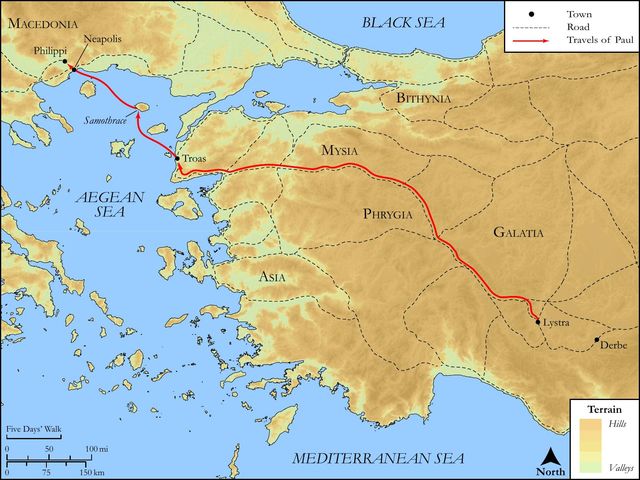
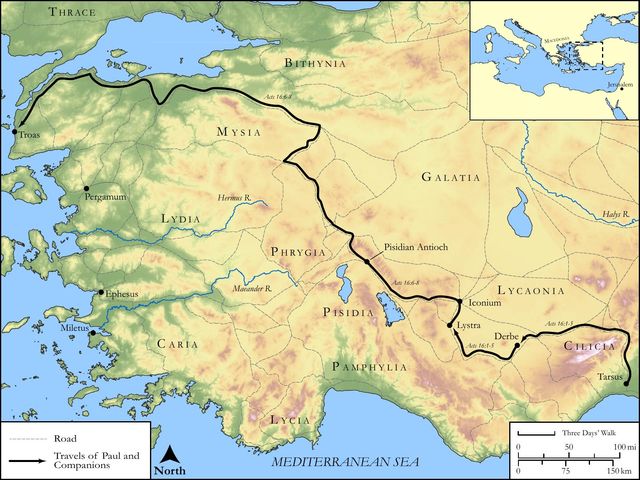
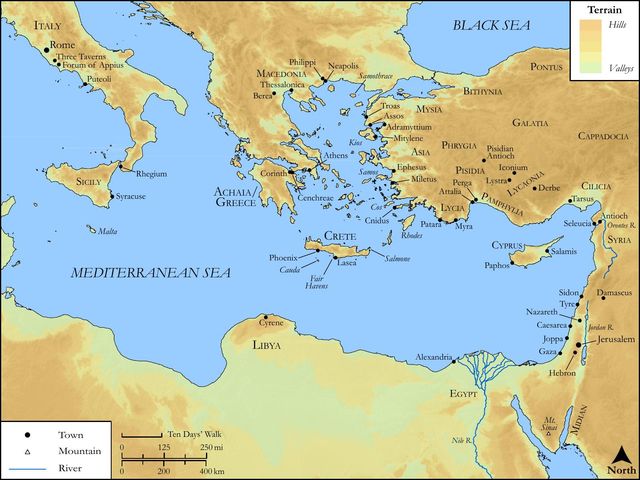
Study this verse
Public-domain commentary
Matthew Henry
From his Commentary on the Whole Bible. Henry comments on passages, not single verses — this entry covers Acts 16:6–15. His four-level outline is real structure in the source text, so it is rendered as structure.
In these verses we have,
I.Paul's travels up and down to do good.
1.He and Silas his colleague went throughout Phrygia and the region of Galatia, where, it should seem, the gospel was already planted, but whether by Paul's hand or no is not mentioned; it is likely it was, for in his epistle to the Galatians he speaks of his preaching the gospel to them at the first, and how very acceptable he was among them, Gal 4:13-15. And it appears by that epistle that the judaizing teachers had then done a great deal of mischief to these churches of Galatia, had prejudiced them against Paul and drawn them from the gospel of Christ, for which he there severely reproves them. But probably that was a great while after this.
2.They were forbidden at this time to preach the gospel in Asia (the country properly so called), because it did not need, other hands being at work there; or because the people were not yet prepared to receive it, as they were afterwards (Act 19:10), when all those that dwelt in Asia heard the word of the Lord; or, as Dr. Lightfoot suggests, because at this time Christ would employ Paul in a piece of new work, which was to preach the gospel to a Roman colony at Philippi, for hitherto the Gentiles to whom he had preached were Greeks. The Romans were more particularly hated by the Jews than other Gentiles; their armies were the abomination of desolation; and therefore there is this among other things extraordinary in his call thither that he is forbidden to preach the gospel in Asia and other places, in order to his preaching it there, which is an intimation that the light of the gospel would in aftertimes be directed more westward than eastward. It was the Holy Ghost that forbade them, either by secret whispers in the minds of both of them, which, when they came to compare notes, they found to be the same, and to come from the same Spirit; or by some prophets who spoke to them from the Spirit. The removals of ministers, and the dispensing of the means of grace by them, are in a particular manner under a divine guidance and direction. We find an Old Testament minister forbidden to preach at all (Eze 3:26): Thou shalt be dumb. But these New Testament ministers are only forbidden to preach in one place, while they are directed to another where there is more need.
3.They would have gone into Bithynia, but were not permitted: the Spirit suffered them not, Act 16:7. They came to Mysia, and, as it should seem, preached the gospel there; for though it was a very mean contemptible country, even to a proverb (Mysorum ultimus, in Cicero, is a most despicable man), yet the apostles disdained not to visit it, owning themselves debtors both to the wise and to the unwise, Rom 1:14. In Bithynia was the city of Nice, where the first general council was held against the Arians; into these countries Peter sent his epistle (Pe1 1:1); and there were flourishing churches here, for, though they had not the gospel sent them now, they had it in their turn, not long after. Observe, Though their judgment and inclination were to go into Bithynia, yet, having then extraordinary ways of knowing the mind of God, they were overruled by them, contrary to their own mind. We must now follow providence, and submit to the guidance of that pillar of cloud and fire; and, if this suffer us not to do what we assay to do, we ought to acquiesce, and believe it for the best. The Spirit of Jesus suffered them not; so many ancient copies read it. The servants of the Lord Jesus ought to be always under the check and conduct of the Spirit of the Lord Jesus, by whom he governs men's minds.
4.They passed by Mysia, or passed through it (so some), sowing good seed, we may suppose, as they went along; and they came down to Troas, the city of Troy, so much talked of, or the country thereabouts, which took its denomination from it. Here a church was planted; for here we find one in being, Act 20:6, Act 20:7, and probably planted at this time, and in a little time. It should seem that at Troas Luke fell in with Paul, and joined himself to his company; for henceforward, for the most part, when he speaks of Paul's journeys, he puts himself into the number of his retinue, we went, Act 16:10.
II.Paul's particular call to Macedonia, that is, to Philippi, the chief city, inhabited mostly by Romans, as appears, Act 16:21. Here we have,
1.The vision Paul had, Act 16:9. Paul had many visions, sometimes to encourage, sometimes, as here, to direct him in his work. An angel appeared to him, to intimate to him that it was the will of Christ he should go to Macedonia. Let him not be discouraged by the embargo laid upon him once and again, by which his designs were crossed; for, though he shall not go where he has a mind to go, he shall go where God has work for him to do. Now observe,
(1.)The person Paul saw. There stood by him a man of Macedonia, who by his habit or dialect seemed so to Paul, or who told him he was so. The angel, some think, assumed the shape of such a man; or, as others think, impressed upon Paul's fancy, when between asleep and awake, the image of such a man: he dreamt he saw such a one. Christ would have Paul directed to Macedonia, not as the apostles were at other times, by a messenger from heaven, to send him thither, but by a messenger thence to call him thither, because in this way he would afterwards ordinarily direct the motions of his ministers, by inclining the hearts of those who needed them to invite them. Paul shall be called to Macedonia by a man of Macedonia, and by him speaking in the name of the rest. Some make this man to be the tutelar angel of Macedonia, supposing angels to have charge of particular places as well as persons, and that so much is intimated Dan 10:20, where we read of the princes of Persia and Grecia, that seem to have been angels. But there is no certainty of this. There was presented either to Paul's eyes or to his mind a man of Macedonia. The angel must not preach the gospel himself to the Macedonians, but must bring Paul to them. Nor must he by the authority of an angel order him to go, but in the person of a Macedonian court him to come. A man of Macedonia, not a magistrate of the country, much less a priest (Paul was not accustomed to receive invitations from such) but an ordinary inhabitant of that country, a plain man, that carried in his countenance marks of probity and seriousness, that did not come to banter Paul nor trifle with him, but in good earnest and with all earnestness to importune his assistance.
(2.)The invitation given him. This honest Macedonian prayed him, saying, Come over into Macedonia, and help us; that is, "Come and preach the gospel to us; let us have the benefit of thy labours." [1.] "Thou hast helped many; we have heard of those in this and the other country to whom thou hast been very useful; and why may we not put in for a share? O come and help us." The benefits others have received from the gospel should quicken our enquiries, our further enquiries, after it. [2.] "It is thy business, and it is thy delight, to help poor souls; thou art a physician for the sick, that art to be ready at the call of every patient; O come and help us." [3.] "We have need of thy help, as much as any people; we in Macedonia are as ignorant and as careless in religion as any people in the world are, are as idolatrous and as vicious as any, and as ingenious and industrious to ruin ourselves as any; and therefore, O come, come with all speed among us. If thou canst do any thing, have compassion on us, and help us." [4.] "Those few among us that have any sense of divine things, and any concern for their own souls and the souls of others, have done what can be done, by the help of natural light; I have done my part for one. We have carried the matter as far as it will go, to persuade our neighbours to fear and worship God, but we can do little good among them. O come come, thou over, and help us. The gospel thou preachest has arguments and powers beyond those we have yet been furnished with." [5.] "Do not only help us with thy prayers here: this will not do; thou must come over and help us." Note, People have great need of help for their souls, and it is their duty to look out for it and invite those among them that can help them.
2.The interpretation made of the vision (Act 16:10): They gathered assuredly from this that the Lord had called them to preach the gospel there; and they were ready to go wherever God directed. Note, We may sometimes infer a call of God from a call of man. If a man of Macedonia says, Come and help us, Paul thence gathers assuredly that God says, Go an help them. Ministers may go on with great cheerfulness and courage in their work when they perceive Christ calling them, not only to preach the gospel, but to preach it at this time, in this place, to this people.
III.Paul's voyage to Macedonia hereupon:
He was not disobedient to the heavenly vision, but followed this divine direction much more cheerfully, and with more satisfaction, than he would have followed any contrivance or inclination of his own.
1.Thitherward he turned his thoughts. Now that he knows the mind of God in the matter he is determined, for this is all he wanted; now he thinks no more of Asia, nor Bithynia, but immediately we endeavoured to go into Macedonia. Paul only had the vision, but he communicated it to his companions, and they all, upon the credit of this, resolved for Macedonia. As Paul will follow Christ, so all his will follow him, or rather follow Christ with him. They are getting things in readiness for this expedition immediately, without delay. Note, God's calls must be complied with immediately. As our obedience must not be disputed, so it must not be deferred; do it today, lest thy heart be hardened. Observe, They could not immediately go into Macedonia; but they immediately endeavoured to go. If we cannot be so quick as we would be in our performances, yet we may be in our endeavours, and this shall be accepted.
2.Thitherward he steered his course. They set sail by the first shipping and with the first fair wind from Troas; for they may be sure they have done what they had to do there when God calls them to another place. They came with a straight course, a prosperous voyage, to Samothracia; the next day they came to Neapolis, a city on the confines of Thrace and Macedonia; and at last they landed at Philippi, a city so called from Philip king of Macedon, the father of Alexander the Great; it is said (Act 16:12) to be,
(1.)The chief city of that part of Macedonia; or, as some read it, the first city, the first they came to when they came from Troas. As an army that lands in a country of which they design to make themselves masters begin with the reduction of the first place they come to, so did Paul and his assistants: they began with the first city, because, if the gospel were received there, it would the more easily spread thence all the country over.
(2.)It was a colony. The Romans not only had a garrison, but the inhabitants of the city were Romans, the magistrates at least, and the governing part. There were the greatest numbers and variety of people, and therefore the most likelihood of doing good.
IV.The cold entertainment which Paul and his companions met with at Philippi.
One would have expected that having such a particular call from God thither they would have had a joyful welcome there, as Peter had with Cornelius when the angel sent him thither. Where was the man of Macedonia that begged Paul to come thither with all speed? Why did not he stir up his countrymen, some of them at least, to go and meet him? Why was not Paul introduced with solemnity, and the keys of the city put into his hand? Here is nothing like this; for,
1.It is a good while before any notice at all is taken of him: We were in that city abiding certain days, probably at a public house and at their own charge, for they had no friend to invite them so much as to a meal's meat, till Lydia welcomed them. They had made all the haste they could thither, but, now that they are there, they are almost tempted to think they might as well have staid where they were. But so it was ordered for their trial whether they could bear the pain of silence and lying by, when this was their lot. Those eminent and useful men are not fit to live in this world that know not how to be slighted and overlooked. Let not ministers think it strange if they be first strongly invited to a place, and then looked shyly upon when they come.
2.When they have an opportunity of preaching it is in an obscure place, and to a mean and small auditory, Act 16:13. There was no synagogue of the Jews there, for aught that appears, to be a door of entrance to them, and they never went to the idol-temples of the Gentiles, to preach to the auditories there; but here, upon enquiry, they found out a little meeting of good women, that were proselytes of the gate, who would be thankful to them if they would give them a sermon. The place of this meeting is out of the city; there it was connived at, but would not be suffered any where within the walls. It was a place where prayer was wont to be made; proseuchē - where an oratory or house of prayer was (so some), a chapel, or smaller synagogue. But I rather take it, as we read it, where prayer was appointed or accustomed to be. Those that worshipped the true God, and would not worship idols, met there to pray together, and, according to the description of the most ancient and universal devotion, to call upon the name of the Lord. Each of them prayed apart every day; this was always the practice of those that worshipped God: but, besides this, they came together on the sabbath day. Though they were but a few and discountenanced by the town, though their meeting was at some distance, though, for aught that appears, there were none but women, yet a solemn assembly the worshippers of God must have, if by any means it be possible, on the sabbath day. When we cannot do as we would we must do as we can; if we have not synagogues, we must be thankful for more private places, and resort to them, not forsaking the assembling of ourselves together, according as our opportunities are. This place is said to be by a river side, which perhaps was chosen, as befriending contemplation. Idolaters are said to take their lot among the smooth stones of the stream, Isa 57:6. But these proselytes had in their eye, perhaps, the example of those prophets who had their visions, one by the river of Chebar (Eze 1:1), another by the great river Hiddekel, Dan 10:4. Thither Paul and Silas and Luke went, and sat down, to instruct the congregation, that they might the better pray with them. They spoke unto the women who resorted thither, encouraged them in practising according to the light they had, and led them on further to the knowledge of Christ.
V.The conversion of Lydia, who probably was the first that was wrought upon there to believe in Christ, though not the last.
In this story of the Acts, we have not only the conversion of places recorded, but of many particular persons; for such is the worth of souls that the reducing of one to God is a great matter. Nor have we only the conversions that were effected by miracle, as Paul's, but some that were brought about by the ordinary methods of grace, as Lydia's here. Observe,
1.Who this convert was that there is such particular notice taken of. Four things are recorded of her: -
(1.)Her name, Lydia. It is an honour to her to have her name recorded here in the book of God, so that wherever the scriptures are read there shall this be told concerning her. Note, The names of the saints are precious with God, and should be so with us; we cannot have our names recorded in the Bible, but, if God open our hearts, we shall find them written in the book of life, and this is better (Phi 4:3) and more to be rejoiced in, Luk 10:20.
(2.)Her calling. She was a seller of purple, either of purple dye or of purple cloth or silk. Observe,
[1.]She had a calling, an honest calling, which the historian takes notice of to her praise; she was none of those women that the apostle speaks of (Ti1 5:13), who learn to be idle, and not only idle, etc.
[2.]It was a mean calling. She was a seller of purple, not a wearer of purple, few such are called. The notice here taken of this is an intimation to those who are employed in honest callings, if they be honest in the management of them, not to be ashamed of them.
[3.]Though she had a calling to mind, yet she was a worshipper of God, and found time to improve advantages for her soul. The business of our particular callings may be made to consist very well with the business of religion, and therefore it will not excuse us from religious exercises alone, and in our families, or in solemn assemblies, to say, We have shops to look after, and a trade to mind; for have we not also a God to serve and a soul to look after? Religion does not call us from our business in the world, but directs us in it. Every thing in its time and place.
(3.)The place she was of - of the city of Thyatira, which was a great way from Philippi; there she was born and bred, but either married at Philippi, or brought by her trade to settle there. The providence of God, as it always appoints, so it often removes, the bounds of our habitation, and sometimes makes the change of our outward condition or place of our abode wonderfully subservient to the designs of his grace concerning our salvation. Providence brings Lydia to Philippi, to be under Paul's ministry, and there, where she met with it, she made a good use of it; so should we improve opportunities.
(4.)Her religion before the Lord opened her heart.
[1.]She worshipped God according to the knowledge she had; she was one of the devout women. Sometimes the grace of God wrought upon those who, before their conversion, were very wicked and vile, publicans and harlots; such were some of you, Co1 6:11. But sometimes it fastened upon those who were of a good character, who had some good in them, as the eunuch, Cornelius, and Lydia. Note, It is not enough to be worshippers of God, but we must be believers in Jesus Christ, for there is no coming to God as a Father, but by him as Mediator. But those who worshipped God according to the light they had stood fair for the discoveries of Christ, and his grace to them; for to him that has shall be given: and to them Christ would be welcome; for those that know what it is to worship God see their need of Christ, and know what use to make of his mediation.
[2.]She heard the apostles. Here, where prayer was made, when there was an opportunity, the word was preached; for hearing the word of God is a part of religious worship, and how can we expect God should hear our prayers if we will not hearken to his word? Those that worshipped God according to the light they had looked out for further light; we must improve the day of small things, but must not rest in it.
2.What the work was that was wrought upon her: Whose heart the Lord opened. Observe here,
(1.)The author of this work: it was the Lord, - the Lord Christ, to whom this judgment is committed, - the Spirit of the Lord, who is the sanctifier. Note, Conversion-work is God's work; it is he that works in us both to will and to do; not as if we had nothing to do, but of ourselves, without God's grace, we can do nothing; nor as if God were in the least chargeable with the ruin of those that perish, but the salvation of those that are saved must be wholly ascribed to him.
(2.)The seat of this work; it is in the heart that the change is made, it is to the heart that this blessed turn is given; it was the heart of Lydia that was wrought upon. Conversion-work is heart-work; it is a renewing of the heart, the inward man, the spirit of the mind.
(3.)The nature of the work; she had not only her heart touched, but her heart opened. An unconverted soul is shut up, and fortified against Christ, straitly shut up, as Jericho against Joshua, Jos 6:1. Christ, in dealing with the soul, knocks at the door that is shut against him (Rev 3:20); and, when a sinner is effectually persuaded to embrace Christ, then the heart is opened for the King of glory to come in - the understanding is open to receive the divine light, the will opened to receive the divine law, and the affections opened to receive the divine love. When the heart is thus opened to Christ, the ear is opened to his word, the lips opened in prayer, the hand opened in charity, and the steps enlarged in all manner of gospel obedience.
3.What were the effects of this work on the heart.
(1.)She took great notice of the word of God. Her heart was so opened that she attended to the things that were spoken by Paul; she not only gave attendance on Paul's preaching, but gave attention to it; she applied to herself (so some read it) the things that were spoken by Paul; and then only the word does us good, and makes an abiding impression upon us, when we apply it to ourselves. Now this was an evidence of the opening of her heart, and was the fruit of it; wherever the heart is opened by the grace of God, it will appear by a diligent attendance on, and attention to, the word of God, both for Christ's sake, whose word it is, and for our own sakes, who are so nearly interested in it.
(2.)She gave up her name to Jesus Christ, and took upon her the profession of his holy religion; She was baptized, and by this solemn rite was admitted a member of the church of Christ; and with her her household also was baptized, those of them that were infants in her right, for if the root be holy so are the branches, and those that were grown up by her influence and authority. She and her household were baptized by the same rule that Abraham and his household were circumcised, because the seal of the covenant belongs to the covenanters and their seed.
(3.)She was very kind to the ministers, and very desirous to be further instructed by them in the things pertaining to the kingdom of God: She besought us saying "If you have judged me to be faithful to the Lord, if you take me to be a sincere Christian, manifest your confidence in me by this, come into my house, and abide there." Thus she desired an opportunity,
[1.]To testify her gratitude to those who had been the instruments of divine grace in this blessed change that was wrought upon her. When her heart was open to Christ, her house was open to his ministers for his sake, and they were welcome to the best entertainment she had, which she did not think too good for those of whose spiritual things she had reaped so plentifully. Nay, they are not only welcome to her house, but she is extremely pressing and importunate with them: She constrained us; which intimates that Paul was very backward and unwilling to go, because he was afraid of being burdensome to the families of the young converts, and would study to make the gospel of Christ without charge (Co1 9:18; Act 20:34), that those who were without might have no occasion given them to reproach the preachers of the gospel as designing, self-seeking men, and that those who were within might have no occasion to complain of the expenses of their religion: but Lydia will have no nay; she will not believe that they take her to be a sincere Christian unless they will oblige her herein; like Abraham inviting the angels (Gen 18:3), If now I have found favour in thy sight, pass not away from thy servant.
[2.]She desired an opportunity of receiving further instruction. If she might but have them for awhile in her family, she might hear them daily (Pro 8:34), and not merely on sabbath days at the meeting. In her own house she might not only hear them, but ask them questions; and she might have them to pray with her daily, and to bless her household. Those that know something of Christ cannot but desire to know more, and seek opportunities of increasing their acquaintance with his gospel.
Historical interpretation
Five Centuries of Reception
4 surviving comments on this verse. Each one is dated, so this reads as a timeline rather than a list.
Select a marker to jump to its quote. Markers stagger vertically where authors wrote within a few decades of each other.
Listen, shepherds of the churches! Listen, God’s shepherds! His angel always comes down from heaven and proclaims to you, “Today a Savior is born for you, who is Christ the Lord.” For, unless that Shepherd comes, the shepherd of the churches will be unable to guard the flock well. Their custody is weak, unless Christ pastures and guards it along with them. We just read in the apostle, “We are coworkers with God.” A good shepherd, who imitates the good Shepherd, is a coworker with God and Christ. He is a good shepherd precisely because he has the best Shepherd with him, pasturing his sheep along with him. For, “God established in his church apostles, prophets, evangelists, shepherds and teachers. He established everything for the perfection of the saints.” Let this suffice for a simpler explanation.But we should ascend to a more hidden understanding. Some shepherds were angels that governed human affairs. Each of these kept his watch. They were vigilant day and night. But, at some point, they were unable to bear the labor of governing the peoples who had been entrusted to them and accomplish it diligently. When the Lord was born, an angel came and announced to the shepherds that the true Shepherd had appeared. Let me give an example. There was a certain shepherd-angel in Macedonia who needed the Lord’s help. Consequently, he appeared to Paul in his dreams as a Macedonian man “and said, ‘Cross over to Macedonia and help us.’ ” Why do I speak of Paul, since the angel said this not to Paul but to Jesus who was in Paul? So shepherds need the presence of Christ.
"And a vision appeared unto Paul in the night." Not now by Angels, as to Philip, as to Cornelius, but how? By a vision it is now shown to him: in more human sort, not now as before in more divine manner. For where the compliance is more easy, it is done in more human sort; but where great force was needed, there in more divine. For since he was but urged to preach, to this end it is shown him in a dream: but to forbear preaching, he could not readily endure: to this end the Holy Ghost reveals it to him. Thus also it was then with Peter, "Arise, go down." For of course the Holy Spirit did not work what was otherwise easy: but (here) even a dream sufficed him. And to Joseph also, as being readily moved to compliance, the appearance is in a dream, but to the rest in waking vision. Thus to Cornelius, and to Paul himself.
"And a vision appeared to Paul in the night; There stood a man of Macedonia, and prayed him, saying, Come over into Macedonia, and help us." Why a vision, and not the Holy Ghost? because He forbade the other. He would even in this way draw them over: since to the saints also He appeared in a dream, and in the beginning (Paul) himself saw a vision, "a man coming in and laying his hands upon him." In this manner also Christ appears to him, saying, "Thou must stand before Caesar." Then for this reason also He draws him thither, that the preaching may be extended. This is why he was forbidden to tarry long in the other cities, Christ urging him on. For these were to enjoy the benefit of John for a long time, and perhaps did not extremely need him (Paul), but thither he behooved to go. And now he crosses over and goes forth.
They were forbidden by the Holy Spirit to speak the word in Asia, etc., up to Passing into Macedonia, help us. Truly the Lord is terrible in counsel above the sons of men. One promises to follow the Master in everything and is not allowed; another, commanded to follow, does not get the requested leave for burial of his father. Saul is drawn in, invincible and resisting. To Cornelius, persistent in prayers and alms, the way of salvation is shown as a reward, and God, who knows the hearts, removes the Teacher from Asia through the grace of a benefit, lest the error of a wicked heart be judged more severely for despised preaching if what is holy is given to dogs. Again, while another apostle cares elsewhere, a legate from Macedonia, whom we believe to be an angel of that nation, asks to be offered crumbs of the Lord's bread.
Continue studying Acts 16:9 across the web’s major study libraries — every link below opens this exact verse, chapter, or book on the destination site.
Read & Compare
 BibleGatewayThis verse in more than 200 translations and 70 languages.
 Bible.comThe YouVersion reader — hundreds of translations, reading plans, and highlights.
 ESV.orgCrossway's official English Standard Version reader.
 NET BibleThe NET translation with 60,000+ translators' notes on every rendering decision.
 STEP BibleTyndale House's free study tool — original text, vocabulary, and scholarly resources.
 BibliaLogos Bible Software's free web reader.
 USCCBThe New American Bible (Revised Edition) with the U.S. bishops' study notes.
Commentaries
 BibleHub CommentariesDozens of classic commentaries on this verse, gathered on one page.
 StudyLightMore than 100 commentary sets — the largest collection on the web.
 BibleRefPlain-English commentary on what this verse means, verse by verse.
 Enduring WordDavid Guzik's free commentary on this chapter, widely used by Bible teachers.
 Bible Study ToolsVerse commentary alongside Greek and Hebrew study aids.
Original Language & Research
- BibleHub InterlinearThe verse word by word — original language, transliteration, and English.
- BibleHub LexiconEvery word's original-language definition and Strong's entry.
 Blue Letter BibleDeep-study tools — Strong's numbers, concordance, and word studies.
 CNTR CollationThe earliest Greek manuscripts of this verse, collated letter by letter.
Sermons, Hymns & Audio


TrulyRandomVerse is not affiliated with these sites and doesn’t control their content. They’re linked because they’re genuinely useful.
Summary
Acts 16:9 records the pivotal "Macedonian Call," a divine vision granted to the Apostle Paul during the night in Troas, which dramatically redirected his second missionary journey. In this vision, a man from Macedonia earnestly pleaded with Paul to "Come over into Macedonia, and help us," signaling God's clear intention for the Gospel to spread from Asia Minor into the continent of Europe, marking a monumental shift in the early church's evangelistic efforts.
Context
ShowHideLiterary Context
This verse is strategically placed within the narrative of Paul's second missionary journey, immediately following a period where the Holy Spirit had repeatedly prevented Paul and his companions (Silas, Timothy, and Luke) from preaching in Asia and Bithynia. Specifically, Acts 16:6 states they were "forbidden of the Holy Ghost to preach the word in Asia," and Acts 16:7 notes that "the Spirit suffered them not" to go into Bithynia. This divine redirection culminates in their arrival at Troas, a significant port city, where the vision of the Macedonian man provides the explicit instruction for their next geographical and evangelistic move, opening a new chapter in the expansion of the early church.
Historical & Cultural Context
At this time, the Roman Empire encompassed a vast territory, and its sophisticated road and sea networks facilitated travel and communication, albeit with inherent dangers. Macedonia was a Roman province, strategically important and culturally Hellenized, with a significant Greek and Roman presence. Cities like Philippi, Thessalonica, and Berea, which Paul would soon visit, were major urban centers. The plea for "help" from a Macedonian man would have resonated with Paul, who understood the spiritual darkness and philosophical searching prevalent in the Greco-Roman world, where various pagan cults and philosophical schools offered little true spiritual solace. This context underscores the urgency and necessity of the Gospel message in a region ripe for spiritual harvest.
Key Themes
ShowHideActs 16:9 powerfully illustrates several overarching themes in the book of Acts and Paul's ministry. Foremost is Divine Guidance and Sovereignty, demonstrating God's active and direct involvement in orchestrating the spread of His Gospel, even when human plans are thwarted. The "Macedonian Call" itself embodies the theme of Evangelistic Opportunity and Urgency, highlighting the spiritual need of unreached peoples and the imperative for believers to respond to such calls. This moment also signifies a major Geographical and Cultural Expansion of the Gospel, as Christianity moves beyond its initial Jewish and Asian contexts into the heart of the European world, fulfilling the mandate to preach the Gospel to "the uttermost part of the earth" as promised in Acts 1:8.
Exposition and Analysis
ShowHideKey Word Analysis
ShowHideThis term refers to a supernatural appearance or revelation, something gazed at, especially a spectacle of divine origin. It distinguishes Paul's experience from a mere dream or a natural perception, emphasizing that this was a direct, divinely orchestrated communication. The use of hórama underscores the authoritative and undeniable nature of the message Paul received.
This verb signifies "to gaze with wide-open eyes, as at something remarkable." It implies a vision that is striking and demands attention, distinct from casual observation. Coupled with hórama, it reinforces the extraordinary, supernatural character of the manifestation, indicating that Paul was fully awake and consciously perceiving a divine reality.
This word means "to call near, invite, invoke (by imploration, hortation or consolation)." In this context, it conveys a strong entreaty, an earnest appeal, or a desperate plea. It suggests that the Macedonian man's request was not a casual invitation but an urgent, heartfelt cry for spiritual intervention and aid, highlighting the deep spiritual need he represented.
Verse Breakdown
ShowHide"And a vision appeared to Paul in the night"
This opening clause immediately establishes the supernatural nature of the event. Paul, while in Troas, receives a direct, divinely initiated communication, not through an audible voice or a logical deduction, but through a visual manifestation. The setting "in the night" often in biblical narratives signifies a time of revelation or significant encounter with the divine, emphasizing the personal and intimate nature of God's guidance to Paul.
"There stood a man of Macedonia"
The content of the vision is specific and clear. Paul sees a distinct figure, identified by his origin as "a man of Macedonia." This detail is crucial, as it provides the geographical and cultural context for the divine directive, leaving no ambiguity about the destination. The "standing" posture suggests a direct address, a figure poised to deliver a message.
"and prayed him, saying, Come over into Macedonia, and help us."
This is the core message of the vision, presented as an urgent, direct appeal. The man's "prayer" (earnest plea) for Paul to "come over" (cross the Aegean Sea) and "help us" (provide spiritual aid, specifically the Gospel message) is a clear, concise divine mandate. The plural "us" indicates a collective need, representing the spiritual plight of an entire region or people group, underscoring the broad impact of this divine redirection.
Literary Devices
ShowHideThe narrative of Acts 16:9 employs several significant literary devices. Symbolism is prominent, as the "man of Macedonia" functions not merely as an individual but as a symbolic representation of an entire continent's spiritual need and invitation. His plea for "help" is symbolic of the deep spiritual void that only the Gospel could fill. The vision itself serves as a Divine Revelation, a direct and unambiguous communication from God, a common narrative device in Acts to underscore God's active sovereignty in guiding the early church's mission. Furthermore, the passage utilizes Dramatic Irony in retrospect, as Paul's previous attempts to preach in Asia and Bithynia were providentially blocked, setting the stage for this unexpected, yet divinely ordained, opening into Europe. This redirection highlights the Theme of Divine Redirection, where God's plans unfold in unexpected ways, often through closed doors leading to open ones.
Theological and Thematic Connections
ShowHideActs 16:9 is a profound illustration of God's sovereign direction over His mission and His chosen instruments. It underscores the theological truth that the expansion of the Gospel is not merely a human endeavor but a divinely orchestrated movement, with God actively opening and closing doors according to His perfect will. The "Macedonian Call" serves as a powerful reminder of the global scope of God's redemptive plan and the imperative for believers to remain sensitive and obedient to divine leading, even when it leads to unexpected territories. This event marks a significant turning point, demonstrating God's desire for the Gospel to transcend geographical and cultural boundaries, bringing salvation to all nations.
Reflection and Application
ShowHideThe Macedonian Call in Acts 16:9 offers a timeless blueprint for discerning and responding to God's will in our own lives and ministries. It challenges believers to cultivate a posture of attentiveness to divine guidance, recognizing that God often communicates through various means—whether through clear visions, open doors, or the urgent needs of those around us. Just as Paul was willing to abandon his own preconceived plans and embark on an entirely new trajectory, we too are called to embrace flexibility and obedience, trusting that God's redirection is always for a greater, more glorious purpose. This passage encourages us to look beyond our immediate comfort zones and familiar spheres of influence, to perceive the spiritual cries for "help" in our communities and across the globe, and to respond with courage and faith, knowing that God equips those whom He calls to participate in His redemptive mission.
Questions for Reflection
ShowHideFAQ
ShowHideWhat was the significance of Macedonia in the spread of the Gospel?
ShowHideMacedonia was a crucial Roman province in the European continent, and Paul's entry there, prompted by the vision in Acts 16:9, marked the official beginning of Christian evangelism in Europe. This region became home to some of the earliest and most significant churches established by Paul, including the church in Philippi, the first church founded on European soil (Acts 16:11-12). The churches in Macedonia, particularly Philippi and Thessalonica, were known for their generosity, steadfast faith, and strong partnership with Paul in the Gospel, as evidenced in his epistles to them (e.g., Philippians 4:15-16).
Why was Paul prevented from going to Asia and Bithynia before receiving the Macedonian call?
ShowHideThe narrative in Acts 16:6-7 explicitly states that the Holy Spirit "forbade" Paul and his companions from preaching in Asia and that "the Spirit suffered them not" to go into Bithynia. While the text doesn't provide the specific reasons for these divine prohibitions, the immediate context of Acts 16:9 reveals the ultimate purpose: God had a different, strategic plan for them. He was intentionally redirecting their efforts to open a new, vital frontier for the Gospel in Europe. This demonstrates God's sovereign control over the mission, ensuring that His evangelistic efforts align with His perfect timing and geographical strategy.
How does this vision relate to the Great Commission?
ShowHideThe vision in Acts 16:9 is a direct, divinely orchestrated fulfillment of the Great Commission given by Jesus in Matthew 28:19-20. Jesus commanded His disciples to "go therefore and make disciples of all nations." The Macedonian Call represents a concrete, Spirit-led step in fulfilling this global mandate, specifically by extending the reach of the Gospel beyond its initial Asian context into Europe. It shows the Holy Spirit actively guiding and empowering believers to cross geographical and cultural boundaries, ensuring that the message of salvation reaches "the uttermost part of the earth" as promised in Acts 1:8.
Christ-Centered Fulfillment
ShowHideThe Macedonian Call, while directed to Paul, finds its ultimate significance and fulfillment in the person and work of Jesus Christ. The "help" that the man of Macedonia desperately sought was not merely humanitarian aid, but the spiritual liberation and eternal life offered exclusively through faith in Christ. Jesus himself declared, "I am the way, the truth, and the life: no man cometh unto the Father, but by me", and He is the "Lamb of God, which taketh away the sin of the world!" (John 1:29). The vision in Acts 16:9 is a powerful testament to Christ's ongoing mission through His Spirit and His church to draw all people to Himself. It demonstrates that the spiritual need of humanity, represented by the Macedonian man, is ultimately a need for the saving grace and transformative power of the Gospel of Jesus Christ. Paul's immediate obedience to "come over" was an act of participating in Christ's global redemptive work, bringing the light of the world, Jesus, to those living in spiritual darkness, fulfilling the very purpose for which Christ came: "to seek and to save that which was lost".