


Acts 18:5
Bible text: King James Version (1769 Blayney text) · Public domain
Bible text: King James Version with Strong's numbers · Public domain
Bible text: Berean Standard Bible · Public domain
Bible text: American Standard Version (1901) · Public domain
Bible text: World English Bible, Messianic edition · Public domain
Bible text: Geneva Bible (1599) · Public domain
Bible text: Young's Literal Translation · Public domain
- ὩςHōsWhenG5613PRTParticle or Disjunctive
- δὲdenowG1161CONJConjunction
- κατῆλθονkatēlthoncame downG2718V-2AAI-3PVerb 2nd Aorist Active Indicative 3rd Plural
- ἀπὸapofromG575PREPPreposition
- τῆςtēs<the>G3588T-GSFDefinite article Genitive Singular Feminine
- ΜακεδονίαςMakedoniasMacedoniaG3109N-GSF-LNoun Genitive Singular Feminine Location
- ὅho<the>G3588T-NSMDefinite article Nominative Singular Masculine
- τεtebothG5037CONJConjunction
- ΣιλᾶςSilasSilasG4609N-NSM-PNoun Nominative Singular Masculine Individual
- καὶkaiandG2532CONJConjunction
- ὁho<the>G3588T-NSMDefinite article Nominative Singular Masculine
- ΤιμόθεοςTimotheosTimothyG5095N-NSM-PNoun Nominative Singular Masculine Individual
- συνείχετοsuneichetowas occupiedG4912V-IPI-3SVerb Imperfect Passive Indicative 3rd Singular
- τῷtōwith theG3588T-DSMDefinite article Dative Singular Masculine
- λόγῳlogōwordG3056N-DSMNoun Dative Singular Masculine
- ὁho<the>G3588T-NSMDefinite article Nominative Singular Masculine
- ΠαῦλοςPaulosPaulG3972N-NSM-PNoun Nominative Singular Masculine Individual
- διαμαρτυρόμενοςdiamarturomenosearnestly testifyingG1263V-PNP-NSMVerb Present Middle Or Passive Deponent Participle Nominative Singular Masculine
- τοῖςtoisto theG3588T-DPMDefinite article Dative Plural Masculine
- ἸουδαίοιςIoudaioisJewsG2453N-DPM-PGNoun Dative Plural Masculine Individual Gentilic
- εἶναιeinaito beG1511V-PANVerb Present Active Infinitive
- τὸνtontheG3588T-ASMDefinite article Accusative Singular Masculine
- χριστὸνchristonChristG5547N-ASM-TNoun Accusative Singular Masculine Title
- ἸησοῦνIēsounJesusG2424N-ASM-PNoun Accusative Singular Masculine Individual
English is a literal word-by-word gloss of the Greek, not the KJV's wording. Why?
This is the original text the KJV's translators worked from — each Greek word with its own literal English meaning in this verse, prepared by scholars at Tyndale House, Cambridge. The KJV translates whole sentences, not word by word, so its wording differs: one Greek word can become several English words, and the KJV may choose “charity” where the gloss reads “love”. Both are faithful — they answer different questions. For the KJV's own rendering, switch to the KJV text.
Details
See on the biblical-era maps
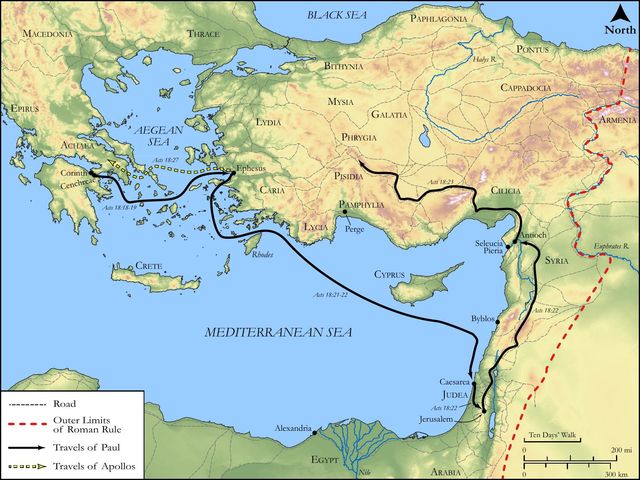
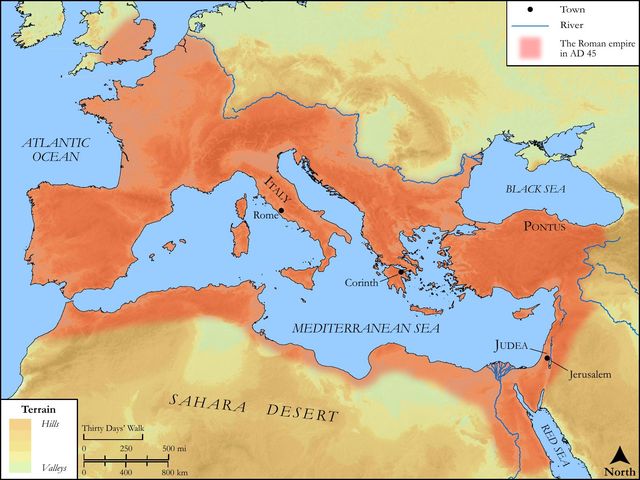
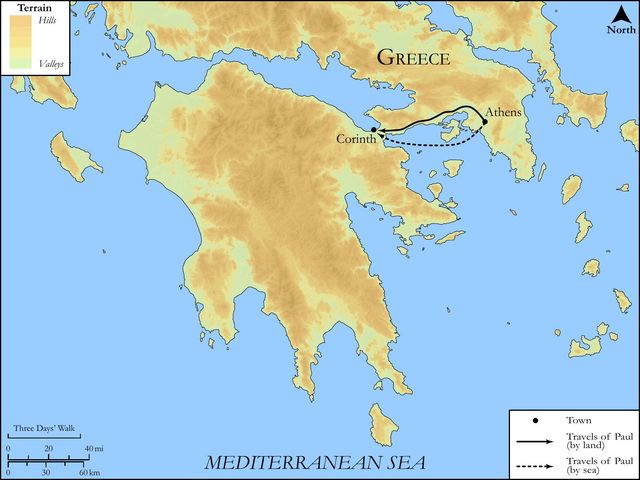
Study this verse
Public-domain commentary
Matthew Henry
From his Commentary on the Whole Bible. Henry comments on passages, not single verses — this entry covers Acts 18:1–6. His three-level outline is real structure in the source text, so it is rendered as structure.
We do not find that Paul was much persecuted at Athens, nor that he was driven thence by any ill usage, as he was from those places where the Jews had or could make any interest; but this reception at Athens being cold, and little prospect of doing good there, he departed from Athens, leaving the care of those there who believed with Dionysius; and thence he came to Corinth, where he was now instrumental in planting a church that became on many accounts considerable. Corinth was the chief city of Achaia, now a province of the empire, a rich and splendid city. Non cuivis homini contingit adire Corinthum - It is not permitted every man to see Corinth. The country thereabouts at this day is called the Morea. Now here we have,
I.Paul working for his living, Act 18:2, Act 18:3.
1.Though he was bred a scholar, yet he was master of a handicraft trade. He was a tent-maker, an upholsterer; he made tents for the use of soldiers and shepherds, of cloth or stuff, or (as some say tents were then generally made) of leather or skins, as the outer covering of the tabernacle. Hence to live in tents was to live sub pellibus - under skins. Dr. Lightfoot shows that it was the custom of the Jews to bring up their children to some trade, yea, though they gave them learning or estates. Rabbi Judah says, "He that teaches not his son a trade is as if he taught him to be a thief." And another says, "He that has a trade in his hand is as a vineyard that is fenced." An honest trade, by which a man may get his bread, is not to be looked upon by any with contempt. Paul, though a Pharisee, and bred up at the feet of Gamaliel, yet, having in his youth learned to make tents, did not by disuse lose the art.
2.Though he was entitled to a maintenance from the churches he had planted, and from the people to whom he preached, yet he worked at his calling to get bread, which is more to his praise who did not ask for supplies than to theirs who did not supply him unasked, knowing what straits he was reduced to. See how humble Paul was, and wonder that so great a man could stoop so low; but he had learned condescension of his Master, who came not to be ministered to, but to minister. See how industrious he was, and how willing to take pains. He that had so much excellent work to do with his mind, yet, when there was occasion, did not think it below him to work with his hands. Even those that are redeemed from the curse of the law are not exempt from that sentence, In the sweat of thy face thou shalt eat bread. See how careful Paul was to recommend his ministry, and to prevent prejudices against it, even the most unjust and unreasonable; he therefore maintained himself with his own labour that he might not make the gospel of Christ burdensome, Co2 11:7, etc.; Th2 3:8, Th2 3:9.
3.Though we may suppose he was master of his trade, yet he did not disdain to work at journey-work: He wrought with Aquila and Priscilla, who were of that calling, so that he got no more than day-wages, a bare subsistence. Poor tradesmen must be thankful if their callings bring them in a maintenance for themselves and their families, though they cannot do as the rich merchants that raise estates by their callings.
4.Though he was himself a great apostle, yet he chose to work with Aquila and Priscilla, because he found them to be very intelligent in the things of God, as appears afterwards (Act 18:26), and he owns that they had been his helpers in Christ Jesus, Rom 16:3. This is an example to those who are going to service to seek for those services in which they may have the best help for their souls. Choose to work with those that are likely to be helpers in Christ Jesus. It is good to be in company and to have conversation with those that will further us in the knowledge of Christ, and to put ourselves under the influence of such as are resolved that they will serve the Lord. Concerning this Aquila we are here told,
(1.)That he was a Jew, but born in Pontus, Act 18:2. Many of the Jews of the dispersion were seated in that country, as appears Pe1 1:1.
(2.)That he was lately come from Italy to Corinth. It seems he often changed his habitation; this is not the world we can propose ourselves a settlement in.
(3.)That the reason of his leaving Italy was because by a late edict of the emperor Claudius Caesar all Jews were banished from Rome; for the Jews were generally hated, and every occasion was taken to put hardship and disgrace upon them. God's heritage was as a speckled bird, the birds round about were against her, Jer 12:9. Aquila, though a Christian, was banished because he had been a Jew; and the Gentiles had such confused notions of the thing that they could not distinguish between a Jew and a Christian. Suetonius, in the life of Claudius, speaks of this decree in the ninth year of his reign, and says, The reason was because the Jews were a turbulent people - assiduo tumultuantes; and that it was impulsore Christo - upon the account of Christ; some zealous for him, others bitter against him, which occasioned great heats, such as gave umbrage to the government, and provoked the emperor, who was a timorous jealous man, to order them all to be gone. If Jews persecute Christians, it is not strange if heathens persecute them both.
II.We have here Paul preaching to the Jews, and dealing with them to bring them to the faith of Christ, both the native Jews and the Greeks, that is, those that were more or less proselyted to the Jewish religion, and frequented their meetings.
1.He reasoned with them in the synagogue publicly every sabbath. See in what way the apostles propagated the gospel, not by force and violence, by fire and sword, not by demanding an implicit consent, but by fair arguing; they drew with the cords of a man, gave a reason for what they said, and gave a liberty to object against it, having satisfactory answers ready. God invites us to come and reason with him (Isa 1:18), and challenges sinners to produce their cause, and bring forth their strong reasons, Isa 41:21. Paul was a rational as well as a scriptural preacher.
2.He persuaded them - epeithe. It denotes,
(1.)The urgency of his preaching. He did not only dispute argumentatively with them, but he followed his arguments with affectionate persuasions, begging of them for God's sake, for their own soul's sake, for their children's sake, not to refuse the offer of salvation made to them. Or,
(2.)The good effect of his preaching. He persuaded them, that is, he prevailed with them; so some understand it. In sententiam suam adducebat - He brought them over to his own opinion. Some of them were convinced by his reasonings, and yielded to Christ.
3.He was yet more earnest in this matter when his fellow-labourers, his seconds, came up with him (Act 18:5): When Silas and Timothy had come from Macedonia, and had brought him good tidings from the churches there, and were ready to assist him here, and strengthened his hands, then Paul was more than before pressed in spirit, which made him more than ever pressing in his preaching. He was grieved for the obstinacy and infidelity of his countrymen the Jews, was more intent than ever upon their conversion, and the love of Christ constrained him to it (Co2 5:14): it is the word that is used here, it pressed him in spirit to it. And, being thus pressed, he testified to the Jews with all possible solemnity and seriousness, as that which he was perfectly well assured of himself, and attested to them as a faithful saying, and worthy of all acceptation, that Jesus is the Christ, the Messiah promised to the fathers and expected by them.
III.We have him here abandoning the unbelieving Jews, and turning from them to the Gentiles, as he had done in other places, Act 18:6.
1.Many of the Jews, and indeed the most of them, persisted in their contradiction to the gospel of Christ, and would not yield to the strongest reasonings nor the most winning persuasions; they opposed themselves and blasphemed; they set themselves in battle array (so the word signifies) against the gospel; they joined hand in hand to stop the progress of it. They resolved they would not believe it themselves, and would do all they could to keep others from believing it. They could not argue against it, but what was wanting in reason they made up in ill language: they blasphemed, spoke reproachfully of Christ, and in him of God himself, as Rev 13:5, Rev 13:6. To justify their infidelity, they broke out into downright blasphemy.
2.Paul hereupon declared himself discharged from them, and left them to perish in their unbelief. He that was pressed in spirit to testify to them (Act 18:5), when they opposed that testimony, and persisted in their opposition, was pressed in spirit to testify against them (Act 18:6), and his zeal herein also he showed by a sign: he shook his raiment, shaking off the dust from it (as before they shook off the dust from their feet, Act 13:51), for a testimony against them. thus he cleared himself from them, but threatened the judgments of God against them. As Pilate by washing his hands signified the devolving of the guilt of Christ's blood from himself upon the Jews, so Paul by shaking his raiment signified what he said, if possible to affect them with it.
(1.)He had done his part, and was clean from the blood of their souls; he had, like a faithful watchman, given them warning, and thereby had delivered his soul, though he could not prevail to deliver theirs. He had tried all methods to work upon them, but all in vain, so that if they perish in their unbelief their blood is not to be required at his hands; here, and Act 20:26, he plainly refers to Eze 33:8, Eze 33:9. It is very comfortable to a minister to have the testimony of his conscience for him, that he has faithfully discharged his trust by warning sinners.
(2.)They would certainly perish if they persisted in their unbelief, and the blame would lie wholly upon themselves: "Your blood be upon your own heads, you will be your own destroyers, your nation will be ruined in this world, and particular persons will be ruined in the other world, and you alone shall bear it." If any thing would frighten them at last into a compliance with the gospel, surely this would.
3.Having given them over, yet he does not give over his work. Though Israel be not gathered, Christ and his gospel shall be glorious: Henceforth I will go unto the Gentiles; and the Jews cannot complain, for they had the first offer, and a fair one, made to them. The guests that were first invited will not come, and the provision must not be lost; guests must be had therefore from the highways and the hedges. "We would have gathered the Jews (Mat 23:37), would have healed them (Jer 51:9), and they would not; but Christ must not be a head without a body, nor a foundation without a building, and therefore, if they will not, we must try whether others will." Thus the fall and diminishing of the Jews became the riches of the Gentiles; and Paul said this to their faces, not only because it was what he could justify, but to provoke them to jealousy, Rom 11:12, Rom 11:14.
Historical interpretation
Two Centuries of Reception
2 surviving comments on this verse. Each one is dated, so this reads as a timeline rather than a list.
Select a marker to jump to its quote. Markers stagger vertically where authors wrote within a few decades of each other.
"And he reasoned in the synagogue every sabbath, and persuaded the Jews and the Greeks. And when Silas and Timotheus were come from Macedonia, Paul was straitened in the word, testifying to the Jews that Jesus is the Christ." "And when the Jews opposed and blasphemed," i.e. they tried to bear him down, they set upon him. "And he disputed in the synagogue every sabbath day, and persuaded both Jews and Greeks": but "when they opposed and blasphemed" he withdrew, by this expecting to draw them more.
"And when Silas and Timothy were come from Macedonia, they were earnest that Paul's preaching," etc. When Silas and Timothy were come from Macedonia to Corinth, where Paul was, he was earnestly teaching the word of the Lord; but as some Jews would not listen, he shook his garments and said to them: "Let the Lord Christ's blood that was shed weigh you down; for my part I will, as I have been commanded, go forthwith to instruct the Gentiles. "And departing for the house of a certain Titus, he then taught the ruler of the synagogue, Crispus, and the latter received the commandments of the Christian faith along with all his house and many other people. One night, the Lord said to Paul in a dream: "Do not fear the wishes of contradictors; I am with thee, and I permit no man to overcome thee. "This reminder gave him strength, and he stayed for a year and six months in the same city, teaching confidently. Because of his new preaching, he was brought by the Jews to the judgement seat of proconsul Gallio. But Gallio, saying that questions of divine law did not concern him, turned them out of doors and sent them away. After several days, Paul took leave of the brethren and came to Ephesus with Aquila and Priscilla. There, though many people begged him to stay, he could not remain very long, as he was hastening towards Jerusalem for the festival of Pentecost.
Continue studying Acts 18:5 across the web’s major study libraries — every link below opens this exact verse, chapter, or book on the destination site.
Read & Compare
 BibleGatewayThis verse in more than 200 translations and 70 languages.
 Bible.comThe YouVersion reader — hundreds of translations, reading plans, and highlights.
 ESV.orgCrossway's official English Standard Version reader.
 NET BibleThe NET translation with 60,000+ translators' notes on every rendering decision.
 STEP BibleTyndale House's free study tool — original text, vocabulary, and scholarly resources.
 BibliaLogos Bible Software's free web reader.
 USCCBThe New American Bible (Revised Edition) with the U.S. bishops' study notes.
Commentaries
 BibleHub CommentariesDozens of classic commentaries on this verse, gathered on one page.
 StudyLightMore than 100 commentary sets — the largest collection on the web.
 BibleRefPlain-English commentary on what this verse means, verse by verse.
 Enduring WordDavid Guzik's free commentary on this chapter, widely used by Bible teachers.
 Bible Study ToolsVerse commentary alongside Greek and Hebrew study aids.
Original Language & Research
- BibleHub InterlinearThe verse word by word — original language, transliteration, and English.
- BibleHub LexiconEvery word's original-language definition and Strong's entry.
 Blue Letter BibleDeep-study tools — Strong's numbers, concordance, and word studies.
 CNTR CollationThe earliest Greek manuscripts of this verse, collated letter by letter.
Sermons, Hymns & Audio


TrulyRandomVerse is not affiliated with these sites and doesn’t control their content. They’re linked because they’re genuinely useful.
Summary
Acts 18:5 marks a pivotal moment in Paul's ministry in Corinth, as the arrival of his trusted companions, Silas and Timotheus, from Macedonia, enables him to fully dedicate himself to preaching. This verse vividly portrays Paul's intense spiritual compulsion to proclaim the gospel, specifically testifying to the Jewish community that Jesus of Nazareth is indeed the long-awaited Christ, the Messiah. It underscores the divine urgency and the core message of the early apostolic witness.
Context
ShowHideLiterary Context
This verse is situated within the broader narrative of Paul's second missionary journey, specifically his extended stay in Corinth. Prior to this, Paul had arrived in Corinth from Athens, where his philosophical discourse had met with limited success (Acts 17:16-34). Upon reaching Corinth, Paul, in his customary manner, supported himself by working as a tentmaker alongside Aquila and Priscilla (Acts 18:1-3). While he had already begun reasoning in the synagogue every Sabbath (Acts 18:4), the arrival of Silas and Timotheus signifies a turning point, allowing Paul to transition from part-time ministry to being "pressed in the spirit" and fully engrossed in proclaiming the Word, leading to a more intensive evangelistic effort. This intensified focus directly precedes the Jewish opposition and Paul's subsequent turning to the Gentiles in Corinth (Acts 18:6-11).
Historical & Cultural Context
Corinth was a thriving, cosmopolitan Roman provincial capital, a major commercial hub connecting East and West, and notorious for its moral laxity and diverse religious practices. Its strategic location made it a crucial center for the spread of the gospel. Paul's initial practice of working as a tentmaker was a common and respectable trade, allowing him to be self-sufficient and avoid being a financial burden, thus preventing accusations of mercenary motives (1 Thessalonians 2:9). The arrival of Silas and Timotheus from Macedonia likely brought not only news from the fledgling churches in Philippi and Thessalonica but also financial support, as Paul later mentions receiving aid from Macedonia while in Corinth (2 Corinthians 11:9). This support would have freed him from the necessity of manual labor, enabling him to dedicate his full time and energy to the demanding work of evangelism and teaching.
Key Themes
ShowHideActs 18:5 powerfully contributes to several key themes within the book of Acts and Paul's ministry. Firstly, it highlights the divine compulsion and Holy Spirit's leading in Paul's life, demonstrating that his ministry was not merely human endeavor but supernaturally driven. The phrase "pressed in the spirit" underscores this profound internal urgency. Secondly, the verse emphasizes the centrality of Jesus' Messiahship as the core of the apostolic message. Paul's unwavering testimony that "Jesus was Christ" was the foundational truth proclaimed to both Jews and Gentiles, fulfilling Old Testament prophecies and establishing the identity of the Savior (Acts 9:22). Thirdly, it illustrates Paul's consistent missionary strategy of Jewish evangelism first, as he faithfully continued to present the gospel to his own people in the synagogue before turning to the Gentiles, a pattern seen throughout his journeys (Romans 1:16). Finally, the verse subtly points to the importance of missionary partnership and support, as the arrival of his companions and their potential financial aid facilitated Paul's intensified focus on the Word.
Exposition and Analysis
ShowHideKey Word Analysis
ShowHideThis word means to hold together, compress, or figuratively, to compel, perplex, or afflict. In this context, it conveys an intense internal spiritual pressure or urgency, indicating Paul was overwhelmed or seized by a divine impulse. It suggests a powerful, irresistible inner force compelling him to act, rather than a mere personal desire or external pressure.
This term can refer to breath, the human soul, or, significantly, a divine spirit. In the context of Paul's apostolic ministry and the overwhelming nature of the "pressing," this most likely refers to the Holy Spirit. It signifies that Paul's compulsion was divinely initiated and empowered, indicating a profound spiritual burden and anointing for proclamation.
This verb means to attest or protest earnestly, or to hortatively charge. It implies a solemn, emphatic, and thorough declaration, underscoring the seriousness, conviction, and authoritative nature with which Paul delivered his message. It was not a casual statement but a weighty, formal proclamation of truth.
Verse Breakdown
ShowHide"And when Silas and Timotheus were come from Macedonia"
This opening clause establishes the critical juncture in Paul's Corinthian ministry. The arrival of Silas (also known as Silvanus) and Timothy, two of Paul's most trusted and consistent missionary companions, from the region of Macedonia (where Paul had recently ministered in cities like Philippi and Thessalonica), marks a significant shift. Their presence likely brought encouragement, news from the Macedonian churches, and possibly financial support, which would have alleviated Paul's need for secular work.
"Paul was pressed in the spirit"
This phrase describes Paul's internal state and the catalyst for his intensified ministry. The Greek synéchō (G4912) indicates a profound compulsion or being overwhelmed, while "in the spirit" (tō pneumati, G4151) refers to the Holy Spirit. This signifies that Paul was not merely enthusiastic or busy, but divinely constrained and empowered by the Holy Spirit to dedicate himself fully to the proclamation of the gospel, experiencing an irresistible inner urgency.
"and testified to the Jews [that] Jesus [was] Christ"
This final clause reveals the specific action Paul took and the core content of his message, along with his primary audience. "Testified" (diamartýromai, G1263) implies a solemn and earnest declaration. Consistent with his established missionary pattern, Paul first directed his message to the Jewish community in Corinth, likely within the synagogue. The essence of his proclamation was the identity of Jesus of Nazareth: He was the Christ (Greek Christos, G5547), the long-awaited Messiah, the Anointed One prophesied in the Hebrew Scriptures, thereby fulfilling the hopes and expectations of Israel.
Literary Devices
ShowHideActs 18:5 employs several literary devices to convey its profound message. The use of Narrative Progression is evident as the arrival of Silas and Timotheus serves as a catalyst, marking a distinct shift in Paul's ministry from part-time tentmaking to full-time, intense proclamation. This transition is crucial for understanding the subsequent events in Corinth. The phrase "pressed in the spirit" utilizes Hyperbole or intense Emphasis to convey the overwhelming nature of Paul's divine compulsion, highlighting that his ministry was not merely a human endeavor but a divinely driven imperative. Furthermore, the verse presents a foundational Theological Statement: "Jesus was Christ." This concise declaration is the very bedrock of early Christian evangelism, asserting the core identity of Jesus as the promised Messiah and the fulfillment of Old Testament prophecy. The verse's structure, moving from external circumstances (the companions' arrival) to Paul's internal spiritual state and then to his outward action and message, creates a clear and impactful sequence of cause and effect.
Theological and Thematic Connections
ShowHideActs 18:5 offers profound theological insights into the nature of apostolic ministry and the core of the Christian message. It underscores the indispensable role of the Holy Spirit in empowering and directing evangelism, demonstrating that true spiritual labor flows from a divine compulsion, not merely human zeal or strategic planning. Paul's unwavering focus on testifying that Jesus is the Christ highlights the absolute centrality of Christ's identity as the Messiah to the gospel message. This was not a peripheral detail but the foundational truth upon which all salvation rests, fulfilling God's redemptive plan revealed throughout the Old Testament. The verse also implicitly affirms the importance of partnership in ministry, as the support from Silas and Timotheus enabled Paul's full devotion to the Word, reflecting a collaborative model for gospel advancement.
Reflection and Application
ShowHideActs 18:5 serves as a powerful call to examine our own commitment to the gospel and our reliance on the Holy Spirit. Paul's experience of being "pressed in the spirit" challenges believers today to cultivate a similar divine urgency and passion for sharing the truth of Jesus Christ. Are we truly constrained by the Spirit to proclaim His message, or do we allow other concerns to dilute our focus? This verse reminds us that the core message—that Jesus is the Christ, the Anointed One, the Savior—remains unchanging and must be declared with conviction and clarity. Furthermore, the arrival of Silas and Timotheus underscores the vital role of community and mutual support in ministry. We are not called to serve in isolation; God often uses the encouragement, practical assistance, and prayer of fellow believers to enable us to fulfill our calling and devote ourselves more fully to His work.
Questions for Reflection
ShowHideFAQ
ShowHideWhat does "Paul was pressed in the spirit" truly mean?
ShowHideThe phrase "Paul was pressed in the spirit" (Greek: syneicheto tō pneumati) signifies an intense, internal compulsion or constraint that Paul experienced, driven by the Holy Spirit. It indicates that he was overwhelmed or seized by a divine urgency to preach the gospel. This was not merely a strong personal desire or a feeling of being busy, but a profound spiritual burden and an irresistible impulse from God that compelled him to dedicate himself entirely to proclaiming the message of Jesus as the Christ. It highlights the supernatural enablement and direction of his ministry, making it impossible for him to do anything else (compare with 1 Corinthians 9:16).
Why did Paul specifically testify "to the Jews" that Jesus was Christ?
ShowHidePaul's missionary strategy, consistent throughout the book of Acts, was to first preach the gospel to the Jews in each city he visited, typically beginning in the synagogue. This approach was rooted in God's covenantal promises to Israel and the understanding that salvation came "first to the Jew and also to the Greek" (Romans 1:16). For the Jewish audience, the central point of contention and conviction was whether Jesus of Nazareth was indeed the long-awaited Messiah (Christ). Paul's testimony directly addressed their messianic expectations, presenting Jesus as the fulfillment of Old Testament prophecies and the Anointed One sent by God (see Acts 17:2-3).
What was the significance of Silas and Timotheus coming from Macedonia?
ShowHideThe arrival of Silas and Timotheus from Macedonia was highly significant for several reasons. Firstly, it brought Paul much-needed companionship and encouragement in Corinth, a city known for its moral challenges. Secondly, they likely brought news and updates from the churches Paul had recently established in Macedonia, such as Philippi and Thessalonica, which would have been a source of joy and strength. Most importantly, their arrival appears to have brought financial support from these churches (as indicated in 2 Corinthians 11:9). This financial aid freed Paul from the necessity of working as a tentmaker, allowing him to devote his full time and energy to preaching and teaching the Word, as explicitly stated by his intensified spiritual state in this verse.
Christ-Centered Fulfillment
ShowHideActs 18:5, though describing Paul's ministry, finds its ultimate Christ-centered fulfillment in the person and work of Jesus Himself. Paul's urgent and Spirit-compelled testimony that "Jesus was Christ" is the very heart of the gospel, proclaiming that the long-awaited Messiah of Israel, foretold by the prophets (e.g., Isaiah 53), has arrived in the person of Jesus of Nazareth. Jesus' life, death, and resurrection are the definitive proof that He is the Anointed One, the King of God's eternal kingdom. Paul's mission, driven by the Spirit, was to make known this truth—that the prophecies concerning the Messiah's suffering and glory (Luke 24:44-47) were perfectly fulfilled in Jesus. Thus, this verse points to Christ as the central figure of redemptive history, the object of faith, and the one whose identity and mission provide the sole basis for salvation for both Jew and Gentile (Acts 4:12). Paul's "pressed" spirit was merely a reflection of the divine urgency inherent in Christ's completed work and the necessity of its proclamation to a lost world.