


Acts 18:4
Bible text: King James Version (1769 Blayney text) · Public domain
Bible text: Berean Standard Bible · Public domain
Bible text: American Standard Version (1901) · Public domain
Bible text: World English Bible, Messianic edition · Public domain
Bible text: Geneva Bible (1599) · Public domain
Bible text: Young's Literal Translation · Public domain
- διελέγετοdielegetohe was reasoningG1256V-INI-3SVerb Imperfect Middle Or Passive Deponent Indicative 3rd Singular
- δὲdenowG1161CONJConjunction
- ἐνeninG1722PREPPreposition
- τῇtēatheG3588T-DSFDefinite article Dative Singular Feminine
- συναγωγῇsunagōgēasynagogueG4864N-DSFNoun Dative Singular Feminine
- κατὰkataonG2596PREPPreposition
- πᾶνpaneveryG3956A-ASNAdjective Accusative Singular Neuter
- σάββατονsabbatonSabbathG4521N-ASNNoun Accusative Singular Neuter
- ἔπειθένepeithenwas persuadingG3982V-IAI-3SVerb Imperfect Active Indicative 3rd Singular
- τεtebothG5037CONJConjunction
- ἸουδαίουςIoudaiousJewsG2453N-APM-PGNoun Accusative Plural Masculine Person Gentilic
- καὶkaiandG2532CONJConjunction
- ἝλληναςHellēnasGreeksG1672N-APM-LGNoun Accusative Plural Masculine Location Gentilic
English is a literal word-by-word gloss of the Greek, not the KJV's wording. Why?
This is the original text the KJV's translators worked from — each Greek word with its own literal English meaning in this verse, prepared by scholars at Tyndale House, Cambridge. The KJV translates whole sentences, not word by word, so its wording differs: one Greek word can become several English words, and the KJV may choose “charity” where the gloss reads “love”. Both are faithful — they answer different questions. For the KJV's own rendering, switch to the KJV text.
Details
See on the biblical-era maps
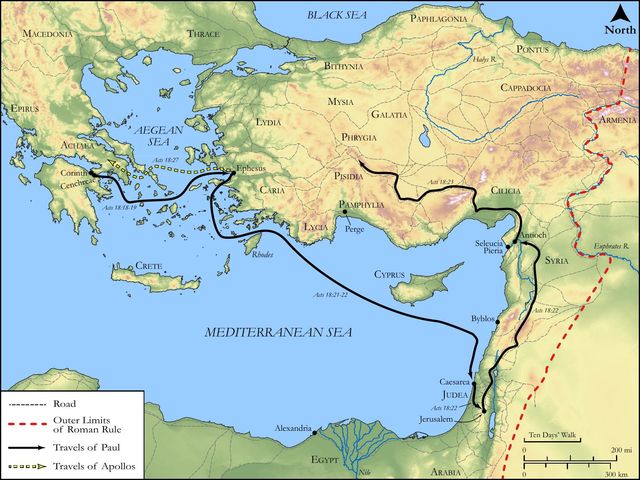
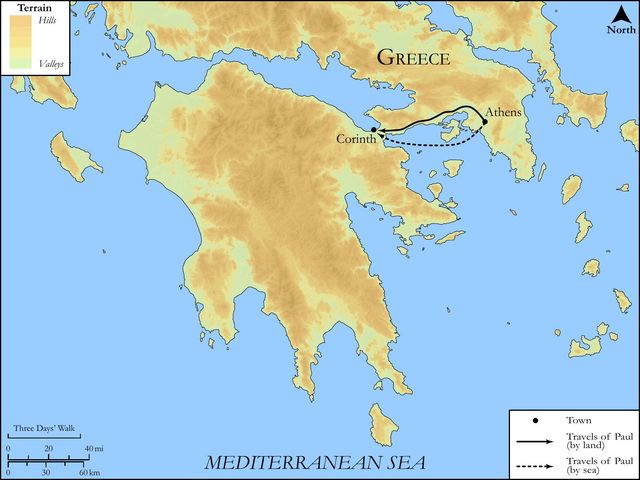
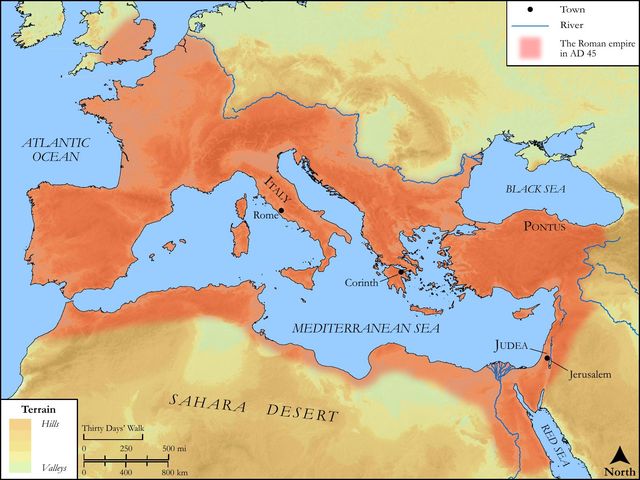
Study this verse
Public-domain commentary
Matthew Henry
From his Commentary on the Whole Bible. Henry comments on passages, not single verses — this entry covers Acts 18:1–6. His three-level outline is real structure in the source text, so it is rendered as structure.
We do not find that Paul was much persecuted at Athens, nor that he was driven thence by any ill usage, as he was from those places where the Jews had or could make any interest; but this reception at Athens being cold, and little prospect of doing good there, he departed from Athens, leaving the care of those there who believed with Dionysius; and thence he came to Corinth, where he was now instrumental in planting a church that became on many accounts considerable. Corinth was the chief city of Achaia, now a province of the empire, a rich and splendid city. Non cuivis homini contingit adire Corinthum - It is not permitted every man to see Corinth. The country thereabouts at this day is called the Morea. Now here we have,
I.Paul working for his living, Act 18:2, Act 18:3.
1.Though he was bred a scholar, yet he was master of a handicraft trade. He was a tent-maker, an upholsterer; he made tents for the use of soldiers and shepherds, of cloth or stuff, or (as some say tents were then generally made) of leather or skins, as the outer covering of the tabernacle. Hence to live in tents was to live sub pellibus - under skins. Dr. Lightfoot shows that it was the custom of the Jews to bring up their children to some trade, yea, though they gave them learning or estates. Rabbi Judah says, "He that teaches not his son a trade is as if he taught him to be a thief." And another says, "He that has a trade in his hand is as a vineyard that is fenced." An honest trade, by which a man may get his bread, is not to be looked upon by any with contempt. Paul, though a Pharisee, and bred up at the feet of Gamaliel, yet, having in his youth learned to make tents, did not by disuse lose the art.
2.Though he was entitled to a maintenance from the churches he had planted, and from the people to whom he preached, yet he worked at his calling to get bread, which is more to his praise who did not ask for supplies than to theirs who did not supply him unasked, knowing what straits he was reduced to. See how humble Paul was, and wonder that so great a man could stoop so low; but he had learned condescension of his Master, who came not to be ministered to, but to minister. See how industrious he was, and how willing to take pains. He that had so much excellent work to do with his mind, yet, when there was occasion, did not think it below him to work with his hands. Even those that are redeemed from the curse of the law are not exempt from that sentence, In the sweat of thy face thou shalt eat bread. See how careful Paul was to recommend his ministry, and to prevent prejudices against it, even the most unjust and unreasonable; he therefore maintained himself with his own labour that he might not make the gospel of Christ burdensome, Co2 11:7, etc.; Th2 3:8, Th2 3:9.
3.Though we may suppose he was master of his trade, yet he did not disdain to work at journey-work: He wrought with Aquila and Priscilla, who were of that calling, so that he got no more than day-wages, a bare subsistence. Poor tradesmen must be thankful if their callings bring them in a maintenance for themselves and their families, though they cannot do as the rich merchants that raise estates by their callings.
4.Though he was himself a great apostle, yet he chose to work with Aquila and Priscilla, because he found them to be very intelligent in the things of God, as appears afterwards (Act 18:26), and he owns that they had been his helpers in Christ Jesus, Rom 16:3. This is an example to those who are going to service to seek for those services in which they may have the best help for their souls. Choose to work with those that are likely to be helpers in Christ Jesus. It is good to be in company and to have conversation with those that will further us in the knowledge of Christ, and to put ourselves under the influence of such as are resolved that they will serve the Lord. Concerning this Aquila we are here told,
(1.)That he was a Jew, but born in Pontus, Act 18:2. Many of the Jews of the dispersion were seated in that country, as appears Pe1 1:1.
(2.)That he was lately come from Italy to Corinth. It seems he often changed his habitation; this is not the world we can propose ourselves a settlement in.
(3.)That the reason of his leaving Italy was because by a late edict of the emperor Claudius Caesar all Jews were banished from Rome; for the Jews were generally hated, and every occasion was taken to put hardship and disgrace upon them. God's heritage was as a speckled bird, the birds round about were against her, Jer 12:9. Aquila, though a Christian, was banished because he had been a Jew; and the Gentiles had such confused notions of the thing that they could not distinguish between a Jew and a Christian. Suetonius, in the life of Claudius, speaks of this decree in the ninth year of his reign, and says, The reason was because the Jews were a turbulent people - assiduo tumultuantes; and that it was impulsore Christo - upon the account of Christ; some zealous for him, others bitter against him, which occasioned great heats, such as gave umbrage to the government, and provoked the emperor, who was a timorous jealous man, to order them all to be gone. If Jews persecute Christians, it is not strange if heathens persecute them both.
II.We have here Paul preaching to the Jews, and dealing with them to bring them to the faith of Christ, both the native Jews and the Greeks, that is, those that were more or less proselyted to the Jewish religion, and frequented their meetings.
1.He reasoned with them in the synagogue publicly every sabbath. See in what way the apostles propagated the gospel, not by force and violence, by fire and sword, not by demanding an implicit consent, but by fair arguing; they drew with the cords of a man, gave a reason for what they said, and gave a liberty to object against it, having satisfactory answers ready. God invites us to come and reason with him (Isa 1:18), and challenges sinners to produce their cause, and bring forth their strong reasons, Isa 41:21. Paul was a rational as well as a scriptural preacher.
2.He persuaded them - epeithe. It denotes,
(1.)The urgency of his preaching. He did not only dispute argumentatively with them, but he followed his arguments with affectionate persuasions, begging of them for God's sake, for their own soul's sake, for their children's sake, not to refuse the offer of salvation made to them. Or,
(2.)The good effect of his preaching. He persuaded them, that is, he prevailed with them; so some understand it. In sententiam suam adducebat - He brought them over to his own opinion. Some of them were convinced by his reasonings, and yielded to Christ.
3.He was yet more earnest in this matter when his fellow-labourers, his seconds, came up with him (Act 18:5): When Silas and Timothy had come from Macedonia, and had brought him good tidings from the churches there, and were ready to assist him here, and strengthened his hands, then Paul was more than before pressed in spirit, which made him more than ever pressing in his preaching. He was grieved for the obstinacy and infidelity of his countrymen the Jews, was more intent than ever upon their conversion, and the love of Christ constrained him to it (Co2 5:14): it is the word that is used here, it pressed him in spirit to it. And, being thus pressed, he testified to the Jews with all possible solemnity and seriousness, as that which he was perfectly well assured of himself, and attested to them as a faithful saying, and worthy of all acceptation, that Jesus is the Christ, the Messiah promised to the fathers and expected by them.
III.We have him here abandoning the unbelieving Jews, and turning from them to the Gentiles, as he had done in other places, Act 18:6.
1.Many of the Jews, and indeed the most of them, persisted in their contradiction to the gospel of Christ, and would not yield to the strongest reasonings nor the most winning persuasions; they opposed themselves and blasphemed; they set themselves in battle array (so the word signifies) against the gospel; they joined hand in hand to stop the progress of it. They resolved they would not believe it themselves, and would do all they could to keep others from believing it. They could not argue against it, but what was wanting in reason they made up in ill language: they blasphemed, spoke reproachfully of Christ, and in him of God himself, as Rev 13:5, Rev 13:6. To justify their infidelity, they broke out into downright blasphemy.
2.Paul hereupon declared himself discharged from them, and left them to perish in their unbelief. He that was pressed in spirit to testify to them (Act 18:5), when they opposed that testimony, and persisted in their opposition, was pressed in spirit to testify against them (Act 18:6), and his zeal herein also he showed by a sign: he shook his raiment, shaking off the dust from it (as before they shook off the dust from their feet, Act 13:51), for a testimony against them. thus he cleared himself from them, but threatened the judgments of God against them. As Pilate by washing his hands signified the devolving of the guilt of Christ's blood from himself upon the Jews, so Paul by shaking his raiment signified what he said, if possible to affect them with it.
(1.)He had done his part, and was clean from the blood of their souls; he had, like a faithful watchman, given them warning, and thereby had delivered his soul, though he could not prevail to deliver theirs. He had tried all methods to work upon them, but all in vain, so that if they perish in their unbelief their blood is not to be required at his hands; here, and Act 20:26, he plainly refers to Eze 33:8, Eze 33:9. It is very comfortable to a minister to have the testimony of his conscience for him, that he has faithfully discharged his trust by warning sinners.
(2.)They would certainly perish if they persisted in their unbelief, and the blame would lie wholly upon themselves: "Your blood be upon your own heads, you will be your own destroyers, your nation will be ruined in this world, and particular persons will be ruined in the other world, and you alone shall bear it." If any thing would frighten them at last into a compliance with the gospel, surely this would.
3.Having given them over, yet he does not give over his work. Though Israel be not gathered, Christ and his gospel shall be glorious: Henceforth I will go unto the Gentiles; and the Jews cannot complain, for they had the first offer, and a fair one, made to them. The guests that were first invited will not come, and the provision must not be lost; guests must be had therefore from the highways and the hedges. "We would have gathered the Jews (Mat 23:37), would have healed them (Jer 51:9), and they would not; but Christ must not be a head without a body, nor a foundation without a building, and therefore, if they will not, we must try whether others will." Thus the fall and diminishing of the Jews became the riches of the Gentiles; and Paul said this to their faces, not only because it was what he could justify, but to provoke them to jealousy, Rom 11:12, Rom 11:14.
Historical interpretation
Historical reception
1 surviving comment on this verse from the historical church.
"And he reasoned in the synagogue every sabbath, and persuaded the Jews and the Greeks. And when Silas and Timotheus were come from Macedonia, Paul was straitened in the word, testifying to the Jews that Jesus is the Christ." "And when the Jews opposed and blasphemed," i.e. they tried to bear him down, they set upon him. "And he disputed in the synagogue every sabbath day, and persuaded both Jews and Greeks": but "when they opposed and blasphemed" he withdrew, by this expecting to draw them more.
Continue studying Acts 18:4 across the web’s major study libraries — every link below opens this exact verse, chapter, or book on the destination site.
Read & Compare
 BibleGatewayThis verse in more than 200 translations and 70 languages.
 Bible.comThe YouVersion reader — hundreds of translations, reading plans, and highlights.
 ESV.orgCrossway's official English Standard Version reader.
 NET BibleThe NET translation with 60,000+ translators' notes on every rendering decision.
 STEP BibleTyndale House's free study tool — original text, vocabulary, and scholarly resources.
 BibliaLogos Bible Software's free web reader.
 USCCBThe New American Bible (Revised Edition) with the U.S. bishops' study notes.
Commentaries
 BibleHub CommentariesDozens of classic commentaries on this verse, gathered on one page.
 StudyLightMore than 100 commentary sets — the largest collection on the web.
 BibleRefPlain-English commentary on what this verse means, verse by verse.
 Enduring WordDavid Guzik's free commentary on this chapter, widely used by Bible teachers.
 Bible Study ToolsVerse commentary alongside Greek and Hebrew study aids.
Original Language & Research
- BibleHub InterlinearThe verse word by word — original language, transliteration, and English.
- BibleHub LexiconEvery word's original-language definition and Strong's entry.
 Blue Letter BibleDeep-study tools — Strong's numbers, concordance, and word studies.
 CNTR CollationThe earliest Greek manuscripts of this verse, collated letter by letter.
Sermons, Hymns & Audio


TrulyRandomVerse is not affiliated with these sites and doesn’t control their content. They’re linked because they’re genuinely useful.
Summary
Acts 18:4 offers a succinct yet profound glimpse into the apostle Paul's consistent and strategic evangelistic methodology in Corinth. It reveals his regular practice of engaging both the Jewish community and Gentile converts within the synagogue setting, employing a blend of intellectual reasoning and spiritual persuasion to present the transformative message of the Gospel. This verse encapsulates Paul's unwavering dedication to his mission and the universal scope of the good news he proclaimed.
Context
ShowHideLiterary Context
This verse immediately follows Paul's arrival in Corinth from Athens, as detailed in Acts 18:1. Paul, having experienced mixed results in Athens, arrives in a new city, a major Roman commercial hub known for its diverse population and moral complexities. The preceding verse, Acts 18:3, establishes that Paul, true to his custom, supported himself by working as a tentmaker alongside Aquila and Priscilla, fellow believers who would become vital partners in his ministry. Acts 18:4 then sets the stage for his public ministry in Corinth, indicating his immediate and consistent engagement with the local community, specifically starting in the Jewish synagogue. This pattern of beginning his evangelistic efforts in the synagogue is a recurring motif throughout the book of Acts, reflecting Paul's strategic approach to reach those already familiar with the Old Testament prophecies concerning the Messiah before turning to a broader Gentile audience, often in response to Jewish rejection.
Historical & Cultural Context
Corinth was a strategically important city, serving as the capital of the Roman province of Achaia and a major trade center due to its location on the Isthmus of Corinth, connecting the Aegean and Adriatic Seas. Its bustling ports attracted a diverse population of Romans, Greeks, Jews, and various other ethnicities, making it a melting pot of cultures and religions. The city was also notorious for its opulence and moral laxity, often associated with pagan idolatry and sexual immorality, particularly linked to the temple of Aphrodite. Within this vibrant but challenging environment, Jewish communities established synagogues, which served not only as places of worship but also as social and educational centers. These synagogues often attracted "God-fearers," Gentiles who were drawn to Jewish monotheism and ethical standards but had not fully converted. Paul's choice to begin his ministry in the synagogue was culturally astute, providing a ready-made audience familiar with the Scriptures and the concept of a Messiah, offering a natural bridge for the Gospel message.
Key Themes
ShowHideActs 18:4 contributes significantly to several overarching themes in the book of Acts and Paul's ministry. Firstly, it highlights Paul's consistent evangelistic strategy, demonstrating his established pattern of entering a city and immediately seeking out the Jewish synagogue. This approach, seen previously in Acts 17:2 and Acts 13:14, underscores his conviction that the Gospel was "to the Jew first and also to the Greek," as he would later articulate in Romans 1:16. Secondly, the verse emphasizes the nature of Paul's communication, described as "reasoning" and "persuading." This points to an intellectual and Spirit-empowered engagement, not merely a declaration, but a thoughtful presentation of truth designed to convince. Finally, the mention of "the Jews and the Greeks" underscores the universal scope of the Gospel, a central theme of Acts, demonstrating that God's redemptive plan extends beyond ethnic boundaries to encompass all humanity, inviting both Jew and Gentile into the new covenant community.
Exposition and Analysis
ShowHideKey Word Analysis
ShowHideThis word, from which we derive "dialogue," signifies more than a simple lecture. According to G1256, it means "to say thoroughly, i.e. discuss (in argument or exhortation)." Paul was not merely delivering monologues but engaging in interactive discussions, debating, presenting arguments, and responding to questions and objections. This implies a thoughtful, intellectual engagement with his audience, rooted in the Scriptures, aiming to demonstrate the truth of Christ.
G3982 defines this as "to convince (by argument, true or false); by analogy, to pacify or conciliate (by other fair means); reflexively or passively, to assent (to evidence or authority), to rely (by inward certainty)." Paul's goal was not just to inform but to convince and win over his listeners, leading them to a change of mind or conviction. This persuasion was both intellectual (through reasoning) and spiritual (through the power of the Holy Spirit accompanying his words), aiming for genuine belief and commitment.
As per G1672, this term refers to "a Hellen (Grecian) or inhabitant of Hellas; by extension a Greek-speaking person, especially a non-Jew." In the context of the synagogue, these "Greeks" would primarily be Gentile "God-fearers" who attended Jewish services and were drawn to monotheism and Jewish ethics, but had not fully converted. Their presence highlights the synagogue as a vital bridge for Paul's ministry to the Gentiles, allowing him to reach a receptive non-Jewish audience already somewhat familiar with the biblical narrative and moral framework.
Verse Breakdown
ShowHide"And he reasoned in the synagogue every sabbath"
This clause highlights Paul's consistent and methodical approach to evangelism. "Every sabbath" emphasizes his regularity and commitment to reaching the community during their traditional day of worship and gathering. His choice of the "synagogue" as his initial platform was strategic, providing an audience already familiar with the Old Testament and the concept of a Messiah, making them a natural starting point for presenting Jesus as the fulfillment of prophecy. The act of "reasoning" signifies an intellectual and argumentative engagement, where Paul presented logical and scriptural proofs for the claims of the Gospel.
"and persuaded the Jews and the Greeks"
This second clause reveals the dual audience Paul targeted and the intended outcome of his efforts. "The Jews" were the native members of the synagogue, while "the Greeks" (likely Gentile "God-fearers") were non-Jews who attended. Paul's aim was to "persuade" both groups, meaning to convince them of the truth of his message and lead them to belief. This demonstrates the universal appeal of the Gospel and Paul's mission to reach both covenant people and those outside the covenant, breaking down traditional barriers.
Literary Devices
ShowHideThe verse employs several literary devices to convey Paul's ministry. Repetition is subtly present in "every sabbath," emphasizing the consistent and unwavering nature of Paul's evangelistic efforts. This highlights his dedication and methodical approach rather than sporadic outreach. Juxtaposition is evident in the phrase "the Jews and the Greeks," which underscores the universal scope of the Gospel and Paul's mission to bridge the divide between these two primary groups of humanity. This pairing is a recurring motif in Paul's epistles, emphasizing the unity found in Christ. Furthermore, the active verb choices "reasoned" and "persuaded" are crucial. They portray Paul's ministry not as passive declaration but as an active, intellectual, and Spirit-empowered engagement, requiring both logical presentation and a divine enablement to bring about conviction and belief.
Theological and Thematic Connections
ShowHideActs 18:4 is a microcosm of Paul's missionary theology, demonstrating his strategic commitment to presenting the Gospel first to the Jews and then to the Gentiles, employing a method rooted in rational discourse and divine persuasion. This approach reflects the continuity of God's redemptive plan, which began with Israel but was always intended to extend to all nations. Paul's consistent presence in the synagogue underscores the importance of engaging with existing religious frameworks as a bridge to the new covenant. The dual outcome of "persuading the Jews and the Greeks" foreshadows the diverse composition of the early church, a community where ethnic and cultural distinctions are transcended by common faith in Christ. This verse thus speaks to the universal call of the Gospel and the Spirit-empowered means by which it spreads.
Reflection and Application
ShowHideActs 18:4 offers profound lessons for contemporary believers regarding evangelism and spiritual discipline. Paul's commitment to "reasoning" and "persuading" reminds us that sharing our faith is not merely about reciting doctrines, but about engaging thoughtfully with others, understanding their questions, and presenting the truth of the Gospel in a compelling and understandable way. This requires both intellectual preparation and a reliance on the Holy Spirit to open hearts and minds. His consistent presence "every sabbath" underscores the value of regularity and perseverance in ministry, even when immediate results are not apparent or opposition arises. Furthermore, Paul's outreach to "the Jews and the Greeks" challenges us to embrace an inclusive vision for evangelism, recognizing that the Gospel is for everyone, regardless of their background, ethnicity, or current beliefs. We are called to step out of our comfort zones and intentionally engage with diverse communities, trusting that God desires all people to come to a saving knowledge of Christ.
Questions for Reflection
ShowHideFAQ
ShowHideWhy did Paul always start his ministry in the synagogue?
ShowHidePaul's consistent practice of beginning his ministry in the synagogue, as seen in Acts 18:4 and other passages like Acts 17:2, was a strategic and theologically grounded decision. Firstly, it provided a ready-made audience already familiar with the Old Testament Scriptures, which formed the foundation for understanding Jesus as the Messiah. This allowed Paul to build upon existing knowledge and prophecies. Secondly, the synagogue often attracted Gentile "God-fearers" who were drawn to Jewish monotheism, offering a natural bridge for the Gospel to reach a receptive non-Jewish audience. This aligned with Paul's understanding that the Gospel was "to the Jew first and also to the Greek" (Romans 1:16), reflecting God's historical covenant with Israel and the universal scope of His redemptive plan.
Christ-Centered Fulfillment
ShowHideActs 18:4, while describing Paul's missionary activity, deeply resonates with the Christ-centered nature of the Gospel. Paul's "reasoning" and "persuading" were not about his own wisdom or philosophy, but about presenting Jesus Christ as the fulfillment of all Old Testament promises and the sole means of salvation. Just as Jesus Himself "opened their minds to understand the Scriptures" (Luke 24:45), Paul's reasoning aimed to reveal Christ as the ultimate truth. The "persuasion" he sought was not merely intellectual assent but a Spirit-empowered conviction that led to faith in the resurrected Lord, echoing the transforming power of the Holy Spirit sent by Christ (John 16:8). Furthermore, Paul's mission to "the Jews and the Greeks" directly reflects Christ's own work of breaking down the dividing wall of hostility between them, making "one new humanity" (Ephesians 2:14-15). Paul's persistent proclamation in the synagogue, despite eventual opposition, mirrors Christ's unwavering commitment to His mission, even unto the cross. Thus, Paul's ministry in Corinth, as depicted in this verse, is a powerful extension of Christ's ongoing work to gather His church from every nation, tribe, and tongue, bringing all into saving relationship with the Lamb of God (Revelation 5:9).