


2 Chronicles 32:11
Bible text: King James Version (1769 Blayney text) · Public domain
Bible text: King James Version with Strong's numbers · Public domain
Bible text: Berean Standard Bible · Public domain
Bible text: American Standard Version (1901) · Public domain
Bible text: World English Bible, Messianic edition · Public domain
Bible text: Geneva Bible (1599) · Public domain
Bible text: Young's Literal Translation · Public domain
- הֲלֹאha·Lo'¿ notH3808Interrog ¦ NegParticle Negativeהֲ¿לֹאnot
- יְחִזְקִיָּהוּye·chiz·ki·Ya·hu[is] HezekiahH2396N-proper-mNoun Proper Masculine
- מַסִּיתma·SitmisleadingH5496V-Hiphil-Prtcpl-msVerb Hiphil Participle Singular Masculine Absolute
- אֶתְכֶם'et·Khem<obj.> youH853DirObjM ¦ 2mpParticle Object Indicatorאֶתְ<obj.>כֶםyou
- לָתֵתla·Tetto giveH5414Prep-l ¦ V-Qal-InfVerb Qal Infinitive Constructלָtoתֵתgive
- אֶתְכֶם'et·Khem<obj.> youH853DirObjM ¦ 2mpParticle Object Indicatorאֶתְ<obj.>כֶםyou
- לָמוּתla·Mutto dieH4191Prep-l ¦ V-Qal-InfVerb Qal Infinitive Constructלָtoמוּתdie
- בְּרָעָבbe·ra·'Avby hungerH7458Prep-b ¦ N-msNoun Singular Masculine Absoluteבְּbyרָעָבhunger
- וּבְצָמָאu·ve·tza·Ma'and by thirstH6772Conj-w ¦ Prep-b ¦ N-msNoun Singular Masculine Absoluteוּandבְbyצָמָאthirst
- לֵאמֹרle·Mor<to> sayingH559Prep-l ¦ V-Qal-InfVerb Qal Infinitive Constructלֵ<to>אמֹרsaying
- יְהוָהYah·wehYahwehH3068N-properNoun Proper Title
- אֱלֹהֵינוּ'e·lo·Hei·nuour GodH430N-mpc ¦ 1cpNoun Plural Masculine ConstructאֱלֹהֵיGodנוּour
- יַצִּילֵנוּya·tzi·Le·nuhe will deliver usH5337V-Hiphil-Imperf-3ms ¦ 1cpVerb Hiphil Imperfect 3rd Singular Masculineיַצִּילֵhe will deliverנוּus
- מִכַּףmi·Kaffrom [the] hand ofH3709Prep-m ¦ N-fscNoun Singular Feminine Constructמִfromכַּף[the] hand of
- מֶלֶךְMe·lekh[the] king ofH4428N-mscNoun Singular Masculine Construct
- אַשּׁוּר'a·ShurAssyriaH804N-properNoun Proper Location
English is a literal word-by-word gloss of the Hebrew, not the KJV's wording. Why?
This is the original text the KJV's translators worked from — each Hebrew word with its own literal English meaning in this verse, prepared by scholars at Tyndale House, Cambridge. The KJV translates whole sentences, not word by word, so its wording differs: one Hebrew word can become several English words, and the KJV may choose “the LORD” where the gloss reads “Yahweh”. Both are faithful — they answer different questions. For the KJV's own rendering, switch to the KJV text.
Details
See on the biblical-era maps
Study this verse
Public-domain commentary
Matthew Henry
From his Commentary on the Whole Bible. Henry comments on passages, not single verses — this entry covers 2 Chronicles 32:9–23. His three-level outline is real structure in the source text, so it is rendered as structure.
This story of the rage and blasphemy of Sennacherib, Hezekiah's prayer, and the deliverance of Jerusalem by the destruction of the Assyrian army, we had more at large in the book of Kings, 2 Kings 18 and 19. It is contracted here, yet large enough to show these three things: -
I.The impiety and malice of the church's enemies.
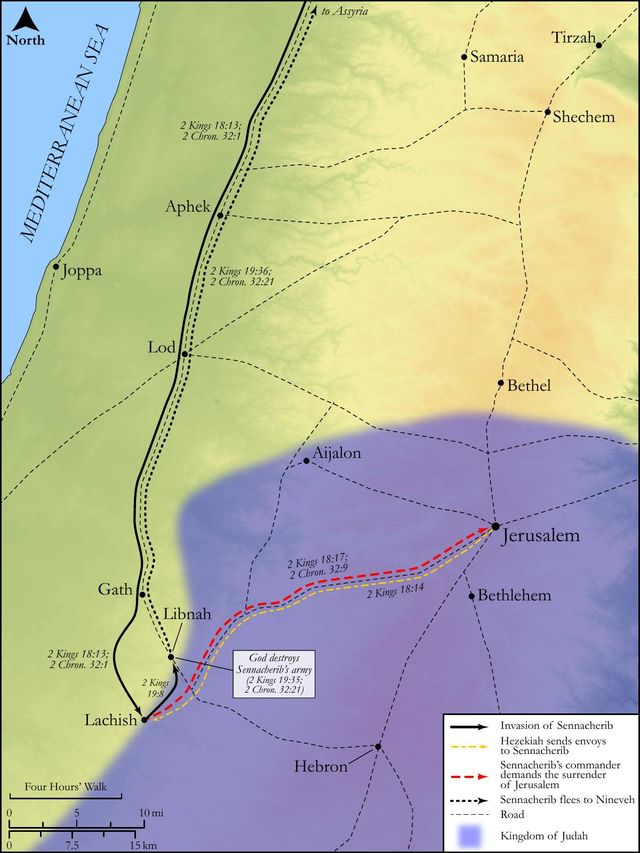
Sennacherib has his hands full in besieging Lachish (Ch2 32:9), but hears that Hezekiah is fortifying Jerusalem and encouraging his people to stand it out; and therefore, before he come in person to besiege it, he sends messengers to make speeches, and he himself writes letters to frighten Hezekiah and his people into a surrender of the city. See,
1.His great malice against the king of Judah, in endeavouring to withdraw his subjects from their allegiance to him. He did not treat with Hezekiah as a man of honour would have done, nor propose fair terms to him, but used mean and base artifices, unbecoming a crowned head, to terrify the common people and persuade them to desert him. he represented Hezekiah as one who designed to deceive his subjects into their ruin and betray them to famine and thirst (Ch2 32:11), as one who had done them great wrong and exposed them already to the divine displeasure by taking away the high places and altars (Ch2 32:12), and who, against the common interest of his people, held out against a force that would certainly be their ruin, Ch2 32:15.
2.His great impiety against the God of Israel, the God of Jerusalem he is called (Ch2 32:19), because that was the place he had chosen to put his name there, and because that was the place which was now threatened by the enemy and which the divine Providence had under its special protection. This proud blasphemer compared the great Jehovah, the Maker of heaven and earth, with the dunghill gods of the nations, the work of men's hands, and thought him no more able to deliver his worshippers than they were to deliver theirs (Ch2 32:19), as if an infinite and eternal Spirit had no more wisdom and power than a stone or the stock of a tree. He boasted of his triumphs over the gods of the nations, that they could none of them protect their people (Ch2 32:13-15), and thence inferred not only, How shall your God deliver you? (Ch2 32:14), but, as if he were inferior to them all, How much less shall your God deliver you? as if he were less able to help than any of them. Thus did they rail, rail in writing (which, being more deliberate, is so much the worse), on the Lord God of Israel, as if he were a cipher and an empty name, like all the rest, Ch2 32:17. Sennacherib, in the instructions he gave, said more than enough; but, as if his blasphemies had been too little, his servants, who learned insolence from their master, spoke yet more than he bade them against the Lord God and his servant Hezekiah, Ch2 32:16. And God resents what is said against his servants, and will reckon for it, as well as what is said against himself. All this was intended to frighten the people from their hope in God, which David's enemies sought to take him off from (Psa 11:1; Psa 42:10), saying, There is no help for him in God, Psa 3:2; Psa 71:11. Thus they hoped to take the city by weakening the hands of those that should defend it. Satan, in his temptations, aims to destroy our faith in God's all-sufficiency, knowing that he shall gain his point if he can do that; as we keep our ground if our faith fail not, Luk 22:32.
II.The duty as well as the interest of the church's friends, and that is in the day of distress to pray and cry to Heaven.
So Hezekiah did, and the prophet Isaiah, Ch2 32:20. It was a happy time when the king and the prophet joined thus in prayer. Is any troubled? Is any terrified? Let him pray. So we engage God for us; so we encourage ourselves in him. Praying to God is here called crying to Heaven, because we are, in prayer, to eye him as our Father in heaven, whence he beholds the children of men, and where he has prepared his throne.
III.The power and goodness of the church's God.
He is able both to control his enemies, be they ever so high, and to relieve his friends, be they ever so low.
1.As the blasphemies of his enemies engage him against them (Deu 32:27), so the prayers of his people engage him for them. They did so here.
(1.)The army of the Assyrians was cut off by the sword of an angel, which triumphed particularly in the slaughter of the mighty men of valour, and the leaders and captains, who defied the sword of any man. God delights to abase the proud and secure. The Targum says, The Word of the Lord (the eternal Word) sent Gabriel to do this execution, and that it was done with lightning, and in the passover night: that was the night in which the angel destroyed the first-born of Egypt. But that was not all.
(2.)The king of the Assyrians, having received this disgrace, was cut off by the sword of his own sons. Those that came forth of his own bowels slew him, Ch2 32:21. Thus was he mortified first, and then murdered - shamed first, and then slain. Evil pursues sinners; and, when they escape one mischief, they run upon another unseen.
2.By this work of wonder,
(1.)God was glorified, as the protector of his people. Thus he saved Jerusalem, not only from the hand of Sennacherib, but from the hand of all others, Ch2 32:22; for such a deliverance as this was an earnest of much mercy in store; and he guided them, that is, he guarded them, on every side. God defends his people by directing them, shows them what they should do, and so saves them from what is designed or done against them. For this many brought gifts unto the Lord, when they saw the great power of God in the defence of his people. Strangers were thereby induced to supplicate his favour and enemies to deprecate his wrath, and both brought gifts to his temple, in token of their care and desire.
(2.)Hezekiah was magnified as the favourite and particular care of Heaven. Many brought presents to him (Ch2 32:22, Ch2 32:23), in token of the honour they had for him, and to make an interest in him. By the favour of God enemies are lost and friends gained.
Continue studying 2 Chronicles 32:11 across the web’s major study libraries — every link below opens this exact verse, chapter, or book on the destination site.
Read & Compare
 BibleGatewayThis verse in more than 200 translations and 70 languages.
 Bible.comThe YouVersion reader — hundreds of translations, reading plans, and highlights.
 ESV.orgCrossway's official English Standard Version reader.
 NET BibleThe NET translation with 60,000+ translators' notes on every rendering decision.
 STEP BibleTyndale House's free study tool — original text, vocabulary, and scholarly resources.
 BibliaLogos Bible Software's free web reader.
 USCCBThe New American Bible (Revised Edition) with the U.S. bishops' study notes.
Commentaries
 BibleHub CommentariesDozens of classic commentaries on this verse, gathered on one page.
 StudyLightMore than 100 commentary sets — the largest collection on the web.
 BibleRefPlain-English commentary on what this verse means, verse by verse.
 Enduring WordDavid Guzik's free commentary on this chapter, widely used by Bible teachers.
 Bible Study ToolsVerse commentary alongside Greek and Hebrew study aids.
Original Language & Research
- BibleHub InterlinearThe verse word by word — original language, transliteration, and English.
- BibleHub LexiconEvery word's original-language definition and Strong's entry.
 Blue Letter BibleDeep-study tools — Strong's numbers, concordance, and word studies.
 SefariaThe Hebrew text with Rashi and centuries of Jewish commentary.
Sermons, Hymns & Audio


TrulyRandomVerse is not affiliated with these sites and doesn’t control their content. They’re linked because they’re genuinely useful.
Summary
2 Chronicles 32:11 captures a critical moment of psychological warfare during the Assyrian siege of Jerusalem, where King Sennacherib's envoys, through a manipulative rhetorical question, attempt to undermine King Hezekiah's leadership and the people's faith. This verse portrays Sennacherib's strategy to sow doubt and fear by suggesting that Hezekiah's call to trust in the Lord for deliverance is a deceptive path leading inevitably to death by famine and thirst, thereby challenging the very foundation of Judah's hope and seeking to compel their surrender without further military engagement.
Context
ShowHideLiterary Context
This verse is situated within the dramatic narrative of Sennacherib's invasion of Judah in 701 BCE, as recounted in 2 Chronicles 32, with parallel accounts in 2 Kings 18-19 and Isaiah 36-37. Following Hezekiah's diligent preparations for the siege—including strengthening the city's defenses, securing water sources, and encouraging his people to be strong and courageous, reminding them that "with us is the LORD our God to help us and to fight our battles" (2 Chronicles 32:7-8)—Sennacherib escalates his assault from military might to psychological warfare. The message in verse 11 directly follows Sennacherib's initial boastful challenge in 2 Chronicles 32:10, where he questioned Yahweh's ability to deliver Jerusalem. This verse serves as a direct, insidious attempt to break the people's morale and trust, setting the stage for Hezekiah's fervent prayer and God's miraculous intervention.
Historical & Cultural Context
The late 8th century BCE was dominated by the Neo-Assyrian Empire, an unparalleled military power renowned for its brutal conquests, forced deportations, and sophisticated psychological warfare. Sennacherib's campaign against Judah in 701 BCE was part of his broader effort to reassert control over rebellious tributaries. He had already devastated numerous fortified cities of Judah, culminating in the siege of Jerusalem. Assyrian military doctrine often incorporated public taunts and propaganda, delivered in the local language by high-ranking officials (like the Rabshakeh), to demoralize the enemy and encourage surrender, thereby minimizing the cost and duration of prolonged sieges. The threat of "famine and thirst" was not a mere rhetorical flourish but a terrifying and common reality of ancient sieges, making Sennacherib's words particularly potent and designed to exploit the deepest, most primal fears of the besieged population.
Key Themes
ShowHideThis verse powerfully illustrates several crucial themes. Firstly, Psychological Warfare is prominently displayed, showcasing the enemy's deliberate strategy to undermine leadership and faith not solely through military might but through fear, deception, and manipulation. Sennacherib aims to sever the bond of trust between Hezekiah and his people, and more importantly, between the people and their God. Secondly, Faith Under Fire is starkly presented, as Hezekiah's unwavering trust in God's deliverance is directly challenged by the Assyrian king's taunts. The people are confronted with a stark choice: surrender to the seemingly invincible Assyrians or face a gruesome death by starvation and thirst, despite Hezekiah's assurances of divine aid. This tests the very foundation of their belief in Yahweh's power and faithfulness, a challenge echoed in parallel accounts like Isaiah 36:13-15. Thirdly, the theme of Divine Sovereignty vs. Human Power is central. Sennacherib's immense military power and past conquests are contrasted with Hezekiah's reliance on the unseen, yet omnipotent, power of God. The Assyrian king's boast seeks to prove that no god, including the Lord of Israel, could deliver His people from his hand, setting up the dramatic demonstration of God's ultimate supremacy that follows in 2 Chronicles 32:21-23.
Exposition and Analysis
ShowHideKey Word Analysis
ShowHideThis verb, from the root H5496, carries the primary meaning "to prick," which figuratively extends to "stimulate," and by implication, "to seduce" or "entice." In this context, Sennacherib employs it to suggest that Hezekiah is not genuinely encouraging faith but rather cunningly misleading or seducing the people into a dangerous and ultimately fatal course of action. It implies a manipulative intent, portraying Hezekiah's call to trust God as a deceptive delusion that will lead to their demise.
This primitive root (H4191) signifies "to die" literally or figuratively, and causatively, "to kill." In the phrase "to die by famine and by thirst," it vividly describes the horrific and slow death that was a common and terrifying consequence of prolonged sieges. Sennacherib's explicit mention of these agonizing forms of death is designed to maximize fear and despair, making the alternative of surrender seem merciful by comparison. It is a direct assault on the most basic human needs for survival.
This primitive root (H5337) means "to snatch away," "rescue," or "save," whether in a good or bad sense. It is the core of Hezekiah's promise to the people and the very thing Sennacherib mocks. The Assyrian king's rhetorical question implies that Yahweh (H3068) is utterly incapable of performing this act of rescue, thereby challenging the very nature and power of Israel's God (H430) and His ability to save His people from the hand (H3709) of the king (H4428) of Assyria (H804).
Verse Breakdown
ShowHide"Doth not Hezekiah persuade you"
This clause functions as a rhetorical question, artfully crafted to elicit an obvious "yes" in the minds of the listeners. Sennacherib's envoys are not genuinely seeking information but rather planting a potent seed of doubt, subtly suggesting that Hezekiah's leadership is not only misguided but actively malicious, leading them astray through cunning manipulation.
"to give over yourselves to die by famine and by thirst"
This clause presents the grim and seemingly inevitable consequence of following Hezekiah's counsel. It frames trusting God as an act of self-destruction, a voluntary surrender to a horrific and agonizing death. The Assyrians are attempting to reframe Hezekiah's call to faith as a death sentence, starkly contrasting it with the perceived "life" and relief that surrender to Assyria would supposedly offer.
"saying, The LORD our God shall deliver us out of the hand of the king of Assyria?"
This is the direct quote of Hezekiah's message, presented by Sennacherib's envoys with palpable derision and contempt. It highlights the direct challenge to Yahweh's power and faithfulness. Sennacherib's implication is that Hezekiah's promise of divine deliverance is a hollow, empty boast, completely out of touch with the overwhelming reality of Assyrian military might and their track record of conquering other nations' gods.
Literary Devices
ShowHideThe verse effectively employs several literary devices to achieve its persuasive and manipulative purpose. The most prominent is the Rhetorical Question, "Doth not Hezekiah persuade you...?", which is not designed to solicit an answer but to implant a specific, negative idea—that Hezekiah is deceitful and leading them to ruin—directly into the minds of the listeners. This device is a cornerstone of Psychological Warfare, aiming to demoralize and divide the besieged population by undermining their trust in their leader and their God. There is also a strong element of Irony, as Sennacherib's boastful dismissal of Yahweh's power will ultimately be proven false by God's miraculous deliverance, turning the Assyrian king's taunts back on himself. The verse also relies on Contrast, setting the Assyrian king's overwhelming human power and cynical pragmatism against Hezekiah's reliance on divine power and spiritual faith. The stark imagery of "famine and thirst" serves as a powerful form of Pathos, appealing directly to the basic human instinct for survival and fear of suffering to sway the people towards surrender.
Theological and Thematic Connections
ShowHideThis verse profoundly underscores the perennial spiritual battle between faith and fear, divine promise and human threat. It highlights how the enemy, whether spiritual or physical, often seeks to undermine our trust in God by presenting dire circumstances and questioning God's ability or willingness to deliver. Sennacherib's taunt is a direct challenge to God's covenant faithfulness and His absolute sovereignty over all nations and their rulers. The dramatic narrative that follows in 2 Chronicles 32 powerfully demonstrates that God is indeed able to deliver His people, not by human strength or military might, but by His own miraculous power, thereby vindicating His name and proving His supremacy over all earthly kings and their gods. This divine intervention serves as a powerful reminder that God's promises are trustworthy, even when circumstances seem overwhelmingly bleak and human logic dictates otherwise, encouraging believers to place their confidence in Him alone.
Reflection and Application
ShowHideIn our own lives, we frequently encounter "Sennacheribs"—voices, circumstances, or spiritual attacks that attempt to sow seeds of doubt, fear, and despair, challenging our trust in God's promises and His ability to deliver. These voices might manifest as overwhelming financial difficulties, debilitating health crises, painful relational breakdowns, or even the subtle whispers of our own anxieties and insecurities. Just as Sennacherib tried to reframe Hezekiah's call to faith as a path to destruction, so too does the enemy attempt to distort the truth of God's Word, making obedience seem foolish or dangerously naive. This verse calls us to cultivate spiritual discernment, enabling us to recognize and resist these manipulative voices. It compels us to remember God's proven faithfulness throughout history, to anchor ourselves in His unchanging character, and to hold fast to His promises, even when immediate circumstances seem overwhelmingly dire and human strength is utterly insufficient. Our ultimate deliverance comes not from capitulating to fear or human reasoning but from steadfastly trusting in the Lord, who remains our unfailing refuge and strength in every time of trouble.
Questions for Reflection
ShowHideFAQ
ShowHideWhat was Sennacherib's primary goal with this message?
ShowHideSennacherib's primary goal with this message was to achieve Jerusalem's surrender without further costly and time-consuming military engagement. By employing psychological warfare, he aimed to demoralize the city's inhabitants, break their will to resist, and undermine their trust in both King Hezekiah and their God, Yahweh. He sought to create internal dissent and fear, making the prospect of continued resistance seem futile and leading them to believe that Hezekiah's call to faith was a deceptive path to death by starvation and thirst. His strategy was to avoid a full-scale assault on a well-fortified city, preferring to achieve victory through the power of his words, as seen in the broader context of 2 Chronicles 32.
How did Hezekiah and the people respond to this psychological attack?
ShowHideHezekiah and the people of Jerusalem responded to this psychological attack with remarkable steadfastness, largely due to Hezekiah's leadership and unwavering faith. While the people were undoubtedly terrified, the text indicates that they "did not answer him a word" (2 Kings 18:36), following Hezekiah's command not to engage with the taunts. Hezekiah himself, upon hearing the message, tore his clothes and went into the house of the Lord, sending for the prophet Isaiah. Together, Hezekiah and Isaiah prayed fervently to the Lord, laying the matter before Him (2 Chronicles 32:20). Their response was not one of panic or surrender, but of deep trust in God's ability to deliver, demonstrating that true faith stands firm even when faced with overwhelming threats and manipulative rhetoric.
Christ-Centered Fulfillment
ShowHideThe miraculous deliverance of Jerusalem from Sennacherib's siege, despite the enemy's taunts and the terrifying threat of "famine and thirst," powerfully foreshadows the ultimate and complete deliverance wrought by Jesus Christ. Sennacherib's arrogant boasts and his attempts to accuse and demoralize the people of God find their ultimate parallel in the deceptive strategies of Satan, "the accuser of our brothers" (Revelation 12:10), who relentlessly seeks to undermine our faith and lead us to spiritual despair and death. Just as God miraculously intervened to defeat the Assyrian army with a single angel (2 Kings 19:35), so too did God intervene decisively in human history through the person of Jesus Christ to secure a far greater victory. Christ, as the true King and ultimate Deliverer, did not merely save His people from a physical siege but from the spiritual bondage of sin, death, and the devil. His triumph on the cross disarmed the spiritual powers that held humanity captive (Colossians 2:15), and His resurrection sealed the victory over death itself (1 Corinthians 15:54-57). Moreover, the "famine and thirst" threatened by Sennacherib find their spiritual answer in Christ, who declared Himself the "Bread of Life" (John 6:35) and offered "living water" that quenches all spiritual thirst (John 4:14), providing eternal sustenance and true satisfaction for all who trust in Him.