


2 Kings 19:10
- כֹּהkohthusH3541AdvAdverb
- תֹאמְרוּןtom·Runyou will say !H559V-Qal-Imperf-2mp ¦ SfxVerb Qal Imperfect 2nd Plural Masculineתֹאמְרוּyou will sayן!
- אֶל'eltoH413PrepPreposition
- חִזְקִיָּהוּchiz·ki·Ya·huHezekiahH2396N-proper-mNoun Proper Masculine
- מֶלֶךְMe·lekh[the] king ofH4428N-mscNoun Singular Masculine Construct
- יְהוּדָהye·hu·DahJudahH3063N-properNoun Proper Location
- לֵאמֹרle·Mor<to> sayingH559Prep-l ¦ V-Qal-InfVerb Qal Infinitive Constructלֵ<to>אמֹרsaying
- אַל'almay notH408NegParticle Negative
- יַשִּׁאֲךָya·shi·'a·Khahe deceive youH5377V-Hiphil-Imperf-3ms ¦ 2msVerb Hiphil Imperfect 3rd Singular Masculineיַשִּׁאֲhe deceiveךָyou
- אֱלֹהֶיךָ'e·lo·Hei·khayour GodH430N-mpc ¦ 2msNoun Plural Masculine ConstructאֱלֹהֶיGodךָyour
- אֲשֶׁר'a·SherwhomH834RelParticle Relative
- אַתָּה'a·TahyouH859Pro-2msPronoun Personal 2nd Singular Masculine
- בֹּטֵחַbo·Te·ach[are] trustingH982V-Qal-Prtcpl-msVerb Qal Participle Singular Masculine Absolute
- בּוֹboin himPrep-b ¦ 3msSuffix Personal 3rd Singular Masculineבּinוֹhim
- לֵאמֹרle·Mor<to> sayingH559Prep-l ¦ V-Qal-InfVerb Qal Infinitive Constructלֵ<to>אמֹרsaying
- לֹאlo'notH3808NegParticle Negative
- תִנָּתֵןti·na·Tenit will be givenH5414V-Niphal-Imperf-3fsVerb Niphal Imperfect 3rd Singular Feminine
- יְרוּשָׁלִַםye·Ru·sha·LimJerusalemH3389N-properNoun Proper Location
- בְּיַדbe·Yadin [the] hand ofH3027Prep-b ¦ N-cscNoun Singular common gender Constructבְּinיַד[the] hand of
- מֶלֶךְMe·lekh[the] king ofH4428N-mscNoun Singular Masculine Construct
- אַשּׁוּר'a·ShurAssyriaH804N-properNoun Proper Location
English is a literal word-by-word gloss of the Hebrew, not the KJV's wording. Why?
This is the original text the KJV's translators worked from — each Hebrew word with its own literal English meaning in this verse, prepared by scholars at Tyndale House, Cambridge. The KJV translates whole sentences, not word by word, so its wording differs: one Hebrew word can become several English words, and the KJV may choose “the LORD” where the gloss reads “Yahweh”. Both are faithful — they answer different questions. For the KJV's own rendering, switch to the KJV text.
Details
See on the biblical-era map
Study this verse
Public-domain commentary
Matthew Henry
From his Commentary on the Whole Bible. Henry comments on passages, not single verses — this entry covers 2 Kings 19:8–19. His two-level outline is real structure in the source text, so it is rendered as structure.
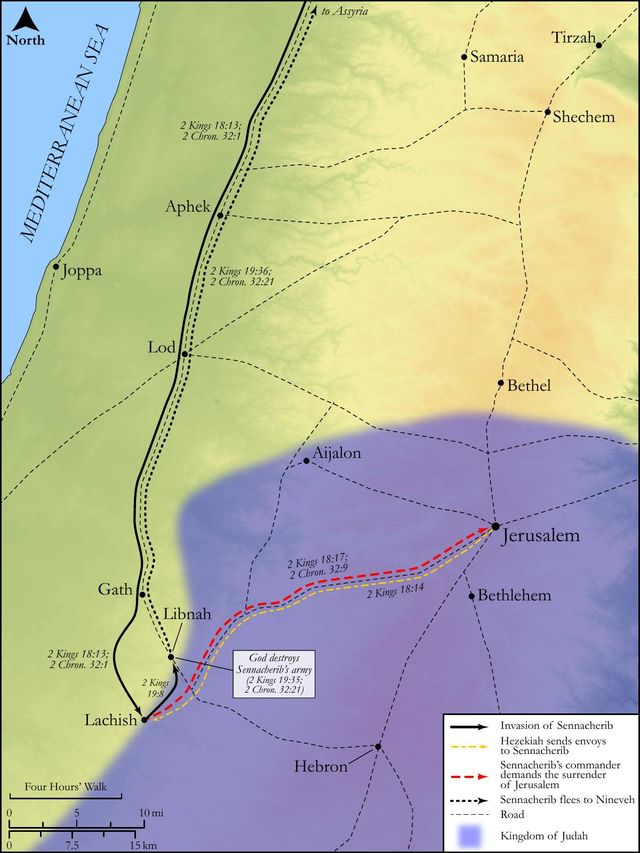
Rabshakeh, having delivered his message and received no answer (whether he took this silence for a consent or a slight does not appear), left his army before Jerusalem, under the command of the other generals, and went himself to attend the king his master for further orders. He found him besieging Libnah, a city that had revolted from Judah, Kg2 8:22. Whether he had taken Lachish or no is not certain; some think he departed from it because he found the taking of it impracticable, Kg2 19:8. However, he was now alarmed with the rumour that the king of the Cushites, who bordered upon the Arabians, was coming out against him with a great army, Kg2 19:9. This made him very desirous to gain Jerusalem with all speed. To take it by force would cost him more time and men than he could well spare, and therefore he renewed his attack upon Hezekiah to persuade him tamely to surrender it. Having found him an easy man once (Kg2 18:14), when he said, That which thou puttest on me I will bear, he hoped again to frighten him into a submission, but in vain. Here,
I.Sennacherib sent a letter to Hezekiah, a railing letter, a blaspheming letter, to persuade him to surrender Jerusalem, because it would be to no purpose for him to think of standing it out. His letter is to the same purport with Rabshakeh's speech; there is nothing new offered in it. Rabshakeh had said to the people, Let not Hezekiah deceive you, Kg2 18:29. Sennacherib writes to Hezekiah, Let not thy God deceive thee, Kg2 18:10. Those that have the God of Jacob for their help, and whose hope is in the Lord their God, need not fear being deceived by him, as the heathen were by their gods. To terrify Hezekiah, and drive him from his anchor, he magnifies himself and his own achievements. See how proudly he boasts,
1.Of the lands he had conquered (Kg2 18:11): All lands, and destroyed utterly! How are the mole-hills of his victories swelled to mountains! So far was he from destroying all lands that at this time the land of Cush, and Tirhakah its king, were a terror to him. What vast hyperboles may one expect in proud men's praises of themselves!
2.Of the gods he had conquered, Kg2 18:12. "Each vanquished nation and its gods, which were so far from being able to deliver them that they fell with them: and shall thy God deliver thee?" 3. Of the kings he had conquered (Kg2 18:13), the king of Hamath and the king of Arpad. Whether he means the prince or the idol, he means to make himself appear greater than either, and therefore very formidable, and the terror of the mighty in the land of the living.
II.Hezekiah encloses this in another letter, a praying letter, a believing letter, and sends it to the King of kings, who judges among the gods. Hezekiah was not so haughty as not to receive the letter, though we may suppose the superscription did not give him his due titles; when he had received it he was not so careless as not to read it; when he had read it he was not in such a passion as to write an answer to it in the same provoking language; but he immediately went up to the temple, presented himself, and then spread the letter before the Lord (Kg2 18:14), not as if God needed to have the letter shown to him (he knew what was in it before Hezekiah did), but hereby he signified that he acknowledged God in all his ways, - that he desired not to aggravate the injuries his enemies did him nor to make them appear worse than they were, but desired they might be set in a true light, - and that he referred himself to God, and his righteous judgment, upon the whole matter. Hereby likewise he would affect himself in the prayer he came to the temple to make; and we have need of all possible helps to quicken us in that duty. In the prayer which Hezekiah prayed over this letter, 1. He adores the God whom Sennacherib had blasphemed (Kg2 18:15), calls him the God of Israel, because Israel was his peculiar people, and the God that dwelt between the cherubim, because there was the peculiar residence of his glory upon earth; but he gives glory to him as the God of the whole earth, and not, as Sennacherib fancied him to be, the God of Israel only, and confined to the temple. "Let them say what they will, thou art sovereign Lord, for thou art the God, the God of gods, sole Lord, even thou alone, universal Lord of all the kingdoms of the earth, and rightful Lord, for thou hast made heaven and earth. Being Creator of all, by an incontestable title thou art owner and ruler of all." 2. He appeals to God concerning the insolence and profaneness of Sennacherib (Kg2 18:16): "Lord, hear; Lord, see. Here it is under his own hand; here it is in black and white." Had Hezekiah only been abused, he would have passed it by; but it is God, the living God, that is reproached, the jealous God. Lord, what wilt thou do for thy great name? 3. He owns Sennacherib's triumphs over the gods of the heathen, but distinguishes between them and the God of Israel (Kg2 18:17, Kg2 18:18): He has indeed cast their gods into the fire; for they were no gods, unable to help either themselves or their worshipers, and therefore no wonder that he has destroyed them; and, in destroying them, though he knew it not, he really served the justice and jealousy of the God of Israel, who has determined to extirpate all the gods of the heathen. But those are deceived who think they can therefore be too hard for him. He is none of the gods whom men's hands have made, but he has himself made all things, Psa 115:3, Psa 115:4. 4. He prays that God will now glorify himself in the defeat of Sennacherib and the deliverance of Jerusalem out of his hands (Kg2 19:19): "Now therefore save us; for if we be conquered, as other lands are, they will say that thou art conquered, as the gods of those lands were: but, Lord, distinguish thyself, by distinguishing us, and let all the world know, and be made to confess, that thou art the Lord God, the self-existent sovereign God, even thou only, and that all pretenders are vanity and a lie." Note, The best pleas in prayer are those which are taken from God's honour; and therefore the Lord's prayer begins with Hallowed be thy name, and concludes with Thine is the glory.
Continue studying 2 Kings 19:10 across the web’s major study libraries — every link below opens this exact verse, chapter, or book on the destination site.
Read & Compare
 BibleGatewayThis verse in more than 200 translations and 70 languages.
 Bible.comThe YouVersion reader — hundreds of translations, reading plans, and highlights.
 ESV.orgCrossway's official English Standard Version reader.
 NET BibleThe NET translation with 60,000+ translators' notes on every rendering decision.
 STEP BibleTyndale House's free study tool — original text, vocabulary, and scholarly resources.
 BibliaLogos Bible Software's free web reader.
 USCCBThe New American Bible (Revised Edition) with the U.S. bishops' study notes.
Commentaries
 BibleHub CommentariesDozens of classic commentaries on this verse, gathered on one page.
 StudyLightMore than 100 commentary sets — the largest collection on the web.
 BibleRefPlain-English commentary on what this verse means, verse by verse.
 Enduring WordDavid Guzik's free commentary on this chapter, widely used by Bible teachers.
 Bible Study ToolsVerse commentary alongside Greek and Hebrew study aids.
Original Language & Research
- BibleHub InterlinearThe verse word by word — original language, transliteration, and English.
- BibleHub LexiconEvery word's original-language definition and Strong's entry.
 Blue Letter BibleDeep-study tools — Strong's numbers, concordance, and word studies.
 SefariaThe Hebrew text with Rashi and centuries of Jewish commentary.
Sermons, Hymns & Audio


TrulyRandomVerse is not affiliated with these sites and doesn’t control their content. They’re linked because they’re genuinely useful.
Summary
Second Kings 19:10 encapsulates the audacious and blasphemous challenge issued by Sennacherib, king of Assyria, to King Hezekiah of Judah during the Assyrian siege of Jerusalem. This verse is a direct quote from Sennacherib's intimidating message, strategically designed to dismantle Hezekiah's faith and trust in the Lord by asserting that Jerusalem, like all other nations before it, was destined to fall into Assyrian hands. It represents a critical moment of profound spiritual and geopolitical tension, where human arrogance directly confronts divine sovereignty and the unwavering faith of God's chosen king.
Context
ShowHideLiterary Context
This verse is deeply embedded within the climactic narrative of Sennacherib's invasion of Judah, which dramatically unfolds from 2 Kings 18:13. Following the swift fall of many fortified cities throughout Judah, Sennacherib dispatches his chief officers, notably the Rabshakeh, with a formidable army and a message of defiance directly to Jerusalem. The immediate preceding verses, specifically 2 Kings 19:8-9, describe the Rabshakeh's return to Sennacherib, who is now engaged in battle against Libnah. News then reaches Sennacherib of Tirhakah, king of Ethiopia, advancing to fight against Assyria. This new threat prompts Sennacherib to send a second, even more direct, insulting, and psychologically targeted message to Hezekiah, of which 2 Kings 19:10 forms a central and provocative part. The message's explicit purpose is to demoralize Hezekiah and prevent him from seeking divine intervention, thereby setting the stage for Hezekiah's desperate prayer and God's miraculous and decisive intervention later in the chapter, particularly in 2 Kings 19:35. This momentous account is also famously paralleled in Isaiah 36-37.
Historical & Cultural Context
The events recounted in 2 Kings 19 transpired around 701 BCE, a period marked by the reign of King Hezekiah in the southern kingdom of Judah and King Sennacherib in the Neo-Assyrian Empire. Assyria, at this time, stood as the undisputed dominant superpower of the ancient Near East, renowned for its ruthless military campaigns, highly efficient administration, and sophisticated psychological warfare tactics. Their strategic approach frequently involved overwhelming displays of force, the systematic deportation of conquered peoples, and extensive propaganda designed to shatter the will of their enemies even before direct combat. Sennacherib's message to Hezekiah was a quintessential example of this strategy, expertly leveraging the Assyrian reputation for invincibility and the perceived impotence of local deities. The Assyrians possessed a long and successful history of conquering nations and subjugating their gods, and they fully anticipated that Judah's God, YHWH, would prove no different from the vanquished deities of Hamath, Arpad, Sepharvaim, Hena, and Ivah, as explicitly boasted in 2 Kings 19:13. Jerusalem, though formidable in its fortifications, was a relatively small city-state confronting an empire that had, decades earlier, completely absorbed the northern kingdom of Israel, as detailed in 2 Kings 17.
Key Themes
ShowHideSennacherib's defiant message in 2 Kings 19:10 powerfully contributes to several overarching themes present throughout 2 Kings and the broader prophetic literature. Firstly, it starkly highlights the challenge to faith that arises when confronting overwhelming worldly power. Sennacherib directly targets the very core of Hezekiah's trust in YHWH, implying that such faith is nothing more than a dangerous delusion, a false hope destined to lead to ruin. This sets the stage for a dramatic and profound confrontation between human arrogance and divine omnipotence. Secondly, the verse powerfully underscores the theme of divine sovereignty versus human arrogance. Sennacherib's words are steeped in hubris and blatant blasphemy, presuming that his military might far surpasses the power of the living God, YHWH. This audacious pride foreshadows God's dramatic and undeniable demonstration of His absolute control over all human affairs, as vividly illustrated by the miraculous deliverance of Jerusalem in 2 Kings 19:35-36. Finally, the verse introduces the critical theme of the nature of deliverance, directly questioning whether Jerusalem can truly be saved. Sennacherib's taunt challenges the very notion of God's ability to rescue His people, thereby preparing the narrative for God to reveal His unique and often unexpected methods of salvation, which transcend conventional human military strategy or political maneuvering.
Exposition and Analysis
ShowHideKey Word Analysis
ShowHideMeaning "strengthened of Jah." This name is profoundly significant in this context, as Sennacherib's message directly aims to weaken Hezekiah's resolve and trust in the very God who is his strength. The king's name itself becomes a poignant counterpoint to the Assyrian's attempt to undermine his faith.
A plural noun often used to refer to the supreme God, YHWH, especially with the article. Sennacherib's taunt challenges the very identity and power of YHWH, placing Him among the "gods" of other nations that have fallen. This is a direct affront to God's unique sovereignty and omnipotence.
Meaning "to hide for refuge," "to trust," "be confident," or "be sure." This word highlights the core of Hezekiah's spiritual posture and the foundation of Judah's resistance. Sennacherib's attack is not merely on Jerusalem's physical defenses but on the object of Hezekiah's faith, aiming to portray such reliance as foolish and futile.
Meaning "to lead astray," "to delude," or "to seduce." Sennacherib accuses YHWH of leading Hezekiah into a false sense of security, implying that Hezekiah's trust in God is a dangerous illusion that will prevent him from making the "sensible" decision to surrender. It's a psychological weapon, aiming to sow doubt about God's character and His ability to act.
Meaning "to give," "to put," "to make," or "to deliver (up)." In this context, Sennacherib asserts that Jerusalem "shall not be delivered" (i.e., "given over" or "handed over") into the hand of the Assyrian king. This directly contradicts any hope or divine promise of salvation, making the city's fate the central point of contention. The entire narrative hinges on whether YHWH will indeed prevent Jerusalem from being "delivered" into enemy hands, thereby proving His power against Sennacherib's boastful claims.
Meaning "hand," but also figuratively "power," "dominion," or "control." When Sennacherib states Jerusalem will not be delivered "into the hand of the king of Assyria," he is speaking of the city falling under Assyrian power and dominion. This emphasizes the complete subjugation and loss of sovereignty that would result from Jerusalem's capture.
Verse Breakdown
ShowHide"Thus shall ye speak to Hezekiah king of Judah, saying,"
This opening clause establishes the sender (Sennacherib) and the recipient (Hezekiah), framing the following words as a direct, authoritative, and confrontational message. It underscores the deliberate nature of Sennacherib's psychological assault, a formal declaration of intent to break Judah's will.
"Let not thy God in whom thou trustest deceive thee,"
This is the audacious core of Sennacherib's taunt. He directly challenges the efficacy, truthfulness, and even the very character of YHWH, the God of Judah. By using the word "deceive," Sennacherib attempts to portray God as unreliable, impotent, or even malicious, leading Hezekiah to a false sense of hope. This is a direct assault on Hezekiah's faith and the divine character, suggesting that trust in Him is a dangerous delusion.
"saying, Jerusalem shall not be delivered into the hand of the king of Assyria."
This final clause reveals the specific "deception" Sennacherib attributes to YHWH. He claims that any divine assurance of Jerusalem's safety is a lie, and that the city's fall into the Assyrian's power is an absolute and inevitable certainty. This statement is a declaration of Assyrian invincibility and a direct blasphemy against YHWH's power and His covenant promises to protect His people and His holy city.
Literary Devices
ShowHideThe passage in 2 Kings 19:10 is rich with literary devices that amplify its dramatic and theological impact. Perhaps the most prominent is Irony. Sennacherib accuses YHWH of "deceiving" Hezekiah, yet it is Sennacherib himself who is attempting to deceive Hezekiah into surrendering through fear and false promises of safety. The true deception lies in Sennacherib's arrogant belief in his own unassailable power and his profound underestimation of the living God. This message also functions as a prime example of Psychological Warfare, a common and effective tactic employed by the Assyrians. By directly challenging Hezekiah's faith and trust in God, Sennacherib aims to break the king's morale and the city's collective resolve without necessarily needing to launch a full-scale physical assault. The words are meticulously designed to instill fear and doubt, thereby undermining the spiritual foundation of Judah's resistance. Furthermore, the passage contains clear Blasphemy and Defiance. Sennacherib's direct challenge to YHWH's power and His ability to deliver Jerusalem constitutes a profound act of disrespect and rebellion against the divine, setting the stage for God's powerful vindication of His own name and sovereignty. Finally, there is a strong sense of Antithesis, sharply contrasting Sennacherib's perceived, but ultimately limited and ephemeral, human power with the infinite, true, and eternal power of God.
Theological and Thematic Connections
ShowHideThe challenge issued by Sennacherib in 2 Kings 19:10 serves as a pivotal moment, highlighting the enduring theological theme of divine sovereignty in the face of human arrogance. Sennacherib's boast is not merely a military threat but a direct assault on the very character and power of YHWH, the God of Israel. His belief that Judah's God is no different from the vanquished gods of other nations sets the stage for a dramatic display of God's unique power and unwavering faithfulness to His covenant people. This episode profoundly underscores that true security and deliverance lie not in military might, human wisdom, or political maneuvering, but in unwavering trust in the Lord. Hezekiah's profound response—taking the blasphemous letter to the temple and spreading it before the Lord in earnest prayer (2 Kings 19:14)—demonstrates the proper and faithful response to such spiritual and physical threats: absolute reliance on God alone. The subsequent miraculous deliverance of Jerusalem is a powerful testament to God's ability to intervene decisively in history, proving that no human power can ultimately thwart His plans or mock His holy name with impunity.
Reflection and Application
ShowHideSennacherib's audacious taunt to Hezekiah in 2 Kings 19:10 resonates deeply with the challenges and spiritual battles believers face today. We often encounter "Sennacheribs" in our contemporary lives—voices of doubt, fear, worldly wisdom, or even direct opposition that seek to undermine our faith and tell us that God cannot or will not deliver us from our troubles. These insidious voices may emanate from external circumstances, societal pressures, the pronouncements of experts, or even internal anxieties and past failures, all whispering that our trust in God is a delusion, a naive hope that will ultimately lead to disappointment. This verse powerfully reminds us not to let such voices "deceive" us. Hezekiah's unwavering trust in God, despite overwhelming odds and direct blasphemous taunts, serves as a profound and enduring example of faithful reliance. Our response to challenges, no matter how daunting, should be rooted in steadfast faith, not in paralyzing fear or despair. Like Hezekiah, our first and most crucial response to threats and overwhelming circumstances should be to take them directly to God in prayer, laying them before Him with complete transparency, humility, and unwavering trust. God remains faithful to those who trust in Him, even when circumstances seem dire and human solutions are utterly exhausted. The ultimate victory is not won by our limited strength, but by His infinite power and faithfulness.
Questions for Reflection
ShowHideFAQ
ShowHideWas Sennacherib's message a common tactic for ancient empires?
ShowHideYes, Sennacherib's message in 2 Kings 19:10 was a quintessential example of ancient Assyrian psychological warfare. The Assyrians were renowned masters of propaganda and intimidation tactics. Before launching a full-scale military assault, they would frequently dispatch messengers with boastful speeches and intimidating letters designed to demoralize the enemy, highlight their own overwhelming power, and ridicule the enemy's gods. The primary goal was to induce surrender without a protracted fight, thereby conserving valuable resources and lives. This sophisticated tactic is well-documented not only in Assyrian annals but also in other biblical accounts, such as the Rabshakeh's earlier, lengthy speech to Jerusalem's inhabitants in 2 Kings 18:19-35.
How did Hezekiah respond to this specific message from Sennacherib?
ShowHideHezekiah's response to this intimidating and blasphemous message, as meticulously recorded in 2 Kings 19:14-19, was one of profound faith, humility, and strategic spiritual action. Instead of succumbing to fear, despair, or immediate military action, Hezekiah took the blasphemous letter from Sennacherib directly to the temple of the Lord. There, he spread it out before God and poured out his heart in a fervent and deeply personal prayer. In his prayer, Hezekiah acknowledged God's absolute sovereignty over all the kingdoms of the earth and appealed to Him to deliver Jerusalem, not primarily for Judah's sake, but for the ultimate vindication of God's own holy name against Sennacherib's audacious blasphemy. This pivotal act of prayer was the catalyst for God's miraculous and decisive intervention.
Christ-Centered Fulfillment
ShowHideSennacherib's taunt in 2 Kings 19:10 serves as a powerful Old Testament foreshadowing of the ultimate cosmic conflict between the forces of darkness and the unassailable sovereignty of God, a conflict that finds its definitive resolution in Jesus Christ. Just as Sennacherib, representing the epitome of worldly power and arrogant defiance, sought to "deceive" Hezekiah into believing that God was incapable of deliverance, so too does Satan, the "prince of this world" (John 12:31), continually attempt to deceive humanity into believing that God is either powerless, uncaring, or unwilling to save. The world, in its fallen state, often presents a compelling narrative of self-reliance, human achievement, and the perceived futility of trusting in an unseen God, much like Sennacherib's boast that no god could stand against his might. However, the miraculous deliverance of Jerusalem by the mighty hand of the Lord points to the greater, ultimate deliverance accomplished by Jesus Christ. When all human hope was utterly lost, when sin and death held humanity captive in an unbreakable grip, God did not merely send an angel to strike down an earthly army; instead, He sent His own beloved Son, the Lamb of God who takes away the sin of the world, to conquer the true and eternal enemies: sin, death, and the devil. Through His crucifixion and glorious resurrection, Christ decisively defeated the spiritual powers and principalities that sought to "deceive" and enslave humanity, offering true, eternal, and complete deliverance to all who trust in Him (Colossians 2:15). He is the true King who delivers His people, not from an earthly empire, but from the dominion of spiritual darkness, graciously transferring them into His glorious and eternal kingdom (Colossians 1:13).