


2 Kings 19:14
- וַיִּקַּחvai·yi·Kachand he tookH3947Conj-w ¦ V-Qal-ConsecImperf-3msVerb Qal Consecutive Imperfect 3rd Singular Masculineוַandיִּקַּחhe took
- חִזְקִיָּהוּchiz·ki·Ya·huHezekiahH2396N-proper-mNoun Proper Masculine
- אֶת'et<obj.>H853DirObjMParticle Object Indicator
- הַסְּפָרִיםha·se·fa·Rimthe lettersH5612Art ¦ N-mpNoun Plural Masculine Absoluteהַtheסְּפָרִיםletters
- מִיַּדmi·Yadfrom [the] hand ofH3027Prep-m ¦ N-cscNoun Singular common gender Constructמִfromיַּד[the] hand of
- הַמַּלְאָכִיםha·mal·'a·Khimthe messengersH4397Art ¦ N-mpNoun Plural Masculine Absoluteהַtheמַּלְאָכִיםmessengers
- וַיִּקְרָאֵםvai·yik·ra·'Emand he read themH7121Conj-w ¦ V-Qal-ConsecImperf-3ms ¦ 3mpVerb Qal Consecutive Imperfect 3rd Singular Masculineוַandיִּקְרָאֵhe readםthem
- וַיַּעַלvai·Ya·'aland he went upH5927Conj-w ¦ V-Qal-ConsecImperf-3msVerb Qal Consecutive Imperfect 3rd Singular Masculineוַandיַּעַלhe went up
- בֵּיתbeit[the] house ofH1004N-mscNoun Singular Masculine Construct
- יְהוָהYah·wehYahwehH3068N-properNoun Proper Title
- וַיִּפְרְשֵׂהוּvai·yif·re·Se·huand he spread out itH6566Conj-w ¦ V-Qal-ConsecImperf-3ms ¦ 3msVerb Qal Consecutive Imperfect 3rd Singular Masculineוַandיִּפְרְשֵׂhe spread outהוּit
- חִזְקִיָּהוּchiz·ki·Ya·huHezekiahH2396N-proper-mNoun Proper Masculine
- לִפְנֵיlif·Nei<to> beforeH6440Prep-l ¦ N-mpcNoun Plural Masculine Constructלִ<to>פְנֵיbefore
- יְהוָהYah·wehYahwehH3068N-properNoun Proper Title
English is a literal word-by-word gloss of the Hebrew, not the KJV's wording. Why?
This is the original text the KJV's translators worked from — each Hebrew word with its own literal English meaning in this verse, prepared by scholars at Tyndale House, Cambridge. The KJV translates whole sentences, not word by word, so its wording differs: one Hebrew word can become several English words, and the KJV may choose “the LORD” where the gloss reads “Yahweh”. Both are faithful — they answer different questions. For the KJV's own rendering, switch to the KJV text.
Details
See on the biblical-era map
Study this verse
Public-domain commentary
Matthew Henry
From his Commentary on the Whole Bible. Henry comments on passages, not single verses — this entry covers 2 Kings 19:8–19. His two-level outline is real structure in the source text, so it is rendered as structure.
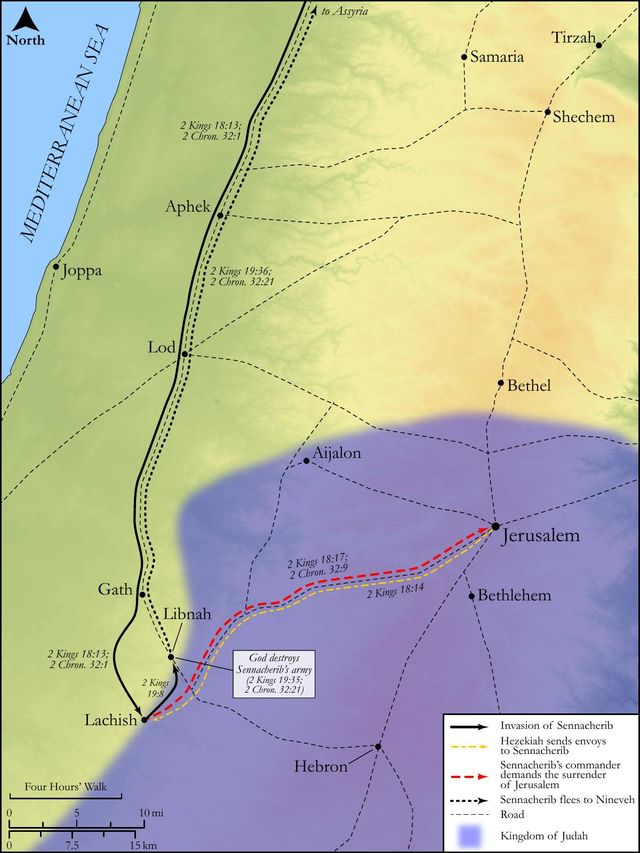
Rabshakeh, having delivered his message and received no answer (whether he took this silence for a consent or a slight does not appear), left his army before Jerusalem, under the command of the other generals, and went himself to attend the king his master for further orders. He found him besieging Libnah, a city that had revolted from Judah, Kg2 8:22. Whether he had taken Lachish or no is not certain; some think he departed from it because he found the taking of it impracticable, Kg2 19:8. However, he was now alarmed with the rumour that the king of the Cushites, who bordered upon the Arabians, was coming out against him with a great army, Kg2 19:9. This made him very desirous to gain Jerusalem with all speed. To take it by force would cost him more time and men than he could well spare, and therefore he renewed his attack upon Hezekiah to persuade him tamely to surrender it. Having found him an easy man once (Kg2 18:14), when he said, That which thou puttest on me I will bear, he hoped again to frighten him into a submission, but in vain. Here,
I.Sennacherib sent a letter to Hezekiah, a railing letter, a blaspheming letter, to persuade him to surrender Jerusalem, because it would be to no purpose for him to think of standing it out. His letter is to the same purport with Rabshakeh's speech; there is nothing new offered in it. Rabshakeh had said to the people, Let not Hezekiah deceive you, Kg2 18:29. Sennacherib writes to Hezekiah, Let not thy God deceive thee, Kg2 18:10. Those that have the God of Jacob for their help, and whose hope is in the Lord their God, need not fear being deceived by him, as the heathen were by their gods. To terrify Hezekiah, and drive him from his anchor, he magnifies himself and his own achievements. See how proudly he boasts,
1.Of the lands he had conquered (Kg2 18:11): All lands, and destroyed utterly! How are the mole-hills of his victories swelled to mountains! So far was he from destroying all lands that at this time the land of Cush, and Tirhakah its king, were a terror to him. What vast hyperboles may one expect in proud men's praises of themselves!
2.Of the gods he had conquered, Kg2 18:12. "Each vanquished nation and its gods, which were so far from being able to deliver them that they fell with them: and shall thy God deliver thee?" 3. Of the kings he had conquered (Kg2 18:13), the king of Hamath and the king of Arpad. Whether he means the prince or the idol, he means to make himself appear greater than either, and therefore very formidable, and the terror of the mighty in the land of the living.
II.Hezekiah encloses this in another letter, a praying letter, a believing letter, and sends it to the King of kings, who judges among the gods. Hezekiah was not so haughty as not to receive the letter, though we may suppose the superscription did not give him his due titles; when he had received it he was not so careless as not to read it; when he had read it he was not in such a passion as to write an answer to it in the same provoking language; but he immediately went up to the temple, presented himself, and then spread the letter before the Lord (Kg2 18:14), not as if God needed to have the letter shown to him (he knew what was in it before Hezekiah did), but hereby he signified that he acknowledged God in all his ways, - that he desired not to aggravate the injuries his enemies did him nor to make them appear worse than they were, but desired they might be set in a true light, - and that he referred himself to God, and his righteous judgment, upon the whole matter. Hereby likewise he would affect himself in the prayer he came to the temple to make; and we have need of all possible helps to quicken us in that duty. In the prayer which Hezekiah prayed over this letter, 1. He adores the God whom Sennacherib had blasphemed (Kg2 18:15), calls him the God of Israel, because Israel was his peculiar people, and the God that dwelt between the cherubim, because there was the peculiar residence of his glory upon earth; but he gives glory to him as the God of the whole earth, and not, as Sennacherib fancied him to be, the God of Israel only, and confined to the temple. "Let them say what they will, thou art sovereign Lord, for thou art the God, the God of gods, sole Lord, even thou alone, universal Lord of all the kingdoms of the earth, and rightful Lord, for thou hast made heaven and earth. Being Creator of all, by an incontestable title thou art owner and ruler of all." 2. He appeals to God concerning the insolence and profaneness of Sennacherib (Kg2 18:16): "Lord, hear; Lord, see. Here it is under his own hand; here it is in black and white." Had Hezekiah only been abused, he would have passed it by; but it is God, the living God, that is reproached, the jealous God. Lord, what wilt thou do for thy great name? 3. He owns Sennacherib's triumphs over the gods of the heathen, but distinguishes between them and the God of Israel (Kg2 18:17, Kg2 18:18): He has indeed cast their gods into the fire; for they were no gods, unable to help either themselves or their worshipers, and therefore no wonder that he has destroyed them; and, in destroying them, though he knew it not, he really served the justice and jealousy of the God of Israel, who has determined to extirpate all the gods of the heathen. But those are deceived who think they can therefore be too hard for him. He is none of the gods whom men's hands have made, but he has himself made all things, Psa 115:3, Psa 115:4. 4. He prays that God will now glorify himself in the defeat of Sennacherib and the deliverance of Jerusalem out of his hands (Kg2 19:19): "Now therefore save us; for if we be conquered, as other lands are, they will say that thou art conquered, as the gods of those lands were: but, Lord, distinguish thyself, by distinguishing us, and let all the world know, and be made to confess, that thou art the Lord God, the self-existent sovereign God, even thou only, and that all pretenders are vanity and a lie." Note, The best pleas in prayer are those which are taken from God's honour; and therefore the Lord's prayer begins with Hallowed be thy name, and concludes with Thine is the glory.
Continue studying 2 Kings 19:14 across the web’s major study libraries — every link below opens this exact verse, chapter, or book on the destination site.
Read & Compare
 BibleGatewayThis verse in more than 200 translations and 70 languages.
 Bible.comThe YouVersion reader — hundreds of translations, reading plans, and highlights.
 ESV.orgCrossway's official English Standard Version reader.
 NET BibleThe NET translation with 60,000+ translators' notes on every rendering decision.
 STEP BibleTyndale House's free study tool — original text, vocabulary, and scholarly resources.
 BibliaLogos Bible Software's free web reader.
 USCCBThe New American Bible (Revised Edition) with the U.S. bishops' study notes.
Commentaries
 BibleHub CommentariesDozens of classic commentaries on this verse, gathered on one page.
 StudyLightMore than 100 commentary sets — the largest collection on the web.
 BibleRefPlain-English commentary on what this verse means, verse by verse.
 Enduring WordDavid Guzik's free commentary on this chapter, widely used by Bible teachers.
 Bible Study ToolsVerse commentary alongside Greek and Hebrew study aids.
Original Language & Research
- BibleHub InterlinearThe verse word by word — original language, transliteration, and English.
- BibleHub LexiconEvery word's original-language definition and Strong's entry.
 Blue Letter BibleDeep-study tools — Strong's numbers, concordance, and word studies.
 SefariaThe Hebrew text with Rashi and centuries of Jewish commentary.
Sermons, Hymns & Audio


TrulyRandomVerse is not affiliated with these sites and doesn’t control their content. They’re linked because they’re genuinely useful.
Summary
In 2 Kings 19:14, King Hezekiah of Judah confronts an overwhelming existential threat from the mighty Assyrian Empire, encapsulated in a blasphemous and taunting letter from King Sennacherib. His immediate and profound response is not to engage in conventional military strategy or political maneuvering, but to enter the Temple, the sacred "house of the LORD," and deliberately unfurl the threatening document before God. This extraordinary act serves as a powerful declaration of absolute dependence on divine sovereignty, an earnest and vulnerable appeal for God's intervention, and a profound demonstration of trust that the Lord alone possessed the power to deliver Judah from an otherwise insurmountable human foe.
Context
ShowHideLiterary Context
This verse marks a critical turning point in the narrative of Judah's desperate confrontation with Assyria under King Sennacherib, a conflict extensively detailed in 2 Kings 18 and 2 Kings 19. Prior to this, Sennacherib's field commander, Rabshakeh, had already delivered a public, psychologically devastating message outside Jerusalem's walls, mocking Judah's reliance on Yahweh and asserting Assyria's superiority over all gods (2 Kings 18:28-35). Hezekiah had already responded by humbling himself, tearing his clothes, and sending a delegation to the prophet Isaiah for divine counsel. The arrival of Sennacherib's direct letter, which reiterated the blasphemous claims and demanded immediate surrender (2 Kings 19:10-13), escalates the crisis to its peak. Hezekiah's action in 2 Kings 19:14 represents his most direct and explicit act of laying the entire burden of the crisis before God, thereby setting the stage for God's dramatic and miraculous intervention.
Historical & Cultural Context
The events described in 2 Kings 19 occurred around 701 BC, during the reigns of King Hezekiah in Judah and King Sennacherib in Assyria. At this time, Assyria was the preeminent superpower of the ancient Near East, notorious for its ruthless military campaigns, advanced siege warfare, and sophisticated psychological intimidation tactics. Sennacherib's invasion of Judah was part of his broader imperial strategy to consolidate control over the Levant. The letter he dispatched was far more than a diplomatic communication; it was a calculated act of psychological warfare designed to shatter Hezekiah's resolve and demoralize Jerusalem's inhabitants by boasting of Assyria's irresistible might and, most critically, by directly insulting and challenging Judah's God, Yahweh. In this cultural milieu, kings typically appealed to their national deities for military success. However, Hezekiah's act of physically bringing a document into the Temple and spreading it before the LORD was an extraordinary and deeply symbolic gesture, signifying a complete and desperate surrender of an impossible situation to divine authority. The Temple, as the perceived dwelling place of God's presence, was the ultimate sanctuary and the very heart of Judah's national and spiritual identity.
Key Themes
ShowHideThis verse profoundly illustrates several foundational theological themes. Firstly, it highlights the theme of Divine Sovereignty versus human arrogance and power. Sennacherib's letter embodies the zenith of human pride and military might, yet Hezekiah's action implicitly declares God's ultimate and unchallengeable authority over all earthly kingdoms and their boasts. Secondly, it powerfully underscores the theme of Prayer as the Primary Response to Crisis. Instead of immediately resorting to conventional military or political strategies, Hezekiah's first and most decisive action is to turn directly to God, demonstrating that true and ultimate help comes solely from the Lord, as affirmed in Psalm 121:2. Thirdly, the deeply symbolic act of "spreading it before the LORD" embodies Radical Trust and Vulnerability. It is a humble admission of human helplessness in the face of an overwhelming foe and a profound act of faith, laying bare the full extent of the threat before the Almighty, trusting implicitly that God would defend His own honor and His covenant people (Psalm 46:1). This pivotal moment sets the stage for God's miraculous deliverance of Jerusalem, a powerful testament to His unwavering faithfulness and omnipotent power (2 Kings 19:35-36).
Exposition and Analysis
ShowHideKey Word Analysis
ShowHideThe Hebrew verb לָקַח (H3947, lâqach) signifies "to take (in the widest variety of applications); accept, bring, receive." In this context, Hezekiah's act of receiving the letter emphasizes his direct engagement with the enemy's message. He did not ignore or delegate this critical communication; he personally took it into his hands. This highlights his full comprehension of the gravity and blasphemous nature of Sennacherib's challenge, which then directly informed and propelled his subsequent, faith-filled action.
The Hebrew verb פָּרַשׂ (H6566, pâras) means "to break apart, disperse, etc.; spread (abroad, forth, selves, out), stretch (forth, out)." This is a highly significant and deliberate word choice. It denotes a physical, intentional act of unfurling the scroll and laying its contents fully open. This visual presentation before the LORD transforms the letter from a mere document into a tangible representation of the crisis itself, a physical petition laid out for divine review and intervention. It is an act of profound transparency, vulnerability, and a powerful, non-verbal prayer.
The Hebrew name יְהֹוָה (H3068, Yᵉhôvâh), derived from a root meaning "to be," refers to "the self-Existent or Eternal; Jehovah, Jewish national name of God." This is the covenant name of God, Yahweh, emphasizing His eternal, self-sufficient, and unchanging nature. Hezekiah's act of spreading the letter "before the LORD" underscores that he was presenting the crisis not merely to a deity, but to the sovereign, covenant-keeping God of Israel, the one true God who had revealed Himself as the ultimate power and defender of His people. This highlights the spiritual dimension of the conflict and the ultimate authority to whom Hezekiah appealed.
Verse Breakdown
ShowHide"And Hezekiah received the letter of the hand of the messengers, and read it:"
This opening clause establishes Hezekiah's direct and personal engagement with the enemy's threat. He doesn't dismiss the message or delegate its handling; he personally takes possession of the letter and internalizes its content. This emphasizes the weight of the challenge and the king's full comprehension of Sennacherib's boastful and blasphemous words, indicating that his subsequent actions were a fully informed response to a clear and present danger.
"and Hezekiah went up into the house of the LORD,"
This describes Hezekiah's immediate and decisive action. His first resort is not to convene a war council, consult with military strategists, or engage in diplomatic negotiations, but to seek God's direct presence in the Temple. This demonstrates his profound faith and his understanding that the ultimate solution lay with God, not with human strength or strategic acumen. The act of "going up" suggests a deliberate ascent to a sacred place, signifying a spiritual shift from the earthly realm of political and military crisis to the divine realm of ultimate authority.
"and spread it before the LORD."
This is the climactic and most deeply symbolic act of the verse, representing a potent form of prayer. Hezekiah literally lays out the enemy's challenge, the physical evidence of their blasphemy and threat, directly before God. It is a visual, tangible petition, a humble admission of his own inability to counter such a formidable foe, and a fervent appeal for divine intervention. This act of "spreading" is one of profound transparency, trust, and complete surrender, presenting the full burden of the situation directly to the Almighty for His consideration and decisive action.
Literary Devices
ShowHideThe verse employs several potent Literary Devices. Symbolism is paramount in Hezekiah's act of spreading the letter. The physical document, representing Sennacherib's overwhelming arrogance, blasphemy, and military might, becomes a tangible symbol of the existential crisis facing Judah. By laying it before the LORD, Hezekiah symbolically lays the entire burden, the enemy's taunts, and Judah's desperate situation directly at God's feet, trusting implicitly in His divine judgment and omnipotent power to intervene. This act also creates a powerful Juxtaposition between the earthly, finite power of Sennacherib, represented by the threatening letter, and the infinite, divine power of the LORD, represented by His "house," the Temple. The human threat is brought into the sacred, divine space, highlighting the ultimate confrontation between human hubris and divine sovereignty. Furthermore, the verse serves as a moment of Foreshadowing, hinting at the miraculous divine intervention that will decisively follow. Hezekiah's unique and faithful response sets the stage for God's dramatic and decisive action against the Assyrian army, powerfully affirming the principle that God defends those who humbly trust in Him.
Theological and Thematic Connections
ShowHideHezekiah's profound response in 2 Kings 19:14 provides a timeless theological model for believers facing overwhelming circumstances. It underscores the profound truth that when human resources and strategies are exhausted, God remains the ultimate refuge and deliverer. The act of spreading the letter before the LORD is a powerful illustration of bringing our anxieties, fears, and seemingly impossible problems directly into God's presence. It is an acknowledgment that the battle is ultimately the Lord's and that His honor is inextricably linked to the well-being of His people when they are threatened. This radical dependence on God, rather than on human might or wisdom, is a recurring and vital theme throughout Scripture, affirming that God is actively involved in the affairs of His creation and is responsive to the humble and faithful cries of His children.
Reflection and Application
ShowHideHezekiah's profound act of faith in 2 Kings 19:14 offers a powerful and enduring blueprint for how believers should respond to crises in their own lives. When confronted with overwhelming challenges—whether they manifest as personal struggles, family difficulties, professional pressures, health crises, or global anxieties—our first and most powerful recourse is to bring them directly and transparently to God. Just as Hezekiah physically laid out the letter, we are called to lay out our burdens, our fears, and even the "evidence" of our seemingly impossible situations before the Lord in prayer. This is not merely a casual mention of our problems, but a deliberate, vulnerable act of presenting our deepest concerns to the One who sees all, knows all, and is capable of all. It is an act of surrendering control, acknowledging our inherent limitations, and placing our complete and unwavering trust in God's sovereign power and His unfailing love. Hezekiah's example powerfully reminds us that true strength is found not in self-reliance or human ingenuity, but in absolute and humble dependence on the Almighty.
Questions for Reflection
ShowHideFAQ
ShowHideWhat was the significance of Hezekiah spreading the letter before the LORD, rather than just reading it?
ShowHideThe act of "spreading" (Hebrew: pâras) the letter was profoundly significant because it was a deliberate, physical, and visual presentation of the crisis to God. It transcended a mere reading; it was an act of laying bare the enemy's threats, boasts, and blasphemies directly before the divine presence in the Temple. This symbolic gesture communicated several crucial things: first, it was a humble admission of Hezekiah's own inability to resolve the crisis by human means; second, it served as a fervent and desperate appeal for divine intervention, as if to say, "Lord, You see this, You hear their blasphemy, You alone must act"; and third, it was an act of profound trust, demonstrating Hezekiah's unwavering belief that God was actively engaged in the affairs of His people and would defend His own honor against those who defied Him. It transformed the letter from a mere document into a tangible petition, a visual prayer.
What was the outcome of Hezekiah's prayer and act of faith?
ShowHideHezekiah's prayer, initiated by spreading the letter before the Lord, led to a miraculous and decisive divine intervention. The prophet Isaiah delivered God's message of assurance to Hezekiah, promising that the Assyrian king would not enter Jerusalem and that God Himself would defend the city (2 Kings 19:32-34). True to God's word, that very night, "the angel of the LORD went out, and smote in the camp of the Assyrians an hundred fourscore and five thousand" (2 Kings 19:35). Sennacherib, humiliated and defeated, returned to Nineveh, where he was later assassinated by his own sons in the temple of his god Nisroch (2 Kings 19:36-37). This incredible deliverance served as a powerful testament to God's sovereignty, His faithfulness to His covenant, and His responsiveness to those who trust in Him.
How does Hezekiah's action relate to prayer in a modern context?
ShowHideHezekiah's action provides a timeless and profound model for prayer that remains highly relevant in a modern context. It encourages believers to bring their anxieties, fears, and seemingly insurmountable problems directly and transparently to God. Just as Hezekiah laid out a physical letter, we are called to articulate our burdens before God, not merely as an informative exercise (for God already knows our needs), but as an act of surrender, trust, and humble dependence. It reminds us that prayer is our primary, not last, resort, and that no problem is too big or too small to be brought before the Almighty. It encourages a posture of humble dependence, echoing the New Testament call to cast "all your care upon him; for he careth for you" (1 Peter 5:7) and to make our requests known to God with thanksgiving (Philippians 4:6).
Christ-Centered Fulfillment
ShowHideHezekiah's desperate act of spreading the blasphemous letter before the LORD, a plea for divine intervention against an overwhelming earthly enemy, finds its ultimate fulfillment and deepest redemptive meaning in the person and work of Jesus Christ. While Hezekiah presented a physical document of human threat and defiance, Christ Himself, as our great High Priest, continually intercedes for us, presenting our needs, our weaknesses, and the full weight of our sin and suffering before the Father. He is the one who took upon Himself the ultimate "letter" of condemnation, the legal record of our debt and transgressions, and triumphantly nailed it to the cross, thereby canceling its power over us (Colossians 2:14). Where Hezekiah appealed to God's honor to save His people from an earthly foe, Christ's perfect sacrifice on the cross secured God's honor and justice while simultaneously providing complete salvation from the ultimate enemies: sin, death, and the devil. Through His finished work, we now have bold and confident access to the throne of grace (Hebrews 4:16), not with a physical letter, but through the living and eternal intercession of the Son of God, who "ever liveth to make intercession for them" (Hebrews 7:25). He is the one who has definitively overcome the world and all its threats (John 16:33), and through Him, we can confidently lay all our burdens before the Father, knowing that our ultimate Advocate is at His right hand, perpetually interceding for us (Romans 8:34).