


2 Kings 19:35
Bible text: King James Version (1769 Blayney text) · Public domain
Bible text: King James Version with Strong's numbers · Public domain
Bible text: Berean Standard Bible · Public domain
Bible text: American Standard Version (1901) · Public domain
Bible text: World English Bible, Messianic edition · Public domain
Bible text: Geneva Bible (1599) · Public domain
Bible text: Young's Literal Translation · Public domain
- וַיְהִיvay·Hiand it wasH1961Conj-w ¦ V-Qal-ConsecImperf-3msVerb Qal Consecutive Imperfect 3rd Singular Masculineוַandיְהִיit was
- בַּלַּיְלָהba·Lay·lahin the nightH3915Prep-b ¦ N-msNoun Singular Masculine Absoluteבַּin theלַּיְלָהnight
- הַהוּאha·Hu'<the> thatH1931Art ¦ Pro-3msPronoun Personal 3rd Singular Masculineהַ<the>הוּאthat
- וַיֵּצֵאvai·ye·Tze'and he went outH3318Conj-w ¦ V-Qal-ConsecImperf-3msVerb Qal Consecutive Imperfect 3rd Singular Masculineוַandיֵּצֵאhe went out
- מַלְאַךְmal·'Akh[the] angel ofH4397N-mscNoun Singular Masculine Construct
- יְהוָהYah·wehYahwehH3068N-properNoun Proper Title
- וַיַּךְvai·yaKhand he struck downH5221Conj-w ¦ V-Hiphil-ConsecImperf-3msVerb Hiphil Consecutive Imperfect 3rd Singular Masculineוַandיַּךְhe struck down
- בְּמַחֲנֵהbe·ma·cha·Nehin [the] camp ofH4264Prep-b ¦ N-fscNoun Singular Feminine Constructבְּinמַחֲנֵה[the] camp of
- אַשּׁוּר'a·ShurAssyriaH804N-properNoun Proper Location
- מֵאָהme·'Ahone hundredH3967N-fsNoun Singular Feminine Absolute
- שְׁמוֹנִיםshe·mo·NimeightyH8084N-mpNoun Plural Masculine Absolute
- וַחֲמִשָּׁהva·cha·mi·Shahand fiveH2568Conj-w ¦ N-csNoun Singular common gender Absoluteוַandחֲמִשָּׁהfive
- אָלֶף'A·lefthousandH505N-csNoun Singular common gender Absolute
- וַיַּשְׁכִּימוּvai·yash·Ki·muand they rose earlyH7925Conj-w ¦ V-Hiphil-ConsecImperf-3mpVerb Hiphil Consecutive Imperfect 3rd Plural Masculineוַandיַּשְׁכִּימוּthey rose early
- בַבֹּקֶרva·Bo·kerin the morningH1242Prep-b ¦ N-msNoun Singular Masculine Absoluteבַin theבֹּקֶרmorning
- וְהִנֵּהve·hi·Nehand there!H2009Conj-w ¦ PrtParticle Interjectionוְandהִנֵּהthere!
- כֻלָּםkhu·Lamall of themH3605N-msc ¦ 3mpNoun Singular Masculine Constructכֻלָּall ofםthem
- פְּגָרִיםpe·ga·Rim[were] corpsesH6297N-mpNoun Plural Masculine Absolute
- מֵתִיםme·TimdeadH4191V-Qal-Prtcpl-mpVerb Qal Participle Plural Masculine Absolute
English is a literal word-by-word gloss of the Hebrew, not the KJV's wording. Why?
This is the original text the KJV's translators worked from — each Hebrew word with its own literal English meaning in this verse, prepared by scholars at Tyndale House, Cambridge. The KJV translates whole sentences, not word by word, so its wording differs: one Hebrew word can become several English words, and the KJV may choose “the LORD” where the gloss reads “Yahweh”. Both are faithful — they answer different questions. For the KJV's own rendering, switch to the KJV text.
Details
See on the biblical-era map
Study this verse
Public-domain commentary
Matthew Henry
From his Commentary on the Whole Bible. Henry comments on passages, not single verses — this entry covers 2 Kings 19:35–37. His two-level outline is real structure in the source text, so it is rendered as structure.
Sometimes it was long ere prophecies were accomplished and promises performed; but here the word was no sooner spoken than the work was done.
I.The army of Assyria was entirely routed.
That night which immediately followed the sending of this message to Hezekiah, when the enemy had just set down before the city and were preparing (as we now say) to open the trenches, that night was the main body of their army slain upon the spot by an angel, Kg2 19:35. Hezekiah had not force sufficient to sally out upon them and attack their camp, nor would God do it by sword or bow; but he sent his angel, a destroying angel, in the dead of the night, to make an assault upon them, which their sentinels, though ever so wakeful, could neither discover nor resist. It was not by the sword of a mighty man or of a mean man, that is, not of any man at all, but of an angel, that the Assyrians army was to fall (Isa 31:8), such an angel as slew the first-born of Egypt. Josephus says it was done by a pestilential disease, which was instant death to them. The number slain was very great, 185,000 men, and Rabshakeh, it is likely, among the rest. When the besieged arose, early in the morning, behold they were all dead corpses, scarcely a living man among them. Some think the 76th Psalm was penned on this occasion, where we read that the stout-hearted were spoiled and slept their sleep, their last, their long sleep, Kg2 19:5. See how great, in power and might, the holy angels are, when one angel, in one night, could make so great a slaughter. See how weak the mightiest of men are before almighty God: who ever hardened himself against him and prospered? The pride and blasphemy of the king are punished by the destruction of his army. All these lives are sacrificed to God's glory and Zion's safety. The prophet shows that therefore God suffered this vast rendezvous to be made, that they might be gathered as sheaves into the floor, Mic 4:12, Mic 4:13.
II.The king of Assyria was hereby put into the utmost confusion.
Ashamed to see himself, after all his proud boasts, thus defeated and disabled to pursue his conquests and secure what he had (for this, we may suppose, was the flower of his army), and continually afraid of falling under the like stroke himself, He departed, and went, and returned; the manner of the expression intimates the great disorder and distraction of mind he was in, Kg2 19:36. And it was not long before God cut him off too, by the hands of two of his own sons, Kg2 19:37.
1.Those that did it were very wicked, to kill their own father (whom they were bound to protect) and in the act of his devotion; monstrous villany! But,
2.God was righteous in it. Justly are the sons suffered to rebel against their father that begat them, when he was in rebellion against the God that made him. Those whose children are undutiful to them ought to consider whether they have not been so to their Father in heaven. The God of Israel had done enough to convince him that he was the only true God, whom therefore he ought to worship; yet he persists in his idolatry, and seeks to his false god for protection against a God of irresistible power. Justly is his blood mingled with his sacrifices, since he will not be convinced by such a plain and dear-bought demonstration of his folly in worshipping idols. His sons that murdered him were suffered to escape, and no pursuit was made after them, his subjects perhaps being weary of the government of so proud a man and thinking themselves well rid of him. And his sons would be looked upon as the more excusable in what they had done if it be true (as bishop Patrick suggested) that he was now vowing to sacrifice them to his god, so that it was for their own preservation that they sacrificed him. His successor was another son, Esarhaddon, who (as it should seem) did not aim, like his father, to enlarge his conquests, but rather to improve them; for he it was that first sent colonies of Assyrians to inhabit the country of Samaria, though it is mentioned before (Kg2 17:24), as appears, Ezr 4:2, where the Samaritans say it was Esarhaddon that brought them thither.
Historical interpretation
Historical reception
2 surviving comments on this verse. Each one is dated, so this reads as a timeline rather than a list.
Select a marker to jump to its quote. Markers stagger vertically where authors wrote within a few decades of each other.
Since the evil spirits have no power, they play as on a stage, changing their shapes and frightening children by the apparition of crowds and by their changed forms. This is why they are to be despised the more for their powerlessness. The true angel sent by the Lord against the Assyrians had no need of crowds or apparitions from without, or loud noises or clappings, but he used his power quietly and destroyed 185, at one time. Powerless demons such as these, however, try to frighten, if only by empty phantoms.
But the Jews will say, “Where is the evidence that God has turned away from us?” Does this still need proof in words? Tell me this. Do not the facts themselves shout it out? Do they not send forth a sound clearer than the trumpet’s call? Do you still ask for proof in words when you see the destruction of your city, the desolation of your temple and all the other misfortunes that have come on you? “But people brought these things on us, not God.” Rather it was God above all others who did these things. If you attribute them to people, then you must consider that even if people were to have the boldness, they would not have had the power to bring these things to accomplishment, unless it were by God’s decree. The barbarian came down on you and brought all Persia with him. He expected that he would catch you all by the suddenness of his attack, and he kept you all locked in the city as if you were caught in the net of a hunter or fisherman. Because God was gracious to you at the time—I repeat, at that time—without a battle, without a war, without a hostile encounter, the barbarian king left 185, of his slain soldiers among you and fled, contented that he alone was saved. And God often decided countless other battles in this way. So also now, if God had not deserted you once and for all, your enemies would not have had the power to destroy your city and leave your temple desolate. If God had not abandoned you, the ruin of desolation would not have lasted so long a time, nor would your frequent efforts to rebuild the temple have been in vain.
Continue studying 2 Kings 19:35 across the web’s major study libraries — every link below opens this exact verse, chapter, or book on the destination site.
Read & Compare
 BibleGatewayThis verse in more than 200 translations and 70 languages.
 Bible.comThe YouVersion reader — hundreds of translations, reading plans, and highlights.
 ESV.orgCrossway's official English Standard Version reader.
 NET BibleThe NET translation with 60,000+ translators' notes on every rendering decision.
 STEP BibleTyndale House's free study tool — original text, vocabulary, and scholarly resources.
 BibliaLogos Bible Software's free web reader.
 USCCBThe New American Bible (Revised Edition) with the U.S. bishops' study notes.
Commentaries
 BibleHub CommentariesDozens of classic commentaries on this verse, gathered on one page.
 StudyLightMore than 100 commentary sets — the largest collection on the web.
 BibleRefPlain-English commentary on what this verse means, verse by verse.
 Enduring WordDavid Guzik's free commentary on this chapter, widely used by Bible teachers.
 Bible Study ToolsVerse commentary alongside Greek and Hebrew study aids.
Original Language & Research
- BibleHub InterlinearThe verse word by word — original language, transliteration, and English.
- BibleHub LexiconEvery word's original-language definition and Strong's entry.
 Blue Letter BibleDeep-study tools — Strong's numbers, concordance, and word studies.
 SefariaThe Hebrew text with Rashi and centuries of Jewish commentary.
Sermons, Hymns & Audio


TrulyRandomVerse is not affiliated with these sites and doesn’t control their content. They’re linked because they’re genuinely useful.
Summary
2 Kings 19:35 vividly recounts the dramatic, supernatural intervention that delivered Jerusalem from the overwhelming Assyrian threat during King Hezekiah's reign. In a single night, the Angel of the LORD executed divine judgment, striking down 185,000 Assyrian soldiers encamped around the city, utterly annihilating Sennacherib's formidable army. This climactic event, a direct answer to Hezekiah's fervent prayer and a fulfillment of God's prophetic promise, powerfully demonstrates God's absolute sovereignty over nations, His unwavering faithfulness to His covenant people, and His swift judgment against human arrogance and blasphemy, securing Jerusalem's salvation and affirming His unique power.
Context
ShowHideLiterary Context
This verse serves as the stunning climax to the narrative of Sennacherib's invasion of Judah, detailed across 2 Kings 18-19. It immediately follows the prophet Isaiah's divine oracle of deliverance, given in direct response to King Hezekiah's desperate and humble prayer before the Lord. Hezekiah had spread Sennacherib's blasphemous letter before God in the temple, appealing to God's honor and reputation among the nations, as recorded in Hezekiah's prayer. God, through Isaiah, had unequivocally promised to defend Jerusalem and turn Sennacherib back, a promise detailed in God's answer through Isaiah. The preceding verses meticulously describe Sennacherib's arrogant taunts and blasphemies against the God of Israel, setting up the dramatic contrast with God's swift and decisive action in verse 35. This event directly fulfills God's promise and sets the stage for Sennacherib's ignominious return and eventual assassination, as recounted in Sennacherib's retreat and death. The narrative emphatically emphasizes God's direct, miraculous intervention as the sole source of Judah's salvation.
Historical & Cultural Context
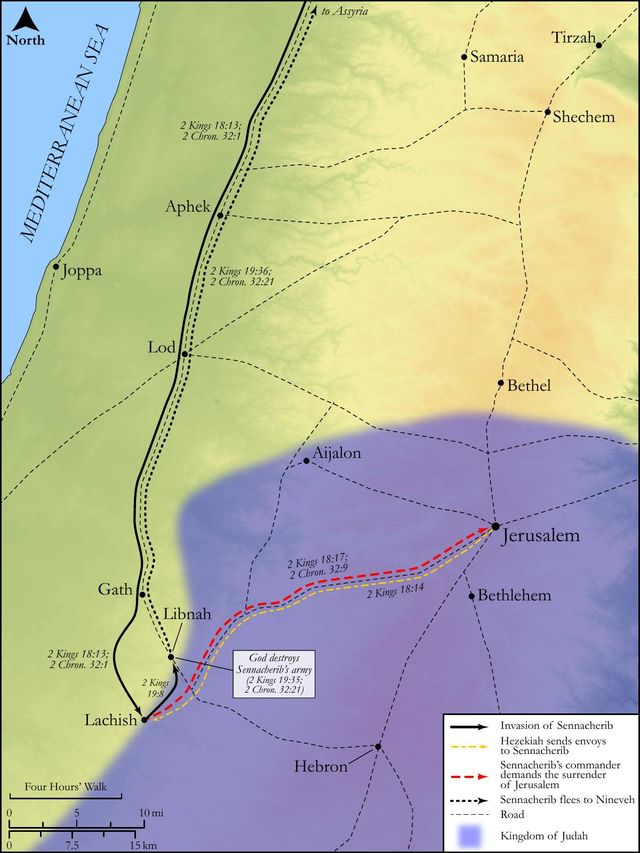
The events of 2 Kings 19:35 are precisely situated during the reign of King Hezekiah of Judah (c. 715-686 BC) and the Assyrian King Sennacherib (705-681 BC). Assyria was the preeminent superpower among the nations of that day, renowned for its brutal military campaigns, systematic deportation of conquered peoples, and highly effective siege warfare. Their vast empire stretched from Mesopotamia to Egypt, and they had already conquered the northern kingdom of Israel in 722 BC, subsequently annexing numerous cities in Judah. Sennacherib's campaign against Judah in 701 BC is recorded in the biblical account, which tells how the king of Assyria, after the angel of the LORD smote his camp, "departed, and went and returned, and dwelt at Nineveh." The Assyrian army was a professional, highly disciplined, and technologically advanced fighting force, and their encampment of 185,000 soldiers would have represented an overwhelming and seemingly unstoppable threat to Jerusalem, a city with limited defenses against such a massive force. The cultural context includes the widespread belief in national gods, where military victories were invariably attributed to the superior power of a nation's deity. Sennacherib's taunts were thus not merely political challenges but profoundly theological ones, directly challenging the supremacy of Yahweh, which made God's intervention all the more significant and necessary for His reputation among the nations.
Key Themes
ShowHideThis verse powerfully encapsulates several overarching themes woven throughout 2 Kings and the broader Old Testament narrative. Firstly, it highlights Divine Sovereignty and Deliverance, demonstrating God's absolute control over human history and His willingness to intervene miraculously to save His people, even against overwhelming odds. This reinforces the profound truth that "salvation belongs to the Lord," a theme echoed in Psalm 3:8 - Salvation Belongs to the Lord. Secondly, it underscores the Power of Prayer and Faith, as King Hezekiah's humble and fervent petition is met with immediate and dramatic divine action, illustrating God's profound responsiveness to the cries of His faithful. Thirdly, the event serves as a vivid portrayal of Divine Judgment against Arrogance and Blasphemy. Sennacherib's prideful defiance and contempt for Yahweh are met with swift and devastating retribution, a recurring theme throughout Scripture concerning those who oppose God, as seen in Proverbs 16:18 - Pride Goes Before Destruction. Finally, it powerfully reaffirms God's Faithfulness to His Covenant Promises, particularly His solemn promise to protect Jerusalem as His chosen city and the dwelling place of His name, a truth celebrated in Psalm 48 - God's Protection of Zion. The miraculous nature of the defeat emphasizes that God acts for His own name's sake, not merely for human merit or strength.
Exposition and Analysis
ShowHideKey Word Analysis
ShowHideMeaning "a messenger; specifically, of God, i.e. an angel (also a prophet, priest or teacher)." In this context, the "angel of the LORD" is not merely a messenger but the direct executor of God's judgment, demonstrating divine omnipotence and immediate intervention. The use of this specific title emphasizes that the destruction was not a natural disaster or a human act, but a direct, supernatural act of God, often understood as a pre-incarnate manifestation of Christ or a unique divine agent.
Meaning "to strike (lightly or severely, literally or figuratively); beat, cast forth, clap, give (wounds), kill, make (slaughter), murder, punish, slaughter, slay, smite, strike, wound." This verb is a strong and decisive term, indicating a forceful, destructive blow. It is used throughout the Old Testament to describe God's judgment, often in the context of inflicting plagues or military defeat (e.g., God striking Egypt in Exodus 12:12 - God Strikes Egypt). Here, it conveys the suddenness, completeness, and overwhelming power of the divine action, leaving no room for human resistance or survival.
Meaning "a carcase (as limp), whether of man or beast; figuratively, an idolatrous image." This term specifically refers to dead bodies, often those that are left unburied or are the result of a great slaughter. The repetition and starkness of "all dead corpses" emphasize the totality of the destruction. It highlights the absolute finality of God's judgment and the utter helplessness of the Assyrian army, who, despite their vast numbers and military might, were rendered lifeless and inert by a single divine act.
Verse Breakdown
ShowHide"And it came to pass that night"
This phrase immediately establishes the precise timing of the miraculous event. The deliverance was not a gradual process or a prolonged battle, but a sudden, overnight act, emphasizing the immediacy and supernatural nature of God's intervention. It highlights that while humans slept, God was actively at work, fulfilling His promise and demonstrating His sovereign control over time and circumstances.
"that the angel of the LORD went out"
This identifies the divine agent of destruction. The "angel of the LORD" is God's direct representative, acting with His full authority and power. "Went out" signifies a deliberate, purposeful mission from the divine presence, directly engaging with the enemy in their own territory. This action underscores God's personal involvement and commitment to His people's deliverance.
"and smote in the camp of the Assyrians"
This specifies the precise target and location of the divine judgment. The blow was directed with pinpoint accuracy at the very heart of the Assyrian military threat, their encampment, demonstrating God's precise aim and comprehensive reach. It was not a random act but a targeted strike against the blasphemous invaders who had defied Him.
"an hundred fourscore and five thousand"
This precise number, 185,000, underscores the immense scale of the destruction and the magnitude of the miracle. It was not a small skirmish but the annihilation of a vast army, a number that would have been virtually impossible for the small forces of Judah to overcome. The specificity lends historical weight and emphasizes the overwhelming nature of God's power and the completeness of the victory.
"and when they arose early in the morning, behold, they [were] all dead corpses"
This concluding clause vividly portrays the shocking aftermath and the discovery of the miracle. The phrase "when they arose early in the morning" implies the expectation of renewed hostilities or continued siege, only to be met with a stunning and horrifying reality. "Behold" draws the reader's attention to the astonishing sight, inviting awe and wonder. The repetition of "all dead corpses" emphasizes the completeness and finality of the destruction, leaving no survivors from the targeted force. The Assyrian threat was utterly neutralized, not by human might, but by divine decree.
Literary Devices
ShowHideThe narrative of 2 Kings 19:35 employs several powerful literary devices to convey its profound theological message. The most prominent is Hyperbole, or more accurately, Divine Magnification, where the immense number of casualties (185,000) serves to underscore the extraordinary scale of God's power and the absolute completeness of His victory, far beyond any human capability. The stark contrast between the overwhelming Assyrian military might and the single, silent act of the Angel of the LORD creates a profound sense of Irony: the seemingly invincible army is rendered utterly helpless and lifeless by an unseen, divine force. The suddenness of the event, occurring "that night," and its immediate discovery "early in the morning," creates a dramatic Juxtaposition of human anticipation (of continued siege) and shocking divine reality, amplifying the miraculous nature of the deliverance. Furthermore, the phrase "all dead corpses" functions as a powerful Repetition and Emphasis, leaving no doubt about the totality of the destruction and the finality of God's judgment. The entire scene functions as a Theophany (or Christophany, if the Angel of the LORD is interpreted as a pre-incarnate manifestation of Christ), where God's presence and omnipotent power are made manifest through a direct, supernatural act, serving as an undeniable demonstration of His sovereignty and unwavering faithfulness.
Theological and Thematic Connections
ShowHideThe miraculous deliverance of Jerusalem in 2 Kings 19:35 stands as a profound theological statement about the very nature of God. It affirms His absolute sovereignty over all earthly powers, empires, and rulers, and His unwavering faithfulness to His covenant promises made to His people and to the city of Jerusalem. This dramatic event demonstrates that God is not merely a distant observer of human affairs but an active, intervening deity who passionately defends His people and His honor. It highlights the utter futility of human arrogance, self-reliance, and reliance on military might when arrayed against the Almighty. The immediate and overwhelming nature of the judgment against Sennacherib's vast army serves as a powerful testament to God's perfect justice and His unwavering commitment to His chosen city and people. This narrative reinforces the foundational biblical truth that true security, ultimate salvation, and lasting peace come from the Lord alone, not from human strength, political alliances, or military prowess. It is a foundational account illustrating divine omnipotence, the efficacy of humble, believing prayer, and God's readiness to act decisively for His own glory.
Reflection and Application
ShowHideThe awe-inspiring account of the Assyrian defeat in 2 Kings 19:35 offers timeless and profoundly relevant lessons for believers today. In a world often characterized by overwhelming challenges, seemingly insurmountable threats, and a pervasive sense of helplessness, this narrative serves as a powerful anchor for our faith. It reminds us with undeniable clarity that no enemy, no matter how vast, formidable, or seemingly invincible, is beyond the reach of God's sovereign power. When we face "Assyrian armies" in our lives—whether they be personal struggles, overwhelming societal pressures, spiritual attacks, or even global crises—this passage encourages us to emulate King Hezekiah's exemplary response: to humble ourselves, bring our petitions before the Lord with fervent faith, and trust implicitly in His ability to deliver. It is a profound call to abandon self-reliance and place our complete confidence in God, knowing with certainty that He hears the cries of His people and acts decisively on their behalf, often in ways far beyond our comprehension. Furthermore, it serves as a sobering reminder of the inevitable consequences of pride and blasphemy against the Most High, urging us to walk in humility, reverence, and profound awe before the Lord. Ultimately, this passage cultivates a deep sense of worship for God's unparalleled power and a profound assurance in His unwavering faithfulness to those who call upon His name in truth and sincerity.
Questions for Reflection
ShowHideFAQ
ShowHideWas the number 185,000 literal, or is it symbolic?
ShowHideWhile some modern critical scholars debate the precise historicity of the number 185,000, the biblical text of 2 Kings 19:35 presents it as a literal figure, emphasizing the immense scale of the miraculous destruction. From a theological perspective, the exact number underscores the magnitude of God's power and the completeness of His intervention. Whether precisely 185,000 or a very large number, the narrative's intent is to highlight that the defeat was not a minor skirmish or a gradual retreat, but the instantaneous annihilation of a vast, formidable army by divine power. This event was so significant that it is also recorded in parallel in the book of Isaiah, specifically in Isaiah 37:36 - Parallel Account. The primary focus of the text is on the divine act itself and its overwhelming impact, rather than on providing a precise military census.
Who was the "angel of the LORD"?
ShowHideThe "angel of the LORD" (Hebrew: mal'akh Yahweh) is a highly significant and often mysterious figure throughout the Old Testament. This designation frequently refers to a divine messenger who acts with the full authority and power of God Himself, sometimes even appearing to be God or speaking as God. Many theologians interpret these appearances as Christophanies—pre-incarnate manifestations of Jesus Christ, the second person of the Trinity. Regardless of whether it was a created angel acting directly on God's behalf or a direct manifestation of God's presence, the key theological point is that the destruction of the Assyrian army was a direct, supernatural, and utterly decisive act of God, not a natural event or a human military action. This figure is consistently depicted as an agent of divine judgment and salvation, as seen in other pivotal contexts like the Passover in Egypt, where the "destroyer" (often identified with the angel of the Lord) struck the firstborn, as recorded in Exodus 12:23 - The Destroyer at Passover.
Why did God intervene so dramatically in this specific instance?
ShowHideGod intervened so dramatically in 2 Kings 19:35 for several crucial and interconnected reasons, demonstrating His character and purposes. Firstly, it was a direct and powerful answer to King Hezekiah's humble and fervent prayer, illustrating God's responsiveness to the faith of His people, as detailed in Hezekiah's prayer. Secondly, and perhaps most importantly, it was to defend His own honor, reputation, and unique sovereignty. Sennacherib had openly blasphemed Yahweh, comparing Him to the defeated, powerless gods of other nations, as recorded in Sennacherib's blasphemy. God's intervention was a powerful vindication of His unparalleled power and a clear declaration that He alone is the true God. Thirdly, it was to fulfill His covenant promises to protect Jerusalem and His chosen people, ensuring the continuation of the Davidic line from which the Messiah would ultimately come, a promise reiterated in God's promise to defend Jerusalem. This event served as an undeniable demonstration that Yahweh is the one true God, sovereign over all earthly kingdoms and their proud rulers.
Christ-Centered Fulfillment
ShowHideThe dramatic deliverance of Jerusalem in 2 Kings 19:35, orchestrated by the Angel of the LORD, finds its ultimate and infinitely greater fulfillment in the person and redemptive work of Jesus Christ. Just as the Angel of the LORD struck down a physical enemy to save God's people from temporal destruction, so Jesus, the true Angel of the Covenant and the very Son of God, came to confront and conquer humanity's ultimate and spiritual enemies: sin, death, and the devil. The vast Assyrian army, a seemingly insurmountable threat that held Jerusalem captive in fear, foreshadows the overwhelming power of spiritual darkness and the tyranny of sin that holds all humanity captive. Yet, through His sacrificial death on the cross and His glorious resurrection, Christ achieved a decisive and eternal victory, disarming the powers and authorities of darkness and triumphing over them by the cross Colossians 2:15 - Christ's Triumph over Powers. The "dead corpses" of the Assyrians point vividly to the spiritual death from which only Christ can deliver, offering new life, spiritual resurrection, and eternal hope to all who believe in Him Ephesians 2:1-5 - Dead in Sins, Made Alive in Christ. Moreover, just as God miraculously defended His earthly city, Jerusalem, Christ establishes and perfectly protects His spiritual city, the Church, against which the very gates of hell will not prevail Matthew 16:18 - The Church Built on the Rock. The miraculous intervention in 2 Kings 19:35 is a powerful testament to God's saving power, a power fully and finally revealed in the person of Jesus, who delivers us not merely from an earthly army or temporal peril, but from eternal condemnation, bringing us into His glorious and eternal kingdom Colossians 1:13-14 - Delivered from Darkness into Light.