


2 Chronicles 32:22
- וַיּוֹשַׁעvai·yo·Sha'and he savedH3467Conj-w ¦ V-Hiphil-ConsecImperf-3msVerb Hiphil Consecutive Imperfect 3rd Singular Masculineוַandיּוֹשַׁעhe saved
- יְהוָהYah·wehYahwehH3068N-properNoun Proper Title
- אֶת'et<obj.>H853DirObjMParticle Object Indicator
- יְחִזְקִיָּהוּye·chiz·ki·Ya·huHezekiahH2396N-proper-mNoun Proper Masculine
- וְאֵתve·'Etand <obj.>H853Conj-w ¦ DirObjMParticle Object Indicatorוְandאֵת<obj.>
- יֹשְׁבֵיyo·she·Vei[the] inhabitants ofH3427V-Qal-Prtcpl-mpVerb Qal Participle Plural Masculine Construct
- יְרוּשָׁלִַםye·ru·sha·LimJerusalemH3389N-properNoun Proper Location
- מִיַּדmi·Yadfrom [the] hand ofH3027Prep-m ¦ N-cscNoun Singular common gender Constructמִfromיַּד[the] hand of
- סַנְחֵרִיבsan·che·RivSennacheribH5576N-proper-mNoun Proper Masculine
- מֶלֶךְMe·lekh[the] king ofH4428N-mscNoun Singular Masculine Construct
- אַשּׁוּר'a·ShurAssyriaH804N-properNoun Proper Location
- וּמִיַּדu·mi·yadand from [the] hand ofH3027Conj-w ¦ Prep-m ¦ N-cscNoun Singular common gender Constructוּandמִfromיַּד[the] hand of
- כֹּלKoleveryoneH3605N-msNoun Singular Masculine Absolute
- וַיְנַהֲלֵםvay·na·ha·Lemand he led themH5095Conj-w ¦ V-Piel-ConsecImperf-3ms ¦ 3mpVerb Piel Consecutive Imperfect 3rd Singular Masculineוַandיְנַהֲלֵhe ledםthem
- מִסָּבִיבmi·sa·Vivfrom round aboutH5439Prep-m ¦ N-csNoun Singular common gender Absoluteמִfromסָּבִיבround about
English is a literal word-by-word gloss of the Hebrew, not the KJV's wording. Why?
This is the original text the KJV's translators worked from — each Hebrew word with its own literal English meaning in this verse, prepared by scholars at Tyndale House, Cambridge. The KJV translates whole sentences, not word by word, so its wording differs: one Hebrew word can become several English words, and the KJV may choose “the LORD” where the gloss reads “Yahweh”. Both are faithful — they answer different questions. For the KJV's own rendering, switch to the KJV text.
Details
See on the biblical-era map
Study this verse
Public-domain commentary
Matthew Henry
From his Commentary on the Whole Bible. Henry comments on passages, not single verses — this entry covers 2 Chronicles 32:9–23. His three-level outline is real structure in the source text, so it is rendered as structure.
This story of the rage and blasphemy of Sennacherib, Hezekiah's prayer, and the deliverance of Jerusalem by the destruction of the Assyrian army, we had more at large in the book of Kings, 2 Kings 18 and 19. It is contracted here, yet large enough to show these three things: -
I.The impiety and malice of the church's enemies.
Sennacherib has his hands full in besieging Lachish (Ch2 32:9), but hears that Hezekiah is fortifying Jerusalem and encouraging his people to stand it out; and therefore, before he come in person to besiege it, he sends messengers to make speeches, and he himself writes letters to frighten Hezekiah and his people into a surrender of the city. See,
1.His great malice against the king of Judah, in endeavouring to withdraw his subjects from their allegiance to him. He did not treat with Hezekiah as a man of honour would have done, nor propose fair terms to him, but used mean and base artifices, unbecoming a crowned head, to terrify the common people and persuade them to desert him. he represented Hezekiah as one who designed to deceive his subjects into their ruin and betray them to famine and thirst (Ch2 32:11), as one who had done them great wrong and exposed them already to the divine displeasure by taking away the high places and altars (Ch2 32:12), and who, against the common interest of his people, held out against a force that would certainly be their ruin, Ch2 32:15.
2.His great impiety against the God of Israel, the God of Jerusalem he is called (Ch2 32:19), because that was the place he had chosen to put his name there, and because that was the place which was now threatened by the enemy and which the divine Providence had under its special protection. This proud blasphemer compared the great Jehovah, the Maker of heaven and earth, with the dunghill gods of the nations, the work of men's hands, and thought him no more able to deliver his worshippers than they were to deliver theirs (Ch2 32:19), as if an infinite and eternal Spirit had no more wisdom and power than a stone or the stock of a tree. He boasted of his triumphs over the gods of the nations, that they could none of them protect their people (Ch2 32:13-15), and thence inferred not only, How shall your God deliver you? (Ch2 32:14), but, as if he were inferior to them all, How much less shall your God deliver you? as if he were less able to help than any of them. Thus did they rail, rail in writing (which, being more deliberate, is so much the worse), on the Lord God of Israel, as if he were a cipher and an empty name, like all the rest, Ch2 32:17. Sennacherib, in the instructions he gave, said more than enough; but, as if his blasphemies had been too little, his servants, who learned insolence from their master, spoke yet more than he bade them against the Lord God and his servant Hezekiah, Ch2 32:16. And God resents what is said against his servants, and will reckon for it, as well as what is said against himself. All this was intended to frighten the people from their hope in God, which David's enemies sought to take him off from (Psa 11:1; Psa 42:10), saying, There is no help for him in God, Psa 3:2; Psa 71:11. Thus they hoped to take the city by weakening the hands of those that should defend it. Satan, in his temptations, aims to destroy our faith in God's all-sufficiency, knowing that he shall gain his point if he can do that; as we keep our ground if our faith fail not, Luk 22:32.
II.The duty as well as the interest of the church's friends, and that is in the day of distress to pray and cry to Heaven.
So Hezekiah did, and the prophet Isaiah, Ch2 32:20. It was a happy time when the king and the prophet joined thus in prayer. Is any troubled? Is any terrified? Let him pray. So we engage God for us; so we encourage ourselves in him. Praying to God is here called crying to Heaven, because we are, in prayer, to eye him as our Father in heaven, whence he beholds the children of men, and where he has prepared his throne.
III.The power and goodness of the church's God.
He is able both to control his enemies, be they ever so high, and to relieve his friends, be they ever so low.
1.As the blasphemies of his enemies engage him against them (Deu 32:27), so the prayers of his people engage him for them. They did so here.
(1.)The army of the Assyrians was cut off by the sword of an angel, which triumphed particularly in the slaughter of the mighty men of valour, and the leaders and captains, who defied the sword of any man. God delights to abase the proud and secure. The Targum says, The Word of the Lord (the eternal Word) sent Gabriel to do this execution, and that it was done with lightning, and in the passover night: that was the night in which the angel destroyed the first-born of Egypt. But that was not all.
(2.)The king of the Assyrians, having received this disgrace, was cut off by the sword of his own sons. Those that came forth of his own bowels slew him, Ch2 32:21. Thus was he mortified first, and then murdered - shamed first, and then slain. Evil pursues sinners; and, when they escape one mischief, they run upon another unseen.
2.By this work of wonder,
(1.)God was glorified, as the protector of his people. Thus he saved Jerusalem, not only from the hand of Sennacherib, but from the hand of all others, Ch2 32:22; for such a deliverance as this was an earnest of much mercy in store; and he guided them, that is, he guarded them, on every side. God defends his people by directing them, shows them what they should do, and so saves them from what is designed or done against them. For this many brought gifts unto the Lord, when they saw the great power of God in the defence of his people. Strangers were thereby induced to supplicate his favour and enemies to deprecate his wrath, and both brought gifts to his temple, in token of their care and desire.
(2.)Hezekiah was magnified as the favourite and particular care of Heaven. Many brought presents to him (Ch2 32:22, Ch2 32:23), in token of the honour they had for him, and to make an interest in him. By the favour of God enemies are lost and friends gained.
Continue studying 2 Chronicles 32:22 across the web’s major study libraries — every link below opens this exact verse, chapter, or book on the destination site.
Read & Compare
 BibleGatewayThis verse in more than 200 translations and 70 languages.
 Bible.comThe YouVersion reader — hundreds of translations, reading plans, and highlights.
 ESV.orgCrossway's official English Standard Version reader.
 NET BibleThe NET translation with 60,000+ translators' notes on every rendering decision.
 STEP BibleTyndale House's free study tool — original text, vocabulary, and scholarly resources.
 BibliaLogos Bible Software's free web reader.
 USCCBThe New American Bible (Revised Edition) with the U.S. bishops' study notes.
Commentaries
 BibleHub CommentariesDozens of classic commentaries on this verse, gathered on one page.
 StudyLightMore than 100 commentary sets — the largest collection on the web.
 BibleRefPlain-English commentary on what this verse means, verse by verse.
 Enduring WordDavid Guzik's free commentary on this chapter, widely used by Bible teachers.
 Bible Study ToolsVerse commentary alongside Greek and Hebrew study aids.
Original Language & Research
- BibleHub InterlinearThe verse word by word — original language, transliteration, and English.
- BibleHub LexiconEvery word's original-language definition and Strong's entry.
 Blue Letter BibleDeep-study tools — Strong's numbers, concordance, and word studies.
 SefariaThe Hebrew text with Rashi and centuries of Jewish commentary.
Sermons, Hymns & Audio


TrulyRandomVerse is not affiliated with these sites and doesn’t control their content. They’re linked because they’re genuinely useful.
Summary
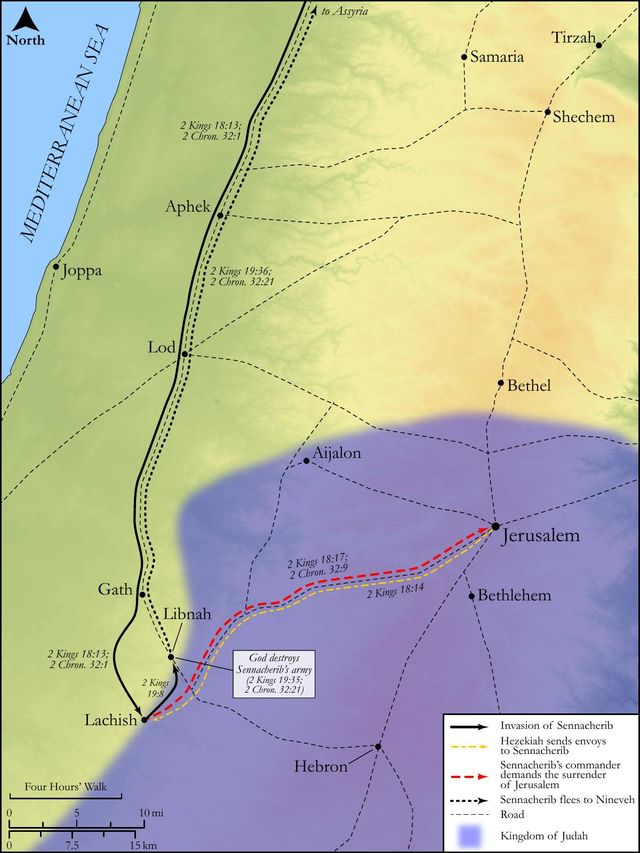
Second Chronicles 32:22 serves as a powerful declaration of Yahweh's decisive and comprehensive intervention, detailing how the LORD miraculously delivered King Hezekiah and the inhabitants of Jerusalem from the overwhelming military might of Sennacherib, the king of Assyria. This pivotal verse not only highlights God's immediate salvation from an existential threat but also underscores His ongoing, pervasive protection and guidance from all other adversaries, thereby affirming His supreme sovereignty, unwavering faithfulness, and providential care for His people.
Context
ShowHideLiterary Context
This verse provides the climactic summary of Judah's miraculous deliverance from the Assyrian invasion, concluding the dramatic narrative presented in 2 Chronicles 32. The preceding verses meticulously detail Sennacherib's formidable campaign, his successful capture of fortified cities in Judah, and his subsequent siege of Jerusalem. Crucially, the narrative emphasizes Sennacherib's arrogant and blasphemous taunts, challenging the LORD's power and equating Him with the defeated gods of other nations (2 Chronicles 32:9-19). In response to this existential threat and direct challenge to divine honor, King Hezekiah and the prophet Isaiah fervently prayed to God (2 Chronicles 32:20). Immediately following their supplication, the narrative records the astonishing, supernatural intervention of the Angel of the LORD, who annihilated the vast Assyrian army overnight (2 Chronicles 32:21). Therefore, 2 Chronicles 32:22 functions as the definitive statement of this divine triumph, setting the stage for Hezekiah's subsequent prosperity and the enduring theological lessons derived from this pivotal event.
Historical & Cultural Context
The events described in 2 Chronicles 32 occurred during the reign of King Hezekiah (c. 715-686 BC), specifically around 701 BC. At this time, the Neo-Assyrian Empire, under the formidable King Sennacherib, stood as the dominant superpower in the ancient Near East, renowned for its ruthless military campaigns, systematic deportations, and the brutal destruction of conquered cities. Sennacherib's own annals boast of his conquests, including the capture of 46 fortified cities of Judah and the siege of Jerusalem, where he claimed to have "imprisoned Hezekiah... like a bird in a cage." Jerusalem was the last remaining stronghold, and its fall seemed inevitable, mirroring the fate of the Northern Kingdom of Israel decades earlier (2 Kings 17:5-6). Culturally, the Assyrian king's taunts were strategically designed to erode the confidence of Jerusalem's inhabitants in their God, suggesting that Yahweh was no more powerful than the defeated deities of other nations. This dire historical backdrop underscores the sheer human impossibility of Jerusalem's survival, making God's intervention a profound and undeniable demonstration of His unique power, covenant faithfulness, and sovereignty over all earthly empires.
Key Themes
ShowHideThe central theme powerfully articulated by 2 Chronicles 32:22 is Divine Deliverance. This was not a victory achieved through Judah's military prowess or strategic cunning, but through God's direct, supernatural action, emphasizing His absolute sovereignty over earthly powers and His unparalleled ability to save against overwhelming odds. Closely intertwined is the theme of God's Faithfulness to His Covenant. Despite the dire circumstances and the Assyrian king's blasphemous arrogance, God remained faithful to His promises to protect His chosen city, Jerusalem, and His people who trusted in Him, reinforcing the enduring covenant established with David (2 Samuel 7:12-16). The narrative also powerfully illustrates the Power of Prayer, as the deliverance was a direct and immediate answer to the fervent supplications of Hezekiah and Isaiah (2 Chronicles 32:20). Finally, the concluding phrase "and guided them on every side" introduces the theme of Comprehensive Divine Protection and Guidance, suggesting that God's care extends beyond immediate crises to encompass ongoing, holistic provision and security for His people in all circumstances.
Exposition and Analysis
ShowHideKey Word Analysis
ShowHideThis is the proper name of God, Yahweh (H3068), derived from the root "to be" (הָיָה), signifying "the Self-Existent or Eternal One." Its use here emphatically identifies the agent of salvation as the covenant God of Israel, distinguishing Him from the impotent gods of other nations and underscoring His unique power and faithfulness to His people.
The verb (H3467) means "to be open, wide or free," and by implication, "to be safe," "to free or succor," or "to bring salvation." In this context, it signifies a complete and decisive act of liberation from a dire, life-threatening situation. The Piel perfect form emphasizes the completed and effective nature of this divine act, highlighting God's role as the ultimate rescuer and deliverer.
This verb (H5095) means "to run with a sparkle," hence "to flow," and transitively, "to conduct," "to protect," or "to sustain." Its application here extends beyond mere rescue, indicating God's ongoing, active superintendence and provision for His people after the immediate crisis. It suggests that God not only removed the threat but continued to shepherd, direct, and sustain them, ensuring their well-being and security.
This adverbial phrase (H5439) literally means "around," "on all sides," or "in every direction." When combined with "guided," it conveys a profound sense of comprehensive and pervasive protection. It indicates that God's care was not limited to one specific threat or direction but encompassed all potential dangers, providing an all-encompassing shield and ensuring the safety and security of Jerusalem from every quarter.
Verse Breakdown
ShowHide"Thus the LORD saved Hezekiah and the inhabitants of Jerusalem"
This opening clause unequivocally identifies the agent of salvation as "the LORD" (Yahweh), the covenant God of Israel, thereby discrediting any notion that human strength, military strategy, or political maneuvering was responsible for the deliverance. The beneficiaries are clearly stated as King Hezekiah, representing the leadership and the Davidic dynasty, and "the inhabitants of Jerusalem," signifying the entire community residing in the capital. This highlights the miraculous nature of the deliverance, emphasizing that it was a divine act of rescue from an otherwise insurmountable foe.
"from the hand of Sennacherib the king of Assyria"
This specifies the immediate, formidable, and humanly overwhelming threat. The phrase "the hand of" is a common biblical idiom representing power, authority, control, and destructive intent. Thus, God saved them from the overwhelming might, dominion, and destructive purpose of the most powerful earthly ruler of their time, underscoring the LORD's absolute supremacy over all human empires and their boasts.
"and from the hand of all [other]"
This phrase significantly broadens the scope of God's deliverance beyond the specific, immediate threat posed by Sennacherib. The bracketed "[other]" in the KJV clarifies that God's salvation extended to protection from any and all other potential enemies, adversaries, or dangers that might arise in the future. This emphasizes the completeness and totality of God's protective care, implying that His deliverance was not a one-off event but a comprehensive safeguard against all forms of opposition.
"and guided them on every side"
This final clause moves beyond mere rescue to describe God's ongoing, holistic providence and care. The word "guided" implies active leadership, direction, and sustained provision, while "on every side" signifies an all-encompassing, pervasive protection. It assures the reader that God's care for His people was not limited to the moment of crisis but extended to their sustained well-being, providing security, peace, and direction from all directions and against all future threats, ensuring their flourishing.
Literary Devices
ShowHideThe verse employs several impactful literary devices to convey its profound theological message. Contrast is prominently featured, juxtaposing the overwhelming earthly power and terrifying might of Sennacherib and his vast army with the singular, decisive, and effortless power of the LORD. This highlights the futility of human strength and arrogance when confronted with divine omnipotence. The repeated phrase "from the hand of" (used in relation to Sennacherib and "all other") functions as a form of Anaphora or Parallelism, emphasizing both the source of the initial threat and God's comprehensive power to deliver from any and all such sources, past, present, or future. Furthermore, "the hand of Sennacherib" is an example of Metonymy, where "hand" stands for the power, authority, and oppressive force of the king, representing his entire military and political might. Finally, the concluding phrase "guided them on every side" uses Hyperbole to convey the absolute and pervasive nature of God's protection, suggesting a level of comprehensive care and security that transcends ordinary human experience and capability.
Theological and Thematic Connections
ShowHideThe profound truth of 2 Chronicles 32:22 resonates deeply with core biblical theology, affirming God's unwavering sovereignty, His covenant faithfulness, and His active, providential involvement in the affairs of His people. It serves as a powerful testament to the fact that divine deliverance is not contingent on human strength, strategic prowess, or numerical superiority, but solely on God's omnipotence and His unyielding commitment to those who trust in Him. This narrative reinforces the theme of God as a mighty warrior (Exodus 15:3) and an unassailable refuge for His people (Psalm 46:1), demonstrating that even in the face of seemingly insurmountable odds, His power is more than sufficient to save. It underscores the vital importance of prayer and humble reliance on God, as Hezekiah's fervent supplication was met with a miraculous display of divine might. This event became a foundational narrative for future generations, reminding them of God's unique ability to protect His chosen city and people, echoing His promise to never leave or forsake them (Deuteronomy 31:6).
Reflection and Application
ShowHideThe historical account of God's miraculous deliverance in 2 Chronicles 32:22 offers profound encouragement and timeless principles for believers today. In a world often characterized by overwhelming challenges, personal crises, and societal anxieties, this verse reminds us that our ultimate security and hope rest not in human institutions, economic stability, or military might, but in the sovereign power of God. Just as Hezekiah faced a "Sennacherib" that threatened to consume him and his people, we too encounter formidable adversaries—whether they be spiritual battles, financial distress, health crises, relational brokenness, or existential fears. This passage calls us to emulate Hezekiah's posture of humble prayer and unwavering trust, recognizing that God is capable of turning impossible situations into powerful testimonies of His faithfulness. The assurance that God "guided them on every side" extends beyond a singular act of rescue; it speaks to His comprehensive, ongoing providence in every aspect of our lives, offering peace and stability in an uncertain world. It invites us to surrender our fears and anxieties to the One who is truly our refuge, strength, and ever-present help, knowing that His protective hand encompasses all our circumstances.
Questions for Reflection
ShowHideFAQ
ShowHideWhy did God intervene so dramatically for Hezekiah and Jerusalem?
ShowHideGod's dramatic intervention was multifaceted. Primarily, it was a profound demonstration of His covenant faithfulness to His people and to the Davidic line, ensuring the preservation of the lineage through which the Messiah would ultimately come. Jerusalem was also His chosen city, where His temple resided, and its protection was vital to His redemptive plan for humanity. Furthermore, it was a powerful response to Hezekiah's righteous leadership and fervent prayer in conjunction with Isaiah (2 Chronicles 32:20), showcasing God's responsiveness to the humble and trusting supplication of His servants. Finally, it served as a decisive demonstration of God's sovereignty over all pagan nations and their false gods, publicly shaming Sennacherib's blasphemous boasts and affirming Yahweh as the one true and living God who alone controls the destinies of nations.
What does "guided them on every side" imply beyond immediate salvation?
ShowHideThe phrase "guided them on every side" (KJV) or "gave them rest on every side" (ESV/NIV) implies a comprehensive and sustained divine providence that extends far beyond the immediate rescue from Sennacherib. It suggests that God's care was not a one-time event but an ongoing, holistic, and protective oversight. This encompasses not only protection from external enemies and future threats but also His active leadership, direction, and sustenance in their daily lives, ensuring their well-being, peace, and security in every aspect. It speaks to God's continuous oversight and His unwavering commitment to providing for His people's needs and guiding them through all circumstances, ensuring their flourishing in the land and their ultimate security in His presence.
Christ-Centered Fulfillment
ShowHideThe miraculous deliverance of Hezekiah and Jerusalem from the "hand of Sennacherib" in 2 Chronicles 32:22 serves as a powerful Old Testament type and shadow, pointing forward to the ultimate and complete salvation accomplished through Jesus Christ. Just as God supernaturally intervened to save His people from an overwhelming earthly foe, so too did He intervene in human history through the incarnation, life, atoning death, and glorious resurrection of His Son to deliver humanity from a far greater and more pervasive enemy: sin, death, and the dominion of Satan. Jesus is the true Lamb of God, who takes away the sin of the world, offering a definitive and eternal victory that transcends any temporal military triumph. He is the Good Shepherd who not only rescues His sheep from danger but also "guides them on every side," leading them beside still waters, restoring their souls, and guiding them through the valley of the shadow of death, providing comprehensive and eternal protection. The salvation offered through Christ is not merely a rescue from an external threat but a spiritual redemption and reconciliation that brings profound peace with God and the promise of eternal life. In Him, believers find refuge from the spiritual "Sennacheribs" of this world, experiencing the comprehensive guidance and ultimate security of the new covenant that promises victory over every adversary and the assurance of His abiding presence (Matthew 28:20).