


2 Chronicles 32:23
- וְרַבִּיםVe·ra·bimand many [people]H7227Conj-w ¦ Adj-mpAdjective Plural Masculine Absoluteוְandרַבִּיםmany [people]
- מְבִיאִיםme·vi·'Im[were] bringingH935V-Hiphil-Prtcpl-mpVerb Hiphil Participle Plural Masculine Absolute
- מִנְחָהmin·Chahan offeringH4503N-fsNoun Singular Feminine Absolute
- לַיהוָהla·Yah·wehto YahwehH3068Prep-l ¦ N-properNoun Proper TitleלַtoיהוָהYahweh
- לִירוּשָׁלִַםli·Ru·sha·Limto JerusalemH3389Prep-l ¦ N-properNoun Proper LocationלִtoירוּשָׁלִַםJerusalem
- וּמִגְדָּנוֹתu·Mig·da·Notand excellent thingsH4030Conj-w ¦ N-fpNoun Plural Feminine Absoluteוּandמִגְדָּנוֹתexcellent things
- לִיחִזְקִיָּהוּli·chiz·ki·Ya·huto HezekiahH2396Prep-l ¦ N-proper-mNoun Proper MasculineלִtoיחִזְקִיָּהוּHezekiah
- מֶלֶךְMe·lekh[the] king ofH4428N-mscNoun Singular Masculine Construct
- יְהוּדָהye·hu·DahJudahH3063N-properNoun Proper Location
- וַיִּנַּשֵּׂאvai·yin·na·Se'and he was lifted upH5375Conj-w ¦ V-Niphal-ConsecImperf-3msVerb Niphal Consecutive Imperfect 3rd Singular Masculineוַandיִּנַּשֵּׂאhe was lifted up
- לְעֵינֵיle·'ei·Neito [the] eyes ofH5869Prep-l ¦ N-fdcNoun Dual Feminine Constructלְtoעֵינֵי[the] eyes of
- כָלkholallH3605N-mscNoun Singular Masculine Construct
- הַגּוֹיִםha·go·Yimthe nationsH1471Art ¦ N-mpNoun Plural Masculine Absoluteהַtheגּוֹיִםnations
- מֵאַחֲרֵיme·'a·cha·reifrom afterH310Prep-m ¦ Adj-mpcAdjective Numerical Plural Masculine Constructמֵfromאַחֲרֵיafter
- כֵןKhenthusH3651AdvAdverb
English is a literal word-by-word gloss of the Hebrew, not the KJV's wording. Why?
This is the original text the KJV's translators worked from — each Hebrew word with its own literal English meaning in this verse, prepared by scholars at Tyndale House, Cambridge. The KJV translates whole sentences, not word by word, so its wording differs: one Hebrew word can become several English words, and the KJV may choose “the LORD” where the gloss reads “Yahweh”. Both are faithful — they answer different questions. For the KJV's own rendering, switch to the KJV text.
Details
See on the biblical-era map
Study this verse
Public-domain commentary
Matthew Henry
From his Commentary on the Whole Bible. Henry comments on passages, not single verses — this entry covers 2 Chronicles 32:9–23. His three-level outline is real structure in the source text, so it is rendered as structure.
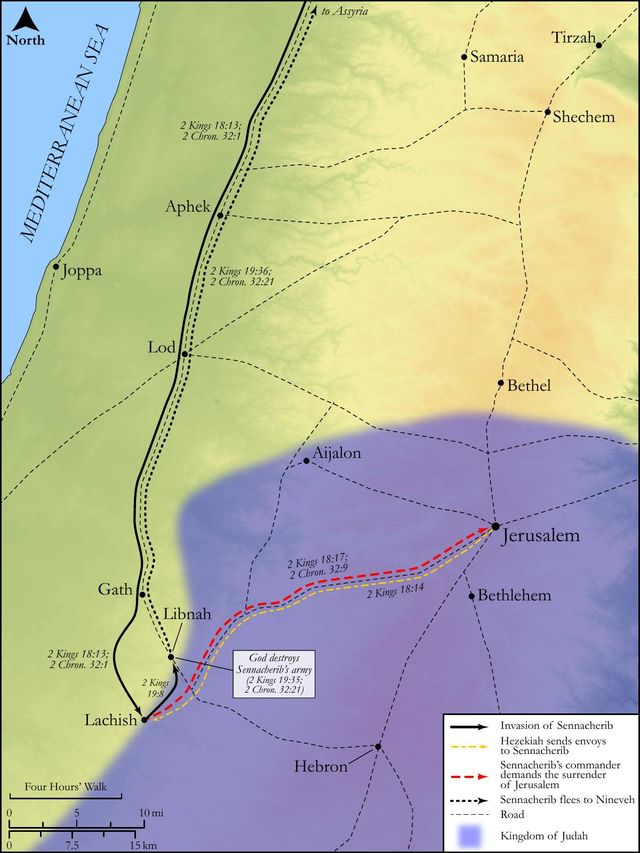
This story of the rage and blasphemy of Sennacherib, Hezekiah's prayer, and the deliverance of Jerusalem by the destruction of the Assyrian army, we had more at large in the book of Kings, 2 Kings 18 and 19. It is contracted here, yet large enough to show these three things: -
I.The impiety and malice of the church's enemies.
Sennacherib has his hands full in besieging Lachish (Ch2 32:9), but hears that Hezekiah is fortifying Jerusalem and encouraging his people to stand it out; and therefore, before he come in person to besiege it, he sends messengers to make speeches, and he himself writes letters to frighten Hezekiah and his people into a surrender of the city. See,
1.His great malice against the king of Judah, in endeavouring to withdraw his subjects from their allegiance to him. He did not treat with Hezekiah as a man of honour would have done, nor propose fair terms to him, but used mean and base artifices, unbecoming a crowned head, to terrify the common people and persuade them to desert him. he represented Hezekiah as one who designed to deceive his subjects into their ruin and betray them to famine and thirst (Ch2 32:11), as one who had done them great wrong and exposed them already to the divine displeasure by taking away the high places and altars (Ch2 32:12), and who, against the common interest of his people, held out against a force that would certainly be their ruin, Ch2 32:15.
2.His great impiety against the God of Israel, the God of Jerusalem he is called (Ch2 32:19), because that was the place he had chosen to put his name there, and because that was the place which was now threatened by the enemy and which the divine Providence had under its special protection. This proud blasphemer compared the great Jehovah, the Maker of heaven and earth, with the dunghill gods of the nations, the work of men's hands, and thought him no more able to deliver his worshippers than they were to deliver theirs (Ch2 32:19), as if an infinite and eternal Spirit had no more wisdom and power than a stone or the stock of a tree. He boasted of his triumphs over the gods of the nations, that they could none of them protect their people (Ch2 32:13-15), and thence inferred not only, How shall your God deliver you? (Ch2 32:14), but, as if he were inferior to them all, How much less shall your God deliver you? as if he were less able to help than any of them. Thus did they rail, rail in writing (which, being more deliberate, is so much the worse), on the Lord God of Israel, as if he were a cipher and an empty name, like all the rest, Ch2 32:17. Sennacherib, in the instructions he gave, said more than enough; but, as if his blasphemies had been too little, his servants, who learned insolence from their master, spoke yet more than he bade them against the Lord God and his servant Hezekiah, Ch2 32:16. And God resents what is said against his servants, and will reckon for it, as well as what is said against himself. All this was intended to frighten the people from their hope in God, which David's enemies sought to take him off from (Psa 11:1; Psa 42:10), saying, There is no help for him in God, Psa 3:2; Psa 71:11. Thus they hoped to take the city by weakening the hands of those that should defend it. Satan, in his temptations, aims to destroy our faith in God's all-sufficiency, knowing that he shall gain his point if he can do that; as we keep our ground if our faith fail not, Luk 22:32.
II.The duty as well as the interest of the church's friends, and that is in the day of distress to pray and cry to Heaven.
So Hezekiah did, and the prophet Isaiah, Ch2 32:20. It was a happy time when the king and the prophet joined thus in prayer. Is any troubled? Is any terrified? Let him pray. So we engage God for us; so we encourage ourselves in him. Praying to God is here called crying to Heaven, because we are, in prayer, to eye him as our Father in heaven, whence he beholds the children of men, and where he has prepared his throne.
III.The power and goodness of the church's God.
He is able both to control his enemies, be they ever so high, and to relieve his friends, be they ever so low.
1.As the blasphemies of his enemies engage him against them (Deu 32:27), so the prayers of his people engage him for them. They did so here.
(1.)The army of the Assyrians was cut off by the sword of an angel, which triumphed particularly in the slaughter of the mighty men of valour, and the leaders and captains, who defied the sword of any man. God delights to abase the proud and secure. The Targum says, The Word of the Lord (the eternal Word) sent Gabriel to do this execution, and that it was done with lightning, and in the passover night: that was the night in which the angel destroyed the first-born of Egypt. But that was not all.
(2.)The king of the Assyrians, having received this disgrace, was cut off by the sword of his own sons. Those that came forth of his own bowels slew him, Ch2 32:21. Thus was he mortified first, and then murdered - shamed first, and then slain. Evil pursues sinners; and, when they escape one mischief, they run upon another unseen.
2.By this work of wonder,
(1.)God was glorified, as the protector of his people. Thus he saved Jerusalem, not only from the hand of Sennacherib, but from the hand of all others, Ch2 32:22; for such a deliverance as this was an earnest of much mercy in store; and he guided them, that is, he guarded them, on every side. God defends his people by directing them, shows them what they should do, and so saves them from what is designed or done against them. For this many brought gifts unto the Lord, when they saw the great power of God in the defence of his people. Strangers were thereby induced to supplicate his favour and enemies to deprecate his wrath, and both brought gifts to his temple, in token of their care and desire.
(2.)Hezekiah was magnified as the favourite and particular care of Heaven. Many brought presents to him (Ch2 32:22, Ch2 32:23), in token of the honour they had for him, and to make an interest in him. By the favour of God enemies are lost and friends gained.
Continue studying 2 Chronicles 32:23 across the web’s major study libraries — every link below opens this exact verse, chapter, or book on the destination site.
Read & Compare
 BibleGatewayThis verse in more than 200 translations and 70 languages.
 Bible.comThe YouVersion reader — hundreds of translations, reading plans, and highlights.
 ESV.orgCrossway's official English Standard Version reader.
 NET BibleThe NET translation with 60,000+ translators' notes on every rendering decision.
 STEP BibleTyndale House's free study tool — original text, vocabulary, and scholarly resources.
 BibliaLogos Bible Software's free web reader.
 USCCBThe New American Bible (Revised Edition) with the U.S. bishops' study notes.
Commentaries
 BibleHub CommentariesDozens of classic commentaries on this verse, gathered on one page.
 StudyLightMore than 100 commentary sets — the largest collection on the web.
 BibleRefPlain-English commentary on what this verse means, verse by verse.
 Enduring WordDavid Guzik's free commentary on this chapter, widely used by Bible teachers.
 Bible Study ToolsVerse commentary alongside Greek and Hebrew study aids.
Original Language & Research
- BibleHub InterlinearThe verse word by word — original language, transliteration, and English.
- BibleHub LexiconEvery word's original-language definition and Strong's entry.
 Blue Letter BibleDeep-study tools — Strong's numbers, concordance, and word studies.
 SefariaThe Hebrew text with Rashi and centuries of Jewish commentary.
Sermons, Hymns & Audio


TrulyRandomVerse is not affiliated with these sites and doesn’t control their content. They’re linked because they’re genuinely useful.
Summary
Following the miraculous and decisive defeat of the formidable Assyrian army by divine intervention, 2 Chronicles 32:23 vividly portrays the widespread recognition and honor bestowed upon King Hezekiah and, more profoundly, upon the God of Israel. This verse details how numerous nations, having witnessed or heard of YHWH's unparalleled power demonstrated in Jerusalem's deliverance, brought tribute and gifts, thereby acknowledging both Hezekiah's divinely-ordained authority and the supreme sovereignty of the Lord, resulting in His name being greatly exalted among the peoples of the earth.
Context
ShowHideLiterary Context
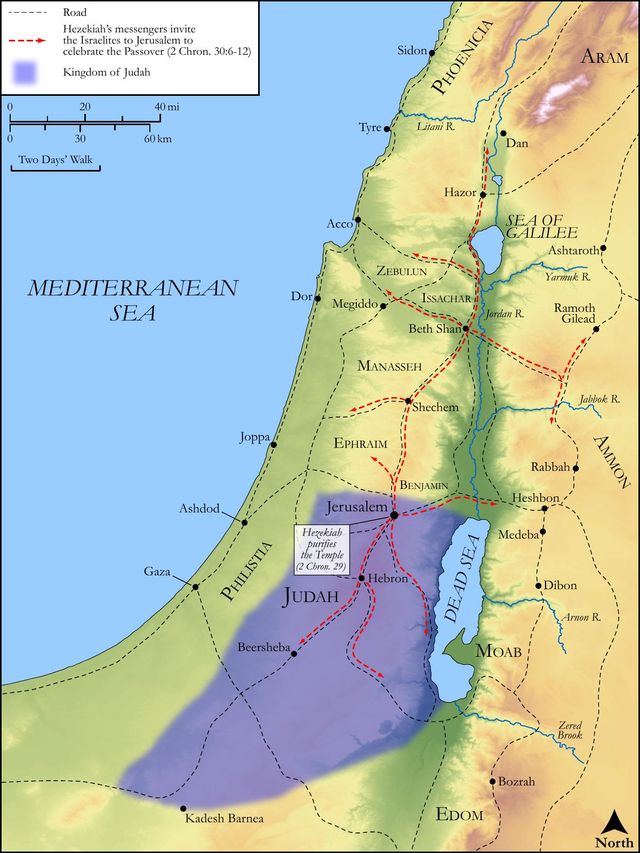
This verse serves as the immediate and profound consequence of the miraculous deliverance of Jerusalem from the overwhelming Assyrian siege under Sennacherib, as recounted in 2 Chronicles 32:20-22. After King Hezekiah and the prophet Isaiah cried out to God in fervent prayer, the Angel of the LORD struck down 185,000 Assyrian soldiers in a single night, leading to Sennacherib's humiliated retreat and subsequent assassination. Verse 23, therefore, marks the triumphant climax of this narrative arc, showcasing the international recognition of God's power and Hezekiah's righteous leadership. It immediately precedes Hezekiah's personal crisis of illness and miraculous recovery (2 Chr 32:24-26), and the subsequent account of his immense wealth and building projects (2 Chr 32:27-30), all of which are presented by the Chronicler as further evidence of God's blessing and favor upon him and Judah. The Chronicler meticulously emphasizes that this global acknowledgment was a direct and undeniable result of YHWH's mighty, supernatural act.
Historical & Cultural Context
The events described in 2 Chronicles 32 occurred around 701 BC, a period dominated by the Neo-Assyrian Empire, which was renowned for its brutal military campaigns, vast territorial control, and systematic subjugation of conquered peoples. Sennacherib's invasion of Judah was part of Assyria's broader strategy to consolidate power and suppress rebellions in the Levant. For a relatively small kingdom like Judah to withstand such a global superpower, especially after other fortified cities had fallen, was an astonishing and unprecedented feat. In the ancient Near East, the defeat of an army was often attributed not merely to military strategy but to the weakness of its gods or the superiority of the victor's deity. Thus, the miraculous destruction of Sennacherib's army would have been interpreted by surrounding nations as undeniable proof of YHWH's supreme power, far surpassing that of the Assyrian gods or any other regional deities. The bringing of "gifts" and "presents" was a common diplomatic and religious practice, signifying tribute, homage, and acknowledgment of a superior power or deity. This act by "many nations" underscores the widespread impact of God's intervention, transcending local political boundaries and establishing YHWH's renown.
Key Themes
ShowHideThis verse powerfully contributes to several overarching themes within 2 Chronicles and the broader biblical narrative. Firstly, it highlights Divine Sovereignty and Vindication, demonstrating unequivocally that God is actively involved in the affairs of nations and is capable of delivering His people against overwhelming, humanly insurmountable odds. The defeat of Assyria was not achieved by human might or military prowess but solely by divine intervention, thereby glorifying YHWH alone, as beautifully articulated in Psalm 115:1. Secondly, it emphasizes the profound theme of God Honoring Those Who Honor Him. Hezekiah's unwavering faith, humble repentance, and fervent prayer in the face of existential crisis led directly to his own exaltation and international recognition, aligning perfectly with the divine principle articulated in 1 Samuel 2:30. Lastly, the powerful phrase "magnified in the sight of all nations" underscores the Global Impact of God's Works. God's actions in Jerusalem were not confined to Judah but served as a powerful, undeniable testimony to the surrounding world, spreading the fame of the God of Israel and His chosen king, thereby foreshadowing the universal recognition of God's glory described in passages like Isaiah 60:3 and Zechariah 8:22-23.
Exposition and Analysis
ShowHideKey Word Analysis
ShowHideThis Hebrew term often refers to a tribute, an offering, or a present. While it can denote a bloodless sacrifice in a cultic context, here, in a diplomatic and political sense, it signifies homage, submission, or a token of respect from a lesser power to a greater one. The fact that these gifts were brought "unto the LORD" indicates a profound recognition of His divine supremacy and active intervention, acknowledging Him as the true and powerful God.
This word, related to preciousness or a gem, refers to a valuable gift or present. In this context, it reinforces the idea of tribute. The bringing of "presents to Hezekiah" alongside gifts to the LORD underscores the dual recognition: the nations acknowledged Hezekiah's legitimate and divinely-backed authority as God's favored king, whose leadership had been vindicated by an unprecedented miracle.
This primitive root means "to lift," "to bear," or "to carry." In this passive form, it conveys the idea of being exalted, elevated, or held in high esteem. Here, it implies that Hezekiah's reputation and prestige, as well as the renown of the God he served, were significantly increased and recognized by surrounding nations. It speaks to an increase in his perceived power, influence, and, crucially, divine favor, making him a figure of international renown.
Verse Breakdown
ShowHide"And many brought gifts unto the LORD to Jerusalem,"
This initial clause highlights the primary theological outcome of the Assyrian defeat. The "many" nations, recognizing the divine hand in Jerusalem's deliverance, brought "gifts" (מִנְחָה) not merely as political tribute but as acts of religious homage. This signifies a profound acknowledgment of YHWH as the true and powerful God who intervened on behalf of His people. The destination "to Jerusalem" emphasizes that the city, as the dwelling place of YHWH's temple and the site of His miraculous intervention, became a focal point for this international recognition of divine power.
"and presents to Hezekiah king of Judah:"
Alongside the homage paid directly to YHWH, valuable "presents" (מִגְדָּנָה) were also rendered to King Hezekiah. This dual act of tribute signifies the recognition of Hezekiah's legitimate, divinely-backed authority and his vindicated leadership. His steadfast faith and fervent prayer during the crisis were affirmed, and his status as a powerful, blessed monarch was solidified and acknowledged by other nations. This close relationship between God's glory and the honor bestowed upon His faithful servant is a recurring theme in the Chronicler's narrative.
"so that he was magnified in the sight of all nations from thenceforth."
This concluding clause describes the profound and lasting impact of the divine intervention. The term "magnified" (נָשָׂא) indicates a significant increase in Hezekiah's (and by extension, YHWH's) international reputation, prestige, and perceived power. The phrase "in the sight of all nations" emphasizes the widespread, global awareness of this miraculous event, transforming a local deliverance into an international testimony to God's supremacy. "From thenceforth" signifies that this elevated status was not fleeting but had a lasting effect on his reign and the perception of Judah and its God among the surrounding peoples.
Literary Devices
ShowHideThe verse employs several effective literary techniques to convey its powerful message. Foremost is Cause and Effect, where the miraculous divine intervention (the cause, detailed in previous verses) directly leads to the international recognition and tribute (the effect) described here. This highlights God's direct and decisive agency in human affairs and the natural consequence of His mighty acts. The phrase "all nations" functions as Hyperbole, a deliberate exaggeration to emphasize the widespread and far-reaching impact of God's actions, rather than a literal enumeration of every single nation. This hyperbole serves to underscore the immense magnitude of God's power and the extensive reach of His glory. Furthermore, the verse acts as a profound Theological Statement, asserting God's absolute sovereignty over all earthly powers and His unparalleled ability to elevate His chosen instruments. It is a clear declaration of YHWH's supremacy, powerfully demonstrated through a verifiable historical event, and His capacity to bring glory to Himself through the faithfulness of His people.
Theological and Thematic Connections
ShowHideThis verse profoundly illustrates the principle that God's powerful acts of deliverance not only save His people but also serve as a profound, public witness to the world, bringing undeniable glory to His name. The international recognition of Hezekiah and, more importantly, YHWH, underscores that God's salvation is never a private affair but has cosmic and universal implications. When God vindicates His faithful, His power is displayed for all to see, drawing attention to His unique sovereignty and truth. This public display transforms a local crisis into a global testimony, demonstrating that the God of Israel is indeed the God of all nations, capable of humbling the proud and exalting the humble. It is a testament to God's desire for His glory to be known throughout the earth.
Reflection and Application
ShowHideThe account of Hezekiah's magnification reminds us that our personal and communal faithfulness to God, especially in times of overwhelming challenge, can have far-reaching implications beyond our immediate circumstances. When we trust God completely, even when circumstances seem dire and human solutions are exhausted, His intervention not only brings us deliverance but also serves as a powerful, undeniable testimony to those around us, and even to the wider world. Our lives, when lived in humble dependence on God and marked by His miraculous interventions, become platforms for His glory to be displayed. This verse encourages us to view our struggles and God's subsequent deliverances not merely as private victories to be enjoyed, but as sacred opportunities for God's name to be "magnified" in the sight of others, drawing them to acknowledge His greatness, sovereignty, and goodness. It challenges us to consider how our unwavering faith and response to God's faithfulness can lead to a broader recognition of His power and goodness in our families, communities, and spheres of influence, ultimately pointing others to Him.
Questions for Reflection
ShowHideFAQ
ShowHideWhy did nations bring gifts to Hezekiah and to the LORD?
ShowHideThis dual act of bringing gifts reflects the common ancient Near Eastern understanding of kingship and divine power. In that cultural context, a king's authority and success were intrinsically linked to the power and favor of his god. Therefore, bringing tribute or "presents" to Hezekiah was an acknowledgment of his divinely-granted authority and the remarkable victory he had experienced. Simultaneously, bringing "gifts unto the LORD" was an act of profound homage to YHWH Himself, recognizing Him as the ultimate source of that power and the superior deity who had defeated the mighty Assyrian army. It was a comprehensive acknowledgment of both the human agent and the divine power behind the victory, signifying respect and submission to both the king and, more importantly, his God. This demonstrated a recognition that Hezekiah's success was not his own, but a direct result of YHWH's intervention.
Was this "magnification" a permanent state for Hezekiah, or did his reign continue without further challenges?
ShowHideWhile 2 Chronicles 32:23 states that Hezekiah "was magnified in the sight of all nations from thenceforth," implying a lasting impact on his international standing and reputation, it does not mean his reign was devoid of further challenges or personal failings. Immediately following this verse, the narrative recounts Hezekiah's severe illness and miraculous recovery (2 Chr 32:24-26). Crucially, 2 Chronicles 32:25 notes that "Hezekiah rendered not again according to the benefit done unto him; for his heart was lifted up: therefore there was wrath upon him, and upon Judah and Jerusalem." This indicates a period of pride and unfaithfulness after his great deliverance, which required humbling. So, while the fame of the Assyrian defeat and God's power was enduring, Hezekiah's personal spiritual state was not always perfectly aligned with this initial magnification. The ultimate and enduring "magnification" is always of God, not of man, as human kings are fallible.
Christ-Centered Fulfillment
ShowHideHezekiah's temporary "magnification" and the international recognition he received serve as a powerful foreshadowing of the ultimate and eternal magnification of Jesus Christ. While nations brought gifts to Hezekiah as a tribute to his divinely-backed authority, all authority in heaven and on earth has been given to Jesus, the true King of kings and Lord of lords, as He Himself declared in Matthew 28:18. Just as God delivered Jerusalem through Hezekiah's prayer and the striking down of an enemy army, so too did God deliver humanity from the dominion of sin and death through the ultimate, self-sacrificial act of the Lamb of God, who takes away the sin of the world. This victory on the cross, followed by the glorious resurrection, is the greatest demonstration of God's power, far surpassing any earthly deliverance. As a result, Jesus, being "lifted up" on the cross and then exalted to the right hand of the Father, draws all people to Himself (John 12:32), and His name is "magnified" above every name, so that "at the name of Jesus every knee should bow, in heaven and on earth and under the earth, and every tongue confess that Jesus Christ is Lord, to the glory of God the Father" (Philippians 2:9-11). The "gifts" brought to Christ are not merely material tributes, but the offering of lives in worship and obedience from every tribe, tongue, people, and nation, acknowledging His supreme reign and redemptive work (Revelation 5:9-10). In Christ, God's glory is eternally and universally magnified, fulfilling the promise of a King whose dominion would extend over all nations and whose reign would be without end.