


2 Chronicles 9:24
Bible text: King James Version (1769 Blayney text) · Public domain
Bible text: King James Version with Strong's numbers · Public domain
Bible text: Berean Standard Bible · Public domain
Bible text: American Standard Version (1901) · Public domain
Bible text: World English Bible, Messianic edition · Public domain
Bible text: Geneva Bible (1599) · Public domain
Bible text: Young's Literal Translation · Public domain
- וְהֵםve·Hemand theyH1992Conj-w ¦ Pro-3mpPronoun Personal 3rd Plural Masculineוְandהֵםthey
- מְבִיאִיםme·vi·'Im[were] bringingH935V-Hiphil-Prtcpl-mpVerb Hiphil Participle Plural Masculine Absolute
- אִישׁ'isheveryoneH376N-msNoun Singular Masculine Absolute
- מִנְחָתוֹmin·cha·Tohis giftH4503N-fsc ¦ 3msNoun Singular Feminine Constructמִנְחָתgiftוֹhis
- כְּלֵיke·Leiarticles ofH3627N-mpcNoun Plural Masculine Construct
- כֶסֶףkhe·SefsilverH3701N-msNoun Singular Masculine Absolute
- וּכְלֵיu·khe·Leiand articles ofH3627Conj-w ¦ N-mpcNoun Plural Masculine Constructוּandכְלֵיarticles of
- זָהָבza·HavgoldH2091N-msNoun Singular Masculine Absolute
- וּשְׂלָמוֹתu·se·la·mOtand garmentsH8008Conj-w ¦ N-fpNoun Plural Feminine Absoluteוּandשְׂלָמוֹתgarments
- נֵשֶׁקNe·shekweaponryH5402N-msNoun Singular Masculine Absolute
- וּבְשָׂמִיםu·ve·sa·Mimand spicesH1314Conj-w ¦ N-mpNoun Plural Masculine Absoluteוּandבְשָׂמִיםspices
- סוּסִיםsu·SimhorsesH5483N-mpNoun Plural Masculine Absolute
- וּפְרָדִיםu·fe·ra·Dimand mulesH6505Conj-w ¦ N-mpNoun Plural Masculine Absoluteוּandפְרָדִיםmules
- דְּבַרde·var[the] matter ofH1697N-mscNoun Singular Masculine Construct
- שָׁנָהsha·Naha yearH8141N-fsNoun Singular Feminine Absolute
- בְּשָׁנָהbe·sha·Nahin a yearH8141Prep-b ¦ N-fsNoun Singular Feminine Absoluteבְּinשָׁנָהa year
English is a literal word-by-word gloss of the Hebrew, not the KJV's wording. Why?
This is the original text the KJV's translators worked from — each Hebrew word with its own literal English meaning in this verse, prepared by scholars at Tyndale House, Cambridge. The KJV translates whole sentences, not word by word, so its wording differs: one Hebrew word can become several English words, and the KJV may choose “the LORD” where the gloss reads “Yahweh”. Both are faithful — they answer different questions. For the KJV's own rendering, switch to the KJV text.
Details
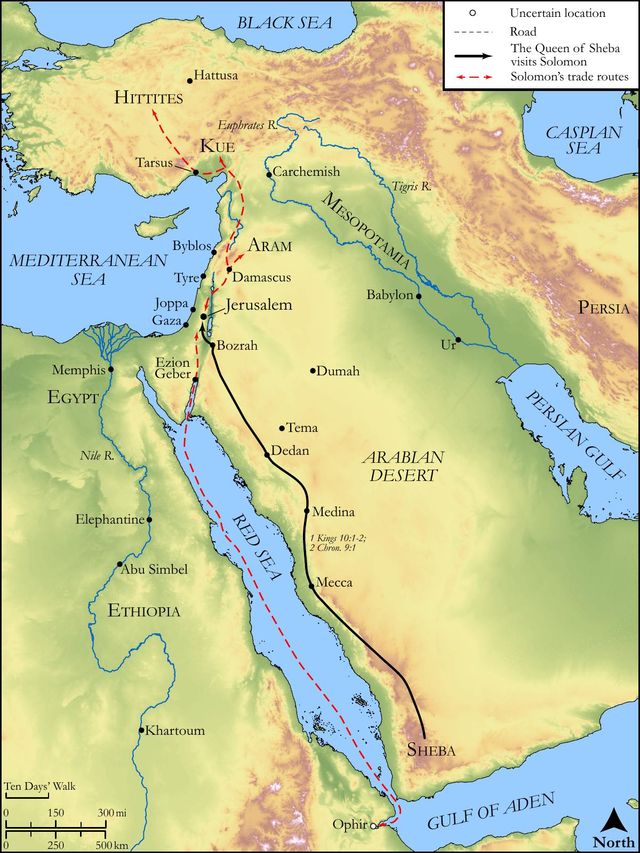
See on the biblical-era map
Study this verse
Public-domain commentary
Matthew Henry
From his Commentary on the Whole Bible. Henry comments on passages, not single verses — this entry covers 2 Chronicles 9:13–31. His two-level outline is real structure in the source text, so it is rendered as structure.
We have here Solomon in his throne, and Solomon in his grave; for the throne would not secure him from the grave. Mors sceptra ligonibus aequat - Death wrenches from the hand the sceptre as well as the spade.
I.Here is Solomon reigning in wealth and power, in ease and fulness, such as, for aught I know, could never since be paralleled by any king whatsoever. In cannot pretend to be critical in comparing the grandeur of Solomon with that of some of the great princes of the earth. But I may observe that the most illustrious of them were famed for their wars, whereas Solomon reigned forty years in profound peace. Some of those that might be thought to vie with Solomon affected retirement, kept people in awe by keeping them at a great distance; nobody must see them, or come near him, upon pain of death: but Solomon went much abroad, and appeared in public business. So that, all things considered, the promise was fulfilled, that God would give him riches, and wealth, and honour, such as no kings have had, or shall have, Ch2 1:12.
1.Never any prince appeared in public with great splendour than Solomon did, which to those that judge by the sight of the eye, as most people do, would very much recommend him. He had 200 targets and 300 shields, all of beaten gold, carried before him (Ch2 9:15, Ch2 9:16), and sat upon a most stately throne, Ch2 9:17-19. There was not the like in any kingdom. The lustre wherein he appeared was typical of the spiritual glory of the kingdom of the Messiah and but a faint representation of his throne, which is above every throne. Solomon's pomp was all artificial; and therefore our Saviour prefers the natural beauty of the lilies of the field before it. Mat 6:29, Solomon, in all his glory, was not arrayed like one of these.
2.Never any prince had greater plenty of gold and silver, though there were no gold or silver mines in his own kingdom. Either he made himself master of the mines in other countries, and, having a populous country, sent hands to dig out those rich metals, or, having a fruitful country, he exported the commodities of it and with them fetched home all this gold that is here spoken of, Ch2 9:13, Ch2 9:14-21.
3.Never any prince had such presents brought him by all his neighbours as Solomon had: All the kings of Arabia, and governors of the country, brought him gold and silver (Ch2 9:14), not as tribute which he extorted from them, but as freewill offerings to procure his favour, or in a way of exchange for some of the productions of his husbandry, corn or cattle. All the kings of the earth brought him presents, that is, all in those parts of the world (Ch2 9:24, Ch2 9:28), because they coveted his acquaintance and friendship. Herein he was a type of Christ, to whom, as soon as he was born, the wise men of the east brought presents, gold, frankincense, and myrrh (Mat 2:11), and to whom all that are about him must bring presents, Psa 76:11; Rom 12:1.
4.Never any prince was so renowned for wisdom, so courted, so consulted, so admired (Ch2 9:23): The kings of the earth (for it was too great a favour for common persons to pretend to) sought to hear his wisdom - his natural philosophy, or his skill in physic, or his state policy, or his rules of prudence for the conduct of human life, or perhaps the principles of his religion, and the reasons of it. The application which they then made to Solomon to hear his wisdom will aggravate, shame, and condemn, men's general contempt of Christ and his gospel. Though in them are hidden all the treasures of wisdom and knowledge, yet none of the princes of this world desire to know them, for they are foolishness to them, Co1 2:8, Co1 2:14.
II.Here is Solomon dying, stripped of his pomp, and leaving all his wealth and power, not to one concerning whom he knew not whether he would be a wise man or a fool (Ecc 2:19), but who he knew would be a fool. This was not only vanity but vexation of spirit, Ch2 9:29-31. It is very observable that no mention is here made of Solomon's departure from God in his latter days, not the least hint given of it,
1.Because the Holy Ghost would teach us not to take delight in repeating the faults and follies of others. If those that have been in reputation for wisdom and honour misbehave, though it may be of use to take notice of their misconduct for warning to ourselves and others, yet we must not be forward to mention it, once the speaking of it is enough; why should that unpleasing string be again struck upon? Why can we not do as the sacred historian here does, speak largely of that in others which is praise-worthy, without saying any thing of their blemishes, yea, though they have been gross and obvious? This is but doing as we would be done by.
2.Because, though he fell, yet he was not utterly cast down. His sin is not again recorded, because it was repented of, and pardoned, and became as if it had never been. Scripture-silence sometimes speaks. I am willing to believe that its silence here concerning the sin of Solomon is an intimation that none of the sins he committed were mentioned against him, Eze 33:16. When God pardons sin he casts it behind his back and remembers it no more.
Continue studying 2 Chronicles 9:24 across the web’s major study libraries — every link below opens this exact verse, chapter, or book on the destination site.
Read & Compare
 BibleGatewayThis verse in more than 200 translations and 70 languages.
 Bible.comThe YouVersion reader — hundreds of translations, reading plans, and highlights.
 ESV.orgCrossway's official English Standard Version reader.
 NET BibleThe NET translation with 60,000+ translators' notes on every rendering decision.
 STEP BibleTyndale House's free study tool — original text, vocabulary, and scholarly resources.
 BibliaLogos Bible Software's free web reader.
 USCCBThe New American Bible (Revised Edition) with the U.S. bishops' study notes.
Commentaries
 BibleHub CommentariesDozens of classic commentaries on this verse, gathered on one page.
 StudyLightMore than 100 commentary sets — the largest collection on the web.
 BibleRefPlain-English commentary on what this verse means, verse by verse.
 Enduring WordDavid Guzik's free commentary on this chapter, widely used by Bible teachers.
 Bible Study ToolsVerse commentary alongside Greek and Hebrew study aids.
Original Language & Research
- BibleHub InterlinearThe verse word by word — original language, transliteration, and English.
- BibleHub LexiconEvery word's original-language definition and Strong's entry.
 Blue Letter BibleDeep-study tools — Strong's numbers, concordance, and word studies.
 SefariaThe Hebrew text with Rashi and centuries of Jewish commentary.
Sermons, Hymns & Audio


TrulyRandomVerse is not affiliated with these sites and doesn’t control their content. They’re linked because they’re genuinely useful.
Summary
2 Chronicles 9:24 vividly portrays the zenith of King Solomon's reign, detailing the immense material prosperity and unparalleled diplomatic influence he commanded. This verse meticulously itemizes the annual tribute—including precious metals, luxurious textiles, military equipment, exotic spices, horses, and mules—brought to him by kings from across the known world. It stands as a powerful testament to the fulfillment of God's promises of abundant blessing and extraordinary wisdom bestowed upon Solomon, showcasing a golden age of wealth, stability, and international recognition for ancient Israel, all flowing directly from the divine favor resting upon the king.
Context
ShowHideLiterary Context
This verse is strategically placed within 2 Chronicles 9, a chapter dedicated to glorifying King Solomon's unparalleled wisdom, wealth, and international renown. It immediately follows statements emphasizing Solomon's preeminence, such as his exceeding "all the kings of the earth in riches and wisdom" (2 Chronicles 9:22) and the universal desire of "all the kings of the earth [to seek] the presence of Solomon, to hear his wisdom, which God had put in his heart" (2 Chronicles 9:23). Verse 24 then functions as concrete evidence, providing a detailed inventory of the "presents" that flowed into Jerusalem annually. This enumeration of silver, gold, raiment, harness, spices, horses, and mules, brought "a rate year by year," serves to substantiate the general claims of Solomon's vast wealth and influence, illustrating the tangible fruits of his God-given wisdom and the widespread acknowledgment of his authority. It solidifies the narrative of a kingdom at its peak, sustained by continuous homage.
Historical & Cultural Context
Among the kings of that day, the practice of bringing "presents" or "tribute" was a fundamental aspect of international diplomacy, signifying homage, subservience, or a desire for favorable relations with a dominant power. Unlike commercial trade, tribute was typically a non-reciprocal offering from a lesser ruler to a greater king, acknowledging the latter's superior status, military might, or protective oversight. Solomon's strategic control over vital trade routes, combined with his divinely granted wisdom and formidable military, positioned him as a regional hegemon. The annual nature of these gifts, indicated by "a rate year by year," points to a formalized and sustained system of international relations, where Solomon's authority was consistently recognized. The specific items listed—precious metals, fine textiles, military assets, and exotic spices—were among the most valuable commodities of the era, reflecting the immense economic power and vast network of resources that converged upon Jerusalem from diverse regions.
Key Themes
ShowHide2 Chronicles 9:24 is pivotal in developing several key themes within the Chronicler's narrative. Firstly, it powerfully underscores Unparalleled Royal Prosperity, presenting Solomon's extraordinary affluence not merely as material wealth but as a tangible manifestation of God's abundant blessing upon His chosen king and nation. This wealth is a visible sign of divine favor. Secondly, the verse highlights International Influence and Recognition, demonstrating how Solomon's God-given wisdom and authority extended far beyond Israel's geographical borders, compelling rulers from distant lands to offer homage. This portrays Israel at its zenith as a regional power. Most significantly for the Chronicler, this prosperity is explicitly presented as a direct consequence of Divine Favor and Blessing, fulfilling promises made to Solomon and the Davidic line. The Chronicler consistently emphasizes the direct correlation between obedience to God and national prosperity, and Solomon's early reign, as depicted here, serves as a prime example of God's abundant provision for a king who sought wisdom, as promised in 1 Kings 3:13. This period represents a high point of God's covenant faithfulness to Israel, where the nation experienced peace and abundance under a righteous king, echoing the blessings promised in Deuteronomy 28.
Exposition and Analysis
ShowHideKey Word Analysis
ShowHideThe Hebrew word מִנְחָה (minchâh, H4503) from an unused root meaning "to apportion, i.e. bestow," carries a range of meanings including "donation," "tribute," or "sacrificial offering." While it often refers to a bloodless grain offering in a cultic context (e.g., Leviticus 2:1), in a diplomatic or secular context, as here, it unequivocally denotes a tribute or homage. It signifies a gift given to acknowledge superior status, secure favor, or express submission, rather than a reciprocal exchange. In 2 Chronicles 9:24, it clearly indicates the submission, respect, and acknowledgment of preeminence paid by foreign rulers to Solomon.
The Hebrew term נֶשֶׁק (nesheq, H5402) from נָשַׁק (meaning "to kiss" or "to touch," often implying "to arm"), refers to "military equipment," "arms (offensive or defensive)," or an "arsenal." In this specific context, given its close association with "horses" and "mules," it most likely refers to the accoutrements associated with cavalry or chariotry—such as armor for horses, bridles, bits, or even the weapons carried by mounted soldiers. This highlights that the tribute was not solely luxurious but also strategically valuable, directly contributing to Solomon's military strength and defensive capabilities.
The Hebrew word דָבָר (dâbâr, H1697) is exceptionally rich, stemming from דָבַר (meaning "to speak"). It primarily means "a word," but by implication, it can refer to "a matter," "a thing," "an affair," "a cause," "a decree," or "a report." In the phrase "a rate year by year," dâbâr signifies a "fixed matter" or "regular arrangement" that occurred annually. It denotes a customary, established practice or a decreed amount, emphasizing the systematic and formalized nature of the tribute, rather than merely a fluctuating quantity. This deepens the understanding of Solomon's sustained authority and the predictable flow of resources into his kingdom.
Verse Breakdown
ShowHide"And they brought every man his present"
This opening clause establishes the widespread and individual nature of the tribute. "Every man" (H376, ʼîysh), while literally referring to an individual, here collectively represents the numerous foreign kings and their envoys who participated in this annual act of homage, as implied by the preceding verses. It emphasizes the universality of this recognition of Solomon's unparalleled authority and wisdom across various nations.
"vessels of silver, and vessels of gold, and raiment, harness, and spices, horses, and mules"
This detailed enumeration provides a concrete and impressive inventory of the valuable goods flowing into Solomon's kingdom. "Vessels of silver, and vessels of gold" (H3627 kᵉlîy, H3701 keçeph, H2091 zâhâb) signify immense wealth, luxury, and artistic craftsmanship. "Raiment" (H8008 salmâh) refers to fine clothing or textiles, a significant marker of status and a valuable trade commodity. "Harness" (H5402 nesheq, military equipment), "horses" (H5483 çûwç), and "mules" (H6505 pered) point to the strategic and military strength these gifts augmented, as well as their value in transport and trade. "Spices" (H1314 besem) signify exotic luxury goods, often used for anointing, perfumes, or culinary purposes, indicating Solomon's access to distant and valuable trade networks. The sheer variety and intrinsic value of these items underscore the immense prosperity and international reach of Solomon's empire.
"a rate year by year"
This crucial final phrase emphasizes the regularity, continuity, and formalized nature of this tribute. The repetition of "year by year" (H8141 shâneh) coupled with "a rate" (H1697 dâbâr, signifying a fixed matter or custom) indicates that this was not a sporadic event but an established, annual practice. This signifies a formalized system of international relations where Solomon was consistently acknowledged as the dominant power, ensuring a continuous influx of resources that contributed to the sustained economic and military strength of his kingdom.
Literary Devices
ShowHideThe verse employs several effective literary devices to convey the unparalleled status and prosperity of Solomon's reign. Enumeration is prominently featured through the detailed listing of "vessels of silver, and vessels of gold, and raiment, harness, and spices, horses, and mules." This extensive catalog of valuable goods serves to impress upon the reader the sheer volume, diversity, and richness of wealth flowing into Solomon's kingdom, making his prosperity tangible and undeniable. The preceding context, stating that "all the kings of the earth sought the presence of Solomon," employs Hyperbole to emphasize the global reach of his reputation and influence, even if not literally every king on earth visited him. This exaggeration effectively communicates the widespread recognition of his wisdom and power. Furthermore, the consistent phrase "a rate year by year" creates a sense of Rhythm and Repetition, underscoring the enduring and systematic nature of this tribute, reinforcing the idea of a stable and continuously flourishing kingdom that enjoyed sustained international homage.
Theological and Thematic Connections
ShowHide2 Chronicles 9:24 stands as a powerful testament to God's faithfulness in fulfilling His promises to Solomon and the Davidic line. Solomon's unprecedented wealth and international recognition were not merely the result of shrewd diplomacy or military might, but a direct consequence of God's blessing, particularly in response to Solomon's humble request for wisdom to govern God's people (1 Kings 3:11-13). This verse illustrates the profound biblical principle that when a ruler (or a people) walks in obedience and seeks God's wisdom, divine favor can manifest in tangible prosperity and widespread respect, serving as a visible sign of God's presence and power among His chosen people. It also subtly foreshadows a future, greater kingdom where all nations will bring their glory and honor to the true, righteous King.
Reflection and Application
ShowHideThe depiction of Solomon's unparalleled wealth and influence in 2 Chronicles 9:24 offers a profound opportunity for reflection on the nature of true prosperity and the source of lasting influence. While Solomon's reign represents a peak of earthly glory, it also serves as a poignant reminder that even the greatest human achievements and material blessings are ultimately temporary and dependent on divine favor. For believers today, this verse challenges us to consider what "presents" we are bringing, not to an earthly king, but to the King of Kings. Our ultimate "tribute" should be lives lived in obedience, hearts seeking God's wisdom above all else, and resources dedicated to His kingdom purposes. Just as Solomon's wisdom drew the nations, our lives, transformed by Christ's wisdom and grace, can become a testimony that draws others to the true source of all blessing. This passage encourages us to pursue a wisdom that yields eternal dividends, recognizing that true wealth is found not in accumulation, but in alignment with God's purposes, and that our greatest offering is a life surrendered to His will.
Questions for Reflection
ShowHideFAQ
ShowHideWas Solomon's wealth and the tribute he received a sign of God's approval?
ShowHideYes, the Chronicler consistently presents Solomon's immense wealth and the lavish tribute he received as a direct and tangible manifestation of God's blessing and approval. This prosperity is explicitly linked to God's promise to Solomon in 1 Kings 3:13, where God states, "I will give you what you have not asked, both riches and honor, so that in all your days there will not be anyone like you among the kings." The abundance was a visible sign of God's covenant faithfulness and the peace and prosperity enjoyed by Israel under a king who initially sought wisdom from God above all else. However, it's also crucial to note that later in his reign, Solomon's accumulation of wealth and foreign alliances, particularly his many wives, led him astray from God's commands (1 Kings 11:1-8), demonstrating that even divine blessings, if not stewarded according to God's will, can become a stumbling block.
What was the significance of "a rate year by year"?
ShowHideThe phrase "a rate year by year" (Hebrew: dâbâr shâneh bᵉshâneh) carries significant meaning, indicating that the tribute was an annual, regular, and formalized payment, not merely a sporadic or one-off gift. This underscores the sustained nature of Solomon's international influence and the remarkable stability of his kingdom. It implies that foreign kings consistently acknowledged Solomon's preeminence and power, entering into a formalized system of tribute that ensured a continuous flow of valuable resources into Jerusalem. This annual influx further solidified his economic and military standing, reflecting a well-established geopolitical hierarchy where Solomon was the undisputed dominant regional power. It speaks to the enduring respect and submission he commanded from surrounding nations.
Christ-Centered Fulfillment
ShowHideWhile 2 Chronicles 9:24 vividly portrays the earthly glory and material abundance of Solomon's kingdom, it ultimately points beyond itself to the greater King, Jesus Christ. Solomon's renowned wisdom, which drew kings from afar to hear his words, foreshadows Christ, who is the very wisdom of God incarnate, the one in whom "are hidden all the treasures of wisdom and knowledge" (Colossians 2:3). The immense wealth and annual tribute brought to Solomon, signifying the nations' recognition of his authority, serve as a profound type for the ultimate universal homage that will be paid to Christ. The New Testament speaks of a glorious future time when "every knee shall bow, in heaven and on earth and under the earth, and every tongue confess that Jesus Christ is Lord, to the glory of God the Father" (Philippians 2:10-11). Just as kings brought their finest to Solomon, the nations will one day bring their glory and honor into the New Jerusalem, where Christ reigns supreme (Revelation 21:24-26). Solomon's reign, marked by peace and prosperity, was a temporary and imperfect glimpse of the eternal, perfect kingdom of God, where Christ, the Prince of Peace, rules with absolute righteousness and receives the unending worship and adoration of all creation, a tribute far surpassing silver and gold, offered not out of obligation but out of love and awe.