


2 Chronicles 9:23
Bible text: King James Version (1769 Blayney text) · Public domain
Bible text: Berean Standard Bible · Public domain
Bible text: American Standard Version (1901) · Public domain
Bible text: World English Bible, Messianic edition · Public domain
Bible text: Geneva Bible (1599) · Public domain
Bible text: Young's Literal Translation · Public domain
- וְכֹלve·Kholand allH3605Conj-w ¦ N-mscNoun Singular Masculine Constructוְandכֹלall
- מַלְכֵיmal·Khei[the] kings ofH4428N-mpcNoun Plural Masculine Construct
- הָאָרֶץha·'A·retzthe earthH776Art ¦ N-fsNoun Singular Feminine Absoluteהָtheאָרֶץearth
- מְבַקְשִׁיםme·vak·Shim[were] seekingH1245V-Piel-Prtcpl-mpVerb Piel Participle Plural Masculine Absolute
- אֶת'et<obj.>H853DirObjMParticle Object Indicator
- פְּנֵיpe·Nei[the] face ofH6440N-mpcNoun Plural Masculine Construct
- שְׁלֹמֹהshe·lo·MohSolomonH8010N-proper-mNoun Proper Masculine
- לִשְׁמֹעַlish·Mo·a'to hearH8085Prep-l ¦ V-Qal-InfVerb Qal Infinitive Constructלִtoשְׁמֹעַhear
- אֶת'et<obj.>H853DirObjMParticle Object Indicator
- חָכְמָתוֹcha·khe·ma·Tohis wisdomH2451N-fsc ¦ 3msNoun Singular Feminine Constructחָכְמָתwisdomוֹhis
- אֲשֶׁר'a·SherwhichH834RelParticle Relative
- נָתַןna·Tanhe had putH5414V-Qal-Perf-3msVerb Qal Perfect 3rd Singular Masculine
- הָאֱלֹהִיםha·'E·lo·Him<the> GodH430Art ¦ N-mpNoun Plural Masculine Absoluteהָ<the>אֱלֹהִיםGod
- בְּלִבּוֹbe·li·Boin his heartH3820Prep-b ¦ N-msc ¦ 3msNoun Singular Masculine Constructבְּinלִבּheartוֹhis
English is a literal word-by-word gloss of the Hebrew, not the KJV's wording. Why?
This is the original text the KJV's translators worked from — each Hebrew word with its own literal English meaning in this verse, prepared by scholars at Tyndale House, Cambridge. The KJV translates whole sentences, not word by word, so its wording differs: one Hebrew word can become several English words, and the KJV may choose “the LORD” where the gloss reads “Yahweh”. Both are faithful — they answer different questions. For the KJV's own rendering, switch to the KJV text.
Details
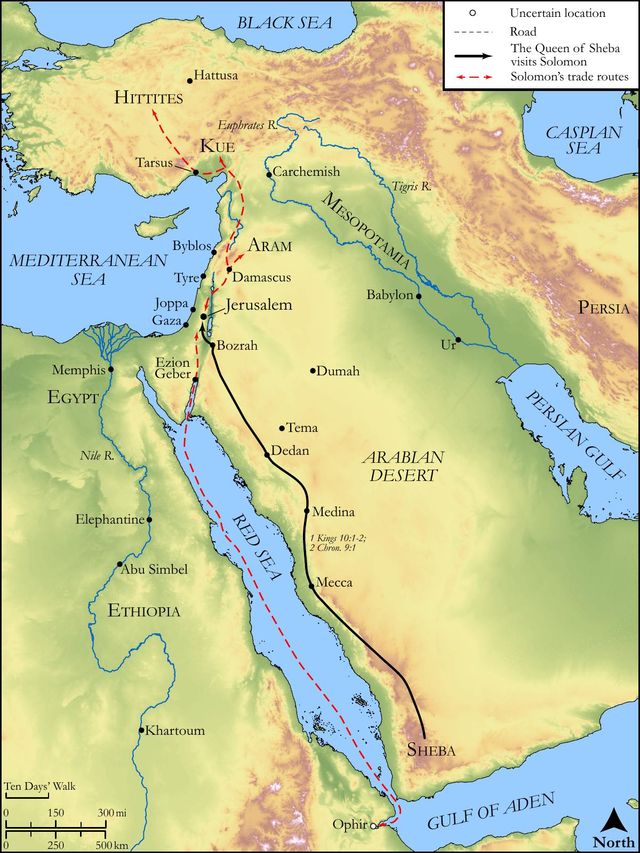
See on the biblical-era map
Study this verse
Public-domain commentary
Matthew Henry
From his Commentary on the Whole Bible. Henry comments on passages, not single verses — this entry covers 2 Chronicles 9:13–31. His two-level outline is real structure in the source text, so it is rendered as structure.
We have here Solomon in his throne, and Solomon in his grave; for the throne would not secure him from the grave. Mors sceptra ligonibus aequat - Death wrenches from the hand the sceptre as well as the spade.
I.Here is Solomon reigning in wealth and power, in ease and fulness, such as, for aught I know, could never since be paralleled by any king whatsoever. In cannot pretend to be critical in comparing the grandeur of Solomon with that of some of the great princes of the earth. But I may observe that the most illustrious of them were famed for their wars, whereas Solomon reigned forty years in profound peace. Some of those that might be thought to vie with Solomon affected retirement, kept people in awe by keeping them at a great distance; nobody must see them, or come near him, upon pain of death: but Solomon went much abroad, and appeared in public business. So that, all things considered, the promise was fulfilled, that God would give him riches, and wealth, and honour, such as no kings have had, or shall have, Ch2 1:12.
1.Never any prince appeared in public with great splendour than Solomon did, which to those that judge by the sight of the eye, as most people do, would very much recommend him. He had 200 targets and 300 shields, all of beaten gold, carried before him (Ch2 9:15, Ch2 9:16), and sat upon a most stately throne, Ch2 9:17-19. There was not the like in any kingdom. The lustre wherein he appeared was typical of the spiritual glory of the kingdom of the Messiah and but a faint representation of his throne, which is above every throne. Solomon's pomp was all artificial; and therefore our Saviour prefers the natural beauty of the lilies of the field before it. Mat 6:29, Solomon, in all his glory, was not arrayed like one of these.
2.Never any prince had greater plenty of gold and silver, though there were no gold or silver mines in his own kingdom. Either he made himself master of the mines in other countries, and, having a populous country, sent hands to dig out those rich metals, or, having a fruitful country, he exported the commodities of it and with them fetched home all this gold that is here spoken of, Ch2 9:13, Ch2 9:14-21.
3.Never any prince had such presents brought him by all his neighbours as Solomon had: All the kings of Arabia, and governors of the country, brought him gold and silver (Ch2 9:14), not as tribute which he extorted from them, but as freewill offerings to procure his favour, or in a way of exchange for some of the productions of his husbandry, corn or cattle. All the kings of the earth brought him presents, that is, all in those parts of the world (Ch2 9:24, Ch2 9:28), because they coveted his acquaintance and friendship. Herein he was a type of Christ, to whom, as soon as he was born, the wise men of the east brought presents, gold, frankincense, and myrrh (Mat 2:11), and to whom all that are about him must bring presents, Psa 76:11; Rom 12:1.
4.Never any prince was so renowned for wisdom, so courted, so consulted, so admired (Ch2 9:23): The kings of the earth (for it was too great a favour for common persons to pretend to) sought to hear his wisdom - his natural philosophy, or his skill in physic, or his state policy, or his rules of prudence for the conduct of human life, or perhaps the principles of his religion, and the reasons of it. The application which they then made to Solomon to hear his wisdom will aggravate, shame, and condemn, men's general contempt of Christ and his gospel. Though in them are hidden all the treasures of wisdom and knowledge, yet none of the princes of this world desire to know them, for they are foolishness to them, Co1 2:8, Co1 2:14.
II.Here is Solomon dying, stripped of his pomp, and leaving all his wealth and power, not to one concerning whom he knew not whether he would be a wise man or a fool (Ecc 2:19), but who he knew would be a fool. This was not only vanity but vexation of spirit, Ch2 9:29-31. It is very observable that no mention is here made of Solomon's departure from God in his latter days, not the least hint given of it,
1.Because the Holy Ghost would teach us not to take delight in repeating the faults and follies of others. If those that have been in reputation for wisdom and honour misbehave, though it may be of use to take notice of their misconduct for warning to ourselves and others, yet we must not be forward to mention it, once the speaking of it is enough; why should that unpleasing string be again struck upon? Why can we not do as the sacred historian here does, speak largely of that in others which is praise-worthy, without saying any thing of their blemishes, yea, though they have been gross and obvious? This is but doing as we would be done by.
2.Because, though he fell, yet he was not utterly cast down. His sin is not again recorded, because it was repented of, and pardoned, and became as if it had never been. Scripture-silence sometimes speaks. I am willing to believe that its silence here concerning the sin of Solomon is an intimation that none of the sins he committed were mentioned against him, Eze 33:16. When God pardons sin he casts it behind his back and remembers it no more.
Continue studying 2 Chronicles 9:23 across the web’s major study libraries — every link below opens this exact verse, chapter, or book on the destination site.
Read & Compare
 BibleGatewayThis verse in more than 200 translations and 70 languages.
 Bible.comThe YouVersion reader — hundreds of translations, reading plans, and highlights.
 ESV.orgCrossway's official English Standard Version reader.
 NET BibleThe NET translation with 60,000+ translators' notes on every rendering decision.
 STEP BibleTyndale House's free study tool — original text, vocabulary, and scholarly resources.
 BibliaLogos Bible Software's free web reader.
 USCCBThe New American Bible (Revised Edition) with the U.S. bishops' study notes.
Commentaries
 BibleHub CommentariesDozens of classic commentaries on this verse, gathered on one page.
 StudyLightMore than 100 commentary sets — the largest collection on the web.
 BibleRefPlain-English commentary on what this verse means, verse by verse.
 Enduring WordDavid Guzik's free commentary on this chapter, widely used by Bible teachers.
 Bible Study ToolsVerse commentary alongside Greek and Hebrew study aids.
Original Language & Research
- BibleHub InterlinearThe verse word by word — original language, transliteration, and English.
- BibleHub LexiconEvery word's original-language definition and Strong's entry.
 Blue Letter BibleDeep-study tools — Strong's numbers, concordance, and word studies.
 SefariaThe Hebrew text with Rashi and centuries of Jewish commentary.
Sermons, Hymns & Audio


TrulyRandomVerse is not affiliated with these sites and doesn’t control their content. They’re linked because they’re genuinely useful.
Summary
2 Chronicles 9:23 vividly portrays the unparalleled global renown of King Solomon, whose extraordinary wisdom, directly imparted by God, drew rulers from across the known world to Jerusalem. This verse encapsulates the peak of Solomon's reign, illustrating how divine favor and spiritual insight not only elevated an individual but also brought immense prestige and influence to the nation of Israel, serving as a testament to God's blessing and the magnetic power of His wisdom.
Context
ShowHideLiterary Context
This verse is situated within a broader narrative in 2 Chronicles 9 that meticulously details the immense wealth, glory, and international recognition achieved during Solomon's reign, particularly following the completion of the Temple. The preceding verses, especially 2 Chronicles 9:1-12, describe the visit of the Queen of Sheba, who traveled a great distance specifically to test Solomon with hard questions and was overwhelmed by his wisdom and prosperity. Verse 23 acts as a summary statement, generalizing the Queen of Sheba's experience to "all the kings of the earth," thereby emphasizing the universal scope of Solomon's reputation for wisdom. This section culminates the chronicler's portrayal of Solomon's golden age before the narrative shifts to his decline and the subsequent division of the kingdom.
Historical & Cultural Context
Among the nations, wisdom was highly prized, often seen as a divine attribute essential for effective kingship, governance, and maintaining social order. Rulers frequently exchanged gifts and engaged in diplomatic visits to forge alliances, secure trade routes, and learn from one another. Solomon's wisdom, however, transcended typical royal sagacity, being explicitly attributed to God. This divine endowment would have been particularly compelling in a polytheistic world, drawing kings who sought not just political counsel but perhaps a connection to the source of such profound insight. Jerusalem, as the capital and site of the newly built Temple, would have become a significant spiritual and political hub, attracting foreign dignitaries eager to witness Israel's unique prosperity and the wisdom of its king.
Key Themes
ShowHideThe verse significantly contributes to several overarching themes in 2 Chronicles. Firstly, it underscores the theme of Divine Wisdom as a Magnet, emphasizing that Solomon's wisdom was not self-acquired but a direct gift from God, as detailed in 2 Chronicles 1:7-12. This divinely sourced wisdom served as the primary attraction, drawing international leaders and showcasing God's ability to bless His chosen king abundantly. Secondly, it highlights the theme of Universal Recognition of God's Blessing, as "all the kings of the earth" sought Solomon, indicating that God's favor on Israel was evident even to foreign nations. This widespread acknowledgment validated God's covenant promises and demonstrated His power to elevate His people. Finally, it reinforces the Value of Wisdom, portraying it as more precious and influential than military might or material wealth, aligning with the wisdom literature found in books like Proverbs 3:13-18, where wisdom is personified as a source of life and blessing.
Exposition and Analysis
ShowHideKey Word Analysis
ShowHideThis verb, derived from a primitive root meaning "to search out," implies an active, deliberate, and earnest pursuit. It denotes a determined effort to gain access to Solomon's presence and counsel, indicating that these foreign rulers recognized a profound need and undertook significant journeys specifically for this purpose. It suggests a striving after something highly valued.
More than mere intellectual knowledge or cleverness, chokmâh in biblical context refers to practical skill, discernment, and the ability to live and govern skillfully according to divine principles. It encompasses moral insight, judicial acumen, and the capacity to understand and apply truth effectively. Solomon's chokmâh was holistic, impacting his judgments, his building projects, and his understanding of the natural world, making him "skilful" in all aspects of kingship.
This phrase emphasizes the divine origin and internal nature of Solomon's wisdom. Nâthan means "to give" or "to put," and lêb refers to the "heart" as the center of one's feelings, will, and intellect. Thus, this signifies that Solomon's wisdom was not something he acquired through study or experience alone, but a direct, supernatural impartation from God into his inner being—his mind, will, and affections. This highlights that his wisdom was a gift, a testament to God's active involvement in his reign.
Verse Breakdown
ShowHide"And all the kings of the earth"
This phrase functions as a hyperbole, signifying a vast and representative group of rulers from the known world. It indicates the widespread and unparalleled nature of Solomon's reputation, suggesting that his fame extended far beyond Israel's immediate neighbors and encompassed the entirety of the then-known international political landscape.
"sought the presence of Solomon"
This means they actively pursued an audience with him, traveling to Jerusalem. "Presence" here implies not just physical proximity but privileged access to his court, his counsel, and the opportunity to interact with him directly. It signifies a diplomatic and intellectual pilgrimage, undertaken with earnest intent.
"to hear his wisdom"
The primary motivation for their arduous journeys was to listen to and learn from Solomon's unique insight. This indicates that his wisdom was not just a theoretical concept but something practical and applicable, offering solutions, discernment, or understanding that other rulers lacked in their own kingdoms.
"that God had put in his heart"
This crucial concluding clause provides the profound theological explanation for Solomon's extraordinary wisdom. It explicitly attributes his sagacity to a divine source, emphasizing that it was a supernatural gift from God, not an inherent human genius. This divine origin is what made his wisdom so compelling and universally sought after, distinguishing it from any other ruler's counsel.
Literary Devices
ShowHideThe verse employs several literary devices to convey Solomon's extraordinary status and the divine source of his influence. Hyperbole is prominently evident in the phrase "all the kings of the earth," which, while not literally every single monarch, effectively communicates the widespread and unprecedented nature of Solomon's fame and the universal appeal of his wisdom. This exaggeration serves to magnify the glory of God's blessing upon him and Israel. There is also a strong sense of Emphasis on the divine origin of Solomon's wisdom, highlighted by the concluding clause "that God had put in his heart." This direct theological explanation elevates the narrative from a mere description of human achievement to a profound testament to God's power and faithfulness in bestowing such a gift. Furthermore, the act of "seeking the presence of Solomon" can be seen as a form of Metonymy, where his "presence" stands for his counsel, his court, and the embodiment of the divine wisdom he possessed.
Theological and Thematic Connections
ShowHide2 Chronicles 9:23 powerfully demonstrates the principle that when God blesses an individual with wisdom and favor, it can have far-reaching, even global, implications. Solomon's divinely imparted wisdom served as a beacon, drawing nations to Jerusalem and implicitly, to the God of Israel who bestowed such gifts. This highlights God's desire for His glory to be known among the nations, often through the remarkable lives of His chosen servants. The verse also underscores the inherent value and magnetic power of true wisdom, which surpasses material wealth or military might in its ability to influence and attract. It points to a divine economy where spiritual gifts yield tangible, widespread recognition, ultimately redounding to God's glory.
Reflection and Application
ShowHideThe account of Solomon's divinely given wisdom and its global impact serves as a profound encouragement for believers today. It reminds us that true wisdom is not merely intellectual prowess or accumulated knowledge, but a spiritual gift from God, essential for navigating life's complexities and influencing our world for good. Just as Solomon's wisdom drew kings, our lives, when submitted to God and guided by His truth, can become a compelling testimony to His grace and power. Seeking God's wisdom through prayer, diligent study of His Word, and reliance on the Holy Spirit enables us to make discerning decisions, speak words of life, and embody Christ-like character in a way that can attract others to the source of all wisdom. Our influence, whether in our homes, workplaces, or communities, is magnified when it flows from a heart saturated with divine insight, demonstrating the beauty and power of God's presence within us.
Questions for Reflection
ShowHideFAQ
ShowHideWas Solomon's wisdom truly unique among the kings of his time, or was it a common attribute for rulers?
ShowHideWhile wisdom was indeed a highly valued attribute for the rulers of the nations, Solomon's wisdom, as described in 2 Chronicles 9:23 and elsewhere, was uniquely profound and explicitly attributed to a direct, divine impartation from God. Unlike other kings who might have cultivated practical wisdom through experience or counsel, Solomon's was a supernatural gift, making him "wiser than all other men" (1 Kings 4:30). This divine origin set his wisdom apart, making it an unparalleled phenomenon that genuinely astonished foreign dignitaries like the Queen of Sheba and compelled "all the kings of the earth" to seek his presence. His wisdom encompassed not only governance and judgment but also a deep understanding of creation, riddles, and proverbs, demonstrating a breadth and depth far beyond typical royal sagacity.
Christ-Centered Fulfillment
ShowHideWhile Solomon's wisdom was a magnificent, divinely bestowed gift that brought glory to his kingdom and drew nations to him, it ultimately pointed beyond itself to a greater reality: Jesus Christ. The New Testament explicitly declares that "one greater than Solomon is here" (Matthew 12:42), referring to Jesus. Solomon received wisdom; Jesus is wisdom incarnate, the very "power of God and the wisdom of God" (1 Corinthians 1:24). In Him "are hidden all the treasures of wisdom and knowledge" (Colossians 2:3). The kings of the earth sought Solomon's wisdom for earthly counsel and prosperity, but the King of kings, Jesus, draws all humanity not for earthly gain, but for eternal life and spiritual transformation. His wisdom is not merely for governance but for salvation, offering reconciliation with God and true understanding of divine truth. Those who come to Christ find not just a wise counselor, but the very source of life, truth, and ultimate wisdom, which leads to eternal blessedness and a kingdom that will never end (Luke 1:33).