


1 Kings 9:14
- וַיִּשְׁלַחvai·yish·Lachand he had sentH7971Conj-w ¦ V-Qal-ConsecImperf-3msVerb Qal Consecutive Imperfect 3rd Singular Masculineוַandיִּשְׁלַחhe had sent
- חִירָםchi·RamHiramH2438N-proper-mNoun Proper Masculine
- לַמֶּלֶךְla·Me·lekhto the kingH4428Prep-l ¦ N-msNoun Singular Masculine Absoluteלַto theמֶּלֶךְking
- מֵאָהme·'Ahone hundredH3967N-fsNoun Singular Feminine Absolute
- וְעֶשְׂרִיםve·'es·Rimand twentyH6242Conj-w ¦ N-mpNoun Plural Masculine Absoluteוְandעֶשְׂרִיםtwenty
- כִּכַּרki·Kartalent[s] ofH3603N-fscNoun Singular Feminine Construct
- זָהָבza·HavgoldH2091N-msNoun Singular Masculine Absolute
English is a literal word-by-word gloss of the Hebrew, not the KJV's wording. Why?
This is the original text the KJV's translators worked from — each Hebrew word with its own literal English meaning in this verse, prepared by scholars at Tyndale House, Cambridge. The KJV translates whole sentences, not word by word, so its wording differs: one Hebrew word can become several English words, and the KJV may choose “the LORD” where the gloss reads “Yahweh”. Both are faithful — they answer different questions. For the KJV's own rendering, switch to the KJV text.
Details
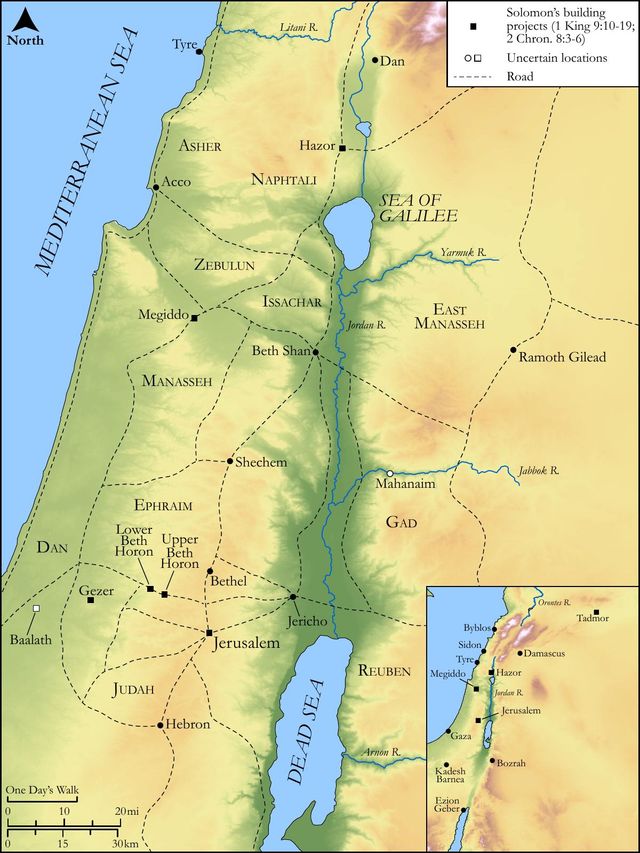
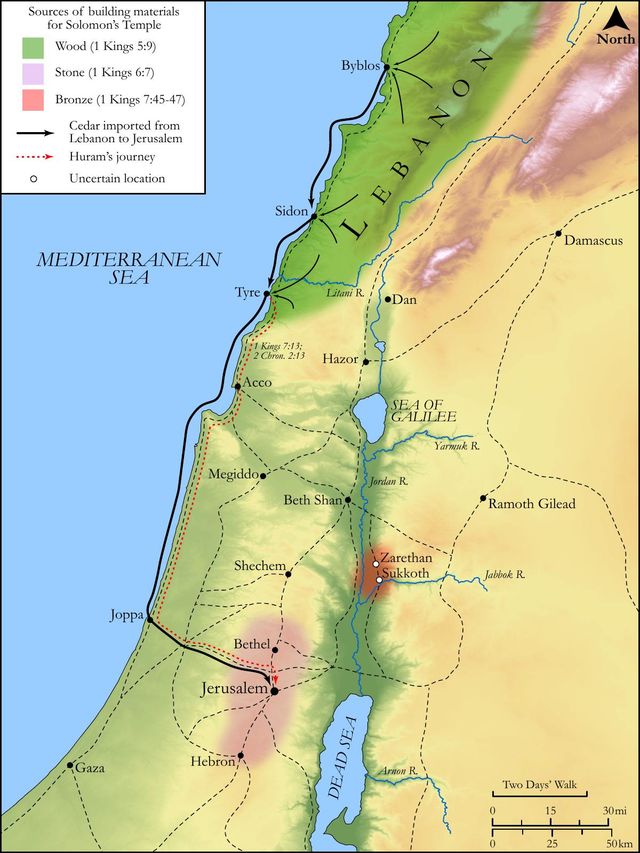
See on the biblical-era map

Study this verse
Public-domain commentary
Matthew Henry
From his Commentary on the Whole Bible. Henry comments on passages, not single verses — this entry covers 1 Kings 9:10–14.
What agreement was made between Solomon and Hiram, when the building-work was to be begun, we read before, ch. 5. Here we have an account of their fair and friendly parting when the work was done. 1. Hiram made good his bargain to the utmost. He had furnished Solomon with materials for his buildings, according to all his desire (Kg1 9:11), and with gold, Kg1 9:15. So far was he from envying Solomon's growing greatness and reputation, and being jealous of him, that he helped to magnify him. Solomon's power, with Solomon's wisdom, needs not be dreaded by any of his neighbours. God honours him; therefore Hiram will. 2. Solomon, no doubt, made good his bargain, and gave Hiram food for his household, as was agreed, Kg1 5:9. But here we are told that, over and above that, he gave him twenty cities (small ones we may suppose, like those mentioned here, Kg1 9:19) in the land of Galilee, Kg1 9:11. It should seem, these were not allotted to any of the tribes of Israel (for the border of Asher came up to them, Jos 19:27, which intimates that it did not include them), but continued in the hands of the natives till Solomon made himself master of them, and then made a present of them to Hiram. It becomes those that are great and good to be generous. Hiram came to see these cities, and did not like them (Kg1 9:12): They pleased him not. He called the country the land of Cabul, a Phoenician word (says Josephus) which signifies displeasing, Kg1 9:13. He therefore returned them to Solomon (as we find, Ch2 8:2), who repaired them, and then caused the children of Israel to inhabit them, which intimates that before they did not; but, when Solomon received back what he had given, no doubt he honourably gave Hiram an equivalent in something else. But what shall we think of this? Did Solomon act meanly in giving Hiram what was not worth his acceptance? Or was Hiram humoursome and hard to please? I am willing to believe it was neither the one nor the other. The country was truly valuable, and so were the cities in it, but not agreeable to Hiram's genius. The Tyrians were merchants, trading men, that lived in fine houses, and became rich by navigation, but knew not how to value a country that was fit for corn and pasture (that was business that lay out of their way); and therefore Hiram desired Solomon to take them again, he knew not what to do with them, and, if he would please to gratify him, let it be in his own element, by becoming his partner in trade, as we find he did, Kg1 9:27. Hiram, who was used to the clean streets of Tyre, could by no means agree with the miry lanes in the land of Cabul, whereas the best lands have commonly the worst roads through them. See how the providence of God suits both the accommodation of this earth to the various dispositions of men and the dispositions of men to the various accommodations of the earth, and all for the good of mankind in general. Some take delight in husbandry, and wonder what pleasure sailors can take on a rough sea; others take as much delight in navigation, and wonder what pleasure husbandmen can take in a dirty country, like the land of Cabul. It is so in many other instances, in which we may observe the wisdom of him whose all souls are and all lands.
Continue studying 1 Kings 9:14 across the web’s major study libraries — every link below opens this exact verse, chapter, or book on the destination site.
Read & Compare
 BibleGatewayThis verse in more than 200 translations and 70 languages.
 Bible.comThe YouVersion reader — hundreds of translations, reading plans, and highlights.
 ESV.orgCrossway's official English Standard Version reader.
 NET BibleThe NET translation with 60,000+ translators' notes on every rendering decision.
 STEP BibleTyndale House's free study tool — original text, vocabulary, and scholarly resources.
 BibliaLogos Bible Software's free web reader.
 USCCBThe New American Bible (Revised Edition) with the U.S. bishops' study notes.
Commentaries
 BibleHub CommentariesDozens of classic commentaries on this verse, gathered on one page.
 StudyLightMore than 100 commentary sets — the largest collection on the web.
 BibleRefPlain-English commentary on what this verse means, verse by verse.
 Enduring WordDavid Guzik's free commentary on this chapter, widely used by Bible teachers.
 Bible Study ToolsVerse commentary alongside Greek and Hebrew study aids.
Original Language & Research
- BibleHub InterlinearThe verse word by word — original language, transliteration, and English.
- BibleHub LexiconEvery word's original-language definition and Strong's entry.
 Blue Letter BibleDeep-study tools — Strong's numbers, concordance, and word studies.
 SefariaThe Hebrew text with Rashi and centuries of Jewish commentary.
Sermons, Hymns & Audio


TrulyRandomVerse is not affiliated with these sites and doesn’t control their content. They’re linked because they’re genuinely useful.
Summary
First Kings 9:14 records King Hiram of Tyre's substantial dispatch of "sixscore talents of gold" to King Solomon of Israel. This significant transfer of wealth highlights the immense prosperity and extensive international relationships that characterized Solomon's reign, particularly following the successful completion of the magnificent Temple and his own royal palace. It underscores the intricate economic and political alliances that shaped the ancient Near East, demonstrating the resilience of these partnerships even amidst minor diplomatic tensions.
Context
ShowHideLiterary Context
This verse is situated within a broader narrative detailing the long-standing and mutually beneficial alliance between King Solomon and King Hiram. The preceding verses, specifically 1 Kings 9:10, mark the completion of the twenty-year construction period for the Temple and Solomon's royal palace. Following this monumental undertaking, Solomon presented Hiram with twenty cities in Galilee as a form of payment or gift, as described in 1 Kings 9:11-13. Hiram, however, was displeased with these cities, calling them "Cabul," a name implying worthlessness or displeasure. Despite this diplomatic setback, 1 Kings 9:14 immediately follows, indicating that the economic relationship remained robust, with Hiram sending a substantial amount of gold. This suggests the gold was either a final payment for Solomon's services (perhaps for the cities, or for other goods/services not explicitly detailed), or a gesture of goodwill to maintain their lucrative partnership, demonstrating the resilience of their alliance despite minor disagreements. The verse thus serves to reaffirm the strength of the economic ties between the two kings, even in the face of minor friction.
Historical & Cultural Context
The alliance between Israel under Solomon and the Phoenician city-state of Tyre under Hiram was a strategic and economic powerhouse in the ancient Near East. Tyre, a prominent maritime trading nation, possessed unparalleled expertise in timber, shipbuilding, and skilled craftsmanship, while Israel controlled vital land routes and agricultural resources. This partnership facilitated the grand architectural projects in Jerusalem and fostered immense wealth for both kingdoms. Gold, as a universal medium of exchange and a symbol of power and prestige, played a crucial role in these international transactions. The "talent" (Hebrew: kikkār) was a standard unit of weight, not coinage, varying slightly by region but generally representing a substantial quantity of precious metal. Such large-scale transfers of wealth were common between powerful monarchs, signifying both economic might and diplomatic ties, often solidifying treaties and alliances. This exchange underscores the sophisticated economic systems and diplomatic protocols of the era.
Key Themes
ShowHideThe exchange of gold in 1 Kings 9:14 contributes to several overarching themes in the book of 1 Kings:
International Diplomacy and Trade
The verse exemplifies the strategic importance of alliances in the ancient world, demonstrating how economic partnerships could foster stability and prosperity. The relationship between Solomon and Hiram is a prime example of successful, albeit complex, international relations, showcasing the give-and-take inherent in maintaining powerful alliances.
Solomon's Immense Wealth and Divine Blessing
The receipt of such a vast amount of gold further illustrates the unparalleled riches and influence that characterized King Solomon's reign, a period often depicted as the pinnacle of Israel's material prosperity and glory. This wealth is often presented as a direct result of God's blessing upon Solomon's wisdom and his dedication to building the Temple, as seen in 1 Kings 3:13. Indeed, 1 Kings 10:14 explicitly states Solomon's staggering annual intake of gold, solidifying the impression of his extraordinary affluence.
Fulfillment of Agreements and Covenants
Despite Hiram's initial disappointment with the cities Solomon offered, the transaction in this verse indicates that the core agreements between the two kings were honored. This highlights the importance of trust, reliability, and the fulfillment of obligations in ancient covenants and diplomatic relations, even when minor disputes arose. It underscores the pragmatic nature of their alliance, where economic benefits outweighed minor grievances.
Exposition and Analysis
ShowHideKey Word Analysis
ShowHideThe king of Tyre, a powerful Phoenician city-state renowned for its maritime trade and skilled craftsmanship. Hiram was a crucial ally to both King David and his son Solomon, providing essential resources such as cedar and fir timber, as well as highly skilled artisans for the monumental construction projects of the Temple and the royal palace in Jerusalem. His relationship with Solomon was a cornerstone of Israel's economic prosperity and diplomatic standing during this era.
Derived from a root meaning "a circle," this term primarily refers to a large, round weight unit, specifically a talent. In the ancient Near East, a talent was a substantial measure of precious metals, typically weighing around 75 pounds (approximately 34 kilograms). The use of "talents" here signifies a significant, standardized unit of value in international trade, emphasizing the immense scale of the financial transaction between Hiram and Solomon.
A highly prized precious metal in the ancient world, valued for its inherent beauty, malleability, and rarity. Gold served as a primary medium of exchange, a reliable store of wealth, and a potent symbol of royal power, divine favor, and opulence. Its presence in such vast quantities in this verse underscores the peak of Solomon's material prosperity and the lavishness of his building projects and court. The shimmering quality implied by its root further highlights its visual appeal and intrinsic worth.
Verse Breakdown
ShowHide"And Hiram sent to the king"
This opening clause establishes the active agent of the transfer—King Hiram of Tyre—and the recipient—King Solomon of Israel. The verb "sent" (Hebrew: shâlach) implies a deliberate and formal dispatch, indicating a significant diplomatic or economic transaction. This action, immediately following Hiram's displeasure with the cities Solomon had given him (1 Kings 9:11-13), is crucial. It suggests that despite the minor diplomatic hiccup, the underlying economic relationship and mutual benefit between the two kings were strong enough to endure, perhaps as a final payment for services or as a gesture to maintain the valuable alliance.
"sixscore talents of gold"
This specifies the exact quantity and type of commodity transferred. "Sixscore" means 120, so this phrase refers to 120 talents of gold. Given that one talent was approximately 75 pounds, this amounts to roughly 9,000 pounds (over 4 metric tons) of pure gold. This astronomical sum highlights the extraordinary wealth flowing into Solomon's kingdom and the vast resources at his disposal. It also speaks to the immense scale of the projects undertaken and the economic power wielded by both Solomon and Hiram, reflecting a period of unparalleled material prosperity for Israel. This gift or payment underscores the magnitude of the alliance and the wealth it generated.
Literary Devices
ShowHideThe verse employs Hyperbole through the sheer scale of the "sixscore talents of gold," emphasizing the immense wealth and grandeur of Solomon's reign and the opulence of his kingdom. While literally true, the number itself functions to impress upon the reader the extraordinary nature of these transactions and the unprecedented prosperity of the era. Symbolism is also profoundly at play, as gold consistently symbolizes wealth, power, divine favor, and earthly glory throughout the biblical narrative. The presence of such a vast quantity of gold underscores God's blessing on Solomon, even as it subtly foreshadows the potential dangers of excessive material accumulation and the temptations that accompany it. Furthermore, the verse contributes to the Narrative Progression by demonstrating the continuation and strength of the economic ties between Solomon and Hiram, despite the preceding account of Hiram's dissatisfaction with the cities. It resolves a potential tension by showing that the alliance, at least economically, remained robust and mutually beneficial.
Theological and Thematic Connections
ShowHideThe transfer of such immense wealth to Solomon, even from a foreign king, underscores the theme of divine blessing upon Israel during this period of its history. God had promised Solomon wisdom, and with it, unprecedented riches and honor, as long as he walked in God's ways (1 Kings 3:13). This verse serves as a tangible manifestation of that promise's fulfillment, showcasing the material abundance that accompanied God's favor. However, the biblical narrative also subtly introduces the inherent dangers of such vast material prosperity. While wealth can be a blessing and a tool for God's purposes (like building the Temple), it also carries the temptation to rely on earthly riches rather than God, and to pursue worldly alliances and pleasures over divine commands. Solomon's later life, marked by the accumulation of horses, chariots, and foreign wives, demonstrates how even divinely bestowed wealth can become a snare if not stewarded with spiritual discernment and if the heart turns away from the Lord.
Reflection and Application
ShowHideThe account of Hiram sending vast amounts of gold to Solomon invites us to reflect deeply on the nature of wealth, its source, and its ultimate purpose. While Solomon's riches were, in part, a divine blessing, the narrative implicitly warns against the dangers of an unbridled pursuit or reliance on material possessions. For believers today, this translates into a call for responsible stewardship of the resources God entrusts to us. Whether our "talents" are financial, relational, intellectual, or spiritual, we are called to use them for God's glory and the good of others, not for selfish accumulation, worldly prestige, or as a substitute for our reliance on God. The interaction between Solomon and Hiram also highlights the importance of integrity and faithfulness in our dealings, even when disagreements arise. Maintaining good relationships and honoring commitments, as Hiram did despite his disappointment, fosters trust and allows for continued productive engagement. Ultimately, this verse prompts us to ask where our true treasure lies and whether our pursuit of prosperity aligns with God's kingdom values, reminding us that true security and fulfillment are found not in earthly riches, but in our relationship with Christ.
Questions for Reflection
ShowHideFAQ
ShowHideHow much gold was "sixscore talents," and what was its significance?
ShowHide"Sixscore talents" translates to 120 talents of gold. A talent (Hebrew: kikkār) was a significant unit of weight in the ancient Near East, typically estimated at around 75 pounds (approximately 34 kilograms). Therefore, 120 talents would amount to roughly 9,000 pounds (over 4 metric tons) of pure gold. This was an astronomical sum, representing immense wealth and power in the ancient world. Its significance lies in demonstrating the unparalleled prosperity of Solomon's reign, the vast scale of his building projects (like the Temple and his palace), and the strength of his international economic alliances. It also served as a tangible sign of God's blessing upon Solomon, who had been promised both wisdom and riches if he walked in God's ways (1 Kings 3:13). This immense transfer of wealth solidified the economic ties between Israel and Tyre, showcasing the opulence and influence of Solomon's kingdom.
Christ-Centered Fulfillment
ShowHideWhile 1 Kings 9:14 speaks of the immense earthly wealth and strategic alliances of King Solomon, its ultimate fulfillment points to the far greater, spiritual riches found in Christ. Solomon's kingdom, with its gold and glory, was a shadow of the eternal, incorruptible kingdom of God, inaugurated and perfectly embodied by Jesus Christ. The vast material resources Solomon received were primarily for the building of a physical temple, a dwelling place for God's presence among His people. In contrast, Christ, the true Son of David, builds a spiritual temple—His Church—composed of living stones (1 Peter 2:5). The "gold" that Hiram sent to Solomon, though impressive, pales in comparison to the "unsearchable riches of Christ" (Ephesians 3:8) that are freely given to all who believe. Our true treasure is not found in perishable earthly wealth, but in the eternal inheritance secured by Christ's sacrifice (1 Peter 1:4). He is the one who truly fulfills all promises of blessing, offering spiritual prosperity and an unbreakable covenant that transcends all earthly alliances, leading us into a kingdom that will never end (Hebrews 12:28). In Christ, we receive a wealth that is imperishable, undefiled, and unfading, a spiritual abundance that surpasses all earthly understanding.