


Joshua 19:27
Bible text: King James Version (1769 Blayney text) · Public domain
Bible text: King James Version with Strong's numbers · Public domain
Bible text: Berean Standard Bible · Public domain
Bible text: American Standard Version (1901) · Public domain
Bible text: World English Bible, Messianic edition · Public domain
Bible text: Geneva Bible (1599) · Public domain
Bible text: Young's Literal Translation · Public domain
- וְשָׁבve·Shavand it turns backH7725Conj-w ¦ V-Qal-ConsecPerf-3msVerb Qal Consecutive Perfect 3rd Singular Masculineוְandשָׁבit turns back
- מִזְרַחmiz·Rach[the] rising ofH4217N-mscNoun Singular Masculine Construct
- הַשֶּׁמֶשׁha·she·Meshthe sunH8121Art ¦ N-csNoun Singular common gender Absoluteהַtheשֶּׁמֶשׁsun
- בֵּיתbeitBethH1016N-properNoun Proper Location
- דָּגֹןda·GonDagonH1016N-properNoun Proper Location
- וּפָגַעu·fa·Ga'and it touchesH6293Conj-w ¦ V-Qal-ConsecPerf-3msVerb Qal Consecutive Perfect 3rd Singular Masculineוּandפָגַעit touches
- בִּזְבֻלוּןBiz·vu·lun<on> ZebulunH2074Prep-b ¦ N-proper-mNoun Proper Masculineבִּ<on>זְבֻלוּןZebulun
- וּבְגֵיu·ve·Geiand <on> [the] valley ofH1516Conj-w ¦ Prep-b ¦ N-cscNoun Singular common gender Constructוּandבְ<on>גֵי[the] valley of
- יִפְתַּחyif·tachIphtahH3317N-properNoun Proper Location
- אֵל'elElH3317N-properNoun Proper Location
- צָפוֹנָהtza·Fo·nahnorth -wardH6828N-fs ¦ SfxNoun Singular Feminine Absoluteצָפוֹנָnorthה-ward
- בֵּיתbeitBethH1025N-properNoun Proper Location
- הָעֵמֶקha·'E·mekEmekH1025N-properNoun Proper Location
- וּנְעִיאֵלu·ne·'i·'Eland NeielH5272Conj-w ¦ N-properNoun Proper LocationוּandנְעִיאֵלNeiel
- וְיָצָאve·ya·Tza'and it goes outH3318Conj-w ¦ V-Qal-ConsecPerf-3msVerb Qal Consecutive Perfect 3rd Singular Masculineוְandיָצָאit goes out
- אֶל'eltoH413PrepPreposition
- כָּבוּלka·VulCabulH3521N-properNoun Proper Location
- מִשְּׂמֹאלmi·se·Molfrom [the] leftH8040Prep-m ¦ N-msNoun Singular Masculine Absoluteמִfromשְּׂמֹאל[the] left
English is a literal word-by-word gloss of the Hebrew, not the KJV's wording. Why?
This is the original text the KJV's translators worked from — each Hebrew word with its own literal English meaning in this verse, prepared by scholars at Tyndale House, Cambridge. The KJV translates whole sentences, not word by word, so its wording differs: one Hebrew word can become several English words, and the KJV may choose “the LORD” where the gloss reads “Yahweh”. Both are faithful — they answer different questions. For the KJV's own rendering, switch to the KJV text.
Details
See on the biblical-era maps
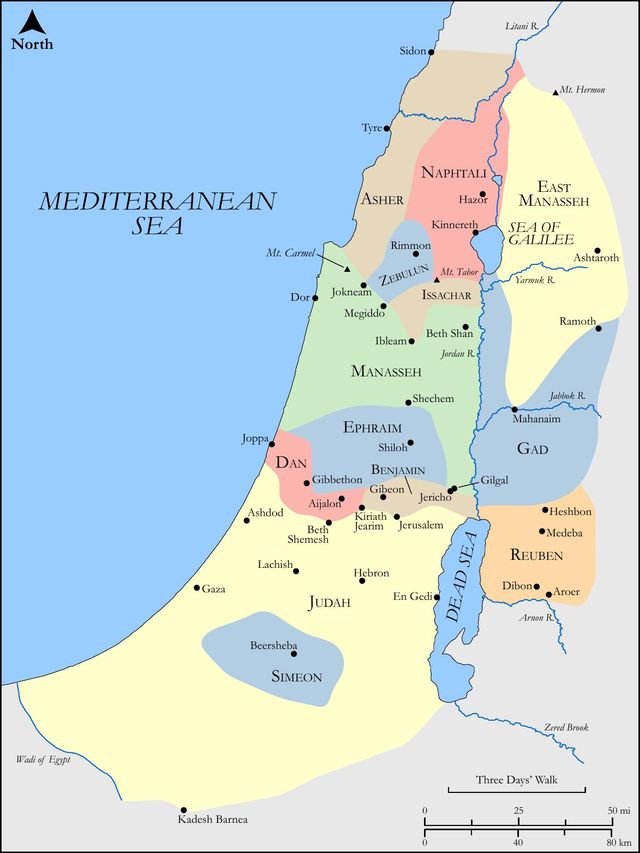
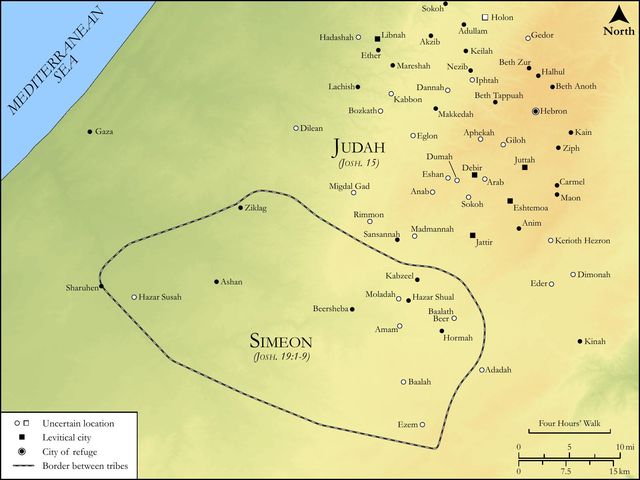
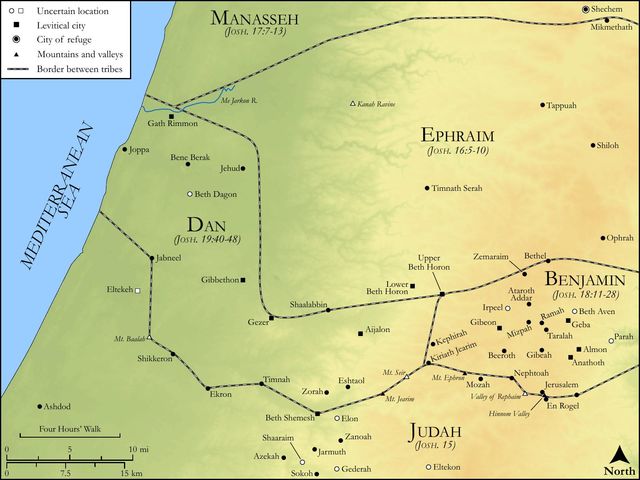
Study this verse
Public-domain commentary
Matthew Henry
From his Commentary on the Whole Bible. Henry comments on passages, not single verses — this entry covers Joshua 19:24–31.
The lot of Asher lay upon the coast of the great sea. We read not of any famous person of this tribe but Anna the prophetess, who was a constant resident in the temple at the time of our Saviour's birth, Luk 2:36. Nor were there many famous places in this tribe. Aphek (mentioned Jos 19:30) was the place near which Benhadad was beaten by Ahad, Kg1 20:30. But close adjoining to this tribe were the celebrated sea-port towns of Tyre and Sidon, which we read so much of. Tyre is called here that strong city (Jos 19:29), but Bishop Patrick thinks it was not the same Tyre that we read of afterwards, for that was built on an island; this old strong city was on the continent. And it is conjectured by some that into these two strong-holds, Sidon and Tzor, or Tyre, many of the people of Canaan fled and took shelter when Joshua invaded them.
Continue studying Joshua 19:27 across the web’s major study libraries — every link below opens this exact verse, chapter, or book on the destination site.
Read & Compare
 BibleGatewayThis verse in more than 200 translations and 70 languages.
 Bible.comThe YouVersion reader — hundreds of translations, reading plans, and highlights.
 ESV.orgCrossway's official English Standard Version reader.
 NET BibleThe NET translation with 60,000+ translators' notes on every rendering decision.
 STEP BibleTyndale House's free study tool — original text, vocabulary, and scholarly resources.
 BibliaLogos Bible Software's free web reader.
 USCCBThe New American Bible (Revised Edition) with the U.S. bishops' study notes.
Commentaries
 BibleHub CommentariesDozens of classic commentaries on this verse, gathered on one page.
 StudyLightMore than 100 commentary sets — the largest collection on the web.
 BibleRefPlain-English commentary on what this verse means, verse by verse.
 Enduring WordDavid Guzik's free commentary on this chapter, widely used by Bible teachers.
 Bible Study ToolsVerse commentary alongside Greek and Hebrew study aids.
Original Language & Research
- BibleHub InterlinearThe verse word by word — original language, transliteration, and English.
- BibleHub LexiconEvery word's original-language definition and Strong's entry.
 Blue Letter BibleDeep-study tools — Strong's numbers, concordance, and word studies.
 SefariaThe Hebrew text with Rashi and centuries of Jewish commentary.
Sermons, Hymns & Audio


TrulyRandomVerse is not affiliated with these sites and doesn’t control their content. They’re linked because they’re genuinely useful.
Summary
Joshua 19:27 meticulously delineates a segment of the northern and eastern boundary of the territory allotted to the tribe of Asher. This verse precisely traces the border's path from Bethdagon towards Zebulun, through the valley of Jiphthahel, and extending to Cabul. As part of the broader geographical descriptions in Joshua 13-21, this detailed account stands as a profound testament to God's unwavering faithfulness in fulfilling His ancient promises to Israel by tangibly establishing their inheritance in the Promised Land.
Context
ShowHideLiterary Context
Joshua 19:27 is embedded within the extensive and highly detailed section of the book of Joshua (chapters 13-21) that meticulously records the division of the land of Canaan among the twelve tribes of Israel. Following the initial military conquests, this segment serves as a comprehensive legal and theological record of the fulfillment of God's promise to give the land as an enduring inheritance. Specifically, chapter 19 outlines the portions received by the tribes of Simeon, Zebulun, Issachar, Asher, Naphtali, and Dan. Verse 27, therefore, functions as a precise geographical marker within the larger narrative of Asher's inheritance, defining its border in relation to neighboring tribes and significant landmarks. The meticulous nature of these boundary descriptions underscores the profound legal, administrative, and theological significance of the land distribution, transforming divine promise into tangible, verifiable reality.
Historical & Cultural Context
The period described in the book of Joshua marks a pivotal transition for the Israelite nation: from nomadic wandering in the wilderness to settled agricultural life within the Promised Land. In ancient Israelite society, land ownership was not merely an economic asset but the foundational basis for tribal identity, communal sustenance, and the tangible expression of covenantal blessing. The highly detailed boundary descriptions, such as those found in Joshua 19:27, were absolutely crucial for establishing clear tribal jurisdictions, preventing inter-tribal disputes, and ensuring the long-term stability and cohesion of the nascent Israelite confederacy. The mention of places like "Bethdagon" also subtly highlights the continued presence of Canaanite populations and their religious practices, even within the newly allocated Israelite territories, underscoring the ongoing challenge of fully dispossessing the inhabitants and establishing Yahweh's exclusive worship throughout the land.
Key Themes
ShowHideThis verse, and the broader context of the land distribution, powerfully illuminates several foundational theological themes. Primarily, it underscores Divine Faithfulness and Fulfillment, demonstrating God's unwavering commitment to His covenant promises, first made to Abraham in Genesis 12:7 and consistently reiterated throughout the wilderness journey (e.g., Numbers 34). The precise delineation of boundaries serves as irrefutable proof that God delivered on His word, down to the most intricate specifics of the land. Secondly, it emphasizes Divine Order and Precision. The systematic, detailed, and seemingly exhaustive allocation of territory reflects God's orderly nature and His meticulous care for His people, ensuring clarity, preventing chaos, and establishing a stable foundation for their national life. Finally, the verse speaks profoundly to Tribal Identity and Inheritance, as the land was not merely property but the physical manifestation of each tribe's unique place within the nation of Israel and their share in God's abundant blessing. This inheritance was foundational to their communal and individual identity, profoundly shaping their future narratives and responsibilities within the covenant nation, as seen throughout the book of Joshua.
Exposition and Analysis
ShowHideKey Word Analysis
ShowHideFrom bayith and dâgôwn, meaning "house of Dagon." This place name carries significant historical and religious implications. Dagon was a prominent Philistine and Canaanite deity, often associated with grain, fertility, and sometimes depicted as a fish-god. While the most famous cult centers of Dagon were in Philistine cities like Ashdod and Gaza, the mention of "Bethdagon" within Asher's territory suggests either a local Canaanite shrine dedicated to Dagon that predated Israelite settlement, or simply a place name that retained its original meaning without necessarily indicating active Dagon worship by the Israelites. Its inclusion here is purely geographical, marking a specific point on Asher's boundary.
From the same root as kevel (fetter), in the sense of limitation or sterility. While its precise etymology is debated, some interpretations suggest "bound," "fettered," or even "displeasing" or "good for nothing." This latter interpretation gains traction from its later appearance in 1 Kings 9:13, where King Hiram of Tyre expresses dissatisfaction with the twenty cities, including Cabul, that King Solomon gave him as payment. In the context of Joshua 19:27, however, Cabul functions simply as a geographical landmark, denoting the western extent of this particular segment of Asher's border.
A primitive root meaning "to go (causatively, bring) out, in a great variety of applications, literally and figuratively, direct and proxim." In this context, it signifies the boundary line's progression or extension. The use of "goeth out" emphasizes the dynamic movement and continuation of the border, indicating that it proceeds from one point to another, marking the full extent of the tribal allotment. This verb highlights the active and definitive establishment of the territorial limits.
Verse Breakdown
ShowHide"And turneth toward the sunrising to Bethdagon"
This initial phrase indicates a specific directional change in the boundary line. The border, having followed a previous course, now takes an eastward turn ("toward the sunrising") to encompass or reach the location known as Bethdagon. This implies that Bethdagon served as a significant corner, pivot point, or landmark that dictated a change in the border's trajectory.
"and reacheth to Zebulun"
This clause signifies that Asher's territorial boundary extended to meet the established border of the tribe of Zebulun. This connection is crucial for understanding the precise geographical relationships and shared frontiers between the various tribal allotments, ensuring no overlap or ambiguity in their respective inheritances.
"and to the valley of Jiphthahel toward the north side of Bethemek, and Neiel"
This section further elaborates on the intricate course of the border, incorporating prominent natural features and specific towns. The "valley of Jiphthahel" is identified as a key part of the boundary, with its relation to other towns or landmarks like Bethemek (specifically on its north side) and Neiel providing highly specific and verifiable details for the precise delineation.
"and goeth out to Cabul on the left hand"
This concluding phrase indicates the continued progression of the border, eventually reaching the town of Cabul. The directional indicator "on the left hand" is significant; when facing east (as implied by "sunrising"), "left hand" typically refers to the north. This further solidifies the precise geographical trajectory of Asher's northern or eastern boundary, providing a clear endpoint for this described segment.
Literary Devices
ShowHideThe primary literary device employed in Joshua 19:27, and indeed throughout the land distribution chapters (Joshua 13-21), is Topographical Listing or Gazetteer Style. This meticulous enumeration of towns, valleys, and directional markers serves several crucial purposes. It provides a highly detailed and verifiable record, akin to a legal deed or a survey document, confirming the precise fulfillment of God's promise to give the land to Israel. The sheer volume and specificity of these geographical names lend an undeniable air of authenticity and historical accuracy to the narrative, grounding the divine actions in concrete reality. Furthermore, the Repetition of directional phrases ("turneth toward," "reacheth to," "goeth out") and the naming of multiple landmarks within a single verse emphasize the thoroughness of the land survey and the divine precision involved in the allocation. This detailed mapping transforms an abstract promise into a tangible, divinely ordained reality, powerfully reinforcing the overarching Fulfillment Narrative that characterizes the entire book of Joshua.
Theological and Thematic Connections
ShowHideJoshua 19:27, though seemingly a dry list of ancient place names, is profoundly theological in its implications. It underscores God's meticulous attention to detail and His unwavering faithfulness in fulfilling His covenant promises. The very act of precisely delineating tribal boundaries demonstrates that God's word is not vague or abstract; it is concrete, specific, and perfectly executed. This divine precision reflects God's orderly nature and His absolute sovereignty over all creation, extending even to the geographical contours of the land. For the Israelites, this detailed inheritance was a tangible sign of their identity as God's chosen people and the security of His provision. It teaches us that God cares about the specifics of our lives, not just the broad strokes, and that His promises, though sometimes long in coming, are always delivered with perfect accuracy, demonstrating His steadfast love and covenant fidelity.
Reflection and Application
ShowHideThe meticulous detail of Joshua 19:27, describing ancient boundaries, might at first seem distant from our contemporary lives. Yet, it offers profound lessons about God's character and His interaction with humanity. This verse reminds us that our God is a God of precision, order, and absolute faithfulness. Just as He meticulously planned and executed the distribution of the Promised Land, down to every valley and town, so too does He orchestrate the details of our lives. This truth should instill in us a deep sense of trust in His sovereign plan and His meticulous care. Even in seemingly mundane or challenging circumstances, we can rest assured that God is at work, fulfilling His purposes and promises with divine accuracy. Furthermore, the concept of boundaries—physical, spiritual, and relational—is vital. God established clear boundaries for Israel's flourishing, and likewise, healthy boundaries in our lives (whether moral, relational, or personal) are often divinely ordained for our protection, identity, and flourishing, guiding us toward the abundant life He intends.
Questions for Reflection
ShowHideFAQ
ShowHideWhy are these geographical details so important in the book of Joshua?
ShowHideThese geographical details are critically important for several reasons. First, they serve as irrefutable proof of God's faithfulness in fulfilling His covenant promises to Abraham and his descendants that they would inherit the land of Canaan. The meticulous listing demonstrates that the promise was not vague but was delivered with precise, tangible boundaries, as affirmed in Joshua 21:43-45. Second, they functioned as a legal and administrative document, clearly defining each tribe's inheritance, which was essential for maintaining order, preventing disputes over territory, and establishing tribal identity and economic stability. Finally, these details underscore the historical accuracy and verifiability of the narrative, rooting the divine action in concrete geographical realities.
What is the significance of "Bethdagon" being mentioned?
ShowHide"Bethdagon" literally means "house of Dagon," referring to a temple or center of worship for Dagon, a prominent Canaanite and Philistine deity associated with grain and fertility. While the most famous Dagon cult centers were in Philistia, this Bethdagon in Asher's territory indicates the pervasive presence of Canaanite religious practices throughout the land. Its mention highlights the spiritual challenge Israel faced in dispossessing the inhabitants and establishing the exclusive worship of Yahweh. It serves as a reminder that the Promised Land was not empty but occupied by cultures with idolatrous practices that Israel was commanded to eradicate, as seen in the broader commands of Deuteronomy 7:1-5.
Is this "Cabul" the same one mentioned in 1 Kings?
ShowHideYes, the Cabul mentioned in Joshua 19:27 is indeed the same geographical location that reappears later in 1 Kings 9:13. In 1 Kings, King Solomon gives twenty cities in the land of Galilee, including Cabul, to Hiram, King of Tyre, as payment for his assistance in building the temple and his own palace. Hiram, however, was displeased with these cities, famously calling them "Cabul," a name that some interpret as "good for nothing" or "displeasing." While in Joshua, Cabul simply functions as a neutral geographical marker defining Asher's boundary, its later appearance provides an interesting historical footnote about its perceived value in a different context, highlighting the differing perspectives on the land's worth.
Christ-Centered Fulfillment
ShowHideThe detailed land distribution in Joshua, exemplified by the meticulous boundary descriptions in Joshua 19:27, finds its ultimate and spiritual fulfillment in Jesus Christ. The physical inheritance of the Promised Land, with its precisely defined boundaries, was a profound type and shadow of the far greater spiritual inheritance and eternal rest that God provides for His people in Christ. Just as the land provided security, identity, and sustenance for the tribes of Israel, so Jesus is our true "inheritance" and "rest" (Hebrews 4:8-10). He is the one who leads us into the ultimate promised land, not of earthly territory, but of spiritual blessings in heavenly places (Ephesians 1:3) and an "inheritance among the saints in light" (Colossians 1:12). The precision of the ancient boundaries foreshadows the certainty of God's eternal plan for His redeemed, culminating in the new heavens and new earth where God Himself will dwell with His people, providing a perfect and everlasting home (Revelation 21:1-4). This divine dwelling place, secured by Christ's redemptive work, far surpasses any earthly allotment, offering an eternal, unshakeable inheritance for all who are in Him, as Jesus Himself promised, "In my Father's house are many mansions... I go to prepare a place for you" (John 14:2).