


Joshua 19:28
Bible text: King James Version (1769 Blayney text) · Public domain
Bible text: Berean Standard Bible · Public domain
Bible text: American Standard Version (1901) · Public domain
Bible text: World English Bible, Messianic edition · Public domain
Bible text: Geneva Bible (1599) · Public domain
Bible text: Young's Literal Translation · Public domain
- וְעֶבְרֹןve·'ev·Ronand EbronH5683Conj-w ¦ N-properNoun Proper LocationוְandעֶבְרֹןEbron
- וּרְחֹבu·re·Choand RehobH7340Conj-w ¦ N-properNoun Proper LocationוּandרְחֹבRehob
- וְחַמּוֹןve·cha·Monand HammonH2540Conj-w ¦ N-properNoun Proper LocationוְandחַמּוֹןHammon
- וְקָנָהve·ka·Nahand KanahH7071Conj-w ¦ N-properNoun Proper LocationוְandקָנָהKanah
- עַד'adtoH5704PrepPreposition
- צִידוֹןtzi·DonSidonH6721N-properNoun Proper Location
- רַבָּהra·BahgreatH7227Adj-fsAdjective Singular Feminine Absolute
English is a literal word-by-word gloss of the Hebrew, not the KJV's wording. Why?
This is the original text the KJV's translators worked from — each Hebrew word with its own literal English meaning in this verse, prepared by scholars at Tyndale House, Cambridge. The KJV translates whole sentences, not word by word, so its wording differs: one Hebrew word can become several English words, and the KJV may choose “the LORD” where the gloss reads “Yahweh”. Both are faithful — they answer different questions. For the KJV's own rendering, switch to the KJV text.
Details
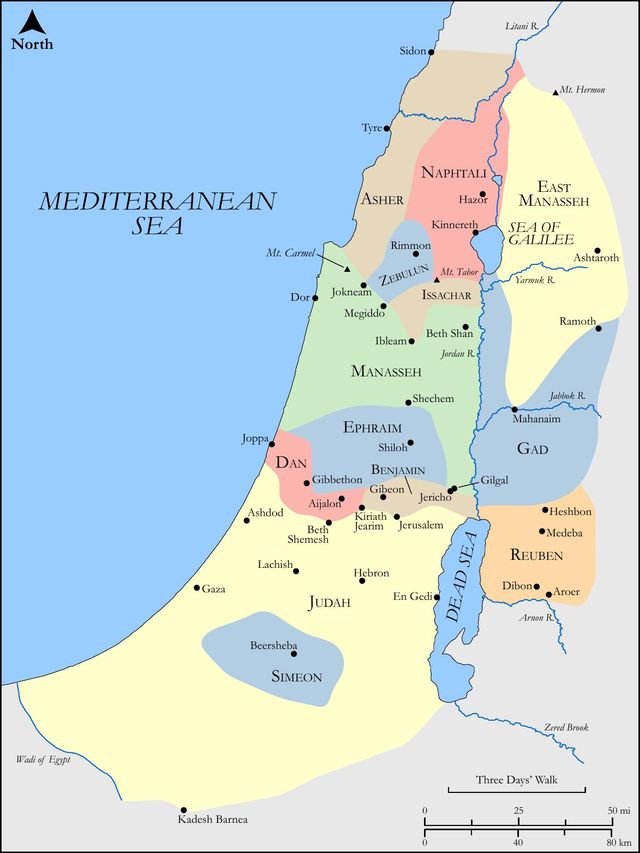
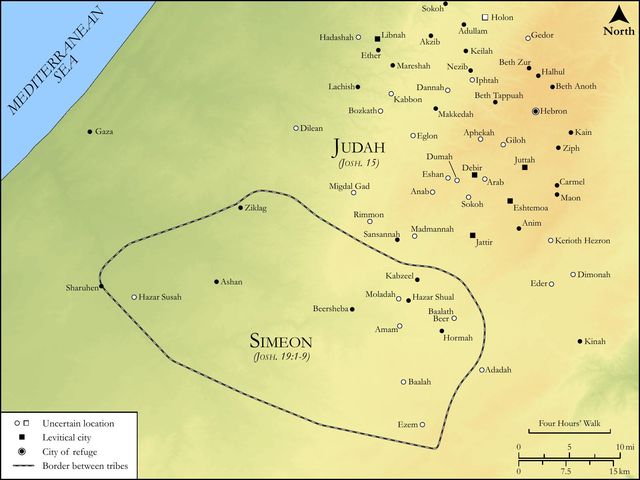
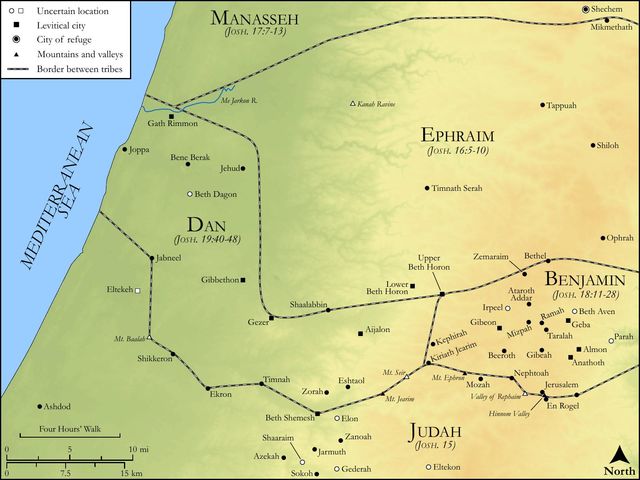
See on the biblical-era maps
Study this verse
Public-domain commentary
Matthew Henry
From his Commentary on the Whole Bible. Henry comments on passages, not single verses — this entry covers Joshua 19:24–31.
The lot of Asher lay upon the coast of the great sea. We read not of any famous person of this tribe but Anna the prophetess, who was a constant resident in the temple at the time of our Saviour's birth, Luk 2:36. Nor were there many famous places in this tribe. Aphek (mentioned Jos 19:30) was the place near which Benhadad was beaten by Ahad, Kg1 20:30. But close adjoining to this tribe were the celebrated sea-port towns of Tyre and Sidon, which we read so much of. Tyre is called here that strong city (Jos 19:29), but Bishop Patrick thinks it was not the same Tyre that we read of afterwards, for that was built on an island; this old strong city was on the continent. And it is conjectured by some that into these two strong-holds, Sidon and Tzor, or Tyre, many of the people of Canaan fled and took shelter when Joshua invaded them.
Continue studying Joshua 19:28 across the web’s major study libraries — every link below opens this exact verse, chapter, or book on the destination site.
Read & Compare
 BibleGatewayThis verse in more than 200 translations and 70 languages.
 Bible.comThe YouVersion reader — hundreds of translations, reading plans, and highlights.
 ESV.orgCrossway's official English Standard Version reader.
 NET BibleThe NET translation with 60,000+ translators' notes on every rendering decision.
 STEP BibleTyndale House's free study tool — original text, vocabulary, and scholarly resources.
 BibliaLogos Bible Software's free web reader.
 USCCBThe New American Bible (Revised Edition) with the U.S. bishops' study notes.
Commentaries
 BibleHub CommentariesDozens of classic commentaries on this verse, gathered on one page.
 StudyLightMore than 100 commentary sets — the largest collection on the web.
 BibleRefPlain-English commentary on what this verse means, verse by verse.
 Enduring WordDavid Guzik's free commentary on this chapter, widely used by Bible teachers.
 Bible Study ToolsVerse commentary alongside Greek and Hebrew study aids.
Original Language & Research
- BibleHub InterlinearThe verse word by word — original language, transliteration, and English.
- BibleHub LexiconEvery word's original-language definition and Strong's entry.
 Blue Letter BibleDeep-study tools — Strong's numbers, concordance, and word studies.
 SefariaThe Hebrew text with Rashi and centuries of Jewish commentary.
Sermons, Hymns & Audio


TrulyRandomVerse is not affiliated with these sites and doesn’t control their content. They’re linked because they’re genuinely useful.
Summary
Joshua 19:28 precisely delineates a segment of the northern boundary for the tribe of Asher's allotted territory within the Promised Land. This verse meticulously lists key towns—Hebron (distinct from the prominent city in Judah), Rehob, Hammon, and Kanah—that marked the extent of Asher's inheritance, stretching geographically "even unto great Zidon." This precise geographical demarcation is an integral part of the comprehensive and divinely ordained division of Canaan among the tribes of Israel, representing a crucial step in the fulfillment of God's ancient covenant promises under the leadership of Joshua.
Context
ShowHideLiterary Context
Joshua 19:28 is situated within the latter half of the Book of Joshua, specifically in chapter 19, which meticulously records the land allotments for the remaining Israelite tribes: Simeon, Zebulun, Issachar, Asher, Naphtali, and Dan. This chapter, along with chapters 13 through 21, serves as the detailed fulfillment of God's promises of land to Abraham's descendants, transitioning Israel from a nomadic people to an established nation. The preceding verses (Joshua 19:24-27) describe the general area of Asher's inheritance, while verse 28 provides specific boundary markers, indicating the northernmost extent of their territory. The subsequent verses (Joshua 19:29-31) continue to delineate Asher's borders and list additional towns within their tribal lot, emphasizing the comprehensive nature of the land distribution process.
Historical & Cultural Context
The division of the land occurred after the initial conquest campaigns led by Joshua, marking a pivotal moment in Israelite history where the nomadic tribes began to settle and establish their distinct identities within the Promised Land. The process of land allocation, often involving lots (as mentioned in Numbers 26:55), was understood as a divine act, ensuring impartiality and God's sovereign hand in their inheritance. Culturally, land ownership was central to Israelite identity, lineage, and economic stability. The mention of "great Zidon" is significant as it places Asher's territory adjacent to, or even encompassing areas near, powerful Phoenician city-states. These were highly developed maritime and commercial centers, distinct in their polytheistic religion and sophisticated culture, presenting both opportunities for trade and significant challenges for Israelite purity and faithfulness to Yahweh, as later seen in Judges 1:31.
Key Themes
ShowHideThis verse, within the broader context of Joshua 19, highlights several key themes. First, it underscores Divine Fulfillment and Inheritance, demonstrating God's absolute faithfulness to His covenant promises made to the patriarchs, particularly Abraham, concerning the land (e.g., Genesis 12:7). The meticulous detail of the boundaries emphasizes the precision of God's word. Second, it touches upon Geographical Significance and Identity, as the land defined the tribal identity and sphere of influence for Asher, integrating them into the larger Israelite nation. The inclusion of "great Zidon" also introduces the theme of Proximity to Foreign Cultures, foreshadowing the ongoing tension and challenges Israel would face in maintaining its distinct identity and obedience to God while living alongside powerful, un-dispossessed peoples. This tension between divine command to dispossess and the reality of co-existence is a recurring motif throughout the book of Joshua and into the book of Judges.
Exposition and Analysis
ShowHideKey Word Analysis
ShowHideDerived from a root meaning "warm," this name likely refers to a "warm spring." Its inclusion in this list indicates a specific geographical marker, possibly a town near a thermal spring, used to delineate Asher's northern boundary. Its precise location is debated, but its function here is purely as a landmark in the tribal allotment.
This adjective, meaning "abundant," "exceedingly," or "mighty," is consistently applied to Zidon in biblical texts (e.g., Joshua 11:8). Its use here emphasizes the significant power, wealth, and influence of Zidon as a major Phoenician maritime and trading hub. The description highlights the formidable nature of this non-Israelite city-state, which bordered Asher's territory.
From a root meaning "to catch fish," this name points to "fishery" and refers to the ancient Phoenician city of Sidon. Located on the Mediterranean coast north of Tyre, Zidon was a prominent commercial and political center. Its mention as the endpoint of Asher's northern boundary signifies the extreme reach of the tribe's inheritance towards a powerful, un-conquered foreign entity, setting the stage for future interactions and challenges.
Verse Breakdown
ShowHide"And Hebron, and Rehob, and Hammon, and Kanah,"
This clause enumerates four specific towns or geographical points that served as markers along the northern boundary of the tribe of Asher's inheritance. These locations were not necessarily cities fully occupied by Asher but rather well-known landmarks that precisely defined the extent of their allotted land. The listing underscores the meticulous and detailed nature of the land distribution, reflecting God's precise fulfillment of His promises and providing clear demarcation for the tribe.
"[even] unto great Zidon;"
This phrase indicates the ultimate northern limit of Asher's territory. The preposition "unto" (ʿad) suggests that the boundary extended up to the vicinity of Zidon, implying that Zidon itself was not necessarily conquered or fully possessed by Asher, but rather served as the final geographical marker. The inclusion of "great Zidon" highlights the proximity of Asher to a powerful, non-Israelite city-state, a reality that would present ongoing challenges and interactions for the tribe in the future regarding their obedience to the command to dispossess the inhabitants of the land.
Literary Devices
ShowHideThe primary literary device employed in Joshua 19:28 is Enumeration, where a list of specific towns (Hebron, Rehob, Hammon, Kanah) is used to precisely define the geographical boundaries. This technique provides concrete detail and reinforces the meticulous nature of the land distribution. Coupled with enumeration is Geographical Precision, which is evident throughout the land allotment chapters of Joshua. This precision serves to authenticate the historical account and underscores the literal fulfillment of God's promise of land. Furthermore, the phrase "even unto great Zidon" functions as a form of Merism, defining the extent of the territory by naming its endpoint. The descriptive adjective "great" attached to Zidon also serves as an Epithet, emphasizing the city's significant status and power, which subtly Foreshadows the future challenges and failures of Asher to fully dispossess the inhabitants of this region, as later recounted in the book of Judges.
Theological and Thematic Connections
ShowHideJoshua 19:28, though a seemingly dry geographical listing, is profoundly theological. It stands as a testament to God's unwavering faithfulness in fulfilling His ancient promises to Abraham regarding the land of Canaan. The meticulous detail of the boundaries underscores that God's word is precise and reliable, leaving no ambiguity about the inheritance He provides for His people. This divine provision was not merely a physical space but the foundation for Israel's identity, worship, and national purpose. The inclusion of "great Zidon" within Asher's boundary also highlights the ongoing tension between God's command to dispossess and the reality of living among ungodly nations, a theme that resonates throughout biblical history and challenges believers to maintain their distinct identity in a fallen world.
Reflection and Application
ShowHideThe detailed geographical descriptions in Joshua, including verse 19:28, serve as a powerful reminder of God's faithfulness and meticulous care for His people. Just as He precisely fulfilled His promise of land to Israel, He is faithful to fulfill every promise He has made to us, down to the smallest detail. This should instill profound trust and confidence in His character, even when our circumstances seem uncertain or our "inheritance" feels distant. Furthermore, the proximity of Asher to "great Zidon" offers a timeless lesson on living as God's people in a complex world. We are called to be in the world, engaging with its challenges and opportunities, but not to be conformed to its values. This requires discernment, spiritual resilience, and a firm commitment to our identity in Christ, ensuring that the boundaries of our faith are not eroded by the powerful influences around us. We are to be distinct, shining as lights in the midst of darkness, even as we navigate the realities of our cultural landscape.
Questions for Reflection
ShowHideFAQ
ShowHideWhy are these specific towns listed in Asher's boundary, and not others?
ShowHideThe towns listed in Joshua 19:28 (Hebron, Rehob, Hammon, Kanah) were likely significant geographical landmarks or existing settlements that served as clear, recognizable markers for the tribal boundary. The biblical text often uses prominent features or established towns to delineate borders, making the division tangible and understandable to the people. While many other towns existed, these specific ones were chosen for their strategic location in defining the northern extent of Asher's inheritance, stretching "even unto great Zidon." This precision ensured that each tribe knew the exact limits of their divinely appointed land.
What is the significance of "great Zidon" being mentioned as a boundary marker?
ShowHideThe mention of "great Zidon" is highly significant because Zidon (Sidon) was a major Phoenician city-state, renowned for its maritime trade, wealth, and powerful influence along the coast of Canaan. Its inclusion as a boundary marker for Asher indicates that the Israelite territory extended to its vicinity, placing the tribe in direct contact with a formidable, non-Israelite culture. This proximity foreshadowed future interactions, challenges, and temptations for Asher, as they were commanded to dispossess the inhabitants of the land but often failed to do so, as noted in Judges 1:31. It highlights the ongoing tension between God's call for separation and the realities of co-existence.
Did the tribe of Asher fully possess all the territory described in this verse, including Zidon?
ShowHideNo, the tribe of Asher did not fully possess or dispossess the inhabitants of all the territory described, particularly the powerful Phoenician cities like Zidon. While Joshua 19:28 defines the allotted boundary, the book of Judges later clarifies that Asher "did not drive out the inhabitants of Acco, or the inhabitants of Sidon, or of Ahlab, or of Achzib, or of Helbah, or of Aphik, or of Rehob" (Judges 1:31). This highlights a recurring theme in Judges: the tribes' failure to fully obey God's command to dispossess the Canaanites, which led to ongoing spiritual and cultural challenges for Israel. The phrase "even unto great Zidon" thus describes the divinely intended boundary, not necessarily the fully realized extent of Asher's occupation.
Christ-Centered Fulfillment
ShowHideWhile Joshua 19:28 meticulously details the earthly inheritance of Asher, it points to a far greater, spiritual inheritance found in Christ. The precise fulfillment of God's promise of land to Israel foreshadows the ultimate and perfect fulfillment of all God's promises in Jesus Christ, who is the "Amen" to every divine pledge (2 Corinthians 1:20). Just as Asher received a physical inheritance, believers in Christ receive a spiritual inheritance that is "imperishable, undefiled, and unfading, kept in heaven for you" (1 Peter 1:4). The boundaries of Asher's land defined their identity and place; similarly, in Christ, believers find their true identity and citizenship in heaven (Philippians 3:20), being brought into God's very family as adopted sons and daughters (Ephesians 1:5). The proximity of Asher to "great Zidon" also serves as a type for the church's mission in the world: we are called to be in the world but not of it, to shine as lights in the midst of darkness (Matthew 5:14), and to proclaim the gospel to all nations, even to the "ends of the earth" (Acts 1:8), engaging with cultures that may be hostile or indifferent to God, yet without compromising our distinct identity in the Lord Jesus Christ.