


Joshua 11:8
- וַיִּתְּנֵםvai·yi·te·Nemand he gave themH5414Conj-w ¦ V-Qal-ConsecImperf-3ms ¦ 3mpVerb Qal Consecutive Imperfect 3rd Singular Masculineוַandיִּתְּנֵhe gaveםthem
- יְהוָהYah·wehYahwehH3068N-properNoun Proper Title
- בְּיַדbe·yadin [the] hand ofH3027Prep-b ¦ N-cscNoun Singular common gender Constructבְּinיַד[the] hand of
- יִשְׂרָאֵלYis·ra·'ElIsraelH3478N-properNoun Proper Location
- וַיַּכּוּםvai·ya·Kumand they struck down themH5221Conj-w ¦ V-Hiphil-ConsecImperf-3mp ¦ 3mpVerb Hiphil Consecutive Imperfect 3rd Plural Masculineוַandיַּכּוּthey struck downםthem
- וַיִּרְדְּפוּםvai·yir·de·Fumand they pursued themH7291Conj-w ¦ V-Qal-ConsecImperf-3mp ¦ 3mpVerb Qal Consecutive Imperfect 3rd Plural Masculineוַandיִּרְדְּפוּthey pursuedםthem
- עַד'adtoH5704PrepPreposition
- צִידוֹןtzi·DonSidonH6721N-properNoun Proper Location
- רַבָּהra·BahgreatH7227Adj-fsAdjective Singular Feminine Absolute
- וְעַדve·'Adand toH5704Conj-w ¦ PrepPrepositionוְandעַדto
- מִשְׂרְפוֹתmis·re·FotMisrephothH4956N-properNoun Proper Location
- מַיִםMa·yimMaimH4956N-properNoun Proper Location
- וְעַדve·'adand toH5704Conj-w ¦ PrepPrepositionוְandעַדto
- בִּקְעַתbik·'At[the] valley ofH1237N-fscNoun Singular Feminine Construct
- מִצְפֶּהmitz·PehMizpahH4708N-properNoun Proper Location
- מִזְרָחָהmiz·Ra·chaheast -wardsH4217N-ms ¦ SfxNoun Singular Masculine Absoluteמִזְרָחָeastה-wards
- וַיַּכֻּםvai·ya·Kumand they struck down themH5221Conj-w ¦ V-Hiphil-ConsecImperf-3mp ¦ 3mpVerb Hiphil Consecutive Imperfect 3rd Plural Masculineוַandיַּכֻּthey struck downםthem
- עַד'aduntilH5704PrepPreposition
- בִּלְתִּיbil·TinotH1115N-csNoun Singular common gender Absolute
- הִשְׁאִירhish·'irhe had leftH7604V-Hiphil-Perf-3msVerb Hiphil Perfect 3rd Singular Masculine
- לָהֶםla·Hemto <the> themPrep-l ¦ 3mpSuffix Personal 3rd Plural Masculineלָto <the>הֶםthem
- שָׂרִידsa·Rida survivorH8300N-msNoun Singular Masculine Absolute
English is a literal word-by-word gloss of the Hebrew, not the KJV's wording. Why?
This is the original text the KJV's translators worked from — each Hebrew word with its own literal English meaning in this verse, prepared by scholars at Tyndale House, Cambridge. The KJV translates whole sentences, not word by word, so its wording differs: one Hebrew word can become several English words, and the KJV may choose “the LORD” where the gloss reads “Yahweh”. Both are faithful — they answer different questions. For the KJV's own rendering, switch to the KJV text.
Details
See on the biblical-era map
Study this verse
Public-domain commentary
Matthew Henry
From his Commentary on the Whole Bible. Henry comments on passages, not single verses — this entry covers Joshua 11:1–9. His three-level outline is real structure in the source text, so it is rendered as structure.
We are here entering upon the story of another campaign that Joshua made, and it was a glorious one, no less illustrious than the former in the success of it, though in respect of miracles it was inferior to it in glory. The wonders God then wrought for them were to animate and encourage them to act vigorously themselves. Thus the war carried on by the preaching of the gospel against Satan's kingdom was at first forwarded by miracles; but, the war being by them sufficiently proved to be of God, the managers of it are now left to the ordinary assistance of divine grace in the use of the sword of the Spirit, and must not expect hail-stones nor the standing still of the sun. In this story we have,
I.The Canaanites taking the field against Israel.
They were the aggressors, God hardening their hearts to begin the war, that Israel might be justified beyond exception in destroying them. Joshua and all Israel had returned to the camp at Gilgal, and perhaps these kings knew no other than that they intended to sit down content with the conquest they had already made, and yet they prepare war against them. Note, Sinners bring ruin upon their own heads, so that God will be justified when he speaks, and they alone shall bear the blame for ever. Judah had now couched as a lion gone up from the prey; if the northern kings rouse him up, it is at their peril, Gen 49:9. Now,
1.Several nations joined in this confederacy, some in the mountains and some in the plains, Jos 11:2. Canaanites from east and west, Amorites, Hittites, Perizzites, etc. (Jos 11:3), of different constitutions and divided interests among themselves, and yet they here unite against Israel as against a common enemy. Thus are the children of this world more unanimous, and therein wiser, than the children of light. The oneness of the church's enemies should shame the church's friends out of their discords and divisions, and engage them to be one.
2.The head of this confederacy was Jabin king of Hazor (Jos 11:1), as Adoni-zedec was of the former; it is said (Jos 11:10) Hazor had been the head of all those kingdoms, which could not have revolted without occasioning ill-will; but this was forgotten and laid aside upon this occasion, by consent of parties, Luk 23:12. When they had all drawn up their forces together, every kingdom bringing in its quota, they were a very great army, much greater than the former, as the sand on the sea shore in multitude, and upon this account much stronger and more formidable, that they had horses and chariots very many, which we do not find the southern kings had; hereby they had a great advantage against Israel, for their army consisted only of foot, and they never brought horses nor chariots into the field. Josephus tells us that the army of the Canaanites consisted of 300,000 foot, 10,000 horses, and 20,000 chariots. Many there be that rise up against God's Israel; doubtless their numbers made them very confident of success, but it proved that so much the greater slaughter was made of them.
II.The encouragement God gave to Joshua to give them the meeting, even upon the ground of their own choosing (Jos 11:6):
Be not afraid because of them. Joshua was remarkable for his courage - it was his master grace, and yet it seems he had need to be again and again cautioned not to be afraid. Fresh dangers and difficulties make it necessary to fetch in fresh supports and comforts from the word of God, which we have always nigh unto us, to be made use of in every time of need. Those that have God on their side need not be disturbed at the number and power of their enemies; more are those that are with us than those that are against us; those have the hosts of the Lord that have the Lord of hosts engaged for them. For his encouragement,
1.God assures him of success, and fixes the hour: Tomorrow about this time, when an engagement (it is probable) was expected and designed on both sides, I will deliver them up slain. Though they were to be slain by the sword of Israel, yet it is spoken of as God's work, that he would deliver them up.
2.He appoints him to hough their horses, hamstring them, lame them, and burn their chariots, not only that Israel might not use them hereafter, but that they might not fear them now, their God designing this contempt to be put upon them. Let Israel look upon their chariots but as rotten wood designed for the fire, and their horses of war as disabled things, scarcely good enough for the cart. This encouragement which God here gave to Joshua no doubt he communicated to the people, who perhaps were under some apprehensions of danger from this vast army, notwithstanding the experience they had had of God's power engaged for them. And the wisdom and goodness of God are to be observed,
(1.)In infatuating the counsels of the enemy, that all the kings of Canaan, who were not dispersed at such a distance from each other but that they might have got all together in a body, did not at first confederate against Israel, but were divided into the southern and northern combination, and so became the less formidable. And,
(2.)In preparing his people to encounter the greater force, by breaking the less. They first engage with five kings together, and now with many more. God proportions our trials to our strength and our strength to our trials.
III.Joshua's march against these confederate forces, Jos 11:7.
He came upon them suddenly, and surprised them in their quarters. He made this haste,
1.That he might put them into the greater confusion, by giving them an alarm, when they little thought he was near them.
2.That he might be sure not to come short of the honour God had fixed, to give him the meeting at the enemies' camp, tomorrow about this time. It is fit we should keep time with God.
IV.His success, Jos 11:8.
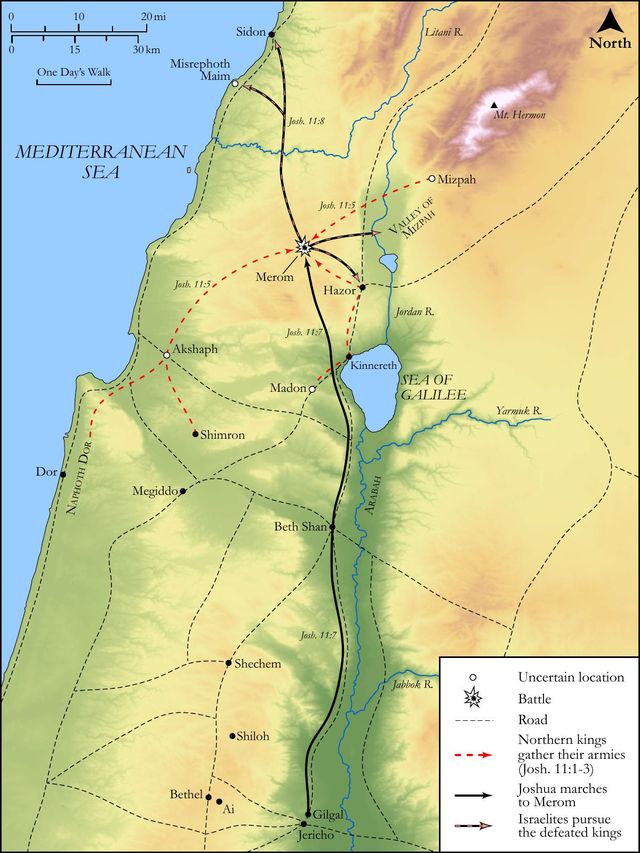
He obtained the honour and advantage of a complete victory; he smote them and chased them, in the several ways they took in their flight; some fled towards Zidon, which lay to the northwest, others towards Mizpeh, eastward, but the parties Joshua sent out pursued them each way. So the Lord delivered them into the hand of Israel; they would not deliver themselves into the hands of Israel to be made proselytes and tributaries, and so offered up to God's grace (Rom 15:16), and therefore God delivered them into their hands to be made sacrifices to his justice; for God will be honoured by us or upon us.
V.His obedience to the orders given him, in destroying the horses and chariots (Jos 11:9), which was an instance,
1.Of his subjection to the divine will, as one under authority, that must do as he is bidden.
2.Of his self-denial, and crossing his own genius and inclination in compliance with God's command.
3.Of his confidence in the power of God engaged for Israel, which enabled them to despise the chariots and horses which others trusted in, Psa 20:7; Psa 33:17.
4.Of his care to keep up in the people the like confidence in God, by taking that from them which they would be tempted to trust too much to. This was cutting of a right hand.
Continue studying Joshua 11:8 across the web’s major study libraries — every link below opens this exact verse, chapter, or book on the destination site.
Read & Compare
 BibleGatewayThis verse in more than 200 translations and 70 languages.
 Bible.comThe YouVersion reader — hundreds of translations, reading plans, and highlights.
 ESV.orgCrossway's official English Standard Version reader.
 NET BibleThe NET translation with 60,000+ translators' notes on every rendering decision.
 STEP BibleTyndale House's free study tool — original text, vocabulary, and scholarly resources.
 BibliaLogos Bible Software's free web reader.
 USCCBThe New American Bible (Revised Edition) with the U.S. bishops' study notes.
Commentaries
 BibleHub CommentariesDozens of classic commentaries on this verse, gathered on one page.
 StudyLightMore than 100 commentary sets — the largest collection on the web.
 BibleRefPlain-English commentary on what this verse means, verse by verse.
 Enduring WordDavid Guzik's free commentary on this chapter, widely used by Bible teachers.
 Bible Study ToolsVerse commentary alongside Greek and Hebrew study aids.
Original Language & Research
- BibleHub InterlinearThe verse word by word — original language, transliteration, and English.
- BibleHub LexiconEvery word's original-language definition and Strong's entry.
 Blue Letter BibleDeep-study tools — Strong's numbers, concordance, and word studies.
 SefariaThe Hebrew text with Rashi and centuries of Jewish commentary.
Sermons, Hymns & Audio


TrulyRandomVerse is not affiliated with these sites and doesn’t control their content. They’re linked because they’re genuinely useful.
Summary
Joshua 11:8 vividly recounts the decisive and comprehensive victory of the Israelite forces, led by Joshua, over the formidable northern confederation of Canaanite kings. This verse powerfully emphasizes the direct and sovereign intervention of the LORD, who actively delivered the enemy into Israel's hands, resulting in a relentless pursuit and the complete destruction of the opposing forces across a vast geographical expanse, thereby fulfilling divine promises and commands for the conquest of Canaan.
Context
ShowHideLiterary Context
Joshua 11:8 is strategically placed within the narrative of the northern campaign (Joshua 11:1-15), which represents the climactic military phase of Israel's conquest of Canaan, following successful central and southern campaigns. The preceding verses (Joshua 11:1-5) describe the assembly of a massive, multi-national Canaanite coalition at the Waters of Merom, posing an overwhelming threat. However, the narrative immediately pivots to God's explicit assurance to Joshua in Joshua 11:6, where He promises victory and provides specific instructions for neutralizing the enemy's superior chariots and horses. Verse 8 then details the fulfillment of this divine promise, depicting the swift and devastating execution of God's command. The subsequent verses further elaborate on the thoroughness of the conquest, including the burning of Hazor and the complete destruction of its inhabitants, culminating in the summary statement of the land's rest from war in Joshua 11:23.
Historical & Cultural Context
The conquest of Canaan unfolded during the Late Bronze Age (approximately 1550-1200 BC), a period characterized by a fragmented political landscape of numerous independent city-states, often forming temporary alliances for mutual defense or aggression. The Canaanites were deeply entrenched in polytheistic practices, including abhorrent rituals such as child sacrifice and various fertility cults, which the LORD explicitly condemned as detestable. Militarily, they frequently employed chariots, a highly effective and feared weapon of the era, which Israel initially lacked. The mention of "great Zidon" (Sidon), a prominent Phoenician city-state on the Mediterranean coast, signifies the extensive reach of Israel's pursuit. Misrephothmaim, likely a coastal area north of Acco, and "the valley of Mizpeh eastward" (possibly referring to a location in the Beqaa Valley or near Mount Hermon), further underscore the vast geographical scope of this campaign, demonstrating Israel's ability to project power far beyond the immediate battleground, a clear testament to God's empowering presence and strategic guidance.
Key Themes
ShowHideThis verse powerfully illustrates several overarching themes central to the book of Joshua and the broader Deuteronomic history. First, Divine Sovereignty and Faithfulness are paramount; the opening phrase, "And the LORD delivered them," unequivocally attributes the victory not to Israel's military prowess or strategic genius but to God's direct intervention and the fulfillment of His covenant promises to grant them the land, as reiterated in Deuteronomy 9:5. Second, the theme of Complete Victory and Judgment is profoundly evident in the thoroughness of the pursuit and the emphatic statement "until they left them none remaining." This reflects God's severe judgment against the entrenched wickedness of the Canaanite nations, as commanded in Deuteronomy 7:2, ensuring the removal of idolatrous influences from the land Israel was to inherit. Finally, Israel's Obedience is subtly highlighted; their diligent pursuit and complete destruction of the enemy forces demonstrate their adherence to God's often difficult commands for the conquest, reinforcing the foundational principle that divine blessing follows faithful obedience, as seen throughout Joshua 1.
Exposition and Analysis
ShowHideKey Word Analysis
ShowHideThe Hebrew verb נָתַן (nâthan, H5414) fundamentally means "to give," "to put," or "to deliver." In this context, it signifies God's active and sovereign agency in handing over the enemy into Israel's power. This emphasizes that the victory was not merely achieved by Israel's military might but was a direct result of the LORD's will and power, making the outcome a divine initiative and gift. This echoes similar declarations of divine assistance seen throughout the conquest narrative, underscoring God's active role as the true warrior for His people.
The Hebrew verb נָכָה (nâkâh, H5221) is a strong and forceful term meaning "to strike," "to beat," "to smite," or "to slay." Its repetition in the verse ("who smote them... and they smote them") highlights the decisive, violent, and thorough nature of the military engagement. It conveys the brutal reality of ancient warfare and the completeness of Israel's execution of God's judgment against the Canaanites, emphasizing the intensity and finality of the action.
The concept of "none remaining" in the phrase "until they left them none remaining" is derived from the Hebrew verb שָׁאַר (shâʼar, H7604), meaning "to remain," "to be left over," or "to survive." Here, used in the negative with the associated noun (H8300, sârîyd, "survivor"), it conveys the utter and complete annihilation of the specific armies engaged in this battle. While such language can be emphatic or hyperbolic in ancient texts, its primary function here is to communicate the decisive nature of the victory, leaving no organized resistance from this particular coalition and aligning with the concept of herem (devotion to destruction) applied to certain Canaanite populations.
Verse Breakdown
ShowHide"And the LORD delivered them into the hand of Israel"
This opening clause immediately establishes the theological foundation for the entire victory. The triumph is unequivocally attributed not to Israel's military strength, strategic prowess, or numerical superiority, but to the direct, sovereign act of Yahweh. He is the one who "gives" or "delivers" the enemy, signifying His active involvement, His unwavering faithfulness to His covenant promises, and His ultimate control over the outcome of battles. This sets the tone for understanding the entire conquest as a divinely orchestrated undertaking.
"who smote them, and chased them unto great Zidon, and unto Misrephothmaim, and unto the valley of Mizpeh eastward;"
This clause details Israel's diligent and extensive execution of the divine mandate. "Smote them" indicates the initial decisive engagement and defeat of the enemy forces. The subsequent "chased them" highlights the relentless and unyielding pursuit, preventing any regrouping, escape, or future threat from the defeated coalition. The listing of distinct geographical markers—"great Zidon" (a significant Phoenician city far to the northwest on the Mediterranean coast), "Misrephothmaim" (likely a coastal area near Tyre/Sidon), and "the valley of Mizpeh eastward" (possibly in the Anti-Lebanon range or Beqaa Valley)—underscores the vast geographical scope of the pursuit, vividly demonstrating the thoroughness of the victory and the complete dispersal of the enemy forces across a wide region.
"and they smote them, until they left them none remaining."
This concluding clause reiterates the intensity of the battle ("smote them" again) and emphatically states the ultimate outcome: a complete and utter defeat of the enemy coalition. The phrase "none remaining" signifies the total destruction of the specific armies that gathered against Israel, ensuring no survivors from those forces could pose a future threat or re-establish organized resistance. This fulfills the divine command for the herem (devotion to destruction) and serves as a powerful testament to the decisive judgment enacted by God through His people, sealing the victory.
Literary Devices
ShowHideJoshua 11:8 employs several potent literary devices to underscore the magnitude and divine nature of Israel's victory. The most prominent is Repetition, specifically the re-use of the verb "smote them" (Hebrew: nâkâh). This iterative phrasing not only emphasizes the intensity and thoroughness of the battle but also creates a rhythmic sense of relentless action and complete devastation. The verse also utilizes Geographical Detail for Emphasis, listing distant and distinct locations such as "great Zidon," "Misrephothmaim," and "the valley of Mizpeh eastward." This extensive catalog of pursuit destinations functions as a form of Hyperbole, vividly portraying the vast scope of the victory and the utter dispersal of the enemy, leaving no place for them to hide or regroup. While perhaps not every single individual was literally killed, the language conveys the complete eradication of the organized military threat from this northern coalition. This emphatic language serves to highlight the divine power at work, transforming an seemingly impossible military challenge into a resounding reality.
Theological and Thematic Connections
ShowHideJoshua 11:8 is a profound theological statement, asserting that the conquest of Canaan was fundamentally a divine work, not merely a human military campaign. The opening declaration, "And the LORD delivered them," establishes God as the primary actor, demonstrating His unwavering faithfulness to His covenant promises to Israel and His sovereign power over all nations. This victory serves as a tangible manifestation of God's justice, executing judgment upon the wicked inhabitants of Canaan while simultaneously fulfilling His promise to provide a land for His people. The thoroughness of the destruction, while challenging to modern sensibilities, reflects the severity of God's judgment against entrenched evil and idolatry, ensuring Israel's purity in the land. This passage thus powerfully affirms God's active involvement in human history, His commitment to His word, and His role as both deliverer and judge.
Reflection and Application
ShowHideJoshua 11:8, though depicting a historical military conquest, offers enduring principles for believers today. It powerfully reminds us that our ultimate victories, especially in spiritual battles, are not won by our own strength, wisdom, or resources, but by the sovereign hand of God. Just as the LORD delivered the formidable Canaanite armies into Israel's hand, He remains faithful to empower and deliver His people from the overwhelming challenges and spiritual opposition they face. This verse calls us to trust in God's active involvement in our lives, His unwavering faithfulness to His promises, and His ability to grant decisive victory over sin, temptation, and the forces of darkness. It encourages us to pursue obedience to His commands with the same diligence and thoroughness that Israel pursued their enemies, knowing that God fights for us when we walk in His ways. Our role is to respond in faith and obedience, allowing God to accomplish His purposes through us, confident that He will leave "none remaining" of the spiritual enemies that seek to hinder His kingdom in our lives.
Questions for Reflection
ShowHideFAQ
ShowHideWhy did God command such a complete destruction of the Canaanites, including leaving "none remaining"?
ShowHideThe command for complete destruction, often referred to as herem or "devotion to destruction," was a unique and severe judgment against the Canaanite nations due to their extreme wickedness. Their pervasive idolatry, child sacrifice, and deep-seated immorality had reached a point of no return, as indicated in passages like Genesis 15:16. God, as the righteous judge of all the earth, was executing divine justice against these abominations. Furthermore, this command served a critical redemptive purpose for Israel: to prevent the spiritual contamination of God's chosen people by the Canaanites' idolatrous practices and immoral ways. It ensured Israel's purity and distinctiveness as a holy nation dedicated to the one true God. The thoroughness described in Joshua 11:8 was thus essential to remove the spiritual cancer from the land and establish a holy dwelling place for God's covenant people, safeguarding their faithfulness.
Christ-Centered Fulfillment
ShowHideJoshua 11:8, with its profound portrayal of divine deliverance and comprehensive victory, finds its ultimate and most glorious fulfillment in the person and work of Jesus Christ. The LORD's act of "delivering" the formidable Canaanite enemies into Israel's hand powerfully foreshadows Christ's decisive and complete triumph over the true, ultimate enemies of humanity: sin, death, and the devil. Just as Joshua, whose name is the Hebrew equivalent of Jesus, led Israel to conquer a physical land, Jesus, our greater Joshua, leads His people in a spiritual conquest of infinitely greater significance. The thoroughness of Israel's victory, leaving "none remaining" of the enemy forces, points prophetically to the decisive and complete nature of Christ's victory achieved through His sacrificial death on the cross and His glorious resurrection. Through His finished work, Jesus "disarmed the rulers and authorities and put them to open shame, by triumphing over them in Him" Colossians 2:15. While the conquest of Canaan involved physical warfare and the sword, Christ's victory is spiritual, establishing His eternal kingdom not through human might, but through sacrificial love, divine power, and the life-transforming work of the Holy Spirit. He is the true Lamb of God who takes away the sin of the world John 1:29, and through His atoning sacrifice, He has left "none remaining" of sin's power to condemn those who believe in Him Romans 8:1-2. Believers are now called to participate in this spiritual victory, empowered by Christ to overcome the world, the flesh, and the devil through faith 1 John 5:4.