


Zechariah 9:2
Bible text: King James Version (1769 Blayney text) · Public domain
Bible text: Berean Standard Bible · Public domain
Bible text: American Standard Version (1901) · Public domain
Bible text: World English Bible, Messianic edition · Public domain
Bible text: Geneva Bible (1599) · Public domain
Bible text: Young's Literal Translation · Public domain
- וְגַםve·gamand alsoH1571Conj-w ¦ AdvAdverbוְandגַםalso
- חֲמָתcha·MatHamathH2574N-properNoun Proper Location
- תִּגְבָּלtig·bol[which] it bordersH1379V-Qal-Imperf-3fsVerb Qal Imperfect 3rd Singular Feminine
- בָּהּBah<in> itPrep-b ¦ 3fsSuffix Personal 3rd Singular Feminineבָּ<in>הּit
- צֹרtzorTyreH6865N-properNoun Proper Location
- וְצִידוֹןve·tzi·Donand SidonH6721Conj-w ¦ N-properNoun Proper LocationוְandצִידוֹןSidon
- כִּיkiforH3588PrtParticle Conditional
- חָכְמָהchokh·mahit is wiseH2449V-Qal-Perf-3fsVerb Qal Perfect 3rd Singular Feminine
- מְאֹדme·'OdexceedinglyH3966Adj-msAdjective Numerical Singular Masculine Absolute
English is a literal word-by-word gloss of the Hebrew, not the KJV's wording. Why?
This is the original text the KJV's translators worked from — each Hebrew word with its own literal English meaning in this verse, prepared by scholars at Tyndale House, Cambridge. The KJV translates whole sentences, not word by word, so its wording differs: one Hebrew word can become several English words, and the KJV may choose “the LORD” where the gloss reads “Yahweh”. Both are faithful — they answer different questions. For the KJV's own rendering, switch to the KJV text.
Details
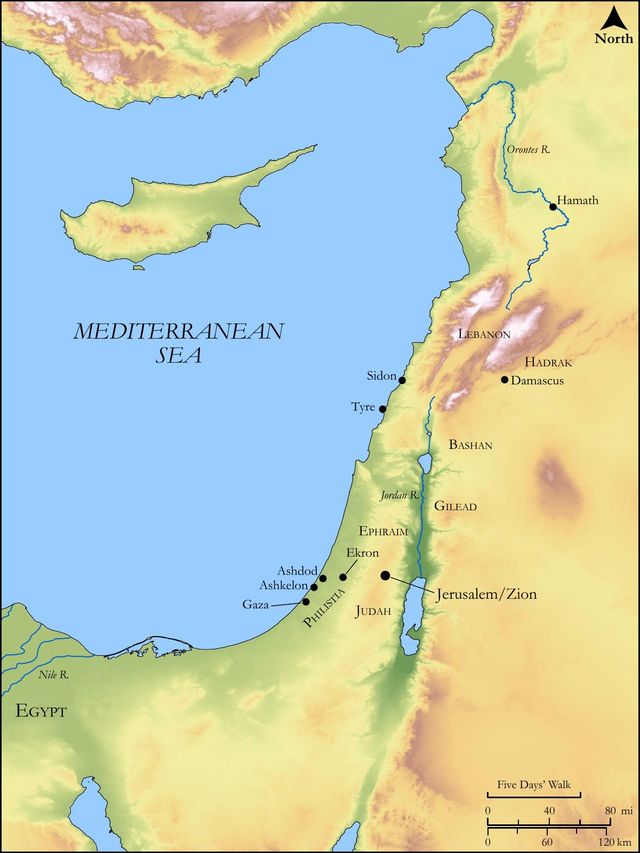
See on the biblical-era map
Study this verse
Public-domain commentary
Matthew Henry
From his Commentary on the Whole Bible. Henry comments on passages, not single verses — this entry covers Zechariah 9:1–8. His three-level outline is real structure in the source text, so it is rendered as structure.
After the precious promises we had in the foregoing chapter of favour to God's people, their persecutors, who hated them, come to be reckoned with, those particularly that bordered close upon them.
I.The Syrians had been bad neighbours to Israel, and God had a controversy with them.
The word of the Lord shall be a burden in the land of Hadrach, that is, of Syria, but it does not appear why it was so called. That that kingdom is meant is plain, because Damascus, the metropolis of that kingdom, is said to be the rest of this burden; that is, the judgments here threatened shall light and lie upon that city. Those are miserable upon whom the burden of the word of the Lord rests, upon whom the wrath of God abides (Joh 3:36); for it is a weight that they can neither shake off nor bear up under. There are those whom God causes his fury to rest upon. Those whom the wrath of God makes its mark it will be sure to hit; those whom it makes its rest it will be sure to sink. And the reason of this burden's resting on Damascus is because the eyes of man, as of all the tribes of Israel (or rather, even of all the tribes of Israel), are towards the Lord, because the people of God by faith and prayer look up to him for succour and relief and depend upon him to take their part against their enemies. Note, It is a sign that God is about to appear remarkably for his people when he raises their believing expectations from him and dependence upon him, and when by his grace he turns them from idols to himself. Isa 17:7, Isa 17:8, At that day shall a man look to his Maker. It may be read thus, for the Lord has an eye upon man, and upon all the tribes of Israel; he is King of nations as well as King of saints; he governs the world as well as the church, and therefore will punish the sins of other people as well as those of his own people. God is Judge of all, and therefore all must give account of themselves to him. When St. Paul was converted at Damascus, and preached there, and disputed with the Jews, then the word of the Lord might be said to rest there, and then the eyes of men, of other men besides the tribes of Israel, began to be towards the Lord; see Act 9:22. Hamath, a country which lay north of Damascus, and which we often read of, shall border thereby (Zac 9:2); it joins to Syria, and shall share in the burden of the word of the Lord that rests upon Damascus. The Jews have a proverb, Woe to the wicked man, and woe to his neighbour, who is in danger of partaking in his sins and in his plagues. Woe to the land of Hadrach, and woe to Hamath that borders thereby.
II.Tyre and Zidon come next to be called to an account here, as in other prophecies, Zac 9:2-4. Observe here,
1.Tyrus flourishing, thinking herself very safe, and ready to set God's judgments, not only at a distance, but at defiance: for,
(1.)She is very wise. It is spoken ironically; she thinks herself very wise, and able to outwit even the wisdom of God. It is granted that her king is a great politician, and that her statesmen are so, Eze 28:3. But with all their wit and policy they shall not be able to evade the judgments of God when they come with commission; there is no wisdom nor counsel against the Lord; nay, it is his honour to take the wise in their own craftiness.
(2.)She is very strong, and well fortified both by nature and art: Tyrus did build herself a strong-hold, which she thought could never be brought down nor got over.
(3.)She is very rich; and money is a defence; it is the sinews of war, Ecc 7:12. By her vast trade she has heaped up silver as the dust, and fine gold as the mire of the streets, that is, she has an abundance of them, heaps of silver as common as heaps of sand, Job 27:16. Solomon made silver to be in Jerusalem as the stones of the streets; but Tyre went further, and made fine gold to be as the mire of the streets. It were well if we could all learn so to look upon it, in comparison with the merchandise of wisdom and grace and the gains thereof.
2.Tyrus falling, after all. Her wisdom, and wealth, and strength, shall not be able to secure her (Zac 9:4): The Lord will cast her out of that strong-hold wherein she has fortified herself, will make her poor (so some read it); there have been instances of those that have fallen from the height of plenty to the depth of poverty, and great riches have come to nothing. God will smite her power in the sea; her being surrounded by the water shall not secure her, but she shall be devoured with fire, and burnt down to the ground. Tyrus, being seated in the midst of the water, was, one would have thought, in danger of being some time or other overflowed or washed away by that; yet God chooses to destroy it by the contrary element. Sometimes he brings ruin upon his enemies by those means which they least suspect. Water enough was nigh at hand to quench the flames of Tyre, and yet by them she shall be devoured; for who can put out the fire which the breath of the Almighty blows up?
III.God next contends with the Philistines, with their great cities and great lords, that bordered southward upon Israel.
1.They shall be alarmed and affrighted by the word of the Lord lighting and resting upon Damascus (Zac 9:5); the disgraces of Israel had many a time been published in the streets of Ashkelon, and they had triumphed in them; but now Ashkelon shall see the ruin of her friends and allies, and shall fear; Gaza also shall see it, and be very sorrowful, and Ekron, concluding that their own turns come next, now that the cup of trembling goes round. What will become of their house when their neighbour's is on fire? They had looked upon Tyre and Zidon as a barrier to their country; but, when those strong cities were ruined, their expectations from them were ashamed, as our expectation from all creatures will be in the issue.
2.They shall themselves be ruined and wasted.
(1.)The government shall be dissolved: The king shall perish from Gaza, not only the present king shall be cut off, but there shall be no succession, no successor,
(2.)The cities shall be dispeopled: Ashkelon shall not be inhabited; the rightful owners shall be expelled, either slain or carried into captivity.
(3.)Foreigners shall take possession of their land and become masters of all its wealth (Zac 9:6): A bastard shall dwell in Ashdod; a spurious brood of strangers shall enter upon the inheritances of the natives, which they have no more right to than a bastard has to the estates of the legitimate children. And thus God will cut off the pride of the Philistines, all the strength and wealth which they prided themselves in, and which were the ground of their confidence in themselves and their contempt of the Israel of God. This prophecy of the destruction of the Philistines, and of Damascus, and Tyre, was accomplished, not long after this, by Alexander the Great, who ravaged all these countries with his victorious army, took the cities, and planted colonies in them, which Quintus Curtius gives a particular account of in the history of his conquests. And some think he is meant by the bastard that shall dwell in Ashdod, for his mother Olympia owned him begotten in adultery, but pretended it was by Jupiter. The Jews afterwards got ground of the Philistines, Syrians, and others of their neighbours, took some of their cities from them and possessed their countries, as appears by the histories of Josephus and the Maccabees, and this was foretold before, Zep 2:4, etc.; Oba 1:20.
3.Some among them shall be converted, and brought home to God, by his gospel and grace; so some understand Zac 9:7, as a promise,
(1.)That God would take away the sins of these nations - their blood and their abominations, their cruelties and their idolatries. God will part between them and these sins which they have rolled under their tongue as a sweet morsel, and are as loth to part with as men are to part with the meat out of their mouths, and which they hold fast between their teeth. Nothing is too hard for the grace of God to do.
(2.)That he would accept of a remnant of them for his own: He that remains shall be for our God. God would preserve a remnant even of these nations, that should be the monuments of his mercy and grace and be set apart for him; and the disadvantages of their birth shall be no bar to their acceptance with God, but a Philistine shall be as acceptable to God, upon gospel-terms, as one of Judah, nay, as a governor, or chief one, in Judah, and a man of Ekron shall be as a Jebusite, or a man of Jerusalem, as a proselyted Jebusite, as Araunah the Jebusite, Sa2 24:16. In Christ Jesus there is no distinction of nations, but all are one in him, all alike welcome to him.
IV.In all this God intends mercy for Israel, and it is in kindness to them that God will deal thus with the neighbouring nations, to avenge their quarrel for what is past and to secure them for the future.
1.Thus some understand the seventh verse, as intimating,
(1.)That thus God would deliver his people from their bloody adversaries, who hated them, and to whom they were an abomination, when they were just ready to devour them and make a prey of them: I will take away his blood (that is, the blood of Israel) out of the mouth of the Philistines and from between their teeth (Amo 3:12), when, in their hatred of them and enmity to them, they were greedily devouring them.
(2.)That lie would thus give them victory and dominion over them: And he that remains (that is, the remnant of Israel) shall be for our God, shall be taken into his favour, shall own him and be owned by him, and he shall be as a governor in Judah; though the Jews have been long in servitude, they shall recover their ancient dignity, and be victorious, as David and other governors in Judah formerly were; and Ekron (that is, the Philistines) shall be as the Jebusites, and the rest of the devoted nations, who were brought into subjection under them.
2.However, this is plainly the sense of Zac 9:8, that God will take his people under his special protection, and therefore will weaken their neighbours, that it may not be in their power to do them a mischief: I will encamp about my house because of the army. Note, God's house lies in the midst of an enemy's country, and his church is as a lily among thorns; and therefore God's power and goodness are to be observed in the special preservation of it. The camp of the saints, being a little flock in comparison with the numerous armies of the powers of darkness that are set against it round about, would certainly be swallowed up if the angels of God did not encamp about it, as they did about Elisha, to deliver it, Rev 20:9; Psa 34:7. When the times are unusually perilous, when armies are marching and counter-marching, and all bearing ill-will to Zion, then Providence will as it were double its guards upon the church of God, because of him that passes by and because of him that returns, that whether he return a conqueror or conquered he may do it no harm. And, as none that pass by shall hurt them, so no oppressor shall pass through them any more; they shall have no enemy within themselves to rule them with rigour, and to make their lives bitter to them with sore bondage, as of old in Egypt. This was fulfilled when, for some time after the struggles of the Maccabees, Judea was a free and flourishing state, or perhaps when Alexander the Great, struck with an awe of Jaddus the high priest, favoured the Jews, and took them under his protection, at the same time when he wasted the neighbouring countries. And the reason given for all this is, "For now have I seen with my eyes, now have I carefully distinguished between my people and other people, with whom before they seemed to have their lot in common, and have made it to appear that I know those that are mine," This agrees with Psa 34:15, The eyes of the Lord are upon the righteous; now his eyes, which run to and fro through the earth, shall fix upon them, that he may show himself tender of them, and strong on their behalf, Ch2 16:9.
Historical interpretation
Historical reception
1 surviving comment on this verse from the historical church.
(Vers. 2 seqq.) Emath quoque in terminis ejus, et Tyrus et Sidon: assumpserunt quippe sibi sapientiam valde. Et aedificavit Tyrus munitionem suam, et coacervavit argentum quasi humum, et aurum ut lutum platearum. Ecce Dominus possidebit eam, et percutiet in mari fortitudinem ejus, et haec igne devorabitur. LXX: Emath in finibus ejus Tyrus et Sidon: quoniam sapientes fuerunt nimis, et aedificavit Tyrus munitionem suam, et congregavit argentum ut humum, et aurum ut lutum viarum. Therefore the Lord will possess it, and strike its strength in the sea, and it will be consumed by fire. Emath, which is interpreted as 'wrath,' that is, indignation, is the one which received the name Epiphania from Antiochus Epiphanes, and now it is the city of Coele Syria. And thus, both Tyre and Sidon will be in the borders of Damascus, or in the borders of the land of Adrach, so that they may believe in the Lord Savior, to whom it was said by the Father: Ask of me, and I will give you the nations as your inheritance, and the ends of the earth as your possession (Ps. 2:8). The daughters of this Tyre, that is, the souls of those who believe in Christ, will bring gifts to the king, so that what is written may be fulfilled: The daughters of Tyre will worship him with gifts (Psalm 44:13). And when the city of God, the Church, is built, of which the Psalmist sings: Glorious things are said of you, O city of God (Psalm 86:2), then the following will immediately come: Behold, foreigners, Tyre, and the people of Ethiopia, these were born there (ibid., 56:4). In two psalms it is said of aliens: Aliens serve me, or are subject to me. In the prophet Zephaniah we read about the Ethiopians: From beyond the rivers of Ethiopia my worshipers, my dispersed ones, will bring me offerings (Zep. 3:10). And in the Psalm: Ethiopia will stretch out her hands to God (Ps. 68:31). But the Gospel speaks of Tyre: Woe to you, Chorazin! Woe to you, Bethsaida! For if the miracles done in you had been done in Tyre and Sidon, they would have repented long ago in sackcloth and ashes (Matt. 11:21). That Canaanite woman from the territory of Tyre and Sidon, whose daughter was badly possessed by a demon, encountered the Lord and Savior (Mark VII); and she dedicated the first fruits of faith of the Tyrians and Sidonians, so that those who did not believe at the time of Christ because they had not yet seen signs and wonders, would later see them through the apostles and believe, and be partakers of that blessedness which the Lord promised, saying: Blessed are those who have not seen and yet have believed (John XX, 29). But Tyre and Sidon (of which one signifies 'narrowness', that is, constraint; the other 'hunting', that is, hunting, according to interpretation) took for themselves such great wisdom, that they proposed to Solomon, that is, the peaceful king, their enigmas, along with their sophisms and the nets of the dialecticians and the intricate web of the sophists, which the Scripture records as their fortifications. They amassed for themselves their silver, which is the brightness of eloquence, and their gold, which is cunning of the senses, gathered together like dust and mud in the streets and roads, in order to possess the kingdom of idolatry which they had fortified. But the Apostle speaks against these fortifications: For the weapons of our warfare are not carnal, but powerful to God, for the destruction of fortifications: destroying thoughts and every height that exalts itself against the knowledge of God (II Cor. X, 4, 5). And in the persona of Nineveh, which is interpreted as adorned, or beautiful (for nothing is more adorned than the world), God speaks through the prophet against the people of the world: And you will be drunk and despised, and you will seek help from your enemy: all your fortifications, like figs with their clusters, if they are shaken, they will fall into the mouth of the eater. And so the Lord will possess both Tyre and Sidon, when he strikes down their strength in the most salty and bitter sea of this age, and nothing of their former wisdom remains, that is, their swelling foolishness, through which they acquired weak fortifications, and silver and gold similar to clay. He will burn them with fire and purify them completely, as the Savior speaks of in the Gospel: I have come to send fire on the earth, and how I wish it were already kindled (Luke XII, 49), according to what is written in Mark: Everyone will be salted with fire (Mark IX, 48).
Continue studying Zechariah 9:2 across the web’s major study libraries — every link below opens this exact verse, chapter, or book on the destination site.
Read & Compare
 BibleGatewayThis verse in more than 200 translations and 70 languages.
 Bible.comThe YouVersion reader — hundreds of translations, reading plans, and highlights.
 ESV.orgCrossway's official English Standard Version reader.
 NET BibleThe NET translation with 60,000+ translators' notes on every rendering decision.
 STEP BibleTyndale House's free study tool — original text, vocabulary, and scholarly resources.
 BibliaLogos Bible Software's free web reader.
 USCCBThe New American Bible (Revised Edition) with the U.S. bishops' study notes.
Commentaries
 BibleHub CommentariesDozens of classic commentaries on this verse, gathered on one page.
 StudyLightMore than 100 commentary sets — the largest collection on the web.
 BibleRefPlain-English commentary on what this verse means, verse by verse.
 Enduring WordDavid Guzik's free commentary on this chapter, widely used by Bible teachers.
 Bible Study ToolsVerse commentary alongside Greek and Hebrew study aids.
Original Language & Research
- BibleHub InterlinearThe verse word by word — original language, transliteration, and English.
- BibleHub LexiconEvery word's original-language definition and Strong's entry.
 Blue Letter BibleDeep-study tools — Strong's numbers, concordance, and word studies.
 SefariaThe Hebrew text with Rashi and centuries of Jewish commentary.
Sermons, Hymns & Audio


TrulyRandomVerse is not affiliated with these sites and doesn’t control their content. They’re linked because they’re genuinely useful.
Summary
Zechariah 9:2 is part of a prophetic oracle declaring the Lord's judgment upon the nations surrounding Israel, specifically naming Hamath, Tyrus (Tyre), and Zidon (Sidon). This verse underscores God's absolute sovereignty over powerful and seemingly impenetrable city-states, highlighting the ultimate futility of human wisdom, wealth, and strategic prowess when confronted with divine decree, thereby setting the stage for the coming of the Messiah and the establishment of His righteous kingdom.
Context
ShowHideLiterary Context
Zechariah 9:2 continues the "burden of the word of the LORD" that begins in Zechariah 9:1, an oracle directed against various Gentile nations. This section (Zechariah 9:1-8) details a sweeping divine judgment that moves geographically from north to south along the Mediterranean coast, encompassing cities like Hadrach, Damascus, Hamath, Tyre, Sidon, Ashkelon, Gaza, Ekron, and Ashdod. This sequence of judgment serves as a prelude to the glorious arrival of Israel's righteous King, prophesied in Zechariah 9:9, emphasizing that the Lord must first clear the way and establish His sovereign authority over all earthly powers before His Messiah can reign.
Historical & Cultural Context
Hamath, located in modern-day Syria, was a significant Aramaean kingdom and a strategic city on the Orontes River, often a buffer or contested territory between major empires. Tyrus (Tyre) and Zidon (Sidon) were the preeminent Phoenician city-states on the Mediterranean coast, renowned for their maritime trade, immense wealth, and formidable fortifications. Tyre, in particular, was famed for its commercial networks, purple dye production, and perceived invincibility due to its island location. These cities represented the pinnacle of human ingenuity, economic power, and military strength among the nations of that day. Their inclusion in this prophecy signifies that no earthly power, however mighty or "wise" in its own estimation, is beyond the scope of God's judgment and sovereign plan.
Key Themes
ShowHideThe inclusion of Hamath, Tyre, and Sidon in this divine oracle highlights several profound themes. Firstly, it powerfully asserts Divine Sovereignty Over Nations, demonstrating that God's authority extends far beyond Israel's borders, encompassing all earthly kingdoms and their perceived strengths. Secondly, the phrase "though it be very wise" directly challenges The Futility of Earthly Wisdom and Wealth when pitted against God's purposes. Tyre and Sidon's celebrated commercial acumen, political shrewdness, and architectural ingenuity, which brought them immense prosperity, would prove utterly ineffective against the Lord's decree. This theme resonates with other prophetic warnings against national pride, such as those found in Ezekiel 28 concerning the prince of Tyre. Lastly, the broad geographical scope of the prophecy emphasizes the Universal Reach of God's Justice and Redemptive Plan, indicating that His ultimate purposes are not confined to one people or region but are global in their implications, preparing the way for the Messiah's universal reign.
Exposition and Analysis
ShowHideKey Word Analysis
ShowHideFrom the same root as a word meaning "walled," referring to a place in Syria. Hamath was a significant walled city and kingdom located north of Israel, a strategic point often involved in regional conflicts. Its mention here signifies the northern reach of God's judgment, encompassing a well-known and powerful entity beyond Israel's immediate southern neighbors.
A primitive root meaning "to twist as a rope," and by extension, "to bound" or "set limits." In this context, it implies that Hamath will be brought into the sphere of this divine judgment, its territory or influence being defined and limited by the unfolding prophecy. It suggests a drawing in or a direct impact on its boundaries, indicating its inescapable inclusion in God's sovereign action.
A primitive root meaning "to be wise (in mind, word or act)." When applied to Tyre and Sidon, it refers not merely to intellectual knowledge but profoundly to practical skill, shrewdness, and cunning, especially in commercial, political, and architectural endeavors. It encapsulates the worldly acumen that made these cities prosperous and influential, yet the prophecy asserts that even this highly developed human wisdom is insufficient to withstand God's judgment.
From a root suggesting "vehemence," this word functions as an intensive or superlative. When paired with "wise," it emphasizes the extreme degree of wisdom attributed to Tyre and Sidon. It means "exceedingly," "greatly," or "mightily wise," highlighting the depth of their self-reliance and the stark contrast with the divine power that would humble them.
Verse Breakdown
ShowHide"And Hamath also shall border thereby;"
This clause extends the scope of the divine judgment, which began with Hadrach and Damascus, to include Hamath. The phrase "border thereby" suggests that Hamath will either be directly affected by the same judgment that falls on its neighbors or that its territory will be brought into the sphere of this prophetic action, indicating its inescapable inclusion within God's sovereign decree. It signifies that the Lord's reach is comprehensive, extending to all significant regional powers.
"Tyrus, and Zidon, though it be very wise."
This part introduces the powerful Phoenician city-states of Tyre and Sidon, known for their immense wealth, maritime dominance, and strategic cunning. The crucial phrase "though it be very wise" serves as a profound theological statement. It acknowledges their renowned human wisdom—their commercial acumen, political astuteness, and architectural brilliance—but simultaneously declares its utter inadequacy and futility in the face of God's impending judgment. Despite their self-sufficiency and perceived invincibility, their wisdom would not save them from divine reckoning.
Literary Devices
ShowHideZechariah 9:2 employs several potent literary devices to convey its message. The primary device is Prophecy, as the verse itself is a divine oracle foretelling future events and judgments upon specific nations. There is also a strong element of Personification, where cities like Hamath, Tyre, and Sidon are treated as active entities that "border" or possess "wisdom," giving them a quasi-human agency in the narrative of divine judgment. Most notably, the phrase "though it be very wise" introduces a powerful Irony. Tyre and Sidon were celebrated for their shrewdness and strategic brilliance, which brought them great prosperity and security. However, the prophecy ironically asserts that this very wisdom, their source of pride and strength, would be utterly useless against the sovereign will of God, highlighting the contrast between human ingenuity and divine power.
Theological and Thematic Connections
ShowHideZechariah 9:2 powerfully asserts God's absolute sovereignty over all earthly powers, demonstrating that no nation, however strong, wealthy, or "wise" in human terms, can withstand His divine decree. It underscores a consistent biblical theme: true wisdom and security are found not in human ingenuity or material possessions, but in humble submission to the Lord. This verse serves as a stark reminder that what humanity often values as ultimate strength—economic prowess, strategic cunning, military might—is ultimately fleeting and insufficient when confronted by the purposes of the Almighty. It prepares the reader for the subsequent revelation of God's righteous King, whose reign will not be established by worldly power, but by divine authority.
Reflection and Application
ShowHideZechariah 9:2 offers profound lessons for contemporary believers. In a world that often prioritizes human achievement, economic strength, and strategic advantage, this verse serves as a powerful corrective. It reminds us that our ultimate security and hope must never be placed in the fleeting wisdom or power of human systems, institutions, or even our own cleverness. Just as the "very wise" cities of Tyre and Sidon ultimately faced divine judgment, so too will all human endeavors that exclude or defy God's sovereignty. This should cultivate a deep humility within us, fostering a greater reliance on God's unchanging character and His ultimate control over all things. It encourages us to discern between worldly wisdom and divine wisdom, prompting us to seek first God's kingdom and righteousness, knowing that His plans will always prevail, regardless of the apparent strength or complexity of the challenges we face.
Questions for Reflection
ShowHideFAQ
ShowHideWhy are these specific cities—Hamath, Tyre, and Sidon—mentioned in this prophecy?
ShowHideThese cities are mentioned because they represent significant geopolitical and economic powers among the nations round about, particularly in the regions north and west of Israel. Hamath was a strategic Aramaean kingdom, while Tyre and Sidon were dominant Phoenician maritime city-states renowned for their wealth, trade networks, and perceived invincibility. By naming these prominent entities, the prophecy underscores the comprehensive and universal scope of God's judgment, demonstrating that His sovereignty extends over all nations, regardless of their perceived strength or influence. Their inclusion also sets the stage for the coming of the Messiah, whose reign will encompass all these territories, as hinted at in Zechariah 9:9-10.
What does it mean that Tyre and Sidon were "very wise," and why is this significant?
ShowHideThe "wisdom" attributed to Tyre and Sidon refers not primarily to moral or spiritual wisdom, but to their practical shrewdness, commercial acumen, political astuteness, and engineering skill. This worldly wisdom enabled them to build vast trade empires, construct formidable fortifications, and amass immense wealth. The significance of this phrase lies in its ironic contrast: despite their extraordinary human wisdom and self-sufficiency, these cities would ultimately fall under divine judgment. It highlights the biblical truth that human ingenuity, no matter how advanced or successful, is ultimately futile when it stands in opposition to or is relied upon instead of God's sovereign will. This theme is echoed in other prophetic books, such as Ezekiel 28, which details the pride and downfall of Tyre's ruler.
Christ-Centered Fulfillment
ShowHideZechariah 9:2, by declaring God's sovereign judgment over the powerful Gentile nations of Hamath, Tyre, and Sidon, ultimately points to the universal scope of Christ's authority and the nature of His kingdom. The prophecy of judgment against these worldly powers paves the way for the coming of the righteous and humble King, as foretold in Zechariah 9:9, who enters Jerusalem riding on a donkey. This King, Jesus Christ, is the ultimate fulfillment of God's sovereign plan, establishing a kingdom that transcends all earthly boundaries and human wisdom. The "wisdom" of Tyre and Sidon, which proved insufficient against God's decree, stands in stark contrast to the divine wisdom embodied in Christ, who is "the power of God and the wisdom of God" (1 Corinthians 1:24). His reign is not built on human might or shrewdness, but on divine righteousness and peace, extending His dominion to the "ends of the earth" (Acts 1:8), encompassing even the territories once dominated by Hamath, Tyre, and Sidon. Thus, this verse foreshadows the comprehensive triumph of Christ's kingdom over all earthly opposition and the ultimate revelation of true wisdom found only in Him.