


Zechariah 9:9
Bible text: King James Version (1769 Blayney text) · Public domain
Bible text: King James Version with Strong's numbers · Public domain
Bible text: Berean Standard Bible · Public domain
Bible text: American Standard Version (1901) · Public domain
Bible text: World English Bible, Messianic edition · Public domain
Bible text: Geneva Bible (1599) · Public domain
Bible text: Young's Literal Translation · Public domain
- גִּילִיgi·LirejoiceH1523V-Qal-Imp-2fsVerb Qal Imperative 2nd Singular Feminine
- מְאֹדme·'OdexceedinglyH3966Adj-msAdjective Numerical Singular Masculine Absolute
- בַּתbatO daughter ofH1323N-fscNoun Singular Feminine Construct
- צִיּוֹןtzi·YonZionH6726N-properNoun Proper Location
- הָרִיעִיha·Ri·'ishout for joyH7321V-Hiphil-Imp-2fsVerb Hiphil Imperative 2nd Singular Feminine
- בַּתbatO daughter ofH1323N-fscNoun Singular Feminine Construct
- יְרוּשָׁלִַםye·ru·sha·LimJerusalemH3389N-properNoun Proper Location
- הִנֵּהhi·Nehthere!H2009PrtParticle Interjection
- מַלְכֵּךְmal·keKhyour kingH4428N-msc ¦ 2fsNoun Singular Masculine Constructמַלְכֵּkingךְyour
- יָבוֹאYa·Vo'he will comeH935V-Qal-Imperf-3msVerb Qal Imperfect 3rd Singular Masculine
- לָךְLakhto youPrep-l ¦ 2fsSuffix Personal 2nd Singular Feminineלָtoךְyou
- צַדִּיקtza·Dik[is] righteousH6662Adj-msAdjective Singular Masculine Absolute
- וְנוֹשָׁעve·no·Sha'and victoriousH3467Conj-w ¦ V-Niphal-Prtcpl-msVerb Niphal Participle Singular Masculine Absoluteוְandנוֹשָׁעvictorious
- הוּאHu'heH1931Pro-3msPronoun Personal 3rd Singular Masculine
- עָנִי'a·NipoorH6041Adj-msAdjective Singular Masculine Absolute
- וְרֹכֵבve·ro·Khevand ridingH7392Conj-w ¦ V-Qal-Prtcpl-msVerb Qal Participle Singular Masculine Absoluteוְandרֹכֵבriding
- עַל'alonH5921PrepPreposition
- חֲמוֹרcha·Mora donkeyH2543N-csNoun Singular common gender Absolute
- וְעַלve·'aland onH5921Conj-w ¦ PrepPrepositionוְandעַלon
- עַיִר'A·yira male donkeyH5895N-msNoun Singular Masculine Absolute
- בֶּןbena young one ofH1121N-mscNoun Singular Masculine Construct
- אֲתֹנוֹת'a·to·Notfemale donkeysH860N-fpNoun Plural Feminine Absolute
English is a literal word-by-word gloss of the Hebrew, not the KJV's wording. Why?
This is the original text the KJV's translators worked from — each Hebrew word with its own literal English meaning in this verse, prepared by scholars at Tyndale House, Cambridge. The KJV translates whole sentences, not word by word, so its wording differs: one Hebrew word can become several English words, and the KJV may choose “the LORD” where the gloss reads “Yahweh”. Both are faithful — they answer different questions. For the KJV's own rendering, switch to the KJV text.
Details
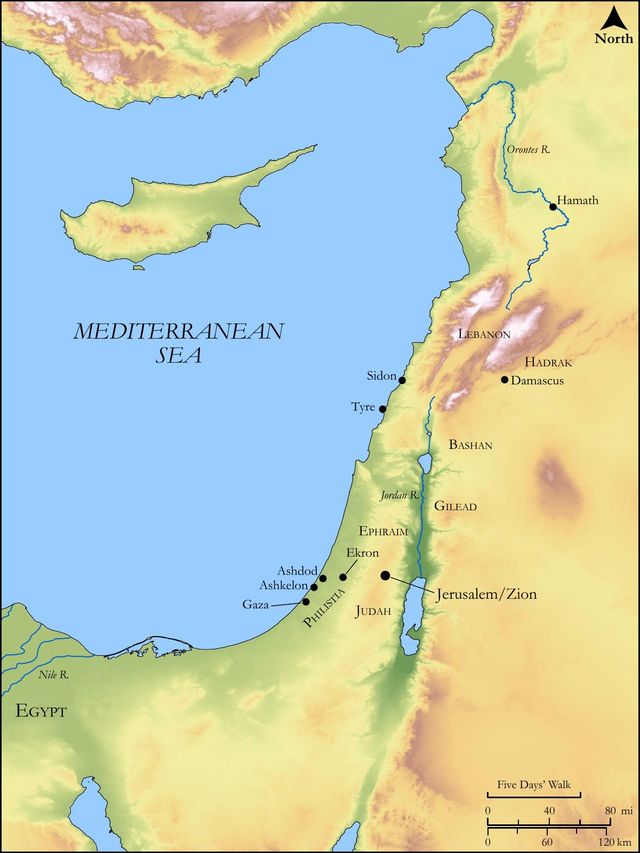
See on the biblical-era map
Study this verse
Public-domain commentary
Matthew Henry
From his Commentary on the Whole Bible. Henry comments on passages, not single verses — this entry covers Zechariah 9:9–11. His two-level outline is real structure in the source text, so it is rendered as structure.
That here begins a prophecy of the Messiah and his kingdom is plain from the literal accomplishment of the ninth verse in, and its express application to, Christ's riding in triumph into Jerusalem, Mat 21:5; Joh 12:15.
I.Here is notice given of the approach of the Messiah promised, as matter of great joy to the Old Testament church:
Behold, thy king cometh unto thee. Christ is a king, invested with regal powers and prerogatives, a sovereign prince, an absolute monarch, having all power both in heaven and on earth. He is Zion's king. God has set him upon his holy hill of Zion, Psa 2:6. In Zion his glory as a king shines; thence his law went forth, even the word of the Lord. In the gospel-church his spiritual kingdom is administered; it is by him that the ordinances of the church are instituted, and its officers commissioned; and it is taken under his protection; he fights the church's battles and secures its interests, as its king. "This King has been long in coming, but now, behold, he cometh; he is at the door. There are but a few ages more to run out, and he that shall come will come. He cometh unto thee; the Word will shortly be made flesh, and dwell within thy borders; he will come to his own. And therefore rejoice, rejoice greatly, and shout for joy; look upon it as good news, and be assured it is true; please thyself to think that he is coming, that he is on his way towards thee; and be ready to go forth to meet him with acclamations of joy, as one not able to conceal it, it is so great, nor ashamed to own it, it is so just; cry Hosanna to him." Christ's approaches ought to be the church's applauses.
II.Here is such a description of him as renders him very amiable in the eyes of all his loving subjects, and his coming to them very acceptable.
1.He is a righteous ruler; all his acts of government will be exactly according to the rules of equity, for he is just.
2.He is a powerful protector to all those that bear faith and true allegiance to him, for he has salvation; he has it in his power; he has it to bestow upon all his subjects. He is the God of salvation; treasures of salvation are in him. He is servatus - saving himself (so some read it), rising out of the grave by his own power and so qualifying himself to be our Saviour. (3.) He is a meek, humble, tender Father to all his subjects as his children; he is lowly; he is poor and afflicted (so the word signifies), so it denotes the meanness of his condition; having emptied himself, he was despised and rejected of men. But the evangelist translates it so as to express the temper of his spirit: he is meek, not taking state upon him, nor resenting injuries, but humbling himself from first to last, condescending to the mean, compassionate to the miserable; this was a bright and excellent character of him as a prophet (Mat 11:29, Learn of me, for I am meek and lowly in heart), and no less so as a king. It was a proof of this that, when he made his public entry into his own city (and it was the only passage of his life that had any thing in it magnificent in the eye of the world), he chose to ride, not upon a stately horse, or in a chariot, as great men used to ride, but upon an ass, a beast of service indeed, but a poor silly and contemptible one, low and slow, and in those days ridden only by the meaner sort of people; nor was it an ass fitted for use, but an ass's colt, a little foolish unmanageable thing, that would be more likely to disgrace his rider than be any credit to him; and that not his own neither, nor helped off, as sometimes a sorry horse is, by good furniture, for he had no saddle, no housings, no trappings, no equipage, but his disciples' clothes thrown upon the colt;' for he made himself of no reputation when he visited us in great humility.
III.His kingdom is here set forth in the glory of it.
This king has, and will have, a kingdom, not of this world, but a spiritual kingdom, a kingdom of heaven.
1.It shall not be set up and advanced by external force, by an arm of flesh or carnal weapons of warfare. No; he will cut off the chariot from Ephraim and the horses from Jerusalem (Zac 9:10), for he shall have no occasion for them while he himself rides upon an ass. He will, in kindness to his people, cut off their horses and chariots, that they may not cut themselves off from God by putting that confidence in them which they should put in the power of God only. He will himself undertake their protection, will himself be a wall of fire about Jerusalem and give his angels charge concerning it (those chariots of fire and horses of fire), and then the chariots and horses they had in their service shall be discarded and cut off as altogether needless.
2.It shall be propagated and established by the preaching of the gospel, the speaking of peace to the heathen; for Christ came and preached peace to those that were afar off and to those that were nigh; and so established his kingdom by proclaiming on earth peace, and good-will towards men.
3.His kingdom, as far as it prevails in the minds of men and has the ascendant over them, will make them peaceable, and slay all enmities; it will cut off the battle-bow, and beat swords into plough-shares. It will not only command the peace, but will create the fruit of the lips, peace.
4.It shall extend itself to all parts of the world, in defiance of the opposition given to it. "The chariot and horse that come against Ephraim and Jerusalem, to oppose the progress of Zion's King, shall be cut off; his gospel shall be preached to the world, and be received among the heathen, so that his dominion shall be from sea to sea, and from the river even to the ends of the earth, as was foretold by David," Psa 72:8. The preachers of the gospel shall carry it from one country, one island, to another, till some of the remotest corners of the world are enlightened and reduced by it.
IV.Here is an account of the great benefit procured for mankind by the Messiah, which is redemption from extreme misery, typified by the deliverance of the Jews out of their captivity in Babylon (Zac 9:11): "As for thee also (thee, O daughter of Jerusalem! or thee, O Messiah the Prince!) by the blood of thy covenant, by force and virtue of the covenant made with Abraham, sealed with the blood of circumcision, and the covenant made with Israel at Mount Sinai, sealed with the blood of sacrifices, in pursuance and performance of that covenant, I have now of late sent forth thy prisoners, thy captives out of Babylon, which was to them a most uncomfortable place, as a pit in which was no water." It was part of the covenant that, if in the land of their captivity, they sought the Lord, he would be found of them, Lev 26:42, Lev 26:44, Lev 26:45; Deu 30:4. It was by the blood of that covenant, typifying the blood of Christ, in whom all God's covenants with man are yea and amen, that they were released out of captivity; and this was but a shadow of the great salvation wrought out by thy King, O daughter of Zion! Note, A sinful state is a state of bondage; it is a spiritual prison; it is a pit, or a dungeon, in which there is no water, no comfort at all to be had. We are all by nature prisoners in this pit; the scripture has concluded us all under sin, and bound us over to the justice of God. God is pleased to deal upon new terms with these prisoners, to enter into another covenant with them; the blood of Christ is the blood of that covenant, purchased it for us and all the benefits of it; by that blood of the covenant effectual provision is made for the sending forth of these prisoners upon easy and honourable terms, and proclamation made of liberty to the captives and the opening of the prison to those that were bound, like Cyrus's proclamation to the Jews in Babylon, which all those whose spirits God stirs up will come and take the benefit of.
Historical interpretation
Five Centuries of Reception
9 surviving comments on this verse. Each one is dated, so this reads as a timeline rather than a list.
Select a marker to jump to its quote. Markers stagger vertically where authors wrote within a few decades of each other.
And when they drew nigh unto Jerusalem, and were come to Bethphage, unto the mount of Olives, then sent Jesus two disciples, Saying unto them, Go into the village over against you, and straightway ye shall find an ass tied, and a colt with her: loose them, and bring them unto me. And if any man say ought unto you, ye shall say, The Lord hath need of them; and straightway he will send them. All this was done, that it might be fulfilled which was spoken by the prophet, saying, Tell ye the daughter of Sion, Behold, thy King cometh unto thee, meek, and sitting upon an ass, and a colt the foal of an ass. [Zechariah 9:9] And the disciples went, and did as Jesus commanded them, And brought the ass, and the colt, and put on them their clothes, and they set him thereon. And a very great multitude spread their garments in the way; others cut down branches from the trees, and strawed them in the way. And the multitudes that went before, and that followed, cried, saying, Hosanna to the Son of David: Blessed is he that cometh in the name of the Lord; Hosanna in the highest. And when he was come into Jerusalem, all the city was moved, saying, Who is this? And the multitude said, This is Jesus the prophet of Nazareth of Galilee.
On the next day much people that were come to the feast, when they heard that Jesus was coming to Jerusalem, Took branches of palm trees, and went forth to meet him, and cried, Hosanna: Blessed is the King of Israel that cometh in the name of the Lord. And Jesus, when he had found a young ass, sat thereon; as it is written, Fear not, daughter of Sion: behold, thy King cometh, sitting on an ass's colt. [Zechariah 9:9] These things understood not his disciples at the first: but when Jesus was glorified, then remembered they that these things were written of him, and that they had done these things unto him. The people therefore that was with him when he called Lazarus out of his grave, and raised him from the dead, bare record. For this cause the people also met him, for that they heard that he had done this miracle. The Pharisees therefore said among themselves, Perceive ye how ye prevail nothing? behold, the world is gone after him.
"And that expression, 'binding his foal to the vine, and the ass's foal to the vine tendril,' was a declaring beforehand both of the works wrought by Him at His first advent, and also of that belief in Him which the nations would repose. For they were like an unharnessed foal, which was not bearing a yoke on its neck, until this Christ came, and sent His disciples to instruct them; and they bore the yoke of His word, and yielded the neck to endure all [hardships], for the sake of the good things promised by Himself, and expected by them. And truly our Lord Jesus Christ, when He intended to go into Jerusalem, requested His disciples to bring Him a certain ass, along with its foal, which was bound in an entrance of a village called Bethphage; and having seated Himself on it, He entered into Jerusalem. And as this was done by Him in the manner in which it was prophesied in precise terms that it would be done by the Christ, and as the fulfilment was recognised, it became a clear proof that He was the Christ. And though all this happened and is proved from Scripture, you are still hard-hearted. Nay, it was prophesied by Zechariah, one of the twelve [prophets], that such would take place, in the following words: 'Rejoice greatly, daughter of Zion; shout, and declare, daughter of Jerusalem; behold, thy King shall come to thee, righteous, bringing salvation, meek, and lowly, riding on an ass, and the foal of an ass.' Now, that the Spirit of prophecy, as well as the patriarch Jacob, mentioned both an ass and its foal, which would be used by Him; and, further, that He, as I previously said, requested His disciples to bring both beasts; [this fact] was a prediction that you of the synagogue, along with the Gentiles, would believe in Him. For as the unharnessed colt was a symbol of the Gentiles even so the harnessed ass was a symbol of your nation. For you possess the law which was imposed [upon you] by the prophets."
A spiritual disciple of this sort truly receiving the spirit of God, who was from the beginning, in all the dispensations of God, present with humankind, and announced things future, revealed things present, and narrated things past—[such a person] does indeed “judge all men but is himself judged by no man.” For he judges the Gentiles, “who serve the creature more than the Creator,” and who with a reprobate mind spend all their labor on vanity. And he also judges the Jews, who do not accept the word of liberty nor are willing to go forth free, although they have a deliverer present [with them]. But they pretend, at a time unsuitable [for such conduct], to serve, [with observances] beyond [those required by] the law, God who stands in need of nothing. And [they] do not recognize the advent of Christ, which he accomplished for the salvation of humanity. Nor are [they] willing to understand that all the prophets announced his two advents: the one, indeed, in which he became a man subject to stripes, and knowing what it is to bear infirmity, and sat upon the foal of an ass, and was the stone rejected by the builders, and was led as a sheep to the slaughter, and by the stretching forth of his hands destroyed Amalek. … He gathered from the ends of the earth into his father’s fold the children who were scattered abroad. … [He] remembered his own dead ones who had formerly fallen asleep and came down to them that he might deliver them. But [in the second advent] he will come on the clouds, bringing on the day which burns as a furnace, and striking the earth with the word of his mouth, and judging the impious with the breath of his lips. Having a fan in his hands, he cleanses his floor, and gathering the wheat indeed into his barn, he burns the chaff with unquenchable fire.
At another time, he speaks of us under the figure of a colt. He means by [the colt] that we are unyoked to evil, unsubdued by wickedness, unaffected, high-spirited only with him our Father. We are colts, not stallions, “who whinny lustfully for their neighbor’s wife, beasts of burden unrestrained in their lust.” Rather, we are free and newly born, joyous in our faith, holding fast to the course of truth, swift in seeking salvation, spurning and trampling upon worldliness. “Rejoice greatly, O daughter of Zion. Shout for joy, O daughter of Jerusalem. Behold, your king comes to you, the just and the Savior, and he is poor and riding upon an ass and upon a young colt.” He is not satisfied to say “colt”; he adds “young” to emphasize humankind’s rejuvenation in Christ and its unending, eternal youth and simplicity. Our divine Tamer trains such young colts as we little ones. Although the passage speaks of a young ass, it too is a colt.
Without Benjamin, the patriarchs went forth; without Paul, the apostles. Neither of them came first, but being summoned by the first, they made greater profit from the arrival of those who came before. There is, he says, grain in Egypt, that is, where there is greater hunger, there is greater plenty. There is much grain in Egypt. Finally, even God the Father says: Out of Egypt I have called my Son. From this seed comes that abundance. For there could not have been a harvest unless the Egyptians had sown the seed beforehand. Therefore, there is grain that no one believed existed before. The patriarchs trade in this grain. And indeed, they brought silver, but the good Joseph gave grain and returned the silver. For Christ is not bought with money, but with grace. Your price is faith. These divine mysteries are bought. However, that unclean donkey carried this grain in the law, but now it is clean in grace.
But how, after not walking openly among the Jews and retiring into the wilderness, does Jesus again enter openly? Having quenched their anger by retiring, he comes to them when they were stilled. Moreover, the multitude which went before and which followed after was sufficient to cast them into agony; for no sign attracted the people as that of Lazarus. And another Evangelist says that they strewed their garments under his feet and that “the whole city was moved,” with so great honor did he enter. And this he did, prefiguring one prophecy and fulfilling another; and the same act was the beginning of the one and the end of the other. For “Rejoice, for your king comes unto you meek” belonged to him as fulfilling a prophecy, but the sitting upon the ass was the act of one prefiguring a future event, that he was about to have the impure race of the Gentiles subject to him.
(Verse 5 onwards) Ascalon will see it and be afraid; Gaza will writhe in agony, and Ekron too, for her hope will wither. Gaza will lose her king and Ashkelon will be deserted. Foreigners will occupy Ashdod, and I will cut off the pride of the Philistines. I will take the blood from their mouths, the forbidden food from between their teeth. Those who are left will belong to our God and become a clan in Judah, and Ekron will be like the Jebusites. And I will surround my house with those who fight for me, going and returning, and no oppressor will pass over them anymore, for now I have seen with my own eyes. Ascalon will see and be afraid; Gaza will be very sorrowful; and Ekron, because her hope is confounded, and her king will perish from Gaza, and Ascalon will not be inhabited. Foreigners will dwell in Ashdod; and I will remove the injustice of the foreigners, and take away their blood from their mouths, and their abominations from the midst of their teeth. And they will be for our God, and they will be like a leader in Judah; and Ekron will be like the Jebusites. And I will make my house a place of honor, so that no one will pass through or return, and no oppressor or oppressor will come upon them, for now I have seen with my own eyes. Ascalon is interpreted as lowly fire, or weighed down: Gaza, strong, or empire: Accaron, barren, or uprooted: Azotus, which in Hebrew is called Esdod, fire generating, or uncle's fire, or breast's fire; Jebusaeus, it signifies trampled. We have expressed the etymologies of the names in order to briefly go through their meaning. Seeing that Ascalon and Gaza and Accaron, since Emath was in the borders of Damascus, and Tyre and Sidon, after they were struck from all sides, and all of their hay, wood, and straw burned in the fire, were possessed by the Lord, and they themselves, terrified by fear and grief and confusion, began to hope for better things. Finally, Ascalon, in which the devil had been earlier, a lowly fire, and had come to the measure and weight of sins, trembled with fear, because it had ceased to have inhabitants. And Gaza mourned greatly, repenting of its former crimes, which had once been strong and hard to tame, and had promised itself the kingdom of all, because its king and prince, contrary speech and the power of the enemy, had lost its own rule. Accaron also is barren because it had no children without the Law and knowledge of God, it was uprooted, so that it might hear that prophetic saying: Rejoice, barren one, who does not bear; burst forth and cry out, you who are not in labor; for more are the children of the desolate than of her who has a husband (Isai. LIV, I). And when Ascalon and Gaza and Accaron were terrified, and mourned, because they had no inhabitants, or had lost their king, or their former hope had been frustrated, strangers shall dwell in Azotus, where fire begets, which the Lord has sent upon the earth, and desires to burn (Luc. XII). For he will baptize with the Holy Spirit and fire (Matt. 3), where 'fratruelis' and 'patruus' are translated as 'brother-in-law' and 'paternal cousin', whom the bride desires in the Song of Songs: where there is the fire of the breast and the abundant udder, of which we read in the same Song: 'He will rest among my breasts' (Song of Songs 1:12). And in the Apostle: 'I gave you milk to drink, not solid food' (1 Cor. 3:2). Because, as we said according to the LXX: 'Aliens shall dwell in Ashdod', in Hebrew it is written, 'he shall dwell' or 'sit', the 'Mamzer' shall dwell in Ashdod, for which we have substituted 'separator' shall sit in Ashdod. Understand the Lord as the separator, who separates the grain from the chaff (Matthew 3 and 13), and the good fish from the bad fish, and discern silver and gold from dirt and slag. And when he has done this, he promises other things: I will destroy the injustice or the pride of the Philistines. For this, the 70 foreigners were brought in. Philistines are translated in our language as 'falling to the cup,' because they drank from the cup of Babylon and fell down drunk. Therefore, at the time of the calling of the Gentiles and the coming of Christ, they will not have pride, but they will follow Jesus with humility and meekness. And he will take from their mouth the blood, the blasphemy, and the abominations, the worship of idols, and the eating of things sacrificed to idols, from between their teeth. So that after these things have been removed, the Philistines themselves, that is, the foreigners, will be abandoned to the Lord, and he will be the leader in Judah, that is, in the people confessing the Lord, so that the former people who were in the head, will be turned into the tail, and the last one who was in the tail, will pass into the head. And once barren Accaron, therefore, uprooted, will be as Jebus, that is, as Jerusalem. For this city is called by three names, Jebus, Salem, and Jerusalem. And I will surround, he says, my house, that is, the Church, with those who fight for me, that is, with those who serve me in various ministries and come and go at my command. Or: I will surround my house with the protection of angels, about whom it is also written elsewhere: The angel of the Lord will encamp around those who fear him, and he will deliver them (Ps. 34:7), so that there is no one who can attack and return, that is, who can plot against my people. Nor shall there pass over him any more the exactor, of whom Isaiah speaks: The exactor hath ceased (Isaiah 14:5), or surely one who drives out, that is, leading outwards, and dragging the bound captives into captivity: because with his own eyes, which we can understand as the prophets and all the saints, the Lord has seen the calling of the nations and the security of the Church.
Rejoice greatly, O daughter of Zion; shout, O daughter of Jerusalem: behold, thy King cometh unto thee: he is just, and having salvation; lowly, and riding upon an ass, and upon a colt the foal of an ass. And I will cut off the chariot from Ephraim, and the horse from Jerusalem, and the battle bow shall be cut off: and he shall speak peace unto the heathen: and his dominion shall be from sea even to sea, and from the river even to the ends of the earth. LXX: Rejoice greatly, O daughter of Zion; proclaim, O daughter of Jerusalem: behold, thy King cometh unto thee, just, and a Saviour, he is meek, and riding upon a young ass, and he shall destroy the chariots out of Ephraim, and the horse out of Jerusalem, and the battle bow shall be destroyed, and he shall speak peace to the Gentiles, and his dominion shall be from the sea to the rivers, and from the rivers to the ends of the earth. The Evangelists write that this prophecy was fulfilled when the Lord entered Jerusalem, sitting on a donkey and the foal of a donkey, and a crowd of children with palm branches came out to meet Him, shouting: Blessed is He who comes in the name of the Lord, hosanna in the highest (Matthew XXI); and when the Pharisees reproached Him for not rebuking the children who were shouting, He replied: Have you not read: Out of the mouth of babes and sucklings you have perfected praise (Psalm VIII, 3)? Therefore, Sion exults and Jerusalem rejoices, the same city (for Sion is the citadel of Jerusalem), because its king has come, who was promised by the prophecies of all the prophets: He himself is just, the Savior, that is, Jesus, as the angel interpreted, speaking to the Virgin: And he shall be called Jesus, for he shall save his people from their sins (Mat. I, 21). Also, poor or, as the LXX translated, meek, who, though rich, became poor for us, and says in the Gospel: Learn from me, for I am meek and humble of heart (Mat. XI, 29). And, riding upon a domestic ass or a young foal, that is, the people of both Circumcision and Uncircumcision, of whom the former had borne the heavy yoke of the Law, as it is written in the Acts of the Apostles: Neither we, nor our fathers, were able to bear the heavy yoke of the Law (Acts 15). Therefore, Paul also writes to the Galatians who wanted to be circumcised: Stand fast, and do not be held again under the yoke of bondage (Galatians 5:1). But the new chick, a multitude of gentiles, having no reins of the Law, nor being straightened by anyone, but always falling into precipices and whirlpools of idolatry, has learned to walk and enter the straight path by the session of the Lord. And I will destroy, he says, the chariot of Ephraim. Moreover, it is said in the person of God the Father, that the chariot, or the chariot, of Ephraim may perish, and the horse from Jerusalem. And in the meantime, according to the letter, he speaks thus: There will be no battles, with the advent and birth of Christ pacifying all. Furthermore, according to a higher understanding, Ephraim is referred to as a multitude of heresies, which is interpreted as bearing fruit, that is, abundance and plentiful crops. This is written in the seventy-seventh psalm: The children of Ephraim, being armed and carrying bows, turned back in the day of battle. About these chariots and charioteers, we read: Some trust in chariots and some in horses, but we trust in the name of the Lord our God. They have bowed down and fallen, but we have risen and stand upright (Psalm 20:7-9). The horse that is lost from Jerusalem, that is whom we read about: A deceitful horse for salvation (Psalm 32:17), And in Jeremiah, those who indulged in luxury and lust, they hear: The horses have gone mad, they have become like females to me: each neighed after his neighbor's wife (Jeremiah 5:8). Hence they are called to repentance, as the Psalmist says: Do not be like a horse or a mule, which have no understanding (Psalm 32:9). When God has destroyed the chariots of Ephraim and the horse from Jerusalem, which were freed from such horses and chariots; they will be brought into the service of the Lord, and will become cherubim, and it will be said of them: The chariots of God are ten thousandfold, thousands of rejoicing (Psalm 68:18). And: I have likened you, my beloved, to my horse in Pharaoh's chariots (Song of Solomon 1:8). And: Ride on horses, and let your riding be salvation (Habakkuk 3:8). The bow of war will be dispersed, so that no burning arrows may be launched, which could strike the hearts of the pleasure seekers. And he will speak peace to the nations, of whom it is written: He shall be the expectation of the nations (Gen. XLIX, 10). And again: The nations shall hope in him (Isai. XI). And: His dominion shall be from sea to sea, and from the rivers to the ends of the earth (Ps. LXXI, 8). This is not to be weakened by allegory, but truly believed to be fulfilled, according to what we read: Ask of me, and I will give you the nations for your inheritance, and the ends of the earth for your possession (Ps. II, 8). In the seventy-first psalm, under the person of Solomon and the true peacemaker, it is said: And he shall rule from sea to sea, and from the river to the ends of the earth (Verse 8).
Now since many historical facts have already been mentioned, let us briefly relate some of the allegorical ones at the end. If you see opposing power attacking God’s people, you will realize who it is that is sitting upon the ass. If you further consider how people are destroyed by demons, you will understand what the ass is. Indeed, in the Gospel you will recognize Jesus sending his disciples to an ass which was tied and its colt, so that the disciples might loose and bring her for the Lord himself to sit upon her. Perhaps this ass, that is, the church, first carried Balaam and now Christ. She had been loosed by the disciples and released from the bonds that tied for this very purpose, that the Son of God might sit upon her and with her enter the holy and heavenly city of Jerusalem. Then was fulfilled the Scripture which says, “Rejoice, O daughter of Zion, exclaim, O daughter Jerusalem! See, your king comes to you, meek and riding on a beast of burden,” that is, an ass (doubtless he is speaking of believers among the Jews) “or young colt” (these apparently are those of the Gentiles who believe in Christ our Lord).
Continue studying Zechariah 9:9 across the web’s major study libraries — every link below opens this exact verse, chapter, or book on the destination site.
Read & Compare
 BibleGatewayThis verse in more than 200 translations and 70 languages.
 Bible.comThe YouVersion reader — hundreds of translations, reading plans, and highlights.
 ESV.orgCrossway's official English Standard Version reader.
 NET BibleThe NET translation with 60,000+ translators' notes on every rendering decision.
 STEP BibleTyndale House's free study tool — original text, vocabulary, and scholarly resources.
 BibliaLogos Bible Software's free web reader.
 USCCBThe New American Bible (Revised Edition) with the U.S. bishops' study notes.
Commentaries
 BibleHub CommentariesDozens of classic commentaries on this verse, gathered on one page.
 StudyLightMore than 100 commentary sets — the largest collection on the web.
 BibleRefPlain-English commentary on what this verse means, verse by verse.
 Enduring WordDavid Guzik's free commentary on this chapter, widely used by Bible teachers.
 Bible Study ToolsVerse commentary alongside Greek and Hebrew study aids.
Original Language & Research
- BibleHub InterlinearThe verse word by word — original language, transliteration, and English.
- BibleHub LexiconEvery word's original-language definition and Strong's entry.
 Blue Letter BibleDeep-study tools — Strong's numbers, concordance, and word studies.
 SefariaThe Hebrew text with Rashi and centuries of Jewish commentary.
Sermons, Hymns & Audio


TrulyRandomVerse is not affiliated with these sites and doesn’t control their content. They’re linked because they’re genuinely useful.
Summary
Zechariah 9:9 is a triumphant prophetic declaration, calling the inhabitants of Zion and Jerusalem to rejoice over the imminent arrival of their King. This King is portrayed not as a conquering warrior on a warhorse, but as a righteous and salvific ruler, characterized by humility, entering His city gently riding on a donkey and its colt, foreshadowing a reign established by peace and grace rather than military might. The word rendered "lowly" is the same Hebrew word the prophets elsewhere render "poor," so that the King comes as one of the poor He saves, and the Gospels record the fulfillment when Jesus rode into Jerusalem, meek and sitting upon an ass.
Context
ShowHideLiterary Context
Zechariah 9 marks a significant shift in the book's prophetic focus, moving from the immediate post-exilic concerns of temple rebuilding and leadership (chapters 1-8) to a series of oracles concerning the future of Israel and the nations (chapters 9-14). Chapter 9 itself begins with prophecies against surrounding Gentile nations (Tyre, Sidon, Philistia), establishing God's sovereignty over all peoples. Verse 9 then pivots dramatically to a joyous announcement for Jerusalem, contrasting the earthly kings and their military might with the unique nature of Israel's coming King. This verse sets the stage for further messianic prophecies in the latter half of Zechariah, including the King's suffering and ultimate triumph.
Historical & Cultural Context
Zechariah ministered to the Jewish community that had returned from Babylonian exile, likely between 520-518 BC. They were a people struggling to rebuild their temple and their national identity, often feeling vulnerable and overlooked. Among the nations, kings typically rode horses into battle or as a display of military power and conquest. Riding a donkey, however, was associated with peace, humility, and sometimes with the arrival of a dignitary or judge in a non-military capacity. This imagery would have immediately conveyed a different kind of kingship to Zechariah's original audience—one that defied conventional expectations of power and might, offering hope for a peaceful, divinely-appointed ruler.
Key Themes
ShowHideThis verse is a cornerstone of Messianic Prophecy, clearly foretelling the arrival of Israel's promised King, whose identity and manner of arrival are distinct from earthly monarchs. It highlights the theme of Divine Kingship, emphasizing that God's chosen ruler operates on principles of Righteousness and Salvation, rather than worldly power. The King is described as "just, and having salvation," indicating His character and His mission. Furthermore, the imagery of riding on a donkey underscores the profound theme of Humility, a characteristic that would later define the ministry of Jesus Christ, who consciously fulfilled this very prophecy during His triumphal entry into Jerusalem. The call to "Rejoice greatly" also introduces the theme of Joy in God's Deliverance, a recurring motif throughout the prophetic books, as seen in passages like Isaiah 61:10.
Exposition and Analysis
ShowHideKey Word Analysis
ShowHideThis primitive root means "to spin round (under the influence of any violent emotion)," usually implying to be glad, to joy, or to be joyful. When paired with "greatly" (H3966, mᵉʼôd), it conveys an intense, exuberant, almost uncontrollable joy, a command for the people to express profound elation at the King's advent.
Derived from a primitive root meaning "to be open, wide or free, i.e. (by implication) to be safe; causatively, to free or succor." The form used here, noshaʻ (participle of yâshaʻ), means "having salvation" or "being saved/victorious." This emphasizes that the King embodies and brings deliverance, rescue, and victory to His people, not merely as an attribute, but as an active state of being.
This word describes someone who is "depressed, in mind or circumstances; afflicted, humble, needy, poor." It conveys a profound sense of humility, meekness, and unpretentiousness. It stands in stark contrast to the typical displays of power and grandeur associated with earthly kings, highlighting the King's identification with the humble and His lack of worldly pomp.
Verse Breakdown
ShowHide"Rejoice greatly, O daughter of Zion; shout, O daughter of Jerusalem:"
This opening command is a fervent exhortation for the people of God, personified as "daughter of Zion" and "daughter of Jerusalem," to express immense, unrestrained joy. The repetition emphasizes the urgency and significance of the event, calling for a collective, vocal celebration.
"behold, thy King cometh unto thee:"
This clause announces the central event: the arrival of "thy King." The word "behold" (Hebrew: hinnēh) draws immediate attention to the King's approach, signaling a momentous and certain event. The King is coming directly "unto thee," indicating a personal and intimate relationship with His people.
"he [is] just, and having salvation;"
This describes the character and mission of the coming King. He is "just" (Hebrew: tsaddîyq), meaning righteous in character and action, upholding divine standards. He is also "having salvation" (Hebrew: noshaʻ), meaning He embodies and brings deliverance, rescue, and victory, not through military might but through His inherent righteousness.
"lowly, and riding upon an ass, and upon a colt the foal of an ass."
This final phrase vividly depicts the King's humble mode of arrival. "Lowly" (Hebrew: ʻânîy) emphasizes His meekness and lack of worldly ostentation. His choice of transport—a donkey and its colt—underscores His peaceful intentions and contrasts sharply with the warhorses of conquering kings, signifying a reign of peace and spiritual authority rather than military conquest. The repetition of "upon an ass, and upon a colt the foal of an ass" serves to emphasize the specific, peaceful mode of transport, leaving no ambiguity about the nature of His arrival, and fulfilling a detail that would later be noted in the Gospel accounts.
Literary Devices
ShowHideZechariah 9:9 is rich with Symbolism and Personification. "Daughter of Zion" and "Daughter of Jerusalem" are classic examples of Personification, treating the cities and their inhabitants as a single feminine entity, capable of expressing emotion and receiving a king. The Symbolism of the king riding on a donkey versus a warhorse is paramount, immediately conveying a message of peace, humility, and a different kind of kingdom, contrasting with the typical displays of earthly power. The phrase "just, and having salvation" uses Juxtaposition to highlight two key attributes of the King, showing His character and His purpose. The repetition of "upon an ass, and upon a colt the foal of an ass" is a form of Emphasis or Redundancy, ensuring the audience grasps the precise, humble nature of the King's entry, leaving no room for misinterpretation of His peaceful intent. The entire verse functions as a powerful Prophecy, a divinely inspired foretelling of future events, specifically the Messiah's triumphal entry.
Theological and Thematic Connections
ShowHideZechariah 9:9 stands as a profound theological statement on the nature of God's Messiah and His kingdom. It redefines traditional expectations of kingship, presenting a ruler whose power is rooted in righteousness and humility, not military might. This challenges human notions of greatness and sovereignty, aligning instead with God's upside-down kingdom values where the last are first and the humble are exalted. The King's "salvation" is not merely political deliverance but a holistic deliverance, encompassing spiritual restoration and peace. This prophecy thus connects deeply with the broader biblical narrative of a suffering servant who brings redemption, culminating in a reign of justice and peace that transcends earthly empires.
Reflection and Application
ShowHideZechariah 9:9 invites us to reconsider our expectations of power, leadership, and divine intervention. In a world that often values strength, wealth, and outward displays of authority, this verse presents a King whose true majesty is found in His justice, His ability to save, and His profound humility. For believers, this means our celebration of Christ should be one of genuine joy, not because He conforms to worldly standards of power, but precisely because He subverts them. It calls us to embrace a counter-cultural humility in our own lives, recognizing that true influence and spiritual authority flow from a posture of service and dependence on God, rather than self-exaltation. Trusting in this humble, righteous King means finding our security not in earthly might, but in His unfailing salvation and just reign, allowing His character to shape our own.
Questions for Reflection
ShowHideFAQ
ShowHideWhy is the King described as "lowly" and riding on a donkey, rather than a horse?
ShowHideThe description of the King as "lowly" (Hebrew: ʻânîy, meaning humble, afflicted, or poor) and riding on a donkey is highly significant and intentional. Among the nations, kings and military leaders typically rode horses, especially warhorses, to signify power, conquest, and military might. Riding a donkey, however, was associated with peace, humility, and the arrival of a dignitary or judge in a non-military capacity. It conveyed a message of peaceful intent and accessibility. This imagery in Zechariah 9:9 therefore contrasts sharply with worldly expectations of a conquering king, instead foreshadowing a Messiah whose kingdom would be established through peace, righteousness, and humble service, not through military force. This is precisely how Jesus entered Jerusalem centuries later, consciously fulfilling this prophecy.
Christ-Centered Fulfillment
ShowHideZechariah 9:9 finds its ultimate and most profound fulfillment in Jesus Christ. His triumphal entry into Jerusalem, meticulously recounted in all four Gospels (e.g., Matthew 21:1-11, Mark 11:1-11, Luke 19:28-44, John 12:12-19), is a direct, deliberate enactment of this prophecy. Jesus, the true King of Israel, chose to ride on a donkey, not a warhorse, embodying the "lowly" and "just" nature described by Zechariah. He came "having salvation," not as a political liberator from Roman rule, but as the Lamb of God who would offer Himself as the ultimate sacrifice for the sins of the world (John 1:29). His kingdom, as He declared, is "not of this world" (John 18:36), established not by force but by grace, truth, and the power of His resurrection. Thus, Zechariah 9:9 beautifully prefigures Christ's unique kingship—a reign of peace, humility, and righteous salvation, inviting all to rejoice in His redemptive work.