


Zechariah 9:8
- וְחָנִיתִיve·cha·Ni·tiand I will encampH2583Conj-w ¦ V-Qal-ConsecPerf-1csVerb Qal Consecutive Perfect 1st Singular common genderוְandחָנִיתִיI will encamp
- לְבֵיתִיle·vei·Tifor my houseH1004Prep-l ¦ N-msc ¦ 1csNoun Singular Masculine Constructלְforבֵיתִhouseיmy
- מִצָּבָהmi·tza·Vaha guardH4675N-fsNoun Singular Feminine Absolute
- מֵעֹבֵרme·'o·Verfrom [one who] passes throughH5674Prep-m ¦ V-Qal-Prtcpl-msVerb Qal Participle Singular Masculine Absoluteמֵfromעֹבֵר[one who] passes through
- וּמִשָּׁבu·mi·Shavand from [one who] returnsH7725Conj-w ¦ Prep-m ¦ V-Qal-Prtcpl-msVerb Qal Participle Singular Masculine Absoluteוּandמִfromשָּׁב[one who] returns
- וְלֹאve·lo'and notH3808Conj-w ¦ NegParticle Negativeוְandלֹאnot
- יַעֲבֹרya·'a·Vorhe will passH5674V-Qal-Imperf-3msVerb Qal Imperfect 3rd Singular Masculine
- עֲלֵיהֶם'a·lei·Hemover themH5921Prep ¦ 3mpPrepositionעֲלֵיoverהֶםthem
- עוֹדodagainH5750Adj-msAdjective Numerical Singular Masculine Absolute
- נֹגֵשׂno·Gesan oppressorH5065V-Qal-Prtcpl-msVerb Qal Participle Singular Masculine Absolute
- כִּיkiforH3588PrtParticle Conditional
- עַתָּה'a·TahnowH6258AdvAdverb
- רָאִיתִיra·'I·tiI have seenH7200V-Qal-Perf-1csVerb Qal Perfect 1st Singular common gender
- בְעֵינָיve·'ei·Naiwith my own eyesH5869Prep-b ¦ N-fdc ¦ 1csNoun Dual Feminine Constructבְwithעֵינָown eyesיmy
English is a literal word-by-word gloss of the Hebrew, not the KJV's wording. Why?
This is the original text the KJV's translators worked from — each Hebrew word with its own literal English meaning in this verse, prepared by scholars at Tyndale House, Cambridge. The KJV translates whole sentences, not word by word, so its wording differs: one Hebrew word can become several English words, and the KJV may choose “the LORD” where the gloss reads “Yahweh”. Both are faithful — they answer different questions. For the KJV's own rendering, switch to the KJV text.
Details
See on the biblical-era map
Study this verse
Public-domain commentary
Matthew Henry
From his Commentary on the Whole Bible. Henry comments on passages, not single verses — this entry covers Zechariah 9:1–8. His three-level outline is real structure in the source text, so it is rendered as structure.
After the precious promises we had in the foregoing chapter of favour to God's people, their persecutors, who hated them, come to be reckoned with, those particularly that bordered close upon them.
I.The Syrians had been bad neighbours to Israel, and God had a controversy with them.
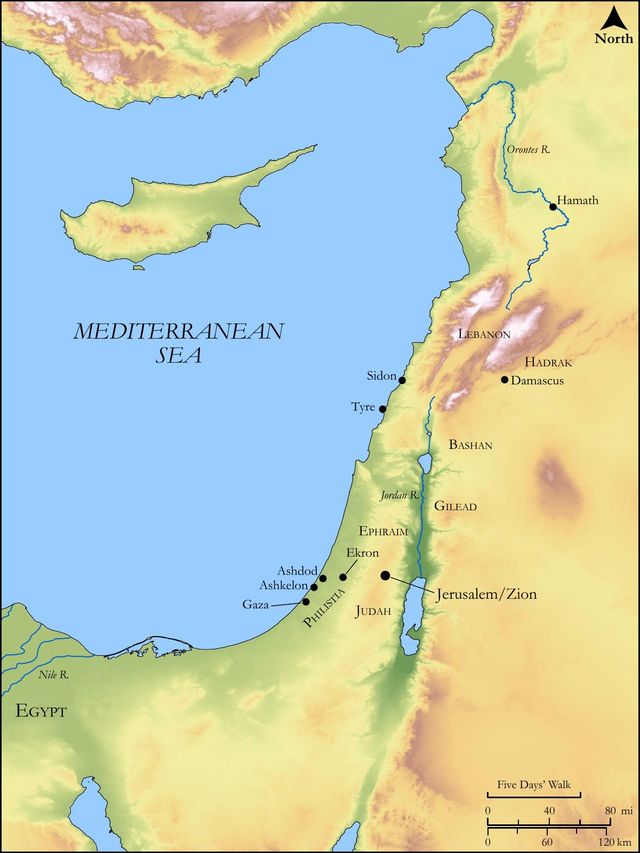
The word of the Lord shall be a burden in the land of Hadrach, that is, of Syria, but it does not appear why it was so called. That that kingdom is meant is plain, because Damascus, the metropolis of that kingdom, is said to be the rest of this burden; that is, the judgments here threatened shall light and lie upon that city. Those are miserable upon whom the burden of the word of the Lord rests, upon whom the wrath of God abides (Joh 3:36); for it is a weight that they can neither shake off nor bear up under. There are those whom God causes his fury to rest upon. Those whom the wrath of God makes its mark it will be sure to hit; those whom it makes its rest it will be sure to sink. And the reason of this burden's resting on Damascus is because the eyes of man, as of all the tribes of Israel (or rather, even of all the tribes of Israel), are towards the Lord, because the people of God by faith and prayer look up to him for succour and relief and depend upon him to take their part against their enemies. Note, It is a sign that God is about to appear remarkably for his people when he raises their believing expectations from him and dependence upon him, and when by his grace he turns them from idols to himself. Isa 17:7, Isa 17:8, At that day shall a man look to his Maker. It may be read thus, for the Lord has an eye upon man, and upon all the tribes of Israel; he is King of nations as well as King of saints; he governs the world as well as the church, and therefore will punish the sins of other people as well as those of his own people. God is Judge of all, and therefore all must give account of themselves to him. When St. Paul was converted at Damascus, and preached there, and disputed with the Jews, then the word of the Lord might be said to rest there, and then the eyes of men, of other men besides the tribes of Israel, began to be towards the Lord; see Act 9:22. Hamath, a country which lay north of Damascus, and which we often read of, shall border thereby (Zac 9:2); it joins to Syria, and shall share in the burden of the word of the Lord that rests upon Damascus. The Jews have a proverb, Woe to the wicked man, and woe to his neighbour, who is in danger of partaking in his sins and in his plagues. Woe to the land of Hadrach, and woe to Hamath that borders thereby.
II.Tyre and Zidon come next to be called to an account here, as in other prophecies, Zac 9:2-4. Observe here,
1.Tyrus flourishing, thinking herself very safe, and ready to set God's judgments, not only at a distance, but at defiance: for,
(1.)She is very wise. It is spoken ironically; she thinks herself very wise, and able to outwit even the wisdom of God. It is granted that her king is a great politician, and that her statesmen are so, Eze 28:3. But with all their wit and policy they shall not be able to evade the judgments of God when they come with commission; there is no wisdom nor counsel against the Lord; nay, it is his honour to take the wise in their own craftiness.
(2.)She is very strong, and well fortified both by nature and art: Tyrus did build herself a strong-hold, which she thought could never be brought down nor got over.
(3.)She is very rich; and money is a defence; it is the sinews of war, Ecc 7:12. By her vast trade she has heaped up silver as the dust, and fine gold as the mire of the streets, that is, she has an abundance of them, heaps of silver as common as heaps of sand, Job 27:16. Solomon made silver to be in Jerusalem as the stones of the streets; but Tyre went further, and made fine gold to be as the mire of the streets. It were well if we could all learn so to look upon it, in comparison with the merchandise of wisdom and grace and the gains thereof.
2.Tyrus falling, after all. Her wisdom, and wealth, and strength, shall not be able to secure her (Zac 9:4): The Lord will cast her out of that strong-hold wherein she has fortified herself, will make her poor (so some read it); there have been instances of those that have fallen from the height of plenty to the depth of poverty, and great riches have come to nothing. God will smite her power in the sea; her being surrounded by the water shall not secure her, but she shall be devoured with fire, and burnt down to the ground. Tyrus, being seated in the midst of the water, was, one would have thought, in danger of being some time or other overflowed or washed away by that; yet God chooses to destroy it by the contrary element. Sometimes he brings ruin upon his enemies by those means which they least suspect. Water enough was nigh at hand to quench the flames of Tyre, and yet by them she shall be devoured; for who can put out the fire which the breath of the Almighty blows up?
III.God next contends with the Philistines, with their great cities and great lords, that bordered southward upon Israel.
1.They shall be alarmed and affrighted by the word of the Lord lighting and resting upon Damascus (Zac 9:5); the disgraces of Israel had many a time been published in the streets of Ashkelon, and they had triumphed in them; but now Ashkelon shall see the ruin of her friends and allies, and shall fear; Gaza also shall see it, and be very sorrowful, and Ekron, concluding that their own turns come next, now that the cup of trembling goes round. What will become of their house when their neighbour's is on fire? They had looked upon Tyre and Zidon as a barrier to their country; but, when those strong cities were ruined, their expectations from them were ashamed, as our expectation from all creatures will be in the issue.
2.They shall themselves be ruined and wasted.
(1.)The government shall be dissolved: The king shall perish from Gaza, not only the present king shall be cut off, but there shall be no succession, no successor,
(2.)The cities shall be dispeopled: Ashkelon shall not be inhabited; the rightful owners shall be expelled, either slain or carried into captivity.
(3.)Foreigners shall take possession of their land and become masters of all its wealth (Zac 9:6): A bastard shall dwell in Ashdod; a spurious brood of strangers shall enter upon the inheritances of the natives, which they have no more right to than a bastard has to the estates of the legitimate children. And thus God will cut off the pride of the Philistines, all the strength and wealth which they prided themselves in, and which were the ground of their confidence in themselves and their contempt of the Israel of God. This prophecy of the destruction of the Philistines, and of Damascus, and Tyre, was accomplished, not long after this, by Alexander the Great, who ravaged all these countries with his victorious army, took the cities, and planted colonies in them, which Quintus Curtius gives a particular account of in the history of his conquests. And some think he is meant by the bastard that shall dwell in Ashdod, for his mother Olympia owned him begotten in adultery, but pretended it was by Jupiter. The Jews afterwards got ground of the Philistines, Syrians, and others of their neighbours, took some of their cities from them and possessed their countries, as appears by the histories of Josephus and the Maccabees, and this was foretold before, Zep 2:4, etc.; Oba 1:20.
3.Some among them shall be converted, and brought home to God, by his gospel and grace; so some understand Zac 9:7, as a promise,
(1.)That God would take away the sins of these nations - their blood and their abominations, their cruelties and their idolatries. God will part between them and these sins which they have rolled under their tongue as a sweet morsel, and are as loth to part with as men are to part with the meat out of their mouths, and which they hold fast between their teeth. Nothing is too hard for the grace of God to do.
(2.)That he would accept of a remnant of them for his own: He that remains shall be for our God. God would preserve a remnant even of these nations, that should be the monuments of his mercy and grace and be set apart for him; and the disadvantages of their birth shall be no bar to their acceptance with God, but a Philistine shall be as acceptable to God, upon gospel-terms, as one of Judah, nay, as a governor, or chief one, in Judah, and a man of Ekron shall be as a Jebusite, or a man of Jerusalem, as a proselyted Jebusite, as Araunah the Jebusite, Sa2 24:16. In Christ Jesus there is no distinction of nations, but all are one in him, all alike welcome to him.
IV.In all this God intends mercy for Israel, and it is in kindness to them that God will deal thus with the neighbouring nations, to avenge their quarrel for what is past and to secure them for the future.
1.Thus some understand the seventh verse, as intimating,
(1.)That thus God would deliver his people from their bloody adversaries, who hated them, and to whom they were an abomination, when they were just ready to devour them and make a prey of them: I will take away his blood (that is, the blood of Israel) out of the mouth of the Philistines and from between their teeth (Amo 3:12), when, in their hatred of them and enmity to them, they were greedily devouring them.
(2.)That lie would thus give them victory and dominion over them: And he that remains (that is, the remnant of Israel) shall be for our God, shall be taken into his favour, shall own him and be owned by him, and he shall be as a governor in Judah; though the Jews have been long in servitude, they shall recover their ancient dignity, and be victorious, as David and other governors in Judah formerly were; and Ekron (that is, the Philistines) shall be as the Jebusites, and the rest of the devoted nations, who were brought into subjection under them.
2.However, this is plainly the sense of Zac 9:8, that God will take his people under his special protection, and therefore will weaken their neighbours, that it may not be in their power to do them a mischief: I will encamp about my house because of the army. Note, God's house lies in the midst of an enemy's country, and his church is as a lily among thorns; and therefore God's power and goodness are to be observed in the special preservation of it. The camp of the saints, being a little flock in comparison with the numerous armies of the powers of darkness that are set against it round about, would certainly be swallowed up if the angels of God did not encamp about it, as they did about Elisha, to deliver it, Rev 20:9; Psa 34:7. When the times are unusually perilous, when armies are marching and counter-marching, and all bearing ill-will to Zion, then Providence will as it were double its guards upon the church of God, because of him that passes by and because of him that returns, that whether he return a conqueror or conquered he may do it no harm. And, as none that pass by shall hurt them, so no oppressor shall pass through them any more; they shall have no enemy within themselves to rule them with rigour, and to make their lives bitter to them with sore bondage, as of old in Egypt. This was fulfilled when, for some time after the struggles of the Maccabees, Judea was a free and flourishing state, or perhaps when Alexander the Great, struck with an awe of Jaddus the high priest, favoured the Jews, and took them under his protection, at the same time when he wasted the neighbouring countries. And the reason given for all this is, "For now have I seen with my eyes, now have I carefully distinguished between my people and other people, with whom before they seemed to have their lot in common, and have made it to appear that I know those that are mine," This agrees with Psa 34:15, The eyes of the Lord are upon the righteous; now his eyes, which run to and fro through the earth, shall fix upon them, that he may show himself tender of them, and strong on their behalf, Ch2 16:9.
Historical interpretation
Fourteen Centuries of Reception
2 surviving comments on this verse. Each one is dated, so this reads as a timeline rather than a list.
Select a marker to jump to its quote. Markers stagger vertically where authors wrote within a few decades of each other.
(Verse 5 onwards) Ascalon will see it and be afraid; Gaza will writhe in agony, and Ekron too, for her hope will wither. Gaza will lose her king and Ashkelon will be deserted. Foreigners will occupy Ashdod, and I will cut off the pride of the Philistines. I will take the blood from their mouths, the forbidden food from between their teeth. Those who are left will belong to our God and become a clan in Judah, and Ekron will be like the Jebusites. And I will surround my house with those who fight for me, going and returning, and no oppressor will pass over them anymore, for now I have seen with my own eyes. Ascalon will see and be afraid; Gaza will be very sorrowful; and Ekron, because her hope is confounded, and her king will perish from Gaza, and Ascalon will not be inhabited. Foreigners will dwell in Ashdod; and I will remove the injustice of the foreigners, and take away their blood from their mouths, and their abominations from the midst of their teeth. And they will be for our God, and they will be like a leader in Judah; and Ekron will be like the Jebusites. And I will make my house a place of honor, so that no one will pass through or return, and no oppressor or oppressor will come upon them, for now I have seen with my own eyes. Ascalon is interpreted as lowly fire, or weighed down: Gaza, strong, or empire: Accaron, barren, or uprooted: Azotus, which in Hebrew is called Esdod, fire generating, or uncle's fire, or breast's fire; Jebusaeus, it signifies trampled. We have expressed the etymologies of the names in order to briefly go through their meaning. Seeing that Ascalon and Gaza and Accaron, since Emath was in the borders of Damascus, and Tyre and Sidon, after they were struck from all sides, and all of their hay, wood, and straw burned in the fire, were possessed by the Lord, and they themselves, terrified by fear and grief and confusion, began to hope for better things. Finally, Ascalon, in which the devil had been earlier, a lowly fire, and had come to the measure and weight of sins, trembled with fear, because it had ceased to have inhabitants. And Gaza mourned greatly, repenting of its former crimes, which had once been strong and hard to tame, and had promised itself the kingdom of all, because its king and prince, contrary speech and the power of the enemy, had lost its own rule. Accaron also is barren because it had no children without the Law and knowledge of God, it was uprooted, so that it might hear that prophetic saying: Rejoice, barren one, who does not bear; burst forth and cry out, you who are not in labor; for more are the children of the desolate than of her who has a husband (Isai. LIV, I). And when Ascalon and Gaza and Accaron were terrified, and mourned, because they had no inhabitants, or had lost their king, or their former hope had been frustrated, strangers shall dwell in Azotus, where fire begets, which the Lord has sent upon the earth, and desires to burn (Luc. XII). For he will baptize with the Holy Spirit and fire (Matt. 3), where 'fratruelis' and 'patruus' are translated as 'brother-in-law' and 'paternal cousin', whom the bride desires in the Song of Songs: where there is the fire of the breast and the abundant udder, of which we read in the same Song: 'He will rest among my breasts' (Song of Songs 1:12). And in the Apostle: 'I gave you milk to drink, not solid food' (1 Cor. 3:2). Because, as we said according to the LXX: 'Aliens shall dwell in Ashdod', in Hebrew it is written, 'he shall dwell' or 'sit', the 'Mamzer' shall dwell in Ashdod, for which we have substituted 'separator' shall sit in Ashdod. Understand the Lord as the separator, who separates the grain from the chaff (Matthew 3 and 13), and the good fish from the bad fish, and discern silver and gold from dirt and slag. And when he has done this, he promises other things: I will destroy the injustice or the pride of the Philistines. For this, the 70 foreigners were brought in. Philistines are translated in our language as 'falling to the cup,' because they drank from the cup of Babylon and fell down drunk. Therefore, at the time of the calling of the Gentiles and the coming of Christ, they will not have pride, but they will follow Jesus with humility and meekness. And he will take from their mouth the blood, the blasphemy, and the abominations, the worship of idols, and the eating of things sacrificed to idols, from between their teeth. So that after these things have been removed, the Philistines themselves, that is, the foreigners, will be abandoned to the Lord, and he will be the leader in Judah, that is, in the people confessing the Lord, so that the former people who were in the head, will be turned into the tail, and the last one who was in the tail, will pass into the head. And once barren Accaron, therefore, uprooted, will be as Jebus, that is, as Jerusalem. For this city is called by three names, Jebus, Salem, and Jerusalem. And I will surround, he says, my house, that is, the Church, with those who fight for me, that is, with those who serve me in various ministries and come and go at my command. Or: I will surround my house with the protection of angels, about whom it is also written elsewhere: The angel of the Lord will encamp around those who fear him, and he will deliver them (Ps. 34:7), so that there is no one who can attack and return, that is, who can plot against my people. Nor shall there pass over him any more the exactor, of whom Isaiah speaks: The exactor hath ceased (Isaiah 14:5), or surely one who drives out, that is, leading outwards, and dragging the bound captives into captivity: because with his own eyes, which we can understand as the prophets and all the saints, the Lord has seen the calling of the nations and the security of the Church.
Rejoice greatly, O daughter of Zion; shout, O daughter of Jerusalem: behold, thy King cometh unto thee: he is just, and having salvation; lowly, and riding upon an ass, and upon a colt the foal of an ass. And I will cut off the chariot from Ephraim, and the horse from Jerusalem, and the battle bow shall be cut off: and he shall speak peace unto the heathen: and his dominion shall be from sea even to sea, and from the river even to the ends of the earth. LXX: Rejoice greatly, O daughter of Zion; proclaim, O daughter of Jerusalem: behold, thy King cometh unto thee, just, and a Saviour, he is meek, and riding upon a young ass, and he shall destroy the chariots out of Ephraim, and the horse out of Jerusalem, and the battle bow shall be destroyed, and he shall speak peace to the Gentiles, and his dominion shall be from the sea to the rivers, and from the rivers to the ends of the earth. The Evangelists write that this prophecy was fulfilled when the Lord entered Jerusalem, sitting on a donkey and the foal of a donkey, and a crowd of children with palm branches came out to meet Him, shouting: Blessed is He who comes in the name of the Lord, hosanna in the highest (Matthew XXI); and when the Pharisees reproached Him for not rebuking the children who were shouting, He replied: Have you not read: Out of the mouth of babes and sucklings you have perfected praise (Psalm VIII, 3)? Therefore, Sion exults and Jerusalem rejoices, the same city (for Sion is the citadel of Jerusalem), because its king has come, who was promised by the prophecies of all the prophets: He himself is just, the Savior, that is, Jesus, as the angel interpreted, speaking to the Virgin: And he shall be called Jesus, for he shall save his people from their sins (Mat. I, 21). Also, poor or, as the LXX translated, meek, who, though rich, became poor for us, and says in the Gospel: Learn from me, for I am meek and humble of heart (Mat. XI, 29). And, riding upon a domestic ass or a young foal, that is, the people of both Circumcision and Uncircumcision, of whom the former had borne the heavy yoke of the Law, as it is written in the Acts of the Apostles: Neither we, nor our fathers, were able to bear the heavy yoke of the Law (Acts 15). Therefore, Paul also writes to the Galatians who wanted to be circumcised: Stand fast, and do not be held again under the yoke of bondage (Galatians 5:1). But the new chick, a multitude of gentiles, having no reins of the Law, nor being straightened by anyone, but always falling into precipices and whirlpools of idolatry, has learned to walk and enter the straight path by the session of the Lord. And I will destroy, he says, the chariot of Ephraim. Moreover, it is said in the person of God the Father, that the chariot, or the chariot, of Ephraim may perish, and the horse from Jerusalem. And in the meantime, according to the letter, he speaks thus: There will be no battles, with the advent and birth of Christ pacifying all. Furthermore, according to a higher understanding, Ephraim is referred to as a multitude of heresies, which is interpreted as bearing fruit, that is, abundance and plentiful crops. This is written in the seventy-seventh psalm: The children of Ephraim, being armed and carrying bows, turned back in the day of battle. About these chariots and charioteers, we read: Some trust in chariots and some in horses, but we trust in the name of the Lord our God. They have bowed down and fallen, but we have risen and stand upright (Psalm 20:7-9). The horse that is lost from Jerusalem, that is whom we read about: A deceitful horse for salvation (Psalm 32:17), And in Jeremiah, those who indulged in luxury and lust, they hear: The horses have gone mad, they have become like females to me: each neighed after his neighbor's wife (Jeremiah 5:8). Hence they are called to repentance, as the Psalmist says: Do not be like a horse or a mule, which have no understanding (Psalm 32:9). When God has destroyed the chariots of Ephraim and the horse from Jerusalem, which were freed from such horses and chariots; they will be brought into the service of the Lord, and will become cherubim, and it will be said of them: The chariots of God are ten thousandfold, thousands of rejoicing (Psalm 68:18). And: I have likened you, my beloved, to my horse in Pharaoh's chariots (Song of Solomon 1:8). And: Ride on horses, and let your riding be salvation (Habakkuk 3:8). The bow of war will be dispersed, so that no burning arrows may be launched, which could strike the hearts of the pleasure seekers. And he will speak peace to the nations, of whom it is written: He shall be the expectation of the nations (Gen. XLIX, 10). And again: The nations shall hope in him (Isai. XI). And: His dominion shall be from sea to sea, and from the rivers to the ends of the earth (Ps. LXXI, 8). This is not to be weakened by allegory, but truly believed to be fulfilled, according to what we read: Ask of me, and I will give you the nations for your inheritance, and the ends of the earth for your possession (Ps. II, 8). In the seventy-first psalm, under the person of Solomon and the true peacemaker, it is said: And he shall rule from sea to sea, and from the river to the ends of the earth (Verse 8).
That serve me in war: Viz., the Machabees.
Continue studying Zechariah 9:8 across the web’s major study libraries — every link below opens this exact verse, chapter, or book on the destination site.
Read & Compare
 BibleGatewayThis verse in more than 200 translations and 70 languages.
 Bible.comThe YouVersion reader — hundreds of translations, reading plans, and highlights.
 ESV.orgCrossway's official English Standard Version reader.
 NET BibleThe NET translation with 60,000+ translators' notes on every rendering decision.
 STEP BibleTyndale House's free study tool — original text, vocabulary, and scholarly resources.
 BibliaLogos Bible Software's free web reader.
 USCCBThe New American Bible (Revised Edition) with the U.S. bishops' study notes.
Commentaries
 BibleHub CommentariesDozens of classic commentaries on this verse, gathered on one page.
 StudyLightMore than 100 commentary sets — the largest collection on the web.
 BibleRefPlain-English commentary on what this verse means, verse by verse.
 Enduring WordDavid Guzik's free commentary on this chapter, widely used by Bible teachers.
 Bible Study ToolsVerse commentary alongside Greek and Hebrew study aids.
Original Language & Research
- BibleHub InterlinearThe verse word by word — original language, transliteration, and English.
- BibleHub LexiconEvery word's original-language definition and Strong's entry.
 Blue Letter BibleDeep-study tools — Strong's numbers, concordance, and word studies.
 SefariaThe Hebrew text with Rashi and centuries of Jewish commentary.
Sermons, Hymns & Audio


TrulyRandomVerse is not affiliated with these sites and doesn’t control their content. They’re linked because they’re genuinely useful.
Summary
Zechariah 9:8 delivers a profound divine promise of unwavering protection and enduring security for God's dwelling place and His people. It declares that the Lord Himself will establish a vigilant encampment around His "house," ensuring that no hostile forces—whether passing by or returning—will ever again oppress them. This declaration is rooted in God's direct observation of their plight, signaling a definitive end to cycles of foreign domination and a new era of divine safeguarding.
Context
ShowHideLiterary Context
Zechariah 9 marks a significant shift in the book's prophetic focus. Chapters 1-8 primarily dealt with the immediate post-exilic concerns of rebuilding the temple and spiritual renewal in Jerusalem. Chapter 9, however, launches into a series of oracles concerning the future, beginning with pronouncements of judgment against the surrounding nations (Syria, Phoenicia, Philistia) who had historically oppressed Israel. Amidst these judgments, Zechariah 9:8 pivots to a powerful affirmation of God's protective presence over His people, specifically Jerusalem, serving as a crucial bridge to the messianic prophecy of the humble King's arrival in Zechariah 9:9. This verse reassures the beleaguered remnant that divine protection precedes and enables the coming of their promised deliverer.
Historical & Cultural Context
The prophecy of Zechariah was delivered to the Jewish community that had returned from Babylonian exile, a period marked by vulnerability and ongoing external threats. While the temple was being rebuilt, Jerusalem remained a relatively weak city-state, subject to the shifting geopolitical sands of the Persian Empire and the lingering animosity of neighboring peoples. The "army" and those "that passeth by, and... that returneth" likely refer to the various military forces and marauding bands that traversed the land of Israel, often causing distress and oppression. The promise of an encampment speaks to a deeply felt need for security in a world where empires rose and fell, and the people of God often found themselves caught in the crossfire, experiencing repeated cycles of invasion and subjugation, a pattern evident throughout the history recorded in Judges and Kings.
Key Themes
ShowHideThis verse powerfully encapsulates several overarching themes within Zechariah and the broader prophetic tradition. Firstly, it highlights Divine Sovereignty and Protection, portraying God as the ultimate defender of His covenant people and His dwelling place, echoing the imagery of the Lord as a shield around Jerusalem found in Psalm 125:2. Secondly, it emphasizes the Cessation of Oppression, promising an end to the long history of foreign domination and tyrannical rule that Israel had endured, a hope for lasting peace and security that resonates with the prophetic vision of a new heaven and new earth where there is no more pain or suffering (see Revelation 21:4). Finally, the phrase "for now have I seen with mine eyes" underscores Divine Omniscience and Compassionate Intervention, revealing that God's protective action is a direct response to His intimate awareness of His people's suffering and the injustices they have faced, reminiscent of His attention to Israel's cries in Egypt as depicted in Exodus 3:7.
Exposition and Analysis
ShowHideKey Word Analysis
ShowHideThis primitive root means "to incline," "to pitch a tent," or "to encamp." In the context of divine action, it conveys the powerful image of God Himself taking up a military posture, setting up a defensive perimeter around His "house." It implies a decisive, active, and protective presence, not merely a passive observation. This is a divine commitment to remain stationed, like a guardian army, ensuring security.
This word broadly refers to a dwelling, a family, or a temple. Here, "mine house" primarily refers to the Temple in Jerusalem, God's designated dwelling place among His people. By extension, it also encompasses the people of Israel themselves, as they are the spiritual "house" or family of God. The divine encampment thus protects both the physical sanctuary and the community of faith.
This root means "to drive," "to tax," "to harass," or "to tyrannize." An "oppressor" (nôgēś) is typically a taskmaster or tyrannical exactor, often associated with foreign subjugation and cruel rule, as seen with the Egyptian taskmasters over Israel. The promise that "no oppressor shall pass through them any more" signifies a complete and permanent end to such tyrannical incursions and exploitative rule.
Verse Breakdown
ShowHide"And I will encamp about mine house"
This opening clause establishes God's direct, personal, and active involvement in the protection of His people and His sanctuary. The imagery of "encamping" suggests a military-style defense, a permanent, vigilant presence, indicating that God Himself will be the ultimate barrier against all threats.
"because of the army, because of him that passeth by, and because of him that returneth"
This specifies the nature of the threats against which God will provide protection. "The army" refers to organized military forces. "Him that passeth by" denotes transient marauders or invading forces moving through the land. "Him that returneth" suggests those who might retreat and then return to inflict further harm, or perhaps those who had previously oppressed and might attempt to do so again. This comprehensive phrasing covers all forms of hostile movement and intrusion.
"and no oppressor shall pass through them any more"
This is the definitive promise of cessation. The "oppressor" (nôgēś) refers to any tyrannical ruler or taskmaster. The phrase "pass through them any more" signifies that the cycles of invasion, subjugation, and exploitation that had plagued Israel will come to a permanent end. This is a promise of lasting peace and freedom from external domination.
"for now have I seen with mine eyes"
This concluding phrase provides the divine motivation for God's intervention. It emphasizes God's direct observation and intimate knowledge of His people's suffering, injustice, and vulnerability. His decision to act is not arbitrary but a compassionate response to what He has personally witnessed, underscoring His justice and faithfulness to His covenant.
Literary Devices
ShowHideZechariah 9:8 employs several potent literary devices to convey its message of divine protection. Imagery is central, particularly with the phrase "I will encamp about mine house," which evokes the vivid picture of a divine army setting up a protective perimeter, conveying strength, vigilance, and an impenetrable defense. The repetition of "because of" (anaphora) in "because of the army, because of him that passeth by, and because of him that returneth" serves to emphasize the comprehensive nature of the threats God is addressing, highlighting His all-encompassing protection. The phrase "no oppressor shall pass through them any more" functions as a powerful hyperbole or absolute declaration, underscoring the finality and totality of God's promised security. Finally, the concluding "for now have I seen with mine eyes" uses anthropomorphism, attributing human sight to God, which serves to personalize God's awareness and compassion, making His intervention seem more immediate and deeply felt.
Theological and Thematic Connections
ShowHideZechariah 9:8 powerfully articulates God's unwavering commitment to His covenant people and His dwelling place. It reveals a God who is not distant but intimately aware of His people's suffering, actively intervening to provide security and bring an end to cycles of oppression. This verse speaks to the very heart of God's faithfulness, demonstrating His protective nature as a fundamental aspect of His character. It foreshadows a future state of perfect peace and security, ultimately fulfilled in the messianic age, where God's presence guarantees lasting freedom from all forms of spiritual and physical tyranny.
Reflection and Application
ShowHideZechariah 9:8 offers profound comfort and reassurance to believers today. It reminds us that the God who promised to encamp around His ancient "house" is the same God who actively guards His spiritual "house"—the church, His people, and each individual believer. In a world fraught with anxieties, spiritual battles, and various forms of oppression, this verse calls us to rest in the sovereign protection of God. We are assured that He sees our struggles, hears our cries, and stands ready to defend us against all adversaries, whether they are direct attacks, subtle temptations, or the pervasive pressures of a fallen world. This promise encourages us to live with confident trust, knowing that our ultimate security rests not in human strength or worldly systems, but in the watchful eye and mighty hand of our faithful God, who will ultimately bring us to a place where all spiritual oppression ceases and we dwell in His perfect peace.
Questions for Reflection
ShowHideFAQ
ShowHideWhat is the "house" that God promises to encamp about in Zechariah 9:8?
ShowHideThe "house" (Hebrew: bayith) primarily refers to the Temple in Jerusalem, which was God's physical dwelling place among His people after the Babylonian exile. However, by extension, it also encompasses the people of Israel themselves, as they are considered God's spiritual "house" or family. This promise signifies God's comprehensive protection over both His sanctuary and His chosen people, ensuring their security and presence in the land.
Who are "him that passeth by, and him that returneth" and the "oppressor"?
ShowHideThese phrases refer to various external threats and hostile forces that historically plagued Israel. "Him that passeth by" likely denotes transient invading armies or marauding bands that would move through the land, causing destruction. "Him that returneth" could refer to those who retreat and then return to inflict further harm, or perhaps a recurring cycle of invaders. The "oppressor" (Hebrew: nâgas) specifically points to tyrannical rulers, taskmasters, or foreign powers that subjugated and exploited God's people. The verse promises an end to all such forms of external aggression and domination, ensuring lasting peace and freedom for God's "house."
Christ-Centered Fulfillment
ShowHideZechariah 9:8 finds its ultimate and most profound fulfillment in Jesus Christ and the establishment of His church. The promise of God encamping about "mine house" transcends the physical temple in Jerusalem to encompass the new spiritual temple—the body of believers, the church, which is built upon the cornerstone of Christ (as seen in Ephesians 2:19-22). Jesus Himself is the ultimate protector and guardian of His church, declaring that "the gates of hell shall not prevail against it" (Matthew 16:18). The cessation of the "oppressor" is spiritually fulfilled in Christ's victory over sin, death, and the devil, who is the ultimate oppressor of humanity. Through His atoning work, believers are delivered from the tyranny of sin and the power of darkness, experiencing true freedom and peace that the world cannot give (Colossians 1:13-14). The "seeing with mine eyes" of God is perfectly embodied in Jesus, who, as God incarnate, intimately knows and sympathizes with our weaknesses and struggles (Hebrews 4:15). Thus, Christ is not only the fulfillment of the promised protection but also the very means by which God's people are eternally secured and liberated from all forms of spiritual oppression, dwelling in His presence forever.