


Isaiah 17:7
- בַּיּוֹםbai·Yomin the dayH3117Prep-b ¦ N-msNoun Singular Masculine Absoluteבַּin theיּוֹםday
- הַהוּאha·Hu'<the> thatH1931Art ¦ Pro-3msPronoun Personal 3rd Singular Masculineהַ<the>הוּאthat
- יִשְׁעֶהyish·'Ehhe will lookH8159V-Qal-Imperf-3msVerb Qal Imperfect 3rd Singular Masculine
- הָאָדָםha·'a·Dam<the> personH120Art ¦ N-msNoun Singular Masculine Absoluteהָ<the>אָדָםperson
- עַל'alonH5921PrepPreposition
- עֹשֵׂהוּ'o·Se·huhis makerH6213V-Qal-Prtcpl-ms ¦ 3msVerb Qal Participle Singular Masculine Constructעֹשֵׂmakerהוּhis
- וְעֵינָיוve·'ei·Navand his eyesH5869Conj-w ¦ N-fdc ¦ 3msNoun Dual Feminine Constructוְandעֵינָיeyesוhis
- אֶל'eltoH413PrepPreposition
- קְדוֹשׁke·Do·osh[the] holy [one] ofH6918Adj-mscAdjective Singular Masculine Construct
- יִשְׂרָאֵלYis·ra·'ElIsraelH3478N-properNoun Proper Location
- תִּרְאֶינָהtir·'Ei·nahthey will seeH7200V-Qal-Imperf-3fpVerb Qal Imperfect 3rd Plural Feminine
English is a literal word-by-word gloss of the Hebrew, not the KJV's wording. Why?
This is the original text the KJV's translators worked from — each Hebrew word with its own literal English meaning in this verse, prepared by scholars at Tyndale House, Cambridge. The KJV translates whole sentences, not word by word, so its wording differs: one Hebrew word can become several English words, and the KJV may choose “the LORD” where the gloss reads “Yahweh”. Both are faithful — they answer different questions. For the KJV's own rendering, switch to the KJV text.
Details
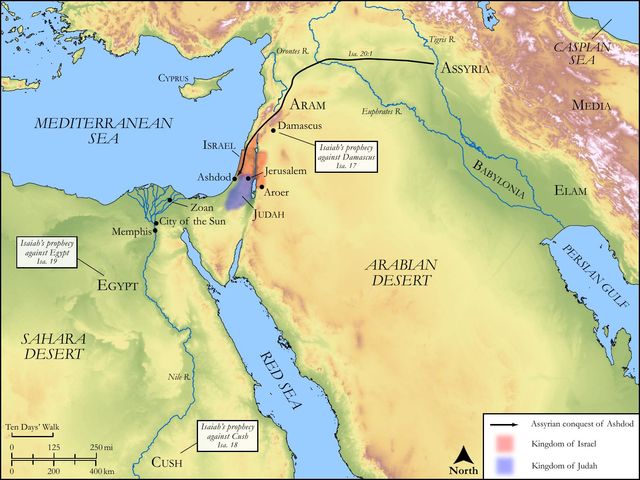
See on the biblical-era map
Study this verse
Public-domain commentary
Matthew Henry
From his Commentary on the Whole Bible. Henry comments on passages, not single verses — this entry covers Isaiah 17:6–8.
Mercy is here reserved, in a parenthesis, in the midst of judgment, for a remnant that should escape the common ruin of the kingdom of the ten tribes. Though the Assyrians took all the care they could that none should slip out of their net, yet the meek of the earth were hidden in the day of the Lord's anger, and had their lives given them for a prey and made comfortable to them by their retirement to the land of Judah, where they had the liberty of God's courts. 1. They shall be but a small remnant, a very few, who shall be marked for preservation (Isa 17:6): Gleaning grapes shall be left in it. The body of the people were carried into captivity, but here and there one was left behind, perhaps one of two in a bed when the other was taken, Luk 17:34. The most desolating judgments in this world are short of the last judgment, which shall be universal and which none shall escape. In times of the greatest calamity some are kept safe, as in times of the greatest degeneracy some are kept pure. But the fewness of those that escape supposes the captivity of the far greatest part; those that are left are but like the poor remains of an olive tree when it has been carefully shaken by the owner; if there be two or three berries in the top of the uppermost bough (out of the reach of those that shook it), that is all. Such is the remnant according to the election of grace, very few in comparison with the multitudes that walk on in the broad way. 2. They shall be a sanctified remnant, Isa 17:7, Isa 17:8. These few that are preserved are such as, in the prospect of the judgment approaching, had repented of their sins and reformed their lives, and therefore were snatched thus as brands out of the burning, or such as having escaped, and becoming refugees in strange countries, were awakened, partly by a sense of the distinguishing mercy of their deliverance, and partly by the distresses they were still in, to return to God. (1.) They shall look up to their Creator, shall enquire, Where is God my Maker, who giveth songs in the night, in such a night of affliction as this? Job 35:10, Job 35:11. They shall acknowledge his hand in all the events concerning them, merciful and afflictive, and shall submit to his hand. They shall give him the glory due to his name, and be suitably affected with his providences. They shall expect relief and succour from him and depend upon him to help them. Their eyes shall have respect to him, as the eyes of a servant to the hand of his master, Psa 123:2. Observe, It is our duty at all times to have respect to God, to have our eyes ever towards him, both as our Maker (the author of our being and the God of nature) and as the Holy One of Israel, a God in covenant with us and the God of grace; particularly, when we are in affliction, our eyes must be towards the Lord, to pluck our feet out of the net (Psa 25:15); to bring us to this is the design of his providence as he is our Maker and the work of his grace as he is the Holy One of Israel. (2.) They shall look off from their idols, the creatures of their own fancy, shall no longer worship them, and seek to them, and expect relief from them. For God will be alone regarded, or he does not look upon himself as at all regarded. He that looks to his Maker must not look to the altars, the work of his hands, but disown them and cast them off, must not retain the least respect for that which his fingers have made, but break it to pieces, though it be his own workmanship - the groves and the images; the word signifies images made in honour of the sun and by which he was worshipped, the most ancient and most plausible idolatry, Deu 4:19; Job 31:26. We have reason to account those happy afflictions which part between us and our sins, and by sensible convictions of the vanity of the world, that great idol, cool our affections to it and lower our expectations from it.
Historical interpretation
Four Centuries of Reception
4 surviving comments on this verse. Each one is dated, so this reads as a timeline rather than a list.
Select a marker to jump to its quote. Markers stagger vertically where authors wrote within a few decades of each other.
By this it is clearly promised that the glory of Israel and all her riches will be taken away, and only a few, who like the few berries on an olive branch can be counted easily, will be left. These are the ones who believe in the Lord. Just after this there is a prophecy of the entire human race turning away from the error of idolatry and recognizing the God of Israel.
(Verse 7, 8) On that day, a man will turn towards his Maker, and his eyes will look to the Holy One of Israel. He will not turn towards the altars that his hands have made, nor towards the works of his fingers. He will not look to the groves and shrines. Some interpret this as fulfilled during the time of Christ, when the kingdom of Damascus was destroyed and the eternal kingdom of the Savior succeeded, and the error of idolatry was diminished. It is indeed a pious interpretation, but it does not follow the order of history. But we say that after Damascus was subdued and the ten tribes were led into Assyria, the remnant of the tribes of Israel, converted by the letters of Hezekiah, came to the worship of God and to the temple in Jerusalem, as the Chronicles history narrates (2 Chronicles 3). Therefore, with Damascus destroyed, the people will turn to their Maker, that is, to the one who created them, and their eyes will no longer look at the idols they made in Bethel and Dan, but they will look to God, despising the shrines and altars that their own fingers made.
(Verse 7, 8). On that day, man will bow down to his maker and his eyes will look to the Holy One of Israel. And he will not bow down to the altars that his hands have made, nor to the things that his fingers have worked on; he will not look to the groves and shrines. In that time, when the Lord your God called the people of Israel, who were once called a fruitful olive tree (Jeremiah 11:16), and as we read in the Psalms: Your children will be like young olive trees around your table (Psalm 128:3), if the Lord hungry for the dryness of spiritual grace finds barely two olives, or three, or four, or five, the fullness of the Gentiles will enter, and they will not bow down to idols made by hands, but they will bow down to their own God, looking to the Holy One of Israel, and they will despise altars, groves, and shrines, knowing that which is written: Every plant that my heavenly Father has not planted will be uprooted (Matthew 15:13).
Those who trust in idols are foolish. Idols are their own creations, things they made with their own hands, but they turn around and say, “These idols are our creators.” How can these people say that something they made is their creator? Moreover, they guard their idols, so that they will not be stolen by thieves. What foolishness! If idols cannot guard and protect themselves, how can they guard and save others?
Continue studying Isaiah 17:7 across the web’s major study libraries — every link below opens this exact verse, chapter, or book on the destination site.
Read & Compare
 BibleGatewayThis verse in more than 200 translations and 70 languages.
 Bible.comThe YouVersion reader — hundreds of translations, reading plans, and highlights.
 ESV.orgCrossway's official English Standard Version reader.
 NET BibleThe NET translation with 60,000+ translators' notes on every rendering decision.
 STEP BibleTyndale House's free study tool — original text, vocabulary, and scholarly resources.
 BibliaLogos Bible Software's free web reader.
 USCCBThe New American Bible (Revised Edition) with the U.S. bishops' study notes.
Commentaries
 BibleHub CommentariesDozens of classic commentaries on this verse, gathered on one page.
 StudyLightMore than 100 commentary sets — the largest collection on the web.
 BibleRefPlain-English commentary on what this verse means, verse by verse.
 Enduring WordDavid Guzik's free commentary on this chapter, widely used by Bible teachers.
 Bible Study ToolsVerse commentary alongside Greek and Hebrew study aids.
Original Language & Research
- BibleHub InterlinearThe verse word by word — original language, transliteration, and English.
- BibleHub LexiconEvery word's original-language definition and Strong's entry.
 Blue Letter BibleDeep-study tools — Strong's numbers, concordance, and word studies.
 SefariaThe Hebrew text with Rashi and centuries of Jewish commentary.
Sermons, Hymns & Audio


TrulyRandomVerse is not affiliated with these sites and doesn’t control their content. They’re linked because they’re genuinely useful.
Summary
Isaiah 17:7 is a potent prophetic declaration within an oracle of judgment against Damascus and Ephraim. It envisions a future day when humanity, having been stripped of false securities and disillusioned by idolatry, will turn their gaze and reverence exclusively toward their divine Creator and the transcendent, covenant-keeping God of Israel. This verse highlights a pivotal shift from spiritual blindness and misplaced trust to an awakened recognition of God's unique sovereignty and holiness, revealing the redemptive purpose embedded within divine discipline.
Context
ShowHideLiterary Context
Isaiah 17 primarily functions as an oracle of judgment directed at Damascus (Aram) and Ephraim (the Northern Kingdom of Israel). The preceding verses Isaiah 17:1-6 graphically depict the impending desolation of these regions, portraying cities reduced to ruins, fields laid waste, and their populations severely diminished. This destruction is presented as a direct consequence of their idolatry and their reliance on human alliances rather than on the Lord. Verse 7, introduced by the significant prophetic idiom "At that day," marks a crucial turning point in the passage. It shifts the focus from the description of judgment to its intended spiritual outcome—a profound reorientation of human focus and faith towards God. It suggests that the stripping away of false securities is a divine means to bring about a spiritual awakening and genuine repentance.
Historical & Cultural Context
The historical setting for Isaiah 17 is the turbulent 8th century BCE, a period dominated by the ascendance of the Assyrian Empire and the resultant geopolitical instability across the Near East. Syria (Aram) and Israel (Ephraim) had formed an alliance against Judah (the Syro-Ephraimite War, circa 735-732 BCE), attempting to coerce Judah into joining their anti-Assyrian coalition. Isaiah's prophecy vehemently warns against such alliances and consistently emphasizes that true security and deliverance are found only in God. Culturally, both Aram and Israel were deeply enmeshed in pagan worship, adopting the deities and practices of surrounding nations, which defiled the land and violated their covenant with Yahweh. The title "Holy One of Israel" is a distinctive and frequently used designation for God in Isaiah, underscoring His absolute transcendence, moral purity, and His unique covenant relationship with His people, standing in stark contrast to the impotent idols they had embraced.
Key Themes
ShowHideThis verse significantly contributes to several overarching themes pervasive in the book of Isaiah. Firstly, it powerfully articulates the theme of Divine Judgment and Redemptive Purpose. The desolation described in the preceding verses is not merely punitive but serves as a divinely orchestrated catalyst for spiritual transformation, designed to turn people away from their idols and back to God. Secondly, it underscores the theme of God's Unique Sovereignty and Holiness. The turning of eyes to the "Maker" and the "Holy One of Israel" affirms God's unparalleled authority as Creator and His moral perfection, challenging the pervasive false worship among the nations. This is a recurring motif, as seen in passages like Isaiah 5:16 where God is exalted in righteousness. Finally, it speaks profoundly to the theme of Spiritual Awakening and Repentance, portraying a future where human pride and self-reliance are shattered, leading to a humble and reverent acknowledgment of the one true God. This newfound spiritual clarity stands in stark contrast to the spiritual blindness often lamented by Isaiah, such as in Isaiah 42:18.
Exposition and Analysis
ShowHideKey Word Analysis
ShowHideThis term (H120) refers to a human being, encompassing both an individual and mankind in general. In this prophetic context, it signifies humanity in its state of vulnerability and dependence, particularly after experiencing the humbling effects of divine discipline. The prophecy envisions a universal turning, where the individual, stripped of false securities and self-sufficiency, recognizes their inherent need for the Creator.
Derived from the primitive root (H6213) meaning "to do or make, in the broadest sense and widest application," this word emphasizes God's active role as the Creator, Fashioner, and Sustainer of all existence. To "look to his Maker" is to acknowledge the ultimate source of life, the one who intricately formed humanity and the entire cosmos, and therefore the one to whom all ultimate allegiance, trust, and reverence are rightfully due. It speaks to a fundamental recognition of divine origin and absolute sovereignty.
This term (H6918) denotes sacredness, moral purity, and separation. When applied to God, it signifies His absolute transcendence, His distinctness from creation, and His perfect righteousness and moral perfection. The title "Holy One of Israel" is a hallmark of Isaiah's prophecy, underscoring God's unique identity as the covenant God who is utterly set apart from all human and pagan deities, demanding exclusive worship and reverent obedience from His people.
Verse Breakdown
ShowHide"At that day shall a man look to his Maker,"
This clause introduces a pivotal future moment, marked by the prophetic idiom "At that day" (H3117), which signifies a decisive time of divine intervention, often involving judgment leading to profound transformation. It declares a fundamental shift in human perspective: instead of relying on idols, political alliances, or self-sufficiency, humanity ("a man," H120) will redirect its gaze and trust toward God as their "Maker" (H6213). This "looking" (Hebrew, shâʻâh' - H8159) implies a deep, attentive consideration, a turning away from distractions and false objects of trust to focus intently on the source of their being and existence. It signifies a recognition of utter dependence and a radical reorientation of allegiance.
"and his eyes shall have respect to the Holy One of Israel."
This second clause parallels and amplifies the first, emphasizing the depth and nature of this spiritual reawakening. The phrase "his eyes shall have respect" (Hebrew, râʼâh' - H7200, used with H5869 for "eyes") indicates not just seeing, but a profound reverence, a mindful regard, and an acknowledgment of supreme authority and worth. The object of this respect is "the Holy One of Israel" (H6918, H3478), a majestic title that highlights God's absolute moral purity, His transcendence, and His unique covenant relationship with His people. This turning of eyes signifies a move from spiritual blindness and idolatry to a reverent, worshipful acknowledgment of God's distinct and sovereign character, recognizing Him as the only true and worthy object of worship and devotion.
Literary Devices
ShowHideIsaiah 17:7 masterfully employs several Literary Devices to convey its powerful message. The phrase "At that day" functions as a Prophetic Idiom, signaling a future time of significant divine action, often encompassing both judgment and salvation, thereby setting a solemn yet hopeful tone for the prophecy. The verse also exhibits strong Parallelism, specifically Synonymous Parallelism, where the second clause ("and his eyes shall have respect to the Holy One of Israel") reiterates and intensifies the meaning of the first ("shall a man look to his Maker"). Both clauses describe a turning of human focus to God, emphasizing different facets of His being (Creator and Holy Covenant God) and different aspects of human response (attentive looking and reverent respect). Furthermore, the verse presents a profound Theological Contrast between the preceding descriptions of desolation and pervasive idolatry and the future spiritual awakening, highlighting God's redemptive purpose even within the context of judgment. The consistent use of the title "Holy One of Israel" serves as a powerful Theological Marker, a signature of Isaiah's prophecy that underscores God's unique transcendence, His covenant faithfulness, and His absolute distinction from all false gods.
Theological and Thematic Connections
ShowHideIsaiah 17:7 encapsulates a central biblical truth: God, in His sovereign wisdom and unwavering love, often uses the stripping away of earthly securities and the experience of judgment to bring humanity to a place of true spiritual sight and dependence. This turning of "eyes" and "respect" to the "Maker" and "Holy One of Israel" is not merely an intellectual acknowledgment but a profound reorientation of the heart, leading to genuine worship and trust. It speaks to the universal human tendency to rely on self, created things, or human systems rather than the Creator, and God's persistent, gracious call for His people, and indeed all humanity, to return to Him as the sole source of life, holiness, and ultimate security. This prophetic vision offers profound hope that even in the midst of severe discipline and desolation, God's ultimate purpose is to draw His creation into a right, reverent, and redemptive relationship with Himself.
Reflection and Application
ShowHideIsaiah 17:7 offers a timeless challenge and comfort for believers today. In a world that constantly encourages reliance on self, material wealth, technological advancements, or political systems, this verse calls us to critically examine where our true gaze is fixed and where our ultimate trust lies. Just as ancient Israel and Damascus learned through hardship, we too can find ourselves trusting in fleeting securities rather than the eternal God. Adversity, whether personal suffering, economic downturns, or global crises, often serves as a divine catalyst, stripping away our illusions of control and self-sufficiency, thereby creating an unparalleled opportunity for profound spiritual awakening. When human solutions fail, and our idols are revealed as empty and impotent, the path is cleared for us to "look to our Maker" and "have respect to the Holy One of Israel." This means cultivating a posture of humble dependence, acknowledging God's absolute sovereignty over all circumstances, and living in awe of His perfect holiness. It is a profound call to shift our focus from the created to the Creator, recognizing that true peace, security, and eternal purpose are found only in Him.
Questions for Reflection
ShowHideFAQ
ShowHideWhat does "At that day" signify in prophetic literature?
ShowHide"At that day" (Hebrew, yôwm' - H3117) is a common prophetic idiom used throughout the Old Testament, especially in Isaiah. It does not necessarily refer to a single 24-hour period but rather to a significant, decisive future time of divine intervention. This "day" often encompasses both judgment and salvation, a period when God acts powerfully to bring about His purposes, whether through punishment for sin, the humbling of human pride, or the establishment of His righteous reign. In Isaiah 17:7, it points to a future moment when the desolation described in the preceding verses will lead to a spiritual awakening and a turning to the Lord, as also seen in other "day of the Lord" passages like Isaiah 2:17.
Why is God referred to as "the Holy One of Israel" so frequently in Isaiah?
ShowHideThe title "Holy One of Israel" (Hebrew, qâdôwsh_ _Yisrâʼêl' - H6918, H3478) is a distinctive and recurring epithet for God in the book of Isaiah, appearing over 25 times. It emphasizes several key aspects of God's character and His unique relationship with His people. Firstly, "Holy" underscores God's absolute transcendence, moral purity, and His complete separation from all sin, imperfection, and the limitations of creation. He is utterly unique and distinct from all human and pagan deities. Secondly, "of Israel" highlights His covenant relationship with His chosen people, emphasizing His faithfulness to them despite their frequent unfaithfulness. This title serves as a constant reminder of God's majestic nature and His rightful claim to Israel's exclusive worship and obedience, contrasting sharply with their idolatrous practices and reliance on foreign alliances. It is a powerful call to remember the God who is both utterly set apart in His perfection and intimately involved with His people, as also seen in Isaiah 41:14.
Christ-Centered Fulfillment
ShowHideIsaiah 17:7 finds its ultimate and most profound fulfillment in the person and redemptive work of Jesus Christ. The "Maker" to whom humanity is called to look is none other than the Son, through whom all things were made and in whom all things hold together, as revealed in John 1:3 and Colossians 1:16-17. The "Holy One of Israel" is perfectly embodied in Jesus, who is truly God, holy and without sin, the very radiance of the Father's glory and the exact imprint of His nature (Hebrews 1:3). The prophetic "that day" when a man shall turn his eyes and have respect to God is inaugurated in the New Covenant era, ushered in by Christ's sacrificial death and glorious resurrection. Through the power of the gospel and the indwelling Spirit, God works to break down the idols of the human heart and the false securities of the world, leading individuals to repent and fix their gaze upon Jesus, the Lamb of God who takes away the sin of the world (John 1:29). The judgment described in Isaiah, intended to bring about repentance and a turning to God, foreshadows the ultimate judgment to come, which will culminate in the full and final turning of all creation to acknowledge Jesus as Lord, to the glory of God the Father (Philippians 2:10-11). Thus, Isaiah 17:7 is not merely a historical prophecy but a timeless, Christ-centered call to look to Jesus, our Creator and Holy One, for salvation, true life, and eternal hope.