


Micah 7:7
Bible text: King James Version (1769 Blayney text) · Public domain
Bible text: Berean Standard Bible · Public domain
Bible text: American Standard Version (1901) · Public domain
Bible text: World English Bible, Messianic edition · Public domain
Bible text: Geneva Bible (1599) · Public domain
Bible text: Young's Literal Translation · Public domain
- וַאֲנִיva·'a·Niand IH589Conj-w ¦ Pro-1csPronoun Personal 1st Singular common genderוַandאֲנִיI
- בַּיהוָהba·Yah·wehfor YahwehH3068Prep-b ¦ N-properNoun Proper TitleבַּforיהוָהYahweh
- אֲצַפֶּה'a·tza·PehI will watchH6822V-Piel-Imperf-1csVerb Piel Imperfect 1st Singular common gender
- אוֹחִילָה'o·Chi·lahI will waitH3176V-Hiphil-Imperf-1csVerb Hiphil Imperfect 1st Singular common gender
- לֵאלֹהֵיle·lo·Heifor [the] God ofH430Prep-l ¦ N-mpcNoun Plural Masculine Constructלֵforאלֹהֵי[the] God of
- יִשְׁעִיyish·'Imy salvationH3468N-msc ¦ 1csNoun Singular Masculine Constructיִשְׁעִsalvationיmy
- יִשְׁמָעֵנִיyish·ma·'E·nihe will hear meH8085V-Qal-Imperf-3ms ¦ 1csVerb Qal Imperfect 3rd Singular Masculineיִשְׁמָעֵhe will hearנִיme
- אֱלֹהָי'e·lo·Haimy GodH430N-mpc ¦ 1csNoun Plural Masculine ConstructאֱלֹהָGodיmy
English is a literal word-by-word gloss of the Hebrew, not the KJV's wording. Why?
This is the original text the KJV's translators worked from — each Hebrew word with its own literal English meaning in this verse, prepared by scholars at Tyndale House, Cambridge. The KJV translates whole sentences, not word by word, so its wording differs: one Hebrew word can become several English words, and the KJV may choose “the LORD” where the gloss reads “Yahweh”. Both are faithful — they answer different questions. For the KJV's own rendering, switch to the KJV text.
Details
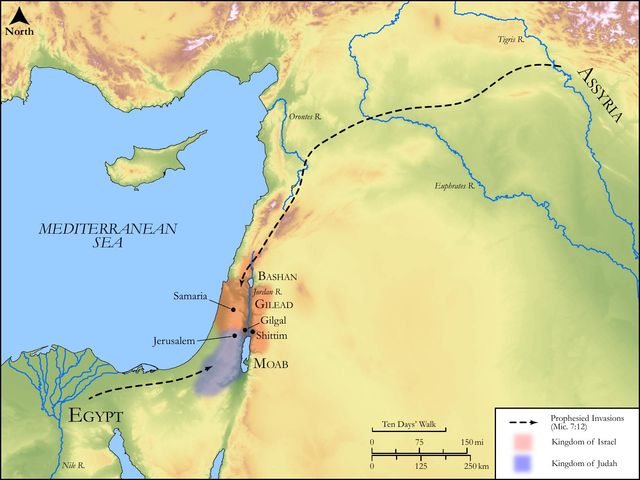
See on the biblical-era map
Study this verse
Public-domain commentary
Matthew Henry
From his Commentary on the Whole Bible. Henry comments on passages, not single verses — this entry covers Micah 7:7–13. His two-level outline is real structure in the source text, so it is rendered as structure.
The prophet, having sadly complained of the wickedness of the times he lived in, here fastens upon some considerations for the comfort of himself and his friends, in reference thereunto. The case is bad, but it is not desperate. Yet now there is hope in Israel concerning this thing.
I."Though God be now displeased he shall be reconciled to us, and then all will be well, Mic 7:7, Mic 7:9.
We are now under the indignation of the Lord; God is angry with us, and justly, because we have sinned against him." Note, It is our sin against God that provokes his indignation against us; and we must see it, and own it, whenever we are under divine rebukes, that we may justify God, and may study to answer his end in afflicting us, by repenting of sin and breaking off from it. Now, at such a time,
1.We must have recourse to God under our troubles (Mic 7:7): Therefore I will look unto the Lord. When a child of God has ever so much occasion to cry, Woe is me (as the prophet here, Mic 7:1), yet it may be a comfort to him that he has a God to look to, a God to come to, to fly to, in whom he may rejoice and have satisfaction. All may look bright above him when all looks black and dark about him. The prophet had been complaining that there was no comfort to be had, no confidence to be put, in friends and relations on earth, and this drives him to his God: Therefore I will look unto the Lord. The less reason we have to delight in any creature the more reason we have to delight in God. If princes are not to be trusted, we may say, Happy is the man that has the God of Jacob for his help, and happy am I, even in the midst of my present woes, if he be my help. If men be false, this is our comfort, that God is faithful; if relations be unkind, he is and will be gracious. Let us therefore look above and beyond them, and overlook our disappointment in them, and look unto the Lord.
2.We must submit to the will of God in our troubles: "I will bear the indignation of the Lord, will bear it patiently, without murmuring and repining, because I have sinned against him." Note, Those that are truly penitent for sin will see a great deal of reason to be patient under affliction. Wherefore should a man complain for the punishment of his sin? When we complain to God of the badness of the times we ought to complain against ourselves for the badness of our own hearts.
3.We must depend upon God to work deliverance for us, and put a good issue to our troubles in due time; we must not only look to him, but look for him: "I will wait for the God of my salvation, and for his gracious returns to me." In our greatest distresses we shall see no reason to despair of salvation if by faith we eye God as the God of our salvation, who is able to save the weakest upon their humble petition, and willing to save the worst upon their true repentance. And, if we depend on God as the God of our salvation, we must wait for him, and for his salvation, in his own way and his own time. Let us now see what the church is here taught to expect and promise herself from God, even when things are brought to the last extremity. (1.) My God will hear me; if the Lord be our God, he will hear our prayers, and grant an answer of peace to them. (2.) "When I fall, and am in danger of being dashed in pieces by the fall, yet I shall arise, and recover myself again. I fall, but am not utterly cast down," Psa 37:24. (3.) "When I sit in darkness, desolate and disconsolate, melancholy and perplexed, and not knowing what to do, nor which way to look for relief, yet then the Lord shall be a light to me, to comfort and revive me, to instruct and teach me, to direct and guide me, as a light to my eyes, a light to my feet, a light in a dark place." (4.) He will plead my cause, and execute judgment for me, Mic 7:9. If we heartily espouse the cause of God, the just but injured cause of religion and virtue, and make it our cause, we may hope he will own our cause, and plead it. The church's cause, though it seem for a time to go against her, will at length be pleaded with jealousy, and judgment not only given against, but executed upon, the enemies of it. (5.) "He will bring me forth to the light, make me shine eminently out of obscurity, and become conspicuous, will make my righteousness shine evidently from under the dark cloud of calumny, Psa 37:6; Isa 58:10. The morning of comfort shall shine forth out of the long and dark night of trouble." (6.) "I shall behold his righteousness; I shall see the equity of his proceedings concerning me and the performance of his promises to me."
II.Though enemies triumph and insult, they shall be silenced and put to shame, Mic 7:8, Mic 7:10. Observe here,
1.How proudly the enemies of God's people trample upon them in their distress. They said, Where is the Lord their God? As if because they were afflicted God had forsaken them, and they knew not where to find him with their prayers, and he knew not how to help them with his favours. This David's enemies said to him, and it was a sword in his bones, Psa 42:10, and see Psa 115:2. Thus, in reproaching Israel as an abandoned people, they reflected on the God of Israel as an unkind unfaithful God.
2.How comfortably the people of God by faith bear up themselves under these insults (Mic 7:8): "Rejoice not against me, O my enemy! I am now down, but shall not be always so, and when my God appears for me then she that is my enemy shall see it, and be ashamed" (not only being disappointed in her expectations of the church's utter ruin, but having the same cup of trembling put into her hand), "then my eyes shall behold her in the same deplorable condition that I am now in; now shall she be trodden down." Note, The deliverance of the church will be the confusion of her enemies; and their shame shall be double, when, as they have trampled upon God's people, so they shall themselves be trampled upon.
III.Though the land continue a great while desolate, yet it shall at length be replenished again, when the time, even the set time, of its deliverance comes.
1.Its salvation shall not come till after it has been desolate; so the margin reads it, Mic 7:13. God has a controversy with the land, and it must lie long under his rebukes, because of those that dwell therein; it is their iniquity that makes their land desolate (Psa 107:34); it is for the fruit of their doings, their evil doings which they have been themselves guilty of, and the evil fruit of them, the sins of others, which they have been accessory to by their bad influence and example. For this they must expect to smart a great while; for the world shall know that God hates sin even in his own people.
2.When it does come it shall be a complete salvation; and it seems to refer to their deliverance out of Babylon by Cyrus, which Isaiah about this time prophesied of, as a type of our redemption by Christ. (1.) The decree shall be far removed. God's decree concerning their captivity, and Nebuchadnezzar's decree concerning the perpetuity of it, his resolution never to release them, "these shall be set aside and revoked, and you shall hear no more of them; they shall no more lie as a yoke upon thy neck." (2.) Jerusalem and the cities of Judah shall be again reared: Then thy walls shall be built, walls for habitation, walls for defence, house-walls, town-walls, temple-walls; it is in order to these that the decree is repealed, Isa 44:28. Though Zion's walls may lie long in ruins, there will come a day when they shall be repaired. (3.) All that belong to the land of Israel, whithersoever dispersed, and howsoever distressed, far and wide over the face of the whole earth, shall come flocking to it again (Mic 7:12): He shall come even to thee, having liberty to return and a heart to return, from Assyria, whither the ten tribes were carried away, though it lay remote, and from the fortified cities, and from the fortress, those strongholds in which they thought they had them fast; for when God's time comes, though Pharaoh will not let the people go, God will fetch them out with a high hand. They shall come from all the remote parts, from sea to sea and from mountain to mountain, not turning back for fear of your discouragements, but they shall go from strength to strength till they come to Zion. Thus in the great day of redemption God will gather his elect from the four winds.
Historical interpretation
Historical reception
1 surviving comment on this verse from the historical church.
(Verse 5-7) Your day of reckoning has come, your visitation is here. Now there will be destruction: do not trust your friend, and do not rely on your leader. Guard the doors of your mouth against the one who lies in your bosom; for a son insults his father, and a daughter rises up against her mother; a daughter-in-law against her mother-in-law, and enemies are those of a man's own household. But as for me, I will look to the Lord; I will wait for God, my savior; my God will hear me. LXX: Woe, woe, your vengeance has come, now there will be weeping for them: do not trust in friends, nor hope in leaders. Beware of those who lie with you, do not trust them, for a son brings shame to his father, and a daughter rises against her mother, and a daughter-in-law against her mother-in-law: a man's enemies are the members of his own household. But I will look to the Lord, I will wait for God my savior: my God will hear me. Except for the beginning of the chapter, both editions agree in the rest of the parts, and in the meantime, according to the historical context, it indicates the day of the siege of Samaria or Jerusalem, which had been eagerly awaited and feared, and its visitation, meaning captivity, saying: Your devastation has come: now there will be devastation for them, that is, for the inhabitants, or siege: Mabucha () indeed signifies more πολιορκίαν and φρούρησιν, that is, siege and custody, than devastation in Hebrew. Therefore, do not believe the words of prophets, nor lend your ear to the deceitful flattery of the divine; because if trust is rare among dear names and blood relations, how much more so in those who flatter you, lying for their own gain, and who command not what is useful for the sick, but what is delightful and pleasing! Do not trust a friend; for Achitophel rose up against David (2 Samuel 15), and true Achitophel Judas rose up against Christ (Matthew 26). And, do not trust in a leader, like the men of Shechem trusted in Abimelech (Judith 9). They made him king, and they were oppressed by him. Guard the gates of your mouth from the one who sleeps in your bosom (Ibid., 16): do not allow what Samson endured from Delilah (2 Kings 16). For a son brings shame to his father; notably Absalom to David: he defiled not only the kingdom, but also his father's concubines with incestuous relations. A daughter rises against her mother: although we may not find direct evidence in the Holy Scriptures, there are so many examples in everyday life that we should mourn their magnitude rather than seek them out. Nurus contra socrum suam: ut uxor Esau consurrexit contra Rebeccam (Gen. XXVI). Inimici hominis, viri domestici ejus. Hic exempla non quaero, cum plura sint, quam ut testimoniis indigeamus. Cum ergo haec ita se habeant, nolite credere, Samaria (( Al. Samariae)) et Jerusalem, pseudoprophetis. Ego autem, inquit propheta, ad Dominum aspiciam, exsultabo in Deum Salvatorem meum, sive Jesum meum, et audiet me Deus meus. The Seventy interpreters follow, who say, Woe, woe, thy revenges are come, that is, the punishments which are to be inflicted for sins. For the Lord saith, Vengeance is mine, and I will repay, saith the Lord (Rom. XII, 19; Deut. XXXII, 35). And in another place: The days of thy retribution are come (Hosea IX, 7). For the Lord doth avenge the clamours of them that cry unto him day and night, saying: How long, O holy and true Lord, dost thou not judge and avenge our blood on them that dwell on the earth (Rev. VI, 10)? So the avengers have come, and now there will be their lamentation, that is, of the avengers, so that those who laughed before may mourn, and immediately departing from the world, they may endure the torments, which that once richly robed and abundant in delights man endures in Hell, where there is weeping and gnashing of teeth (Luke 16; Matthew 8, 13). But what follows, 'now there will be'; understand either at the end of each person's life, or at the consummation of all things, and on the day of judgment, when the avengers will come upon all people. Therefore, do not trust friends, because every friend deceives through deception, and one who is a friend because of something is not as much a friend to the one they pretend to love (for he is called a friend by love) as to the thing that they cherish. When asked what a friend was, someone responded: Another self. But if the example of the Pythagoreans is opposed to us, who pledged themselves as sureties to a tyrant, we say that this is not a general statement against all friends and affections of love, but was uttered by God not against all time, but specifically concerning that which the Apostle says: In the last days perilous times will come: for men will be lovers of themselves, covetous, boasters, proud, blasphemers, disobedient to parents, unthankful, unholy, without natural affection, truce-breakers, false accusers, incontinent, fierce, despisers of those that are good, traitors, heady, high-minded, lovers of pleasures more than lovers of God (2 Timothy 3:1-2), and so on. For then a brother will betray a brother, and a father his son, and children will rise against their parents and have them put to death (Matthew X, 35, 36). But even now faith is rare: what is said on the lips is different from what is in the heart: the poison of the soul is hidden by the honey of the tongue. Many are friends of the wealthy, but they depart from the poor as well those who appear to be their friends. Hence it is said: If you have a friend, possess him in times of temptation (Ecclesiasticus VI, 7). I read in a certain Controversy: A friend is sought for a long time, found with difficulty, and difficult to keep. Theophrastus wrote three volumes about friendship, extolling it above all other virtues, yet also declaring that it is rare among human affairs. There is also Cicero's book On Friendship, which he dedicated to Laelius: in which he states what is often said among our people: Let our friend be like old wine, and let us drink it with pleasure, the word themselves almost the same. Friendship either accepts or creates equals: where there is inequality and one person is superior and the other subservient, there is not so much friendship as flattery. And elsewhere we read: Let the same soul be a friend. And the lyric poet praying for a friend says: Preserve, he says, the half of my soul. Therefore, do not believe in friends, that is, in those men who seek profit in friendships. If you want to delight in true friendship, be a friend of God, like Moses who spoke to God as a friend to a friend. Be a friend, like the Apostles, to whom the Savior said: I no longer call you servants, because a servant does not know what his master desires; but I call you friends, because you have persevered with me in all my temptations. Friendship is delicate, which follows the successes and wealth of friends. Such people do not seem to me to be friends, but to love themselves. Let us consider more carefully the words of the Lord: But I call you friends, he says. And he gives the reasons why he calls them friends: Because you have persevered with me in temptation, and have not given up until now: but in all, he says, my temptations. Indeed, it sometimes happens that one who has persevered with us in one temptation is defeated by others and departs. Secondly, it is commanded: Do not hope in leaders, for cursed is the man who has hope in man (Jeremiah 17:5). In man there is vain hope, and true hope is in God. Therefore, Paul speaks: And from among yourselves, men will rise up speaking perverse things (Acts 20:30). And the Lord Himself through the prophet: The leaders of my people do not know me, the foolish sons are senseless and do not understand: they are wise to do evil, but they do not know how to do good (Jeremiah 4:22). Indeed, they were called leaders, he says, both my leaders and the leaders of my people. But because they did not know me and destroyed the meaning of the word by their actions, therefore the children are foolish and unintelligent: they have wisdom only to subjugate a simple flock to themselves and trample them under their feet; however, they do not know how to do good and govern the people. Do not believe in leaders (or judges), not in bishops, not in priests, not in deacons, not in any dignity of men. Nor do I mean that you should not be subject to such authorities in the Church: For whoever curses his father or mother shall be put to death (Lev. XX, 9). And the Apostle teaches that we should obey the authorities in the Church; but it is one thing to honor leaders, another to place hope in leaders (I Pet. II). Let us honor the bishop, let us defer to the priest, let us rise for the deacon; and yet let us not place our hope in them: for the hope of man is in vain, and our certain hope is in the Lord (I Thess. IV). Third commandment: Guard against believing a woman who shares your bed. Hence the Apostle calls women vessels of weakness and orders that honor be shown to them by their husbands. For man was not created for woman, but woman for man (Ephesians 5). And he says, 'Wife, fear your husband' (1 Corinthians 11). To fear one's wife is to love one's husband with reverence. Men only to love; for love is the perfection of the saints. He says, 'Men, love your wives and do not be loved by them' (Ephesians 5:25); even though they may provoke anger and do things for which they deserve to endure bitterness. For this indeed signifies to be embittered: but you should not render them in return with bitterness. But also Solomon in Ecclesiastes: And he said, I have found one man among a thousand, but I have not found a woman among all these. Perhaps, having learned from his own example, he does not trust women, through whom he had offended God. But also the sublime Poet (not another Homer, as Lucillus suspects about Ennius; but the first Homer among the Romans):
.. . . . . . . Varium et mutabile semper Femina. . . . . . . . . . . . . . . . . . Plenae sunt historiae Graecae et Latinae, quanti viri ab uxoribus suis decepti sint eorumque vita sit prodita. De Scripturis autem et Dalilae, cujus supra fecimus mentionem, et alterius ante Dalilam testantur exempla, quae arcanum Samson septem dierum expressit lacrymis, et amore simulato, quod latebat, invenit. Unde Samson postea loquitur: Nisi domuissetis vitulam meam, non invenissetis propositionem meam (Jud. XIII, 19) . So far, it is commanded that we not trust easily in friends, leaders, and wives. And the reason given is not sufficient in response to the proposition; for it is said: Because a son dishonors his father, a daughter rises against her mother, a daughter-in-law against her mother-in-law, and the enemies of a man are those of his own household. For what does it pertain to a friend, a leader, a wife, if a son and daughter and daughter-in-law rise against their father, mother, and mother-in-law? Therefore, it seems to me that it can be connected in this way with the previous statements: Do not trust in friends, leaders, and wives, who can be changed and can be for a time: since even a son and daughter, forgetting their upbringing and infancy, rise against the authors of their lives and bodies, and it is a crime to harm them, whom it is also a crime to injure with one's face. But this explanation does not at all apply to the daughter-in-law rising up against her mother-in-law, and to a man, to whom his domestic enemies are hostile. Terence in Hecyra:
What is this? All mothers-in-law hate their daughters-in-law: which, although it may be ambiguous, is nevertheless almost natural: that daughters-in-law hate their mothers-in-law, and mothers-in-law hate their daughters-in-law. This prophetic discourse describes the consummation and end of the world, and what kind of generation will precede the coming of the Antichrist. Now we must discuss according to the previous interpretation, in which we spoke about heretics: Listen, O three, and who adorned the city? Was it not the fire and the house of the wicked? And again, concerning the Church: Woe to me, for I have become like one who gathers straw in the harvest. And again: Woe to me, my soul: reverence ((Al. returning)) from the earth has perished; and among men there is no one who corrects. And furthermore: The prince demands, and the judge has spoken peaceful words, the desire of his soul. Hence, a double curse follows: Woe, woe, your vengeance has come: now there will be lamentation, and let us speak the scripture concerning heretics: Do not trust in friends, O simple people, and in wicked leaders who promise to be friends and leaders of heresy: for they seek not your salvation, but their own gain, and they trample the flock deceived by them underfoot: and be cautious not to believe anything of her who sleeps with you, whom I can only understand to be flesh, so that we may not easily believe the flattery of the flesh, lest the hardness of the soul and the manly steadfastness be softened by her allurements. For the son who is born of God, neglecting his Creator, blasphemes him by whom he was created, as the Scripture says: 'Did not one God create you? Did not one father create all of you?' (Malachi 2:10). And he despises the heavenly soul of Jerusalem, and he scorns the Church as a mother, and whoever scorns her will die by death. And the daughter-in-law rises against her mother-in-law, which seems difficult to understand figuratively; but whoever reads the Song of Songs and understands the bridegroom of the soul, the word of God, and believes in the Gospel, which we have recently translated according to the Hebrews (wherein, in the person of the Savior, it is said: 'My mother recently brought me forth, the Holy Spirit in one of my hairs') (Matthew 10). He will not hesitate to say that the word of God has its origin in the spirit and that the soul, which is the bride of the word, has the Holy Spirit as its mother-in-law, who is called Rua in the feminine gender by the Hebrews. Therefore, heretics, having previously believed in the Scriptures, which were written and published by the Holy Spirit, transfer themselves to new doctrines and the leaven of the Pharisees and the commandments of men. And while they despise the word of God, they do harm to their mother-in-law. And so that you do not doubt, consider the words of Gabriel to Mary: 'The Holy Spirit will come upon you, and the power of the Most High will overshadow you; therefore the child to be born will be called holy, the Son of God' (Luke 1:35). After this, it follows: 'The enemies of man will be those of his own household.' According to our interpretation, it seems that every man's head is Christ, and Christ is the head of the Church (1 Corinthians 11:3): these are often his enemies, those who are thought to be in his house, that is, in the Church, and do not depart from the head, but go against their own head. They arrogantly promise knowledge of the Scriptures by their own judgement, without a teacher and the grace of the Lord, and they are ignorant and quarrel about questions, contentions, and battles of words. Truly, those who are truly in the house are enemies of the truth. However, we must know that in the Gospel the same words are used as we now read in the Prophet, but according to the context of that place, they have a different meaning. Whether they are taken from the Prophet or accepted by His own authority, it is for us to know, who has spoken both in the Prophets and in the Gospels. But there the Lord says: 'I came to set a man against his father, and a daughter against her mother, and a daughter-in-law against her mother-in-law, and a man's enemies will be those of his own household." (Matthew 10:35-36) Therefore, let us expound (if indeed we have been able to grasp the meaning of the Scriptures). The holy one understands that charity has grown cold, and that people in the end times will not be lovers of God, but lovers of themselves. They will believe in friends, leaders, wives, sons, daughters, and daughters-in-law, rising up against fathers, mothers, and mothers-in-law. Even the enemies within one's own household. He himself believes in the Lord, and all his contemplation is in his God. And although he may be oppressed by the tribulations and pressures of the world, having no confidence in anyone except the one who says, 'Do not be afraid, I have conquered the world' (John 16:36), he waits for his God and Savior, believing in him and always directing his eyes towards him, hoping to be heard whenever he calls upon him.
Continue studying Micah 7:7 across the web’s major study libraries — every link below opens this exact verse, chapter, or book on the destination site.
Read & Compare
 BibleGatewayThis verse in more than 200 translations and 70 languages.
 Bible.comThe YouVersion reader — hundreds of translations, reading plans, and highlights.
 ESV.orgCrossway's official English Standard Version reader.
 NET BibleThe NET translation with 60,000+ translators' notes on every rendering decision.
 STEP BibleTyndale House's free study tool — original text, vocabulary, and scholarly resources.
 BibliaLogos Bible Software's free web reader.
 USCCBThe New American Bible (Revised Edition) with the U.S. bishops' study notes.
Commentaries
 BibleHub CommentariesDozens of classic commentaries on this verse, gathered on one page.
 StudyLightMore than 100 commentary sets — the largest collection on the web.
 BibleRefPlain-English commentary on what this verse means, verse by verse.
 Enduring WordDavid Guzik's free commentary on this chapter, widely used by Bible teachers.
 Bible Study ToolsVerse commentary alongside Greek and Hebrew study aids.
Original Language & Research
- BibleHub InterlinearThe verse word by word — original language, transliteration, and English.
- BibleHub LexiconEvery word's original-language definition and Strong's entry.
 Blue Letter BibleDeep-study tools — Strong's numbers, concordance, and word studies.
 SefariaThe Hebrew text with Rashi and centuries of Jewish commentary.
Sermons, Hymns & Audio


TrulyRandomVerse is not affiliated with these sites and doesn’t control their content. They’re linked because they’re genuinely useful.
Summary
Micah 7:7 stands as a profound declaration of faith and resolute hope amidst profound national and moral decay. In stark contrast to the surrounding verses that lament widespread corruption, treachery, and the breakdown of societal trust, the prophet Micah pivots his focus entirely from human failure to divine faithfulness, expressing an unwavering commitment to look to, wait for, and trust in the God who is his salvation, confident that He will hear and respond.
Context
ShowHideLiterary Context
Micah 7:7 marks a dramatic and pivotal shift in the book of Micah. The preceding verses (Micah 7:1-6) paint a devastating picture of societal collapse, moral depravity, and pervasive corruption within Israel. The prophet laments the absence of righteous people, describing a society where "the good man is perished out of the earth" and "every man hunts his brother with a net" (Micah 7:2). Trust has evaporated, even within families, with "the son dishonoring the father, the daughter rising up against her mother, the daughter-in-law against her mother-in-law" (Micah 7:6). This bleak portrayal sets the stage for Micah's personal declaration of hope, demonstrating that even in the darkest times, the righteous individual can find refuge and expectation in God alone, turning from the despair of human failure to the certainty of divine intervention.
Historical & Cultural Context
Micah prophesied during the reigns of Jotham, Ahaz, and Hezekiah, kings of Judah (approximately 740-697 BC). This was a tumultuous period marked by the Assyrian threat, internal idolatry, oppression, and a significant moral decline within both Israel (the Northern Kingdom, which fell to Assyria in 722 BC) and Judah (the Southern Kingdom). The prophet's message consistently condemns the exploitation of the poor, corrupt leadership, and false prophets, reflecting the widespread societal breakdown. The cultural norms of justice and covenant faithfulness, once central to Israelite identity, had been severely eroded. In such an environment, where human institutions and relationships offered no hope, Micah's declaration to "look unto the LORD" was not merely a spiritual platitude but a radical act of defiance against the prevailing despair, embodying the faithful remnant's only viable path to hope and deliverance.
Key Themes
ShowHideThis verse powerfully encapsulates several key themes prevalent in Micah and the broader prophetic literature. Firstly, it highlights the theme of Divine Sovereignty and Faithfulness, asserting God as the ultimate source of salvation and hope when all human avenues fail. Secondly, it underscores the Importance of Personal Piety and Trust even in a corrupt society, demonstrating that individual faith can shine brightest against a backdrop of widespread ungodliness. The repeated emphasis on "my God" points to a deeply personal and covenantal relationship, a theme echoed throughout the Old Testament where God identifies Himself as the God of His people, such as when He declares, "I will be their God, and they shall be my people". Finally, it introduces the theme of Patient Endurance and Expectation, as Micah resolves to "wait" for God, reflecting a posture of hopeful perseverance that is a hallmark of biblical faith in times of distress, as seen in the psalmist's cry, "I wait for the LORD, my soul waits, and in his word do I hope".
Exposition and Analysis
ShowHideKey Word Analysis
ShowHideThis word means "to lean forward, i.e., to peer into the distance; by implication, to observe, await; behold, espy, look up (well), wait for, (keep the) watch(-man)." In Micah 7:7, it conveys an active, intentional, and hopeful gaze, like a watchman diligently scanning the horizon for a sign of relief or the arrival of a deliverer. It's not a passive glance but a focused, expectant posture, indicating a deliberate turning of attention and anticipation towards God.
This primitive root means "to wait; by implication, to be patient, hope." It encompasses the ideas of enduring hope, patient expectation, and a steadfast reliance on God's timing and intervention. This waiting is not idle but is rooted in confidence and trust, signifying a settled assurance in God's character and His promise to act.
This term denotes "liberty, deliverance, prosperity; safety, salvation, saving." It is a comprehensive term for rescue, well-being, and triumph over adversity. In this context, it refers to God's act of delivering His people from their distress, whether from moral decay, external enemies, or the consequences of their sin. It emphasizes God's role as the ultimate source of rescue and restoration.
This primitive root means "to hear intelligently (often with implication of attention, obedience, etc.; causatively, to tell, etc.)." While it literally means to perceive sound, in a theological context, it often implies much more: to listen attentively, to understand, to heed, and crucially, to respond or act upon what is heard. Micah's confidence is not just that God will perceive his cry, but that He will understand and intervene on his behalf.
Verse Breakdown
ShowHide"Therefore I will look unto the LORD;"
This opening clause marks a decisive turning point, introduced by the conjunction "Therefore," which signals a conclusion drawn from the preceding lamentable circumstances. Instead of succumbing to despair or seeking human solutions that have proven futile, the prophet makes a conscious, deliberate choice to fix his gaze and hope solely upon Yahweh (the LORD), the covenant-keeping God. This "looking" implies an active posture of faith, a watchful anticipation, and a redirection of his entire being towards the divine.
"I will wait for the God of my salvation:"
This clause reinforces and expands upon the previous declaration, emphasizing patient endurance and unwavering expectation. The phrase "the God of my salvation" highlights God's specific role as the deliverer and rescuer. It's a deeply personal affirmation, acknowledging God not just as a distant deity, but as the one who is intimately involved in the prophet's personal deliverance and well-being. This waiting is an active, hopeful trust, not a passive resignation.
"my God will hear me."
This final clause expresses profound confidence and assurance. The repetition of "my God" underscores the personal relationship and covenantal faithfulness. The prophet is certain that God will not only listen to his cry but also understand and, most importantly, act in response. This "hearing" implies divine attentiveness, compassion, and ultimate intervention, providing the bedrock for Micah's hope in the face of overwhelming adversity.
Literary Devices
ShowHideMicah 7:7 is rich in literary devices that amplify its powerful message. The most prominent is Contrast, as the verse sharply juxtaposes the preceding six verses of moral decay and human failure with a resolute declaration of divine hope. This stark contrast highlights the prophet's deliberate shift from despair to faith. Another significant device is Personal Declaration, evident in the repeated use of "I will" and "my God," which underscores the individual's choice to trust God amidst a faithless generation. This makes the verse a powerful model for personal piety. Furthermore, the verbs "look" and "wait" function as Metaphors for active faith and patient endurance. "Looking unto the LORD" is not merely seeing but fixing one's hope and attention, while "waiting for the God of my salvation" implies a steadfast, hopeful expectation rather than idle passivity. The entire verse also functions as a Confession of Faith, articulating a deep theological truth about God's character and His responsiveness to His faithful ones.
Theological and Thematic Connections
ShowHideMicah 7:7 provides a timeless theological statement about the nature of true hope and the character of God. It affirms that in times of profound human failure and societal collapse, the ultimate and only reliable source of salvation is God Himself. The prophet's decision to "look unto the LORD" and "wait for the God of my salvation" is a profound act of faith, demonstrating that spiritual resilience is found not in human strength or societal reform, but in a steadfast reliance on divine faithfulness. This posture of patient expectation and confident prayer underscores God's attentiveness to His people and His unwavering commitment to deliver those who trust in Him, even when circumstances seem utterly hopeless. It teaches that God is not only sovereign over all circumstances but also intimately involved in the personal struggles and salvation of His faithful ones.
Reflection and Application
ShowHideMicah 7:7 offers a profound blueprint for believers navigating a world often characterized by disappointment, betrayal, and moral decline. When human systems fail, when trust is broken, and when the future seems bleak, this verse calls us to a conscious and deliberate reorientation of our hope. It challenges us to shift our gaze from the brokenness around us and within us to the unwavering faithfulness of God. This is not a passive resignation but an active, hopeful waiting, rooted in the conviction that our God is indeed the God of our salvation—the one who delivers, protects, and restores. Our confidence, like Micah's, should be in God's personal attentiveness: "my God will hear me." This assurance empowers us to persevere in prayer and trust, knowing that no matter how dire the circumstances, God is listening and will act on behalf of those who place their hope in Him. It reminds us that our ultimate security and deliverance come not from human efforts or earthly institutions, but from the sovereign, loving, and ever-present God.
Questions for Reflection
ShowHideFAQ
ShowHideWhy does Micah suddenly shift from lament to hope in this verse?
ShowHideMicah's dramatic shift in tone in Micah 7:7 is a powerful rhetorical device and a theological statement. The preceding verses (Micah 7:1-6) describe a society utterly devoid of righteousness, where corruption, injustice, and betrayal are rampant, even within families. This paints a picture of profound despair and human failure. The "Therefore" at the beginning of Micah 7:7 signals a conclusion drawn from this bleak reality: since there is no hope to be found in humanity or societal structures, the only recourse is to turn entirely to God. It highlights that true hope is not found in human institutions or efforts, but solely in the faithful character and redemptive power of the Lord. This shift serves to emphasize God as the ultimate, unfailing source of salvation and hope, even when all else fails.
Christ-Centered Fulfillment
ShowHideMicah 7:7, with its profound declaration of looking to and waiting for the "God of my salvation," finds its ultimate and most glorious fulfillment in Jesus Christ. The prophet's hope in a God who would hear and deliver foreshadows the coming of the One who is not merely a deliverer, but Salvation incarnate. Jesus is the "God of our salvation" in the most complete sense, as He is God made flesh, who came to "save his people from their sins" (Matthew 1:21). The act of "looking unto the LORD" is perfectly realized in "looking unto Jesus, the author and finisher of our faith" (Hebrews 12:2), who endured the cross for our redemption. Our patient "waiting for the God of our salvation" is now a waiting for Christ's return, when our salvation will be fully consummated (Philippians 3:20). Furthermore, Micah's confidence that "my God will hear me" is fulfilled in Christ, our great High Priest, who "is able to save to the uttermost those who come to God through Him, since He always lives to make intercession for them" (Hebrews 7:25). In Christ, the abstract hope of a distant prophet becomes the tangible, personal, and eternal reality of a God who has not only heard but has acted decisively to bring about our salvation.