


Ezekiel 28:3
Bible text: King James Version (1769 Blayney text) · Public domain
Bible text: Berean Standard Bible · Public domain
Bible text: American Standard Version (1901) · Public domain
Bible text: World English Bible, Messianic edition · Public domain
Bible text: Geneva Bible (1599) · Public domain
Bible text: Young's Literal Translation · Public domain
- הִנֵּהhi·Nehthere!H2009PrtParticle Interjection
- חָכָםcha·Kham[are] wiseH2450Adj-msAdjective Singular Masculine Absolute
- אַתָּה'a·TahyouH859Pro-2msPronoun Personal 2nd Singular Masculine
- מִדָּנִיֵּאלmi·da·ni·'elmore than DanielH1841Prep-m ¦ N-proper-mNoun Proper Masculineמִmore thanדָּנִיֵּאלDaniel
- כָּלkolanyH3605N-msNoun Singular Masculine Absolute
- סָתוּםsa·Tumsecret [thing]H5640V-Qal-PassPrtcpl-msVerb Qal Participle Passive Singular Masculine Absolute
- לֹאlo'notH3808NegParticle Negative
- עֲמָמוּךָ'a·ma·Mu·khapeople hold dark from youH6004V-Qal-Perf-3cp ¦ 2msVerb Qal Perfect 3rd Plural common genderעֲמָמוּpeople hold dark fromךָyou
English is a literal word-by-word gloss of the Hebrew, not the KJV's wording. Why?
This is the original text the KJV's translators worked from — each Hebrew word with its own literal English meaning in this verse, prepared by scholars at Tyndale House, Cambridge. The KJV translates whole sentences, not word by word, so its wording differs: one Hebrew word can become several English words, and the KJV may choose “the LORD” where the gloss reads “Yahweh”. Both are faithful — they answer different questions. For the KJV's own rendering, switch to the KJV text.
Details
See on the biblical-era map
Study this verse
Public-domain commentary
Matthew Henry
From his Commentary on the Whole Bible. Henry comments on passages, not single verses — this entry covers Ezekiel 28:1–10. His four-level outline is real structure in the source text, so it is rendered as structure.
We had done with Tyrus in the foregoing chapter, but now the prince of Tyrus is to be singled out from the rest. Here is something to be said to him by himself, a message to him from God, which the prophet must send him, whether he will hear or whether he will forbear.
I.He must tell him of his pride.
His people are proud (Eze 27:3) and so is he; and they shall both be made to know that God resists the proud. Let us see, 1. What were the expressions of his pride: His heart was lifted up, Eze 28:2. He had a great conceit of himself, was puffed up with an opinion of his own sufficiency, and looked with disdain upon all about him. Out of the abundance of the pride of his heart he said, I am a god; he did not only say it in his heart, but had the impudence to speak it out. God has said of princes, They are gods (Psa 82:6); but it does not become them to say so of themselves; it is a high affront to him who is God alone, and will not give his glory to another. He thought that the city of Tyre had as necessary a dependence upon him as the world has upon the God that made it, and that he was himself independent as God and unaccountable to any. He thought himself to have as much wisdom and strength as God himself, and as incontestable an authority, and that his prerogatives were as absolute and his word as much a law as the word of God. He challenged divine honours, and expected to be praised and admired as a god, and doubted not to be deified, among other heroes, after his death as a great benefactor to the world. Thus the king of Babylon said, I will be like the Most High (Isa 14:14), not like the Most Holy. "I am the strong God, and therefore will not be contradicted, because I cannot be controlled. I sit in the seat of God; I sit as high as God, my throne equal with his. Divisum imperium cum Jove Caesar habet - Caesar divides dominion with Jove. I sit as safely as God, as safely in the heart of the seas, and as far out of the reach of danger, as he in the height of heaven." He thinks his guards of men of war about his throne as pompous and potent as the hosts of angels that are about the throne of God. He is put in mind of his meanness and mortality, and, since he needs to be told, he shall be told, that self-evident truth, Thou art a man, and not God, a depending creature; thou art flesh, and not spirit, Isa 31:3. Note, Men must be made to know that they are but men, Psa 9:20. The greatest wits, the greatest potentates, the greatest saints, are men, and not gods. Jesus Christ was both God and man. The king of Tyre, though he has such a mighty influence upon all about him, and with the help of his riches bears a mighty sway, though he has tribute and presents brought to his court with as much devotion as if they were sacrifices to his altar, though he is flattered by his courtiers and made a god of by his poets, yet, after all, he is but a man; he knows it; he fears it. But he sets his heart as the heart of God; "Thou hast conceited thyself to be a god, hast compared thyself with God, thinking thyself as wise and strong, and as fit to govern the world, as he." It was the ruin of our first parents, and ours in them, that they would be as gods, Gen 3:5. And still that corrupt nature which inclines men to set up themselves as their own masters, to do what they will, and their own carvers, to have what they will, their own end, to live to themselves, and their own felicity, to enjoy themselves, sets their hearts as the heart of God, invades his prerogatives, and catches at the flowers of his crown - a presumption that cannot go unpunished.
2.We are here told what it was that he was proud of.
(1.)His wisdom. It is probable that this prince of Tyre was a man of very good natural parts, a philosopher, and well read in all the parts of learning that were then in vogue, at least a politician, and one that had great dexterity in managing the affairs of state. And then he thought himself wiser than Daniel, Eze 28:3. We found, before, that Daniel, though now but a young man, was celebrated for his prevalency in prayer, Eze 14:14. Here we find he was famous for his prudence in the management of the affairs of this world, a great scholar and statesman, and withal a great saint, and yet not a prince, but a poor captive. It was strange that under such external disadvantages his lustre should shine forth, so that he had become wise to a proverb. When the king of Tyre dreams himself to be a god he says, I am wiser than Daniel. There is no secret that they can hide from thee. Probably he challenged all about him to prove him with questions, as Solomon was proved, and he had unriddled all their enigmas, had solved all their problems, and none of them all could puzzle him. He had perhaps been successful in discovering plots, and diving into the counsels of the neighbouring princes, and therefore thought himself omniscient, and that no thought could be withholden from him; therefore he said, I am a god. Note, Knowledge puffeth up; it is hard to know much and not to know it too well and to be elevated with it. He that was wiser than Daniel was prouder than Lucifer. Those therefore that are knowing must study to be humble and to evidence that they are so.
(2.)His wealth. That way his wisdom led him; it is not said that by his wisdom he searched into the arcana either of nature or government, modelled the state better than it was, or made better laws, or advanced the interests of the commonwealth of learning; but his wisdom and understanding were of use to him in traffic. As some of the kings of Judah loved husbandry (Ch2 26:10), so the king of Tyre loved merchandise, and by it he got riches, increased his riches, and filled his treasures with gold and silver, Eze 28:4, Eze 28:5. See what the wisdom of this world is; those are cried up as the wisest men that know how to get money and by right or wrong to raise estates; and yet really this their way is their folly, Psa 49:13. It was the folly of the king of Tyre,
[1.]That he attributed the increase of his wealth to himself and not to the providence of God, forgetting him who gave him power to get wealth, Deu 8:17, Deu 8:18.
[2.]That he thought himself a wise man because he was a rich man; whereas a fool may have an estate (Ecc 2:19), yea, and a fool may get an estate, for the world has been often observed to favour such, when bread is not to the wise, Ecc 9:11.
[3.]That his heart was lifted up because of his riches, because of the increase of his wealth, which made him so haughty and secure, so insolent and imperious, and which set his heart as the heart of God. The man of sin, when he had a great deal of worldly pomp and power, showed himself as a god, Th2 2:4. Those who are rich in this world have therefore need to charge that upon themselves which the word of God charges upon them, that they be not high-minded, Ti1 6:17.
II.Since pride goes before destruction, and a haughty spirit before a fall, he must bell him of that destruction, of that fall, which was now hastening on as the just punishment of his presumption in setting up himself a rival with God. "Because thou hast pretended to be a god (Eze 28:6), therefore thou shalt not be long a man," Eze 28:7. Observe here,
1.The instruments of his destruction: I will bring strangers upon thee - the Chaldeans, whom we do not find mentioned among the many nations and countries that traded with Tyre, ch. 27. If any of those nations had been brought against it, they would have had some compassion upon it, for old acquaintance-sake; but these strangers will have none. They are people of a strange language, which the king of Tyre himself, wise as he is, perhaps understands not. They are the terrible of the nations; it was an army made up of many nations, and it was at this time the most formidable both for strength and fury. These God has at command, and these he will bring upon the king of Tyre.
2.The extremity of the destruction: They shall draw their swords against the beauty of thy wisdom (Eze 28:7), against all those things which thou gloriest in as thy beauty and the production of thy wisdom. Note, It is just with God that our enemies should make that their prey which we have made our pride. The king of Tyre's palace, his treasury, his city, his navy, his army, these he glories in as his brightness, these, he thinks, made him illustrious and glorious as a god on earth. But all these the victorious enemy shall defile, shall deface, shall deform. He thought them sacred, things that none durst touch; but the conquerors shall seize them as common things, and spoil the brightness of them. But, whatever becomes of what he has, surely his person is sacred. No (Eze 28:8): They shall bring thee down to the pit, to the grave; thou shalt die the death. And,
(1.)It shall not be an honourable death, but an ignominious one. He shall be so vilified in his death that he may despair of being deified after his death. He shall die the deaths of those that are slain in the midst of the seas, that have no honour done them at their death, but their dead bodies are immediately thrown overboard, without any ceremony or mark of distinction, to be a feast for the fish. Tyre is likely to be destroyed in the midst of the sea (Eze 27:32) and the prince of Tyre shall fare no better than the people.
(2.)It shall not be a happy death, but a miserable one. He shall die the deaths of the uncircumcised (Eze 28:10), of those that are strangers to God and not in covenant with him, and therefore die under his wrath and curse. It is deaths, a double death, temporal and eternal, the death both of body and soul. He shall die the second death; that is dying miserably indeed. The sentence of death here passed upon the king of Tyre is ratified by a divine authority: I have spoken it, saith the Lord God. And what he has said he will do. None can gainsay it, nor will he unsay it.
3.The effectual disproof that this will be of all his pretensions to deity (Eze 28:9): "When the conqueror sets his sword to thy breast, and thou seest no way of escape, wilt thou then say, I am God? Wilt thou then have such a conceit of thyself as thou now hast? No; thy being overpowered by death, and by the fear of it, will force thee to own that thou art not a god, but a weak, timorous, trembling, dying man. In the hand of him that slays thee (in the hand of God, and of the instruments that he employed) thou shalt be a man, and not God, utterly unable to resist, and help thyself." I have said, You are gods; but you shall die like men, Psa 82:6, Psa 82:7. Note, Those who pretend to be rivals with God shall be forced one way or other to let fall their claims. Death at furthest, when we come into his hand, will make us know that we are men.
Historical interpretation
Historical reception
8 surviving comments on this verse. Each one is dated, so this reads as a timeline rather than a list.
Select a marker to jump to its quote. Markers stagger vertically where authors wrote within a few decades of each other.
Who would refuse the counsel of Daniel, of whom God said, “Who is wiser than Daniel?” How can people doubt about the minds of those to whom God has given such grace? By the counsel of Moses wars were brought to an end, and for his merit’s sake food came from heaven and drink from the rock. How pure must have been the soul of Daniel to soften the character of barbarians and to tame the lions! What temperance was his, what self-restraint in soul and body! Not unworthily did he become an object of admiration to all, when—and all people do admire this—though enjoying royal friendships, he looked not for gold or counted the honor given him as more precious than his faith. For he was willing to endure danger for the law of God rather than to be turned from his purpose in order to gain human favor.
(Verse 35, 36, and following) And I will bring you into a desert of peoples, and there I will judge you face to face. Just as I contended with your fathers in the desert of the land of Egypt, so I will judge you, says the Lord. And I will subject you to my scepter, and I will bring you into the bonds of the covenant, and I will choose from among you the transgressors and the wicked: from their place of residence I will bring them out, and they will not enter the land of Israel, and you will know that I am the Lord. Thus says the Lord: I will do for you who are in Babylon, and now serve idols, what I did for your ancestors in Egypt. I will lead you into the desert of the peoples, and there I will judge you face to face, just as I contended with them in judgment when they came out of Egypt. And after I have judged you, I will subject you to my scepter and rule, and I will make a covenant with you and bring you into your land with the bonds of love, so that bound by my love, you will never be able to depart from me. But I will choose from among you the transgressors and the wicked, who persist in the hardness of their hearts in evil deeds, not for possession, but for rejection. And I will indeed bring them out of the land of their dwelling, so that when they are brought out, they will not enter the land of Israel; but they will perish in various regions. And by the distinction between good and evil, you shall know that I am the Lord, who judges all things. The rest of the discourse hastens, and we briefly go through each point, in order to provide only the meaning to the readers.
(Chapter 28, Verse 1 onwards) 'The word of the Lord came to me, saying: Son of man, say to the prince of Tyre: Thus says the Lord God: Because your heart is lifted up, and you have said, 'I am a god, I sit in the seat of gods, in the heart of the seas,' yet you are a man, and not a god, though you set your heart as the heart of a god. Behold, you are wiser than Daniel! There is no secret that is hidden from you. By your wisdom and your understanding you have gained wealth for yourself and have acquired gold and silver in your treasuries.' In the abundance of your wisdom, and in your trading, you have multiplied strength for yourself, and your heart has been lifted up in your power. Therefore, thus says the Lord (God adds): because your heart has been lifted up as the heart of God, therefore, behold, I will bring upon you the most strong of the nations, and they shall draw their swords against the beauty of your wisdom, and they shall defile your splendor. They shall kill you, and deliver you up, and you shall die the death of the slain in the heart of the sea. Are you saying, 'I am God,' in the presence of those who are about to kill you, even though you are a man and not God, and they will kill you with the hands of foreigners? You will die the death of the uncircumcised at the hands of strangers, for I have spoken, declares the Lord God. LXX: And the word of the Lord came to me, saying: And you, son of man, say to the prince of Tyre: Thus says the Lord God: Because your heart is proud, and you have said, 'I am a god, I sit in the seat of the gods, in the heart of the seas,' yet you are but a man, and no god, though you make your heart like the heart of a god— are you wiser than Daniel? The wise have not taught you their discipline: have you made for yourself strength and made gold and silver in your treasuries, or in your abundant knowledge have you multiplied your strength and your power? Your heart is lifted up in your strength, therefore thus says the Lord God: Because you have given your heart as the heart of God, behold, I will bring upon you foreign pestilential people from the nations, and they will unsheath their swords against you because of the splendor of your knowledge, and they will humble your splendor in destruction. They will lead you away, and they will dispose of you, and you will die the death of the wounded in the heart of the sea. Will you say, 'I am God,' when you face those who kill you? You are a man, not God, in the midst of your attackers. You will die at the hands of foreigners, uncircumcised in heart, because I have spoken, declares the Lord God.' Wherever YHWH is placed in the Septuagint, the first name, YHWH, is the proper name of God and is unspeakable. The second name, Adonai, is the common name found frequently in humans. However, just as the city of Tyre is depicted as a ship, first in its wealth and then in its destruction and mourning, so too is a prophetic discourse addressed to the ruler of Tyre. It is stated that he became proud and did not make good use of the wealth he possessed, and as a result suffered sadness and lamentation, experiencing great misfortune. Therefore, the first things to be said must be explained. It is written in Isaiah (Isa. 14) concerning the king of Babylon, Nebuchadnezzar, that he equated himself with God's power and became so arrogant that he dared to say, 'I will ascend above the stars of heaven and I will be like the Most High.' And hurled from his throne, he deserved to hear: How did Lucifer fall, he who rose in the morning? And of Pharaoh in the same prophet: The rivers are mine, and I made them (Isaiah 29:9). And of the prince of Tyre, who in his pride arrogantly said: I am a god, and I sit on the throne of God, or I dwell in the habitation of God, even though he is a man and not God. Although these words may seem to exceed the powers of human frailty, and not to be the words of men but of raving demons, we must take them as hyperbole, in that they have swelled to such an extent and have not known their measure, that in the midst of the swelling of worldly happiness and the power of the kingdom, men have not known themselves and have claimed eternal dominion for themselves. Although under the guise of princes, kings, and individual cities, or provinces, opposing powers may be demonstrated, about which the Apostle Paul writes: For our struggle is not against flesh and blood, but against the rulers, against the authorities, against the powers of this dark world and against the spiritual forces of evil in the heavenly realms (Ephesians 6:12). And in another place: We speak a message of wisdom among the mature, but not the wisdom of this age or of the rulers of this age, who are coming to nothing (1 Corinthians 2:6). And again, discussing wisdom, he says, which none of the rulers of this world knew. For if they had known, they would never have crucified the Lord of glory (I Cor. II, 8). Also, in the prophecy of Daniel, it is clearly written that the Prince of the Israelite people is Michael, and the prince of Greece, and the prince of Persia (Dan. X). And Moses explicitly writes in the Song of Deuteronomy: When the Most High divided the nations, and scattered the sons of Adam, he established the boundaries of the nations, according to the number of the angels of God (Deut. XXXII, 8); or as it is better in Hebrew: according to the number of the sons of Israel. And so it happened that the people of the Lord, his portion, Jacob, became the inheritance of Israel. And we should not be surprised that on the opposite side the worst kings precede the best kings, David, Solomon, Josiah, and the patriarchs, and prophets, as a foreshadowing of the Lord and Savior. Therefore, according to both understandings, let us discuss the arrogant kings and apostate princes equally, which are written. He says, therefore (or, as said by Alexander, since you are a man, and being surrounded by the frailty of human flesh and swollen with pride, you think that you can dwell on the throne of God in the heavens, even though you are held in the narrowness of the middle of the sea and on the islands. And also, because you boast of your wisdom to such an extent that the men of your kingdom challenge Solomon with riddles: Are you wiser than Daniel, who by the grace of God conquered all the magicians and soothsayers, and is now the wisest in Babylon? Or, to put it another way: Even if you are wiser than Daniel, who is acknowledged to be the wisest of all, and even if you desire to compare yourself to God in the magnitude of wealth and power: you will still be captured by your enemies, and with the destruction of your city, you will be struck by many wounds. And you will no longer say, 'I am God,' but, having learned through your downfall, you will recognize that you are a human, not God. But if we wish to call the prince of Tyre the same power to whom the city itself, or the province, was given by God, let us accept that testimony. I said, 'You are gods, and all of you are sons of the Most High. But you will die like men, and fall like one of the princes' (Psalm 82:7). For power was given to them to govern the provinces, like judges appointed by the Emperor. However, they, forgetting their honor and being driven by a tyrannical mindset, rose up against their king and Lord. Dispersed throughout the whole world, they took on the names of idols and, filled with pride, fell into the judgment and snare of the devil. About this, Jesus spoke in the Gospel: I saw Satan falling like lightning from heaven (Luke 10:18).
The same apostle writes that God alone is wise, although both Solomon and many other holy people are called wise, and it is said, according to the Hebrew, to the prince of Tyre, “You are wiser than Daniel.” Therefore, just as he alone is called the light, immortal and wise, although they are many who are immortal, and who are lights and who are wise, so also the human perfection that proceeds not from nature but from grace shows that those who seem to be perfect are imperfect.
(Verse 27, 29 onwards) Therefore speak to the house of Israel, son of man, and tell them: Thus says the Lord God: Moreover, your fathers have blasphemed against me and have treated me with contempt, even as they spurned me. And I brought them into the land that I had lifted my hand to give them ((Vulgate adds: that land)): they saw every high hill and every leafy tree, and there they offered their sacrifices and presented there the irritation of their offerings, and they placed there the fragrance of their sweetness, and they poured out their ((Vulgate is silent on this)) libations there. And I said to them, 'What is the high place to which you are going?' And its name was called the High Place until this day. Therefore speak to the house of Israel, son of man, and say to them, 'Thus says the Lord God: As for your fathers, they have provoked Me to anger by their iniquities, by the fact that they have fallen away from Me. So I brought them into the land that I had lifted My hand in an oath to give them.' They saw every high hill and every leafy tree, and there they offered their sacrifices. They also presented there the provocation of their gifts, and they set there their pleasing aroma, and they poured out there their drink offerings. And I said to them: What is abbana, because you enter there? And they called its name abbana until this day. I wanted, he said, to scatter them in the wilderness, and to give them not good precepts, so that they would sacrifice to idols what they should have offered to me, and consecrate all their first-fruits to them by fire, so that I might kill them and destroy them. But when he says, I wanted, he shows that he did not do what he wanted. And that which follows: 'And they shall know that I am the Lord,' is not found in the Septuagint. For it did not seem fitting to them to know after their destruction that he himself is the Lord. But you, son of man, speak again to them, that is, to the elders of the house of Israel, who have come to inquire of you: Your fathers, from whom you have descended, have also blasphemed against me and held me in contempt; after I brought them into the land which I had given them to possess, they turned against me to provoke me. For when they saw every high hill and leafy tree, they would sacrifice on the mountains and in the groves and thickets, and offer victims to the idols, and pour out libations. And when I saw this, I said to them: What is this, Bama? for it is called high: or why do you enter into such a place which you have chosen for yourselves in all the hills, so that even today these places are called Bamoth, and the ancient error retains its original name? Regarding Bama, which we translate as excelsum, there is an error in the Septuagint edition, where it is written as ἀββανὰ, which does not resonate in the Hebrew language. Bama can mean 'in which' if the two syllables are divided into two words, but in the present context, that sense does not fit. However, wherever it is written in the Books of Kings and Chronicles: 'The people still sacrificed and offered incense on the high places,' Bama in the singular and Bamoth in the plural mean 'high places.'
Can anyone claim to be without sin, when Daniel confesses his own sins? I mean, some proud person or other was asked through the prophet Ezekiel, “Are you wiser than Daniel?” Again, the prophet also placed this Daniel among the three holy men in whom God signifies the three sorts of human beings he is going to deliver when the great tribulation comes on the human race.
Could we be better than Daniel himself, concerning whom the Lord said to the prince of Tyre by the prophet Ezekiel: “Are you wiser than Daniel?” He is unique in being included among the three just men whom God says he will deliver, doubtless showing three special types of just people, when he says he will so deliver them as not to deliver their sons with them, but they only shall be delivered: namely, Noah, Daniel and Job.
This is the reason, if I am not mistaken, why in the prophet Ezekiel a certain most haughty person is asked, “Are you then wiser than Daniel?” Nor on this point can that be possibly said that some contend for in opposition to the Lord’s Prayer: “For although,” they say, “that prayer was offered by the apostles, after they became holy and perfect and had no sin whatever, it was not on behalf of their own selves but for imperfect and still sinful people that they said, ‘Forgive us our debts, as we also forgive our debtors.’ They used the word our, they say, “in order to show that in one body are contained both those who still have sins and themselves, who were already altogether free from sin.” Now this certainly cannot be said in the case of Daniel, who (as I suppose) foresaw as a prophet this presumptuous opinion when he said so often in his prayer, “We have sinned” … he expresses himself in language so distinct and precise … and wanted above all things to commend it to our notice: “My sins,” says he, “and the sins of my people.” Who can contradict such evidence as this, but one who is more pleased to defend what he thinks than to find out what he ought to think?
Continue studying Ezekiel 28:3 across the web’s major study libraries — every link below opens this exact verse, chapter, or book on the destination site.
Read & Compare
 BibleGatewayThis verse in more than 200 translations and 70 languages.
 Bible.comThe YouVersion reader — hundreds of translations, reading plans, and highlights.
 ESV.orgCrossway's official English Standard Version reader.
 NET BibleThe NET translation with 60,000+ translators' notes on every rendering decision.
 STEP BibleTyndale House's free study tool — original text, vocabulary, and scholarly resources.
 BibliaLogos Bible Software's free web reader.
 USCCBThe New American Bible (Revised Edition) with the U.S. bishops' study notes.
Commentaries
 BibleHub CommentariesDozens of classic commentaries on this verse, gathered on one page.
 StudyLightMore than 100 commentary sets — the largest collection on the web.
 BibleRefPlain-English commentary on what this verse means, verse by verse.
 Enduring WordDavid Guzik's free commentary on this chapter, widely used by Bible teachers.
 Bible Study ToolsVerse commentary alongside Greek and Hebrew study aids.
Original Language & Research
- BibleHub InterlinearThe verse word by word — original language, transliteration, and English.
- BibleHub LexiconEvery word's original-language definition and Strong's entry.
 Blue Letter BibleDeep-study tools — Strong's numbers, concordance, and word studies.
 SefariaThe Hebrew text with Rashi and centuries of Jewish commentary.
Sermons, Hymns & Audio


TrulyRandomVerse is not affiliated with these sites and doesn’t control their content. They’re linked because they’re genuinely useful.
Summary
Ezekiel 28:3 delivers a profoundly ironic and scathing divine declaration against the King of Tyre. Far from being a genuine commendation, this verse functions as a sharp, satirical rebuke, highlighting the monarch's boundless arrogance and self-deception. Inflated by Tyre's immense wealth and formidable power, the king had deluded himself into believing he possessed a wisdom superior even to that divinely bestowed upon Daniel, and that no truth could remain hidden from his supposed omniscience. This biting statement powerfully sets the stage for the severe divine judgment that would inevitably follow such audacious hubris.
Context
ShowHideLiterary Context
This verse is intricately woven into a powerful prophetic lamentation and oracle specifically directed at the King of Tyre, encompassing Ezekiel 28:1-19. The immediate preceding verses establish the king's egregious self-exaltation, where he audaciously proclaims himself a god, asserting his dominion by sitting "in the seat of God" within the heart of the seas (Ezekiel 28:2). Following this verse, the prophecy meticulously dismantles the king's illusion of divinity and invincibility, vividly detailing his impending downfall and humiliation at the hands of foreign invaders (Ezekiel 28:7-10). While the primary focus is undeniably on the earthly ruler, the language, particularly from Ezekiel 28:11 onwards, shifts to a more exalted and symbolic description, leading many scholars to interpret it as also carrying a profound secondary, allegorical reference to the primordial fall of Satan, the ultimate embodiment of pride and rebellion against the Most High God.
Historical & Cultural Context
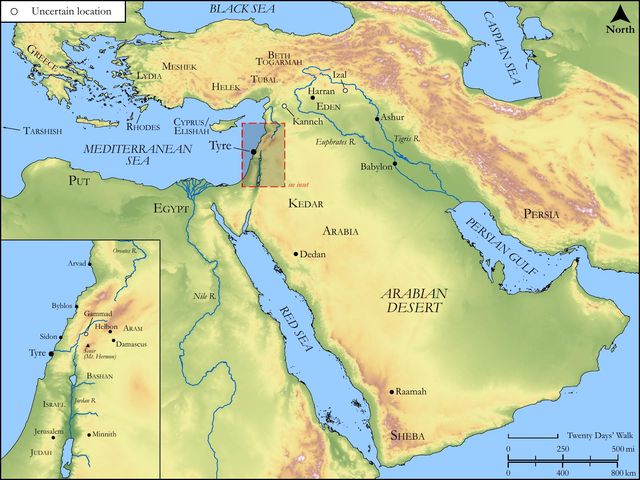
Tyre stood as a preeminent Phoenician city-state, celebrated among the nations for its immense wealth, its sophisticated and expansive maritime trade network, and its seemingly impregnable fortifications, strategically located on an island off the Mediterranean coast. This bustling hub of commerce and luxury fostered an overwhelming sense of invincibility and self-sufficiency among its inhabitants, and particularly its ruler. The King of Tyre, buoyed by this unprecedented prosperity and geopolitical influence, likely perceived himself as an unparalleled strategist and an intellectual titan, capable of discerning all complex matters of statecraft, trade, and even hidden truths. This cultural milieu of material success, self-reliance, and perceived intellectual prowess significantly contributed to the king's spiritual blindness and his audacious, blasphemous claim to god-like wisdom—a tragically common pitfall for powerful rulers among the nations who frequently blurred the sacred lines between divine authority and human kingship.
Key Themes
ShowHideThe verse powerfully contributes to several overarching themes pervasive within the book of Ezekiel and the broader prophetic literature. Foremost among these is the theme of Blinding Pride, vividly illustrating how the king's self-exaltation and perceived wisdom are, in reality, a dangerous delusion that inexorably leads to his destruction. This is starkly contrasted with the theme of True Wisdom, which is exemplified by Daniel, a wisdom that is divinely bestowed, accompanied by profound humility, and never by self-aggrandizement, as seen when Daniel attributes all understanding to God (Daniel 2:28). The passage also profoundly underscores the theme of Divine Judgment against human arrogance, unequivocally asserting God's absolute sovereignty over all earthly rulers and their fleeting, ephemeral power. The King of Tyre's false claim to omniscience represents a direct and audacious affront to God, who alone possesses perfect knowledge and reveals secrets according to His sovereign will (Isaiah 45:7).
Exposition and Analysis
ShowHideKey Word Analysis
ShowHideThis word (H2450), derived from the root חָכַם, typically denotes intelligence, skill, or practical wisdom. However, in this specific context, it is employed with profound irony. The King of Tyre's "wisdom" is not the genuine, divinely-given wisdom exemplified by Daniel, but rather a self-proclaimed intellectual superiority born of egregious arrogance. It highlights his cunning and artfulness in worldly affairs, which he mistakenly elevates to the level of divine insight, leading him to believe he is beyond ordinary human limitations and possessing an almost supernatural discernment.
The name (H1840), originating from דָּן and אֵל, literally means "judge of God." Daniel was a revered contemporary of Ezekiel, renowned among the nations for his exceptional, God-given wisdom, his unparalleled ability to interpret dreams and unravel mysteries, and his unwavering faithfulness to Yahweh. By sarcastically comparing the King of Tyre to Daniel, Ezekiel underscores the king's immense pride and his audacious, yet ultimately hollow and blasphemous, claim to a wisdom that rivals, or even presumptuously surpasses, that which God Himself graciously bestowed upon Daniel. It powerfully highlights the king's profound spiritual blindness to the true, divine source of all wisdom.
This word (H5640), also appearing as שָׂתַם, is a primitive root meaning "to stop up," and by implication, "to keep secret" or "to hide." The king's audacious boast that "there is no secret that they can hide from thee" unveils his delusional belief in his own omniscience. He imagines himself capable of penetrating all mysteries, uncovering all hidden truths, and possessing a comprehensive understanding that leaves absolutely nothing concealed from his intellect. This presumptuous claim directly usurps an attribute belonging solely and exclusively to God, who alone knows all things, both revealed and hidden.
Verse Breakdown
ShowHide"Behold, thou [art] wiser than Daniel;"
This opening clause is a masterstroke of sarcasm and biting irony. It is not a genuine compliment but a devastating condemnation. The King of Tyre, inflated by his city's immense wealth, geopolitical power, and commercial success, had developed an overweening pride that led him to believe his own intellect and discernment surpassed even that of Daniel, a figure universally celebrated for his divinely inspired wisdom and his unique ability to interpret profound mysteries. The prophet, speaking for God, uses this hyperbolic comparison to expose the king's self-deification and his profound spiritual blindness, highlighting the sheer absurdity of a mortal man claiming such intellectual and spiritual superiority over one divinely gifted.
"there is no secret that they can hide from thee:"
This second clause further amplifies the king's arrogant and delusional self-perception. It articulates his belief in his own omniscience, presuming that no hidden knowledge, no concealed plot, no intricate divine mystery, and no human deception could possibly escape his penetrating discernment. This audacious claim is a direct affront to God, who alone possesses perfect and exhaustive knowledge, and who reveals secrets according to His sovereign will and timing. The king's boast underscores his complete departure from humility and his audacious attempt to usurp divine attributes, thereby setting the inexorable stage for God's inevitable and righteous judgment against such unparalleled hubris.
Literary Devices
ShowHideEzekiel 28:3 is exceptionally rich in literary devices, each meticulously employed to underscore its profound prophetic message and deliver a searing indictment. The most prominent device is Irony, specifically Verbal Irony, where the prophet, speaking on behalf of God, states the exact opposite of what is truly meant. The declaration "thou art wiser than Daniel" is not a genuine compliment but a cutting, contemptuous indictment of the king's inflated self-perception and spiritual blindness. This irony is inextricably linked with Sarcasm, which imbues the statement with a sharp, mocking, and contemptuous tone, effectively ridiculing the king's boundless arrogance. Furthermore, the verse employs Hyperbole, exaggerating the king's perceived wisdom to an absurd and blasphemous degree (claiming he is wiser than Daniel and capable of knowing all secrets) in order to vividly highlight the profound extent of his self-delusion and hubris. Finally, a clear and dramatic Contrast is established between the King of Tyre's self-proclaimed, worldly, and ultimately destructive wisdom, and the true, humble, divinely-sourced wisdom exemplified by the prophet Daniel, which leads to spiritual insight and God's favor.
Theological and Thematic Connections
ShowHideEzekiel 28:3 serves as a profound theological statement on the insidious nature of pride and the exclusive attributes of God. It unequivocally teaches that true wisdom is not self-derived, nor is it merely a product of human ingenuity, accumulated wealth, or temporal power. Rather, genuine wisdom is a gracious gift from God, invariably accompanied by profound humility and an unwavering recognition of His absolute sovereignty. The King of Tyre's arrogant and blasphemous claim to omniscience directly challenges and attempts to usurp God's unique and incommunicable attribute of knowing all things, both revealed and hidden. This verse, therefore, powerfully highlights the extreme danger of self-deification and the inevitable, severe judgment that awaits all who elevate themselves above their Creator. It serves as a timeless reminder that all human achievements, intellect, and perceived wisdom are finite, limited, and ultimately dependent upon the divine source of all true knowledge and understanding.
Reflection and Application
ShowHideEzekiel 28:3 offers a timeless and piercing warning against the insidious and destructive nature of pride, particularly when it is fueled by worldly success, abundant wealth, or perceived intellectual superiority. The tragic downfall of the King of Tyre vividly illustrates that human achievements and capabilities, when divorced from humility and a humble dependence on God, can lead to a perilous self-delusion where one begins to believe they are beyond accountability, error, or even divine judgment. For us today, this verse challenges us profoundly to examine the true sources of our confidence, our perceived wisdom, and our understanding. Do we attribute our successes, our insights, and our knowledge to our own cleverness, our hard work, or our innate abilities, or do we humbly acknowledge God as the ultimate, sovereign source of all true knowledge, profound insight, and every blessing? True wisdom, as the Scriptures consistently teach, begins with the fear of the Lord, not with self-exaltation or humanistic pride. This passage calls us to cultivate a spirit of profound humility, recognizing our inherent limitations, our finite understanding, and continually seeking God's divine guidance and revelation, rather than relying solely on our own fallible intellect or worldly acumen.
Questions for Reflection
ShowHideFAQ
ShowHideWas the King of Tyre literally wiser than Daniel?
ShowHideNo, absolutely not. The statement "Behold, thou art wiser than Daniel" in Ezekiel 28:3 is a profound and deliberate example of sarcasm and irony. Ezekiel, speaking on behalf of God, employs this biting language to mock the King of Tyre's inflated self-perception and extreme arrogance. Daniel, a contemporary figure, was renowned among the nations for his divinely bestowed wisdom and his extraordinary ability to interpret mysteries, always attributing his supernatural insight solely to God (Daniel 2:28). The King of Tyre, conversely, attributed his supposed wisdom and discernment entirely to himself, believing he was omniscient and self-sufficient. The prophet's cutting words powerfully highlight the king's dangerous delusion and his audacious attempt to usurp an attribute belonging exclusively to God, thereby setting the stage for his inevitable and catastrophic downfall.
Does this passage (Ezekiel 28:1-19) refer to Satan?
ShowHideWhile Ezekiel 28:1-10 is unequivocally directed at the earthly King of Tyre, many theologians and biblical scholars interpret the subsequent section, particularly Ezekiel 28:11-19, as having a dual fulfillment or a deeper, allegorical reference to the primeval fall of Satan. The highly symbolic and elevated language used in these verses—describing a being who was "the seal of perfection, full of wisdom and perfect in beauty," who was "in Eden, the garden of God," and who was "the anointed cherub who covers"—transcends what could be literally applied to any human king. This rich, evocative language is widely understood to describe a primeval, angelic being who fell from a position of unparalleled glory due to profound pride and rebellion. This interpretation is often connected to other pivotal biblical passages that speak of Satan's fall, such as Isaiah 14:12-15 and Luke 10:18. Therefore, while the immediate historical context is the King of Tyre, the passage is widely understood to also reveal profound, timeless truths about the origin and nature of evil, personified in Satan's prideful rebellion against God.
Christ-Centered Fulfillment
ShowHideThe prophetic irony so sharply wielded in Ezekiel 28:3, which exposes the King of Tyre's false, self-derived wisdom and destructive pride, finds its ultimate contrast and glorious fulfillment in the person and work of Jesus Christ. While the King of Tyre boasted of a self-proclaimed omniscience that inexorably led to his destruction, Christ embodies true, divine wisdom and perfect humility. He is not merely "wiser than Daniel," but is, in fact, Himself "the wisdom of God" (1 Corinthians 1:24) and the One "in whom are hidden all the treasures of wisdom and knowledge" (Colossians 2:3). Unlike the King of Tyre who audaciously sought to elevate himself to godhood, Christ, being God in His very essence, "did not consider equality with God something to be used to his own advantage; rather, he made himself nothing by taking the very nature of a servant, being made in human likeness" (Philippians 2:6-7). He came not to hide secrets or hoard knowledge, but to reveal the Father in His fullness (John 1:18) and to graciously unveil the mysteries of the kingdom of God to those who would hear and believe (Mark 4:11). The severe judgment pronounced against the King of Tyre for his audacious pride foreshadows Christ's ultimate and decisive triumph over all pride, rebellion, and evil, including Satan himself, who is the spiritual archetype underlying the King of Tyre's arrogant spirit. Christ's wisdom is not a worldly cunning or self-serving intellect but a humble, self-sacrificial love that leads to eternal salvation and life, offering a profound and glorious counterpoint to the destructive pride and self-deification of fallen humanity.