


Daniel 2:27
Bible text: King James Version (1769 Blayney text) · Public domain
Bible text: King James Version with Strong's numbers · Public domain
Bible text: Berean Standard Bible · Public domain
Bible text: American Standard Version (1901) · Public domain
Bible text: World English Bible, Messianic edition · Public domain
Bible text: Geneva Bible (1599) · Public domain
Bible text: Young's Literal Translation · Public domain
- עָנֵה'a·Neh[was] replyingH6032V-Peal-Prtcpl-msVerb Peal Participle Singular Masculine Absolute
- דָנִיֵּאלda·ni·YelDanielH1841N-proper-mNoun Proper Masculine
- קֳדָםko·DambeforeH6925N-cscNoun Singular common gender Construct
- מַלְכָּאmal·Ka'king theH4430N-cs ¦ ArtNoun Singular common gender Definiteמַלְכָּkingאthe
- וְאָמַרve·'a·Marand [was] sayingH560Conj-w ¦ V-Qal-Prtcpl-msVerb Qal Participle Singular Masculine Absoluteוְandאָמַר[was] saying
- רָזָהra·Zah'secret theH7328N-cs ¦ ArtNoun Singular common gender Definiteרָזָsecretהthe
- דִּיdiwhichH1768ConjConjunction
- מַלְכָּאmal·Ka'king theH4430N-cs ¦ ArtNoun Singular common gender Definiteמַלְכָּkingאthe
- שָׁאֵלsha·'El[is] askingH7593V-Peal-Prtcpl-msVerb Peal Participle Singular Masculine Absolute
- לָאla'notH3809NegParticle Negative
- חַכִּימִיןcha·ki·Minwise menH2445Adj-mpAdjective Plural Masculine Absolute
- אָשְׁפִין'a·she·FinconjurersH826N-mpNoun Plural Masculine Absolute
- חַרְטֻמִּיןchar·tu·MinmagiciansH2749N-mpNoun Plural Masculine Absolute
- גָּזְרִיןga·ze·RinastrologersH1505V-Peal-Prtcpl-mpVerb Peal Participle Plural Masculine Absolute
- יָכְלִיןya·khe·Lin[are] being ableH3202V-Peal-Prtcpl-mpVerb Peal Participle Plural Masculine Absolute
- לְהַחֲוָיָהle·ha·cha·va·Yahto declareH2324Prep-l ¦ V-Hiphil-InfVerb Hiphil Infinitive Constructלְtoהַחֲוָיָהdeclare
- לְמַלְכָּאle·mal·Ka'to king theH4430Prep-l ¦ N-cs ¦ ArtNoun Singular common gender Definiteלְtoמַלְכָּkingאthe
English is a literal word-by-word gloss of the Hebrew, not the KJV's wording. Why?
This is the original text the KJV's translators worked from — each Hebrew word with its own literal English meaning in this verse, prepared by scholars at Tyndale House, Cambridge. The KJV translates whole sentences, not word by word, so its wording differs: one Hebrew word can become several English words, and the KJV may choose “the LORD” where the gloss reads “Yahweh”. Both are faithful — they answer different questions. For the KJV's own rendering, switch to the KJV text.
Details
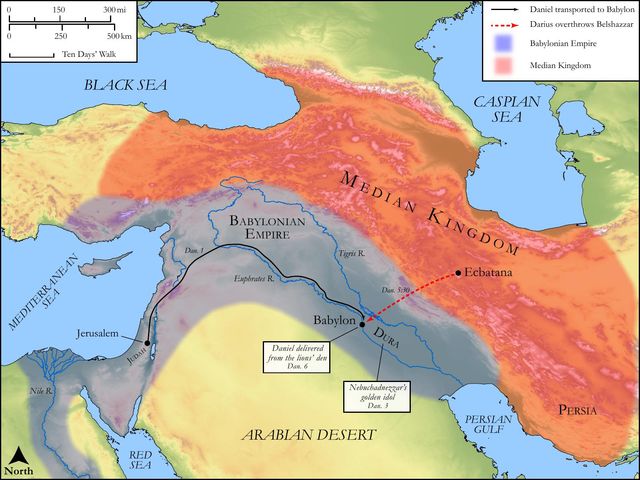
See on the biblical-era map
Study this verse
Public-domain commentary
Matthew Henry
From his Commentary on the Whole Bible. Henry comments on passages, not single verses — this entry covers Daniel 2:24–30. His two-level outline is real structure in the source text, so it is rendered as structure.
We have here the introduction to Daniel's declaring the dream, and the interpretation of it.
I.He immediately bespoke the reversing of the sentence against the wise men of Babylon, Dan 2:24.
He went with all speed to Arioch, to tell him that his commission was now superseded: Destroy not the wise men of Babylon. Though there were those of them perhaps that deserved to die, as magicians, by the law of God, yet here that which they stood condemned for was not a crime worth of death or of bonds, and therefore let them not die, and be unjustly destroyed, but let them live, and be justly shamed, as having been nonplussed and unable to do that which a prophet of the Lord could do. Note, Since God shows common kindness to the evil and good, we should do so too, and be ready to save the lives of even bad men, Mat 5:45. A good man is a common good. To Paul in the ship God gave the souls of all that sailed with him; they were saved for his sake. To Daniel was owing the preservation of all the wise men, who yet rendered not according to the benefit done to them, Dan 3:8.
II.He offered his service, with great assurance, to go to the king, and tell him his dream and the interpretation of it, and was admitted accordingly, Dan 2:24, Dan 2:25. Arioch brought him in haste to the king, hoping to ingratiate himself by introducing Daniel; he pretends he had sought him to interpret the king's dream, whereas really it was to execute upon him the king's sentence that he sought him. But courtiers' business is every way to humour the prince and make their own services acceptable.
III.He contrived as much as might be to reflect shame upon the magicians, and to give honour to God, upon this occasion.
The king owned that it was a bold undertaking, and questioned whether he could make it good (Dan 2:26): Art thou able to make known unto me the dream? What! Such a babe in this knowledge, such a stripling as thou are, wilt thou undertake that which thy seniors despair of doing? The less likely it appeared to the king that Daniel should do this the more God was glorified in enabling him to do it. Note, In transmitting divine revelation to the children of men it has been God's usual way to make use of the weak and foolish things and persons of the world, and such as were despised and despaired of, to confound the wise and mighty, that the excellency of the power might be of him, Co1 1:27, Co1 1:28. Daniel from this takes occasion,
1.To put the king out of conceit with his magicians and soothsayers, whom he had such great expectations from (Dan 2:27): "This secret they cannot show to the king; it is out of their power; the rules of their art will not reach to it. Therefore let not the king be angry with them for not doing that which they cannot do; but rather despise them, and cast them off, because they cannot do it." Broughton reads it generally: "This secret no sages, astrologers, enchanters, or entrail-cookers, can show unto the king; let not the king therefore consult them any more." Note, The experience we have of the inability of all creatures to give us satisfaction should lessen our esteem of them, and lower our expectations from them. They are baffled in their pretensions; we are baffled in our hopes from them. Hitherto they come, and no further; let us therefore say to them, as Job to his friends, Now you are nothing; miserable comforters are you all.
2.To bring him to the knowledge of the one only living and true God, the God whom Daniel worshipped: "Though they cannot find out the secret, let not the king despair of having it found out, for there is a God in heaven that reveals secrets," Dan 2:28. Note, The insufficiency of creatures should drive us to the all-sufficiency of the Creator. There is a God in heaven (and it is well for us there is) who can do that for us, and make known that to us, which none on earth can, particularly the secret history of the work of redemption and the secret designs of God's love to us therein, the mystery which was hidden from ages and generations; divine revelation helps us out where human reason leaves us quite at a loss, and makes known that, not only to kings, but to the poor of this world, which none of the philosophers or politicians of the heathens, with all their oracles and arts of divination to help them, could ever pretend to give us any light into, Rom 16:25, Rom 16:26.
IV.He confirmed the king in his opinion that the dream he was thus solicitous to recover the idea of was really well worth enquiring after, that it was of great value and of vast consequence, not a common dream, the idle disport of a ludicrous and luxuriant fancy, which was not worth remembering or telling again, but that it was a divine discovery, a ray of light darted into his mind from the upper world, relating to the great affairs and revolutions of this lower world. God in it made known to the king what should be in the latter days (Dan 2:28), that is, in the times that were to come, reaching as far as the setting up of Christ's kingdom in the world, which was to be in the latter days, Heb 1:1. And again (Dan 2:29): "The thoughts which came into thy mind were not the repetitions of what had been before, as our dreams usually are" -
Omnia quae sensu volvuntur vota diurno
Tempore sopito reddit amica quies -
The sentiments which we indulge throughout the day
often mingle with the grateful slumbers of the night.
- Claudian
"But they were predictions of what should come to pass hereafter, which he that reveals secrets makes known unto thee; and therefore thou art in the right in taking the hint and pursuing it thus." Note, Things that are to come to pass hereafter are secret things, which God only can reveal; and what he has revealed of those things, especially with reference to the last days of all, to the end of time, ought to be very seriously and diligently enquired into and considered by every one of us. Some think that the thoughts which are said to have come into the king's mind upon his bed, what should come to pass hereafter, were his own thoughts when he was awake. Just before he fell asleep, and dreamed this dream, he was musing in his own mind what would be the issue of his growing greatness, what his kingdom would hereafter come to; and so the dream was an answer to those thoughts. What discoveries God intends to make he thus prepares men for.
V.He solemnly professes that he could not pretend to have merited from God the favour of this discovery, or to have obtained it by any sagacity of his own (Dan 2:30): "But, as for me, this secret is not found out by me, but is revealed to me, and that not for any wisdom that I have more than any living, to qualify me for the receiving of such a discovery." Note, It well becomes those whom God has highly favoured and honoured to be very humble and low in their own eyes, to lay aside all opinion of their own wisdom and worthiness, that God alone may have all the praise of the good they are, and have, and do, and that all may be attributed to the freeness of his good-will towards them and the fulness of his good work in them. The secret was made known to him not for his own sake, but,
1.For the sake of his people, for their sakes that shall make known the interpretation to the king, that is, for the sake of his brethren and companions in tribulation, who had by their prayers helped him to obtain this discovery, and so might be said to make known the interpretation - that their lives might be spared, that they might come into favour and be preferred, and all the people of the Jews might fare the better, in their captivity, for their sakes. Note, Humble men will be always ready to think that what God does for them and by them is more for the sake of others than for their own.
2.For the sake of his prince; and some read the former clause in this sense, "Not for any wisdom of mine, but that the king may know the interpretation, and that thou mightest know the thoughts of thy heart, that thou mightest have satisfaction given thee as to what thou wast before considering, and thereby instruction given thee how to behave towards the church of God." God revealed this thing to Daniel that he might make it known to the king. Prophets receive that they may give, that the discoveries made to them may not be lodged with themselves, but communicated to the persons that are concerned.
Historical interpretation
Four Centuries of Reception
6 surviving comments on this verse. Each one is dated, so this reads as a timeline rather than a list.
Select a marker to jump to its quote. Markers stagger vertically where authors wrote within a few decades of each other.
"Cannot the wise men, the magicians." He instructs the king not to seek an explanation of heavenly mysteries from earthly men, for they shall be accomplished in their due time by God.
Let us not then be looking open-mouthed toward others. For it is true, the prayers of the saints have the greatest power, on condition, however, of our repentance and change. Since even Moses, who had rescued his own brother and six hundred thousand men from the wrath that was then coming on them from God, had no power to deliver his sister. … And Samuel was not able to save Saul from the wrath from above, yet he oftentimes preserved the Israelites.… And Daniel saved the barbarians from slaughter, but he did not deliver the Jews from their captivity.… So on the one hand, if we are careless, we shall not be able to obtain salvation, no, not even by the help of others; if, on the other hand, we are watchful, we shall be able to do this by ourselves, and by ourselves rather than by others. Yes, for God is more willing to give his grace to us than to others for us, that we, by our zeal to avoid his wrath, may both enjoy a deep trust in him and become better people.
For nothing is so advantageous and so likely to pacify the hearers as to say nothing about one’s self of an honorable nature, but on the contrary, to forestall all suspicion of wishing to do so. And, in truth, much more did they [the apostles] increase their glory by despising glory and showing that what had just taken place was not a human act but a divine work; and that it was their part to join with the beholders in admiration rather than to receive it from them.… In the same manner also did the ancient fathers, for instance, Daniel, say, “Not because of any wisdom I have more than all the living has this mystery been revealed to me.” … And again Joseph, “Do not interpretations belong to God?”
Verse 27. "As for the secret for which the king is asking, neither the wise men nor the magi nor the soothsayers nor the diviners are able to declare it to the king." In place of diviners (haruspices), as we have rendered it, the Hebrew text has Gazareni , which only Symmachus has rendered as sacrificers , a. class of people whom the Greeks usually call liver-diviners (epatoskopoi), and who inspect the inwards in order to make predictions from them concerning the future. By terming a mystery the category of a revealed dream, Daniel shows that whatever is hidden and unknown by men can still be called a "mystery." Moreover he obviates any evil suspicion on the king's part, lest he should imagine that human cleverness can discover something which is reserved to the knowledge of God alone.
The one who interprets what another has seen is more a prophet than the one who had seen.… Less a prophet is he who … sees in spirit only the signs of the things signified, and a greater prophet is he who is granted only an understanding of images. But the greatest prophet is he who is endowed with both gifts, namely, that of seeing in spirit the symbolic likeness of corporeal objects and that of understanding them with the vital power of the mind. Such a one was Daniel. His preeminence was tested and established when he not only told the dream he had had but also explained the meaning of it. For the corporeal images themselves were produced in his spirit, and an understanding of them was revealed in his mind. I am using the word spirit, therefore, in the sense in which Paul uses it, where he distinguishes it from the mind: "I will pray with the spirit, but I will pray with the mind also." Here he implies that signs of things are formed in the spirit and that an understanding of the signs shines forth in the mind.
“To you, O king, as you lay in bed came thoughts of what would be hereafter, and he who reveals mysteries made known to you what is to be.” And a little later, “You, O king, saw, and behold, a great image.” … Daniel, therefore, in reverently indicating that the dream was to be fulfilled and in telling from what thoughts it arose, shows clearly that dreams often rise from our thoughts and from revelation. Seeing, then, that dreams may arise from such a variety of causes, one ought to be very reluctant to put one’s faith in them, since it is hard to tell from what source they come.… If the mind is not on its guard against these, it will be entangled in countless vanities by the master of deceit, who is clever enough to foretell many things that are true in order finally to capture the soul by but one falsehood. This happened recently to one of our people who believed strongly in dreams. In one of them he was promised a long life. After collecting a large sum of money to last him for many years, he died suddenly, leaving all of his wealth behind untouched, without having so much as a single good work to take with him.
Continue studying Daniel 2:27 across the web’s major study libraries — every link below opens this exact verse, chapter, or book on the destination site.
Read & Compare
 BibleGatewayThis verse in more than 200 translations and 70 languages.
 Bible.comThe YouVersion reader — hundreds of translations, reading plans, and highlights.
 ESV.orgCrossway's official English Standard Version reader.
 NET BibleThe NET translation with 60,000+ translators' notes on every rendering decision.
 STEP BibleTyndale House's free study tool — original text, vocabulary, and scholarly resources.
 BibliaLogos Bible Software's free web reader.
 USCCBThe New American Bible (Revised Edition) with the U.S. bishops' study notes.
Commentaries
 BibleHub CommentariesDozens of classic commentaries on this verse, gathered on one page.
 StudyLightMore than 100 commentary sets — the largest collection on the web.
 BibleRefPlain-English commentary on what this verse means, verse by verse.
 Enduring WordDavid Guzik's free commentary on this chapter, widely used by Bible teachers.
 Bible Study ToolsVerse commentary alongside Greek and Hebrew study aids.
Original Language & Research
- BibleHub InterlinearThe verse word by word — original language, transliteration, and English.
- BibleHub LexiconEvery word's original-language definition and Strong's entry.
 Blue Letter BibleDeep-study tools — Strong's numbers, concordance, and word studies.
 SefariaThe Hebrew text with Rashi and centuries of Jewish commentary.
Sermons, Hymns & Audio


TrulyRandomVerse is not affiliated with these sites and doesn’t control their content. They’re linked because they’re genuinely useful.
Summary
Daniel 2:27 serves as Daniel's profound initial declaration to King Nebuchadnezzar, unequivocally stating the absolute inability of all human wisdom, occult practices, and pagan diviners within Babylon to reveal the king's forgotten dream and its interpretation. This pivotal statement not only highlights the inherent limitations of worldly knowledge and spiritualistic endeavors but also strategically prepares the monarch for the subsequent revelation, which can only emanate from the one true God of heaven, thereby setting the stage for divine glory to be powerfully manifested through Daniel.
Context
ShowHideLiterary Context
This verse marks a critical turning point in the narrative of Daniel 2. It immediately follows King Nebuchadnezzar's furious decree to execute all the wise men of Babylon, including Daniel and his companions, due to their collective failure to recall and interpret his disturbing dream. Daniel, having learned of the decree, courageously approached Arioch, the captain of the king's guard, and then secured an audience with the king to request time for divine revelation. After Daniel and his three friends earnestly sought God in prayer and received the mystery in a night vision, Daniel was brought before the king. Daniel 2:27 initiates Daniel's direct address to Nebuchadnezzar, serving as a crucial transition from the crisis of human impotence to the promise of divine omniscience. It starkly contrasts the futility of Babylonian wisdom with the omnipotence of God, a theme Daniel will elaborate upon in the subsequent verses, attributing all knowledge and power to the God of heaven in Daniel 2:28-30.
Historical & Cultural Context
In the 6th century BCE, Babylon stood as a preeminent global empire, celebrated for its advanced achievements in astronomy, mathematics, and various forms of divination. King Nebuchadnezzar's court heavily relied on a sophisticated class of "wise men," which included astrologers, magicians, and soothsayers. These individuals were integral advisors, tasked with interpreting omens, discerning the future, and providing counsel based on their specialized knowledge. The king's demand for them to not only interpret but also recall his dream was unprecedented and designed to be an ultimate test of their claimed supernatural capabilities. Their collective failure, explicitly underscored by Daniel in this verse, vividly illustrates the profound chasm between the prevalent pagan worldview—which sought knowledge through human intellect, occult practices, and polytheistic deities—and the unwavering monotheistic faith of Daniel, who relied exclusively on the God of Israel for genuine divine revelation. This historical backdrop magnifies the dramatic impact of Daniel's declaration.
Key Themes
ShowHideDaniel 2:27 profoundly contributes to several overarching themes woven throughout the book of Daniel. Firstly, it firmly establishes the limitations of human wisdom and pagan practices, demonstrating that even the most esteemed human intellect and sophisticated occult arts are utterly inadequate when confronted with divine mysteries. This theme is foundational, as the entire narrative of Daniel 2 hinges on the Chaldean wise men's inability to interpret the dream, thereby paving the way for God's sovereign intervention. Secondly, the verse subtly but powerfully introduces the theme of God's exclusive sovereignty in revelation, implying that if human means cannot unveil the secret, then the source must undeniably be divine. This prepares the king for Daniel's subsequent declaration that "there is a God in heaven who reveals mysteries" found in Daniel 2:28. Lastly, Daniel 2:27 highlights the contrast between true divine power and false human power, setting up a dramatic confrontation between the impotent gods and practices of Babylon and the living God of Israel, who alone holds the keys to all knowledge and the future. This crucial theme resonates throughout the book, particularly in the accounts of the fiery furnace in Daniel 3 and Daniel's deliverance from the lions' den in Daniel 6.
Exposition and Analysis
ShowHideKey Word Analysis
ShowHideThis Aramaic term, derived from a root meaning "to attenuate" or "hide," refers to a mystery or something concealed. In this specific context, it denotes King Nebuchadnezzar's forgotten dream, which is presented as a divine mystery far beyond human comprehension or discovery. Daniel's use of this word emphasizes that the king's demand is not merely for an interpretation of a known event but for the unveiling of something divinely hidden, inaccessible through conventional or occult means.
The combination of the Aramaic verb yᵉkêl ("to be able") and the negative particle lâʼ' ("not," the simple absolute negation) creates a strong, unequivocal statement of absolute inability. This linguistic construction signifies that it is utterly impossible for the wise men to fulfill the king's demand, not merely difficult or improbable. It powerfully underscores the complete and total impotence of human wisdom and pagan practices when confronted with a divinely concealed truth.
This Aramaic verb means "to show," "to make known," or "to declare." Daniel's emphatic declaration that the wise men "cannot shew" the secret directly addresses the king's demand for the dream to be revealed. It highlights that the very act of bringing this hidden truth to light, of making it manifest, is beyond their inherent capacity, further emphasizing the indispensable need for a supernatural source of revelation.
Verse Breakdown
ShowHide"Daniel answered in the presence of the king, and said,"
This opening clause immediately establishes the solemnity and profound significance of the moment. Daniel, an Israelite captive, stands directly before Nebuchadnezzar, the most powerful monarch of his era, poised to deliver a message of immense consequence. His direct presence and formal address underscore his unique position as God's chosen vessel for divine revelation, setting a tone of authority and divine appointment.
"The secret which the king hath demanded cannot the wise [men], the astrologers, the magicians, the soothsayers, shew unto the king;"
This is the core, emphatic declaration of the verse. Daniel unequivocally states that the "secret" (referring to the forgotten dream and its interpretation) that the king has "demanded" is utterly beyond the capabilities of all the recognized and esteemed categories of Babylonian "wise men." He meticulously lists them: the general "wise men" (chakkîym), the "astrologers" (ʼashshâph), the "magicians" (charṭôm), and the "soothsayers" (gᵉzar). By comprehensively naming each group, Daniel systematically dismisses every form of human and occult wisdom available in Babylon, asserting their collective impotence in the face of a divinely concealed mystery. This powerful dismissal sets the indispensable stage for the subsequent revelation, which will come from a source entirely outside their realm of knowledge and power.
Literary Devices
ShowHideDaniel 2:27 prominently employs Contrast and Repetition to underscore its central message. The entire verse functions as a stark Contrast between the inherent powerlessness of Babylonian wisdom and the implied, yet soon-to-be-explicit, omnipotence of the God of heaven. Daniel systematically lists the various categories of "wise men"—the astrologers, magicians, and soothsayers—highlighting their collective inability to "shew" or reveal the "secret." This systematic dismissal serves to magnify the unique and exclusive power of God, who alone possesses the capacity to reveal such profound mysteries. The Repetition of "the king" (appearing three times in this concise verse) emphasizes Nebuchadnezzar's supreme authority and the gravity of his unprecedented demand, further intensifying the dramatic tension. This repetition also highlights the king's utter helplessness despite his power, thereby magnifying the significance of Daniel's bold declaration that even the monarch's most trusted and learned advisors are utterly helpless. This masterful literary framing effectively sets the stage for God's unparalleled glory to be revealed.
Theological and Thematic Connections
ShowHideDaniel 2:27 serves as a profound theological statement on the intrinsic limits of human autonomy and the exclusive sovereignty of God in matters of divine revelation. It asserts that true knowledge of God's intricate plans and purposes, especially those pertaining to the unfolding of history and His kingdom, cannot be attained through human intellect, occult practices, or any form of worldly wisdom, no matter how sophisticated. Instead, such profound truths are solely within the purview of the Almighty, who chooses to reveal them according to His sovereign will and timing. This verse establishes a foundational biblical principle: God is the ultimate, indeed the only, source of all true wisdom and understanding, particularly concerning the mysteries of His divine kingdom and the trajectory of human history. It powerfully highlights the vast, unbridgeable chasm between finite human capacity and infinite divine knowledge, meticulously preparing the reader for the subsequent revelation of God's unparalleled power, foresight, and ultimate control over all things.
Reflection and Application
ShowHideIn a contemporary world that increasingly places its trust in human ingenuity, scientific advancement, technological prowess, and various forms of self-help or spiritualistic practices, Daniel 2:27 offers a sobering, yet profoundly essential, reminder. It challenges us to recognize that there are profound "secrets"—divine truths, ultimate purposes, and spiritual realities—that remain utterly inaccessible to even the most brilliant human minds, the most sophisticated technologies, or the most advanced philosophical systems. This verse calls believers to cultivate a deep and abiding humility, acknowledging the inherent limitations of our own wisdom and the wisdom of the world around us. It encourages a radical and unwavering dependence on God as the sole revealer of truth, urging us to seek Him diligently through fervent prayer, the diligent study of His inspired Word, and the faithful guidance of the Holy Spirit for understanding life's deepest mysteries and navigating its complexities. When faced with challenges that seem insurmountable or questions that defy human logic, Daniel's bold declaration points us unequivocally to the God who delights in revealing His wisdom to those who humbly seek Him, reminding us that true insight and understanding come not from within ourselves or from worldly sources, but exclusively from above.
Questions for Reflection
ShowHideFAQ
ShowHideWhy did King Nebuchadnezzar demand that his wise men tell him the dream itself, not just the interpretation?
ShowHideKing Nebuchadnezzar's extraordinary demand, as explicitly presented in Daniel 2:5, served as a crucial and absolute test of authenticity. He had genuinely forgotten the precise details of the dream, yet he knew with certainty that he had experienced a dream of immense and unsettling significance. By requiring his wise men to first recall and articulate the dream itself, he ensured that any subsequent interpretation they offered would be genuinely divine and not merely a clever guess, a manipulative fabrication, or a generalized astrological reading. This impossible demand exposed the fraudulent and limited nature of their claims to supernatural insight, thereby setting the stage for Daniel, empowered by the true and living God, to demonstrate genuine, undeniable divine revelation.
What was the significance of Daniel specifically naming the different types of "wise men" in Babylon?
ShowHideDaniel's detailed listing of "the wise [men], the astrologers, the magicians, the soothsayers" serves to underscore the comprehensive and absolute nature of their collective failure. These were not merely generic advisors; they represented the most esteemed, specialized, and diverse practitioners of wisdom and occult arts within the vast Babylonian Empire. They embodied the full spectrum of human and demonic attempts to gain supernatural knowledge and control. By meticulously naming each category, Daniel emphatically emphasizes that no human or pagan method, regardless of its specific specialization or purported power, could access the divine secret. This deliberate enumeration magnifies the unique power, authority, and exclusivity of the God of Israel, who would ultimately and miraculously reveal what was hidden from all others.
Christ-Centered Fulfillment
ShowHideDaniel 2:27, by powerfully highlighting the utter inability of human wisdom and worldly systems to comprehend divine mysteries, serves as a profound foreshadowing of the ultimate revelation of God's most significant "secret" in the person of Jesus Christ. The "secret" that the Babylonian wise men could not "shew" finds its ultimate and glorious parallel in the "mystery of Christ" Ephesians 3:4, a divine truth that was "hidden for ages and generations but is now revealed to his saints" Colossians 1:26. Just as Daniel, empowered by the Spirit of God, alone could reveal Nebuchadnezzar's dream, so too is Jesus Christ the sole and ultimate revealer of God's redemptive plan for humanity. He is explicitly identified as the "wisdom of God" 1 Corinthians 1:24 in whom "are hidden all the treasures of wisdom and knowledge" Colossians 2:3. The world, with all its philosophies, intellectual prowess, and spiritualistic endeavors, could not discern God's profound plan for salvation, but Christ, through His perfect life, atoning death, and glorious resurrection, made it fully known. He is the ultimate "secret" revealed, the one through whom humanity can truly know God and His perfect will, thereby fulfilling the timeless truth that only God can "shew" the deepest mysteries of His eternal purpose and kingdom.