


Daniel 1:20
Bible text: King James Version (1769 Blayney text) · Public domain
Bible text: King James Version with Strong's numbers · Public domain
Bible text: Berean Standard Bible · Public domain
Bible text: American Standard Version (1901) · Public domain
Bible text: World English Bible, Messianic edition · Public domain
Bible text: Geneva Bible (1599) · Public domain
Bible text: Young's Literal Translation · Public domain
- וְכֹלve·Kholand everyH3605Conj-w ¦ N-mscNoun Singular Masculine Constructוְandכֹלevery
- דְּבַרde·Varmatter ofH1697N-mscNoun Singular Masculine Construct
- חָכְמַתcha·khe·Matwisdom ofH2451N-fscNoun Singular Feminine Construct
- בִּינָהbi·NahunderstandingH998N-fsNoun Singular Feminine Absolute
- אֲשֶׁר'a·SherwhichH834RelParticle Relative
- בִּקֵּשׁbi·Keshhe soughtH1245V-Piel-Perf-3msVerb Piel Perfect 3rd Singular Masculine
- מֵהֶםme·Hemfrom themPrep-m ¦ 3mpSuffix Personal 3rd Plural Masculineמֵfromהֶםthem
- הַמֶּלֶךְha·Me·lekhthe kingH4428Art ¦ N-msNoun Singular Masculine Absoluteהַtheמֶּלֶךְking
- וַיִּמְצָאֵםvai·yim·tza·'Emand he found themH4672Conj-w ¦ V-Qal-ConsecImperf-3ms ¦ 3mpVerb Qal Consecutive Imperfect 3rd Singular Masculineוַandיִּמְצָאֵhe foundםthem
- עֶשֶׂר'E·sertenH6235N-mscNoun Singular Masculine Construct
- יָדוֹתya·DothandsH3027N-cpNoun Plural common gender Absolute
- עַל'alaboveH5921PrepPreposition
- כָּלkolallH3605N-mscNoun Singular Masculine Construct
- הַחַרְטֻמִּיםha·char·tu·Mimthe soothsayer-priestsH2748Art ¦ N-mpNoun Plural Masculine Absoluteהַtheחַרְטֻמִּיםsoothsayer-priests
- הָאַשָּׁפִיםha·'a·sha·Fimthe conjurersH825Art ¦ N-mpNoun Plural Masculine Absoluteהָtheאַשָּׁפִיםconjurers
- אֲשֶׁר'a·SherwhoH834RelParticle Relative
- בְּכָלbe·khol[were] in allH3605Prep-b ¦ N-mscNoun Singular Masculine Constructבְּ[were] inכָלall
- מַלְכוּתוֹmal·khu·Tohis kingdomH4438N-fsc ¦ 3msNoun Singular Feminine Constructמַלְכוּתkingdomוֹhis
English is a literal word-by-word gloss of the Hebrew, not the KJV's wording. Why?
This is the original text the KJV's translators worked from — each Hebrew word with its own literal English meaning in this verse, prepared by scholars at Tyndale House, Cambridge. The KJV translates whole sentences, not word by word, so its wording differs: one Hebrew word can become several English words, and the KJV may choose “the LORD” where the gloss reads “Yahweh”. Both are faithful — they answer different questions. For the KJV's own rendering, switch to the KJV text.
Details
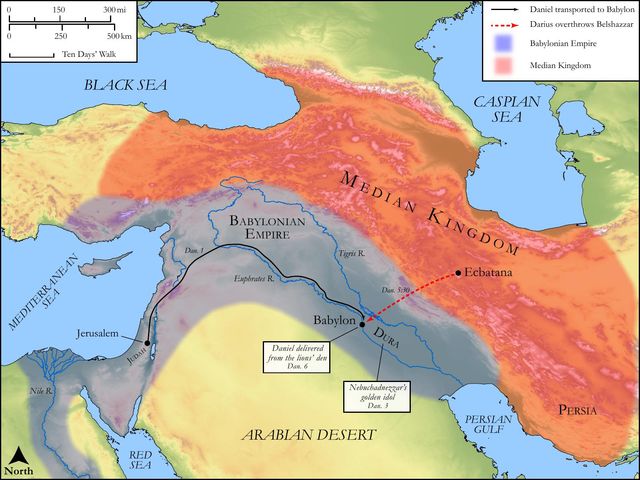
See on the biblical-era map
Study this verse
Public-domain commentary
Matthew Henry
From his Commentary on the Whole Bible. Henry comments on passages, not single verses — this entry covers Daniel 1:17–21. His two-level outline is real structure in the source text, so it is rendered as structure.
Concerning Daniel and his fellows we have here,
I.Their great attainments in learning, Dan 1:17.
They were very sober and diligent, and studied hard; and we may suppose their tutors, finding them of an uncommon capacity, took a great deal of pains with them, but, after all, their achievements are ascribed to God only. It was he that gave them knowledge and skill in all learning and wisdom; for every good and perfect gift is from above, from the Father of the lights. It is the Lord our God that gives men power to get this wealth; the mind is furnished only by him that formed it. The great learning which God gave these four children was,
1.A balance for their losses. They had, for the iniquity of their fathers, been deprived of the honours and pleasures that would have attended their noble extraction; but, to make them amends for that, God, in giving them learning, gave them better honours and pleasures than those they had been deprived of.
2.A recompence for their integrity. They kept to their religion, even in the minutest instances of it, and would not so much as defile themselves with the king's meat or wine, but became, in effect, Nazarites; and now God rewarded them for it with eminency in learning; for God gives to a man that is good in his sight, wisdom, and knowledge, and joy with them, Ecc 2:26. To Daniel he gave a double portion; he had understanding in visions and dreams; he knew how to interpret dreams, as Joseph, not by rules of art, such as are pretended to be given by the oneirocritics, but by a divine sagacity and wisdom which God gave him. Nay, he was endued with a prophetic spirit, by which he was enabled to converse with God, and to receive the notices of divine things in dreams and visions, Num 12:6. According to this gift given to Daniel, we find him, in this book, all along employed about dreams and visions, interpreting or entertaining them; for, as every one has received the gift, so shall he have an opportunity, and so should he have a heart, to minister the same, Pe1 4:10.
II.Their great acceptance with the king.
After three years spent in their education (they being of some maturity, it is likely, when they came, perhaps about twenty years old) they were presented to the king with the rest that were of their standing, Dan 1:18. And the king examined them and communed with them himself, Dan 1:19. He could do it, being a man of parts and learning himself, else he would not have come to be so great; and he would do it, for it is the wisdom of princes, in the choice of the persons they employ, to see with their own eyes, to exercise their own judgment, and not trust too much to the representation of others. The king examined them not so much in the languages, in the rules of oratory or poetry, as in all matters of wisdom and understanding, the rules of prudence and true politics; he enquired into their judgment about the due conduct of human life and public affairs; not "Were they wits?" but, "Were they wise?" And he not only found them to excel the young candidates for preferment that were of their own standing, but found that they had more understanding than the ancients, than all their teachers, Psa 119:99, Psa 119:100. So far was the king from being partial to his own countrymen, to seniors, to those of his own religion and of an established reputation, that he freely owned that, upon trial, he found those poor young captive Jews ten times wiser and better than all the magicians that were in all his realm, Dan 1:20. He was soon aware of something extraordinary in these young men, and, which gave him a surprising satisfaction, was soon aware that a little of their true divinity was preferable to a great deal of the divination he had been used to. What is the chaff to the wheat? what are the magicians' rods to Aaron's? There was no comparison between them. These four young students were better, were ten times better, than all the old practitioners, put them all together, that were in all his realm, and we may be sure that they were not a few. This contempt did God pour upon the pride of the Chaldeans, and this honour did he put upon the low estate of his own people; and thus did he make not only these persons, but the rest of their nation for their sakes, the more respected in the land of their captivity. Lastly, This judgment being given concerning them, they stood before the king (Dan 1:19); they attended in the presence-chamber, nay, and in the council-chamber, for to see the king's face is the periphrasis of a privy-counsellor, Est 1:14. This confirms Solomon's observation, Seest thou a man diligent in his business, sober and humble? he shall stand before kings; he shall not stand before mean men. Industry is the way to preferment. How long the other three were about the court we are not told; but Daniel, for his part, continued to the first year of Cyrus (Dan 1:21), though not always alike in favour and reputation. He lived and prophesied after the first year of Cyrus; but that is mentioned to intimate that he lived to see the deliverance of his people out of their captivity and their return to their own land. Note, Sometimes God favours his servants that mourn with Zion in her sorrows to let them live to see better times with the church than they saw in the beginning of their days and to share with her in her joys.
Historical interpretation
Historical reception
1 surviving comment on this verse from the historical church.
Verse 20. "And every word of wisdom and understanding the king inquired of them, he found it in them ten times as great as all the soothsayers and magicians put together who were to be found in his entire realm." For "soothsayers" and "magicians" the Vulgate edition translated "sophists" and "philosophers" - terms to be understood not in the sense of the philosophy and sophistic erudition which Greek learning holds forth, but rather in the sense of the lore of a barbarian people, which the Chaldeans pursue as philosophy even to this day.
Continue studying Daniel 1:20 across the web’s major study libraries — every link below opens this exact verse, chapter, or book on the destination site.
Read & Compare
 BibleGatewayThis verse in more than 200 translations and 70 languages.
 Bible.comThe YouVersion reader — hundreds of translations, reading plans, and highlights.
 ESV.orgCrossway's official English Standard Version reader.
 NET BibleThe NET translation with 60,000+ translators' notes on every rendering decision.
 STEP BibleTyndale House's free study tool — original text, vocabulary, and scholarly resources.
 BibliaLogos Bible Software's free web reader.
 USCCBThe New American Bible (Revised Edition) with the U.S. bishops' study notes.
Commentaries
 BibleHub CommentariesDozens of classic commentaries on this verse, gathered on one page.
 StudyLightMore than 100 commentary sets — the largest collection on the web.
 BibleRefPlain-English commentary on what this verse means, verse by verse.
 Enduring WordDavid Guzik's free commentary on this chapter, widely used by Bible teachers.
 Bible Study ToolsVerse commentary alongside Greek and Hebrew study aids.
Original Language & Research
- BibleHub InterlinearThe verse word by word — original language, transliteration, and English.
- BibleHub LexiconEvery word's original-language definition and Strong's entry.
 Blue Letter BibleDeep-study tools — Strong's numbers, concordance, and word studies.
 SefariaThe Hebrew text with Rashi and centuries of Jewish commentary.
Sermons, Hymns & Audio


TrulyRandomVerse is not affiliated with these sites and doesn’t control their content. They’re linked because they’re genuinely useful.
Summary
Daniel 1:20 stands near the triumphant close of the opening chapter, highlighting the extraordinary intellectual and spiritual superiority of Daniel and his three companions. Following their faithful adherence to God's dietary laws and the subsequent divine favor bestowed upon them, King Nebuchadnezzar personally examined them. The verse emphatically declares that in every inquiry concerning wisdom and understanding, the king found them vastly superior—ten times better—than all the established magicians and astrologers throughout his vast Babylonian empire, powerfully underscoring God's ability to elevate and empower His faithful servants.
Context
ShowHideLiterary Context
Daniel 1:20 functions as the climactic culmination of the narrative in Daniel chapter 1. The preceding verses meticulously detail the capture of young, noble Israelites by Nebuchadnezzar, their relocation to Babylon, and their selection for a three-year training program in the royal court. The narrative establishes Daniel's unwavering resolve not to defile himself with the king's rich food and wine, a decision rooted in his covenant faithfulness (Daniel 1:8). This faithfulness is immediately met with divine favor, as God grants Daniel "favor and compassion" with the chief eunuch (Daniel 1:9). A ten-day test confirms the physical well-being of Daniel and his friends on a simple vegetarian diet (Daniel 1:12-15), demonstrating God's blessing. Crucially, God then bestows upon them "knowledge and skill in all literature and wisdom; and Daniel had understanding in all visions and dreams" (Daniel 1:17). Daniel 1:20 presents the ultimate public validation of this divine endowment and their faithfulness, showcasing their unparalleled intellectual and spiritual superiority when brought before the king, thereby setting the stage for their pivotal roles in the Babylonian court and the unfolding prophetic narrative of the book of Daniel.
Historical & Cultural Context
The historical backdrop of Daniel 1:20 is the sophisticated and powerful Neo-Babylonian Empire under King Nebuchadnezzar, following his conquest of Jerusalem in 605 BC. Babylon was not only a military superpower but also a center of advanced learning, particularly in areas related to astrology, divination, and various occult practices. The Babylonian court maintained a highly influential class of "wise men," which included various specialists such as "magicians" (often associated with priestly functions and magical arts) and "astrologers" (those who divined by observing celestial bodies and interpreting omens). These individuals served as royal advisors, interpreters of complex phenomena, and custodians of esoteric knowledge, holding significant prestige and power within the empire. The comparison drawn in Daniel 1:20 is therefore not merely an academic assessment but a direct, public challenge to the established intellectual and spiritual authority of the most formidable empire of its time. It dramatically highlights the stark contrast between the accumulated human and pagan wisdom of Babylon and the divinely-sourced wisdom granted by the God of Israel, asserting His supremacy over all earthly systems and their practitioners.
Key Themes
ShowHideThis verse powerfully contributes to several overarching themes that permeate the book of Daniel. Firstly, it emphatically underscores the theme of Divine Sovereignty and Empowerment. Even within a pagan empire that had conquered God's people, God remains actively involved in human affairs, demonstrating His ability to grant supernatural wisdom, discernment, and favor to His faithful servants. This divine intervention elevates them far beyond human capabilities. Secondly, the verse highlights the Superiority of God's Wisdom over all forms of worldly knowledge and pagan practices. The "ten times better" comparison is a stark, undeniable declaration of the qualitative difference between God's truth and the limited, often deceptive, wisdom of human systems and occult arts. This motif recurs throughout Daniel, particularly in the divine interpretations of Nebuchadnezzar's dreams in Daniel 2 and Daniel 4, where the Babylonian wise men consistently fail, and only Daniel, empowered by God, succeeds. Thirdly, Daniel 1:20 powerfully reinforces the theme of Faithfulness and Reward. Daniel and his friends' earlier commitment to God's covenant, even in seemingly small matters like diet, directly leads to their exceptional distinction and elevation in the king's eyes, illustrating the biblical principle that "those who honor me I will honor" (1 Samuel 2:30).
Exposition and Analysis
ShowHideKey Word Analysis
ShowHideThis word signifies "a word; by implication, a matter (as spoken of) or thing." In the context of Daniel 1:20, dâbâr refers to the various subjects, questions, or affairs that King Nebuchadnezzar presented to Daniel and his companions for their counsel, judgment, or interpretation. Its usage here indicates the comprehensive breadth and scope of the inquiries, encompassing all areas of royal concern where wisdom and understanding were required, from governance to complex problems.
This term denotes "wisdom (in a good sense); skilful, wisely, wit." Chokmâh refers to more than mere intellectual knowledge; it encompasses practical skill, insightful discernment, and the ability to apply knowledge effectively in real-world situations. It is the capacity for sound judgment, prudent decision-making, and the skillful management of affairs, which was divinely imparted to Daniel and his friends, enabling them to excel where others failed.
This word describes "a horoscopist (as drawing magical lines or circles); magician." In the courts of Egypt and Babylon, charṭôm referred to a specific class of wise men, often associated with priestly functions, occult practices, divination, and interpreting omens. Their inclusion in this comparison highlights the contrast between human, often deceptive, and supernaturally-derived wisdom, emphasizing the superiority of God's truth over the pagan arts they practiced.
Verse Breakdown
ShowHide"And in all matters of wisdom and understanding,"
This opening phrase sets the stage by emphasizing the comprehensive nature of the king's examination. It was not a superficial test but an exhaustive inquiry across "all matters" requiring profound intellectual and spiritual acumen, encompassing both practical insight ("wisdom") and the ability to discern and comprehend complex, often hidden, issues ("understanding"). This highlights the thoroughness of the king's assessment.
"that the king enquired of them,"
This clause underscores the direct and personal involvement of King Nebuchadnezzar himself. The most powerful ruler of his time personally tested the capabilities of these four young exiles. This detail not only emphasizes the high stakes involved for Daniel and his friends but also lends significant weight and credibility to the subsequent declaration of their superiority, as it comes from the ultimate authority.
"he found them ten times better"
This is a powerful and emphatic declaration of their extraordinary superiority. The phrase "ten times better" (Hebrew: ʻeser yâd, literally "ten hands" or "ten portions") is a hyperbolic expression common in ancient Hebrew and Aramaic literature. It is not meant as a literal mathematical calculation but signifies an overwhelming, undeniable, and divinely-granted excellence that far surpassed mere human intellectual capacity. It's a qualitative assessment, indicating unparalleled distinction.
"than all the magicians and astrologers that were in all his realm."
This concluding clause provides the stark and crucial contrast. The "magicians and astrologers" represent the pinnacle of Babylonian wisdom, occult knowledge, and established intellectual authority within the empire. The comparison unequivocally declares the divine wisdom of Daniel and his friends to be vastly superior to the collective expertise and accumulated knowledge of the entire pagan intellectual establishment of the most powerful empire of their day.
Literary Devices
ShowHideDaniel 1:20 employs several powerful literary devices to convey its profound message. Hyperbole is prominently featured in the phrase "ten times better," which is not intended as a literal mathematical multiplier but rather as an emphatic exaggeration to underscore the overwhelming and undeniable superiority of Daniel and his companions. This serves to highlight the profound difference between divinely bestowed wisdom and human-derived knowledge. The verse also utilizes Contrast as a central rhetorical strategy, setting the wisdom of God's faithful servants directly against the wisdom of the world, represented by the "magicians and astrologers." This stark opposition vividly illustrates the ultimate source of true knowledge and insight. Furthermore, there is a subtle yet powerful element of Divine Irony at play: these young Jewish exiles, seemingly powerless and displaced within a foreign land, are elevated by God to surpass the most esteemed and powerful intellectual figures within the very empire that had subjugated them, demonstrating God's ability to use the humble to confound the proud.
Theological and Thematic Connections
ShowHideDaniel 1:20 is a profound theological statement on the nature and source of true wisdom, asserting that genuine insight and understanding are not merely products of human ingenuity, occult practices, or worldly education, but are ultimately gifts from the sovereign God. This divine endowment elevates His faithful servants to a position of unparalleled excellence, demonstrating His absolute sovereignty over all earthly powers and intellectual systems. The "ten times better" outcome is a powerful testament to God's faithfulness to those who honor Him, proving that His wisdom is qualitatively superior to any human or demonic knowledge. This foundational truth establishes a recurring theme in the book of Daniel: God alone reveals mysteries and grants understanding, often through His chosen vessels, thereby demonstrating His supremacy over all false gods and their practitioners, and validating the covenant faithfulness of His people even in exile.
Reflection and Application
ShowHideDaniel 1:20 offers profound encouragement and practical guidance for believers navigating a world that often prioritizes worldly wisdom, academic credentials, and secular success. It serves as a powerful reminder that our ultimate source of wisdom, discernment, and understanding is God Himself. In a contemporary culture saturated with information, competing ideologies, and complex challenges, the call for believers is to actively seek divine insight from the Holy Spirit, allowing His truth to shape our perspectives, decisions, and responses. This verse challenges us to pursue excellence in our callings, professions, and daily tasks, not for personal aggrandizement, but as a compelling testimony to God's transformative power and character working through us. When we operate with integrity, diligence, and a reliance on divine wisdom, we can, like Daniel and his friends, stand out in our workplaces, communities, and spheres of influence, becoming authentic lights that point others to Christ. Our faithfulness, even in seemingly small acts of obedience and ethical choices, can lead to unexpected favor, open doors of opportunity, and ultimately bring glory to God, demonstrating that He truly honors those who honor Him.
Questions for Reflection
ShowHideFAQ
ShowHideWhat does "ten times better" truly signify in this context?
ShowHideThe phrase "ten times better" (Hebrew: ʻeser yâd, literally "ten hands" or "ten portions") is a powerful hyperbolic expression. It is not meant to be interpreted as a literal mathematical multiple but rather signifies an overwhelming, undeniable, and profound superiority. It means that Daniel and his companions were found to be incomparably, vastly, and qualitatively more insightful, discerning, and wise than all the other wise men in Nebuchadnezzar's court. This emphatic statement highlights the qualitative difference of their divinely-granted wisdom compared to the accumulated human knowledge and occult practices of the Babylonian "magicians and astrologers" (Daniel 1:20).
Who were the "magicians and astrologers" in ancient Babylon?
ShowHideIn ancient Babylon, the "magicians" (Hebrew: charṭôm) were a distinct class of learned men, often associated with the priesthood. They practiced various forms of magic, divination, and the interpretation of omens, sometimes involving the drawing of magical lines or circles. The "astrologers" (Hebrew: ʼashshâph) were specialists who sought to predict future events or interpret divine will through the observation and interpretation of celestial bodies. These groups formed the intellectual and spiritual elite of the Babylonian court, serving as royal advisors, dream interpreters, and holding significant influence. Their consistent inability to interpret dreams or provide true wisdom, as vividly demonstrated later in Daniel 2 and Daniel 4, starkly contrasts with the divinely-inspired wisdom and discernment of Daniel.
Christ-Centered Fulfillment
ShowHideDaniel 1:20, while rooted in the Old Testament narrative of God's faithfulness to His people in exile, powerfully foreshadows the ultimate wisdom and understanding found supremely in Jesus Christ. Daniel and his friends, by virtue of their divine endowment, excelled over all the accumulated worldly wisdom of Babylon, pointing to the One who is the very embodiment and source of all true wisdom. The New Testament profoundly reveals that Christ is "the power of God and the wisdom of God" (1 Corinthians 1:24) and "in whom are hidden all the treasures of wisdom and knowledge" (Colossians 2:3). Just as Daniel and his companions surpassed the magicians and astrologers, Christ's wisdom infinitely transcends all human philosophy, worldly systems, and demonic deceptions. His life, teachings, death, and resurrection reveal the perfect will of God and offer true understanding, eternal life, and redemption—something no earthly wise man, no occult practice, and no human system could ever provide. As believers, we are called to grow in the "knowledge of God and of Christ Jesus our Lord" (2 Peter 1:2), for in Him, we find the ultimate fulfillment of all wisdom and understanding, enabling us to live lives that honor God in a world that desperately needs His light.