


Daniel 1:19
Bible text: King James Version (1769 Blayney text) · Public domain
Bible text: Berean Standard Bible · Public domain
Bible text: American Standard Version (1901) · Public domain
Bible text: World English Bible, Messianic edition · Public domain
Bible text: Geneva Bible (1599) · Public domain
Bible text: Young's Literal Translation · Public domain
- וַיְדַבֵּרvay·da·Berand he spokeH1696Conj-w ¦ V-Piel-ConsecImperf-3msVerb Piel Consecutive Imperfect 3rd Singular Masculineוַandיְדַבֵּרhe spoke
- אִתָּם'i·Tamwith themH854Prep ¦ 3mpPrepositionאִתָּwithםthem
- הַמֶּלֶךְha·me·leKhthe kingH4428Art ¦ N-msNoun Singular Masculine Absoluteהַtheמֶּלֶךְking
- וְלֹאve·Lo'and notH3808Conj-w ¦ NegParticle Negativeוְandלֹאnot
- נִמְצָאnim·Tza'he was foundH4672V-Niphal-Perf-3msVerb Niphal Perfect 3rd Singular Masculine
- מִכֻּלָּםmi·ku·Lamany of all of themH3605Prep-m ¦ N-msc ¦ 3mpNoun Singular Masculine Constructמִany ofכֻּלָּall ofםthem
- כְּדָנִיֵּאלke·da·ni·Yellike DanielH1840Prep-k ¦ N-proper-mNoun Proper MasculineכְּlikeדָנִיֵּאלDaniel
- חֲנַנְיָהcha·nan·YahHananiahH2608N-proper-mNoun Proper Masculine
- מִישָׁאֵלmi·sha·'ElMishaelH4332N-proper-mNoun Proper Masculine
- וַעֲזַרְיָהva·'a·zar·Yahand AzariahH5838Conj-w ¦ N-proper-mNoun Proper MasculineוַandעֲזַרְיָהAzariah
- וַיַּעַמְדוּvai·ya·'am·Duand they stoodH5975Conj-w ¦ V-Qal-ConsecImperf-3mpVerb Qal Consecutive Imperfect 3rd Plural Masculineוַandיַּעַמְדוּthey stood
- לִפְנֵיlif·Nei<to> beforeH6440Prep-l ¦ N-mpcNoun Plural Masculine Constructלִ<to>פְנֵיbefore
- הַמֶּלֶךְha·Me·lekhthe kingH4428Art ¦ N-msNoun Singular Masculine Absoluteהַtheמֶּלֶךְking
English is a literal word-by-word gloss of the Hebrew, not the KJV's wording. Why?
This is the original text the KJV's translators worked from — each Hebrew word with its own literal English meaning in this verse, prepared by scholars at Tyndale House, Cambridge. The KJV translates whole sentences, not word by word, so its wording differs: one Hebrew word can become several English words, and the KJV may choose “the LORD” where the gloss reads “Yahweh”. Both are faithful — they answer different questions. For the KJV's own rendering, switch to the KJV text.
Details
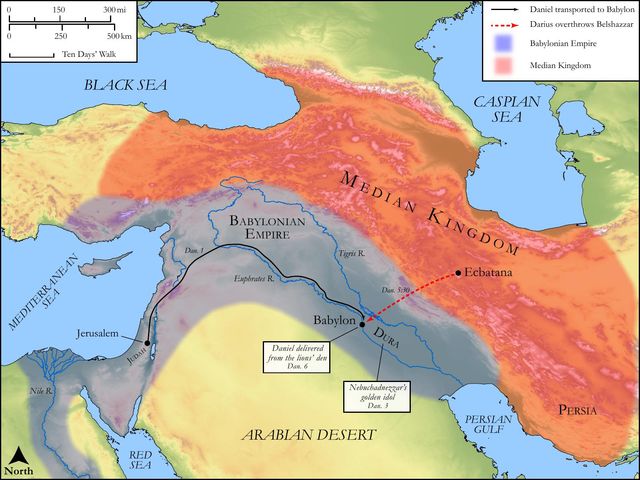
See on the biblical-era map
Study this verse
Public-domain commentary
Matthew Henry
From his Commentary on the Whole Bible. Henry comments on passages, not single verses — this entry covers Daniel 1:17–21. His two-level outline is real structure in the source text, so it is rendered as structure.
Concerning Daniel and his fellows we have here,
I.Their great attainments in learning, Dan 1:17.
They were very sober and diligent, and studied hard; and we may suppose their tutors, finding them of an uncommon capacity, took a great deal of pains with them, but, after all, their achievements are ascribed to God only. It was he that gave them knowledge and skill in all learning and wisdom; for every good and perfect gift is from above, from the Father of the lights. It is the Lord our God that gives men power to get this wealth; the mind is furnished only by him that formed it. The great learning which God gave these four children was,
1.A balance for their losses. They had, for the iniquity of their fathers, been deprived of the honours and pleasures that would have attended their noble extraction; but, to make them amends for that, God, in giving them learning, gave them better honours and pleasures than those they had been deprived of.
2.A recompence for their integrity. They kept to their religion, even in the minutest instances of it, and would not so much as defile themselves with the king's meat or wine, but became, in effect, Nazarites; and now God rewarded them for it with eminency in learning; for God gives to a man that is good in his sight, wisdom, and knowledge, and joy with them, Ecc 2:26. To Daniel he gave a double portion; he had understanding in visions and dreams; he knew how to interpret dreams, as Joseph, not by rules of art, such as are pretended to be given by the oneirocritics, but by a divine sagacity and wisdom which God gave him. Nay, he was endued with a prophetic spirit, by which he was enabled to converse with God, and to receive the notices of divine things in dreams and visions, Num 12:6. According to this gift given to Daniel, we find him, in this book, all along employed about dreams and visions, interpreting or entertaining them; for, as every one has received the gift, so shall he have an opportunity, and so should he have a heart, to minister the same, Pe1 4:10.
II.Their great acceptance with the king.
After three years spent in their education (they being of some maturity, it is likely, when they came, perhaps about twenty years old) they were presented to the king with the rest that were of their standing, Dan 1:18. And the king examined them and communed with them himself, Dan 1:19. He could do it, being a man of parts and learning himself, else he would not have come to be so great; and he would do it, for it is the wisdom of princes, in the choice of the persons they employ, to see with their own eyes, to exercise their own judgment, and not trust too much to the representation of others. The king examined them not so much in the languages, in the rules of oratory or poetry, as in all matters of wisdom and understanding, the rules of prudence and true politics; he enquired into their judgment about the due conduct of human life and public affairs; not "Were they wits?" but, "Were they wise?" And he not only found them to excel the young candidates for preferment that were of their own standing, but found that they had more understanding than the ancients, than all their teachers, Psa 119:99, Psa 119:100. So far was the king from being partial to his own countrymen, to seniors, to those of his own religion and of an established reputation, that he freely owned that, upon trial, he found those poor young captive Jews ten times wiser and better than all the magicians that were in all his realm, Dan 1:20. He was soon aware of something extraordinary in these young men, and, which gave him a surprising satisfaction, was soon aware that a little of their true divinity was preferable to a great deal of the divination he had been used to. What is the chaff to the wheat? what are the magicians' rods to Aaron's? There was no comparison between them. These four young students were better, were ten times better, than all the old practitioners, put them all together, that were in all his realm, and we may be sure that they were not a few. This contempt did God pour upon the pride of the Chaldeans, and this honour did he put upon the low estate of his own people; and thus did he make not only these persons, but the rest of their nation for their sakes, the more respected in the land of their captivity. Lastly, This judgment being given concerning them, they stood before the king (Dan 1:19); they attended in the presence-chamber, nay, and in the council-chamber, for to see the king's face is the periphrasis of a privy-counsellor, Est 1:14. This confirms Solomon's observation, Seest thou a man diligent in his business, sober and humble? he shall stand before kings; he shall not stand before mean men. Industry is the way to preferment. How long the other three were about the court we are not told; but Daniel, for his part, continued to the first year of Cyrus (Dan 1:21), though not always alike in favour and reputation. He lived and prophesied after the first year of Cyrus; but that is mentioned to intimate that he lived to see the deliverance of his people out of their captivity and their return to their own land. Note, Sometimes God favours his servants that mourn with Zion in her sorrows to let them live to see better times with the church than they saw in the beginning of their days and to share with her in her joys.
Historical interpretation
Historical reception
1 surviving comment on this verse from the historical church.
"And among them all, was found none like Daniel." These men, who were proved faithful witnesses in Babylon, were led by the Word in all wisdom, that by their means the idols of the Babylonians should be put to shame, and that Nebuchadnezzar should be overcome by three youths, and that by their faith the fire in the furnace should be kept at bay, and the desire of the wicked elders (or chiefs) proved vain.
Continue studying Daniel 1:19 across the web’s major study libraries — every link below opens this exact verse, chapter, or book on the destination site.
Read & Compare
 BibleGatewayThis verse in more than 200 translations and 70 languages.
 Bible.comThe YouVersion reader — hundreds of translations, reading plans, and highlights.
 ESV.orgCrossway's official English Standard Version reader.
 NET BibleThe NET translation with 60,000+ translators' notes on every rendering decision.
 STEP BibleTyndale House's free study tool — original text, vocabulary, and scholarly resources.
 BibliaLogos Bible Software's free web reader.
 USCCBThe New American Bible (Revised Edition) with the U.S. bishops' study notes.
Commentaries
 BibleHub CommentariesDozens of classic commentaries on this verse, gathered on one page.
 StudyLightMore than 100 commentary sets — the largest collection on the web.
 BibleRefPlain-English commentary on what this verse means, verse by verse.
 Enduring WordDavid Guzik's free commentary on this chapter, widely used by Bible teachers.
 Bible Study ToolsVerse commentary alongside Greek and Hebrew study aids.
Original Language & Research
- BibleHub InterlinearThe verse word by word — original language, transliteration, and English.
- BibleHub LexiconEvery word's original-language definition and Strong's entry.
 Blue Letter BibleDeep-study tools — Strong's numbers, concordance, and word studies.
 SefariaThe Hebrew text with Rashi and centuries of Jewish commentary.
Sermons, Hymns & Audio


TrulyRandomVerse is not affiliated with these sites and doesn’t control their content. They’re linked because they’re genuinely useful.
Summary
Daniel 1:19 marks a pivotal moment in the lives of Daniel, Hananiah, Mishael, and Azariah, showcasing the divine favor and exceptional wisdom bestowed upon them by God. Following their three-year training in the Babylonian court, King Nebuchadnezzar personally evaluated them, discovering that their knowledge and discernment far surpassed all other young men. This extraordinary distinction led to their immediate and prominent placement in the king's service, validating their earlier commitment to spiritual purity and faithfulness.
Context
ShowHideLiterary Context
This verse serves as the culmination of the initial narrative arc in Daniel 1, which details Daniel and his three friends' capture, their selection for royal training, and their resolute decision to abstain from the king's defiling food and wine. Their faithfulness, as described in Daniel 1:8, is met with divine blessing, as God grants them "knowledge and skill in all learning and wisdom" in Daniel 1:17. Verse 19 directly follows their successful completion of the training period and their presentation before the king, signifying the immediate and tangible outcome of their integrity and God's empowering presence. It sets the stage for their future roles and the subsequent prophetic visions and historical events recorded in the book, particularly their crucial role in interpreting Nebuchadnezzar's dream in Daniel 2.
Historical & Cultural Context
The setting is the Babylonian Empire under King Nebuchadnezzar, following the siege of Jerusalem in 605 BC. It was common practice for conquering empires to assimilate the brightest and most promising young men from subjugated nations into their own administrative systems. These individuals would be trained in the language, literature, and customs of the conquering power to serve as loyal officials. The three-year training period mentioned in Daniel 1:5 was typical for such programs, designed to thoroughly indoctrinate and prepare them for service. The king's personal "communing" or examination underscores the high stakes and the direct involvement of the monarch in selecting his most trusted advisors, highlighting the significance of the young men's exceptional performance in a highly competitive and politically charged environment. Their elevation reflects the meritocratic, albeit ruthless, nature of the court of Babylon, where ability, even from a conquered people, could be recognized and utilized.
Key Themes
ShowHideDaniel 1:19 powerfully illustrates several core themes found throughout the book of Daniel. Firstly, Divine Favor and Sovereignty are paramount; God actively intervenes to grant wisdom and distinction to those who honor Him, demonstrating His control even in a pagan empire. Secondly, the theme of Faithfulness in Exile is central, showing that integrity and adherence to God's commands, even in a hostile foreign land, lead not to neglect but to unexpected prominence and influence. This is seen in their initial resolve not to defile themselves in Daniel 1:8 and their subsequent elevation. Thirdly, the verse highlights Wisdom and Discernment as God's Gift, emphasizing that true intellectual superiority comes from divine inspiration, not merely human effort. This sets the stage for Daniel's later interpretations of dreams and visions, such as Nebuchadnezzar's dream in Daniel 2, which further solidify this theme of divinely imparted wisdom.
Exposition and Analysis
ShowHideKey Word Analysis
ShowHideThis primitive root primarily means "to speak" or "to arrange," but in this context, it signifies a deep, personal, and thorough discussion or examination. It implies that King Nebuchadnezzar engaged directly with Daniel and his friends, probing their knowledge, understanding, and perhaps even their character, rather than merely receiving a report from his officials. This personal interaction underscores the king's direct assessment of their capabilities, highlighting the depth of his inquiry.
This word means "to come forth to," "appear," "exist," or "to attain, i.e., find or acquire." Here, it emphasizes the discovery or ascertainment of a fact. It suggests that after the king's extensive evaluation, it was definitively "found" or determined that no one else possessed the same level of wisdom and understanding as these four young men. It speaks to a clear, undeniable revelation of their superior qualities, indicating that their excellence was objectively discernible.
Meaning "to stand," this word encompasses various relations, including "to be present," "to serve," or "to be appointed." In this context, "stood they before the king" signifies their immediate and permanent appointment to a position of service and prominence in the king's court. It is not merely a physical posture but a declaration of their new, established status as royal advisors and servants, a direct consequence of their proven excellence and the king's recognition of their unique value.
Verse Breakdown
ShowHide"And the king communed with them;"
This clause describes the personal interaction between King Nebuchadnezzar and the four young men. The king, having overseen their three-year training, now takes the initiative to personally interview and assess their wisdom, knowledge, and understanding. This was not a perfunctory review but a significant engagement that allowed their exceptional qualities to be directly observed by the highest authority in the land, underscoring the importance of their examination.
"and among them all was found none like Daniel, Hananiah, Mishael, and Azariah:"
This is the core declaration of the verse, highlighting the unparalleled distinction of Daniel and his friends. After the rigorous training and the king's personal evaluation, it was unequivocally determined that no other young man in the entire program, from any nation, possessed the same caliber of wisdom, discernment, and administrative capability. This statement underscores their unique excellence, which was divinely granted and humanly recognized, setting them apart from all their peers.
"therefore stood they before the king."
This final clause states the immediate and direct consequence of their exceptional performance. Because they were found to be without peer, they were formally appointed to serve in the king's direct presence, signifying a position of high trust, influence, and authority within the Babylonian court. This was not merely a ceremonial standing but an official induction into royal service, confirming their elevation and the beginning of their significant roles in the empire, directly linking their proven merit to their new prestigious status.
Literary Devices
ShowHideThe verse employs Hyperbole to emphasize the unparalleled excellence of Daniel and his friends, stating that "none like" them were found. While perhaps not literally meaning zero individuals possessed any similar traits, it powerfully conveys their extraordinary and singular distinction among all the trainees. This exaggeration serves to magnify God's blessing upon them and their unique qualifications. Additionally, Cause and Effect is a prominent structural device, where the king's "communing" and the subsequent finding of their unmatched wisdom directly lead to the effect of them "standing before the king" in service. This highlights the direct correlation between their faithfulness, God's favor, and their resulting elevation. The verse also utilizes Juxtaposition by implicitly contrasting the four Hebrew youths with "all" the other young men, underscoring their superior qualities against the backdrop of their peers and emphasizing their distinctiveness.
Theological and Thematic Connections
ShowHideDaniel 1:19 profoundly illustrates the principle that God honors those who honor Him, often granting them exceptional wisdom and favor that sets them apart. This divine enablement is not merely for personal benefit but for God's glory and the advancement of His purposes, even in pagan environments. The narrative demonstrates that faithfulness in seemingly small matters—like dietary choices—can lead to significant opportunities for influence and witness on a grander scale. Their wisdom was not just intellectual acumen but a divinely infused discernment that transcended human understanding, positioning them as instruments of God's truth within a powerful empire. This passage serves as a powerful testament to God's sovereignty, demonstrating His ability to elevate His faithful servants to positions of influence even within hostile political systems.
Reflection and Application
ShowHideThe story of Daniel and his friends in Daniel 1:19 offers profound encouragement for believers navigating complex, secular, or even hostile environments today. It reminds us that our commitment to biblical principles, even in seemingly small acts of obedience, can lead to God's extraordinary favor and open doors of influence that we might never anticipate. Rather than compromising our faith to fit in, this verse challenges us to embrace integrity and pursue excellence, trusting that God can use our distinctiveness for His glory. True wisdom and success, as demonstrated here, are not merely products of human effort or intellect but are divine gifts bestowed upon those who prioritize faithfulness to God above all else. Our dedication in quiet moments of conviction can lead to public demonstrations of God's power and wisdom through our lives, impacting those around us, even those in positions of authority. This passage calls us to live with unwavering conviction, knowing that our ultimate audience is God, and His recognition far surpasses any earthly accolade.
Questions for Reflection
ShowHideFAQ
ShowHideWhat was the significance of the king "communing" with Daniel and his friends?
ShowHideThe term "communed" (Hebrew: dâbar) suggests more than a casual conversation; it implies a deep, personal, and thorough examination or discussion. King Nebuchadnezzar, the most powerful ruler of his time, personally engaged with these young men to assess their knowledge, understanding, and wisdom. This direct interaction underscores the high value placed on their intellectual and administrative capabilities and highlights the king's personal interest in selecting the most exceptional individuals for his service. It was a rigorous evaluation that confirmed their unparalleled distinction, demonstrating the king's meticulous approach to staffing his court with the most capable individuals, regardless of their origin.
How did Daniel and his friends achieve such exceptional wisdom and understanding?
ShowHideTheir exceptional wisdom and understanding were a direct result of God's divine favor, granted to them because of their faithfulness. As recorded in Daniel 1:17, "As for these four young men, God gave them knowledge and skill in all literature and wisdom; and Daniel had understanding in all visions and dreams." Their prior decision to honor God by abstaining from the king's rich food and wine (Daniel 1:8) demonstrated their integrity and their commitment to divine principles. God honored their commitment by bestowing upon them a wisdom that surpassed all their peers, illustrating that true wisdom is a gift from God to those who seek to honor Him.
Christ-Centered Fulfillment
ShowHideDaniel 1:19, while highlighting the exceptional wisdom and favor bestowed upon Daniel and his friends, ultimately points to the greater wisdom and perfect favor found in Jesus Christ. Just as Daniel and his companions were found "none like" them in their generation, Jesus stands uniquely as the Son of God, unparalleled in wisdom, grace, and truth. He is the Wisdom of God personified, far surpassing any human understanding or achievement. While Daniel's wisdom led him to stand before an earthly king, Christ, as the King of kings and Lord of lords, stands eternally before the Father, and through Him, believers are granted access to all the treasures of wisdom and knowledge. Daniel's elevation was a shadow of the ultimate exaltation of Christ, who, though he humbled himself, was highly exalted by God and given a name above every name. The favor shown to Daniel foreshadows the ultimate grace and redemption offered through Christ, enabling believers to stand before God, not by their own merit, but by the perfect righteousness of the Lamb of God, who takes away the sin of the world!