


Daniel 2:22
Bible text: King James Version (1769 Blayney text) · Public domain
Bible text: Berean Standard Bible · Public domain
Bible text: American Standard Version (1901) · Public domain
Bible text: World English Bible, Messianic edition · Public domain
Bible text: Geneva Bible (1599) · Public domain
Bible text: Young's Literal Translation · Public domain
- הוּאhu'heH1932Pro-3msPronoun Personal 3rd Singular Masculine
- גָּלֵאga·Le'[is] revealingH1541V-Peal-Prtcpl-msVerb Peal Participle Singular Masculine Absolute
- עַמִּיקָתָא'a·mi·ka·Ta'<the> deep [things]H5994Adj-fp ¦ ArtAdjective Plural Feminine Definiteעַמִּיקָתָ<the>אdeep [things]
- וּמְסַתְּרָתָאu·me·sa·te·ra·Ta'and <the> hidden [things]H5642Conj-w ¦ V-Pael-Prtcpl-fp ¦ ArtVerb Pael Participle Plural Feminine Definiteוּandמְסַתְּרָתָ<the>אhidden [things]
- יָדַעya·Da'[he is] knowingH3046V-Peal-Prtcpl-msVerb Peal Participle Singular Masculine Absolute
- מָהmahwhat?H4101InterrogPronoun Interrogative
- בַחֲשׁוֹכָאva·cha·sho·Kha'[is] in darkness theH2816Prep-b ¦ N-cs ¦ ArtNoun Singular common gender Definiteבַ[is] inחֲשׁוֹכָdarknessאthe
- וּנְהוֹרָאu·ne·hi·ra'and light theH5094Conj-w ¦ N-cs ¦ ArtNoun Singular common gender Definiteוּandנְהוֹרָlightאthe
- עִמֵּהּ'i·Mehwith himH5974Prep ¦ 3msPrepositionעִמֵּwithהּhim
- שְׁרֵאshe·Re'[is] dwellingH8271V-Peil-Prtcpl-msVerb Peil Participle Singular Masculine Absolute
English is a literal word-by-word gloss of the Hebrew, not the KJV's wording. Why?
This is the original text the KJV's translators worked from — each Hebrew word with its own literal English meaning in this verse, prepared by scholars at Tyndale House, Cambridge. The KJV translates whole sentences, not word by word, so its wording differs: one Hebrew word can become several English words, and the KJV may choose “the LORD” where the gloss reads “Yahweh”. Both are faithful — they answer different questions. For the KJV's own rendering, switch to the KJV text.
Details
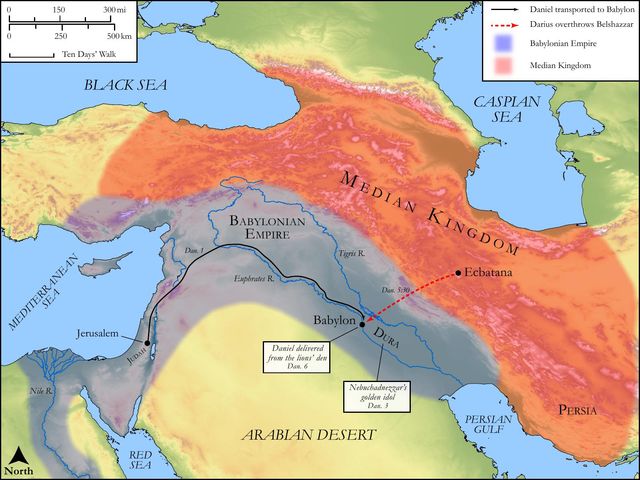
See on the biblical-era map
Study this verse
Public-domain commentary
Matthew Henry
From his Commentary on the Whole Bible. Henry comments on passages, not single verses — this entry covers Daniel 2:14–23. His four-level outline is real structure in the source text, so it is rendered as structure.
When the king sent for his wise men to tell them his dream, and the interpretation of it (Dan 2:2), Daniel, it seems, was not summoned to appear among them; the king, though he was highly pleased with him when he examined him, and thought him ten times wiser than the rest of his wise men, yet forgot him when he had most occasion for him; and no wonder, when all was done in a heat, and nothing with a cool and deliberate thought. But Providence so ordered it; that the magicians being nonplussed might be the more taken notice of, and so the more glory might redound to the God of Daniel. But, though Daniel had not the honour to be consulted with the rest of the wise men, contrary to all law and justice, by an undistinguishing sentence, he stands condemned with them, and till he has notice brought him to prepare for execution he knows nothing of the matter. How miserable is the case of those who live under arbitrary government, as this of Nebuchadnezzar's! How happy are we, whose lives are under the protection of the law and methods of justice, and lie not thus at the mercy of a peevish and capricious prince!
We have found already, in Ezekiel, that Daniel was famous both for prudence and prayer; as a prince he had power with God and by man; by prayer he had power with God, by prudence he had power with man, and in both he prevailed. Thus did he find favour and good understanding in the sight of both, and in these verses we have a remarkable instance of both.
I.Daniel by prudence knew how to deal with men, and he prevailed with them.
When Arioch, the captain of the guard, that was appointed to slay all the wise men of Babylon, the whole college of them, seized Daniel (for the sword of tyranny, like the sword of war, devours one as well as another), he answered with counsel and wisdom (Dan 2:14); he did not fall into a passion, and reproach the king as unjust and barbarous, much less did he contrive how to make resistance, but mildly asked, Why is the decree so hasty? Dan 2:15. And whereas the rest of the wise men had insisted upon it that it was utterly impossible for him ever to have his demand gratified, which did but make him more outrageous, Daniel undertakes, if he may but have a little time allowed him, to give the king all the satisfaction he desired, Dan 2:16. The king, being now sensible of his error in not sending for Daniel sooner, whose character he began to recollect, was soon prevailed upon to respite the judgment, and make trial of Daniel. Note, The likeliest method to turn away wrath, even the wrath of a king, which is as the messenger of death, is by a soft answer, by that yielding which pacifies great offences; thus, though where the word of a king is there is power, yet even that word may be repelled, and that so as to be repealed; and so some read it here (Dan 2:14): Then Daniel returned, and stayed the counsel and edict, through Arioch, the king's provost-marshal.
II.Daniel knew how by prayer to converse with God, and he found favour with him, both in petition and in thanksgiving, which are the two principal parts of prayer. Observe,
1.His humble petition for this mercy, that God would discover to him what was the king's dream, and the interpretation of it. When he had gained time he did not go to consult with the rest of the wise men whether there was anything in their art, in their books, that might be of use in this matter, but went to his house, there to be alone with God, for from him alone, who is the Father of lights, he expected this great gift. Observe,
(1.)He did not only pray for this discovery himself, but he engaged his companions to pray for it too. He made the thing known to those who had been all along his bosom-friends and associates, requesting that they would desire mercy of God concerning this secret, Dan 2:17, Dan 2:18. Though Daniel was probably their senior, and every way excelled them, yet he engaged them as partners with him in this matter, Vis unita fortior - The union of forces produces greater force. See Est 4:16. Note, Praying friends are valuable friends; it is good to have an intimacy with and an interest in those that have fellowship with God and an interest at the throne of grace; and it well becomes the greatest and best of men to desire the assistance of the prayers of others for them. St. Paul often entreats his friends to pray for him. Thus we must show that we put a value upon our friends, upon prayer, upon their prayers.
(2.)He was particular in this prayer, but had an eye to, and a dependence upon, the general mercy of God: That they would desire the mercies of the God of heaven concerning this secret, Dan 2:18. We ought in prayer to look up to God as the God of heaven, a God above us, and who has dominion over us, to whom we owe adoration and allegiance, a God of power, who can do everything. Our savior has taught us to pray to God as our Father in heaven. And, whatever good we pray for, our dependence must be upon the mercies of God for it, and an interest in those mercies we must desire; we can expect nothing by way of recompence for our merits, but all as the gift of God's mercies. They desired mercy concerning this secret. Note, Whatever is the matter of our care must be the matter of our prayer; we must desire mercy of God concerning this thing and the other thing that occasions us trouble and fear. God gives us leave to be humbly free with him, and in prayer to enter into the detail of our wants and burdens. Secret things belong to the Lord our God, and therefore, if there be any mercy we stand in need of that concerns a secret, to him we must apply; and, though we cannot in faith pray for miracles, yet we may in faith pray to him who has all hearts in his hand, and who in his providence does wonders without miracles, for the discovery of that which is out of our view and the obtaining of that which is out of our reach, as far as is for his glory and our good, believing that to him nothing is hidden, nothing is hard.
(3.)Their plea with God was the imminent peril they were in; they desired mercy of God in this matter, that so Daniel and his fellows might not perish with the rest of the wise men of Babylon, that the righteous might not be destroyed with the wicked. Note, When the lives of good and useful men are in danger it is time to be earnest with God for mercy for them, as for Peter in prison, Act 12:5.
(4.)The mercy which Daniel and his fellows prayed for was bestowed. The secret was revealed unto Daniel in a night-vision, Dan 2:19. Some think he dreamed the same dream, when he was asleep, that Nebuchadnezzar had dreamed; it should rather seem that when he was awake, and continuing instant in prayer, and watching in the same, the dream itself, and the interpretation of it, were communicated to him by the ministry of an angel, abundantly to his satisfaction. Note, The effectual fervent prayer of righteous men avails much. There are mysteries and secrets which by prayer we are let into; with that key the cabinets of heaven are unlocked, for Christ has said, Thus knock, and it shall be opened unto you.
2.His grateful thanksgiving for this mercy when he had received it: Then Daniel blessed the God of heaven, Dan 2:19. He did not stay till he had told it to the king, and seen whether he would own it to be his dream or no, but was confident that it was so, and that he had gained his point, and therefore he immediately turned his prayers into praises. As he had prayed in a full assurance that God would do this for him, so he gave thanks in a full assurance that he had done it; and in both he had an eye to God as the God of heaven. His prayer was not recorded, but his thanksgiving is. Observe,
(1.)The honour he gives to God in this thanksgiving, which he studies to do in a great variety and copiousness of expression: Blessed be the name of God for ever and ever. There is that for ever in God which is to be blessed and praised; it is unchangeably and eternally in him. And it is to be blessed for ever and ever; as the matter of praise is God's eternal perfection, so the work of praise shall be everlastingly in the doing.
[1.]He gives to God the glory of what he is in himself: Wisdom and might are his, wisdom and courage (so some); whatever is fit to be done he will do; whatever he will do he can do, he dares do, and he will be sure to do it in the best manner, for he has infinite wisdom to design and contrive and infinite power to execute and accomplish. With him are strength and wisdom, which in men are often parted.
[2.]He gives him the glory of what he is to the world of mankind. He has a universal influence and agency upon all the children of men, and all their actions and affairs. Are the times changed? Is the posture of affairs altered? Does every thing lie open to mutability? It is God that changes the times and the seasons, and the face of them. No change comes to pass by chance, but according to the will and counsel of God. Are those that were kings removed and deposed? Do they abdicate? Are they laid aside? It is God that removes kings. Are the poor raised out of the dust, to be set among princes? It is God that sets up kings; and the making and unmaking of kings is a flower of his crown who is the fountain of all power, King of kings and Lord of lords. Are there men that excel others in wisdom, philosophers and statesmen, that think above the common rate, contemplative penetrating men? It is God that gives wisdom to the wise, whether they be so wise as to acknowledge it or no; they have it not of themselves, but it is he that gives knowledge to those that know understanding, which is a good reason why we should not be proud of our knowledge, and why we should serve and honour God with it and make it our business to know him.
[3.]He gives him the glory of this particular discovery. He praises him, First, For that he could make such a discovery (Dan 2:22): He reveals the deep and secret things which are hidden from the eyes of all living. It was he that revealed to man what is true wisdom when none else could (Job 28:27, Job 28:28); it is he that reveals things to come to his servants and prophets. He does himself perfectly discern and distinguish that which is most closely and most industriously concealed, for he will bring into judgment every secret thing; the truth will be evident in the great day. He knows what is in the darkness, and what is done in the darkness, for that hides not from him, Psa 139:11, Psa 139:12. The light dwells with him, and he dwells in the light (Ti1 6:16), and yet, as to us, he makes darkness his pavilion. Some understand it of the light of prophecy and divine revelation, which dwells with God and is derived from him; for he is the Father of lights, of all lights; they are all at home in him. Secondly, For that he had made this discovery to him. Here he has an eye to God as the God of his fathers; for, though the Jews were now captives in Babylon, yet they were beloved for their father's sake. He praises God, who is the fountain of wisdom and might, for the wisdom and might he had given him, wisdom to know this great secret and might to bear the discovery. Note, What wisdom and might we have we must acknowledge to be God's gift. Thou hast made this known to me, Dan 2:23. What was hidden from the celebrated Chaldeans, who made the interpreting of dreams their profession, is revealed to Daniel, a captive-Jew, a babe, much their junior. God would hereby put honour upon the Spirit of prophecy just when he was putting contempt upon the spirit of divination. Was Daniel thus thankful to God for making known that to him which was the saving of the lives of him and his fellows? Much more reason have we to be thankful to him for making known to us the great salvation of the soul, to us and not to the world, to us and not to the wise and prudent.
(2.)The respect he puts upon his companions in this thanksgiving. Though it was by his prayers principally that this discovery was obtained, and to him that it was made, yet he owns their partnership with him, both in praying for it (it is what we desired of thee) and in enjoying it - Thou hast made known unto us the king's matter. Either they were present with Daniel when the discovery was made to him, or as soon as he knew it he told it them (heurēka, heurēka - I have found it, I have found it), that those who had assisted him with their prayers might assist him in their praises; his joining them with him is an instance of his humility and modesty, which well become those that are taken into communion with God. Thus St. Paul sometimes joins Sylvanus, Timotheus, or some other minister, with himself in the inscriptions to many of his epistles. Note, What honour God puts upon us we should be willing that our brethren may share with us in.
Historical interpretation
Historical reception
3 surviving comments on this verse. Each one is dated, so this reads as a timeline rather than a list.
Select a marker to jump to its quote. Markers stagger vertically where authors wrote within a few decades of each other.
Concerning the light Daniel noted, “It reveals the profound and hidden things, knowing those things that are in the darkness and the light is with it,” that is, the Son with the Father, for even as the Father is light, so too is the Son light. And David also speaks in the psalm: “In your light shall we see light,” for the Father is seen in the Son, as the Lord tells us in the Gospel: “Who sees me, sees the Father.” From the true light, indeed, the true light proceeded, and from the invisible the visible.
Verse 22. "It is He who reveals deep and hidden things, and He knows what is placed in the darkness, and with Him is the light." A man to whom God makes profound revelations and who can say, "O the depth of the riches of the knowledge and wisdom of God!" (Romans 11:33), he it is who by the indwelling Spirit probes even into the deep things of God, and digs the deepest of wells in the depths of his soul. He is a man who has stirred up the whole earth, which is wont to conceal the deep waters, and he observes the command of God, saying: "Drink water from thy vessels and from the spring of thy wells" (Proverbs 5:15). As for the words which follow, "He knows what is placed in the darkness, and with Him is the light," the darkness signifies ignorance, and the light signifies knowledge and learning. Therefore as wrong cannot hide God away, so right encompasses and surrounds Him. Or else we should interpret the words to mean all the dark mysteries and deep things (concerning God), according to what we read in Proverbs: "He understands also the parable and the dark saying." (Proverbs 1:6, LXX) This in turn is equivalent to what we read in the Psalms: "Dark waters in the clouds of the sky" (Psalm 18:11). For one who ascends to the heights and forsakes the things of earth, and like the birds themselves seeks after the most rarified atmosphere and everything ethereal, he becomes like a cloud to which the truth of God penetrates and which habitually showers rain upon the saints. Replete with a plenitude of knowledge, he contains in his breast many dark waters enveloped with deep darkness, a darkness which only Moses can penetrate and speak with God face to face (Exodus 33:11), of Whom the Scripture says: "He hath made darkness His hiding-place" (Psalm 18:11).
Such is the life of the devout, acknowledging that God is the source of understanding. He was the One who met Daniel’s needs at the right moment and assured him a safe harbor. And after being well supplied with that which was the best, Daniel did not prove forgetful of the gifts but sang praises in response to his holy benefactor.
Continue studying Daniel 2:22 across the web’s major study libraries — every link below opens this exact verse, chapter, or book on the destination site.
Read & Compare
 BibleGatewayThis verse in more than 200 translations and 70 languages.
 Bible.comThe YouVersion reader — hundreds of translations, reading plans, and highlights.
 ESV.orgCrossway's official English Standard Version reader.
 NET BibleThe NET translation with 60,000+ translators' notes on every rendering decision.
 STEP BibleTyndale House's free study tool — original text, vocabulary, and scholarly resources.
 BibliaLogos Bible Software's free web reader.
 USCCBThe New American Bible (Revised Edition) with the U.S. bishops' study notes.
Commentaries
 BibleHub CommentariesDozens of classic commentaries on this verse, gathered on one page.
 StudyLightMore than 100 commentary sets — the largest collection on the web.
 BibleRefPlain-English commentary on what this verse means, verse by verse.
 Enduring WordDavid Guzik's free commentary on this chapter, widely used by Bible teachers.
 Bible Study ToolsVerse commentary alongside Greek and Hebrew study aids.
Original Language & Research
- BibleHub InterlinearThe verse word by word — original language, transliteration, and English.
- BibleHub LexiconEvery word's original-language definition and Strong's entry.
 Blue Letter BibleDeep-study tools — Strong's numbers, concordance, and word studies.
 SefariaThe Hebrew text with Rashi and centuries of Jewish commentary.
Sermons, Hymns & Audio


TrulyRandomVerse is not affiliated with these sites and doesn’t control their content. They’re linked because they’re genuinely useful.
Summary
Daniel 2:22 is a profound declaration of God's unique attributes, articulated by the prophet Daniel in a prayer of thanksgiving after God miraculously revealed King Nebuchadnezzar's forgotten dream and its interpretation. This verse extols God as the sole revealer of hidden mysteries, possessing absolute knowledge of all that exists, even in the deepest obscurity, and embodying perfect truth and understanding. It underscores His unparalleled wisdom and sovereign control over all things, powerfully contrasting divine omniscience with the inherent limitations of human wisdom and pagan practices.
Context
ShowHideLiterary Context
Daniel 2:22 is embedded within Daniel's magnificent prayer of praise and thanksgiving, which immediately follows God's miraculous revelation of King Nebuchadnezzar's dream and its interpretation. The preceding narrative (specifically Daniel 2:14-19) details Daniel's urgent plea for divine intervention after the king's decree to execute all the wise men of Babylon, including Daniel and his companions, for their inability to reveal the dream. Upon receiving the revelation in a night vision, Daniel responds with an immediate and fervent doxology (found in Daniel 2:20-23), acknowledging God as the ultimate source of all wisdom and power. This particular verse serves as a climactic statement within that prayer, highlighting the very attributes of God—His ability to disclose the unknown and His inherent nature as light—that enabled Him to solve the king's impossible demand, thereby saving Daniel and his friends from certain death. It powerfully sets the stage for Daniel's subsequent appearance before the king, where he will unequivocally attribute all understanding not to his own intellect, but to the "God in heaven" who reveals mysteries (Daniel 2:28).
Historical & Cultural Context
The setting for this profound declaration is the zenith of the Neo-Babylonian Empire, during the formidable reign of King Nebuchadnezzar II (605-562 BC), a period when Babylon stood as the undisputed dominant world power. Nebuchadnezzar's royal court was populated by a diverse array of "wise men," including magicians, enchanters, sorcerers, and Chaldean astrologers, who typically relied on occult practices, astrological observations, and human-derived wisdom to interpret omens, advise the king, and decipher dreams. Nebuchadnezzar's unprecedented demand—not only for the interpretation of his dream but also for the dream itself—was a deliberate and extreme test designed to expose the true capabilities of his advisors. In this polytheistic and deeply superstitious environment, Daniel's bold declaration of Yahweh as the one true God who "revealeth the deep and secret things" directly challenges and utterly discredits the efficacy and authority of the Babylonian deities and their human intermediaries. The prevailing cultural norm was for kings to consult their wise men for such matters, but no human or pagan deity could perform what Yahweh did, thus demonstrating His absolute supremacy over all other gods, powers, and human limitations.
Key Themes
ShowHideThis verse powerfully contributes to several overarching themes that permeate the book of Daniel and resonate throughout biblical theology. Firstly, it emphatically emphasizes Divine Revelation, asserting that God alone possesses the power and prerogative to disclose hidden truths and future events, a theme foundational to the prophetic nature of Daniel's ministry and the book's apocalyptic visions (e.g., the vision of the four beasts in Daniel 7 or the seventy weeks in Daniel 9). Secondly, it highlights God's Omniscience, demonstrating His comprehensive and exhaustive knowledge of all things, even those concealed in "darkness" or the depths of human ignorance and the future. This absolute knowledge underpins His unwavering sovereignty over human affairs and the course of history, as powerfully illustrated by His ability to shift kingdoms and appoint rulers according to His will (Daniel 2:21). Thirdly, the theme of God as Light is profoundly prominent, symbolizing His intrinsic nature as truth, wisdom, and purity, standing in stark contrast to the spiritual and intellectual darkness of humanity apart from Him. This concept is foundational to understanding God's character throughout Scripture, as the ultimate source of all illumination and understanding (Psalm 36:9).
Exposition and Analysis
ShowHideKey Word Analysis
ShowHideThis Aramaic term, corresponding to the Hebrew gālâh, carries the primary meaning "to denude" or "to uncover," often implying a bringing into plain sight what was previously concealed, sometimes even in a disgraceful sense. In this context, it signifies God's active, divine disclosure of hidden things, making known what is beyond human discovery. It is particularly associated with prophetic revelation, unveiling mysteries that transcend human comprehension or foresight.
Derived from a root meaning "to be dark," this word refers to literal obscurity. More profoundly in this theological context, it symbolizes ignorance, hiddenness, mystery, or that which lies beyond the reach of human perception, intellect, or understanding. It represents the realm of the unknown, the concealed, or that which is morally and spiritually obscure, emphasizing that even in the deepest recesses of the unknown, God's knowledge penetrates.
This Aramaic word, related to illumination, stands in stark contrast to "darkness." It symbolizes truth, knowledge, wisdom, and divine illumination. It denotes perfect clarity, profound understanding, and the very presence of God, indicating that God is the inherent source and embodiment of all true insight, revelation, and moral purity.
Verse Breakdown
ShowHide"He revealeth the deep and secret things"
This opening clause emphatically declares God's unique and exclusive capacity to unveil that which is profoundly hidden or utterly inaccessible to human intellect and investigation. The term "deep" (ʻămîyq) refers to things unfathomable, unsearchable, or profoundly mysterious, while "secret things" (çᵉthar) denotes that which is concealed, kept from knowledge, or intentionally hidden. This highlights that God is not merely aware of secrets, but He actively and sovereignly discloses them, particularly when it serves His divine purposes, as powerfully demonstrated in the revelation of Nebuchadnezzar's forgotten dream.
"he knoweth what [is] in the darkness"
This clause asserts God's absolute and comprehensive omniscience. "Darkness" here is a potent metaphor, representing not only literal obscurity but also the unknown, the mysterious, the hidden motives of the human heart, and the unseen realities of the universe, including the future. God's knowledge penetrates every veil and every hidden corner; absolutely nothing is hidden from His all-seeing eye, whether it be physical, intellectual, spiritual, or temporal. This underscores His complete and exhaustive understanding of all things, past, present, and future.
"and the light dwelleth with him"
This final, profound clause describes God's intrinsic and inseparable nature. "Light" symbolizes truth, wisdom, purity, and divine revelation. The phrase "dwelleth with him" (shᵉrêʼ ʻim) signifies that light is not merely an external attribute that God possesses or a tool He uses; rather, it is inherent to His very being and essence. He is the source, embodiment, and very definition of all illumination, perfect understanding, and moral perfection. Where God is, there is no darkness, no confusion, no deception—only perfect clarity, absolute truth, and unblemished purity.
Literary Devices
ShowHideDaniel 2:22 employs several powerful literary devices to convey its profound theological truths with striking clarity. The most prominent is Antithesis or Contrast, specifically between "darkness" and "light," and implicitly between the "deep and secret things" and God's act of "revealeth." This stark opposition highlights God's unique ability to transcend human limitations and illuminate what is otherwise obscure or hidden. Symbolism is heavily utilized, with "darkness" symbolizing ignorance, hiddenness, human inability to comprehend divine mysteries, and the realm of the unknown, while "light" symbolizes divine knowledge, truth, wisdom, and revelation. The phrase "the light dwelleth with him" employs a form of Personification or Metonymy, attributing a dwelling place to an abstract concept like light, thereby profoundly emphasizing its inseparable and inherent connection to God's very essence and character. The verse also functions as a Doxology, a formal and elevated expression of praise to God, magnifying His attributes in direct response to His mighty and revelatory acts.
Theological and Thematic Connections
ShowHideDaniel 2:22 serves as a foundational cornerstone for understanding God's nature as the ultimate and exclusive source of all wisdom, knowledge, and revelation. It unequivocally establishes His absolute omniscience, affirming that nothing, no matter how profound, concealed, or future, is hidden from His all-encompassing gaze. This divine attribute is not merely passive knowledge but an active, dynamic understanding that enables Him to intervene decisively in human history, reveal His sovereign will, and meticulously execute His divine plans. The verse profoundly contrasts God's infinite wisdom with the finite, often futile, and ultimately impotent attempts of human wisdom and pagan practices to grasp ultimate truth. It underscores the vital theological truth that true insight into the "deep and secret things" comes solely through divine initiative and an act of grace.
Reflection and Application
ShowHideIn a world frequently shrouded in uncertainty, perplexing confusion, and hidden complexities, Daniel 2:22 offers profound comfort, unwavering assurance, and a steadfast anchor for the human soul. Knowing that God "revealeth the deep and secret things" and "knoweth what is in the darkness" provides a powerful assurance that no situation, no personal struggle, no global crisis, and no future mystery is beyond His perfect understanding, His sovereign control, or His redemptive purpose. This liberating truth invites us to relinquish our anxieties about the unknown and to place our complete trust in His infinite wisdom and benevolent oversight. Furthermore, the declaration that "the light dwelleth with him" serves as a potent reminder that true wisdom, clarity, and infallible guidance are found only in Him. When we seek understanding for life's most perplexing questions, when we navigate difficult and complex decisions, or when we yearn for deeper spiritual insight, our ultimate and most reliable recourse is to draw near to the One who is the very essence of light, truth, and perfect knowledge. This verse calls us to profound humility, acknowledging our inherently limited human understanding, and to persistent, expectant prayer, seeking His divine illumination in all areas of our lives, confident that He delights in revealing Himself and His truth to those who seek Him.
Questions for Reflection
ShowHideFAQ
ShowHideWhat does "deep and secret things" refer to in Daniel 2:22?
ShowHideThe "deep and secret things" refer to mysteries that are beyond human comprehension, discovery, or foresight. In the immediate context of Daniel 2, this specifically means King Nebuchadnezzar's forgotten dream and its interpretation, which no human wise man in Babylon could recall or explain. More broadly, it encompasses all hidden truths, future events, divine plans, and the profound complexities of creation and existence that are known only to God. It highlights God's unique and exclusive capacity to reveal what is otherwise unfathomable, demonstrating His absolute sovereignty over knowledge itself.
How does "the light dwelleth with him" relate to God's character?
ShowHideThe phrase "the light dwelleth with him" signifies that light is not merely an external attribute that God possesses or a tool He uses; rather, it is intrinsic to and inseparable from His very being and character. "Light" here symbolizes absolute truth, perfect knowledge, divine wisdom, unblemished purity, and ultimate revelation. It means that God is the ultimate source and embodiment of all understanding and illumination, and in His presence, there is no darkness, no confusion, no deception, and no moral impurity. This concept is foundational to understanding God as holy, righteous, and the supreme revealer of all truth, a theme powerfully echoed throughout Scripture (e.g., 1 John 1:5 unequivocally states, "God is light, and in him is no darkness at all.").
Christ-Centered Fulfillment
ShowHideDaniel 2:22 finds its ultimate fulfillment and most profound expression in the person and work of Jesus Christ. If God the Father "revealeth the deep and secret things" and is the One with whom "light dwelleth," then Jesus is the very embodiment and perfect manifestation of that revelation and that divine light. He is explicitly described as the "radiance of God's glory and the exact representation of his being" (Hebrews 1:3), the One through whom the Father has chosen to make Himself fully and finally known. Jesus Himself declared, "I am the light of the world. Whoever follows me will never walk in darkness, but will have the light of life" (John 8:12). He came to reveal the "deep things of God" (1 Corinthians 2:10), to disclose the Father's character, His perfect will, and His eternal plan of salvation, which had been "kept secret since the world began" (Romans 16:25). In Christ, the "darkness" of human ignorance, spiritual blindness, and sin is utterly dispelled, and the "light" of divine truth, grace, and eternal life shines forth, leading humanity into a saving knowledge of God (John 1:9). He is the wisdom of God personified (1 Corinthians 1:24), the ultimate answer to all of life's profound mysteries, and the one who fully and perfectly reveals the Father's heart to humanity (John 14:9).