


Amos 3:12
- כֹּהkohthusH3541AdvAdverb
- אָמַר'a·Marhe saysH559V-Qal-Perf-3msVerb Qal Perfect 3rd Singular Masculine
- יְהוָהYah·wehYahwehH3068N-properNoun Proper Title
- כַּאֲשֶׁרka·'a·Sherjust asH834Prep-k ¦ RelParticle Relativeכַּjustאֲשֶׁרas
- יַצִּילya·Tzilhe deliversH5337V-Hiphil-Imperf-3msVerb Hiphil Imperfect 3rd Singular Masculine
- הָרֹעֶהha·ro·'Ehthe shepherdH7462Art ¦ V-Qal-Prtcpl-msVerb Qal Participle Singular Masculine Absoluteהָtheרֹעֶהshepherd
- מִפִּיmi·Pifrom [the] mouth ofH6310Prep-m ¦ N-mscNoun Singular Masculine Constructמִfromפִּי[the] mouth of
- הָאֲרִיha·'a·Ri<the> lionH738Art ¦ N-msNoun Singular Masculine Absoluteהָ<the>אֲרִיlion
- שְׁתֵּיshe·TeitwoH8147N-fdcNoun Dual Feminine Construct
- כְרָעַיִםkhe·ra·'A·yimlegsH3767N-fdNoun Dual Feminine Absolute
- אוֹ'oorH176ConjConjunction
- בְדַלve·dala piece ofH915N-mscNoun Singular Masculine Construct
- אֹזֶן'O·zenan earH241N-fsNoun Singular Feminine Absolute
- כֵּןkensoH3651AdvAdverb
- יִנָּצְלוּyi·na·tze·Luthey will be deliveredH5337V-Niphal-Imperf-3mpVerb Niphal Imperfect 3rd Plural Masculine
- בְּנֵיbe·Nei[the] people ofH1121N-mpcNoun Plural Masculine Construct
- יִשְׂרָאֵלYis·ra·'ElIsraelH3478N-properNoun Proper Location
- הַיֹּשְׁבִיםhai·yo·she·Vimwho dwellH3427Art ¦ V-Qal-Prtcpl-mpVerb Qal Participle Plural Masculine Absoluteהַwhoיֹּשְׁבִיםdwell
- בְּשֹׁמְרוֹןbe·Sho·me·Ronin SamariaH8111Prep-b ¦ N-properNoun Proper LocationבְּinשֹׁמְרוֹןSamaria
- בִּפְאַתbif·'Atwith a corner ofH6285Prep-b ¦ N-fscNoun Singular Feminine Constructבִּwithפְאַתa corner of
- מִטָּהmi·Taha bedH4296N-fsNoun Singular Feminine Absolute
- וּבִדְמֶשֶׁקu·vid·Me·shekand with silk ofH1833Conj-w ¦ Prep-b ¦ N-mscNoun Singular Masculine Constructוּandבִwithדְמֶשֶׁקsilk of
- עָרֶשׂ'A·resa couchH6210N-fsNoun Singular Feminine Absolute
English is a literal word-by-word gloss of the Hebrew, not the KJV's wording. Why?
This is the original text the KJV's translators worked from — each Hebrew word with its own literal English meaning in this verse, prepared by scholars at Tyndale House, Cambridge. The KJV translates whole sentences, not word by word, so its wording differs: one Hebrew word can become several English words, and the KJV may choose “the LORD” where the gloss reads “Yahweh”. Both are faithful — they answer different questions. For the KJV's own rendering, switch to the KJV text.
Details
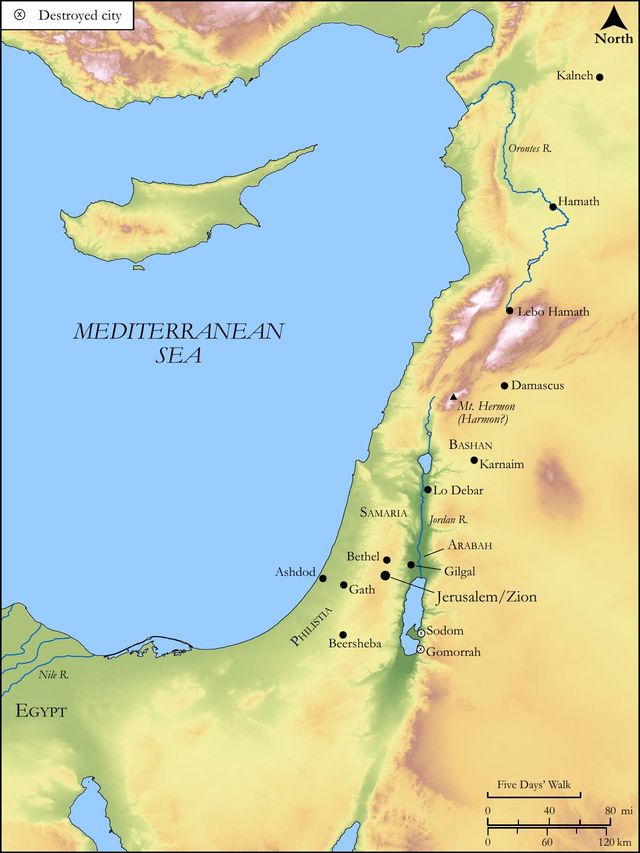
See on the biblical-era map
Study this verse
Public-domain commentary
Matthew Henry
From his Commentary on the Whole Bible. Henry comments on passages, not single verses — this entry covers Amos 3:9–15. His four-level outline is real structure in the source text, so it is rendered as structure.
The Israelites are here again convicted and condemned, and particular notice given of the crimes they are convicted of and the punishment they are condemned to.
1.Notice is given of it to their neighbours. The prophet is ordered to publish it in the palaces of Ashdod, one of the chief cities of the Philistines; nay, the summons must go further, even to the palaces in the land of Egypt. "The great men of both those nations, that dwell in the palaces, that are inquisitive concerning the affairs of the neighboring nations, and are conversant with the public intelligence, let them assemble themselves upon the mountains of Samaria," Amo 3:9. There, upon a throne high and lifted up, the judgment is set. Samaria is the criminal that is to be tried; let them be present at the trial, for it shall be (as other trials are) public, in the face of the country; let them make an appointment to meet there from all parts, to judge between God and his vineyard. God appeals to all impartial righteous men, Eze 23:45. They will all subscribe to the equity of his proceedings when they see how the case stands. Note, God's controversies with sinners do not fear a scrutiny; even Philistines and Egyptians will be made to see, and say, that the ways of the Lord are equal, but our ways are unequal. They are likewise summoned to attend, not only that they may justify God and be witness for him that he deals fairly, but that they may themselves take warning; for, if judgment begin at the house of God, as they see it does, what shall be the end of those that are strangers to him? Pe1 4:17. If this be done in a green tree, what shall be done in a dry? Or this intimates that the sin of Israel had been so notorious that the neighboring nations could come in witnesses against them, and therefore it was fit that their punishment should be so. "If it could have been concealed, we would have said, Tell it not in Gath; publish it not in the streets of Ashkelon;" but why should their friends consult their reputation, when they themselves do not consult it? If they have grown impudent in sin, let them bear the shame: "Publish it in Ashdod, in Egypt."
1.Let them see how black the charge is, and how well proved. Let them observe the behaviour of the inhabitants of Samaria; let them look off from the adjacent hills, and they may see how rude and boisterous they are, and hear how loud they cry of their sin is, as was that of Sodom.
(1.)Look into their streets and you will see nothing but riot and disorder, great tumults in the midst thereof; reason and justice are upon all occasions run down by the noise and fury of an outrageous mob, the dominion of which is the sin and shame of any people, and is likely to be their ruin.
(2.)Look into their prisons, and you will see them filled with injured innocents: The oppressed are in the midst thereof, thrown down and crushed by their oppressors, overpowered and overwhelmed, and they had no comforter, Ecc 4:1.
(3.)Look into their courts of justice, and you will see that those who preside in those courts know not to do right, because they have always been accustomed to do wrong; they act as if they had no notion at all of the thing called justice, are in no care to do justice themselves nor to see that others do justice.
(4.)Look into their treasures and stores, and you will see them replenished with violence and robbery, with that which was unjustly got and is still unjustly kept. Thus they have heaped treasures together for the last days, but it will prove a treasure of wrath against the day of wrath. It may well be said, Those know not to do right who think to enrich themselves by doing wrong.
2.Let them see how heavy the doom is, and how well executed, Amo 3:11, Amo 3:12.
(1.)Their country shall be invaded and ruined; and observe how the punishment answers to the sin.
[1.]Great tumults are in the midst of the land, and therefore an adversary shall be even round about the land; the Assyrian forces shall surround it and break in upon it on every side. Note, When sin is harboured and indulged in the midst of a people they can expect no other than that adversaries should be round about them, so that, go which way they will, they go into the mouth of danger, Luk 19:43.
[2.]They strengthened themselves in their wickedness, but the enemy shall bring down their strength from them, that strength which they abused in oppressing the poor, and doing violence to all about them. Note, That power which is made an instrument of unrighteousness will justly be brought down and broken.
[3.]They stored up robbery in their palaces, and therefore their palaces shall be spoiled; for what is got and kept wrongfully will not be kept long. Even palaces will be no protection to fraud and oppression; but the greatest of men, if they have spoiled others, shall themselves be spoiled, for the Lord is the avenger of all such.
(2.)Their countrymen shall not escape, Amo 3:12. They shall be in the hands of the enemy, as a lamb in the mouth of a lion, all devoured and eaten up, and they shall be utterly unable to make an resistance; and if any do make their escape, so as neither to fall by the sword or go into captivity, yet they shall be very few, and those of the meanest and least considerable, like two legs, or shanks, of a lamb, or, it may be, a piece of an ear, which the lion drops, or the shepherd takes from him, when he has eaten the whole body; so, perhaps, here and there one may escape from Samaria and from Damascus, when the king of Assyria shall fall upon them both, but none to make any account of; and those that do escape shall do so with the utmost difficult and hazard, by hiding themselves in the corner of a bed or under the bed's feet, which intimates that their spirits shall sneak shamefully in the time of danger. They shall not hide themselves in dens and caves, but in the corner of a bed, or the piece of a bed, such as poor people must be content with. They shall very narrowly escape, as it is foretold concerning the last destruction of Jerusalem that there shall be two in a bed together, one taken and the other left. Note, When God's judgments come forth against a people with commission it will be in vain to think of escaping them. Some make their dwelling in the corner of a bed, and in a couch, to denote their present security and sensuality; they are at ease, as in a bed, or on a couch, but, when God comes to contend with them, he shall make them uneasy, shall take them away out of the bed of their sloth and slumber. Those that stretch themselves lazily upon their couches when God's judgments are abroad shall go captive with the first that go captive.
II.Notice is given of it to themselves, Amo 3:13.
Let this be testified, and heard, in the house of Jacob, among all the seed of Israel, for it is spoken by the Lord God, the God of hosts, who has authority to pass this sentence and ability to execute it; let them know from him that the day is at hand when God will visit the transgressions of Israel upon him, when he will enquire into them and reckon for them: there will come a day of visitation, a day of punishment, and in that day all those things they are proud of, and put confidence in, shall fail them, and so they shall smart for the sins they have been guilty of about them.
1.Woe to their altars, for God will visit them. He will enquire into the sins they have been guilty of at their altars, and bring into the account all their superstition and idolatry, all their expenses on their false gods, and all their expectations from them; and he will lay the altars themselves under the marks of his displeasure, for the horns of the altar shall be cut off, and fall to the ground, and with them the altar itself demolished and broken to pieces. We find the altar at Bethel prophesied against (Kg1 13:2), and immediately rent (Amo 3:3), and that prophecy fulfilled with Josiah burnt men's bones upon it, Kg2 23:15, Kg2 23:16. This seconds that prophecy, and seems to point at the same event. Note, If men will not destroy idolatrous altars, God will, and those with them that had them in veneration. Some make the horns of the altar to signify all those things which they flee to for refuge, and trust in, and which they make their sanctuary: they shall all be cut off, so that they shall have nothing to take hold of.
2.Woe to their houses, for God will visit them too. He will enquire into the sins they have been guilty of in their houses, the robbery that have stored up in their houses, and the luxury in which they lived: and I will smite the winter-house with the summer-house, Amo 3:15. Their nobility, and gentry, and rich merchants, had their winter-houses in the city and their summer-houses in the country, so nice were they in guarding against the inconveniences of the winter when the country was thought too cold, and of the summer when the city was thought too hot, though the climate of that good land was so temperate, like that of ours, that neither the cold nor heat was ever in extremity. They indulged a foolish affectation of change and variety; but God will, either by war or by the earthquake, smite both the winter-house and the summer-house; neither shall serve to shelter them from his judgments. The houses of ivory (so called because the ceiling, or wainscot, or some of the ornaments of them, were edged or inlaid with ivory) shall perish, shall be burnt or pulled down; and the great houses shall have an end; the most splendid and spacious houses, the houses of their great men, shall no longer be, or at least be no longer theirs. Note, The pomp or pleasantness of men's houses will be so far from fortifying them against God's judgments that it will make them the more grievous and vexatious, as their extravagance about them will be put to the score of their sins and follies.
Historical interpretation
Historical reception
2 surviving comments on this verse. Each one is dated, so this reads as a timeline rather than a list.
Select a marker to jump to its quote. Markers stagger vertically where authors wrote within a few decades of each other.
If, then, any hope of salvation is still left to you, if any slight remembrance of God, if any desire for future rewards, if any fear of the punishments reserved for the unrepentant come back quickly to sobriety; raise your eyes to the heavens; return to your senses; cease your wickedness; shake off the drunkenness that has drenched you; stand up against him who has overthrown you. Have the strength to rise up from the earth. Remember the good Shepherd, how he will pursue and deliver you. And if there are but “two legs, or the tip of an ear,” leap back from him who has wounded you. Remember the compassion of God, how he heals with olive oil and wine. Do not despair of salvation. Recall the memory of what has been written, how he that falls rises again, and he that is turned away turns again, he that has been smitten is healed, he that is caught by wild beasts escapes, and he that confesses is not rejected. The Lord does not wish the death of the sinner, but that he return and live. Do not be contemptuous as one who has fallen into the depths of sins.
(Vers. 12, 13.) Thus says the Lord: Just as a shepherd rescues from the mouth of a lion two legs or the tip of an ear, so will the sons of Israel who dwell in Samaria be rescued, on the corner of a bed and in Damascus on the sheets. LXX: Thus says the Lord: Just as a shepherd tears away from the mouth of a lion two legs or the tip of an ear, so will the sons of Israel who dwell in Samaria be torn away, in front of the tribe and in Damascus. In the beginning of Amos, where we discussed those verses: The Lord will roar from Zion, and from Jerusalem He will give His voice; and the beautiful pastures will mourn, and the top of Carmel will wither, we said that He was using his art of speaking so that, since as a shepherd of sheep He knew nothing more terrifying than a lion, He would compare the anger of the Lord to lions. According to this meaning, he now also takes an example from what he had often seen, and thus describes that the small remaining remnants of the Assyrians must be extracted by hand: just as if a shepherd, with all the other parts devoured, were to snatch two legs or the outermost part of the ear from the jaws of a lion. And with the example of comparison set aside, he says that the sons of Israel, specifically the ten tribes who dwell in Samaria, will be extracted in the same way, from the edge of the bed and from the grab at Damascus. What seems to me to be explained in this way: we read in Isaiah that Rezin king of Aram, that is, the Syrians, who reigned in Damascus, and Pekah son of Remaliah king of Israel, with the intention of fighting against Judah, came (Isa. VII): concerning whom the Lord directs Achaz king of Judah and Jerusalem not to be afraid of the two half-burnt torches: because as a sign of complete liberation, the Virgin's conception and childbirth are shown to him. Therefore, the children of Samaria dwell in the region and district of the bed, resting in the help of the Syrians, and promising victory to themselves in the bed of Damascus: just as one who is tired is refreshed in bed: so they fortified their weakened forces with the help of the neighboring nation. And in the same Isaiah, it is said by way of a type of future events, that a child will be born who, before he knows how to call his father and mother, will receive the spoils of Samaria and the power of Damascus, which, of course, fought against Jerusalem with united forces (Ibid.). For the blow of the bed and of Damascus, the Seventy translated it against the tribe and in Damascus: so that, according to the symbolism, we may refer the tribe to Judah, and Damascus to the calling of the Gentiles: from which one flock of the Lord was made, whose wild beasts often tear apart the sheep: from whose jaws scarcely two legs or the very tip of the ear are taken away. In the calf the path of teachings is shown, in the ear the sacraments of words. Therefore, even the apostles were commanded to walk without shoes and any skin of a dead animal on their bare feet (Matth. X). And it is said to the believers: He who has ears to hear, let him hear (Luc. VIII, 8). In the Apocalypse of John, we also read: He who has ears, let him hear what the Spirit says to the Churches (Apoc. II, 7). And more explicitly through the prophet: Set your words in the ears of your heart. Both heretics and their teachers rush to hinder this journey and to weave nets so that we may fall on the way that is Christ. But if a man from the church and a man of God come, and Samson, who is interpreted as 'sun', kills the lion: descending into the lake of the underworld, which cools the waters, he suffocates the lion in the time of snow, storm, and winter: so that we may be able to follow the Lord with sure foot and safe ears, and hear his words.
Continue studying Amos 3:12 across the web’s major study libraries — every link below opens this exact verse, chapter, or book on the destination site.
Read & Compare
 BibleGatewayThis verse in more than 200 translations and 70 languages.
 Bible.comThe YouVersion reader — hundreds of translations, reading plans, and highlights.
 ESV.orgCrossway's official English Standard Version reader.
 NET BibleThe NET translation with 60,000+ translators' notes on every rendering decision.
 STEP BibleTyndale House's free study tool — original text, vocabulary, and scholarly resources.
 BibliaLogos Bible Software's free web reader.
 USCCBThe New American Bible (Revised Edition) with the U.S. bishops' study notes.
Commentaries
 BibleHub CommentariesDozens of classic commentaries on this verse, gathered on one page.
 StudyLightMore than 100 commentary sets — the largest collection on the web.
 BibleRefPlain-English commentary on what this verse means, verse by verse.
 Enduring WordDavid Guzik's free commentary on this chapter, widely used by Bible teachers.
 Bible Study ToolsVerse commentary alongside Greek and Hebrew study aids.
Original Language & Research
- BibleHub InterlinearThe verse word by word — original language, transliteration, and English.
- BibleHub LexiconEvery word's original-language definition and Strong's entry.
 Blue Letter BibleDeep-study tools — Strong's numbers, concordance, and word studies.
 SefariaThe Hebrew text with Rashi and centuries of Jewish commentary.
Sermons, Hymns & Audio


TrulyRandomVerse is not affiliated with these sites and doesn’t control their content. They’re linked because they’re genuinely useful.
Summary
Amos 3:12 vividly illustrates the severity of God's impending judgment upon the Northern Kingdom of Israel, particularly its complacent elite in Samaria and Damascus. Through the stark imagery of a shepherd salvaging only meager fragments from a lion's kill, the prophet declares that only a tiny, barely recognizable remnant of Israel's privileged class will escape the coming devastation, stripped of their luxurious comforts and security. This pronouncement underscores the principle of divine accountability for covenant unfaithfulness and oppression.
Context
ShowHideLiterary Context
Amos 3:12 is situated within a series of divine pronouncements of judgment against Israel, following the prophet's declaration in Amos 3:1-2 that because God "knew" Israel uniquely among all the families of the earth, He would therefore "punish [them] for all [their] iniquities." This verse serves as a grim illustration of that promised punishment. The preceding verses establish Israel's culpability, while the subsequent chapters detail the specific sins (oppression, idolatry, moral decay) that necessitate such severe judgment. The imagery of the lion (a common biblical symbol for divine wrath or powerful enemies) and the shepherd's meager salvage sets a tone of near-total destruction, contrasting sharply with the complacent luxury described in the latter half of the verse.
Historical & Cultural Context
The prophecy of Amos was delivered during the reign of Jeroboam II in the Northern Kingdom of Israel (c. 793-753 BCE), a period marked by significant economic prosperity and territorial expansion. However, this affluence was accompanied by rampant injustice, oppression of the poor, and widespread idolatry, particularly the worship of Baal and the golden calves at Bethel and Dan. The elite in cities like Samaria, the capital, lived in lavish comfort, oblivious or indifferent to the spiritual and social decay around them. Damascus, mentioned alongside Samaria, was a significant Aramaean city that had historically been a rival and sometimes an oppressor of Israel, but here it likely represents the broader sphere of luxurious living and perhaps a place of refuge for the wealthy, or simply another city experiencing similar judgment. The impending threat of the Assyrian Empire, which would ultimately conquer Samaria in 722 BCE, looms large as the historical instrument of this divine judgment.
Key Themes
ShowHideThis verse powerfully contributes to several overarching themes in the book of Amos. Firstly, it highlights the severity of divine judgment, emphasizing that God's justice will not spare even His covenant people when they persist in sin. The image of the "two legs, or a piece of an ear" is a stark portrayal of near-total annihilation, leaving only a pitiful remnant. Secondly, it underscores the consequences of complacency and luxury, directly indicting the wealthy elite who "dwell in Samaria in the corner of a bed, and in Damascus in a couch." Their self-indulgent lives, detached from the suffering of the poor and the demands of God's law, are shown to offer no protection from the impending catastrophe, a theme echoed in Amos 6:1. Lastly, while the judgment is severe, the verse subtly introduces the theme of a meager remnant, hinting that not all will be utterly destroyed, even if what remains is barely recognizable. This idea of a preserved remnant, albeit a small one, is a recurring motif in prophetic literature, though here it is presented with a sobering emphasis on loss, as seen in Amos 9:8.
Exposition and Analysis
ShowHideKey Word Analysis
ShowHideMeaning "(the) self-Existent or Eternal; Jehovah, Jewish national name of God." The use of this covenant name, YHWH, emphasizes that the pronouncement of judgment comes from the God who established a unique relationship with Israel, highlighting His unwavering character as both faithful and just. It signifies that this is not an arbitrary threat but a solemn declaration from the ultimate authority.
A primitive root meaning "to snatch away, whether in a good or a bad sense; to defend, deliver (self), escape, pluck, preserve, recover, rescue, rid, save, spoil, strip, take (out)." In this context, it conveys a forceful, desperate act of rescue, but one that yields only the barest fragments. It implies a violent struggle where little is salvaged, underscoring the limited nature of escape from the lion's (judgment's) grasp.
A primitive root meaning "to sit down; by implication, to dwell, to remain; causatively, to settle." This word paints a picture of settled, comfortable habitation. The Israelites, particularly the elite, were "dwelling" in luxury and security, contrasting sharply with the violent "snatching out" that awaits them. Their state of settled ease is precisely what will be violently disrupted.
Verse Breakdown
ShowHide"Thus saith the LORD; As the shepherd taketh out of the mouth of the lion two legs, or a piece of an ear;"
This opening clause establishes the divine authority of the prophecy and introduces a vivid simile. The image is drawn from the harsh realities of ancient pastoral life, where a shepherd might attempt to recover some proof of a lost sheep from a predator to avoid being held responsible for its loss. The "two legs, or a piece of an ear" are the most meager, unappetizing, and least valuable parts, signifying utter devastation and the barest, most pitiful remnants of what was once whole. This sets the tone for the extent of the coming destruction.
"so shall the children of Israel be taken out that dwell in Samaria in the corner of a bed, and in Damascus [in] a couch."
This clause completes the simile, applying the grim imagery to the Northern Kingdom. "The children of Israel" refers specifically to the residents of the Northern Kingdom, particularly its complacent and luxurious elite. "Samaria" was the capital, a symbol of Israel's wealth and spiritual decay. "The corner of a bed" and "a couch" denote extreme comfort and luxury, perhaps even implying the most comfortable or prominent part of a lavish dwelling. The mention of "Damascus" alongside Samaria could indicate a broader judgment on the region's wealthy or a specific group of exiles who might seek refuge there. The contrast between the violent, desperate salvage from the lion's mouth and the serene image of lounging in luxury powerfully highlights the sudden and brutal disruption that awaits those who feel secure in their material possessions.
Literary Devices
ShowHideAmos 3:12 is rich in literary devices that amplify its powerful message. The most prominent is Simile, explicitly introduced by "As... so shall." This comparison between the shepherd's meager salvage from a lion and Israel's impending fate vividly conveys the extent of the disaster. Imagery is central to the verse's impact, painting a stark picture of the violent struggle between shepherd and lion, contrasted with the opulent comfort of "the corner of a bed, and in Damascus in a couch." This creates a powerful visual and emotional juxtaposition. There is a strong element of Irony in the verse: those who live in the greatest comfort and security will be reduced to the most pitiful fragments, their perceived safety proving utterly illusory. The "lion" functions as a Metaphor for the instrument of God's judgment, likely referring to the Assyrian Empire, which would soon devour the Northern Kingdom. The "two legs, or a piece of an ear" serve as a Synecdoche, where a part (the meager remnants) represents the whole (the almost complete destruction of Israel's elite and their way of life).
Theological and Thematic Connections
ShowHideAmos 3:12 serves as a profound theological statement on divine justice and the nature of judgment for covenant people. It powerfully communicates that God, in His righteousness, will hold His chosen nation accountable for their persistent sin, particularly their oppression and spiritual apathy. The image of the meager remnant underscores that while God's covenant faithfulness ensures He will not utterly destroy His people (as hinted in Amos 9:8), the consequences of rebellion can be devastating, leaving only a shadow of former glory. This passage reminds us that privilege brings greater responsibility, and complacency in the face of sin invites severe discipline. It is a stark warning against placing trust in material security over spiritual fidelity, demonstrating that true safety lies only in a right relationship with the sovereign LORD.
Reflection and Application
ShowHideAmos 3:12 offers a piercing challenge to our contemporary lives, urging us to examine where our security and comfort truly lie. The vivid imagery of a people clinging to luxury while divine judgment looms is a potent reminder that material possessions, social status, or even national prosperity offer no ultimate shield against the consequences of spiritual and moral decay. We are called to recognize that God's justice is unwavering, and His patience has limits, even for those who claim His name. This verse compels us to confront any complacency in our own lives, particularly if our comfort has led to indifference towards injustice, neglect of the vulnerable, or spiritual apathy. It is a call to prioritize righteousness, humility, and genuine faith over fleeting pleasures and worldly security, understanding that true peace and lasting security are found only in a vibrant, obedient relationship with God.
Questions for Reflection
ShowHideFAQ
ShowHideWhat does the "two legs, or a piece of an ear" symbolize in Amos 3:12?
ShowHideThis vivid imagery symbolizes the extremely meager and pitiful remnant that will be salvaged from the impending judgment. In ancient Near Eastern culture, a shepherd might bring back such fragments from a sheep killed by a predator as proof that the animal was lost due to an unavoidable attack, not negligence. For Israel, it means that very little will be left of their wealth, power, or even their population after the catastrophe. It signifies a near-total destruction, leaving only the barest, most undesirable fragments, highlighting the severity and completeness of God's judgment on their unfaithfulness.
Why are Samaria and Damascus mentioned together in this verse?
ShowHideSamaria was the capital of the Northern Kingdom of Israel, serving as a symbol of its wealth, power, and spiritual corruption. The "corner of a bed" and "couch" refer to the luxurious lifestyle of its elite. Damascus was the capital of Aram (Syria), a powerful neighbor and often an adversary of Israel. Its inclusion here could signify several things: it might represent other cities where wealthy Israelites had sought refuge or established luxurious homes, indicating that their comfort would be stripped from them wherever they were. Alternatively, it could imply a shared fate of judgment for nations that indulged in similar complacency and injustice, or even a specific reference to the Aramaeans who had oppressed Israel in the past, now sharing a similar fate of being "snatched out" by a greater power. The primary focus, however, remains on the complacent elite of Israel.
Does this verse offer any hope for Israel?
ShowHideWhile Amos 3:12 is primarily a message of severe judgment, the very concept of a "remnant"—even a meager one—implies that God will not utterly destroy His people. The act of "taking out" suggests a preservation, however minimal. This aligns with broader prophetic themes where God always preserves a faithful remnant through judgment, ensuring the continuity of His covenant promises. Although the immediate outlook is grim, the continued existence of even a "piece of an ear" hints at God's ultimate faithfulness to His long-term plan for Israel, which culminates in restoration and redemption, as seen in later prophecies within Amos and other books like Isaiah 10:20-22.
Christ-Centered Fulfillment
ShowHideAmos 3:12, with its stark imagery of a meager remnant salvaged from destruction, finds its ultimate fulfillment and transformation in the person and work of Jesus Christ. The judgment threatened upon Israel for their sin foreshadows the universal judgment against all humanity's sin, a judgment that Christ Himself bore on the cross. He became the Lamb of God who takes away the sin of the world, enduring the divine wrath that we deserved, thus offering a true escape from spiritual destruction. The "taking out" of a remnant, a small portion saved from the lion's mouth, points to the spiritual remnant, the elect, whom God preserves through faith in Christ. While the Old Testament remnant often faced physical exile and hardship, the New Testament remnant, the Church, is "taken out" of the dominion of darkness and transferred into the kingdom of His beloved Son. Our security is not found in earthly comforts or luxurious "beds and couches," which are fleeting, but in Christ alone, who promises eternal life and a salvation that cannot be snatched away (John 10:28). Thus, the severe judgment of Amos 3:12 ultimately magnifies the grace and mercy of God revealed in Christ, through whom a spiritual remnant is not merely salvaged but gloriously redeemed and brought into full fellowship with God.