


1 Kings 22:25
- וַיֹּאמֶרvai·Yo·merand he saidH559Conj-w ¦ V-Qal-ConsecImperf-3msVerb Qal Consecutive Imperfect 3rd Singular Masculineוַandיֹּאמֶרhe said
- מִיכָיְהוּmi·Kha·ye·huMicaiahH4321N-proper-mNoun Proper Masculine
- הִנְּךָhi·ne·Khathere youH2005Prt ¦ 2msParticle Interjectionהִנְּthereךָyou
- רֹאֶהro·'Eh[are] about to seeH7200V-Qal-Prtcpl-msVerb Qal Participle Singular Masculine Absolute
- בַּיּוֹםbai·Yomon the dayH3117Prep-b ¦ N-msNoun Singular Masculine Absoluteבַּon theיּוֹםday
- הַהוּאha·Hu'<the> thatH1931Art ¦ Pro-3msPronoun Personal 3rd Singular Masculineהַ<the>הוּאthat
- אֲשֶׁר'a·SherwhenH834RelParticle Relative
- תָּבֹאta·Vo'you will goH935V-Qal-Imperf-2msVerb Qal Imperfect 2nd Singular Masculine
- חֶדֶרChe·dera roomH2315N-msNoun Singular Masculine Absolute
- בְּחֶדֶרbe·Che·derin a roomH2315Prep-b ¦ N-msNoun Singular Masculine Absoluteבְּinחֶדֶרa room
- לְהֵחָבֵהle·he·cha·Vehto hide yourselfH2247Prep-l ¦ V-Niphal-InfVerb Niphal Infinitive Constructלְtoהֵחָבֵהhide yourself
English is a literal word-by-word gloss of the Hebrew, not the KJV's wording. Why?
This is the original text the KJV's translators worked from — each Hebrew word with its own literal English meaning in this verse, prepared by scholars at Tyndale House, Cambridge. The KJV translates whole sentences, not word by word, so its wording differs: one Hebrew word can become several English words, and the KJV may choose “the LORD” where the gloss reads “Yahweh”. Both are faithful — they answer different questions. For the KJV's own rendering, switch to the KJV text.
Details
See on the biblical-era maps
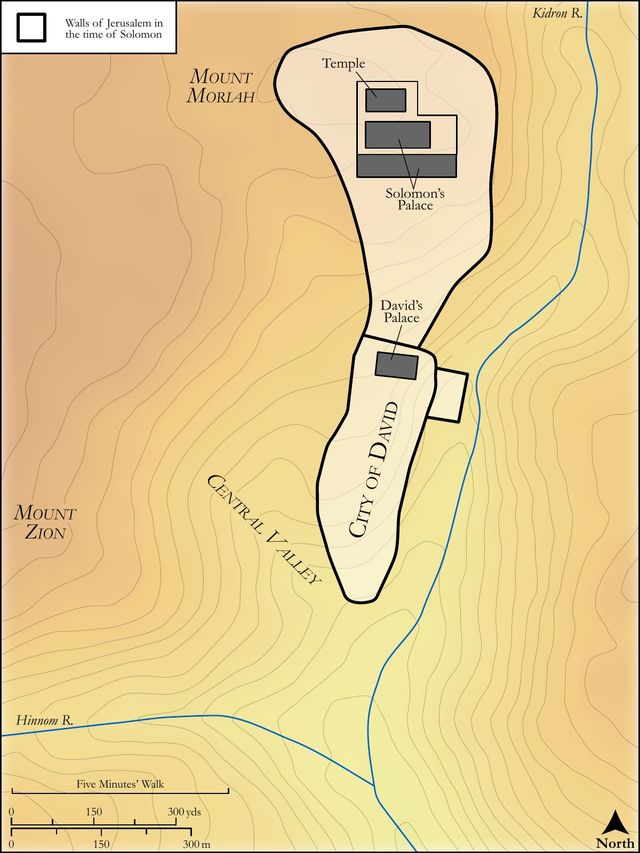
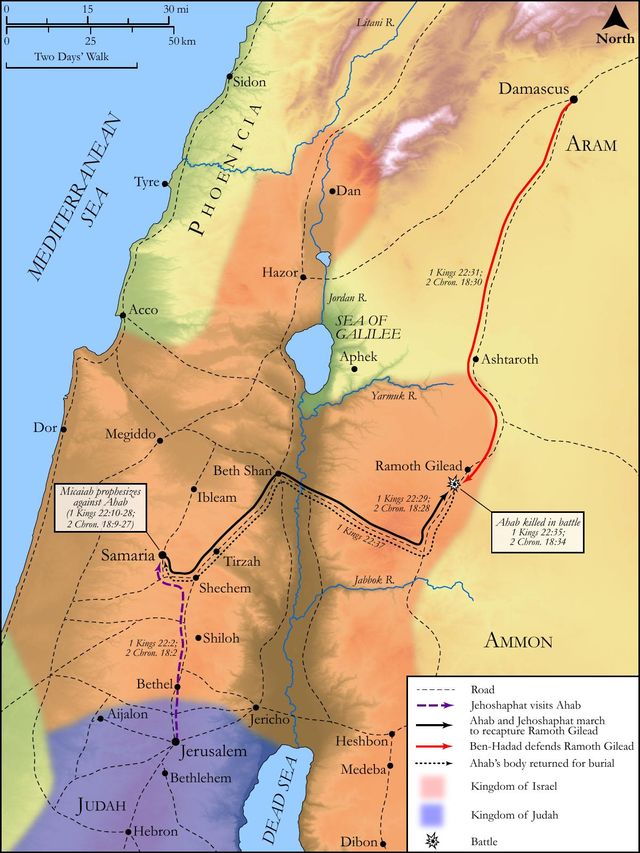
Study this verse
Public-domain commentary
Matthew Henry
From his Commentary on the Whole Bible. Henry comments on passages, not single verses — this entry covers 1 Kings 22:15–28. His three-level outline is real structure in the source text, so it is rendered as structure.
Here Micaiah does well, but, as is common, suffers ill for so doing.
I.We are told how faithfully he delivered his message, as one that was more solicitous to please God than to humour either the great or the many. In three ways he delivers his message, and all displeasing to Ahab: -
1.He spoke as the rest of the prophets had spoken, but ironically: Go, and prosper, Kg1 22:15. Ahab put the same question to him that he had put to his own prophets (Shall we go, or shall we forbear?) seeming desirous to know God's mind, when, like Balaam, he was strongly bent to do his own, which Micaiah plainly took notice of when he bade him go, but with such an air and pronunciation as plainly showed he spoke it by way of derision; as if he had said, "I know you are determined to go, and I hear your own prophets are unanimous in assuring you of success; go then and take what follows. They say, The Lord shall deliver it into the hand of the king; but I do not tell thee that thus saith the Lord; no, he saith otherwise." Note, Those deserve to be bantered that love to be flattered; and it is just with God to give up those to their own counsels that give up themselves to their own lusts. Ecc 11:9. In answer to this Ahab adjured him to tell him the truth, and not to jest with him (v. 16), as if he sincerely desired to know both what God would have him to do and what he would do with him, yet intending to represent the prophet as a perverse ill-humoured man, that would not tell him the truth till he was thus put to his oath, or adjured to do it.
2.Being thus pressed, he plainly foretold that the king would be cut off in this expedition, and his army scattered, Kg1 22:17. He saw them in a vision, or in a dream, dispersed upon the mountains, as sheep that had no one to guide them. Smite the shepherd, and the sheep will be scattered, Zac 13:7. This intimates,
(1.)That Israel should be deprived of their king, who was their shepherd. God took notice of it, These have no master.
(2.)That they would be obliged to retire re infecta - without accomplishing their object. He does not foresee any great slaughter in the army, but that they should make a dishonorable retreat. Let them return every man to his house in peace, put into disorder indeed for the present, but no great losers by the death of their king; he shall fall in war, but they shall go home in peace. Thus Micaiah, in his prophecy, testified what he had seen and heard (let them take it how they pleased), while the others prophesied merely out of their own hearts; see Jer 23:28. "The prophet that has a dream let him tell that, and so quote his authority; and he that has my word, let him speak my word faithfully, and not his own; for what is the chaff to the wheat?" Now Ahab finds himself aggrieved, turns to Jehoshaphat, and appeals to him whether Micaiah had not manifestly a spite against him, Kg1 22:18. Those that bear malice to others are generally willing to believe that others bear malice to them, though they have no cause for it, and therefore to put the worst constructions upon all they say. What evil did Micaiah prophesy to Ahab in telling him that, if he proceeded in this expedition, it would be fatal to him, while he might choose whether he would proceed in it or no? The greatest kindness we can do to one that is going a dangerous way is to tell him of his danger.
3.He informed the king how it was that all his prophets encouraged him to proceed, that God permitted Satan by them to deceive him into his ruin, and he by vision knew of it; it was represented to him, and he represented it to Ahab, that the God of heaven had determined he should fall at Ramoth-Gilead (Kg1 22:19, Kg1 22:20), that the favour he had wickedly shown to Ben-hadad might be punished by him and his Syrians, and that he being in some doubt whether he should go to Ramoth-Gilead or no, and resolving to be advised by his prophets, they should persuade him to it and prevail (Kg1 22:21, Kg1 22:22); and hence it was that they encouraged him with so much assurance (Kg1 22:23); it was a lie from the father of lies, but by divine permission. This matter is here represented after the manner of men. We are not to imagine that God is ever put upon new counsels, or is ever at a loss for means whereby to effect his purposes, nor that he needs to consult with angels, or any creature, about the methods he should take, nor that he is the author of sin or the cause of any man's either telling or believing a lie; but, besides what was intended by this with reference to Ahab himself, it is to teach us, (1.) That God is a great king above all kings, and has a throne above all the thrones of earthly princes. "You have your thrones," said Micaiah to these two kings, "and you think you may do what you will, and we must all say as you would have us; but I saw the Lord sitting upon his throne, and every man's judgment proceeding from him, and therefore I must say as he says; he is not a man, as you are." (2.) That he is continually attended and served by an innumerable company of angels, those heavenly hosts, who stand by him, ready to go where he sends them and to do what he bids them, messengers of mercy on his right hand, of wrath on his left hand. (3.) That he not only takes cognizance of, but presides over, all the affairs of this lower world, and overrules them according to the counsel of his own will. The rise and fall of princes, the issues of war, and all the great affairs of state, which are the subject of the consultations of wise and great men, are no more above God's direction than the meanest concerns of the poorest cottages are below his notice. (4.) That God has many ways of bringing about his own counsels, particularly concerning the fall of sinners when they are ripe for ruin; he can do it either in this manner or in that manner. (5.) That there are malicious and lying spirits which go about continually seeking to devour, and, in order to that, seeking to deceive, and especially to put lies into the mouths of prophets, by them to entice many to their destruction. (6.) It is not without the divine permission that the devil deceives men, and even thereby God serves his own purposes. With him are strength and wisdom, the deceived and the deceivers are his, Job 12:16. When he pleases, for the punishment of those who receive not the truth in the love of it, he not only lets Satan loose to deceive them (Rev 20:7, Rev 20:8), but gives men up to strong delusions to believe him, Th2 2:11, Th2 2:12. (7.) Those are manifestly marked for ruin that are thus given up. God has certainly spoken evil concerning those whom he had given up to be imposed upon by lying prophets. Thus Micaiah gave Ahab fair warning, not only of the danger of proceeding in this war, but of the danger of believing those that encouraged him to proceed. Thus we are warned to beware of false prophets, and to try the spirits; the lying spirit never deceives so fatally as in the mouth of prophets.
II.We are told how he was abused for delivering his message thus faithfully, thus plainly, in a way so very proper both to convince and to affect.
1.Zedekiah, a wicked prophet, impudently insulted him in the face of the court, smote him on the cheek, to reproach him, to silence him and stop his mouth, and to express his indignation at him (thus was our blessed Saviour abused, Mat 26:67, that Judge of Israel, Mic 5:1); and as if he not only had the spirit of the Lord, but the monopoly of this Spirit, that he might not go without his leave, he asks, Which way went the Spirit of the Lord from me to speak to thee? Kg1 22:24. The false prophets were always the worst enemies the true prophets had, and not only stirred up the government against them, but were themselves abusive to them, as Zedekiah here. To strike within the verge of the court, especially in the king's presence, is looked upon by our law as a high misdemeanour; yet this wicked prophet gives this abuse to a prophet of the Lord, and is not reprimanded nor bound to his good behaviour for it. Ahab was pleased with it, and Jehoshaphat had not courage to appear for the injured prophet, pretending it was out of his jurisdiction; but Micaiah, though he returns not his blow (God's prophets are not strikers nor persecutors, dare not avenge themselves, render blow for blow, or be in any way accessory to the breach of the peace), yet, since he boasted so much of the Spirit, as those commonly do that know least of his operations, he leaves him to be convinced of his error by the event: Thou shalt know when thou hidest thyself in an inner chamber, Kg1 22:25. It is likely Zedekiah went with Ahab to the battle, and took his horns of iron with him to encourage the soldiers, to see with pleasure the accomplishment of his prophecy, and return in triumph with the king; but, the army being routed, he fled among the rest from the sword of the enemy, sheltered himself as Ben-hadad had done in a chamber within a chamber (Kg1 20:30), lest he should perish, as he knew he deserved to do, with those whom he had deluded, as Balaam did (Num 31:8), and lest the blind prophet should fall into the ditch with the blinded prince whom he had misled. Note, Those that will not have their mistakes rectified in time by the word of God will be undeceived, when it is too late, by the judgments of God.
2.Ahab, that wicked king, committed him to prison (Kg1 22:27), not only ordered him to be taken into custody, or remitted to the prison whence he came, but to be fed with bread and water, coarse bread and puddle-water, till he should return, not doubting but that he should return a conqueror, and then he would put him to death for a false prophet (Kg1 22:27) - hard usage for one that would have prevented his ruin! But by this it appeared that God had determined to destroy him, as Ch2 25:16. How confident is Ahab of success. He doubts not but he shall return in peace, forgetting what he himself had reminded Ben-hadad of, Let not him that girdeth on the harness boast; but there was little likelihood of his coming home in peace when he left one of God's prophets behind him in prison. Micaiah put it upon the issue, and called all the people to be witnesses that he did so: "If thou return in peace, the Lord has not spoken by me, Kg1 22:28. Let me incur the reproach and punishment of a false prophet, if the king come home alive." He ran no hazard by this appeal, for he knew whom he had believed; he that is terrible to the kings of the earth, and treads upon princes as mortar, will rather let thousands of them fall to the ground than one jot or tittle of his own word; he will not fail to confirm the word of his servants, Isa 44:26.
Historical interpretation
Historical reception
1 surviving comment on this verse from the historical church.
Go into a chamber: This happened when he heard the king was slain, and justly apprehended that he should be punished for his false prophecy.
Continue studying 1 Kings 22:25 across the web’s major study libraries — every link below opens this exact verse, chapter, or book on the destination site.
Read & Compare
 BibleGatewayThis verse in more than 200 translations and 70 languages.
 Bible.comThe YouVersion reader — hundreds of translations, reading plans, and highlights.
 ESV.orgCrossway's official English Standard Version reader.
 NET BibleThe NET translation with 60,000+ translators' notes on every rendering decision.
 STEP BibleTyndale House's free study tool — original text, vocabulary, and scholarly resources.
 BibliaLogos Bible Software's free web reader.
 USCCBThe New American Bible (Revised Edition) with the U.S. bishops' study notes.
Commentaries
 BibleHub CommentariesDozens of classic commentaries on this verse, gathered on one page.
 StudyLightMore than 100 commentary sets — the largest collection on the web.
 BibleRefPlain-English commentary on what this verse means, verse by verse.
 Enduring WordDavid Guzik's free commentary on this chapter, widely used by Bible teachers.
 Bible Study ToolsVerse commentary alongside Greek and Hebrew study aids.
Original Language & Research
- BibleHub InterlinearThe verse word by word — original language, transliteration, and English.
- BibleHub LexiconEvery word's original-language definition and Strong's entry.
 Blue Letter BibleDeep-study tools — Strong's numbers, concordance, and word studies.
 SefariaThe Hebrew text with Rashi and centuries of Jewish commentary.
Sermons, Hymns & Audio


TrulyRandomVerse is not affiliated with these sites and doesn’t control their content. They’re linked because they’re genuinely useful.
Summary
1 Kings 22:25 records the prophet Micaiah's chilling and direct prophecy to Zidkijah, one of King Ahab's false prophets, immediately after Zidkijah struck Micaiah. This verse serves as a stark warning and a vivid prediction of the coming humiliation and desperate fear that would befall those who dared to speak falsehood in the name of the Lord, particularly as the truth of Micaiah's genuine prophecy unfolded, exposing the deception of the court prophets.
Context
ShowHideLiterary Context
This verse is deeply embedded within a dramatic and pivotal confrontation between true and false prophecy in the biblical narrative. King Ahab of Israel, in alliance with King Jehoshaphat of Judah, was intent on reclaiming Ramoth-Gilead from the Arameans. Prior to battle, Ahab consulted his 400 court prophets, who, under the leadership of Zidkijah, uniformly prophesied victory and urged the king to advance (see 1 Kings 22:6-12). Jehoshaphat, discerning the lack of divine authenticity, wisely insisted on consulting a true prophet of the Lord. Reluctantly, Ahab summoned Micaiah, whom he openly admitted to despising because Micaiah never prophesied good concerning him. After an initial sarcastic affirmation of the false prophecy, Micaiah, under solemn oath, delivered God's unvarnished, dire message: Israel would be scattered like sheep without a shepherd, and Ahab would fall in battle (see 1 Kings 22:15-17). It was following this pronouncement, and Micaiah's revelation of a deceiving spirit sent by God to Ahab's prophets (see 1 Kings 22:20-23), that Zidkijah, in a brazen act of defiance and arrogance, struck Micaiah on the cheek, questioning his divine inspiration. Micaiah's response in verse 25 is a direct, prophetic counter-challenge, foretelling Zidkijah's future desperate state when the truth of Micaiah's words would be undeniably manifest.
Historical & Cultural Context
The setting is the mid-9th century BCE, a period marked by significant political tension and shifting alliances in the ancient Near East. King Ahab, notoriously wicked for his promotion of Baal worship and persecution of true prophets (as detailed in 1 Kings 16:29-33), reigned over the northern kingdom of Israel. His alliance with Jehoshaphat, the more righteous king of Judah, for the military campaign against Aram (Syria) was a notable political maneuver. In ancient Israel, prophets held a crucial role in advising kings and interpreting divine will, but there was a perpetual struggle between true prophets, who spoke God's unvarnished truth, and false prophets, who often flattered the king or spoke what was popular and politically expedient. Striking a prophet was an act of profound disrespect, a public attempt to silence God's word, and often seen as a direct affront to God Himself. The imagery of hiding in an "inner chamber" (similar to Ben-Hadad's desperate flight in 1 Kings 20:30) would have immediately resonated with the audience as a symbol of extreme fear, shame, and desperation, representing a place of last resort for those facing imminent danger or judgment.
Key Themes
ShowHideThis pivotal encounter highlights several enduring themes. Firstly, the Vindication of True Prophecy stands out; despite being outnumbered, ridiculed, and persecuted, God's authentic word, spoken through Micaiah, would ultimately prove true, demonstrating God's faithfulness to His word and His messengers. Secondly, the Consequences of Falsehood and Deception are starkly portrayed; Zidkijah's future humiliation and desperate hiding symbolize the inevitable exposure and judgment awaiting those who mislead God's people for personal gain or to appease human authority. Thirdly, Divine Sovereignty and Judgment are paramount; even amidst human rebellion, manipulation, and rejection of God's word, God's sovereign plan for judgment and truth prevails, as evidenced by Ahab's prophesied death and the subsequent scattering of Israel's forces (see 1 Kings 22:34-36). Lastly, the narrative underscores the critical importance of Spiritual Discernment in distinguishing between genuine divine revelation and human fabrication, a theme that resonates throughout the prophetic literature of the Old Testament (e.g., Deuteronomy 18:20-22).
Exposition and Analysis
ShowHideKey Word Analysis
ShowHideThis name, meaning "Who is like Yahweh?" or "Who is like the Lord?", is profoundly significant given the context. Micaiah stands as the lone voice of truth against 400 false prophets, embodying the very question his name poses: no one is like Yahweh, and His word alone is true. His prophetic integrity and courage underscore the unique authority of God's message over human consensus or political expediency.
While literally meaning "day," in this prophetic context, "that day" (Hebrew, bayyôm hahû') functions as an idiomatic expression referring to a specific, future day of reckoning, crisis, or divine intervention. It is a prophetic marker, pointing to the precise moment when Micaiah's prophecy would be fulfilled and its truth undeniably revealed. For Zidkijah, "that day" would be the day of Ahab's defeat and death, when the consequences of his false prophecy would become evident to all, leading to his desperate need for concealment. It underscores the certainty and inevitability of the prophetic word.
This term, appearing twice in the Hebrew text (cheder b'cheder), literally means "a chamber within a chamber" or "the innermost room." It signifies a place of extreme seclusion, secrecy, and desperation. It is not merely a private room but suggests a hidden, confined space, often used for refuge or concealment in times of great fear or danger. The repetition intensifies the meaning, emphasizing the deepest, most inaccessible part of a dwelling, highlighting the depth of Zidkijah's future shame and his desperate attempt to escape public wrath or divine judgment. This imagery powerfully evokes a sense of utter humiliation and fear, contrasting sharply with Zidkijah's current public arrogance.
A primitive root meaning "to secrete" or "to hide (self)." The verb "to hide" implies an act of concealment driven by fear, shame, or the desire to escape detection or punishment. In this context, it suggests Zidkijah's attempt to evade the wrath of those he misled, particularly after the disastrous outcome of the battle. It speaks to a profound loss of prestige and a reversal of fortune, from a position of public acclaim to one of abject fear and isolation.
Verse Breakdown
ShowHide"And Micaiah said"
This opening establishes the authoritative nature of Micaiah's words. Despite being struck and imprisoned, Micaiah maintains his prophetic integrity and delivers a direct, unyielding response, demonstrating his confidence in the divine origin of his message. His statement is not a personal retort but a prophetic declaration of God's certain judgment.
"Behold, thou shalt see in that day"
This phrase serves as a powerful affirmation of the prophecy's certainty and its future fulfillment. "Behold" (Hebrew, hinnēh) draws immediate attention to the gravity of what is about to be revealed. Micaiah is not merely predicting an event but assuring Zidkijah that he will personally witness and experience the consequences of his deception on a specific, future day of reckoning. This direct address underscores the personal nature of the impending judgment.
"when thou shalt go into an inner chamber to hide thyself"
This is the core of Micaiah's prophecy against Zidkijah. It foretells a future state of extreme fear and humiliation for the false prophet. The act of "going into an inner chamber to hide" vividly depicts Zidkijah's desperate attempt to escape the repercussions of his lies once Ahab's defeat and death confirm Micaiah's true prophecy. It contrasts Zidkijah's present public confidence and physical aggression with his future abject fear and isolation, highlighting the dramatic reversal of his fortunes and the ultimate vindication of God's word. The imagery conveys a profound sense of shame and vulnerability.
Literary Devices
ShowHideThe verse employs several potent Literary Devices. Most notably, there is profound Irony. Zidkijah, in his arrogance, strikes Micaiah, believing he holds the true prophetic anointing and silencing what he deems a false voice. Yet, Micaiah's response reveals that Zidkijah will soon be the one in a position of shame and fear, desperately trying to hide from the very people he misled. This dramatic reversal of fortunes is central to the narrative's tension and moral lesson. The "inner chamber" functions as powerful Symbolism, representing not just a physical hiding place but a state of utter desperation, humiliation, and fear-driven isolation. It contrasts sharply with Zidkijah's current public prominence and bold defiance, emphasizing his fall from grace. The entire statement acts as Foreshadowing, not only of Zidkijah's personal disgrace but also, by extension, of the larger judgment awaiting Ahab and the false prophets. It is a concise yet vivid example of Prophetic Confrontation, where a true prophet directly challenges and exposes the falsehood of a deceptive one, relying on the ultimate vindication of God's word rather than immediate human power or popularity. The direct address "thou shalt see" also employs Apostrophe, directly speaking to Zidkijah to emphasize the personal nature of his impending doom.
Theological and Thematic Connections
ShowHideThis verse powerfully underscores the unwavering truthfulness of God's word and the severe consequences for those who presume to speak falsely in His name. It highlights the divine commitment to exposing deception and vindicating His faithful messengers, even when they are persecuted and outnumbered. The confrontation between Micaiah and Zidkijah serves as a timeless theological lesson: God's truth, though often unpopular and met with resistance, will ultimately prevail and reveal the emptiness of human-fabricated lies. It also emphasizes the principle that those who sow deception will reap humiliation and judgment, a stark reminder of divine justice and the ultimate accountability for one's words and actions before God.
Reflection and Application
ShowHideMicaiah's bold prophecy and Zidkijah's predicted humiliation offer profound lessons for believers today. In a world saturated with diverse voices and claims of truth, the narrative calls for rigorous spiritual discernment. We are challenged to critically evaluate teachings and prophecies, not by their popularity, the charisma of their proponents, or their alignment with our desires, but by their unwavering faithfulness to God's revealed Word and their fruit. This verse encourages us to cultivate a profound love for truth, even when it is uncomfortable, costly, or leads to opposition, and to resist the temptation to compromise integrity for personal gain, social acceptance, or political expediency. It reminds us that while speaking God's truth may lead to temporary persecution or isolation, God ultimately vindicates His messengers and His message. Conversely, those who propagate falsehoods, whether intentionally or through negligence, will face an inevitable reckoning, where their deception will be exposed, leading to shame and regret. We are called to be people of truth, reflecting God's character in our words and actions, trusting that His ultimate triumph will make plain all hidden things and bring justice to light.
Questions for Reflection
ShowHideFAQ
ShowHideWhy did Zidkijah strike Micaiah?
ShowHideZidkijah struck Micaiah as an act of profound defiance, arrogance, and an attempt to discredit him publicly. As a leading prophet in Ahab's court, Zidkijah had just delivered a unanimous prophecy of victory, which pleased the king and affirmed his military plans. Micaiah's counter-prophecy of defeat and Ahab's death directly contradicted Zidkijah's message and exposed his deception. The blow was a symbolic rejection of Micaiah's divine inspiration, as Zidkijah sarcastically questioned, "Which way went the Spirit of the Lord from me to speak unto thee?" (see 1 Kings 22:24). It was an aggressive assertion of his own perceived authority and an attempt to silence the uncomfortable, divinely revealed truth.
Was Micaiah's prophecy concerning Zidkijah fulfilled?
ShowHideWhile the Bible does not explicitly detail Zidkijah's specific fate after Ahab's death, the broader context and the narrative's resolution strongly imply the fulfillment of Micaiah's prophecy. Micaiah's primary prophecy concerning Ahab's death in battle was indeed fulfilled with devastating clarity (see 1 Kings 22:34-36). When the king died and the army was scattered, the catastrophic failure of Zidkijah's prophecy would have become undeniably evident to all. As a result, Zidkijah, who had promised victory and misled the king and the people, would have faced immense public wrath, shame, and potentially severe consequences. Hiding in an "inner chamber" would have been a necessary act of self-preservation, fulfilling Micaiah's prediction of his desperate state. The vindication of Micaiah's word regarding Ahab implicitly confirms the truthfulness and certainty of his entire prophetic declaration, including the fate of Zidkijah, demonstrating God's justice.
Christ-Centered Fulfillment
ShowHideThe dramatic confrontation between Micaiah and Zidkijah, and the ultimate vindication of true prophecy, finds its ultimate and perfect fulfillment in Jesus Christ. Micaiah, as a true prophet, faithfully delivered God's unpopular truth, facing rejection, persecution, and physical assault for his unwavering integrity. In Christ, we see the perfect embodiment of the true Prophet (as foretold in Deuteronomy 18:15). He is the very Word made flesh (see John 1:14), who spoke God's truth with absolute authority, even when it challenged the religious establishment and led to His rejection and crucifixion (see John 18:37). Unlike Zidkijah, who spoke lies and faced eventual shame and a desperate need to hide, Jesus is the Truth itself, and His words bring eternal life, not judgment, to those who believe. The "inner chamber" of Zidkijah's desperate hiding contrasts sharply with the secure refuge and eternal security found in Christ. Those who trust in Him do not need to hide from God's judgment; instead, they find complete forgiveness and eternal life through the atoning sacrifice of the Lamb of God who takes away the sin of the world. Ultimately, just as Micaiah's prophecy was vindicated by events, so too was Christ's claim to be the Son of God and the Messiah powerfully confirmed through His resurrection from the dead (see Romans 1:4), demonstrating that all of God's promises find their definitive "Yes" and "Amen" in Him (see 2 Corinthians 1:20).