


Numbers 31:8
Bible text: King James Version (1769 Blayney text) · Public domain
Bible text: King James Version with Strong's numbers · Public domain
Bible text: Berean Standard Bible · Public domain
Bible text: American Standard Version (1901) · Public domain
Bible text: World English Bible, Messianic edition · Public domain
Bible text: Geneva Bible (1599) · Public domain
Bible text: Young's Literal Translation · Public domain
- וְאֶתve·'Etand <obj.>H853Conj-w ¦ DirObjMParticle Object Indicatorוְandאֶת<obj.>
- מַלְכֵיmal·Khei[the] kings ofH4428N-mpcNoun Plural Masculine Construct
- מִדְיָןmid·YanMidianH4080N-properNoun Proper Location
- הָרְגוּha·re·Guthey killedH2026V-Qal-Perf-3cpVerb Qal Perfect 3rd Plural common gender
- עַל'alwithH5921PrepPreposition
- חַלְלֵיהֶםcha·lei·Hemtheir slain [ones]H2491Adj-mpc ¦ 3mpAdjective Plural Masculine Constructחַלְלֵיslain [ones]הֶםtheir
- אֶת'et<obj.>H853DirObjMParticle Object Indicator
- אֱוִי'e·ViEviH189N-proper-mNoun Proper Masculine
- וְאֶתve·'Etand <obj.>H853Conj-w ¦ DirObjMParticle Object Indicatorוְandאֶת<obj.>
- רֶקֶםre·kemRekemH7552N-proper-mNoun Proper Masculine
- וְאֶתve·'Etand <obj.>H853Conj-w ¦ DirObjMParticle Object Indicatorוְandאֶת<obj.>
- צוּרtzurZurH6698N-proper-mNoun Proper Masculine
- וְאֶתve·'Etand <obj.>H853Conj-w ¦ DirObjMParticle Object Indicatorוְandאֶת<obj.>
- חוּרchurHurH2354N-proper-mNoun Proper Masculine
- וְאֶתve·'Etand <obj.>H853Conj-w ¦ DirObjMParticle Object Indicatorוְandאֶת<obj.>
- רֶבַעRe·va'RebaH7254N-proper-mNoun Proper Masculine
- חֲמֵשֶׁתcha·Me·shet[the] fiveH2568Adj-cscAdjective Numerical Singular common gender Construct
- מַלְכֵיmal·Khei[the] kings ofH4428N-mpcNoun Plural Masculine Construct
- מִדְיָןmid·YanMidianH4080N-properNoun Proper Location
- וְאֵתve·'Etand <obj.>H853Conj-w ¦ DirObjMParticle Object Indicatorוְandאֵת<obj.>
- בִּלְעָםbil·'AmBalaamH1109N-proper-mNoun Proper Masculine
- בֶּןben[the] son ofH1121N-mscNoun Singular Masculine Construct
- בְּעוֹרbe·'orBeorH1160N-proper-mNoun Proper Masculine
- הָרְגוּha·re·Guthey killedH2026V-Qal-Perf-3cpVerb Qal Perfect 3rd Plural common gender
- בֶּחָרֶבbe·Cha·revwith the swordH2719Prep-b ¦ N-fsNoun Singular Feminine Absoluteבֶּwith theחָרֶבsword
English is a literal word-by-word gloss of the Hebrew, not the KJV's wording. Why?
This is the original text the KJV's translators worked from — each Hebrew word with its own literal English meaning in this verse, prepared by scholars at Tyndale House, Cambridge. The KJV translates whole sentences, not word by word, so its wording differs: one Hebrew word can become several English words, and the KJV may choose “the LORD” where the gloss reads “Yahweh”. Both are faithful — they answer different questions. For the KJV's own rendering, switch to the KJV text.
Details
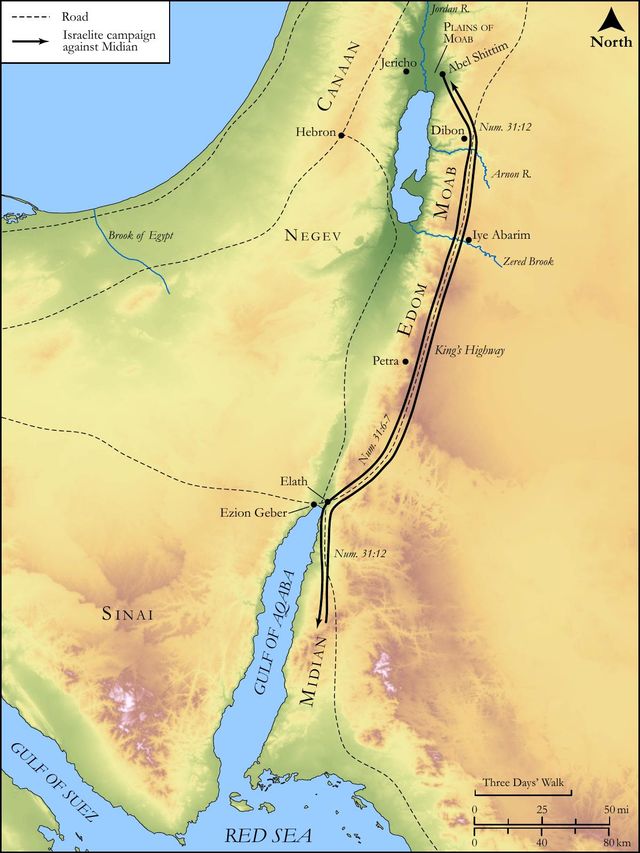
See on the biblical-era map
Study this verse
Historical interpretation
Historical reception
1 surviving comment on this verse from the historical church.
The soothsayer Balaam set up a scandal for the people of Israel when he went to meet their warriors, not with men in armor but with women arrayed in all their finery. He hoped to make the men drop their arms for debauchery, change their triumph into disgrace, bring the avengers of guilt into guilt themselves and—to put it briefly—to profane all their holiness into depravity. As a result of it all, when Moses was meting out punishment, he sentenced Balaam thus: “Kill Balaam the soothsayer, because he set up a stumbling block before the children of Israel.”
Continue studying Numbers 31:8 across the web’s major study libraries — every link below opens this exact verse, chapter, or book on the destination site.
Read & Compare
 BibleGatewayThis verse in more than 200 translations and 70 languages.
 Bible.comThe YouVersion reader — hundreds of translations, reading plans, and highlights.
 ESV.orgCrossway's official English Standard Version reader.
 NET BibleThe NET translation with 60,000+ translators' notes on every rendering decision.
 STEP BibleTyndale House's free study tool — original text, vocabulary, and scholarly resources.
 BibliaLogos Bible Software's free web reader.
 USCCBThe New American Bible (Revised Edition) with the U.S. bishops' study notes.
Commentaries
 BibleHub CommentariesDozens of classic commentaries on this verse, gathered on one page.
 StudyLightMore than 100 commentary sets — the largest collection on the web.
 BibleRefPlain-English commentary on what this verse means, verse by verse.
 Enduring WordDavid Guzik's free commentary on this chapter, widely used by Bible teachers.
 Bible Study ToolsVerse commentary alongside Greek and Hebrew study aids.
Original Language & Research
- BibleHub InterlinearThe verse word by word — original language, transliteration, and English.
- BibleHub LexiconEvery word's original-language definition and Strong's entry.
 Blue Letter BibleDeep-study tools — Strong's numbers, concordance, and word studies.
 SefariaThe Hebrew text with Rashi and centuries of Jewish commentary.
Sermons, Hymns & Audio


TrulyRandomVerse is not affiliated with these sites and doesn’t control their content. They’re linked because they’re genuinely useful.
Summary
Numbers 31:8 records the decisive and divinely sanctioned execution of the five kings of Midian—Evi, Rekem, Zur, Hur, and Reba—alongside Balaam, the son of Beor, by the Israelite forces. This pivotal act signifies the comprehensive nature of God's judgment against those who actively conspired to corrupt His covenant people, Israel, through idolatry and immorality, thereby bringing a definitive end to the instigators of the Baal-peor apostasy and securing Israel's spiritual purity.
Context
ShowHideLiterary Context
Numbers 31:8 is situated within the narrative of Israel's punitive war against the Midianites, a campaign explicitly commanded by God as vengeance for their role in the Baal-peor incident. This divine mandate, detailed in Numbers 31:1-2, serves as retribution for the Midianites' complicity in tempting Israel to sin, an event vividly recounted in Numbers 25. The broader context of Numbers chronicles Israel's wilderness journey, their encounters with various peoples, and their preparations to enter the Promised Land. This specific military action, culminating in the thorough defeat and execution of Midianite leadership and Balaam, marks a critical step in purifying the Israelite camp and removing external spiritual threats before their inheritance. It also sets the stage for the subsequent division of spoils and tribal allocations, emphasizing the completion of a necessary punitive action before further progress.
Historical & Cultural Context
The Midianites were a people group, descendants of Abraham through Keturah (Genesis 25:2), who inhabited areas east of the Jordan. While some Midianites, like Moses' father-in-law Jethro, had positive interactions with Israel, this particular conflict arose from a direct act of spiritual and moral hostility. Among the nations round about, the execution of enemy kings was a common practice, signifying total victory, the eradication of a threat, and the complete subjugation of a people. The specific naming of the five kings in Numbers 31:8 underscores the thoroughness of the Israelite victory and the divine mandate behind it. Balaam, a diviner from Pethor of Mesopotamia, was not a Midianite by birth but was present among them and directly implicated in their scheme to corrupt Israel, highlighting the pervasive nature of the spiritual threat to God's people.
Key Themes
ShowHideThis verse powerfully underscores several major themes within the book of Numbers and the broader Pentateuch. Firstly, it highlights Divine Justice and the severe consequences of rebellion against God, particularly when it involves leading His covenant people astray. The war against Midian was not for territorial gain but for vengeance as commanded by God (Numbers 31:2). Secondly, it emphasizes the theme of Spiritual Purity and Vigilance, demonstrating God's unwavering commitment to protecting His people from corrupting influences, both physical and spiritual. The death of Balaam, in particular, illustrates the judgment against those who use spiritual gifts for personal gain and lead others into apostasy, a theme echoed in Numbers 31:16. Finally, it reinforces the concept of God's Sovereignty in defending His people and fulfilling His promises, even through decisive military action against His adversaries.
Exposition and Analysis
ShowHideKey Word Analysis
ShowHideThis verb (H2026) is a primitive root meaning "to smite with deadly intent; destroy, out of hand, kill, murder(-er), put to (death), make (slaughter), slay(-er), [idiom] surely." In the context of Numbers 31:8, it emphasizes that the deaths of the Midianite kings and Balaam were not accidental casualties of war but deliberate, targeted eliminations. This highlights the intentionality of the divine judgment being executed through Israel, ensuring the complete removal of those responsible for the spiritual corruption at Baal-peor.
This noun (H4428) derives from a root meaning "to reign" and denotes "a king; king, royal." Referring to the five named rulers, this term signifies the highest political and military authority within the Midianite confederation. Their execution indicates a complete decapitation of Midianite leadership, symbolizing the utter defeat of their organized opposition and the eradication of the primary instigators of the plot against Israel. It underscores the thoroughness of the judgment and the magnitude of Israel's victory, ensuring no future leadership could continue their malicious designs.
This proper noun (H1109) is "probably from בַּל and עַם; not (of the) people, i.e. foreigner"; Bilam is the prophet of Pethor of Mesopotamia, and the name belongs also to a place in the land of Canaan, appearing as Balaam or Bileam. This name belongs to the diviner of Pethor who, despite being divinely constrained from cursing Israel, later advised Balak on how to cause Israel to stumble through seduction and idolatry (Numbers 31:16). His inclusion among the slain Midianite leaders confirms his culpability and the ultimate consequence of his covetousness and willingness to compromise divine truth for personal gain. His death by the sword of Israel serves as a stark testament to God's justice against those who actively seek to corrupt His people, even if they possess prophetic insight.
Verse Breakdown
ShowHide"And they slew the kings of Midian, beside the rest of them that were slain;"
This initial clause establishes the primary targets of the Israelite offensive: the Midianite kings. It distinguishes them from the general populace or soldiers killed in battle, indicating a specific, targeted execution of leadership. This highlights the strategic and punitive nature of the campaign, focusing on the architects of the anti-Israel plot, and emphasizes the comprehensive nature of the judgment that extended beyond the immediate battlefield.
"[namely], Evi, and Rekem, and Zur, and Hur, and Reba, five kings of Midian:"
This provides a precise and exhaustive list of the five royal figures. The enumeration underscores the thoroughness of the judgment and confirms that the entire Midianite royal leadership was eradicated. The mention of Zur is particularly significant, as his daughter Cozbi was the Midianite woman slain with an Israelite man during the Baal-peor incident, which brought the plague to a halt (Numbers 25:15). This detail directly links the judgment to the specific acts of apostasy that provoked God's wrath.
"Balaam also the son of Beor they slew with the sword."
This climactic statement reveals the fate of Balaam. His death "with the sword" signifies a violent, decisive end, linking his demise directly to the military judgment against Midian. His presence among the slain leaders confirms his deep involvement in the Midianite scheme to corrupt Israel, despite his earlier prophetic pronouncements. This underscores that his counsel, not just his initial curses, led to his ultimate demise, fulfilling the principle that those who lead others astray will face severe consequences. His intellectual and spiritual treachery was met with physical judgment.
Literary Devices
ShowHideNumbers 31:8 employs several literary devices to convey its powerful message. Enumeration is prominent, with the explicit naming of the five Midianite kings (Evi, Rekem, Zur, Hur, and Reba). This precise listing emphasizes the thoroughness of the Israelite victory and the complete eradication of Midianite leadership, leaving no doubt about the extent of the divine judgment. Juxtaposition is also evident in the verse's structure, placing the Midianite kings alongside Balaam. This highlights Balaam's deep complicity with the Midianites and his shared fate, underscoring that spiritual corruption (Balaam's counsel) and political leadership (the kings) were equally targets of divine wrath. Furthermore, there is a strong element of Poetic Justice in Balaam's death. The prophet who was divinely prevented from cursing Israel directly ultimately dies by the sword of Israel, a stark reversal of his malicious intentions and a powerful testament to God's ultimate control over those who oppose His people and His unwavering commitment to justice.
Theological and Thematic Connections
ShowHideNumbers 31:8 stands as a profound testament to God's unwavering justice and His active defense of His covenant people. The execution of the Midianite kings and Balaam underscores that God does not tolerate spiritual compromise or the deliberate leading of His people into sin. This event serves as a stark reminder that while God is merciful, He is also righteous in judgment, especially against those who seek to undermine His covenant relationship with Israel. The thoroughness of the judgment reflects the gravity of the Midianites' and Balaam's actions, which led to a devastating plague among the Israelites. It demonstrates that God takes seriously the spiritual integrity of His community and will remove obstacles and corrupting influences that threaten it. This act of divine vengeance is not arbitrary but a just response to severe apostasy and spiritual warfare, ensuring the purity and holiness of His chosen nation.
Reflection and Application
ShowHideNumbers 31:8 provides a sobering reflection for believers today on the profound dangers of spiritual compromise and the gravity of leading others astray. The decisive judgment against the Midianite kings and Balaam serves as a powerful reminder that God is holy and will not tolerate practices or teachings that draw His people into idolatry, immorality, or spiritual infidelity. We are called to cultivate spiritual discernment, identifying and rejecting corrupting influences—whether they come from external pressures or from within the community—that seek to undermine our faith and obedience. This passage challenges us to consider the seriousness of our own counsel and influence on others, recognizing that those who promote false teachings or compromise truth will ultimately face divine accountability. Furthermore, it offers assurance of God's active protection for His people, reminding us that He is sovereign over all forces of evil and deception, and He will ultimately triumph over every adversary that seeks to harm His church, ensuring its purity and steadfastness.
Questions for Reflection
ShowHideFAQ
ShowHideWhy was Balaam, who blessed Israel, slain by them?
ShowHideDespite being divinely prevented from cursing Israel directly and even pronouncing blessings upon them in Numbers 23-24, Balaam later advised Balak, king of Moab, on how to cause Israel to stumble. This "counsel of Balaam" (Numbers 31:16) involved using Midianite women to entice Israelite men into sexual immorality and idolatry, leading to the devastating Baal-peor incident (Numbers 25) and a plague that killed 24,000 Israelites. His death among the Midianite leaders was divine judgment for his active role in corrupting God's people, demonstrating that even those with prophetic gifts are accountable for their actions and counsel that leads others to sin.
What was the significance of slaying the five kings?
ShowHideThe execution of the five Midianite kings (Evi, Rekem, Zur, Hur, and Reba) was highly significant. It symbolized the complete dismantling of Midianite political and military leadership, ensuring that the source of the spiritual corruption that led to the Baal-peor incident was utterly removed. This was not merely a military victory but a fulfillment of God's explicit command for vengeance against those who had actively conspired to lead Israel into apostasy (Numbers 31:2). The specificity of naming them underscores the thoroughness of the judgment and the divine intention to eliminate the architects of the plot against God's covenant people, thereby preventing future threats from the same source.
Christ-Centered Fulfillment
ShowHideThe decisive judgment enacted in Numbers 31:8, particularly the slaying of Balaam and the Midianite kings, powerfully foreshadows the ultimate triumph of Jesus Christ over sin, spiritual deception, and the forces that seek to corrupt God's people. Balaam, who sought to profit from leading God's people astray through false counsel, stands in stark contrast to Christ, the true Prophet who always speaks God's truth and leads His people in righteousness and purity (Deuteronomy 18:15). While the Israelites executed physical judgment with the sword, Christ's victory is spiritual, with significance for all creation; He disarmed the principalities and powers, triumphing over them by the cross (Colossians 2:15). The judgment against the Midianite kings, who represented an organized opposition to God's people, points forward to Christ's ultimate defeat of all spiritual enemies, including Satan and his kingdom, ensuring that no "counsel of Balaam" can ultimately prevail against His church (1 John 3:8). This passage, therefore, serves as a powerful reminder that God is just and will ultimately bring all forms of evil and rebellion to an end, culminating in Christ's final judgment and the establishment of His eternal kingdom where righteousness dwells (Revelation 19:11-21 and Revelation 20:10).