


Numbers 31:7
Bible text: King James Version (1769 Blayney text) · Public domain
Bible text: Berean Standard Bible · Public domain
Bible text: American Standard Version (1901) · Public domain
Bible text: World English Bible, Messianic edition · Public domain
Bible text: Geneva Bible (1599) · Public domain
Bible text: Young's Literal Translation · Public domain
- וַיִּצְבְּאוּvai·yitz·be·'Uand they waged warH6633Conj-w ¦ V-Qal-ConsecImperf-3mpVerb Qal Consecutive Imperfect 3rd Plural Masculineוַandיִּצְבְּאוּthey waged war
- עַל'alonH5921PrepPreposition
- מִדְיָןmid·YanMidianH4080N-properNoun Proper Location
- כַּאֲשֶׁרka·'a·Sherjust asH834Prep-k ¦ RelParticle Relativeכַּjustאֲשֶׁרas
- צִוָּהtzi·Vahhe had commandedH6680V-Piel-Perf-3msVerb Piel Perfect 3rd Singular Masculine
- יְהוָהYah·wehYahwehH3068N-properNoun Proper Title
- אֶת'et<obj.>H853DirObjMParticle Object Indicator
- מֹשֶׁהmo·ShehMosesH4872N-proper-mNoun Proper Masculine
- וַיַּהַרְגוּvai·ya·har·Guand they killedH2026Conj-w ¦ V-Qal-ConsecImperf-3mpVerb Qal Consecutive Imperfect 3rd Plural Masculineוַandיַּהַרְגוּthey killed
- כָּלkoleveryH3605N-msNoun Singular Masculine Absolute
- זָכָרza·KharmaleH2145Adj-msAdjective Singular Masculine Absolute
English is a literal word-by-word gloss of the Hebrew, not the KJV's wording. Why?
This is the original text the KJV's translators worked from — each Hebrew word with its own literal English meaning in this verse, prepared by scholars at Tyndale House, Cambridge. The KJV translates whole sentences, not word by word, so its wording differs: one Hebrew word can become several English words, and the KJV may choose “the LORD” where the gloss reads “Yahweh”. Both are faithful — they answer different questions. For the KJV's own rendering, switch to the KJV text.
Details
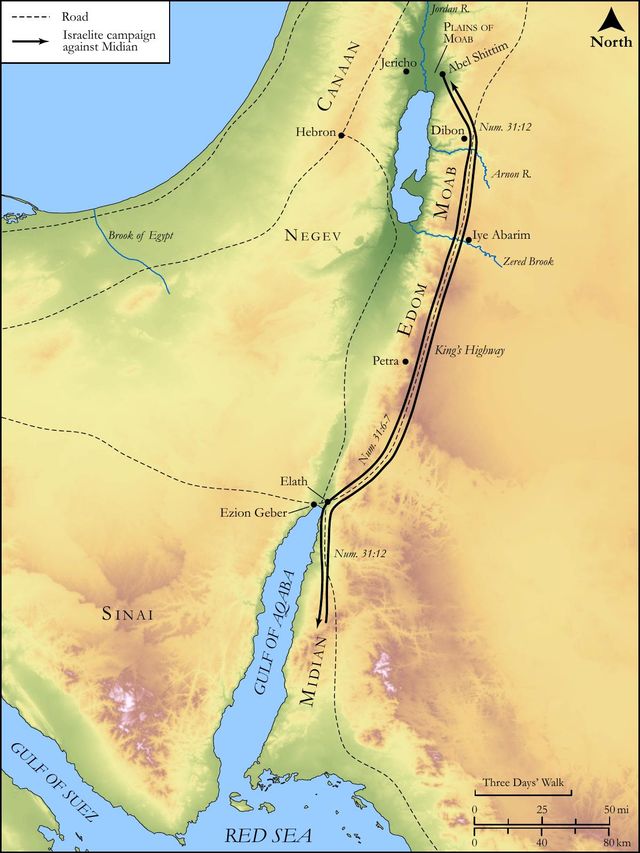
See on the biblical-era map
Study this verse
Continue studying Numbers 31:7 across the web’s major study libraries — every link below opens this exact verse, chapter, or book on the destination site.
Read & Compare
 BibleGatewayThis verse in more than 200 translations and 70 languages.
 Bible.comThe YouVersion reader — hundreds of translations, reading plans, and highlights.
 ESV.orgCrossway's official English Standard Version reader.
 NET BibleThe NET translation with 60,000+ translators' notes on every rendering decision.
 STEP BibleTyndale House's free study tool — original text, vocabulary, and scholarly resources.
 BibliaLogos Bible Software's free web reader.
 USCCBThe New American Bible (Revised Edition) with the U.S. bishops' study notes.
Commentaries
 BibleHub CommentariesDozens of classic commentaries on this verse, gathered on one page.
 StudyLightMore than 100 commentary sets — the largest collection on the web.
 BibleRefPlain-English commentary on what this verse means, verse by verse.
 Enduring WordDavid Guzik's free commentary on this chapter, widely used by Bible teachers.
 Bible Study ToolsVerse commentary alongside Greek and Hebrew study aids.
Original Language & Research
- BibleHub InterlinearThe verse word by word — original language, transliteration, and English.
- BibleHub LexiconEvery word's original-language definition and Strong's entry.
 Blue Letter BibleDeep-study tools — Strong's numbers, concordance, and word studies.
 SefariaThe Hebrew text with Rashi and centuries of Jewish commentary.
Sermons, Hymns & Audio


TrulyRandomVerse is not affiliated with these sites and doesn’t control their content. They’re linked because they’re genuinely useful.
Summary
Numbers 31:7 records a pivotal moment in Israel's wilderness journey, detailing the immediate and decisive execution of divine judgment against the Midianites. This verse succinctly states that the Israelite forces engaged in battle, acting in direct and faithful obedience to the LORD's explicit command given to Moses, and achieved a comprehensive initial victory by slaying all the Midianite males. This act was not an unprovoked aggression but a divinely mandated retribution for Midian's treacherous role in corrupting Israel at Baal-Peor, thereby underscoring God's unwavering justice, His demand for holiness from His covenant people, and Israel's role as instruments of His righteous will.
Context
ShowHideLiterary Context
Numbers 31:7 is situated within a broader narrative of divine judgment, covenant fidelity, and Israel's preparation for entering the Promised Land. Immediately preceding this verse, the LORD issues a solemn command to Moses to take vengeance on the Midianites for their treachery at Peor before Moses' impending death, emphasizing the urgency and divine imperative of the mission (Numbers 31:1-3). This command is swiftly followed by the meticulous mobilization of Israel's forces, with a thousand men selected from each tribe, led by Phinehas, who carries the holy vessels and the trumpets for the alarm, signifying a sacred, divinely sanctioned war (Numbers 31:4-6). Thus, verse 7 describes the direct and obedient fulfillment of this divine directive, setting the stage for the subsequent details of the campaign, including the taking of spoil, the controversial handling of captives, and the necessary purification rituals that follow (Numbers 31:8-24). This event serves as a stark reminder of the severe consequences of apostasy and the absolute necessity of holiness as Israel nears the fulfillment of God's promises.
Historical & Cultural Context
The Midianites were a nomadic people, descendants of Abraham through Keturah (Genesis 25:1-2), who frequently interacted with Israel, sometimes peacefully (as seen with Jethro, Moses' father-in-law) but often hostilely. The immediate historical trigger for this war was the infamous incident at Baal-Peor, where Midianite and Moabite women enticed Israelite men into sexual immorality and idolatry, leading to a devastating plague that killed 24,000 people (Numbers 25:1-9). Crucially, the prophet Balaam, after failing to curse Israel directly, had advised the Midianites to use this strategy of seduction and spiritual corruption to undermine Israel from within (Numbers 31:16). This act of vengeance, therefore, was a divinely sanctioned "holy war" (cherem), aimed at eradicating a severe spiritual and existential threat that had directly attacked God's covenant with Israel. Such wars were understood in Israel as expressions of the LORD's justice against those who defied His will or threatened His people, ensuring the purity and survival of the covenant community.
Key Themes
ShowHideThe Midianite war in Numbers 31 powerfully illustrates several key themes prevalent throughout the book of Numbers and the Pentateuch. First, Divine Command and Obedience is paramount, as the phrase "as the LORD commanded Moses" emphatically underscores Israel's role as instruments of God's righteous will. Their immediate and decisive obedience, even to such a difficult command, highlights the seriousness of God's directives and the nature of the covenant relationship. Second, God's Justice and Judgment is a central and unwavering theme, demonstrating His absolute righteousness against those who actively seek to corrupt His people and lead them into grievous sin. The severity of the judgment reflects the profound gravity of the Midianites' actions and the purity God demands from His covenant nation. Third, the war contributes significantly to the overarching theme of the Purity and Holiness of Israel. By eliminating the Midianite influence, particularly those who had led Israel astray, God was preparing His people for their entry into the Promised Land, ensuring a measure of spiritual purity and separation from pagan practices that could defile them, a principle reiterated throughout the Mosaic Law, notably in Deuteronomy 7:1-6.
Exposition and Analysis
ShowHideKey Word Analysis
ShowHideThis verb (H6633), often translated as "to wage war," "to serve," or "to perform military service," implies an organized, disciplined, and purposeful military campaign. It's not a chaotic skirmish but a methodical execution of a divine directive, highlighting Israel's role as God's army. In this context, it underscores the deliberate and authorized nature of the judgment being carried out.
This word (H6680) signifies a strong, authoritative, and binding directive. It emphasizes that the action taken by Israel was not of their own initiative or vengeance but a direct, explicit order from the LORD to Moses. This divine mandate elevates the event from a mere tribal conflict to a sacred act of judgment, underscoring God's sovereignty and Israel's required obedience to His revealed will.
This verb (H2026) means "to kill," "to slay," or "to murder." In this context, it denotes a decisive and complete act of killing, specifically targeting the Midianite males. It conveys the finality and thoroughness of the initial phase of the military operation, leaving no ambiguity about the outcome for this segment of the population, thereby fulfilling the divine punitive decree.
Verse Breakdown
ShowHide"And they warred against the Midianites"
This opening clause immediately establishes the active engagement of the Israelite forces in a military campaign. The "they" refers to the twelve thousand chosen men, a thousand from each tribe, who were specifically sent to execute the divine command. The target, "the Midianites," is explicitly named, identifying the specific recipients of God's judgment, indicating a direct and focused military action rather than a general conflict.
"as the LORD commanded Moses;"
This crucial phrase provides the theological justification and ultimate authority for the war. It clarifies unequivocally that the campaign was not a human initiative or an act of tribal aggression, but a direct fulfillment of a divine mandate. This obedience to the LORD's specific instruction through His chosen leader, Moses, profoundly underscores the covenant relationship and Israel's role as instruments of God's righteous will, highlighting the absolute sovereignty of God over human affairs and His justice.
"and they slew all the males."
This final clause describes the immediate and decisive outcome of this phase of the battle. The phrase "all the males" signifies a comprehensive and thorough execution of the military directive concerning the male population, indicating a complete and decisive victory in this initial engagement. This specific targeting is a key detail, setting the stage for later developments in the narrative concerning the women and children, and emphasizing the severity and precision of the judgment.
Literary Devices
ShowHideNumbers 31:7 employs several literary devices to convey its powerful message with clarity and impact. The most prominent is Direct Statement, presenting the events in a straightforward, declarative manner ("And they warred... and they slew..."). This unadorned prose emphasizes the factual and unequivocal execution of the divine command, leaving no room for ambiguity or interpretation regarding Israel's actions. The verse also functions as a Fulfillment Narrative, demonstrating the immediate and complete obedience to the LORD's prior command articulated in Numbers 31:1-3. The phrase "as the LORD commanded Moses" serves as a powerful Repetition (or echo) of divine authority, a common motif throughout the Pentateuch that consistently reinforces God's sovereignty, His absolute right to command, and the necessity of Israel's obedient response. Finally, the verse exhibits a remarkable degree of Conciseness, packing a significant military action and its divine authorization into a single, compact sentence, highlighting the efficiency and decisiveness of both God's command and Israel's faithful, swift response.
Theological and Thematic Connections
ShowHideNumbers 31:7 stands as a stark testament to God's unwavering holiness and His righteous judgment against sin, particularly against those who actively seek to corrupt His covenant people. This passage underscores that God is not indifferent to evil, especially when it directly undermines the spiritual integrity and purity of His chosen nation. The severity of the judgment against the Midianites reflects the profound gravity of their sin at Peor, where they deliberately enticed Israel into idolatry and sexual immorality, thus incurring divine wrath. Theologically, it affirms God's justice, demonstrating that He will indeed hold nations and individuals accountable for their actions. While challenging for modern readers, this event serves as a powerful reminder that God's character encompasses both profound love and uncompromising justice, and that His covenant relationship with Israel demanded purity and separation from pagan influences that threatened their unique identity as His people.
Reflection and Application
ShowHideWhile believers today are not called to wage physical wars of retribution against nations, Numbers 31:7 offers profound spiritual insights for the Christian life. This passage highlights the seriousness with which God views influences that seek to corrupt faith and lead believers astray. Just as ancient Israel had to contend with external forces that threatened their spiritual purity and covenant fidelity, Christians are called to engage in a spiritual battle against the "Midianite" influences in their own lives and in the world. This involves actively putting off sinful desires and worldly enticements that wage war against the soul (1 Peter 2:11) and standing firm against the schemes of spiritual adversaries (Ephesians 6:11). The obedience of Israel to a difficult command underscores the paramount importance of our own obedience to God's spiritual directives, which are always for our sanctification and purity. It reminds us that God is holy and righteous in all His ways, and He desires His people to reflect that holiness in their lives, actively separating themselves from anything that defiles the temple of the Holy Spirit.
Questions for Reflection
ShowHideFAQ
ShowHideWhy did God command such a harsh judgment against the Midianites?
ShowHideThe severe judgment against the Midianites was not arbitrary but a direct and righteous consequence of their deliberate and malicious actions against Israel at Baal-Peor, as detailed in Numbers 25. The Midianites, specifically through the perverse counsel of Balaam (Numbers 31:16), had enticed Israel into idolatry and sexual immorality, leading to a devastating plague that killed 24,000 Israelites. This act was a profound spiritual assault, designed to break God's covenant with His people and defile them before their entry into the Promised Land. God's holiness demands justice against such egregious sin, especially when it threatens the purity and very existence of His chosen nation. The judgment served as a deterrent and a purification, ensuring Israel understood the gravity of idolatry and the absolute importance of separation from pagan influences.
Christ-Centered Fulfillment
ShowHideWhile Numbers 31:7 describes a physical war of judgment in the Old Covenant, its ultimate fulfillment and profound spiritual application are found in Christ. The Midianite war, driven by God's holy justice against sin and His fervent desire for His people's purity, profoundly foreshadows the greater spiritual war waged and won by Jesus. He is the ultimate Avenger of sin, not through physical warfare against nations, but through His perfect, atoning sacrifice on the cross. Just as the Israelites "slew all the males" as commanded, Christ decisively "slew" the power of sin and death, fulfilling the righteous requirements of God's law on behalf of humanity (Romans 8:3-4). He is the true Lamb of God who takes away the sin of the world, providing the means for humanity's complete purification that the Old Covenant rituals could only symbolize. Through His precious blood, believers are cleansed from all unrighteousness (1 John 1:7), enabling them to live in the holiness and purity God desires. The judgment against Midian highlights God's absolute intolerance for spiritual corruption; in Christ, we see God's perfect justice met with perfect mercy, providing a way for us to be delivered from the dominion of sin and to enter into His spiritual promised land, the eternal kingdom. Our spiritual battle now is not against flesh and blood, but against spiritual forces of evil (Ephesians 6:12), a battle in which Christ has already secured the decisive and final victory.